
Life, 1902-02-27 · page 6 of 20
Life — February 27, 1902 — page 6: what you’re looking at
What you’re looking at
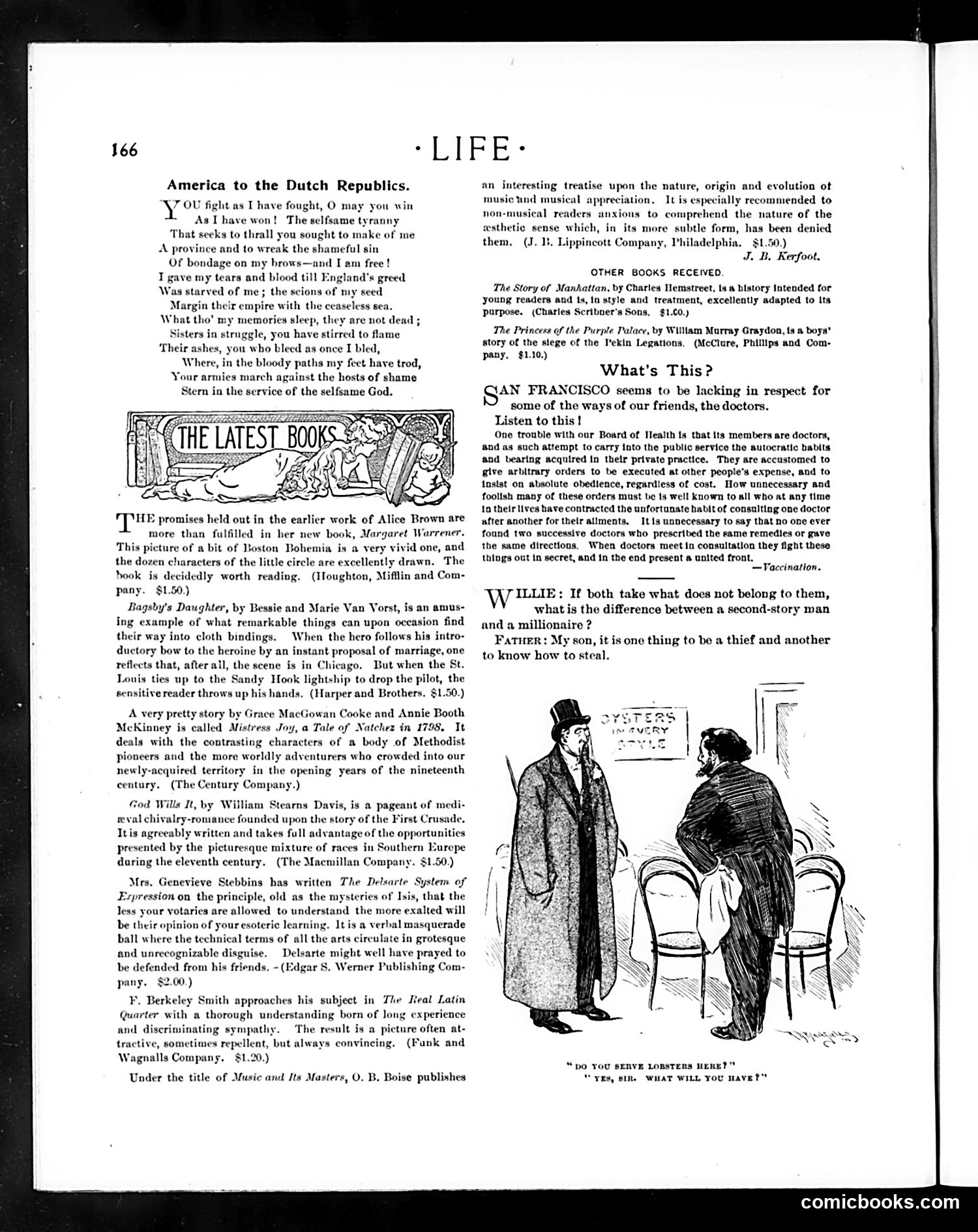
This cartoon satirizes San Francisco's medical profession through a dialogue about restaurant service. A well-dressed man asks a waiter about lobsters; the waiter responds evasively: "Yes, sir. What will you have?" The accompanying text "What's This?" criticizes San Francisco's Board of Health, alleging that its doctors routinely give conflicting medical advice based on private interests rather than patient welfare. The cartoon uses the lobster exchange as a metaphor: just as the waiter deflects the customer's question, the doctors allegedly evade responsibility by giving contradictory prescriptions, forcing patients to consult multiple physicians and enriching individual practitioners. The satire targets medical corruption and lack of professional accountability in early 20th-century San Francisco.
📄 Transcribed text from this page (OCR, searchable)
Machine-transcribed from the original scan — historical spelling and the odd misread are preserved.
* LIFE « America to the Dutch Republics. Y OU fight as T have fought, O may you win As I have won! The selfsame tyranny ‘That seeks to thrall you sought to make of me A province and to wreak the shameful sin Of bondage on my brows—and I am free! I gave my tears and blood till England's greed Was starved of me; the scions of my seed Margin their empire with the cea: sea, What tho’ my memories sleep, they are not dead ; Sisters in struggle, you have stirred to flame Their ashes, you who bleed as once I bled, Where, in the bloody paths my feet have trod, Your armies march against the hosts of shame Stern in the service of the selfsame God. “CRE LATEST.B HE promises held out in the earlier work of Alice Brown are more than fulfilled in her new book, Margaret Warrener. This picture of a bit of Boston Bohemia is a very vivid one, and the dozen characters of the little circle are excellently drawn, The hook is decidedly worth reading. (Houghton, Mifflin and Com- pany. $1.50.) Bagsby’s Daughter, by Bessie and Marie Van Vorst, is an amus- ing example of what remarkable things can upon occasion find their way into cloth bindings. When the hero follows his intro- ductory bow to the heroine by an instant proposal of marriage, one reflects that, afterall, the scene is in Chicago. But when the St. Louis ties up to the Sandy Hook lightship to drop the pilot, the sensitive reader throws up his hands. (Harper and Brothers. $1.50.) A very pretty story by MacGowan Cooke and Annie Booth inney is called Mistress Joy, a Tale of Natchez in 1798. It s with the contrasting characters of a body of Methodist pioneers and the more worldly adventurers who crowded into our newly-acquired territory in the opening years of the nineteenth century. (The Century Company.) God Wills It, by William Stearns Davis, is a pageant of medi- eval chivalry-romiance founded upon the story of the First Crusade. Itis agreeably written and takes full advantage of the opportunities presented by the picturesque mixture of races in Southern Europe daring the eleventh century. (The Macmillan Company. $1.50.) Mrs. Genevieve Stebbins has written The Delsarte System of Expression on the principle, old as the mysteries of Isis, that the less your votaries are allowed to understand the more be their opinion of your esoteric learning. It is a verbal masquerade ball where the technical terms of all the arts circulate in grotesque and unrecognizable disguise. Delsarte might well have prayed to be defended from his friends. - (Edgar 8. Werner Publishing Com- pany. $2.00.) F. Berkeley Smith approaches his subject in The Meal Latin Quarter with a thorough understanding born of long experience and discriminating sympathy. The result is a picture often at- tractive, sometimes repellent, but always convineing. (Fank and Wagnalls Company. $1.20.) der the title of Music and /ts Masters, O. B. Boise publishes an interesting treatise upon the nature, origin and evolution of i It is especially recommended to us to comprehend the nature of the more subtle form, has been denied Lippincott Compa music und musical appreciation, non-musical readers at wsthetic sense which, in i them, (J.1 , Philadelphia, $1.50.) J.B, Kerfoot, OTHER BOOKS RECEIVED. The Story of Manhattan, by Charles Hemstreet, 1s. history Intended for young readers and ts, in style and treatment, excellently adapted to Its Purpose. (Charles Scribner's Sons, $1.60.) The Princess of the Purple Palace, by Wiltam Murray Graydon, ts a boys’ story of the stege of the Pekin Legations, (McClure, Philllps and Com- pany, $1.10.) What's This? SAN FRANCISCO seems to be lacking in respect for some of the ways of our friends, the doctors. Listen to this! One trouble with our Board of Health {s that {ts members are doctors, and as such attempt to carry into the public service the autocratic bablts and bearing acquired in thelr private practice. They are accustomed to give arbitrary orders to be executed at other people's expense, and to insist on absolute obedience, regardiess of cost. How unnecessary and foolish many of these orders must be 1s well known to all who at any time in their lives have contracted the unfortunate habit of consulting one doctor after another for their ailments. It 1s unnecessary to say that no one ever found two successive doctors who prescribed the ame remedies or gave the same directions. When doctors meet in consultation they fight these things out in secret, and in the end present a united front. Vaccination. W ILLIE: If both take what does not belong to them, what is the difference between a second-story man and a millionaire ? Fatuer: My son, it is one thing to be a thief and another to know how to steal. “bo You SERVE Lonstens HERE?” “YES, SUR. WHAT WILL You nave?” comicbooks.com