
A complete issue · 20 pages · 1902
Life — January 30, 1902
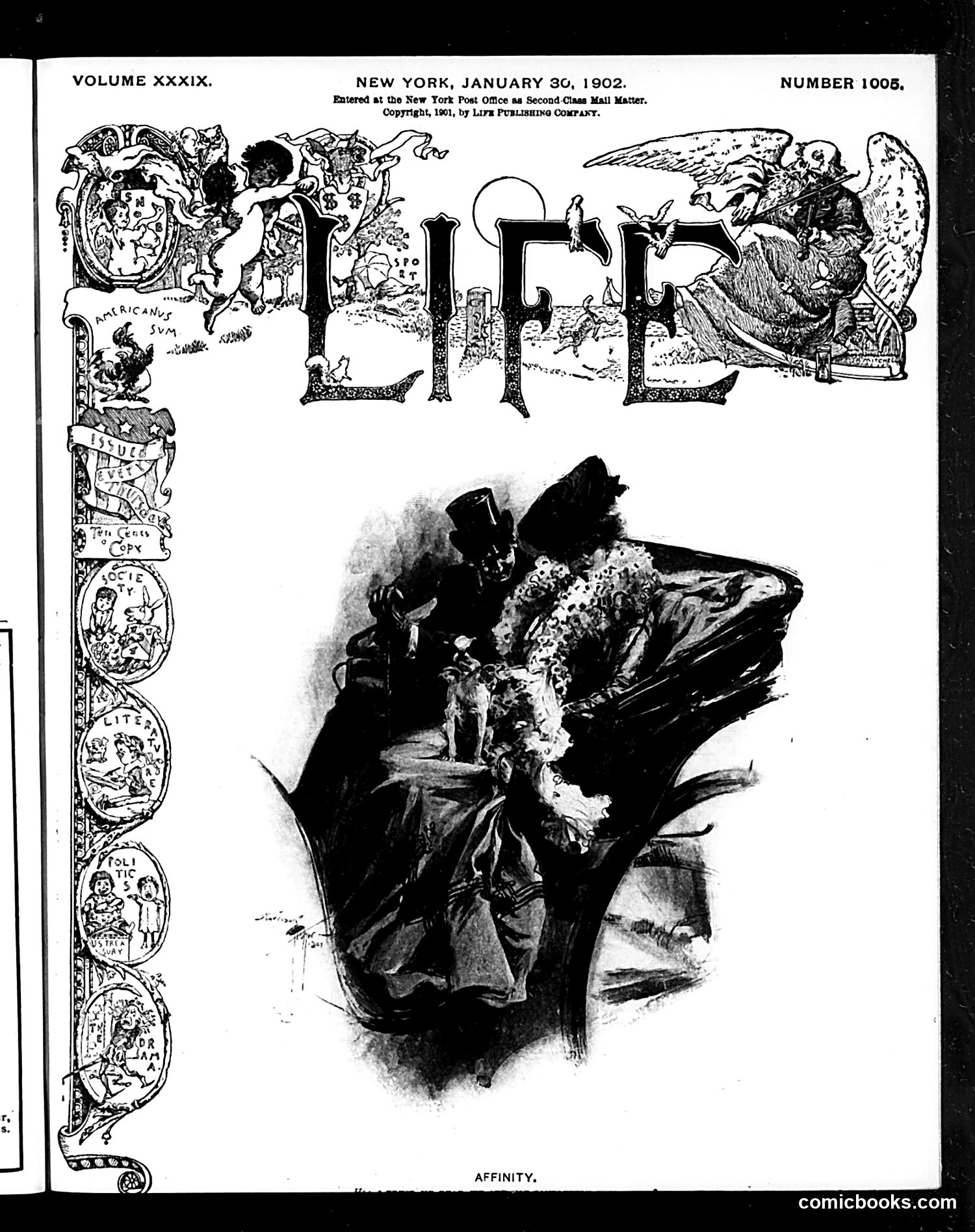
This satirical cartoon depicts two figures in formal Victorian dress sharing an intimate moment with flowers between them. The title "Affinity" suggests romantic or social attraction. The elaborate decorative border on the left contains classical medallions and ornamental designs typical of Life's aesthetic style. The ornate header with cherubs and pastoral scenes frames the word "LIFE" prominently. Without additional context from the article text, the specific satire targets remain unclear. However, given the magazine's focus on social commentary, this likely mocks either: a particular romantic pairing in high society, sentimental courtship conventions of the era, or possibly critiques artificial social "affinities" among the wealthy. The refined artistic execution contrasts with the satirical intent—typical of Life's approach to social criticism.
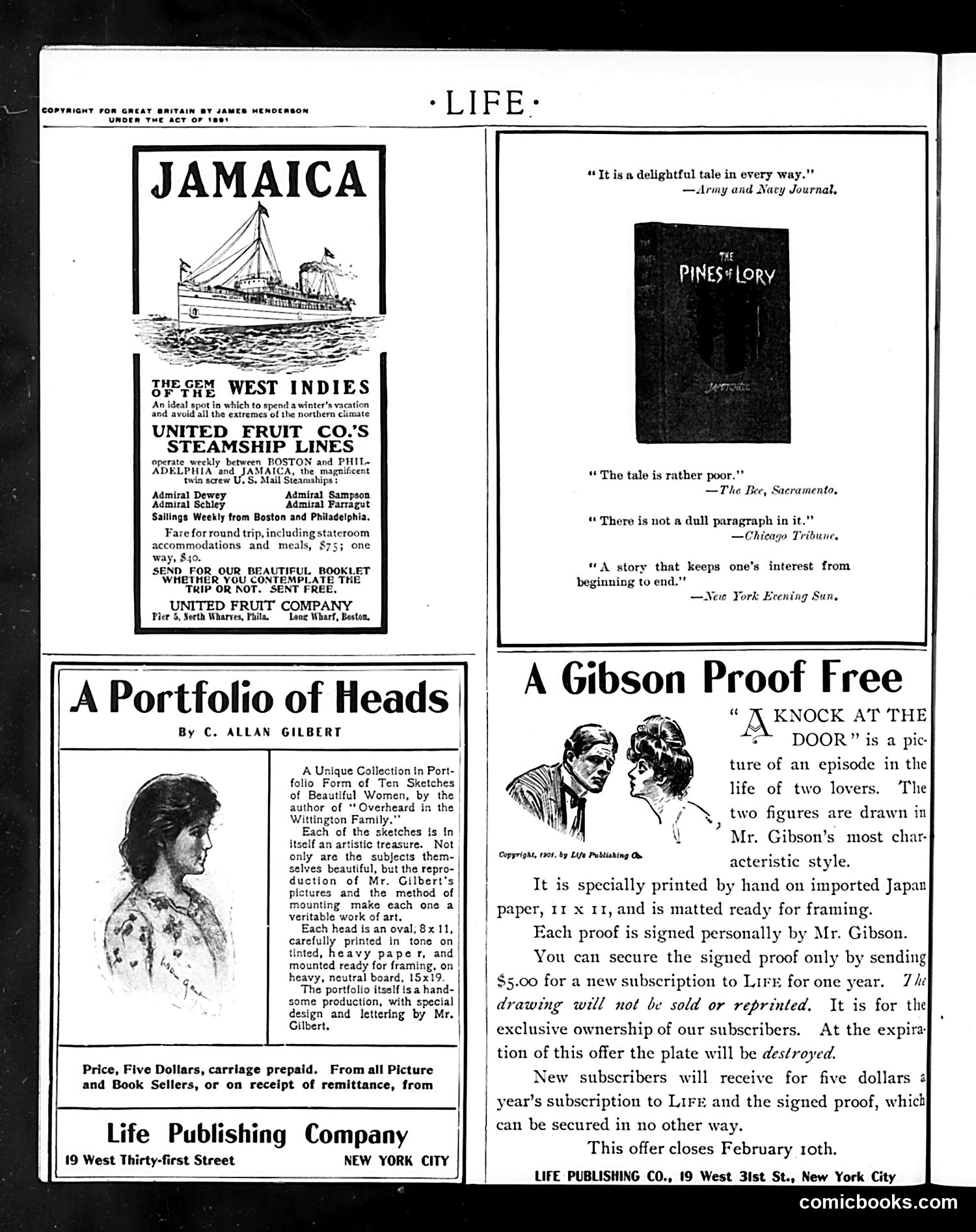
This page is primarily **advertising and promotional content** rather than satirical cartoons. The left side advertises the United Fruit Company's Jamaica steamship line and C. Allan Gilbert's "Portfolio of Heads" — a collection of portrait sketches priced at five dollars. The right side promotes "The Pines of Glory" book and features a Gibson Proof offer: Life Publishing Company is offering subscribers a signed, hand-printed artwork by illustrator Charles Dana Gibson depicting "A Knock at the Door" (two figures in intimate conversation). The offer costs $5 for a new one-year subscription. The proof is limited edition and will be destroyed after the subscription period closes February 10th. This represents typical **turn-of-century magazine marketing** combining travel promotion, art sales, and subscription incentives.
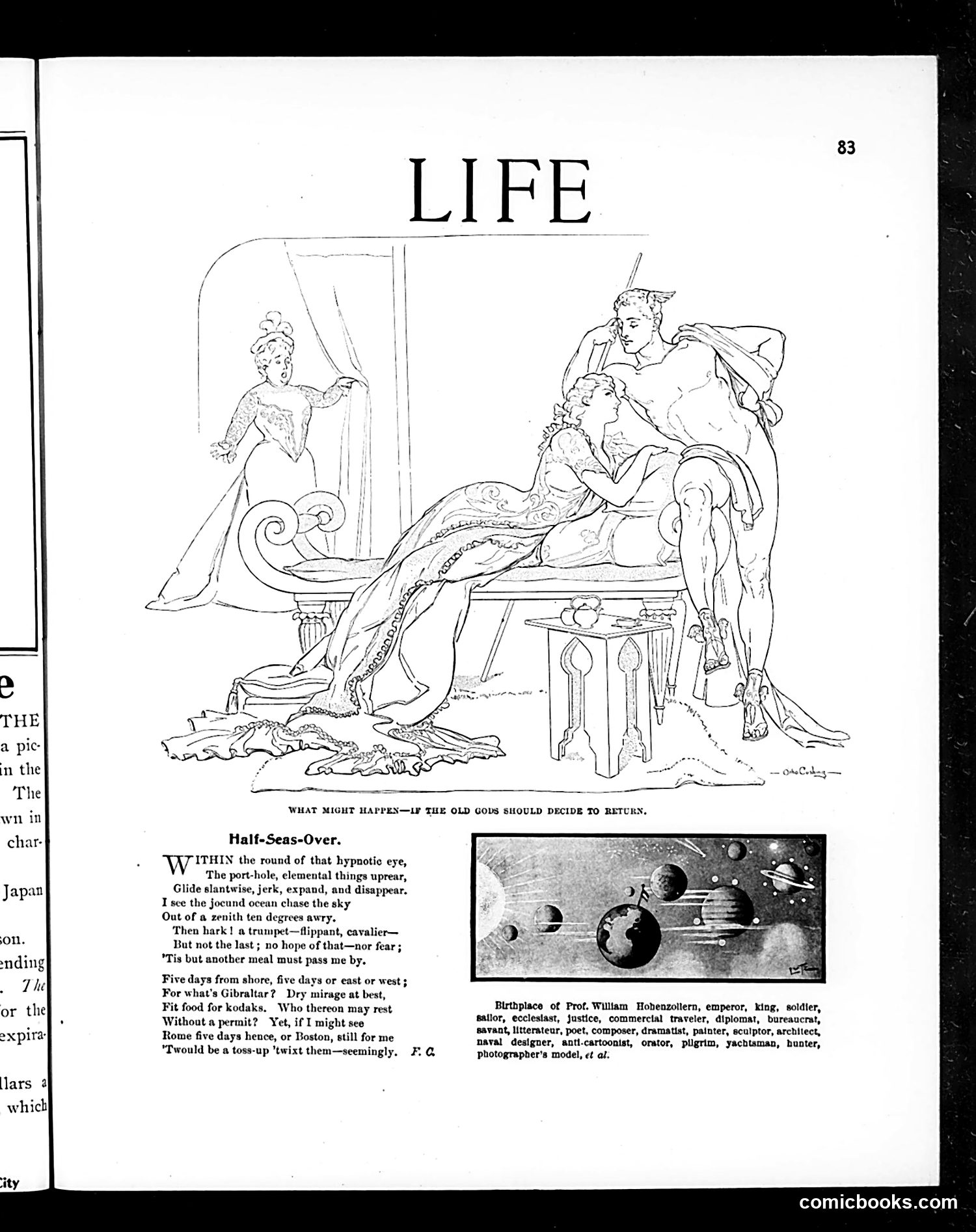
The main cartoon depicts a classical mythological scene titled "What Might Happen—If the Old Gods Should Decide to Return." It shows what appears to be Mars (god of war, identifiable by his military helmet and warrior appearance) reclining with a woman, while another figure watches from a doorway. The accompanying poem "Half-Seas-Over" satirizes the return of classical gods to modern life, suggesting they'd struggle to adapt. References to "kodaks," "Gibraltar," and modern maritime travel ground the fantasy in contemporary (early 20th-century) reality. The small illustration below depicts astronomical or planetary imagery, likely supporting the mythological theme. The satire appears to mock both classical pretensions and modern life's incompatibility with romantic idealism.
This 1902 *Life* magazine page discusses German-American diplomatic relations and prominent figures. The main text mentions **Dr. Whitelaw Reid**, U.S. Special Ambassador, and notes German Prince Henry's visit to help President Roosevelt's daughter christen a yacht—framed as notable European royalty engaging with American society. The piece also critiques **Charles Schwab**, a wealthy financier, for his lavish lifestyle at Monte Carlo and suggests his behavior damages American prestige abroad. The satire contrasts diplomatic protocol with private excess. A final section addresses **Fifth Avenue overcrowding**, criticizing tracks that create public nuisance—a New York City infrastructure complaint. The cartoons appear decorative rather than explicitly political, illustrating the text's social commentary on wealth, diplomacy, and urban management.
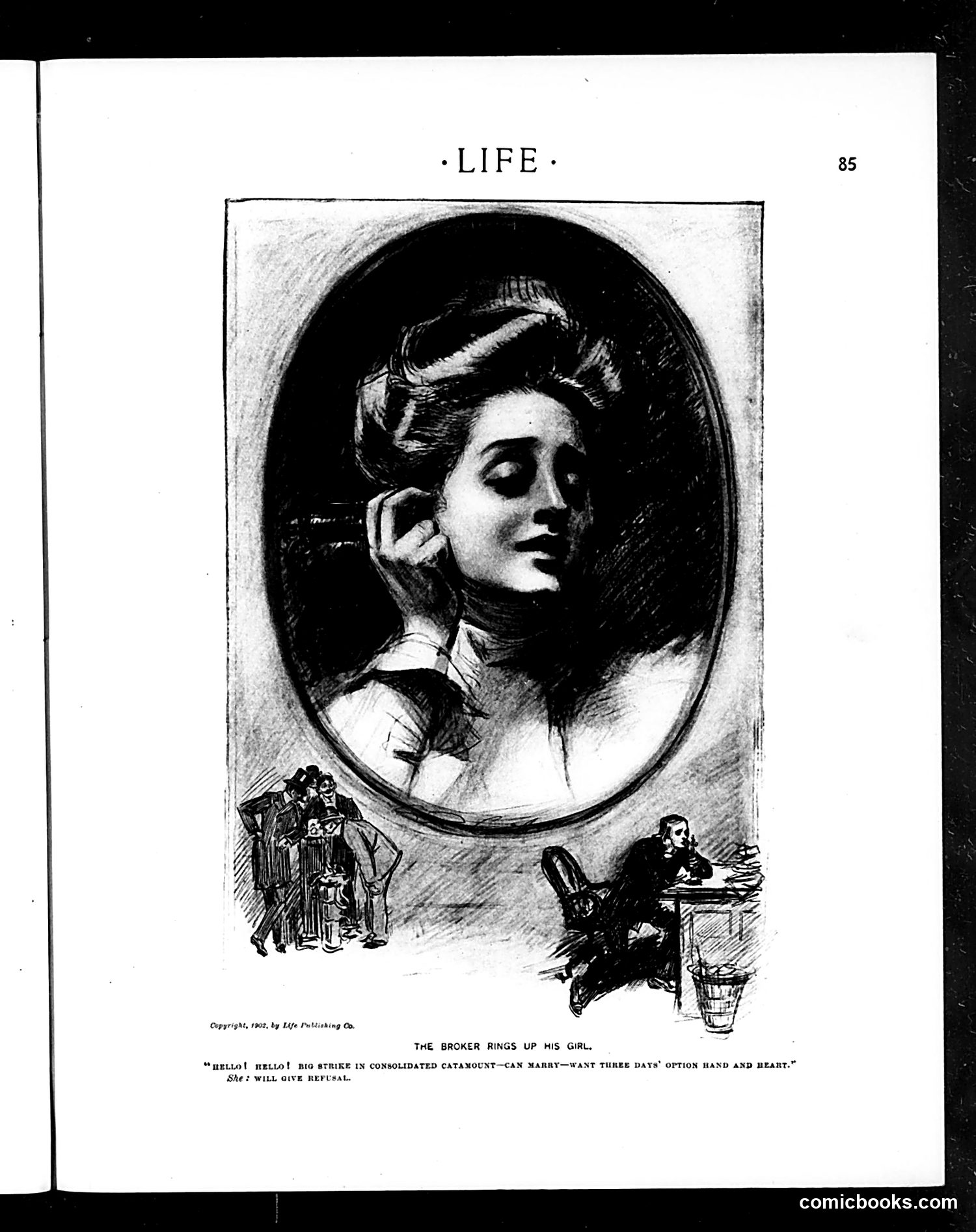
This Life magazine page (No. 85) presents a sketch titled "The Broker Rings Up His Girl." The image shows a woman's portrait in an oval frame with two smaller scenes below depicting office interactions. The caption reads: "HELLO! HELLO! BIG STRIKE IN CONSOLIDATED CATAMOUNT—CAN MARRY—WANT THREE DAYS' OPTION HAND AND HEART. SINE: WILL GIVE REFUSAL." This satirizes the commodification of romance through financial/stock market language. A broker excitedly calls his girlfriend to propose marriage, but frames it using stock-trading terminology—"big strike," "option," and "refusal" (a financial term for deferring a transaction). The satire mocks how businessmen reduce personal relationships to transactional, profit-driven language, treating courtship as a speculative investment. It's social commentary on early 20th-century commercialism invading intimate human connections.
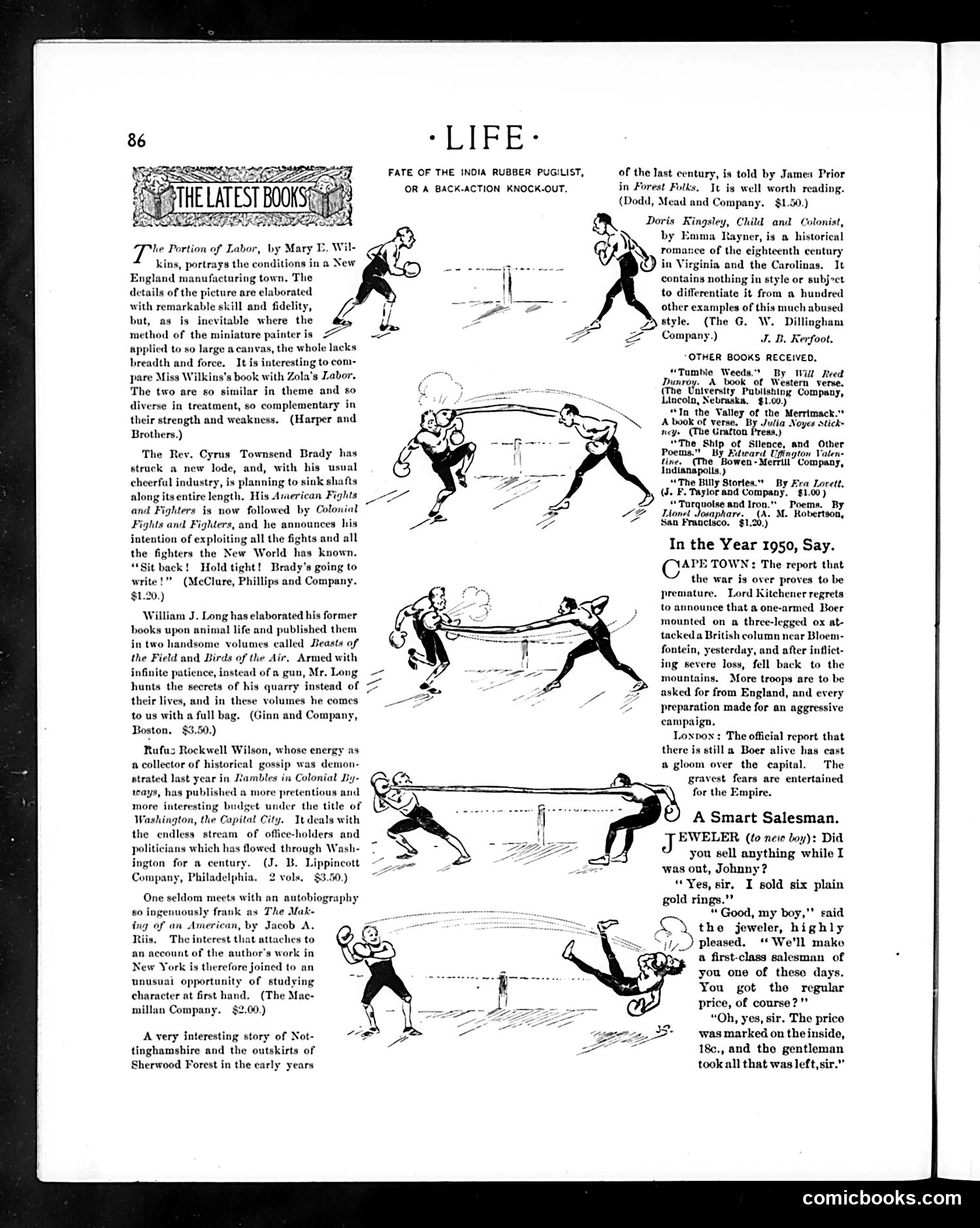
This page contains **book reviews** rather than political cartoons. The left column reviews recent publications, including works on manufacturing, labor, and colonial history. The right side features **"A Smart Salesman,"** a humorous dialogue about a jeweler who sold six gold rings. The customer claims the marked price was 18 cents, but the jeweler insists it was marked higher on the inside of the rings—implying the customer either misread it or is dishonestly claiming a bargain. This is gentle commercial satire about retail deception and haggling. The illustrations throughout show figures engaged in **tug-of-war and athletic activities**, likely decorative elements accompanying the text rather than specific satire. The page lacks overt political commentary—it's primarily literary and commercial humor typical of Life magazine's general-interest satirical content.
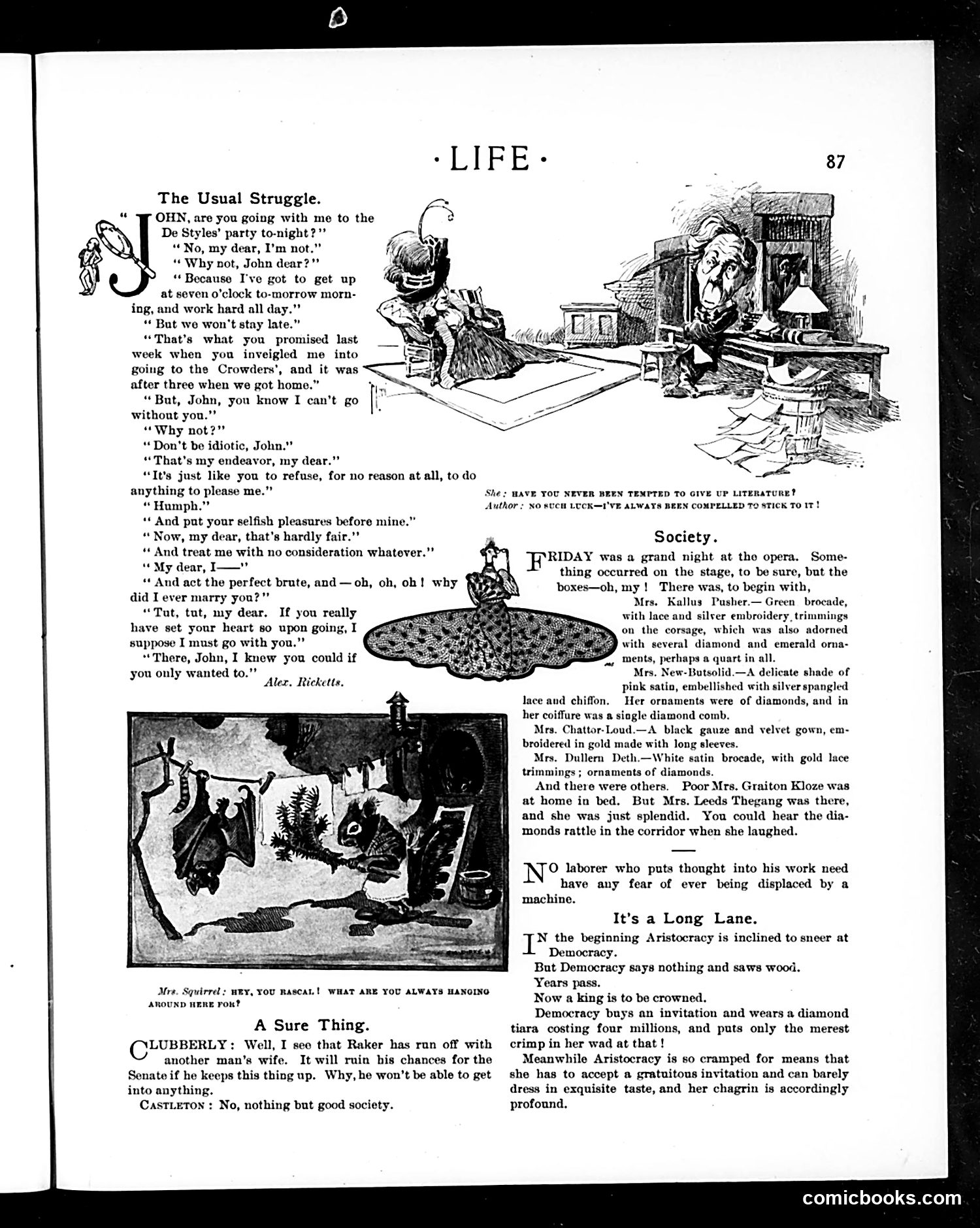
This page contains three separate satirical pieces: **"The Usual Struggle"** depicts a domestic argument where a husband refuses to attend a social event, citing work obligations. His wife counters with emotional appeals. The satire targets marital dynamics and conflicting priorities between spouses—a recurring theme in early 20th-century domestic humor. **"Society"** mocks high society's obsession with material display, describing women's elaborate gowns adorned with diamonds and expensive embroidery at a theatrical event. The satire critiques wealth-based status anxiety. **"It's a Long Lane"** offers political commentary contrasting aristocracy and democracy—suggesting aristocracy scoffs at democracy initially, but eventually democracy "crowns" itself through material excess and invitation-buying, implying both systems ultimately corrupt toward wealth-worship. The cartoon below ("A Sure Thing") jokes about political scandal and Senate corruption.
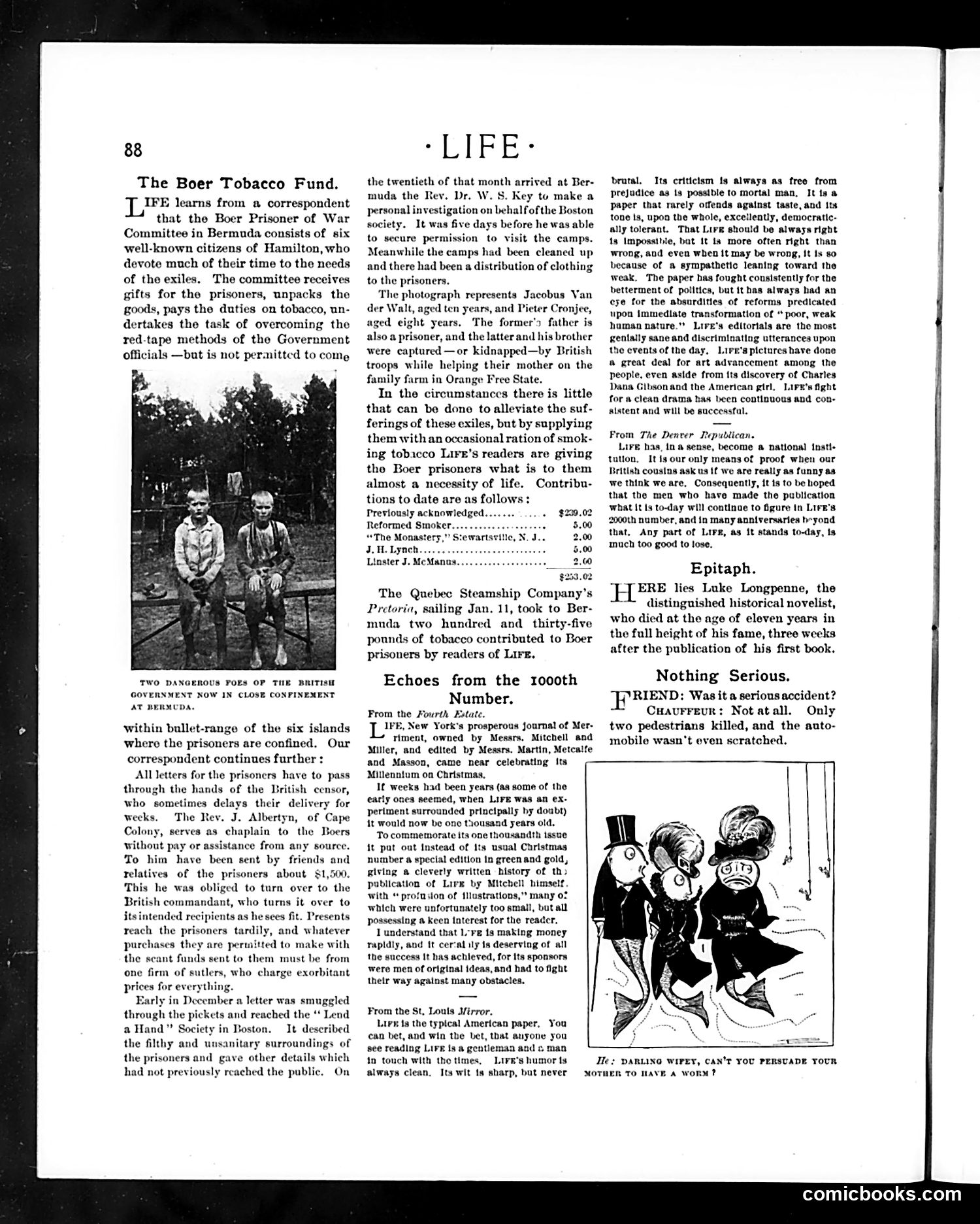
This page contains several distinct sections rather than a unified cartoon. **"The Boer Tobacco Fund"** describes a charity collecting tobacco for British prisoners of war confined in Bermuda during the Boer War. The accompanying photograph shows two Boer prisoners. **"Echoes from the 1000th Number"** celebrates Life's milestone issue with a historical anecdote about the *Fourth Estate* journal. **"Epitaph"** notes the death of Lake Longpenne, a historical novelist. **"Nothing Serious"** is a brief joke about a carriage accident where a Chauffeur assures a Friend that only two pedestrians were killed and the automobile wasn't scratched—satirizing indifference to human life versus property damage. The accompanying cartoon illustrates this joke visually, showing the chauffeur's callous priorities.
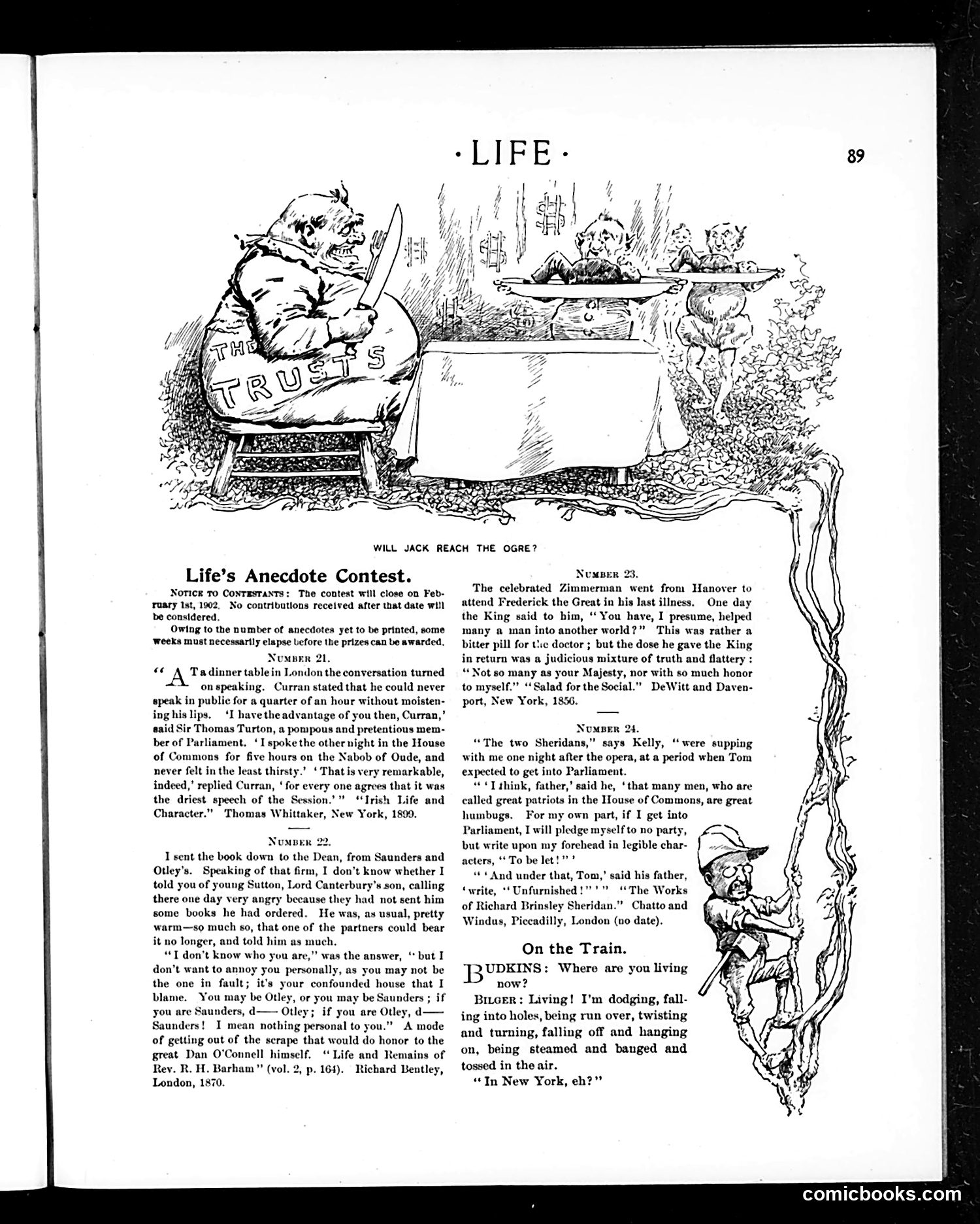
This satirical cartoon depicts a caricatured figure labeled "TRUSTS" as a grotesque ogre sitting at a table, threatening smaller figures approaching from the right. The cartoon critiques **monopolistic business trusts** of the Gilded Age—large corporate combinations that dominated American markets and faced public outcry. The ominous ogre represents how trusts were perceived: as dangerous, predatory entities threatening ordinary citizens ("Jack"). The sword the ogre holds suggests their power to harm. This reflects late-19th century Progressive Era anxieties about corporate monopolies crushing competition and exploiting workers. The cartoon advocates for trust-busting reforms—legal action to break up these corporate giants, a major political issue of the period.
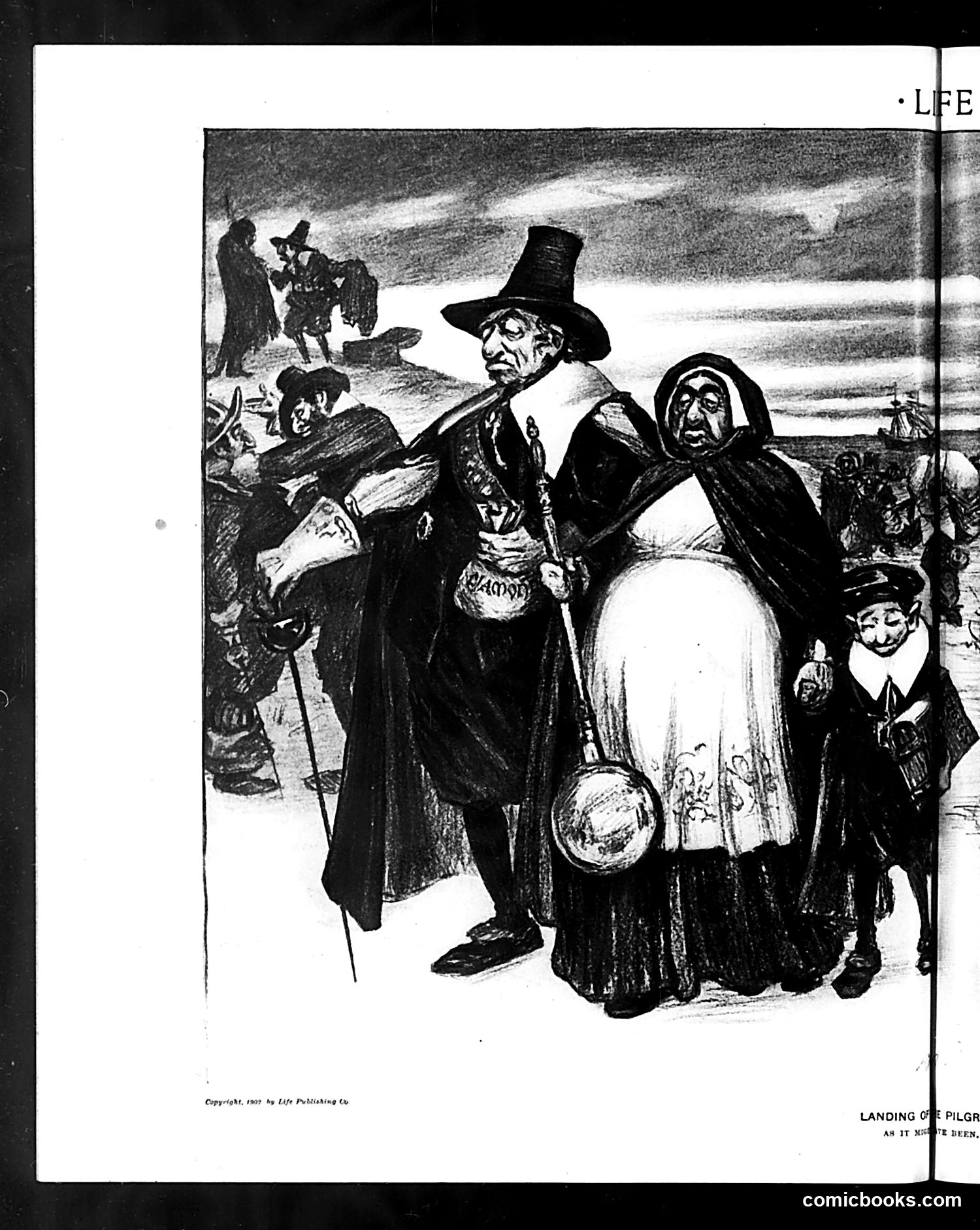
This satirical cartoon reimagines the Pilgrims' 1620 arrival at Plymouth Rock through a darker lens. The central figure—a well-dressed gentleman in a top hat with a walking stick—appears to represent a wealthy industrialist or political figure of the Gilded Age era (early 1900s, based on Life's publication date). The satire suggests that if such a figure had led the Pilgrims instead of religious separatists, the landing would have prioritized profit and exploitation. The surrounding ragged figures and the desolate winter landscape emphasize suffering and hardship, contrasting sharply with the prosperous appearance of the central character. The cartoon likely critiques how contemporary wealthy Americans exploited workers and the poor while claiming moral legitimacy, much as the actual Pilgrims claimed religious purpose.
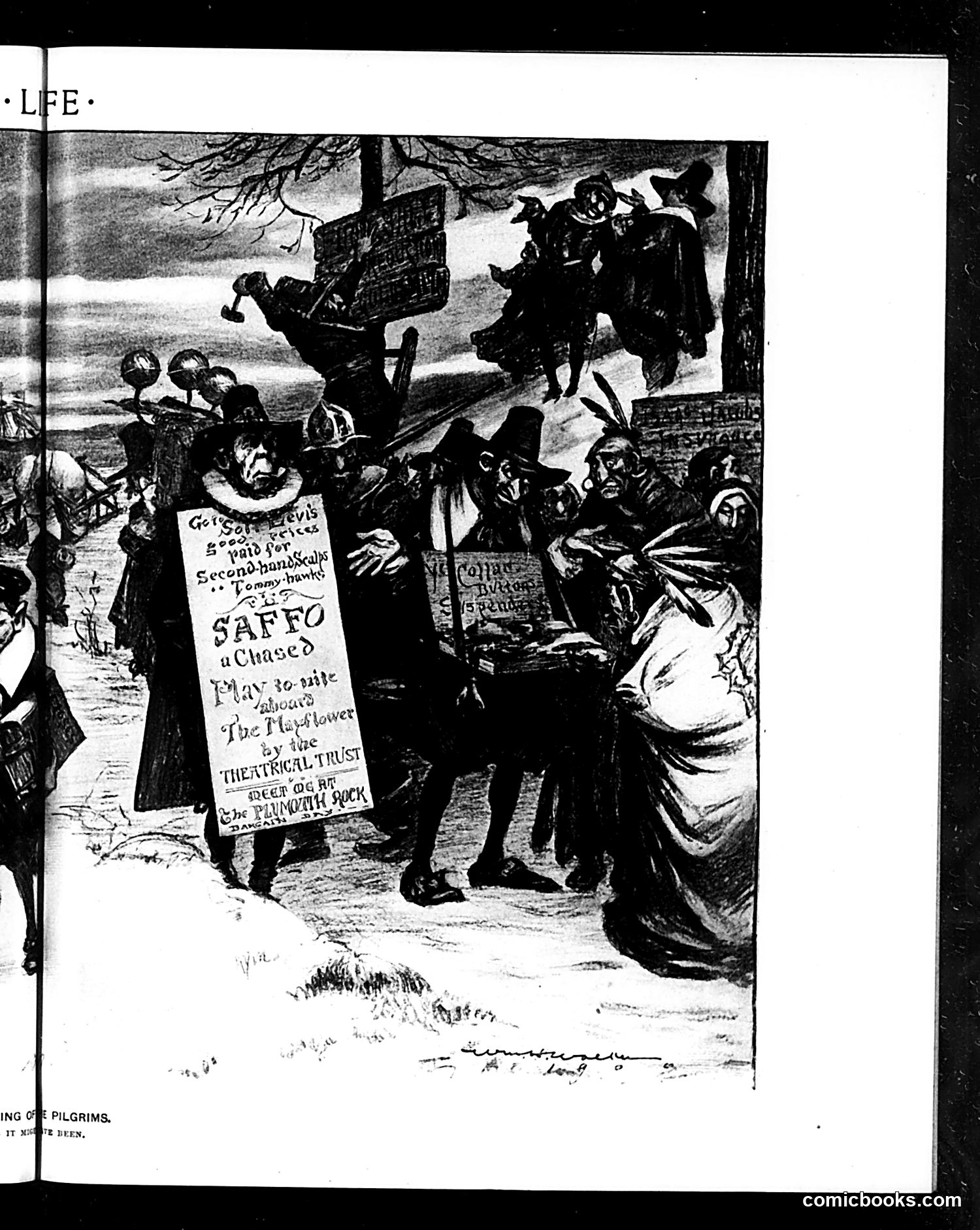
This appears to be a satirical illustration depicting a theatrical scandal or controversy. The central figure holds a sign advertising "Saffos Chased" and references "The Theatrical Trust," suggesting conflict between independent theatrical producers and a monopolistic theater organization. The demonic or grotesque character depictions and the prominent signage indicate this satirizes corporate theater control—likely the "Theatrical Trust" that dominated American theater distribution in the early 1900s. The chaotic crowd scene with devils implies the Trust was viewed as corrupt or villainous by satirists. The specific play "Saffos" (possibly "Sapho") appears to have been caught in this theatrical dispute, though details remain unclear from the visible text alone. This reflects broader Progressive-era anxieties about monopolistic business practices in entertainment.
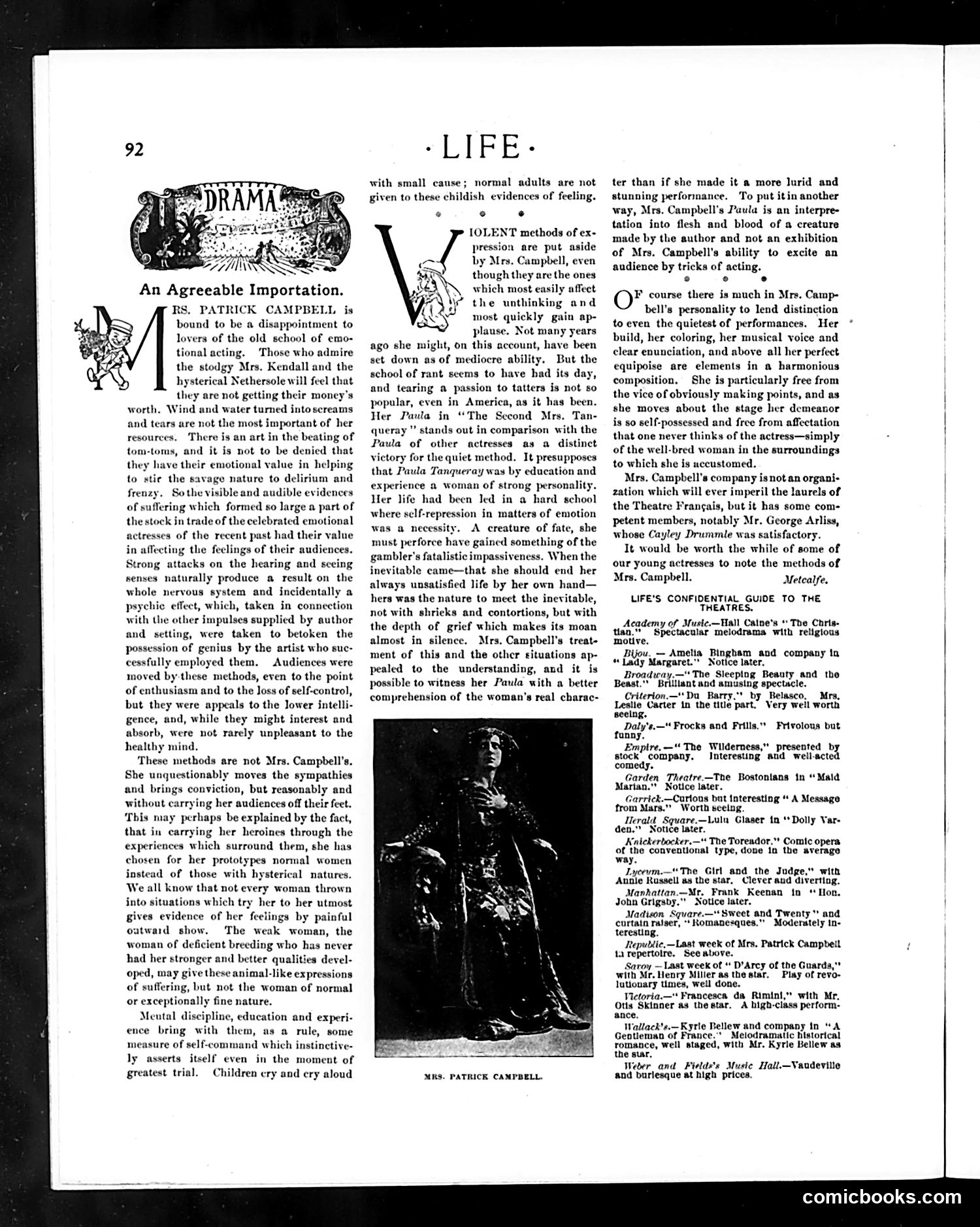
This page contains a theater review titled "An Agreeable Importation" discussing **Mrs. Patrick Campbell**, a prominent British actress. The text praises her acting method, which emphasizes emotional restraint and conviction over theatrical excess—contrasting with more melodramatic contemporary styles. The accompanying photograph shows Campbell in what appears to be a dramatic role, illustrating the article's discussion of her distinctive performance approach. The review highlights how Campbell's technique—avoiding histrionics while conveying genuine emotion—represents a more sophisticated form of acting that appeals to intelligent audiences rather than relying on cheap sentimentality. The page also includes a "Life's Confidential Guide to the Theatres" listing current productions at various venues, standard for theater criticism of this era.
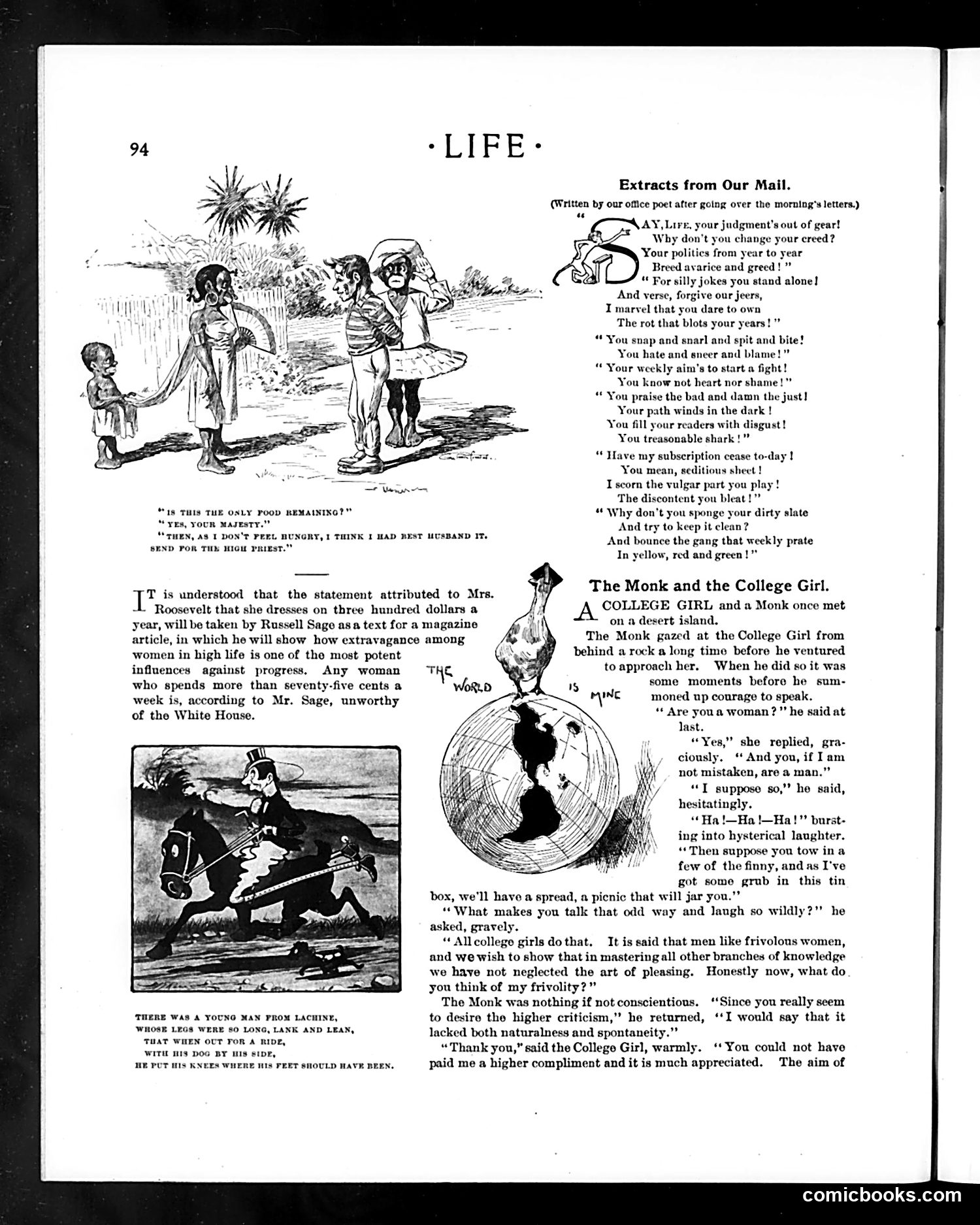
This page contains multiple satirical pieces targeting contemporary figures and social issues: **Top cartoon**: Satirizes First Lady Mrs. Roosevelt's claim that she dresses on only $300 yearly. Critic Russell Sage is referenced as planning to use this as evidence that high-society women's extravagance undermines progress. The satire mocks Sage's extreme standard—suggesting even 75 cents weekly spending is "unworthy" of the White House. **"Extracts from Our Mail"**: Life publishes critical reader letters attacking the magazine itself—accusing it of bias, promoting discord, printing "rot," and being seditious. This is meta-satire: Life ridicules its own critics by printing their complaints, implying readers' objections are overwrought. **"The Monk and the College Girl"**: A humorous dialogue mocking the "New Woman"—the educated college girl of the era. The joke: she affects frivolous, affected behavior while claiming education. The Monk's dry criticism that her laughter "lacked naturalness and spontaneity" is the punchline, highlighting the contradiction between intellectual pretension and hollow performance.
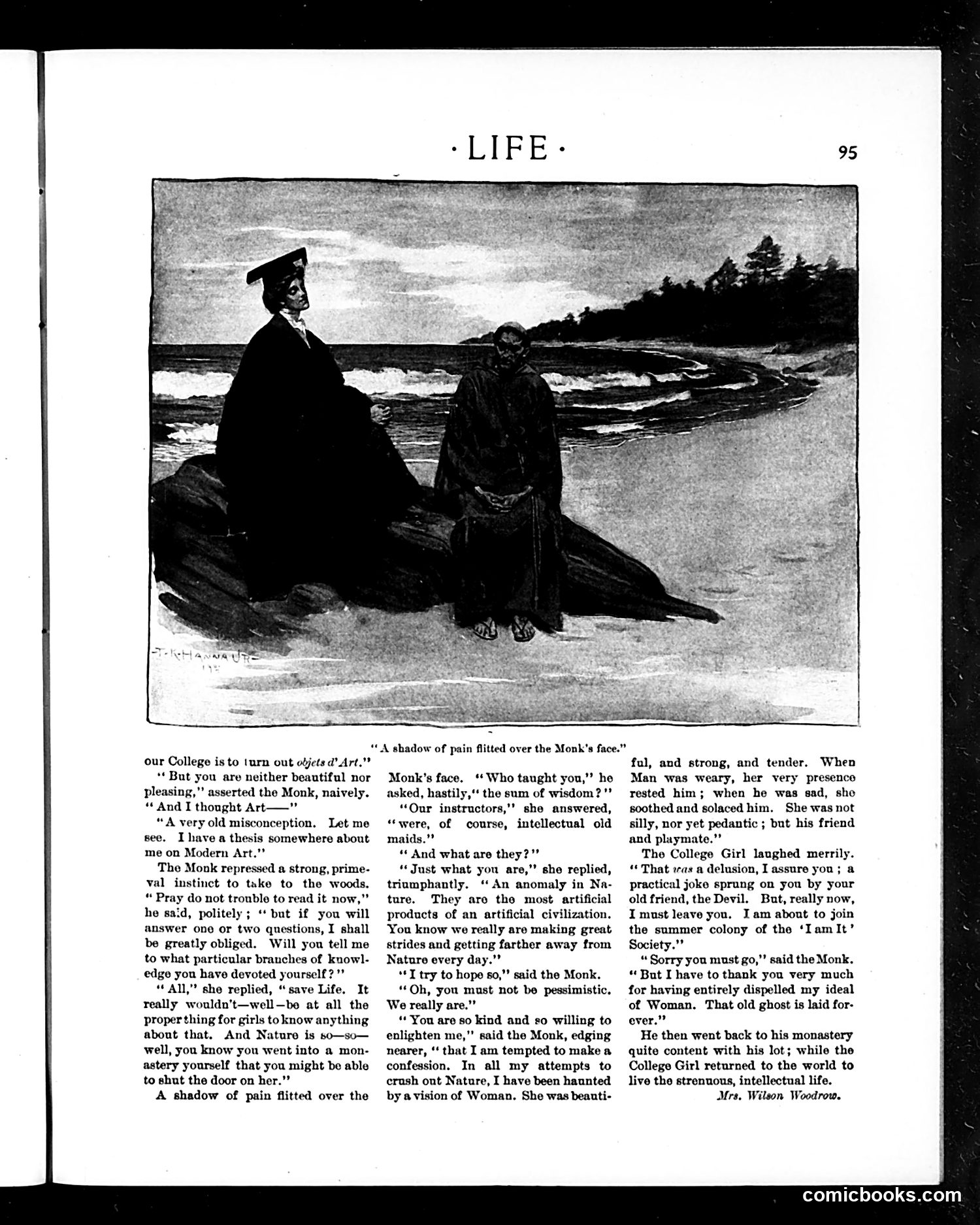
This satirical dialogue contrasts a traditionalist Monk with a progressive "College Girl"—likely representing early 1900s debates about women's education and "New Woman" feminism. The Monk represents old-fashioned ideals: he reveres women as naturally nurturing, spiritual counterweights to masculine struggle. The College Girl embodies the modern, educated woman who rejects "Nature" in favor of intellectual achievement and artificial civilization. She dismisses his romantic vision as a "delusion" and a "practical joke sprung on you by your old friend, the Devil." The satire cuts both ways: the girl's pedantic rejection of womanly "nature" and her shallow pursuit of intellectual trends (joining the "'I am It' Society") mock progressive pretension. Yet the Monk's pain suggests the author sympathizes with his loss of idealized femininity. The byline attributes this to "Mrs. Wilson Woodrow," likely a pseudonym, allowing commentary on gender roles without revealing the author's identity.
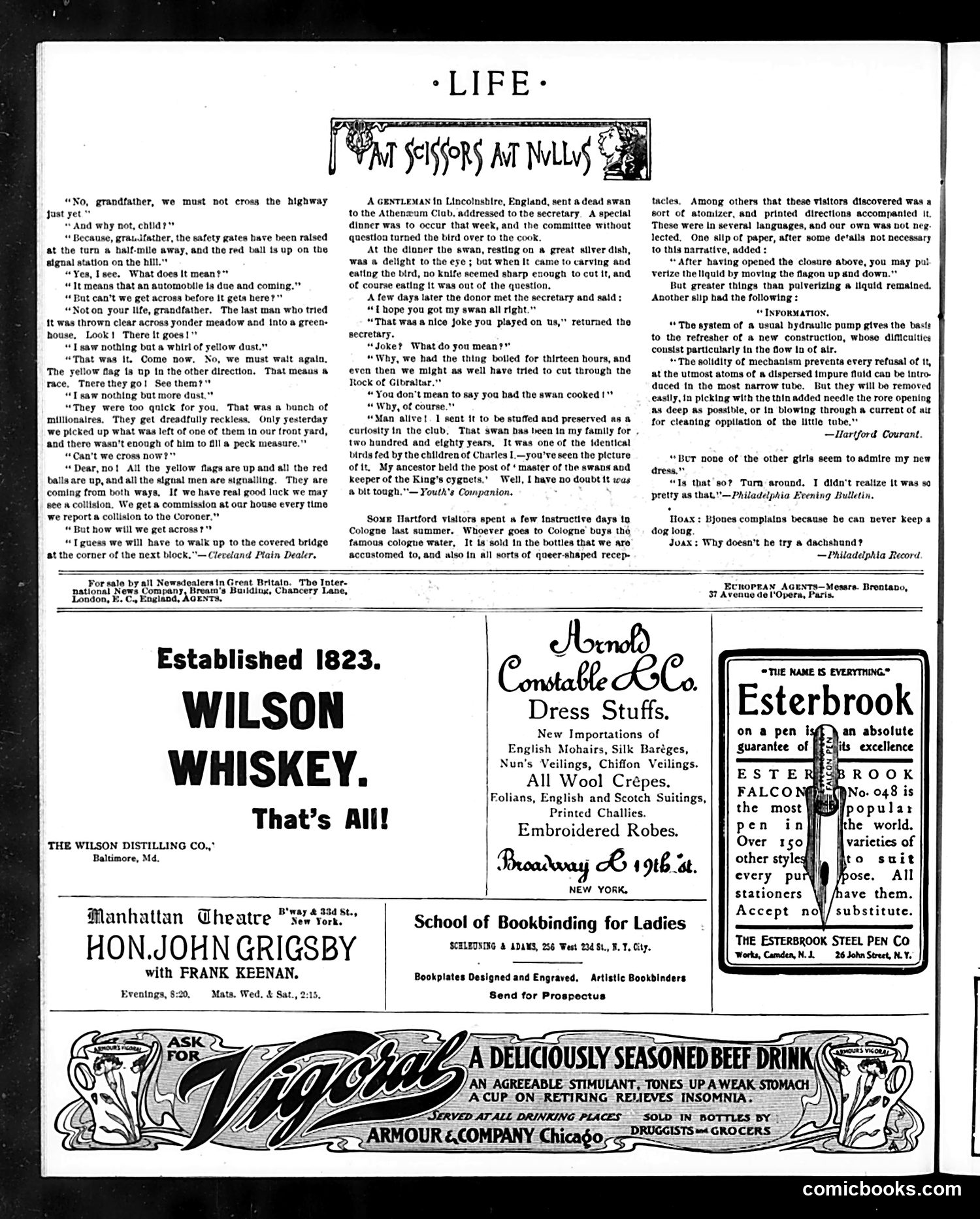
This page from *Life* magazine contains three satirical anecdotes mocking contemporary absurdities: 1. **The Highway Safety Debate** (top): A grandfather and child discuss railroad crossing safety gates and colored signal balls. The joke satirizes the dangerous, unpredictable early automobile era—so chaotic that collisions are treated as routine events worth reporting to coroners for compensation. 2. **The Stuffed Swan Incident**: A gentleman donates what he claims is a 280-year-old swan (fed by children of King Charles I) to a club, expecting it preserved as a curiosity. The committee cooks it instead, discovering it's stone-hard and inedible. The satire mocks miscommunication and the club's culinary incompetence. 3. **Cologne Water Instructions**: Visitors to Cologne find hilariously garbled English translation instructions for a perfume atomizer, with phrases like "pulverize the liquid by moving the flagon up and down." This ridicules poor foreign translations and product instructions. All three pieces use humor to highlight human foolishness, technological chaos, and communication failures of the era.
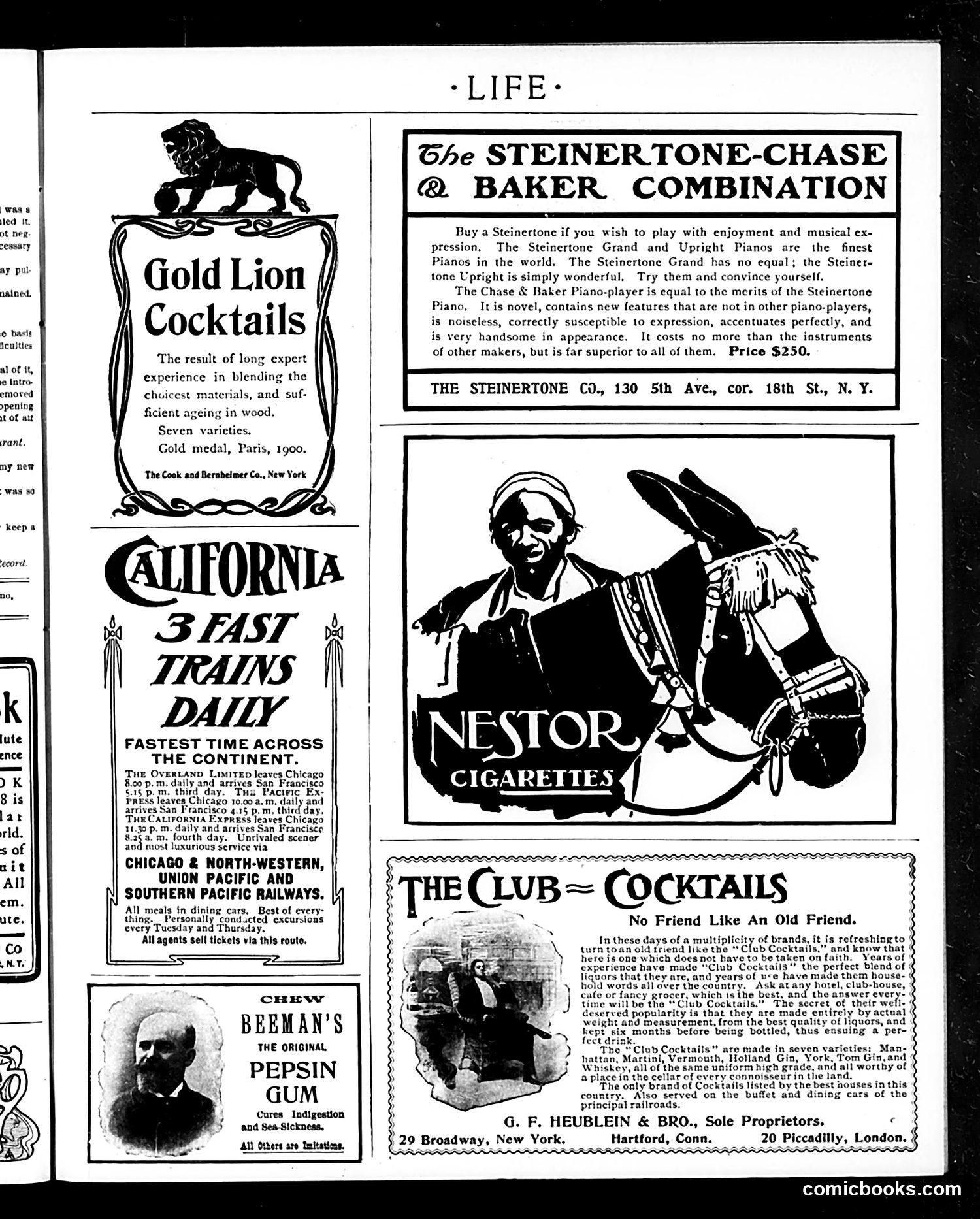
This is primarily an **advertising page** from an early 1900s issue of Life magazine, not a political cartoon. The page contains commercial advertisements for various products and services typical of the era. The ads include: - **Gold Lion Cocktails** (won a gold medal in Paris, 1900) - **Steinertone-Chase & Baker pianos** (luxury instruments) - **California Beast Trains** (railroad service advertising fastest transcontinental travel via Chicago & North-Western railways) - **Beeman's Pepsin Gum** (claims to cure indigestion and sea-sickness) - **Nestor Cigarettes** (features an illustrated figure with a horse) - **Club Cocktails** (marketed as "No Friend Like An Old Friend") The only illustration with potential satirical intent is the **Nestor Cigarettes ad**, which shows a figure in period costume with a horse, though its specific meaning or reference is unclear without additional context. This page reflects early 20th-century consumer culture and advertising practices rather than political satire.
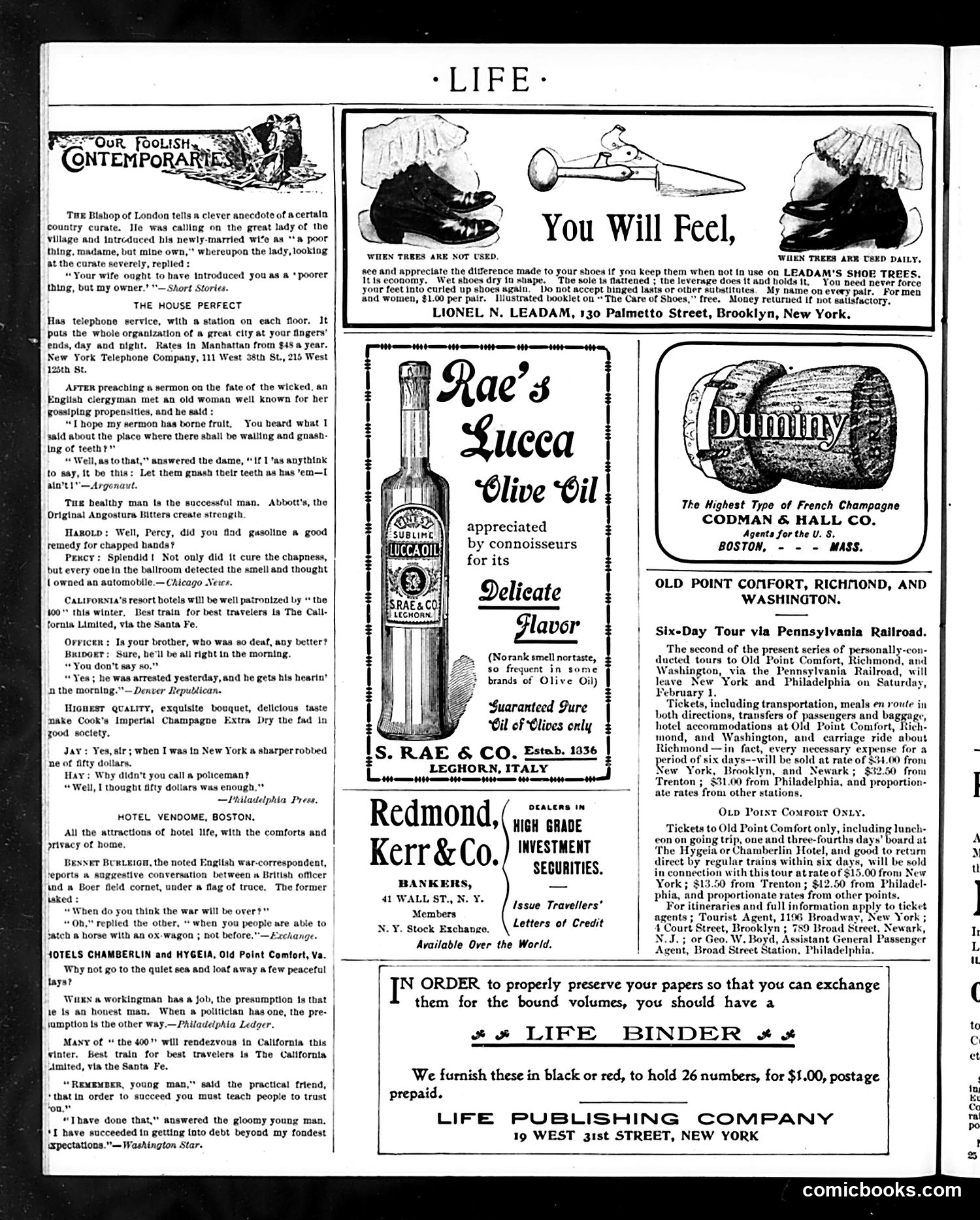
This page is primarily **advertisements and humorous anecdotes** rather than political cartoons. The content includes: **Humorous stories** mocking social pretension (a bishop's anecdote about a curate introducing his wife as "a poor thing"), clergy gossip, and various light jokes about everyday situations. **Shoe tree advertisement** by Lionel N. Leadam showing diagrams of shoes with/without support, claiming the product maintains shoe shape. **Product advertisements** for olive oil (S. Rae & Co.), champagne (Codman & Hall), and various hotels and services. **No clear political satire** is evident on this page. The humor is genteel, domestic, and commercial rather than satirical. The only potentially pointed joke mocks gossiping women and hypocritical clergy, but these are mild social observations rather than sharp political commentary. This appears to be from Life's lighter, advertisement-heavy content rather than its editorial cartooning section.
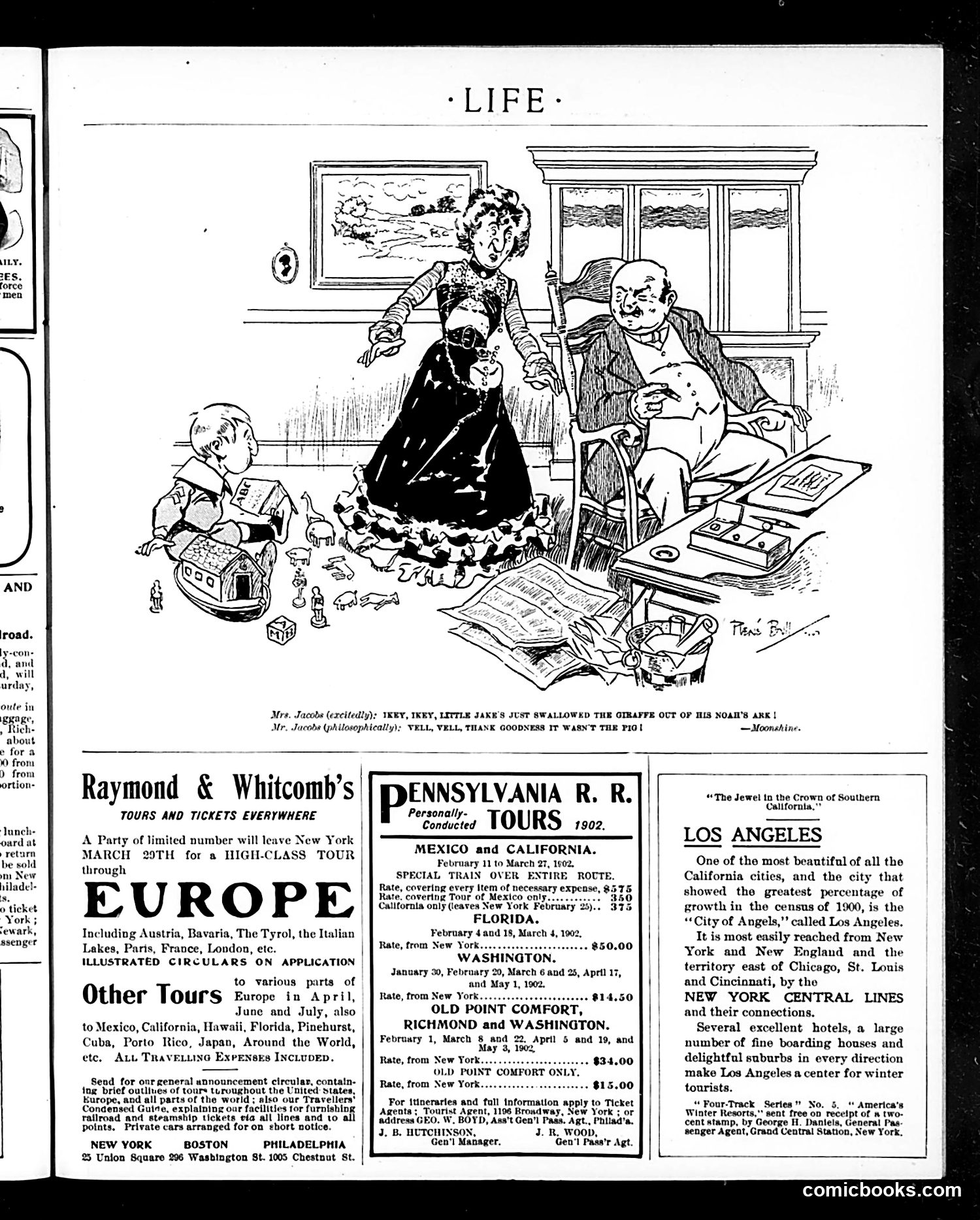
**The Main Cartoon:** A mother (Mrs. Jacobs) excitedly tells her husband that their young son "Little Jake" has swallowed the giraffe from a Noah's Ark toy. The father responds philosophically that at least it wasn't the pig. **The Joke:** This is a domestic humor cartoon typical of early 1900s *Life* magazine. The satire lies in the father's peculiar logic—he's relieved the child swallowed a toy giraffe rather than a toy pig, suggesting arbitrary and absurd parental priorities. The exaggerated Yiddish-inflected dialect ("VELL, VELL") indicates the family's immigrant status, a common comedic marker in period American humor. The scene depicts a cluttered parlor with toys scattered about, emphasizing middle-class domestic chaos. **Context:** This reflects *Life's* typical satirical approach to everyday family life and immigrant domestic culture of the era. **The Remainder:** The page is primarily **advertising**—travel tours to Europe, Florida, California, and Los Angeles, typical of upscale magazine advertising circa 1902.
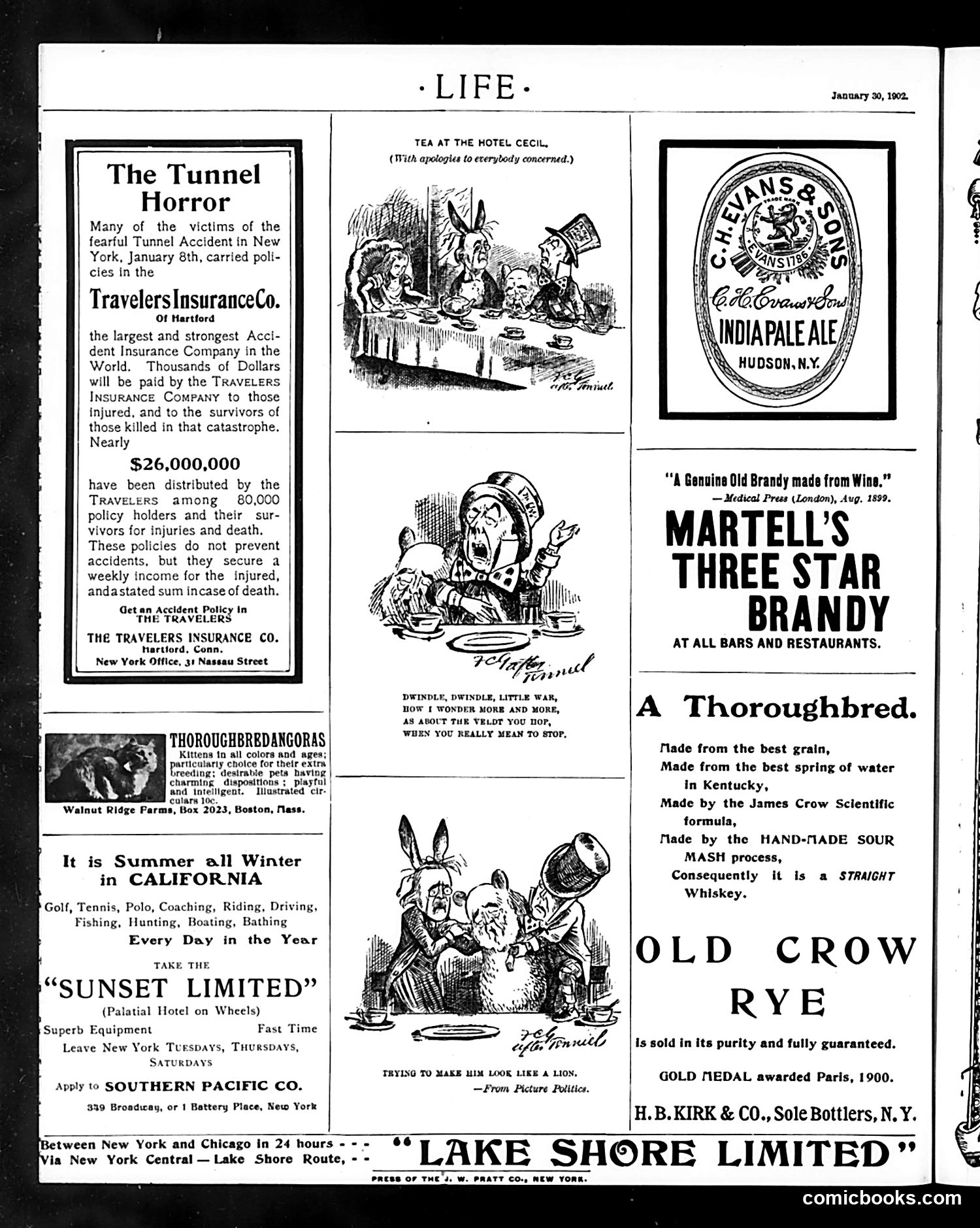
This page is primarily **advertising**, with one notable political cartoon. The central cartoon shows an anthropomorphic rabbit or hare attempting to look fierce, captioned "Trying to Make Him Look Like a Lion—From Picture Politics." This appears to satirize **political manipulation or propaganda**—likely referencing someone (unclear who) being artificially presented as more powerful or threatening than they actually are. The page otherwise features advertisements for insurance (capitalizing on a recent New York tunnel disaster from January 8th), liquor brands (Old Crow Rye, Martell's Brandy), California travel, and thoroughbred animals. The "Tea at the Hotel Cecil" cartoon is a separate social satire, likely mocking fashionable hotel society, though specific context is unclear. The dominant message: **Life used humor to critique both politics and high society while selling consumer products.**