
Life, 1902-01-30 · page 12 of 20
Life — January 30, 1902 — page 12: what you’re looking at
What you’re looking at
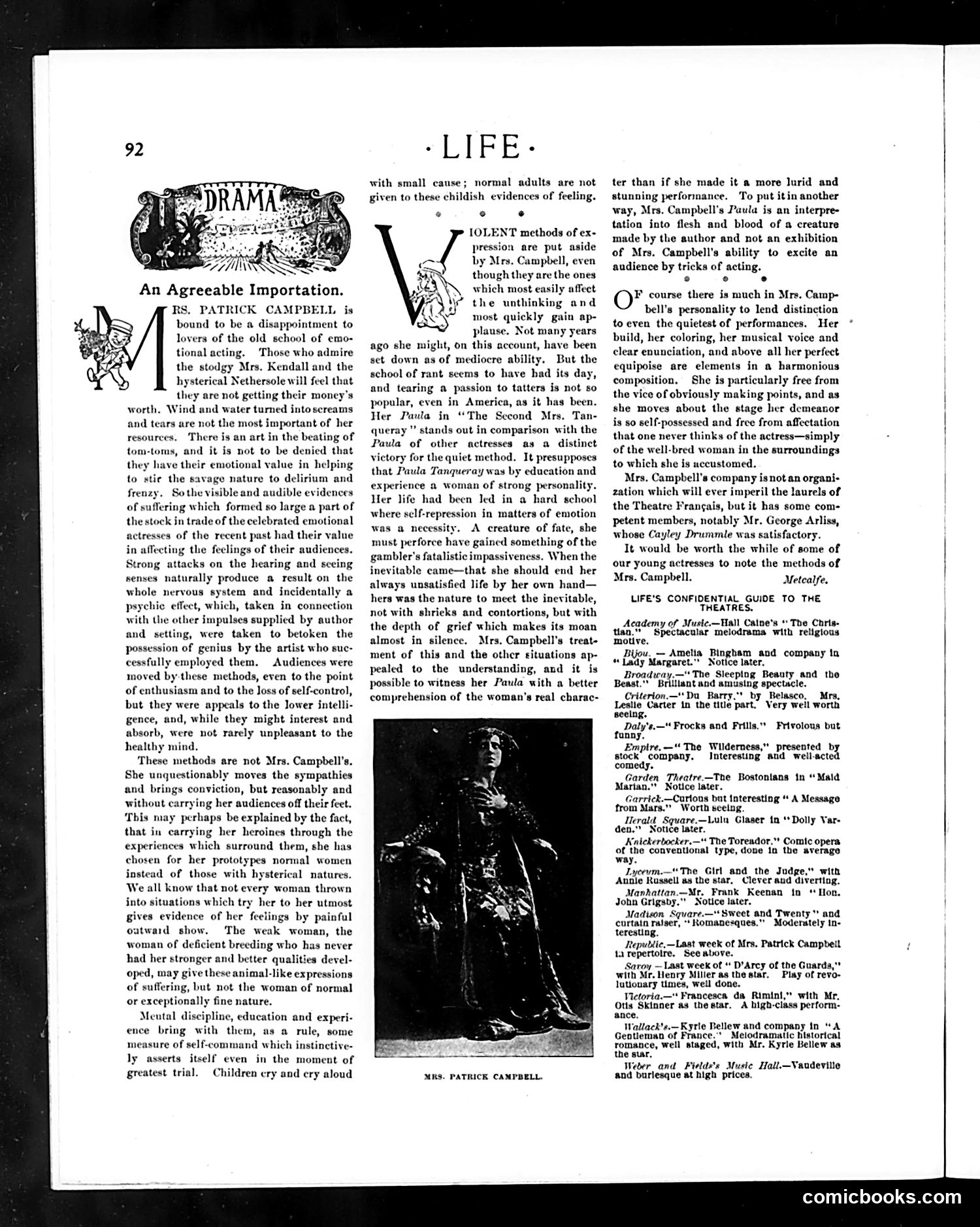
This page contains a theater review titled "An Agreeable Importation" discussing **Mrs. Patrick Campbell**, a prominent British actress. The text praises her acting method, which emphasizes emotional restraint and conviction over theatrical excess—contrasting with more melodramatic contemporary styles. The accompanying photograph shows Campbell in what appears to be a dramatic role, illustrating the article's discussion of her distinctive performance approach. The review highlights how Campbell's technique—avoiding histrionics while conveying genuine emotion—represents a more sophisticated form of acting that appeals to intelligent audiences rather than relying on cheap sentimentality. The page also includes a "Life's Confidential Guide to the Theatres" listing current productions at various venues, standard for theater criticism of this era.
📄 Transcribed text from this page (OCR, searchable)
Machine-transcribed from the original scan — historical spelling and the odd misread are preserved.
An Agreeable Importation. RS. PATRICK CAMPBELL is bound to be a disappointment to lovers of the old school of emo- tional acting. Those who admire the stodgy Mrs. Kendall and the hysterical Nethersole will feel that they are not getting their money's worth. Wind and water turned into screams and tears are not the most important of her resources. There is an art in the beating of tom-toms, and it is not to be denied that they have their emotional value in helping to stie the savage nature to delirium and frenzy, So the visibleand audible evidences of suffering which formed so large a part of the stock in trade of the celebrated emotional actresses of the recent past had their value in affecting the feelings of their audiences. Strong attacks on the hearing and sceing senses naturally produce a result on the whole nervous system and incidentally a psychic effect, which, taken in connection with the other impulses supplied by author and setting, were taken to betoken the possession of genius by the artist who suc- cessfully employed them. Audiences were moved by-these methods, even to the point of enthusiasm and to the Joss of self-control, but they were appeals to the lower intelli- gence, and, while they might interest and absorb, were not rarely unpleasant to the healthy mind, These methods are not Mrs. Campbell's, She unquestionably moves the sympathies and brings conviction, but reasonably and without carrying her audiences off their feet. ‘This may perhaps be explained by the fact, that in carrying her heroines through the experiences which surround them, she has chosen for her prototypes normal women instead of those with hysterical natures. We all know that not every woman thrown into situations which try her to her utmost gives evidence of her feelings by painful outward show The weak woman, the woman of deficient breeding who has never had her stronger and better qualities devel- oped, may give these animal-like expressions of suffering, but not the woman of normal or exceptionally fine nature. Meutal discipline, education and experi ence bring with them, as a rule, some measure of self-command which instinctive- ly asserts itself even in the moment of greatest trial. Children cry and ery aloud -LIFE- with small cause; normal adults are not given to these childish evidences of feeling. ° ° e IOLENT methods of ex- ion are put aside y Mrs. Campbell, even aw though they are the ones é \) which most easily affect \? the unthinking and most quickly gain ap- plause. Not many years ago she might, on this account, have been set down as of mediocre ability. But the school of rant seems to have had its day, and tearing a passion to tatters is not so popular, even in America, as it has been. Her Paula in “The Second Mrs. Tan- queray ” stands out in comparison with the Paula of other actresses as a distinct victory for the quiet method. It presupposes that Paula Tanqueray was by education and experience a woman of strong personality. Her life had been led in a hard school where self-repression in matters of emotion was a necessity. A creature of fate, she must perforce have gained something of the gambler’s fatalistic impassiveness. When the inevitable came—that she should end her always unsatisfied life by her own hand— hers was the nature to meet the inevitable, not with shrieks and contortions, but with the depth of grief which makes its moan almost in silence. Mrs. Campbell's treat- ment of this and the other situations ap- pealed to the understanding, and it is possible to witness her Paula with a better comprehension of the woman’s real charac- MRS. PATRICK CAMPBELL. ter than if she made it a more lurid and stunning performance. To put itin another way, Mrs. Campbell's Paula is an interpre- tation into flesh and blood of a creature made by the author and not an exhibition of Mrs. Campbell's ability to excite an audience by tricks of acting. O course there is much in Mrs. Camp- bells personality to lend distinction to even the quietest of performances. Her build, her coloring, her musical voice and clear enunciation, and above all her perfect equipoise are elements in a harmonious composition. She is particularly free from the vice of obviously making points, and as she moves about the stage her demeanor is so self-possessed and free from affectation that one never thinks of the actress—simply of the well-bred woman in the surroundings to which she is uccustomed. Mrs. Campbell's company isnot an organi- zation which will ever imperil the laurels of the Theatre Francais, but it has some com- petent members, notably Mr. George Arliss, whose Cayley Drummle was satisfactory. It would be worth the while of some of our young actresses to note the methods of Mrs. Campbell. Metcalfe, LIFE'S CONFIDENTIAL GUIDE TO THE THEATRES. Academy of Muste-—Hall Catne's * The Chris- tian.” Spectacular melodrama with religious motive, Bijou. — Amelia Bingham and company tn “Lady Margaret.” Notice later, Broadway.—" The Sleeping Beauty and the Beast” Brillant and ‘amusing spectacle. Criterton.—" Da Barry." by Belasco. Mra, Lesile Carter in the title part, Very weil worth seeing. Daly’ fanny, Empire. —“ The Wilderness," presented by stock company, Interesting’ and well-act comedy. Garden Theatre.—The Bostonians in + Mald Marian.’ Notice later. Garrick.—Curtons but interesting “ A Message from Mars.” “Worth seeing. Herald Square.—Lulu Glaser tn Dolly Var- den." Notice later. Knickerbocker.—“ The Toreador."* Comic opera of the conventional type, done tn the average way. Lycevm.—"The Girl and the Judge," with Annie Russell as the star, Clever and diverting. Manhattan.—Mr. Frank Keenan tn “Hon. Notice later. ware.—* Sweet and Twenty” and * Komanesques."" Moderately in- “Frocks and Frills." Frivolous but curtain raiser, teresting. Republic,—Last week of Mrs. Patrick Campbeil 1a repertoire. See above. Saroy — Last week ot D'Arcy of the Guards,"* with Mr. Henry Miller as the star. Play of revo- lutionary times, well done. Victoria.—" Francesca da Rimini,” with Mr, Otis Skinner as the star. A high-class perform: ance, Wallack's.— Kyrie Rellew and company in “A Gentleman of France." Melodramatic hilstortcal romance, well staged, with Mr. Kyrie Bellew as the sur, Weber and Fields's Music Hall.—Vaudevilie and burlesque at high prices. comicbooks.com