
Life, 1902-01-30 · page 6 of 20
Life — January 30, 1902 — page 6: what you’re looking at
What you’re looking at
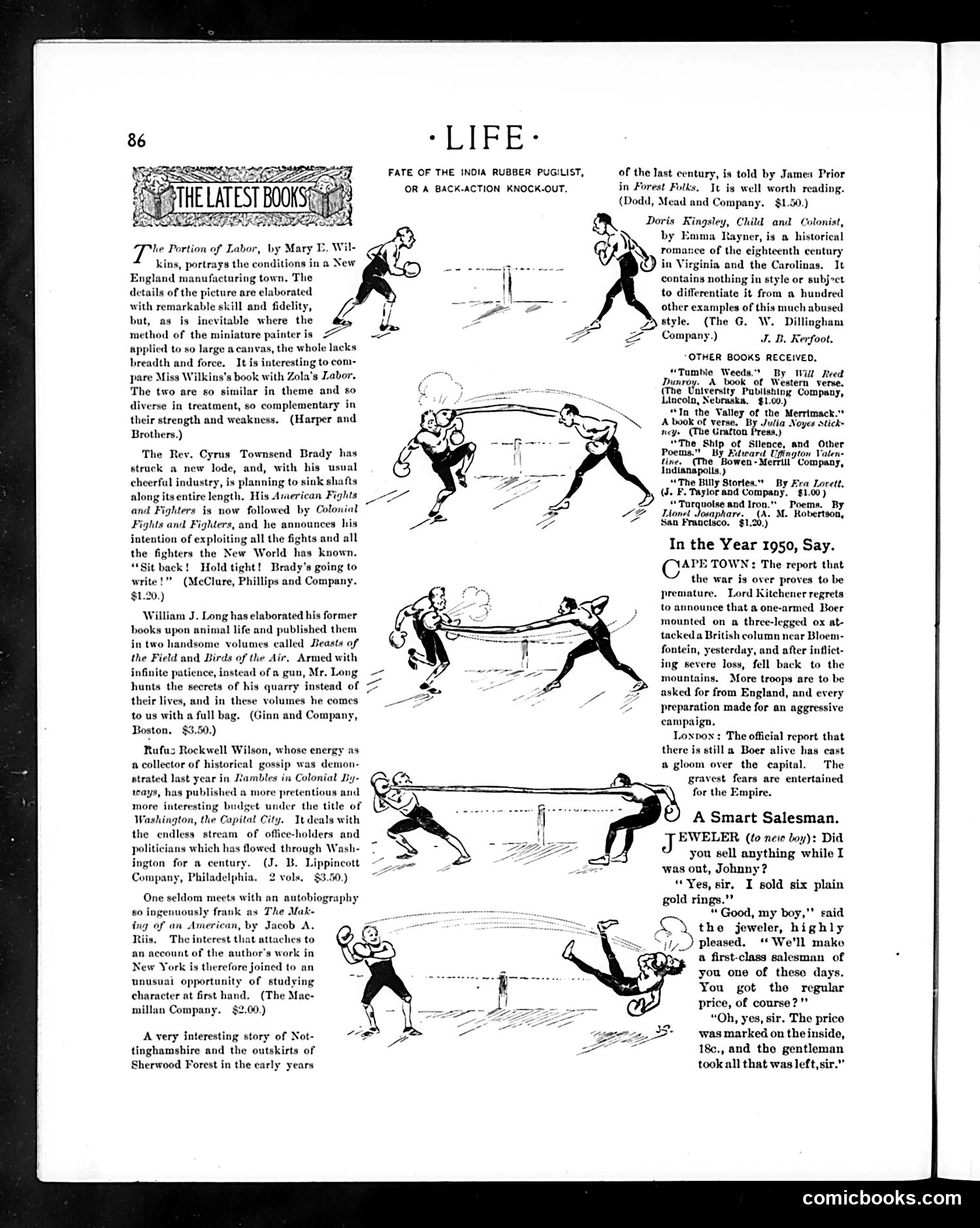
This page contains **book reviews** rather than political cartoons. The left column reviews recent publications, including works on manufacturing, labor, and colonial history. The right side features **"A Smart Salesman,"** a humorous dialogue about a jeweler who sold six gold rings. The customer claims the marked price was 18 cents, but the jeweler insists it was marked higher on the inside of the rings—implying the customer either misread it or is dishonestly claiming a bargain. This is gentle commercial satire about retail deception and haggling. The illustrations throughout show figures engaged in **tug-of-war and athletic activities**, likely decorative elements accompanying the text rather than specific satire. The page lacks overt political commentary—it's primarily literary and commercial humor typical of Life magazine's general-interest satirical content.
📄 Transcribed text from this page (OCR, searchable)
Machine-transcribed from the original scan — historical spelling and the odd misread are preserved.
T ke Portion of Labor, by Mary ©. kins, portrays the conditions in a New England manufacturing town. The details of the picture are elaborated with remarkable skill and fidelity, but, as is inevitable where the method of the miniature painter is applied to so large a canvas, the whole lacks breadth and force. It is interesting to com- pare Miss Wilkins’s book with Zola’s Labor, The two are so similar in theme and so diverse in treatment, so complementary in their strength and weakness. (Harper and Brothers.) The Rev. Cyrus Townsend Brady has struck a new lode, and, with his usual cheerful industry, is planning to sink shafts along itsentire length. His American Fights and Fighters is now followed by Colonial Fights and Fighters, and he announces his intention of exploiting all the fights and all the fighters the New World has known. “Sit back! Hold tight! Brady's going to write!” (McClure, Phillips and Company. $1.20.) William J. Long has elaborated his former books upon animal life and published them in two handsome volumes called Beasts of the Field and Birds of the Air, Armed with infinite patience, instead of a gun, Mr. Long hunts the secrets of his quarry instead of their lives, and in these volumes he comes to us with a full bag. (Ginn and Company, Boston, $3.50.) Rufus Rockwell Wilson, whose ener a collector of historical gossip was demon- strated last year in Rambles in Colonial By- ways, 3 published a more etentious and more interesting budget under the title of (US Washington, the Capital City. It deals with the endless stream of office-holders and politicians which has flowed through Wash- ington for a century. (J. B. Lippincott Company, Philadelphia, 2 vols, $3.50.) One seldom meets with an autobiography so ingenuously frank as The Mak- ing of an American, by Jacob A. Riis, The interest that attaches to an account of the author's work in New York is therefore joined to an unusuai opportunity of studying character at first hand. (The Mac- millan Company. $2.00.) A very interesting story of Not- tinghamshire and the outskirts of Sherwood Forest in the early years «LIFE: FATE OF THE INDIA RUBBER PUGILIST, OR A BACK-ACTION KNOCK-OUT. Sj of the last century, is told by James Prior in Forest Fulks. It is well worth reading. (Dodd, Mead and Company. $1.50.) Doris Kingsley, Child and Colonist, y by Emma Rayner, is a historical romance of the eighteenth century in Virginia and the Carolinas. It contains nothing in style or subject to differentiate it from a hundred other examples of this much abused style. (The G. W. Dillingham Company.) J.B. Kerfoot. OTHER BOOKS RECEIVED, “Tambie Weeds." By Will Reed Dunroy. A book of Western verve. (The University Publishing Company, Lincoln, Nebraska. $1.00.) “Tn the Valley of the Merrimack. A book of verse. By Julia Noyes stick= ney. (The Gratton Press.) “The Ship of Silence, and Other Poems." By Edward Upington Vate fine. (The “Bowen Merrill Company, Indianapolis.) “The Billy Stories." By Era Lovett, (J. F. Taylor and Company. $1.00) “Turquolse and Iron." Poems. By Lionet Josaphare. (A. M. Robertson, San Francisco. $1.20.) In the Year 1950, Say. APE TOWN: The report that the war is over proves to be premature. Lord Kitchener regrets to announce that a one-armed Boer mounted on a three-legged ox at- tackeda British column near Bloem- fontein, yesterday, and after inflict- ing se loss, fell back to the mountains, More troops are to be asked for from England, and every preparation made for an aggressive campaign. Loxpox: The official report that there is still a Boer alive has cast a gloom over the capital. The gravest fears are entertained for the Empire. A Smart Salesman. J EWELER (to new boy): Did you sell anything while I was out, Johnny? “Yes, sir. I sold six plain gold rings.’” “ Good, my boy,’* said CY the jeweler, highly ‘1,_) pleased. ‘* We'll mako a first-class salesman of you one of these days. You got the regular price, of course?” “Oh, yes, sir. The price was marked on the inside, 18c., and the gentleman took all that was left, sir. comicbooks.com