
A complete issue · 20 pages · 1902
Life — January 23, 1902
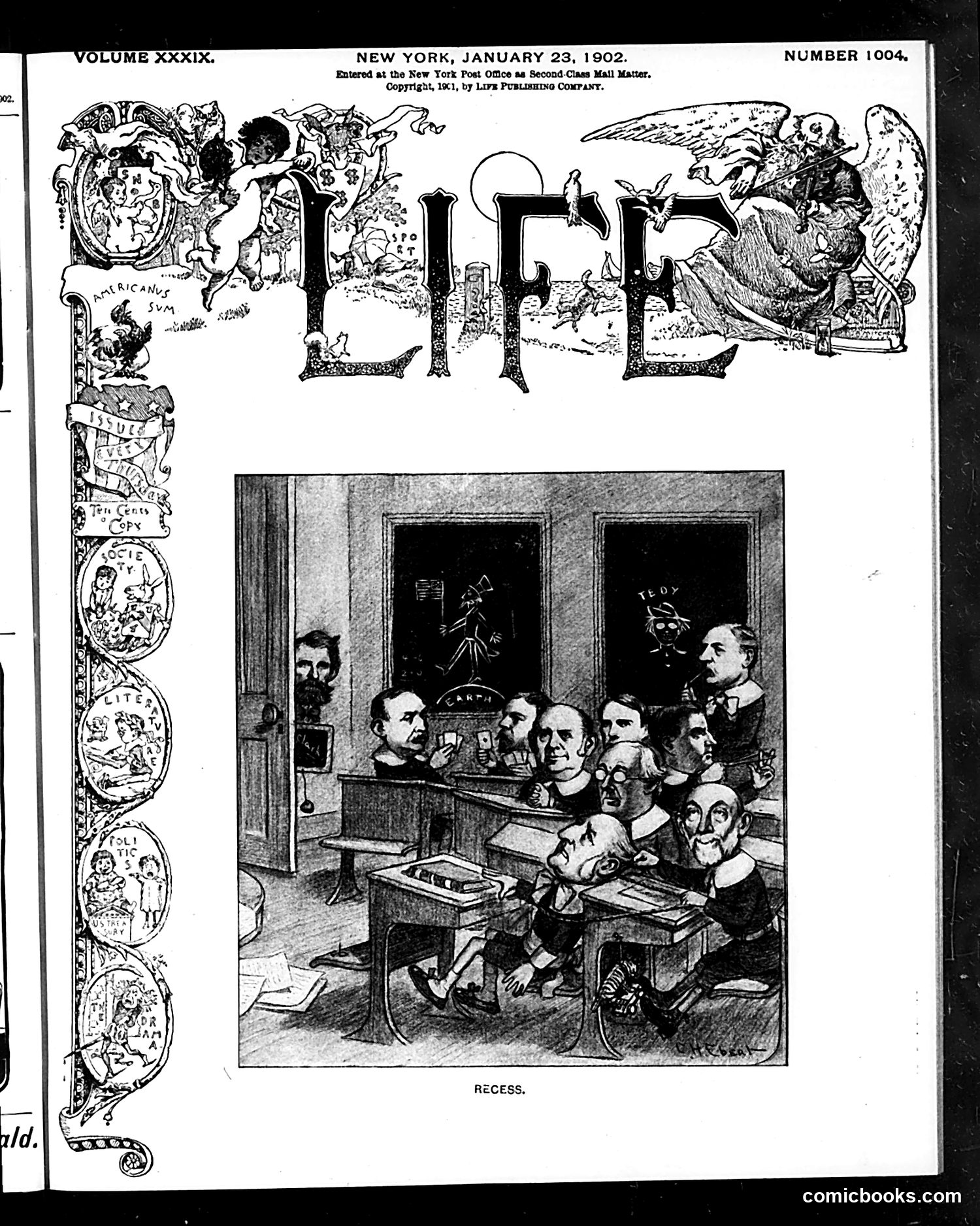
The main cartoon, titled "Recess," depicts what appears to be a schoolroom scene with exaggerated caricatured faces of men in a chaotic classroom setting. One figure appears to be teaching or supervising while others sit at desks. The style and presentation suggests political satire using the metaphor of a schoolroom and recess period. Given the 1902 date and the satirical nature, this likely comments on political figures or governmental bodies behaving childishly or unprofessionally. However, without clearer identification of the specific individuals caricatured or explicit text naming them, I cannot definitively identify which politicians or political situation this references. The exaggerated facial features and chaotic composition indicate mockery of their conduct or decision-making.
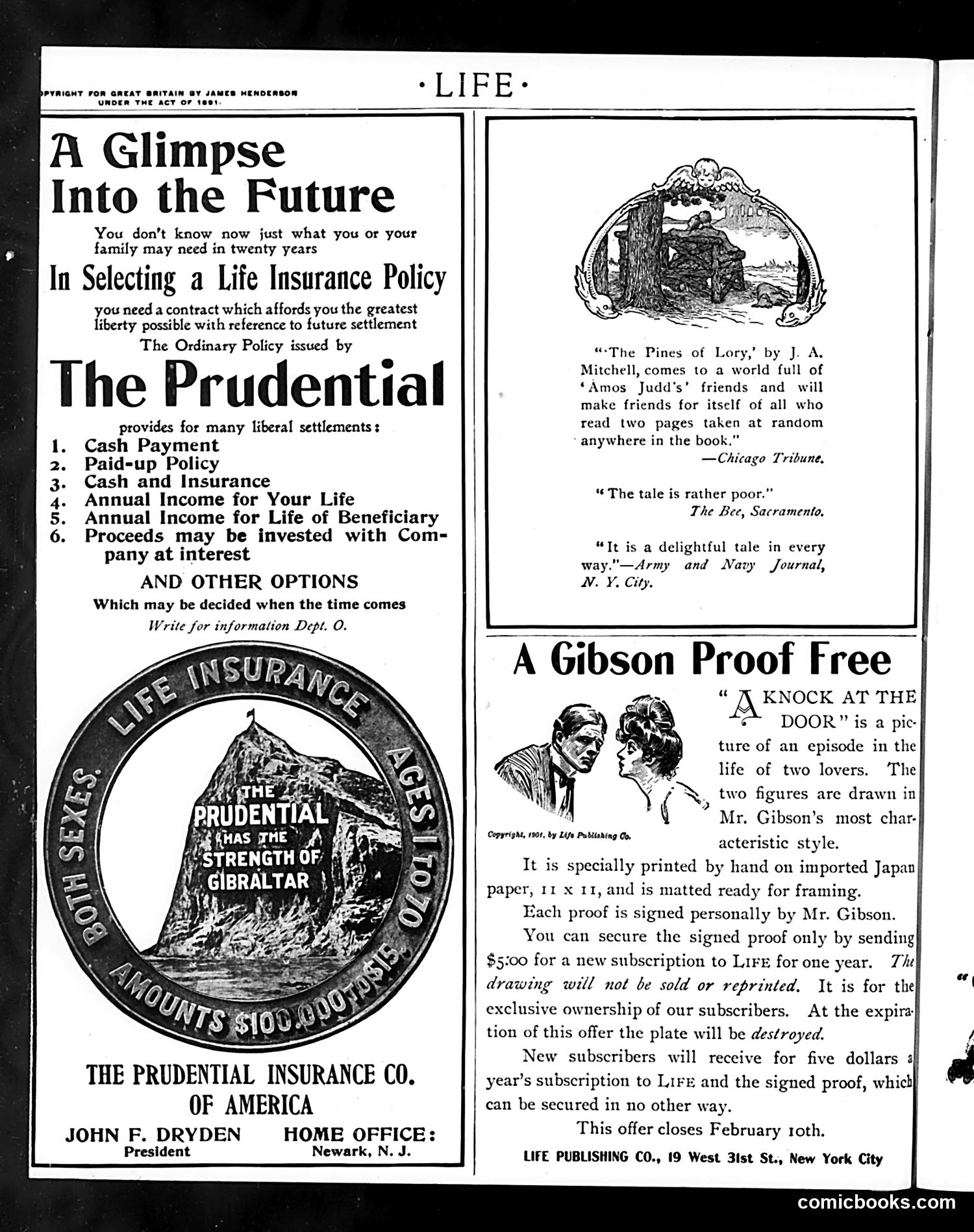
This page is primarily **advertising**, not editorial content or satire. The left side advertises **The Prudential Insurance Company's life insurance policies**, emphasizing flexible settlement options (cash payments, paid-up policies, annual income). The company's seal features Gibraltar, symbolizing strength and stability—a common insurance industry marketing metaphor of the era. The right side promotes two offerings: a book called *"The Pines of Lory"* by J.A. Mitchell (with critical quotes), and a **Gibson Proof art print** by Charles Dana Gibson. The Gibson proof is a limited reproduction, hand-signed and printed on imported Japanese paper, available only to *Life* magazine subscribers ($5 for a year's subscription). The offer emphasizes exclusivity and scarcity—the plate would be destroyed after the subscription period ended. No political satire is present on this page.
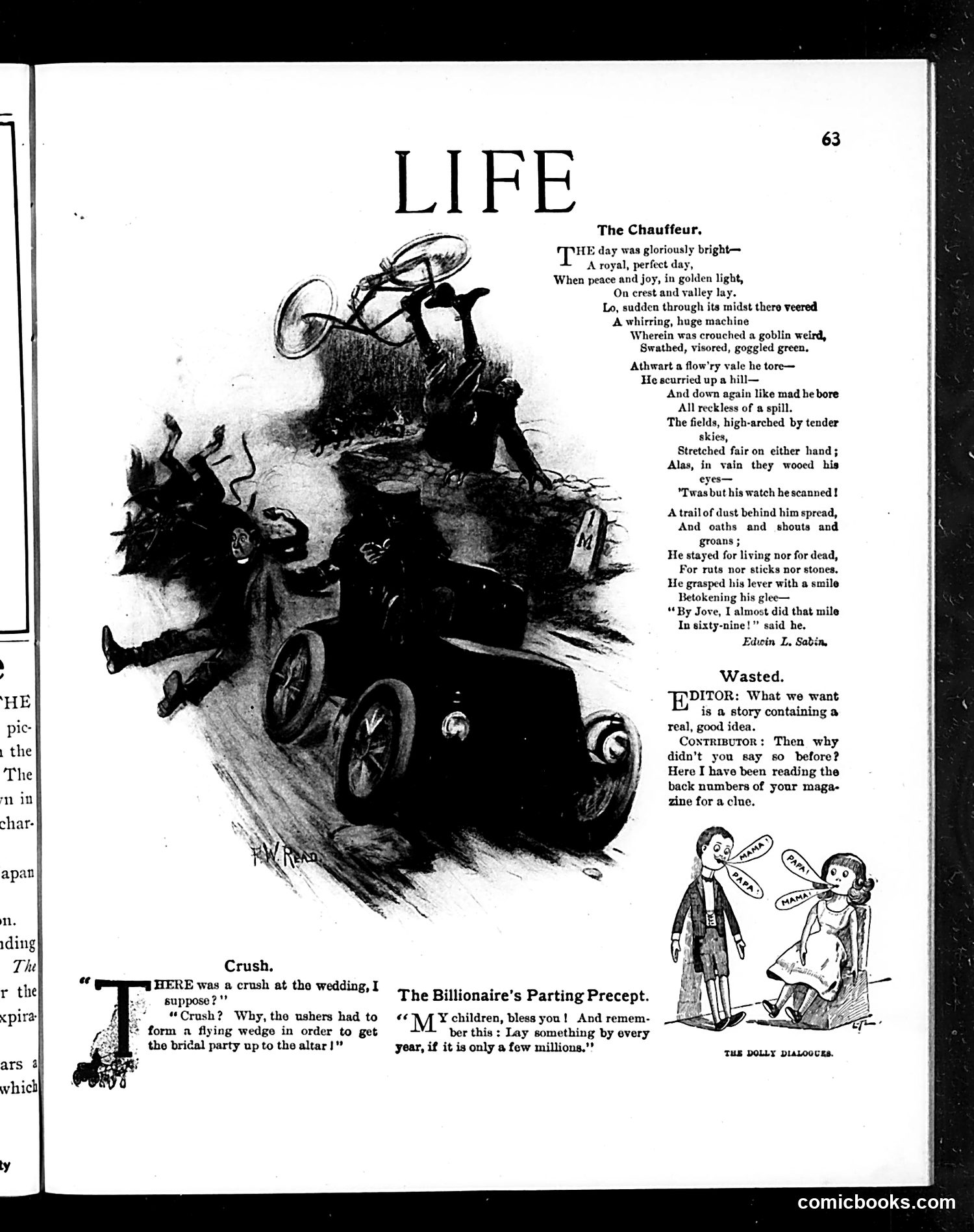
**"The Chauffeur"** (poem by Edwin L. Sabin): Satirizes early automobiles as dangerous, unreliable machines. The illustration shows a chauffeur and vehicle in a catastrophic crash—wheels up, passengers tumbling—capturing contemporary anxiety about this new technology. The poem's humor derives from the chauffeur's casual attitude ("By Jove, I almost did that mile / In sixty-nine!") despite the disaster, mocking both reckless drivers and the era's mechanical hazards. **"Crush"** and **"The Billionaire's Parting Precept"**: Brief satirical snippets. "Crush" jokes about wedding chaos; the precept mocks wealthy fathers dispensing platitudes to heirs about frugality ("lay something by every year"). The page reflects early-1900s concerns: automotive danger, class dynamics, and social pretension.
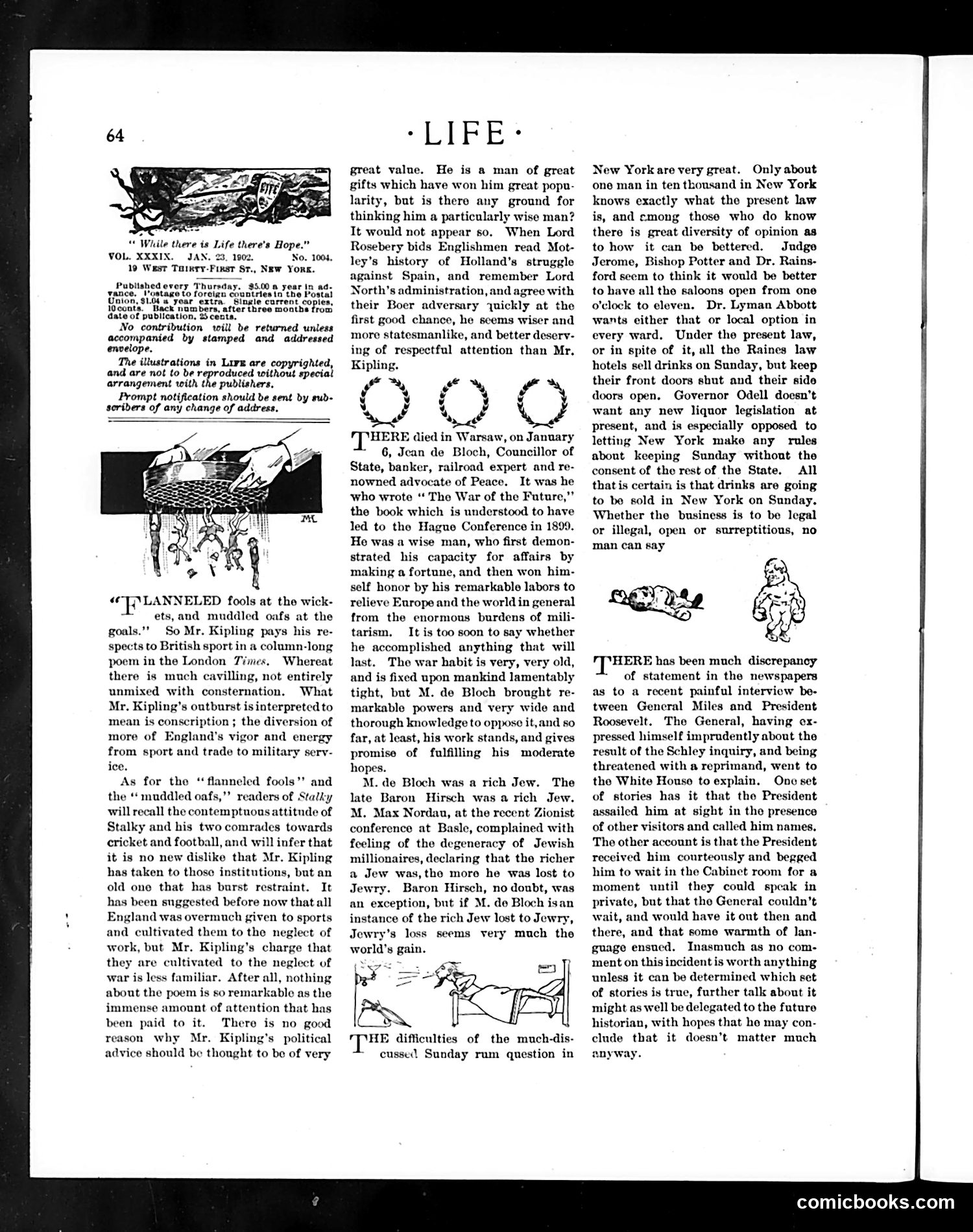
This page contains three editorial cartoons satirizing contemporary figures and issues: 1. **"While there is Life there's Hope"** (top): A small illustration mocking what appears to be political or military leadership, though the specific reference is unclear from the visible portion. 2. **"Flanneled fools at the wickets"** (middle): Critiques Mr. Kipling's column in the *London Times*, sarcastically suggesting his "outburst is interpreted to mean is conservatism." The cartoon ridicules Kipling's political commentary, suggesting he lacks real authority on military or sporting matters despite his fame. 3. **Bottom cartoon**: Depicts someone in bed, likely continuing commentary on a public figure, though the specific individual remains unclear. The page overall attacks prominent public figures' unsolicited political opinions—particularly Kipling's—suggesting they overstate their expertise beyond their actual domain.
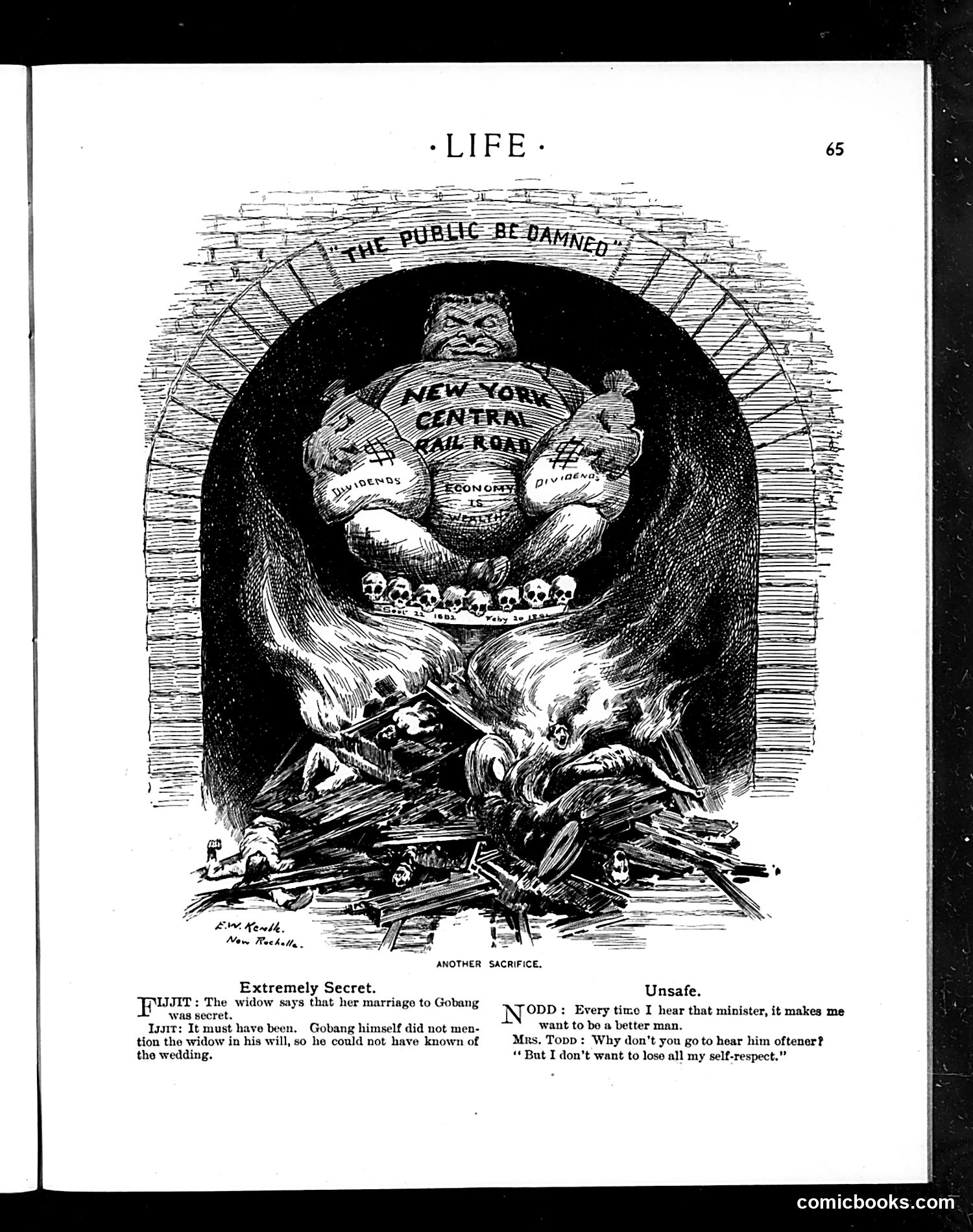
This cartoon satirizes the **New York Central Railroad** and its financial practices. The grotesque figure labeled "The Public Be Damned" clutches a bloated railroad magnate holding bags marked "Dividends" and "Economy." Two demonic creatures below—likely representing corporate greed or mismanagement—feed on piles of skulls and wreckage, symbolizing the human cost and destruction caused by the railroad's operations. The phrase "The Public Be Damned" references a famous 1883 statement by William Vanderbilt (railroad tycoon), who allegedly said exactly that when defending the railroad's self-interest over public welfare. The cartoon criticizes how railroads prioritized shareholder profits and executive compensation while endangering public safety and workers' lives. The skulls emphasize deaths caused by railway accidents or exploitation.
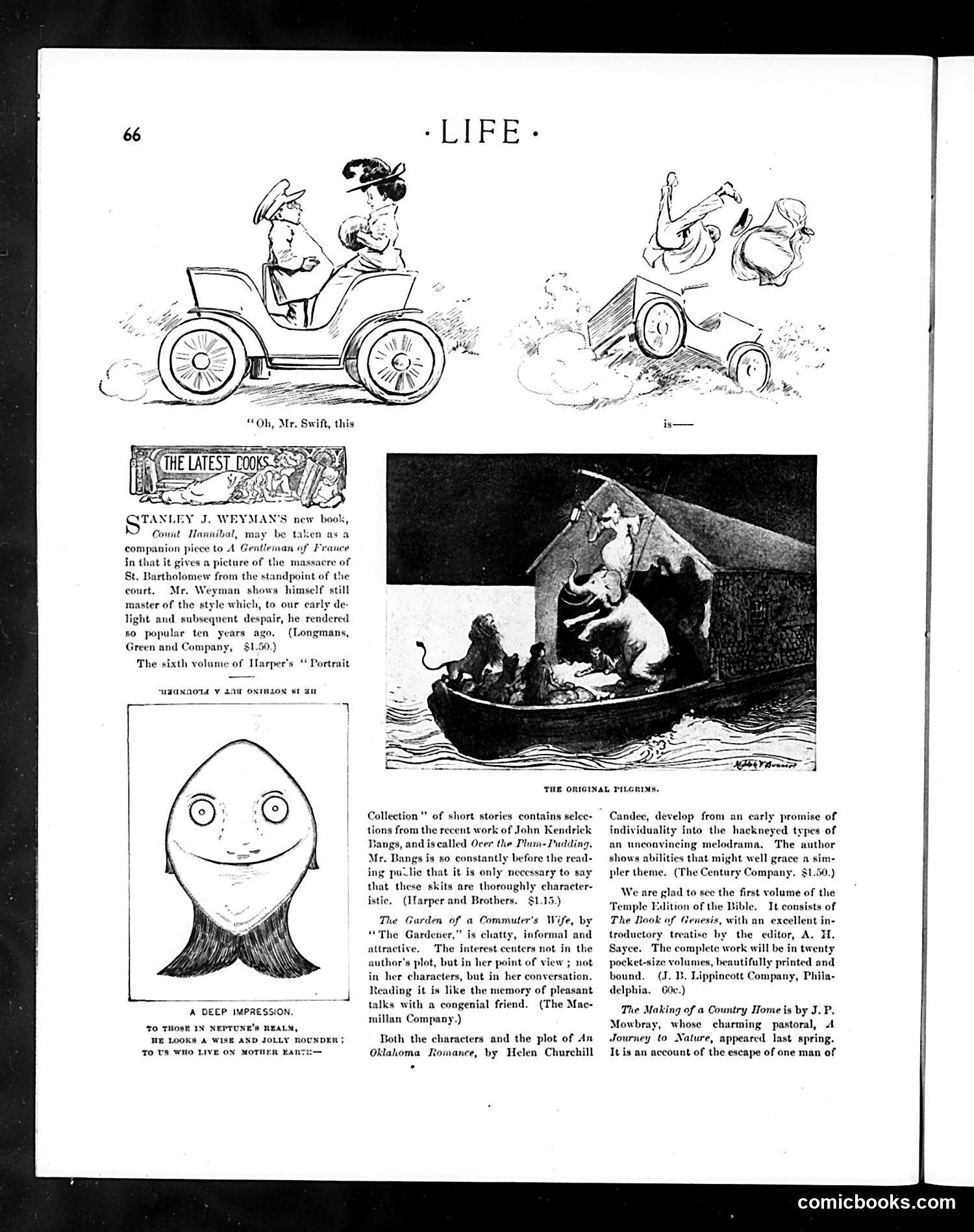
The top cartoon shows two separate automobile scenes. The left panel depicts an early motorcar with passengers, captioned "Oh, Mr. Swift, this" (incomplete). The right panel shows a vehicle accident or mishap with figures being thrown from a car. These appear to be satirical takes on early automobile dangers and the novelty of motoring in the early 1900s. Below is a book review section discussing Stanley J. Weyman's *Count Hannibal* and other literary works. A separate illustration labeled "A Deep Impression" depicts an exaggerated face, though its satirical meaning is unclear from context alone. The page also features "The Original Pilgrims," a black-and-white illustration showing figures in a boat, likely referencing early American colonial history. The content mixes automotive humor with literary reviews typical of Life's format.
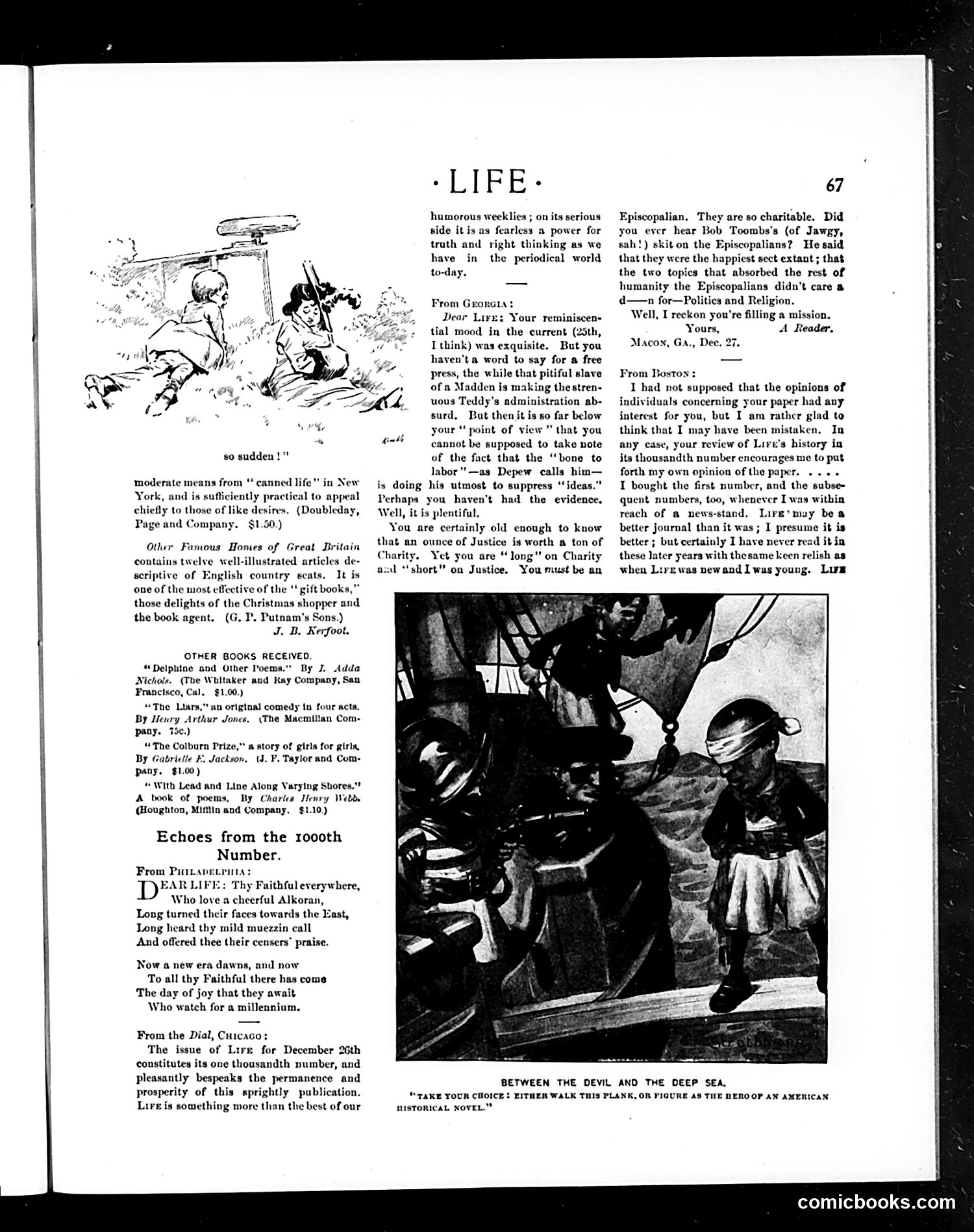
The upper cartoon ("so sudden!") depicts two children playing with toys—appearing to satirize childhood innocence or naïveté. However, the specific reference is unclear without additional context. The lower image titled "Between the Devil and the Deep Sea" shows what appears to be a dramatic scene with multiple figures in distress or conflict. The caption reads: "Take your choice: Either walk this plank, or figure as the hero of an American historical novel." This caption satirizes the limited, unattractive choices facing someone—implying that American historical narratives romanticize suffering or dangerous situations. The "plank" and "hero" reference suggests commentary on how history glorifies hardship. The surrounding text discusses *Life* magazine's editorial mission regarding justice and charity, suggesting this page addresses contemporary social or political debates about American values and representation.
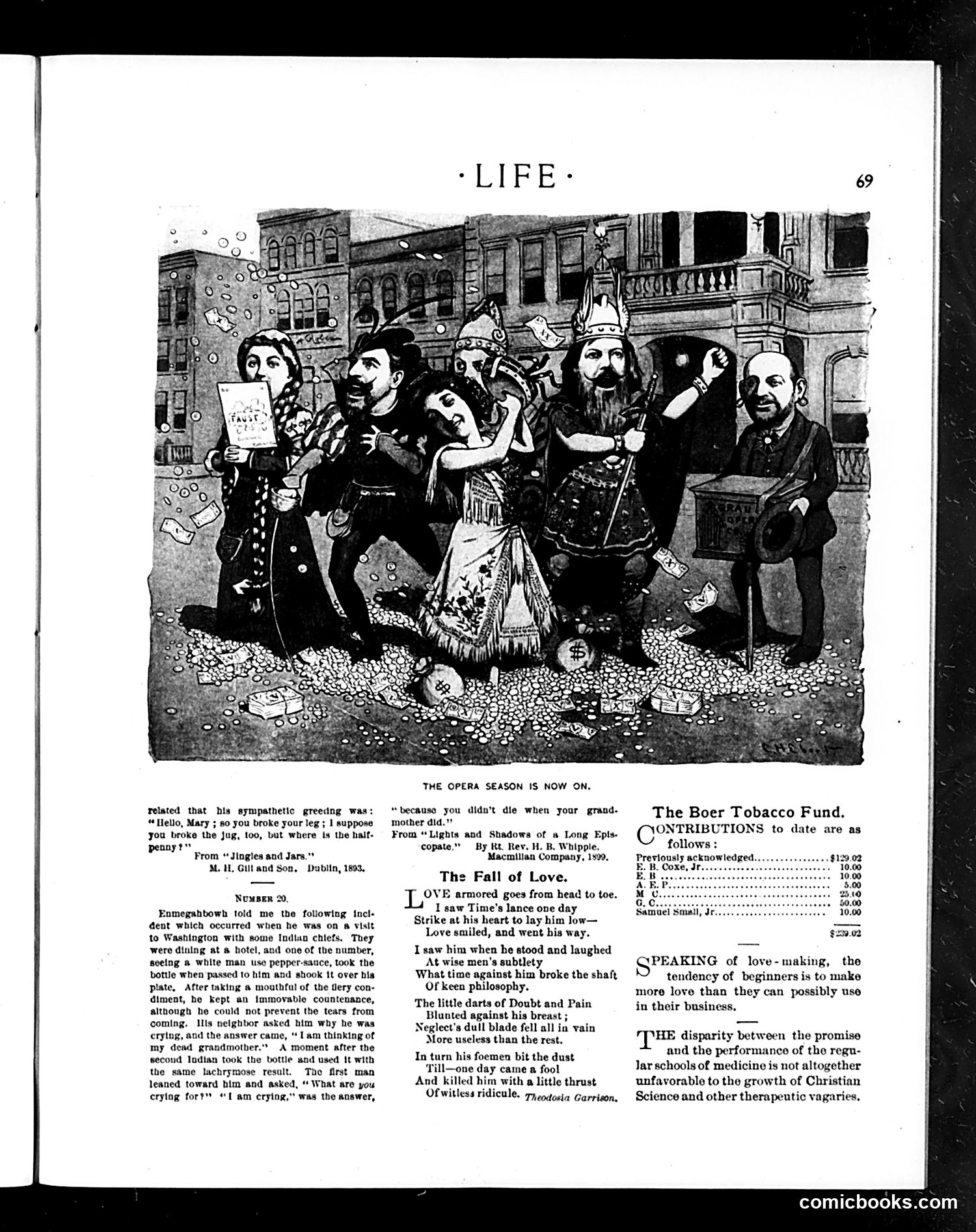
The main illustration depicts "The Opera Season is Now On," showing six caricatured figures in elaborate period costumes standing in a street scene amid scattered coins and money. The exaggerated facial features and theatrical dress suggest these are prominent opera performers or impresarios of the era, though specific identities aren't labeled in the visible text. The satire targets the opera world's extravagance and expense—the scattered money emphasizes how costly opera attendance was for patrons. The figures' pompous posturing mocks the pretentiousness associated with opera culture. Below are literary excerpts and advertisements, including "The Boer Tobacco Fund" contributions and an essay titled "The Fall of Love," alongside commentary on love-making and medicine. The page represents typical Life magazine content: satirical commentary mixed with literary and commercial material.
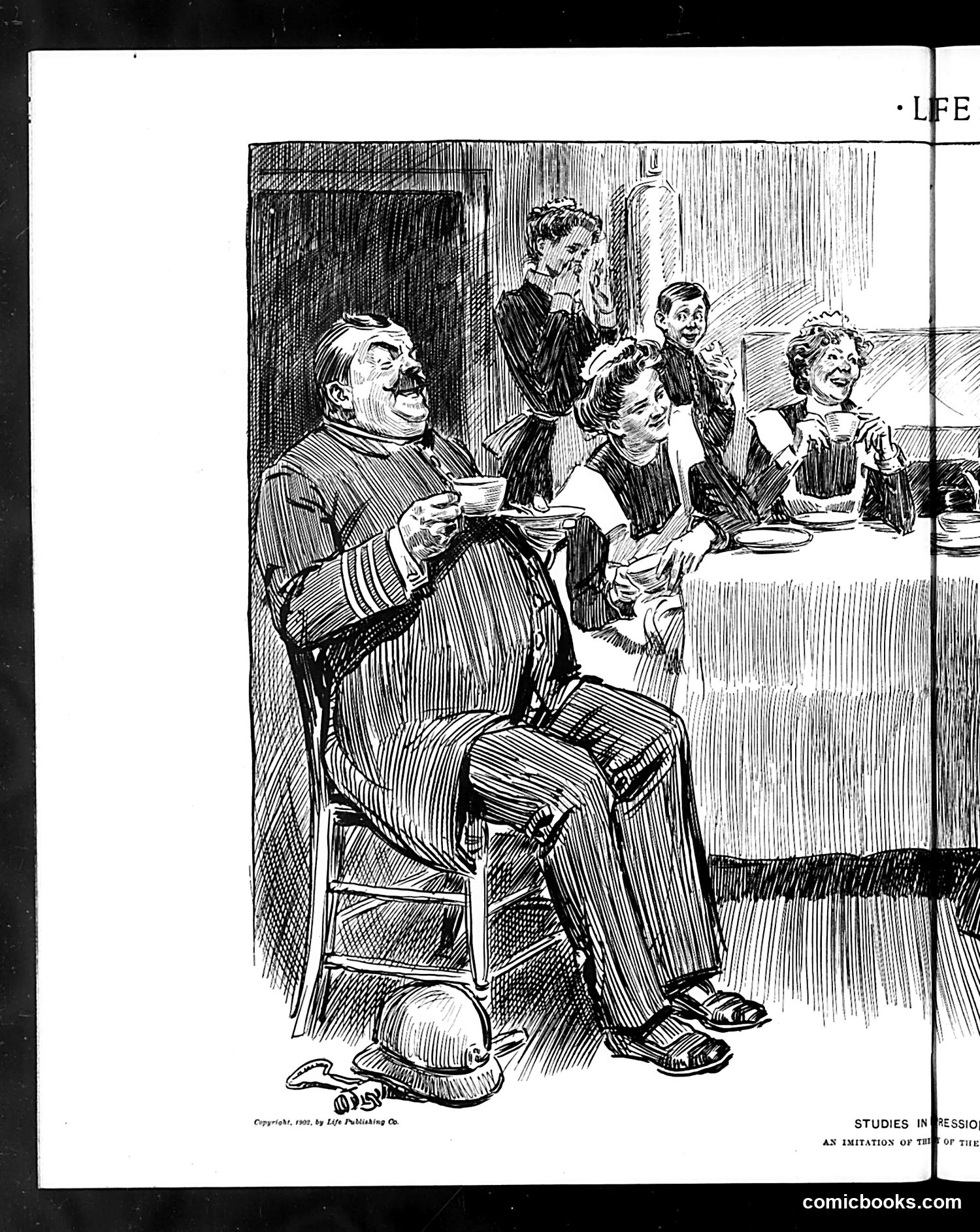
This Life magazine cartoon satirizes theatrical or social pretension through exaggerated facial expressions. The central figure—a rotund man seated prominently—displays an overwrought, theatrical grimace while holding a teacup, apparently during a formal meal or social gathering. The other figures around the table react with amusement or bewilderment to his dramatic display. The satire targets pompous behavior in polite society: the man's exaggerated "expression" seems designed to impress or entertain, but instead reveals affectation and poor taste. The title "Studies in Expression" suggests this is mocking acting techniques or social performance—how people artificially present themselves rather than behaving naturally. This reflects Life magazine's typical role mocking upper-class pretension and false gentility of early 20th-century American society.
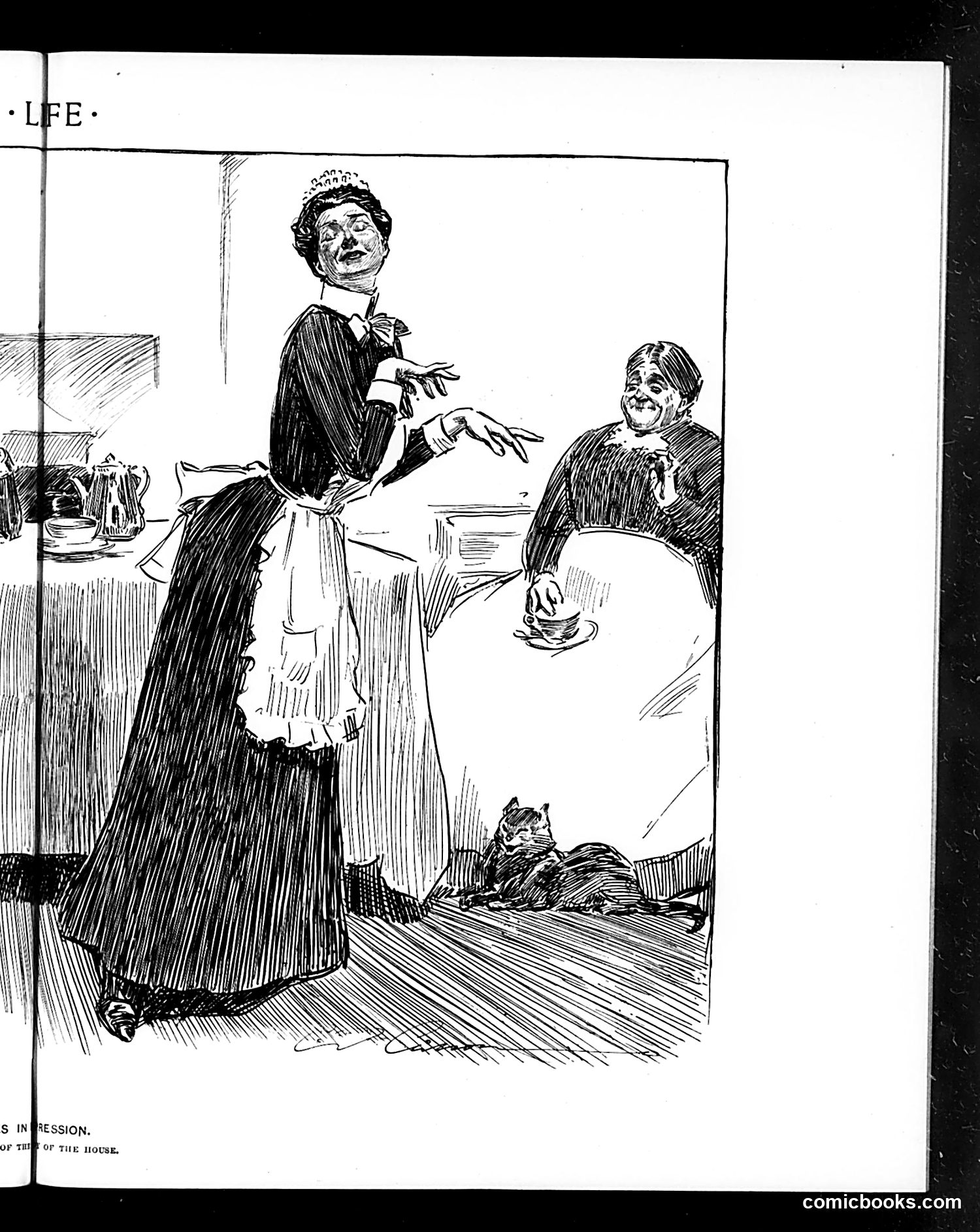
This appears to be a satirical cartoon from *Life* magazine depicting a domestic servant scene. The image shows a standing maid or housekeeper addressing a seated woman (likely her employer) in what seems to be a drawing room. A cat lounges on the floor. The partial text visible at bottom references "IN SESSION" and "OF THE HOUSE," suggesting political commentary, though the complete caption is cut off and unclear. The cartoon likely satirizes class dynamics, servant-employer relationships, or possibly comments on women's roles in domestic spaces—common *Life* magazine subjects from the early 20th century. However, without the full caption text, the specific political or social target of this satire cannot be definitively identified. The artist's signature is present but not clearly legible.
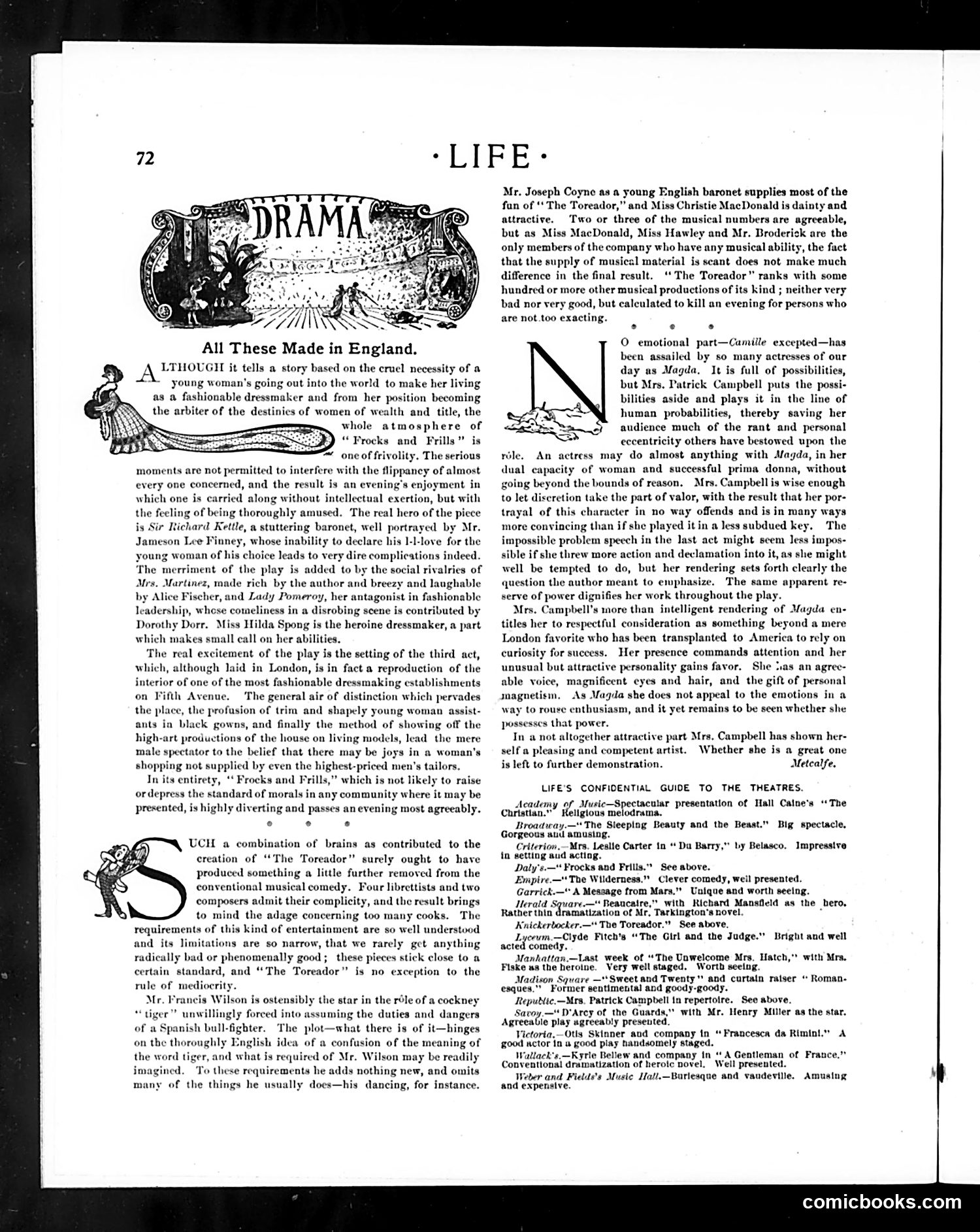
This page reviews theatrical productions, focusing on a play called "All These Made in England." The text discusses "The Toreador," praising young English baronet Joseph Coyne's performance and Miss Christie MacDonald's appeal. The main review concerns a play featuring Sir Richard Kyrie (performed by Mr. Jameson Lee Finney), whose inability to declare his love for a young woman drives the plot. The satire centers on the "Poodle and Frills" atmosphere and social rivalries involving characters named Mrs. Merton and Lady Pomeroy. The page includes theatrical reviews of various London productions and a "Life's Confidential Guide to the Theatres" listing current shows. The humor appears gentle, focused on romantic entanglements and fashionable society rather than sharp political satire.
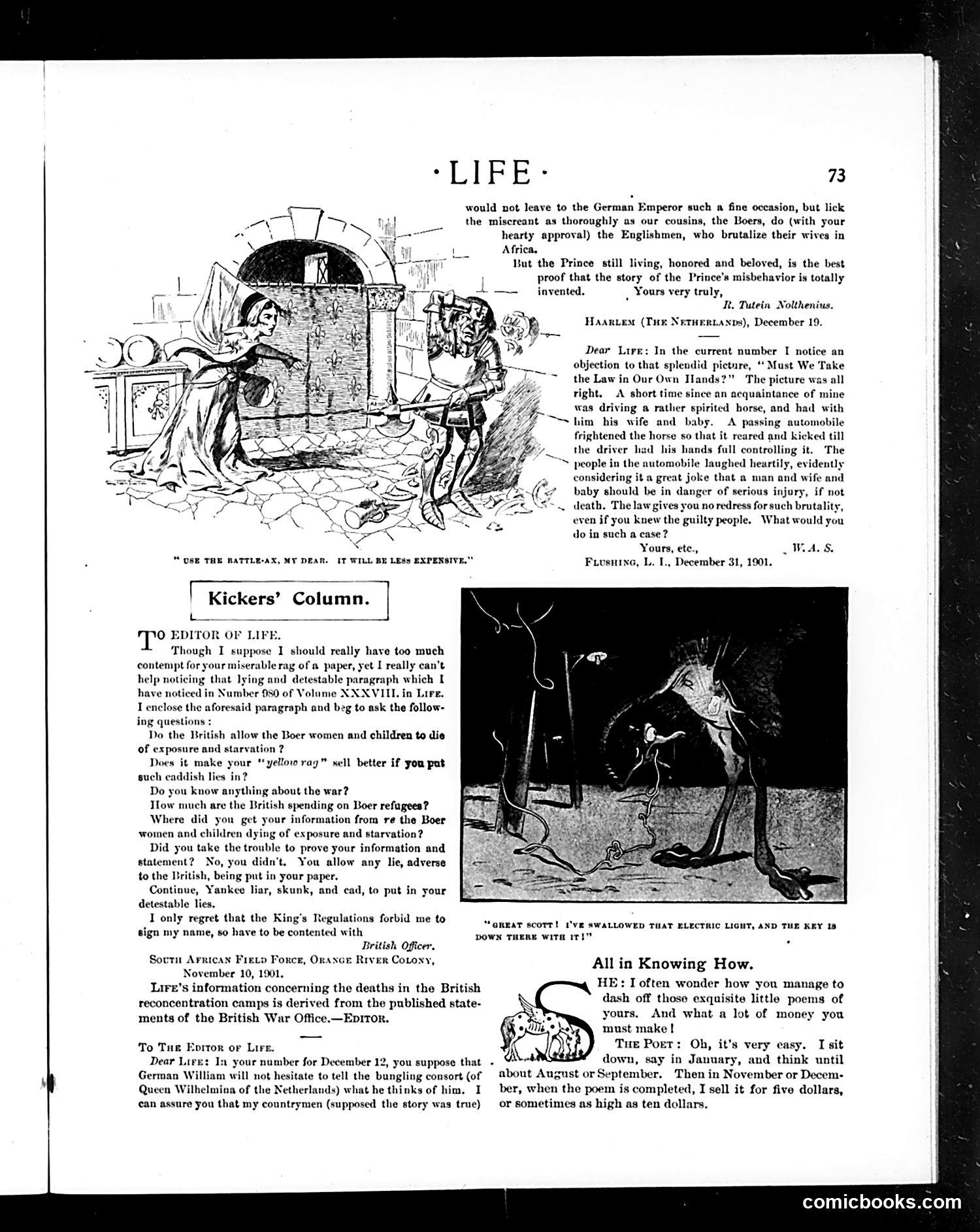
This page features satirical letters and cartoons reflecting the Boer War (1899-1902). The main cartoon, "Use the Battle-Ax, My Dear," depicts a woman wielding a battle-ax in a domestic scene, sardonically suggesting "economical" violence as an alternative to expensive warfare—likely mocking both militarism and domestic brutality. The letters section includes heated debate over Life's coverage of the war. A British officer angrily denies Life's claims about British mistreatment of Boer women and children in reconcentration camps, calling the magazine a "yellow rag" for printing "lies adverse to the British." Life's editor responds by citing official British War Office statements—a factual riposte suggesting the magazine's accuracy. Another letter criticizes dangerous automobiles frightening horses, demanding legal recourse for recklessness. The bottom cartoon humorously depicts a poet's creative process: months of thinking for minimal payment ($5-10)—satirizing the struggling literary profession's meager compensation for intellectual labor. The page overall showcases Life's satirical approach to contemporary controversies and social absurdities.
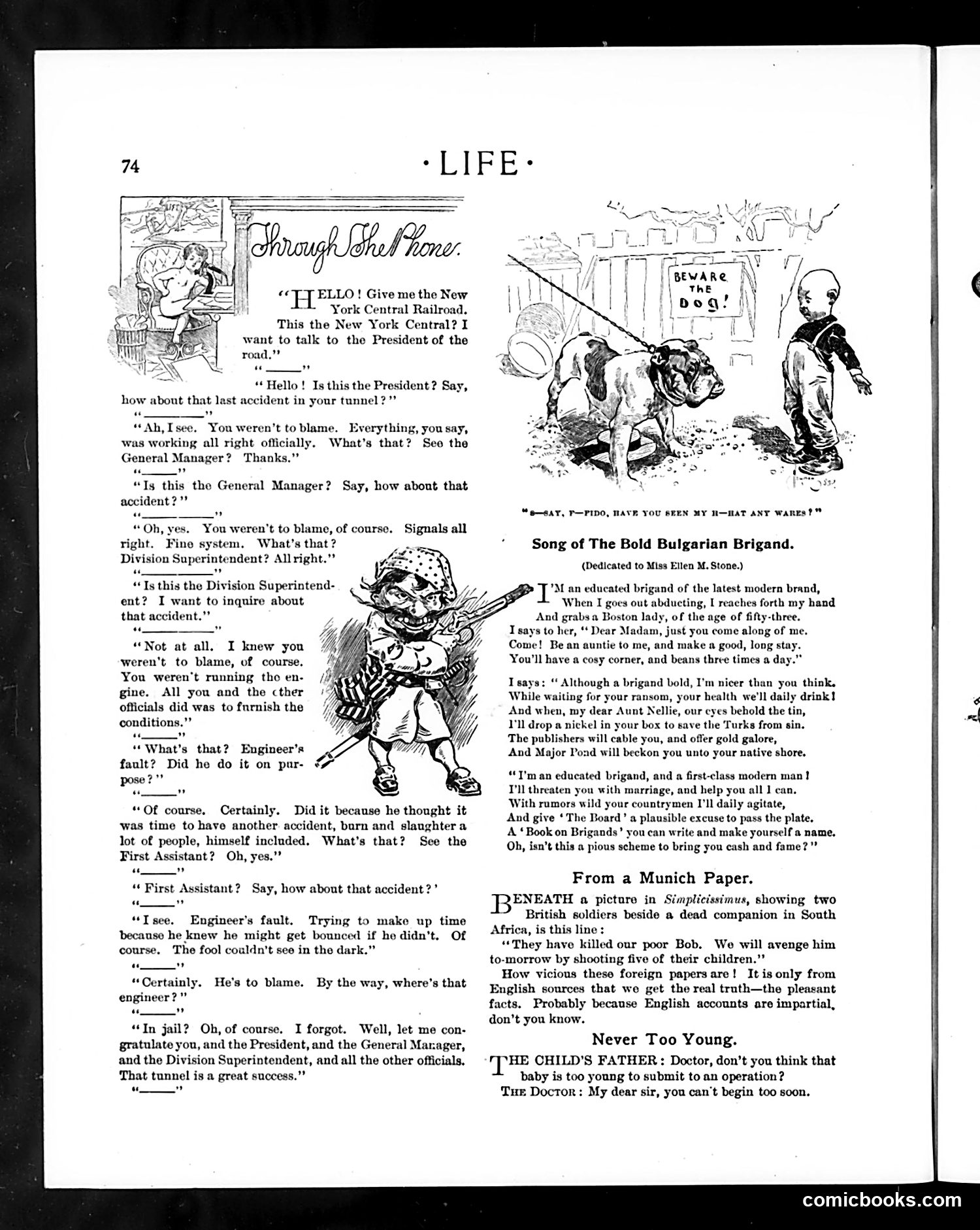
The left cartoon satirizes railroad safety negligence through an endless chain-passing of responsibility. A caller inquires about a tunnel accident to the New York Central Railroad President, who blames the General Manager, who blames the Division Superintendent, who blames the engineer. Each official claims innocence while acknowledging they collectively "furnished the conditions" for disaster. The joke: everyone's responsible yet nobody accepts blame—a critique of corporate accountability failures in early 20th-century railroads, which suffered frequent fatal accidents. The page also includes a satirical song about the Bulgarian brigand who kidnapped American missionary Ellen M. Stone (a real 1901 incident), mocking how her abduction became a sensational fundraising opportunity. A final section quotes a German newspaper's brutal Boer War commentary, sarcastically noting that only *foreign* press is unethical—implying English accounts were equally propagandistic.
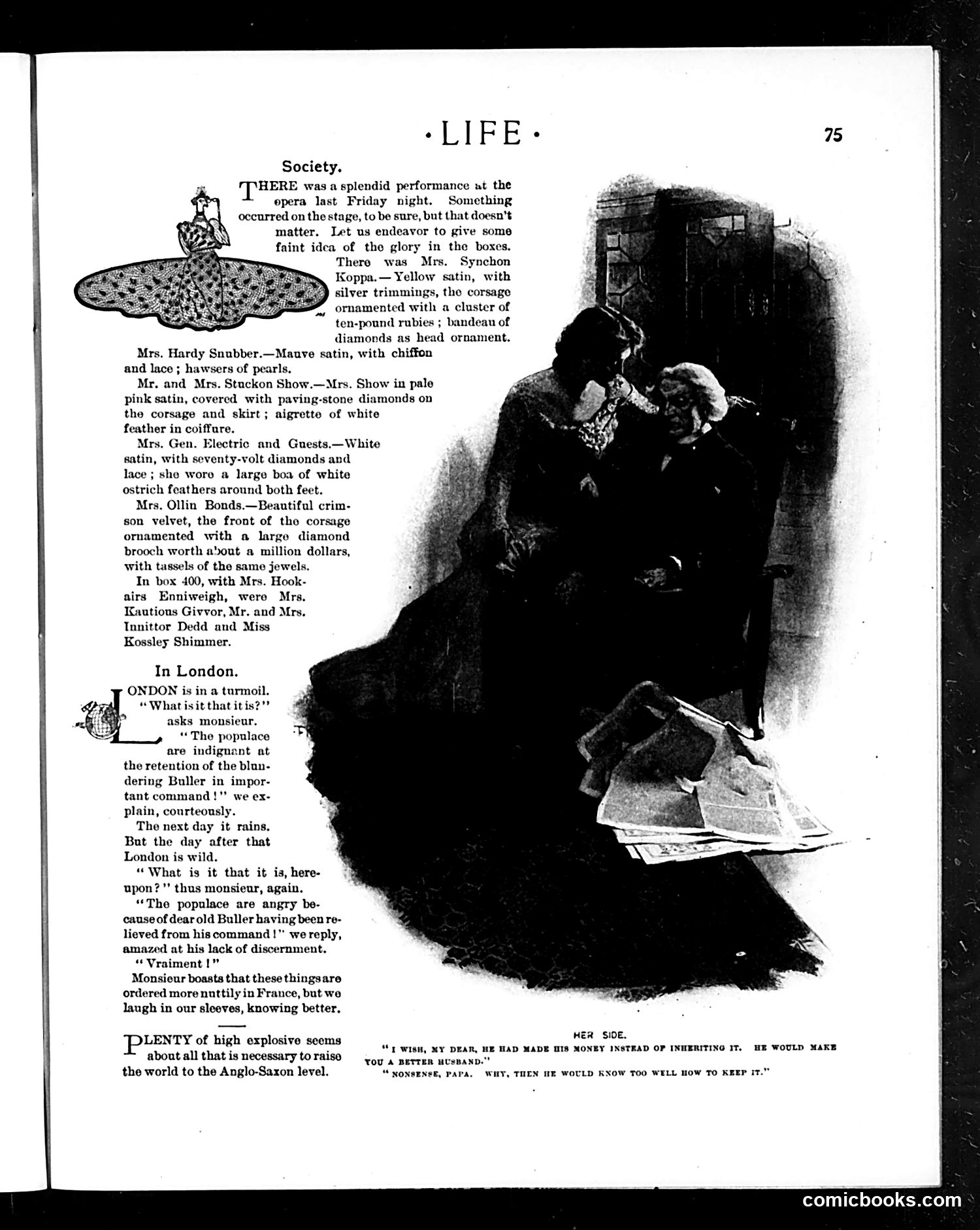
This page contains two distinct satirical pieces: ## "Society" Section A mockery of high-society opera-goers who wear absurdly expensive jewelry and clothing. The humor lies in deliberately absurd descriptions—women wearing "ten-pound rubies," "paving-stone diamonds," and "seventy-volt diamonds" (likely mocking the recent invention of electric light). The satirical names ("Mrs. Electric," "Mrs. Bonds," "Snubber") reveal characters defined solely by wealth and social pretension. The joke: nobody cares what actually happened on stage; only the ostentatious display in the boxes matters. ## "In London" Section Political satire about General Buller and the Boer War. The British public alternately demanded his removal and his retention, making contradictory demands regardless of circumstances. The French monsieur's confusion mirrors readers' bewilderment at this fickle public opinion. The satire: London's populace don't reason consistently—they simply rage. ## Bottom Cartoon A domestic scene where a wife tells her husband she *wants* him to manage their money poorly so she won't have to know how to manage it herself—satirizing women's financial dependence and willful ignorance in marriage.
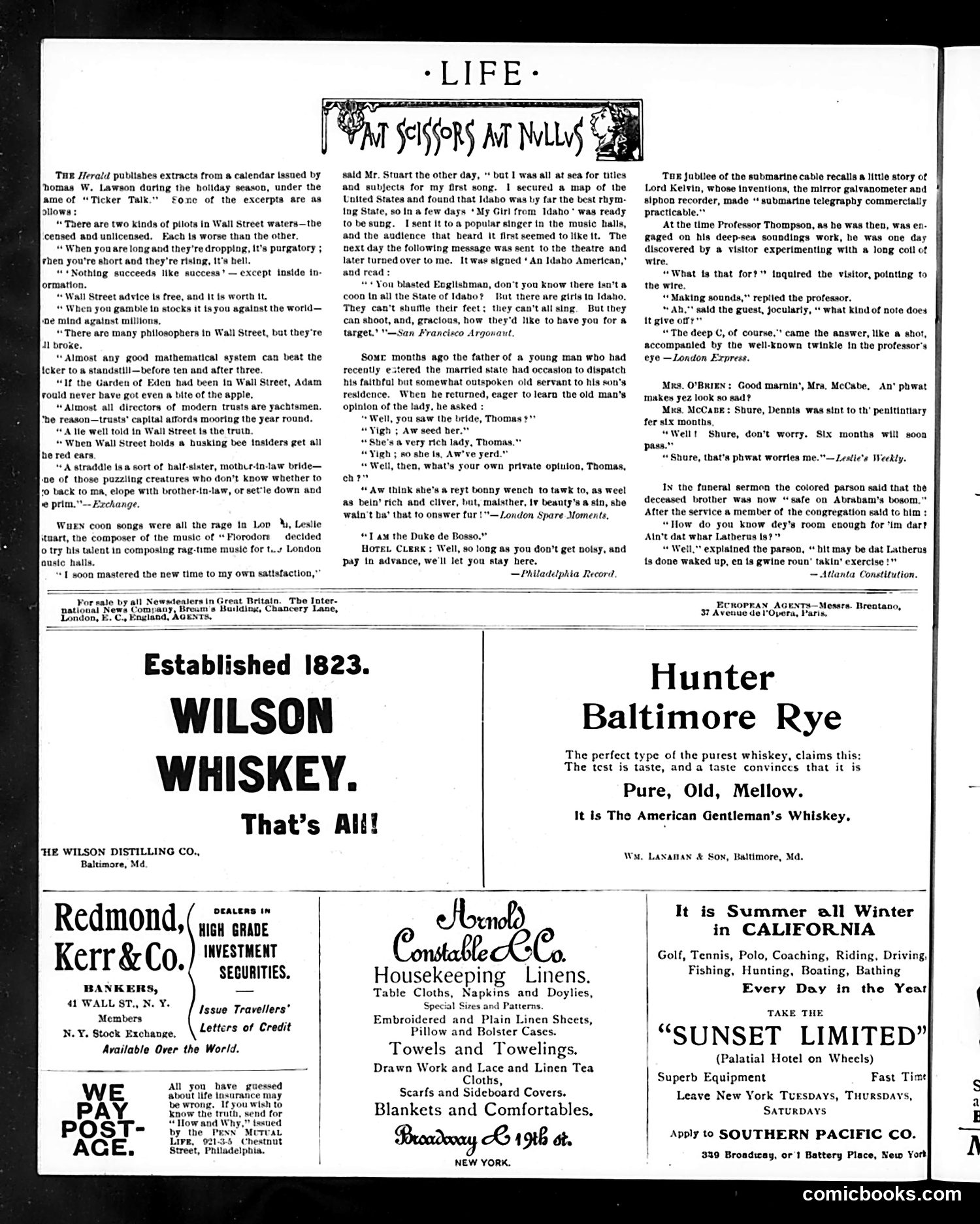
This is primarily an **advertising page** from Life magazine with miscellaneous humorous anecdotes in the margins. The main content consists of four short satirical pieces: 1. **"Ticker Talk"** — Cynical observations about Wall Street stock trading, mocking both bull and bear markets, insider trading, and the hypocrisy of financial advice. 2. **"My Girl from Idaho"** — A British composer's story about accidentally writing a racist "coon song" (a period music-hall genre), then receiving an angry letter from an Idaho resident complaining there are no Black people in Idaho—only women. The joke plays on offensive stereotypes of both the time. 3. **The Old Servant's Opinion** — A Yorkshire dialect joke where an elderly servant grudgingly approves of his employer's new daughter-in-law, noting her wealth and intelligence but implying she's insufficiently attractive ("beauty's a sin"). 4. **Lord Kelvin anecdote** — A brief story about the famous scientist experimenting with sound transmission through wire (an early telephone reference). The **advertisements** promote whiskey, linens, investment securities, and California tourism—typical of the era.
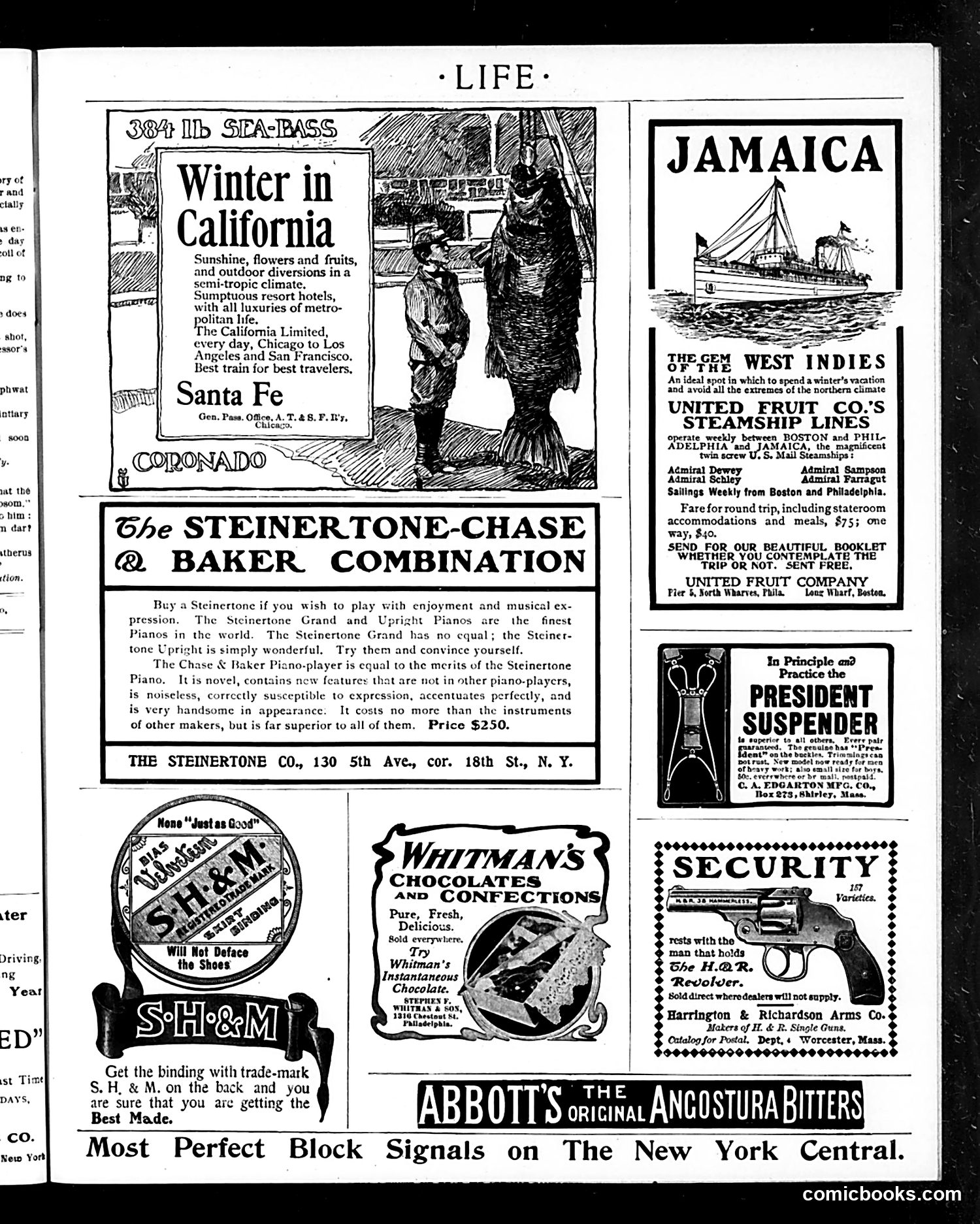
This is **primarily an advertising page** from Life magazine, not a political cartoon. It contains multiple commercial advertisements from the early 20th century: **Notable ads include:** - **Santa Fe Railway**: Promoting winter travel to California with semi-tropical climate and resort hotels - **Jamaica/United Fruit Company**: Advertising steamship cruises to the West Indies - **Steinertone pianos**: Touting superior quality pianos at $250 - **S.H. & M. shoe polish**: With a trade-mark guarantee - **Whitman's Chocolates**: Promoting confections - **President Suspender**: Clothing accessory - **Harrington & Richardson revolver**: The "Security" handgun - **Abbott's Angostura Bitters**: Medicinal/beverage product The page reflects Gilded Age consumer culture: luxury travel, entertainment products, and manufactured goods marketed to affluent readers. The revolver advertisement is notable—casually presented alongside chocolates and suspenders, reflecting different attitudes toward firearms advertising in that era. No satire or political commentary appears visible; this is straightforward commercial content.
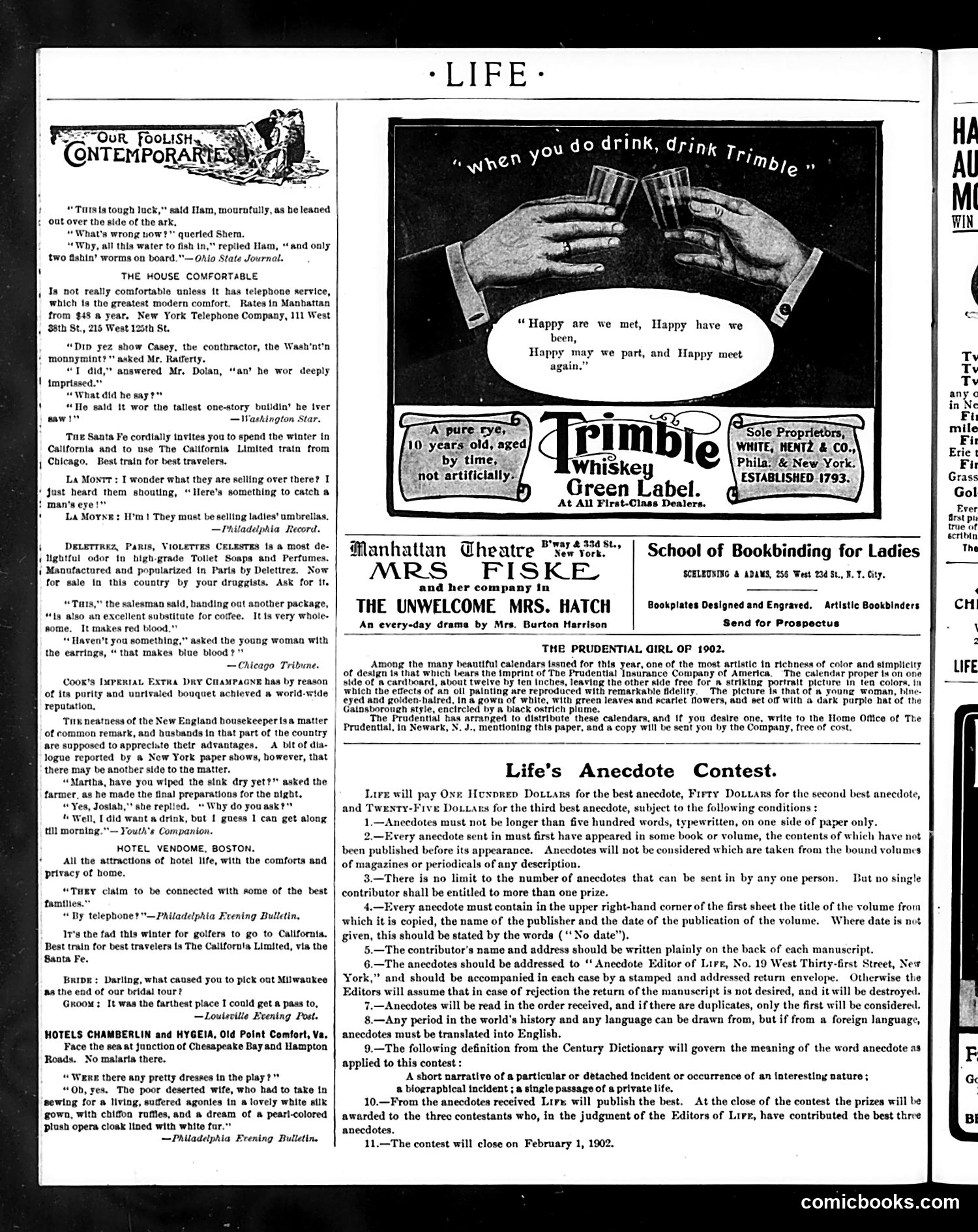
This is primarily a **miscellaneous humor and advertisements page** from Life magazine (circa 1902, based on the "Prudential Girl of 1902" content). ## Main Content: **"Our Foolish Contemporaries"** consists of brief jokes satirizing modern life and social customs: - A Noah's Ark joke about fishing - Jokes about telephone service as a "modern comfort" - Irish immigrant dialogue humor - Gender satire (the "blue blood" joke mocking upper-class pretension) The **central large advertisement** promotes Trimble Whiskey, using an image of two toasting hands with sentimental verse—standard advertising imagery of the era. Below are theatrical advertisements (Mrs. Fiske in "The Unwelcome Mrs. Hatch"), a **Life's Anecdote Contest** offering cash prizes ($100-$50-$25), and various hotel and service advertisements. ## Context for Modern Readers: There's **no significant political satire** here. The humor is gentle social observation about telephone technology, immigrant speech patterns, and gender roles. Most content is advertising, reflecting the magazine's business model. The "foolish contemporaries" mocks mild ironies of contemporary American life rather than targeting specific events or figures.
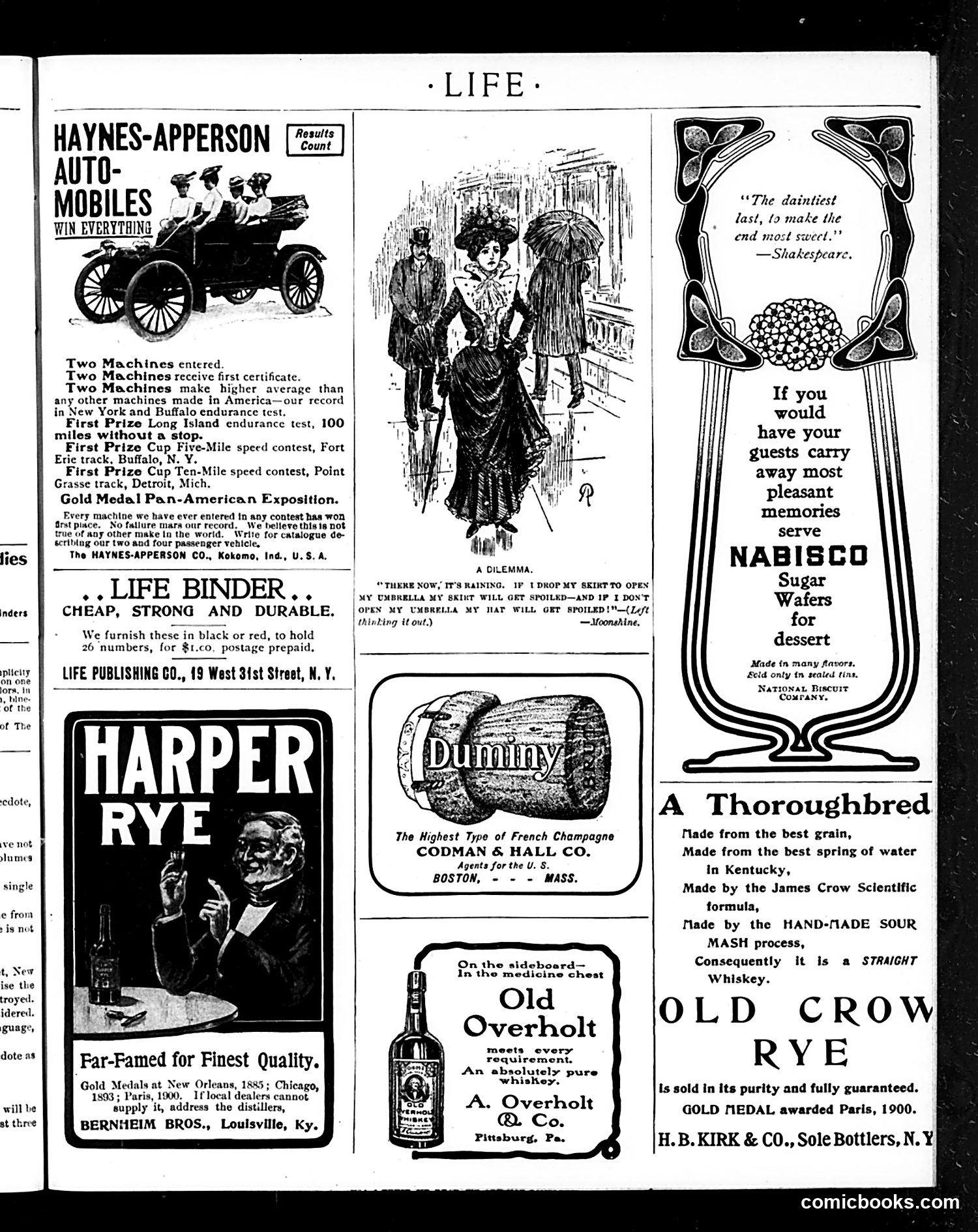
This page is primarily **advertising** with one cartoon. The cartoon titled "A Dilemma" depicts a woman in early 1900s dress caught in a practical predicament: if she opens her umbrella to shield herself from rain, her skirt will get wet; if she keeps the umbrella closed to protect her skirt, her hat will get spoiled. The humor satirizes the absurd constraints of women's fashion at the time—the rigid social expectation that skirts must stay dry while wearing impractical clothing in weather. The surrounding advertisements promote automobiles, whiskeys (Harper Rye, Old Overholt, Old Crow Rye), champagne, sugar wafers, and magazine binders—typical turn-of-the-century luxury goods. The Haynes-Apperson automobile ad emphasizes racing victories, a common marketing approach for early automobiles.
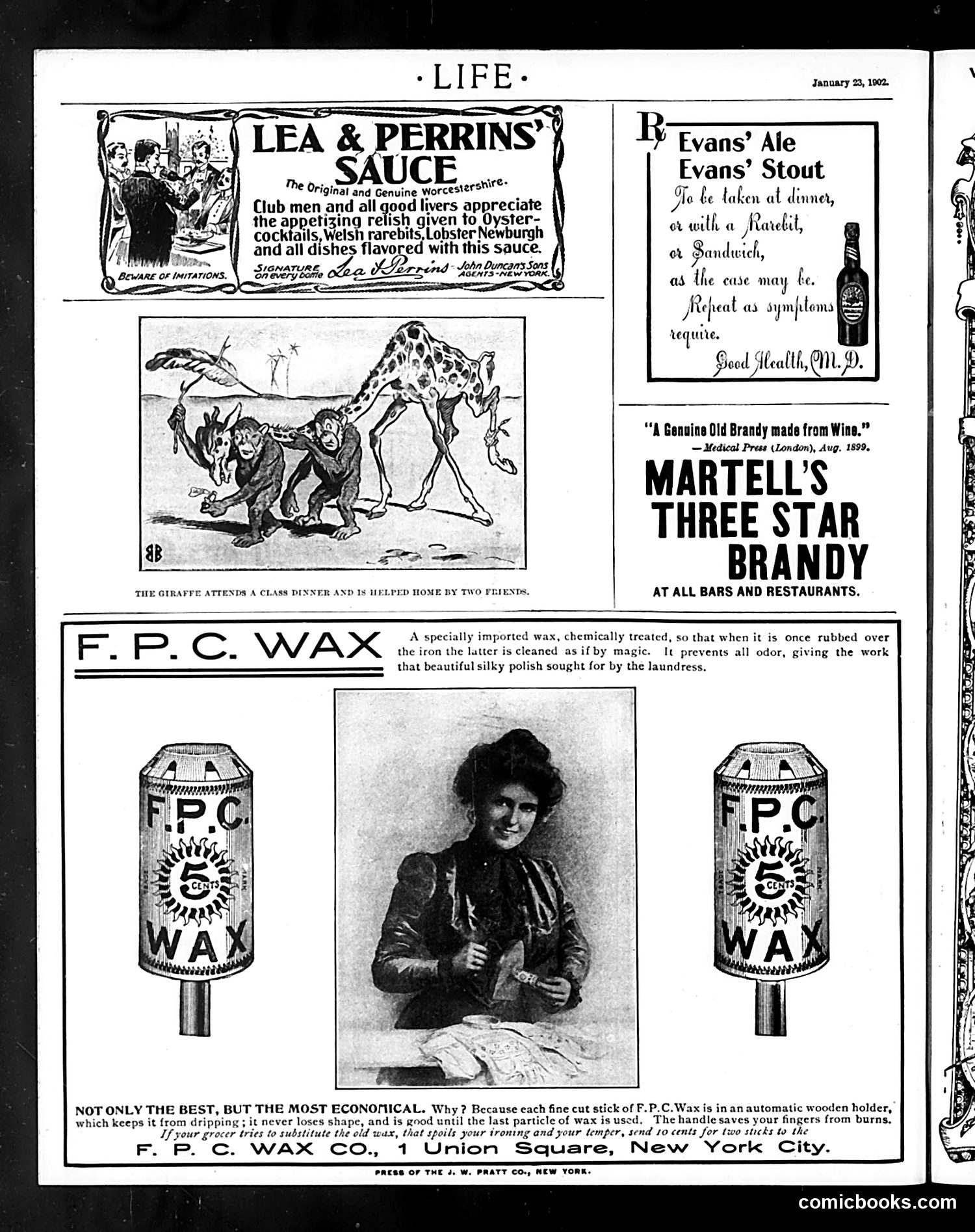
This page is primarily **advertising**, not political satire. It contains four distinct product advertisements typical of early 1900s magazines: 1. **Lea & Perkins' Sauce** - promotes a Worcestershire sauce for cocktails and dishes, with a decorative border illustration 2. **Evans' Ale and Stout** - beer advertisement citing a doctor's recommendation for health benefits 3. **Martell's Three Star Brandy** - spirits advertisement quoting medical endorsement 4. **F.P.C. Wax** - the largest ad, featuring a photograph of a woman demonstrating an ironing wax product, with technical specifications about its automatic wooden holder and convenience The **only cartoon element** is a small illustration captioned "The Giraffe Attends a Class Dinner and Is Helped Home by Two Friends"—a humorous sketch showing a tall, thin figure (the "giraffe") being supported by companions after apparent overindulgence, likely a mild joke about dinner-club excess. The page reflects early 20th-century advertising conventions, including dubious health claims for alcohol and practical household product marketing.