
Life, 1902-01-23 · page 4 of 20
Life — January 23, 1902 — page 4: what you’re looking at
What you’re looking at
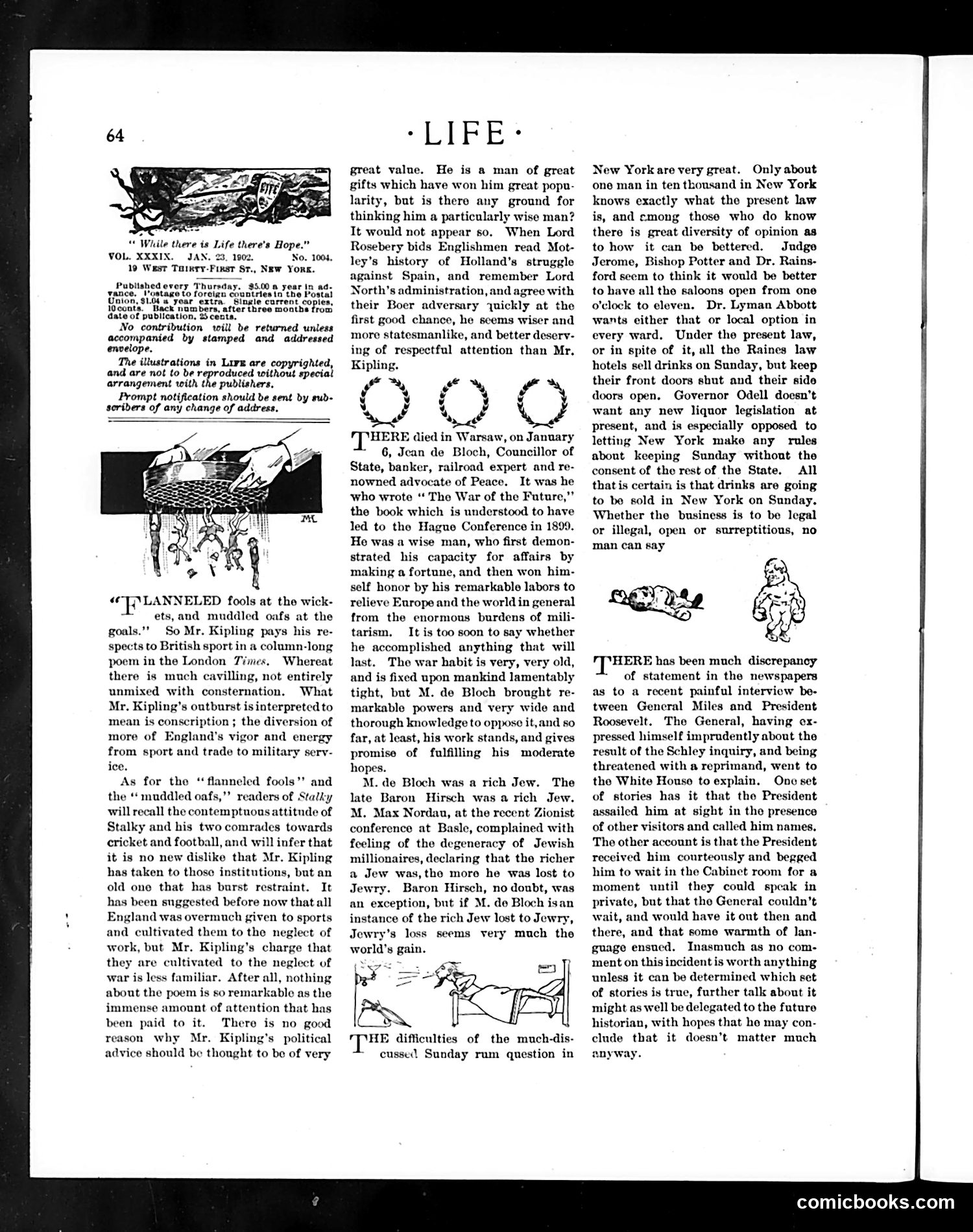
This page contains three editorial cartoons satirizing contemporary figures and issues: 1. **"While there is Life there's Hope"** (top): A small illustration mocking what appears to be political or military leadership, though the specific reference is unclear from the visible portion. 2. **"Flanneled fools at the wickets"** (middle): Critiques Mr. Kipling's column in the *London Times*, sarcastically suggesting his "outburst is interpreted to mean is conservatism." The cartoon ridicules Kipling's political commentary, suggesting he lacks real authority on military or sporting matters despite his fame. 3. **Bottom cartoon**: Depicts someone in bed, likely continuing commentary on a public figure, though the specific individual remains unclear. The page overall attacks prominent public figures' unsolicited political opinions—particularly Kipling's—suggesting they overstate their expertise beyond their actual domain.
📄 Transcribed text from this page (OCR, searchable)
Machine-transcribed from the original scan — historical spelling and the odd misread are preserved.
“While there is Life there's Hope.” VOL. XXXIX. JAN, 23, 1902. No. 1004, 19 Wast Tainry-Fixst St., New York. Published every Thursday. $5.00 0 year in ad. vance. ostage to foreign countries ta the Postal Union, Sota year extra. AWconts. “Back nambe: dato of publication, 3 No contribution will be returned unless accompanied by stamped and addressed envelope. The illustrations in Lire are copyrighted, and are not to be reproduced without special arrangement with the publishers, Prompt notification should be sent by sud- soribers of any change of address. le current copies, three months from «(PLANNELED fools at the wick- ets, and muddled oafs at the goals."". So Mr. Kipling pays his re- spects to British sport in a column-long poem in the London Times. Whereat there is much cavilling, not entirely unmixed with consternation. What Mr. Kipling’s outburst is interpreted to mean is conscription ; the diversion of more of England's vigor and energy from sport and trade to military serv- ice. As for the ‘ flanneled fools’? and the “ muddled oafs,”” readers of Stalky will recall the contemptuous attitnde of Stalky and his two comrades towards cricket and football, and will infer that it is no new dislike that Mr. Kipling has taken to those institutions, but an old one that has burst restraint. It has been suggested before now that all England was overmuch given to sports and cultivated them to the neglect of work, but Mr. Kipling’s charge that they are cultivated to the neglect of war is less familiar. After all, nothing about the poem is so remarkable as the immense amount of attention that has been paid to it. There is no good reason why Mr. Kipling’s political advice should be thought to be of very -LIPE.* great value. He is a man of great gifts which have won him great popu- larity, but is there any ground for thinking him a particularly wise man? It would not appear so. When Lord Rosebery bids Englishmen read Mot- ley’s history of Holland's struggle against Spain, and remember Lord North’s administration, and agree with their Boer adversary quickly at the first good chance, he scems wiser and more statesmanlike, and better deserv- ing of respectful attention than Mr. Kipling. “s™ “4% & Ls i Sd HERE died in Warsaw, on January ~ 6, Jean de Bloch, Councillor of State, banker, railroad expert and re- nowned advocate of Peace. It was he who wrote ‘‘ The War of the Future,” the book which is understood to have led to the Hague Conference in 1899. He was a wise man, who first demon- strated his capacity for affairs by making a fortune, and then won him- self honor by his remarkable labors to relieve Europe and the world in general from the enormous burdens of mili- tarism, It is too soon to say whether he accomplished anything that will last. The war habit is very, very old, and is fixed upon mankind lamentably tight, but M. de Bloch brought re- markable powers and very wide and thorough knowledge to oppose it,and so far, at least, his work stands, and gives promise of fulfilling his moderate hopes. M. de Bloch was a rich Jew. The late Baron Hirsch was a rich Jew. M. Max Nordau, at the recent Zionist conference at Basle, complained with feeling of the degeneracy of Jewish millionaires, declaring that the richer a Jew was,the moro he was lost to Jewry. Baron Hirsch, no doubt, was an exception, but if M. de Bloch isan instance of the rich Jew lost to Jewry, Jewry’s loss seems very much the world’s gain. "THE difficulties of the much-dis- cusse) Sunday rum question in New York are very great. Only about one man in ten thousand in New York knows exactly what the present law is, and cemong those who do know there is great diversity of opinion as to how it can be bettered. Judge Jerome, Bishop Potter and Dr. Rains- ford seem to think it would be better to have all the saloons open from one o'clock to eleven. Dr. Lyman Abbott wants either that or local option in every ward, Under the present law, or in spite of it, all the Raines law hotels sell drinks on Sunday, but keep their front doors shut and their sido doors open. Governor Odell doesn’t want any new liquor legislation at present, and is especially opposed to letting New York make any rules about keeping Sunday without the consent of the rest of the State. All that is certain is that drinks are going to be sold in New York on Sunday. Whether the business is to be legal or illegal, open or surreptitious, no man can say [HERE has been much discrepancy of statement in the newspapers as to a recent painful interviow be- tween Gencral Miles and President Roosevelt. The General, having cx- pressed himself imprudently about the result of the Schley inquiry, and being threatened with a reprimand, went to the White Houso to explain. Ono set of stories has it that tho President assailed him at sight in the presence of other visitors and called him names, The other account is that the President received him courteously and begged him to wait in the Cabinet room for a moment until they could speak in private, but that the General couldn't wait, and would have it out then and there, and that some warmth of lan- guage ensued. Inasmuch as no com- ment on this incident is worth anything unless it can be determined which set of stories is true, further talk about it might aswell be delegated to the future historian, with hopes that he may con- clude that it doesn’t matter much anyway. comicbooks.com