
Life, 1902-01-23 · page 12 of 20
Life — January 23, 1902 — page 12: what you’re looking at
What you’re looking at
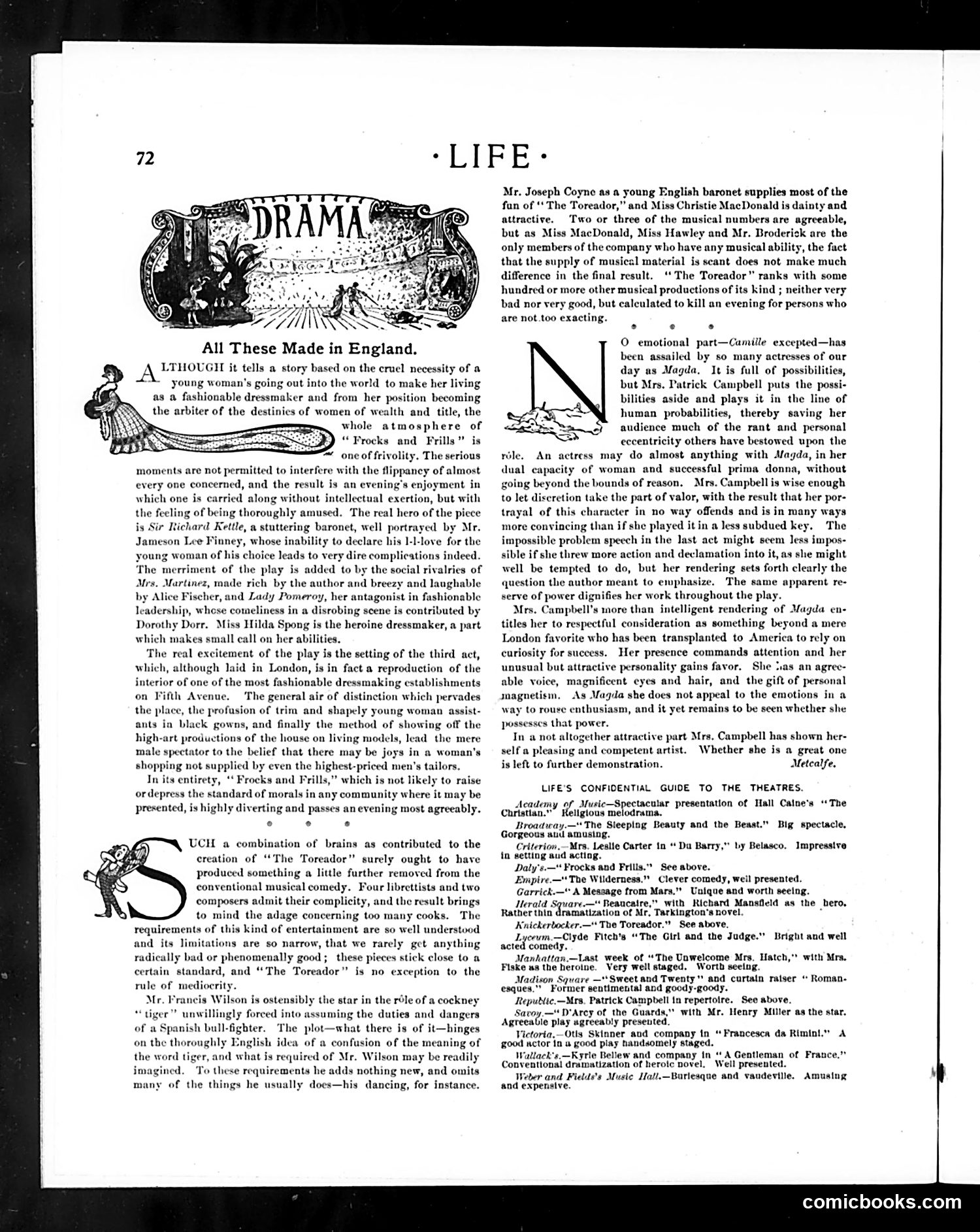
This page reviews theatrical productions, focusing on a play called "All These Made in England." The text discusses "The Toreador," praising young English baronet Joseph Coyne's performance and Miss Christie MacDonald's appeal. The main review concerns a play featuring Sir Richard Kyrie (performed by Mr. Jameson Lee Finney), whose inability to declare his love for a young woman drives the plot. The satire centers on the "Poodle and Frills" atmosphere and social rivalries involving characters named Mrs. Merton and Lady Pomeroy. The page includes theatrical reviews of various London productions and a "Life's Confidential Guide to the Theatres" listing current shows. The humor appears gentle, focused on romantic entanglements and fashionable society rather than sharp political satire.
📄 Transcribed text from this page (OCR, searchable)
Machine-transcribed from the original scan — historical spelling and the odd misread are preserved.
LIFE All These Made in England. A¥ -THOUGIL it tells a story based on the cruel necessity of a young woman's going out into the world to make her living as a fashionable dressmaker and from her position becoming the arbiter of the destinics of women of wealth and title, the whole atmosphere of SD “Frocks and Frills” is ™ one of frivolity. The serious moments are not permitted to interfere with the flippancy of almost every one concerned, and the result is an evening's enjoyment in which one is carried along without intellectual exertion, but with the feeling of being thoroughly amused. The real hero of the piece is Sir Richard Kettle, a stuttering baronet, well portrayed by Mr. Jameson Lee Finn whose inability to declare his 1-l-love for the young woman of his choice leads to very dire complications indeed. he merriment of the play is added to by the social rivalries of Mrs, Martinez, made rich by the author and breezy and laughable by Alice cher, and Lady Pomeroy, her antagonist in fashionable adership, whose comeliness in a disrobing scene is contributed by Dorothy Dorr. Miss Hilda Spong is the heroine dressmaker, a part which makes small call on her abilities. The real excitement of the play is the setting of the third act, , although laid in London, is in fact a reproduction of the inter of one of the most fashionable dressmaking establishments on hh Avenue, The general air of distinction which pervades the place, the profusion of trim and shapely young woman ants ia black gowns, and finally the method of showing off the high-art productions of the house on living models, lead the mere male spectator to the belief that there may be joys in a woman's shopping not supplied by even the highest-priced men's tailors. In its entirety, ‘* Frocks and Frills,” which is not likely to raise or depress the standard of morals in any community where it may be presented, is highly diverting and passes an evening most agreeably. e ° ° whie assist- UCH a combination of brains as contributed to the creation of “The Toreador” surely ought to have produced something a little further removed from the conventional musical comedy. Four librettists and two composers admit their complicity, and the result brings to mind the adage concerning too many cooks. The requirements of this kind of entertainment are so well understood and its limitations are so narrow, that we rarely get anything radically bad or phenomenally good; these pieces stick close to a certain standard, and “The Toreador” is no exception to the rule of mediocrity. Mr. Francis Wilson is ostensibly the star in the role of a cockney * unwillingly forced into assuming the duties and dangers anish bull-fighter. The plot—what there is of it—hinges on the thoroughly English idea of a confusion of the meaning of the word tiger, and what is required of Mr, Wilson may be readily imagined. these requirements he adds nothing new, and omits many of the things he usually does—his dancing, for instance. Mr. Joseph Coyne as a young English baronet supplies most of the fan of ‘The Toreador,” and Miss Christie MacDonald is dainty and attractive. Two or three of the musical numbers are agreeable, but as Miss MacDonald, Miss Hawley and Mr. Broderick are the only members of the company who have any musical ability, the fact that the supply of musical material is scant does not make much difference in the final result. ‘The Toreador” ranks with some hundred or more other musical productions of its kind ; neither very bad nor very good, but calculated to kill an evening for persons who are not.too exacting. 7 e« O emotional part—Camiile excepted—has been assailed by so many actresses of our day as Magda. It is full of possibilities, but Mrs. Patrick Campbell puts the possi: bilities aside and plays it in the line of human probabilities, thereby saving her audience much of the rant and personal eccentricity others have bestowed upon the role. An actress may do almost anything with Magda, in her dual capacity of woman and successful prima donna, without going beyond the bounds of reason. Mrs. Campbell is wise enough to let discretion take the part of valor, with the result that her por- trayal of this character in no way offends and is in many ways more convincing than if she played it in a less subdued key. ‘The impossible problem speech in the last act might scem less impos- sible if she threw more action and declamation into it, as she might well be tempted to do, but her rendering sets forth clearly the question the author meant to emphasize. The same apparent re- serve of power dignifies her work throughout the play. Mrs. Campbell's tore than intelligent rendering of Magda en- titles her to respectful consideration as something beyond a mere London favorite who has been transplanted to America to rely on curiosity for success. Her presence commands attention and her unusual but attractive personality gains favor. She tas an agrec- able voice, magnificent eyes and hair, and the gift of personal snagnetism, As Magda she does not appeal to the emotions in a way to rouse enthusiasm, and it yet remains to be seen whether she possesses that power. In a not altogether attractive part Mrs. Campbell has shown her- self a pleasing and competent artist. Whether she is a great one is left to further demonstration. Metcalfe, LIFE'S CONFIDENTIAL GUIDE TO THE THEATRES. Afuric Spectacular presentation of Hall Caine's “The Reugtous melodrama. Broadway.—* The Sleeping Beauty and the Beast." Big spectacle, Gorgeous aud amusing. Criterion.—Mrs. Leslte Carter in “ Da Barry, tn wetting aud acting. Daly's. Frocks and Frills.” See above. Empire.—" The Wilderness.” Clever comedy, weil presented. Garrick.—" A Message from Mars."" Unique and worth seeing. Herald Square.—" Reancaire,” with Richard Mansfeld as the bero. Rather thin dramatization of Mr, Tarkington's novel. Knickerbocker." The Toreador.” See above. Lyceum.—Ciyde Fitch's “The Girl and the Judge." acted comedy. Manhattan.—Last week of “The Unwelcome Mrs, Hatch,” with Mra, Fiske us the heroine. Very well staged, Worth seeing. Madison Square —" Sweet and Twenty and curtain ratser “ Roman- esques."” Former sentimental and goody-goody. Reputtic.—Mrs, Patrick Campbell n repertoire. See above, Savoy.—" D'Arcy of the Guards," with Mr. Henry Miller as the star. Agreeabie play ugreeably preseuted. Vietoria,—Otis Skinner aud company tn good uctor in u good piay handsomely staged. Watlack's.—Kyrie Bellew and company in ‘A Gentleman of France.” Conventional dramatization of heroic novel, Weil presented. Weber and Fields's Music Hall.—Barlesque and vaudeville. ‘and expensive Ly Belasco, Impressive Bright and well Francesca da Rimini." A Amusing comicbooks.com