
A complete issue · 20 pages · 1902
Life — January 2, 1902
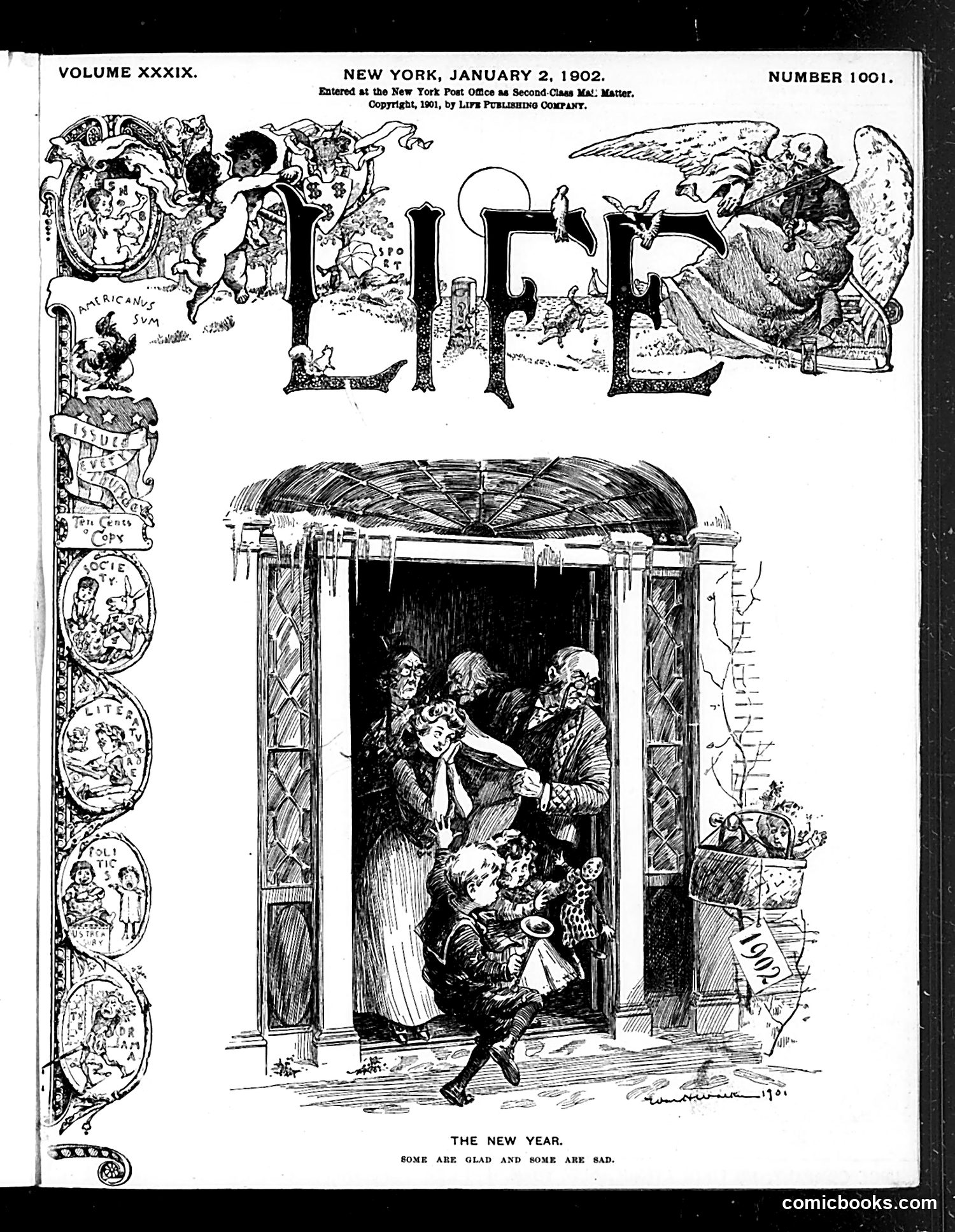
This New Year's issue uses the caption "Some are glad and some are sad" to comment on the new century's arrival. The main illustration shows a doorway where wealthy figures peer out at a poor child in the street below, suggesting class divisions persisting into 1902. The decorative left border contains circular medallions depicting various scenes—likely referencing events from 1901 or cultural touchstones of the past year. The ornate header illustration shows mythological and allegorical figures, typical of Life's artistic style, celebrating the calendar transition. This is fundamentally social commentary on economic inequality, contrasting the comfort of the privileged with the poverty visible just outside their threshold—a pointed satire on American society as the new century begins.
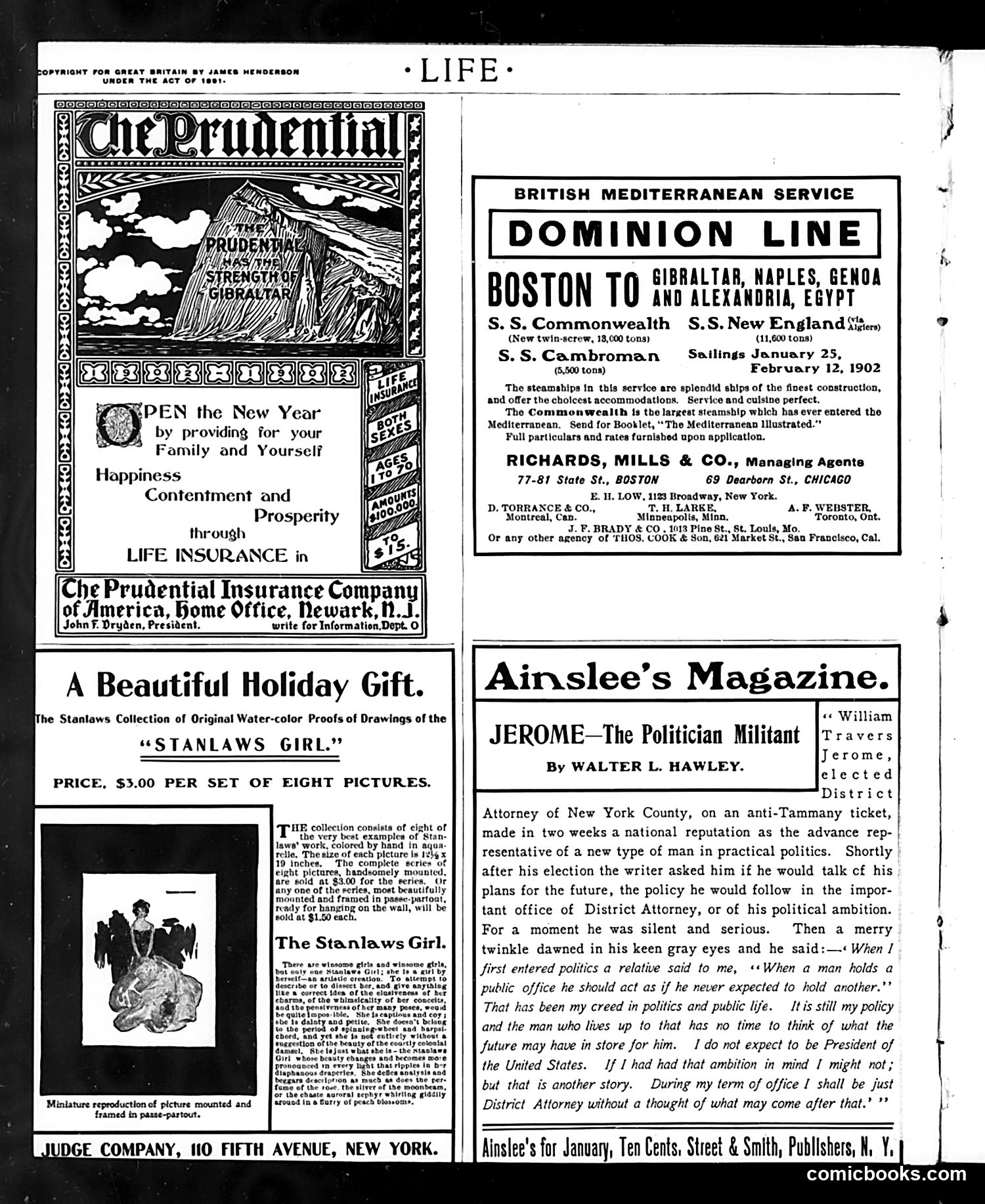
This page is primarily **advertising**, not satirical content. It contains: 1. **The Prudential Insurance Company** ad (left): A New Year's greeting promoting life insurance as providing "Happiness, Contentment and Prosperity." 2. **Dominion Line shipping advertisement** (top right): Promotes steamship service from Boston to Gibraltar, Naples, Genoa, and Alexandria, sailing February 12, 1902. 3. **Ainslee's Magazine feature** (bottom right): An article titled "JEROME—The Politician Militant" by Walter L. Hawley about William Travers Jerome, elected District Attorney of New York County on an anti-Tammany ticket. The piece quotes Jerome on his pragmatic approach to politics and public service. 4. **Stanlaws Girl collection** (bottom left): Promotes watercolor proofs as a holiday gift. The page reflects early 1900s consumer culture and political discussion rather than satirical commentary.
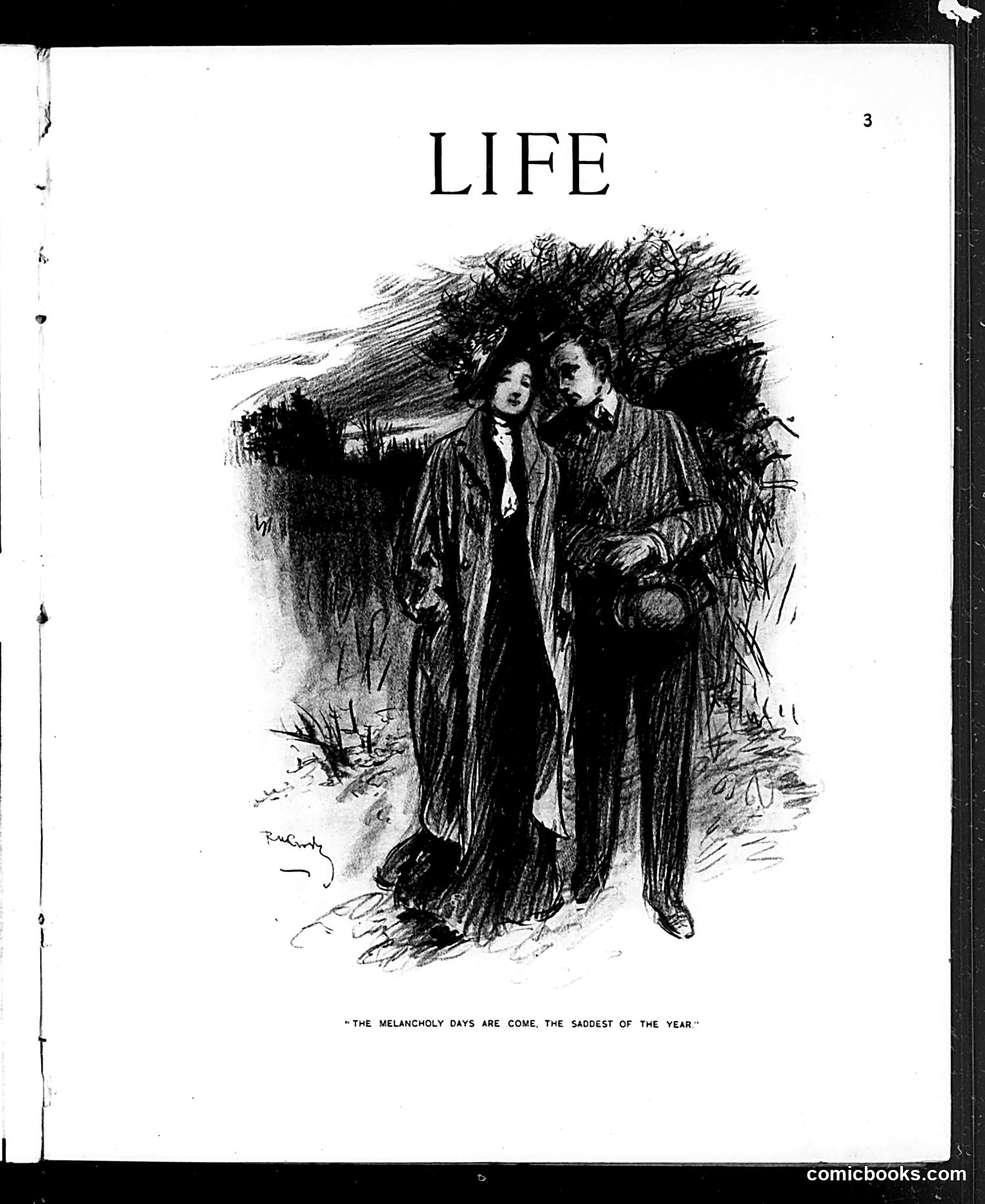
This *Life* magazine page features a sketch titled "LIFE" showing two figures in winter clothing standing in a melancholic outdoor setting. The caption reads: "THE MELANCHOLY DAYS ARE COME. THE SADDEST OF THE YEAR." The illustration appears to be a romantic or sentimental piece rather than political satire. It depicts what seems to be a couple during autumn or winter, referencing a poetic sentiment about seasonal melancholy. The artist's signature appears in the lower left. The quote likely references the autumn season's association with decline and sadness in literature and popular culture—a common romantic theme of the era. Without additional context from the magazine's date or surrounding content, the specific identities of the figures remain unclear, though they appear to represent universal characters experiencing seasonal emotional decline.
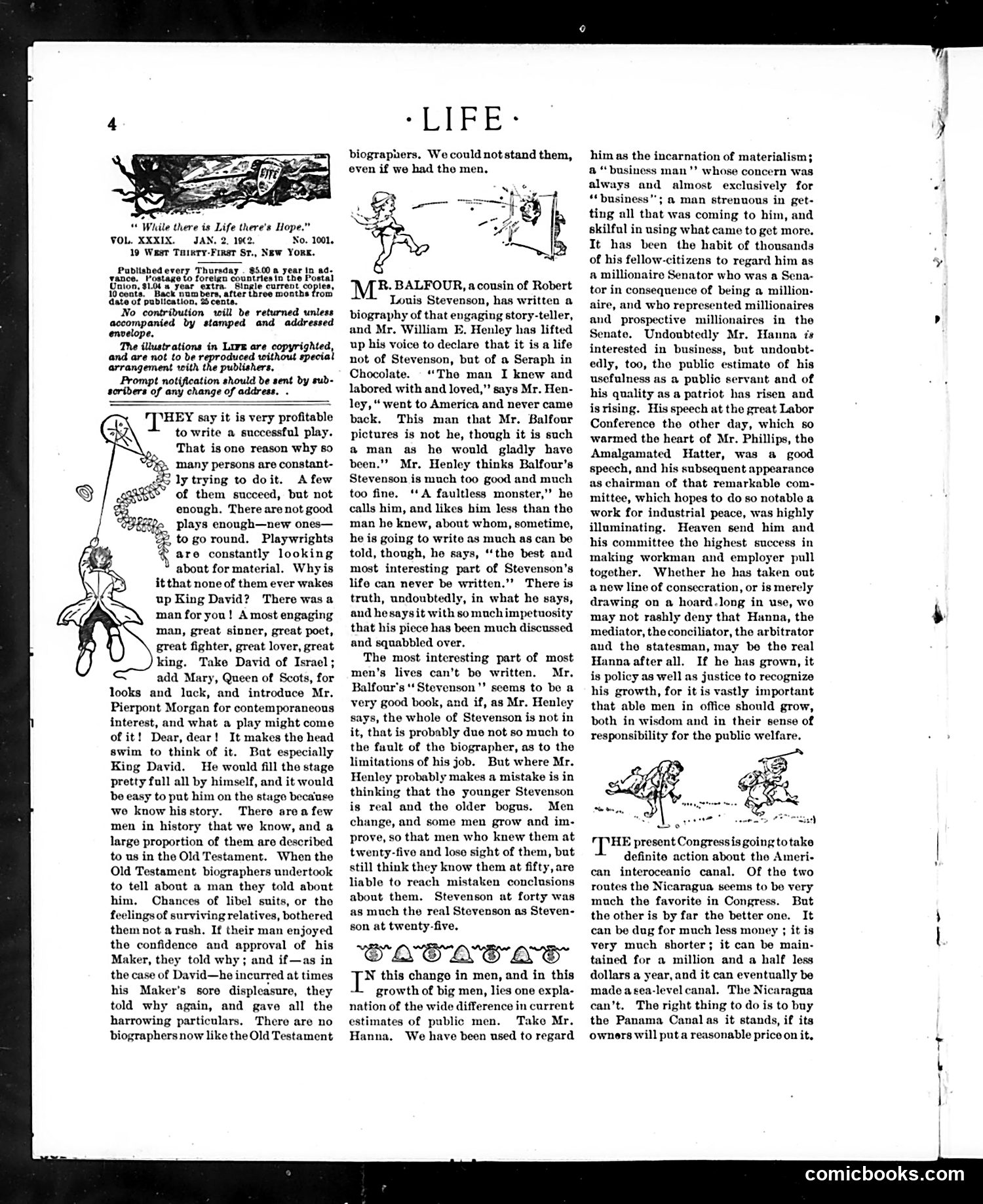
This page discusses **Robert Louis Stevenson's biography** by William E. Henley, critiquing both the book and biographical writing generally. The text debates whether Stevenson's life was truly as interesting as his fiction. The **left margin contains decorative illustrations** of figures in action poses—appearing to be generic artistic flourishes rather than specific political caricatures. The **lower section** transitions to discussion of **Congressional action on an American canal** (likely the Nicaragua Canal, mentioned explicitly). The satire compares canal-building options: one route "can be dogged for much less money"; another "can be much shorter." The point mocks Congress's indecision and cost-consciousness regarding major infrastructure projects—suggesting political gridlock over practical engineering decisions.
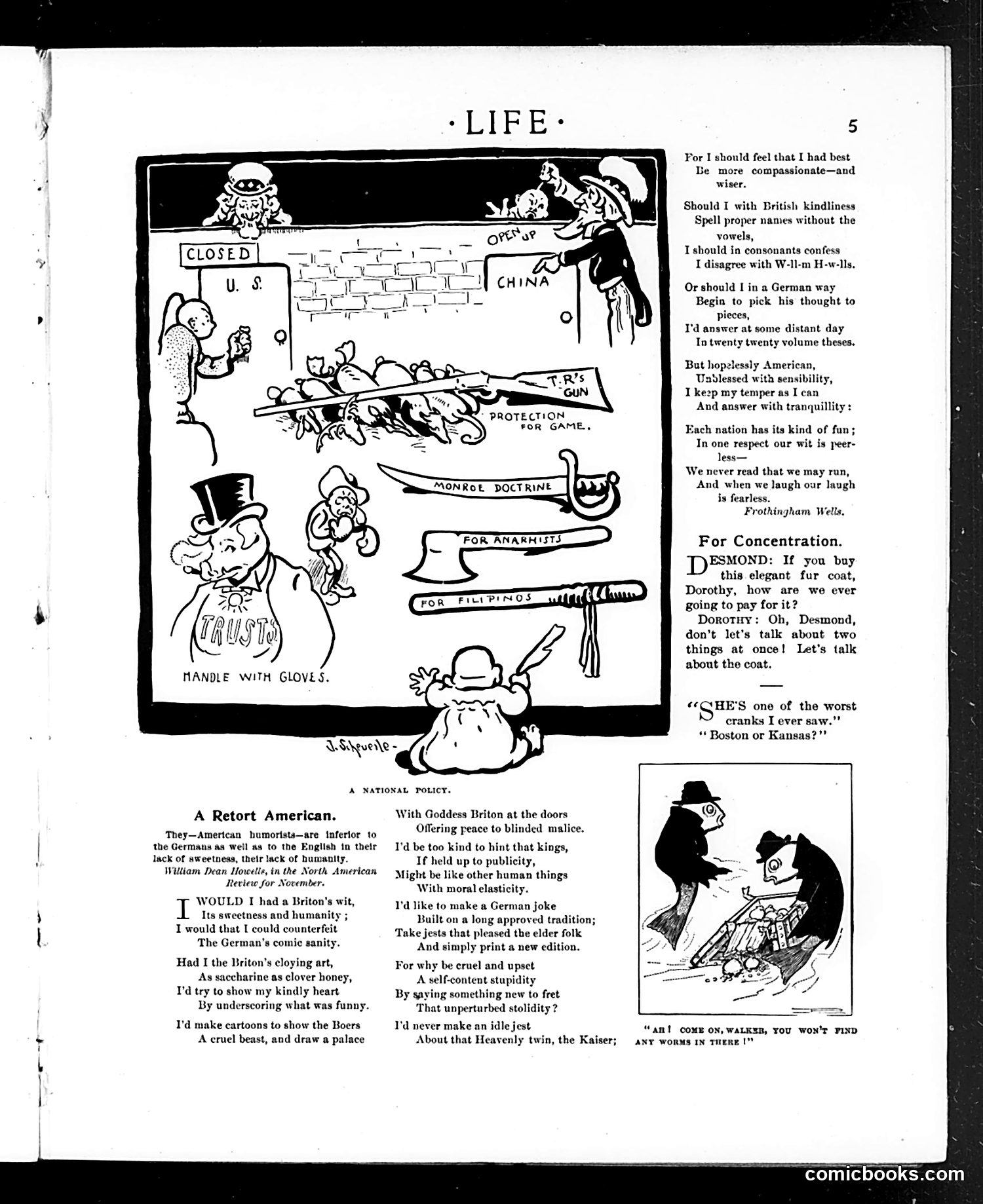
This Life magazine page satirizes American foreign policy during WWI-era tensions. The central cartoon titled "A National Policy" mocks U.S. neutrality by depicting various international threats (labeled "Monroe Doctrine," "For Anarchists," "For Filipinos," etc.) approaching America's closed borders. The figure labeled "Trust" represents American business interests, while the imagery suggests the U.S. government is poorly equipped to handle multiple external threats simultaneously. The accompanying poem by William Dean Howells critiques American diplomatic weakness, contrasting American naivety unfavorably with European powers' cunning. The cartoon below shows two figures examining a map, captioned about finding "worms" — likely referencing hidden political problems or spies. The overall message criticizes America's isolationist stance as dangerously inadequate given global instability.
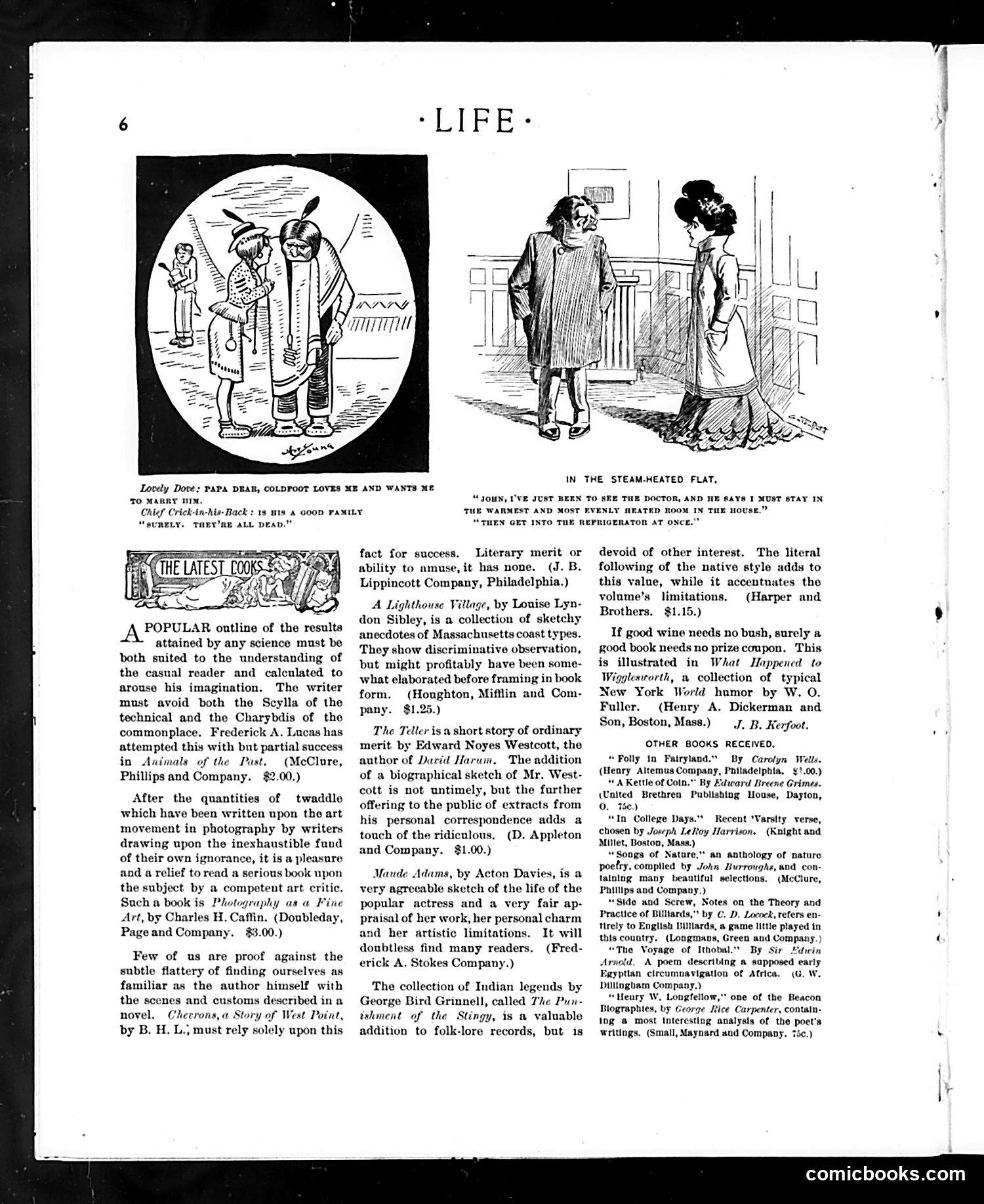
This page contains two editorial cartoons and a book review section rather than political satire. **Left cartoon** ("Lovely Dove"): Depicts a Native American family group, labeled with references to "Papa Dear, Coldfoot Loves Me and Wants Me" and "Chief Cries-in-his-Back." The style reflects early 20th-century stereotypical portrayals of Indigenous peoples common in American humor publications. **Right cartoon** ("In the Steam-Heated Flat"): Shows a domestic scene where a woman tells a man to visit a doctor in "the warmest and most evenly heated room in the house"—the refrigerator. This jokes about inadequate heating in urban apartments, a genuine housing complaint of the era. Both cartoons use gentle humor about contemporary social conditions rather than sharp political commentary.
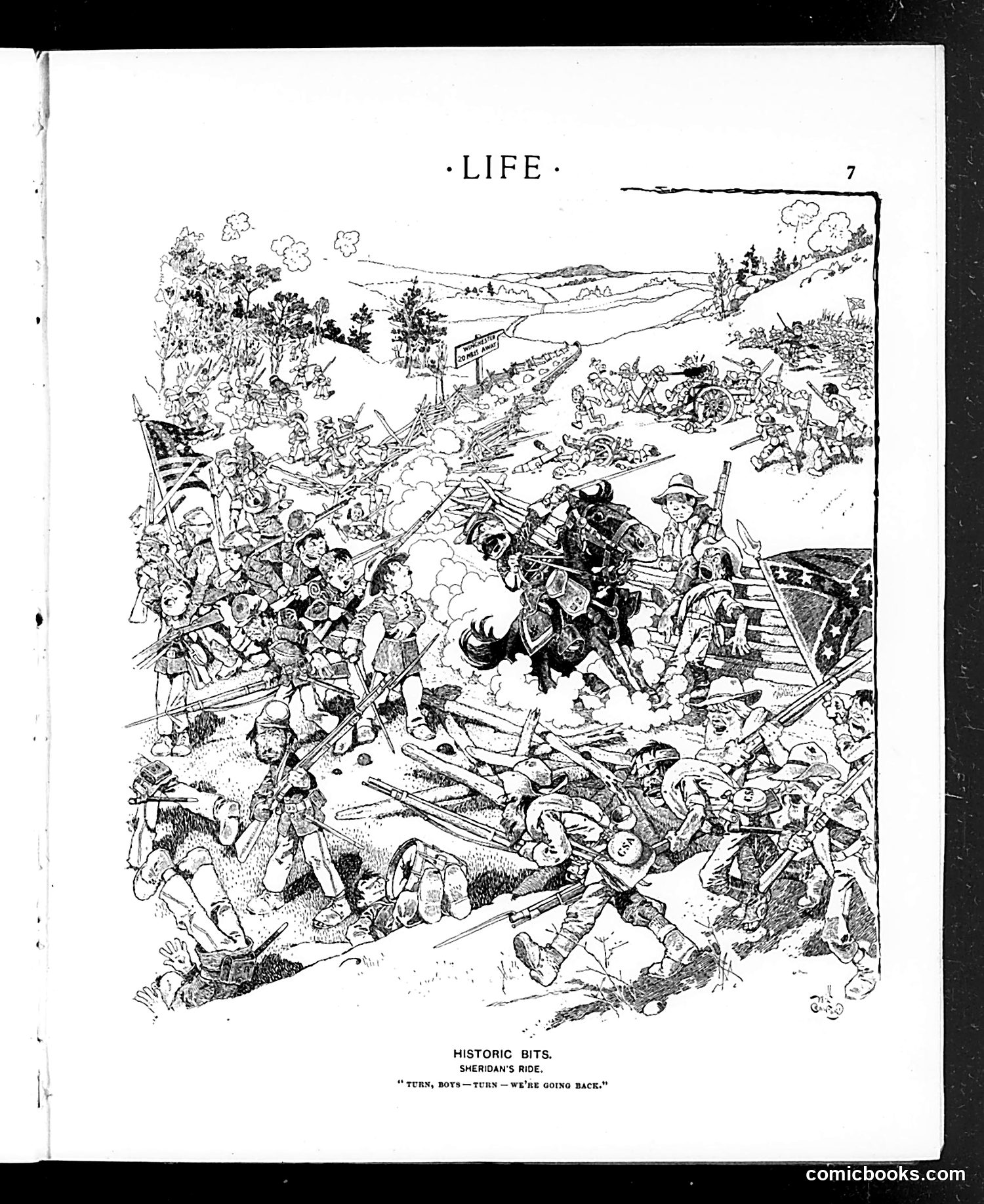
This illustration depicts **General Philip Sheridan's famous Civil War cavalry charge**, referenced in the caption "Turn, boys—turn—we're going back." The cartoon satirizes this celebrated military moment by crowding the heroic scene with numerous soldiers, horses, chaos, and action. The satire likely mocks either: - The romanticization of war in popular memory - Sheridan's actual tactical decisions - Patriotic myth-making around Civil War figures The dense, energetic composition emphasizes absurdity through visual overload—multiple figures and activity compressed into one scene. The "Historic Bits" heading suggests Life magazine is debunking or humorously re-examining celebrated historical moments rather than accepting them at face value. Without additional context, the specific satirical target remains unclear.
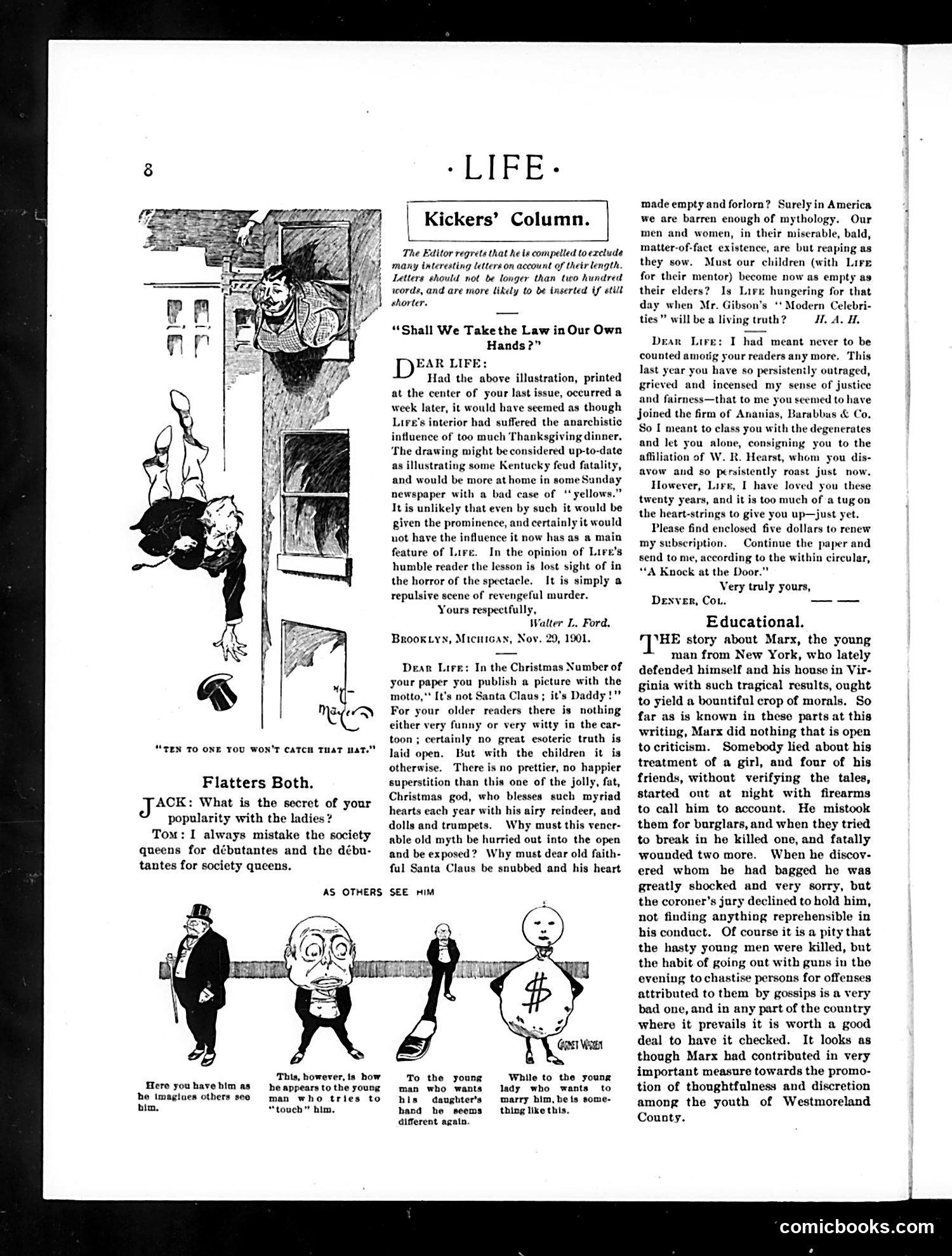
This page contains reader letters and a section titled "Flatters Both" with accompanying cartoons about social etiquette. The cartoons illustrate contrasting male types and their appeal to different social circles. The left figure (labeled as someone who "imagines others see him") appears to be a working-class or common man, while subsequent figures represent wealthier or more refined types. The final figure sports a dollar sign, satirizing materialism. The satire critiques how social status—particularly wealth—determines acceptance in high society, while simultaneously mocking both the pretentiousness of the wealthy and the delusions of those who aspire to their station. The point appears to be that regardless of class pretensions, money ultimately buys social access in American society.
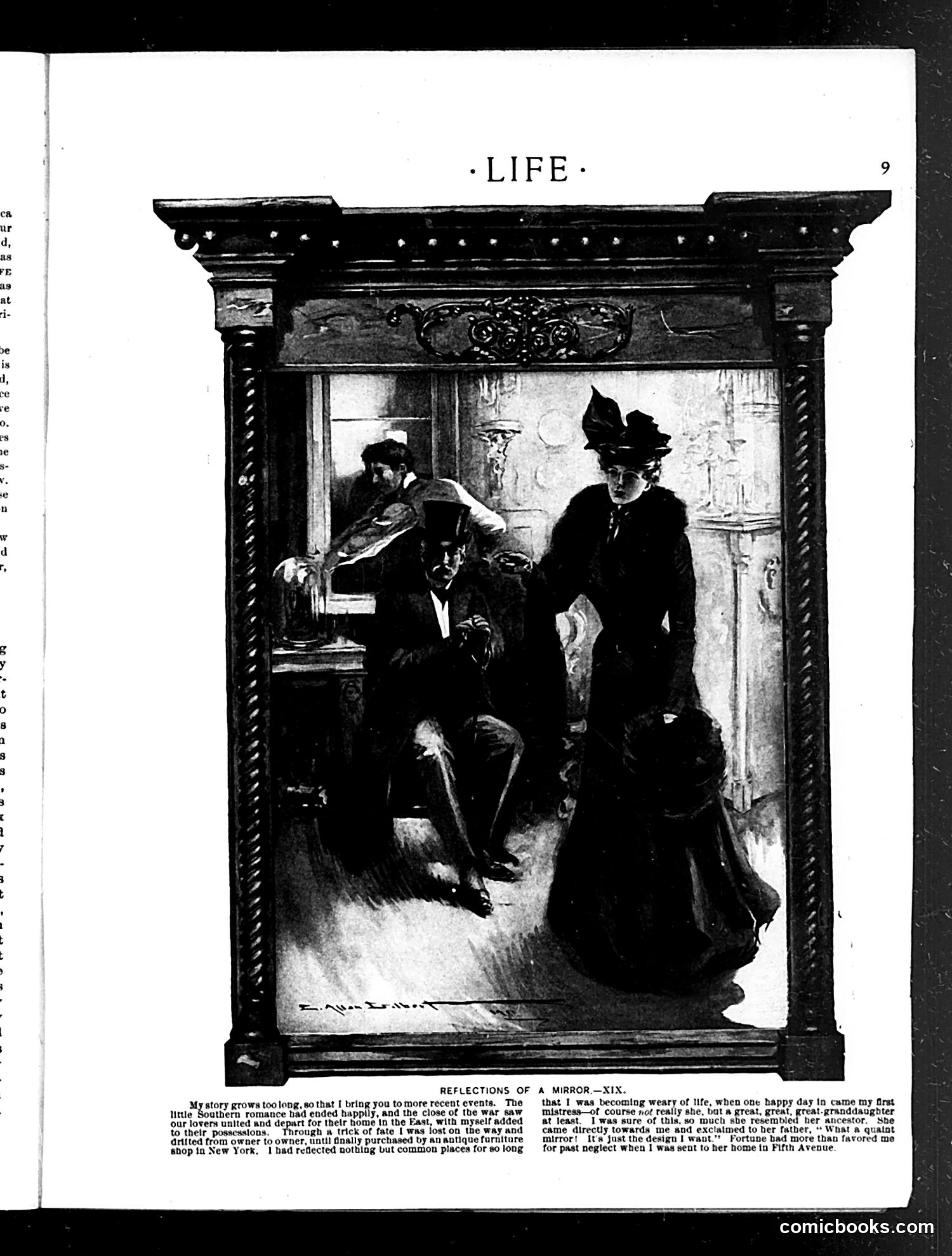
This illustration depicts a scene in what appears to be a mirror shop or antique dealer's establishment. The caption "Reflections of a Mirror" suggests a moral or satirical commentary on self-perception and deception. The accompanying text references a Southern romance that "ended happily" after WWI, mentioning the narrator's weariness with life and an encounter with a "first mistress." The narrative hints at themes of infidelity, regret, and moral compromise—specifically mentioning someone directing the narrator "towards an excoriated [damaged] her father" and reflecting on past neglect. The framed illustration likely uses the mirror as a metaphor for confronting uncomfortable truths about oneself, a common satirical device in early 20th-century American humor magazines.
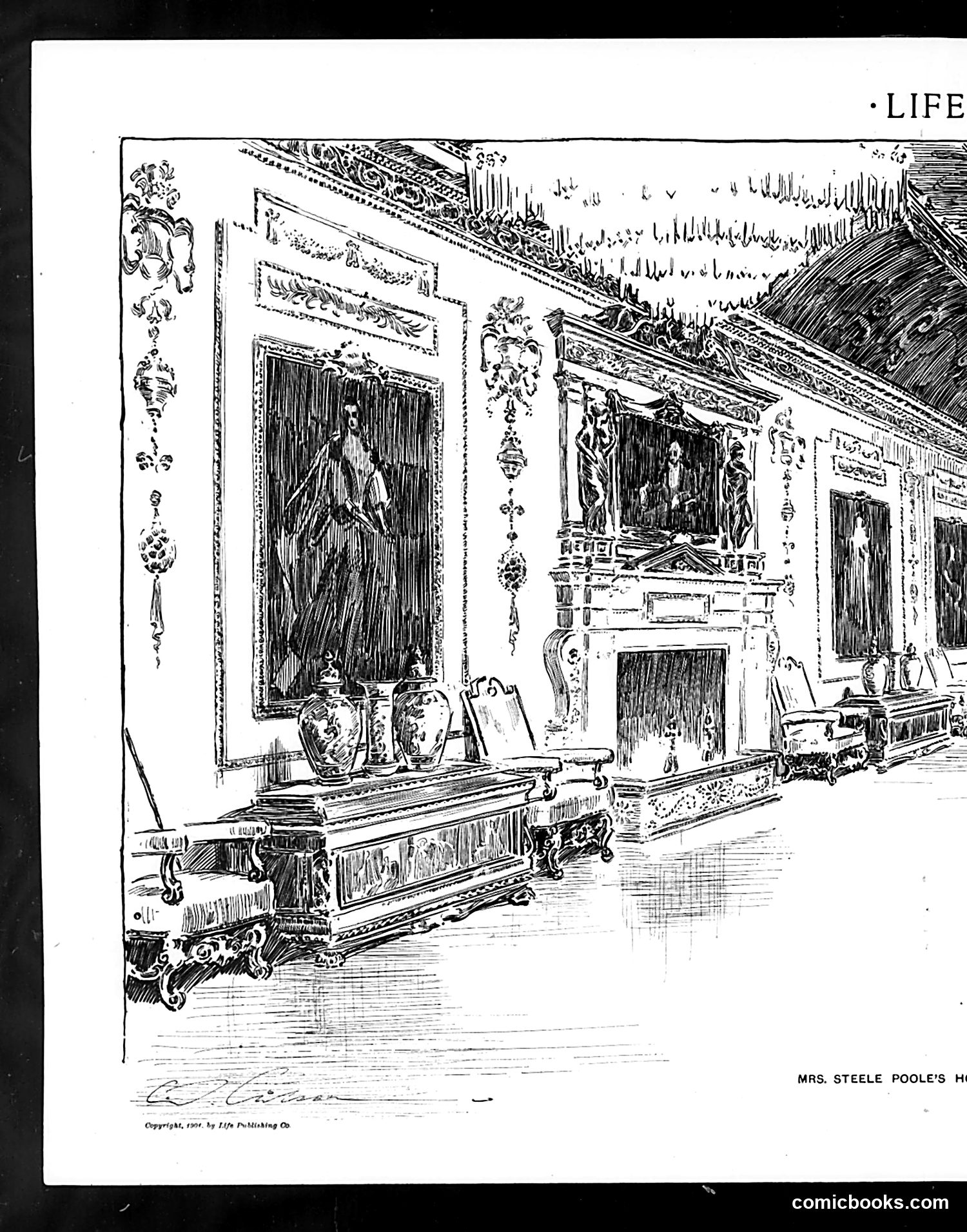
This is an architectural illustration rather than a political cartoon. The image depicts an elegant interior room—identified in the caption as "MRS. STEELE POOLE'S H[OME]"—showcasing early 20th-century luxury design and furnishings. The sketch shows ornate wall panels, decorative paintings in frames, an elaborate fireplace mantel with Asian vases, ornamental hanging elements, and period furniture including what appears to be an ornate chest or low cabinet. The detailed linework emphasizes the room's refined aesthetic and expensive appointments. This appears to be a design or lifestyle feature typical of *Life* magazine's coverage of wealthy Americans' homes, rather than satire. The copyright notation suggests this is from around 1907. It celebrates contemporary interior design taste among the affluent.
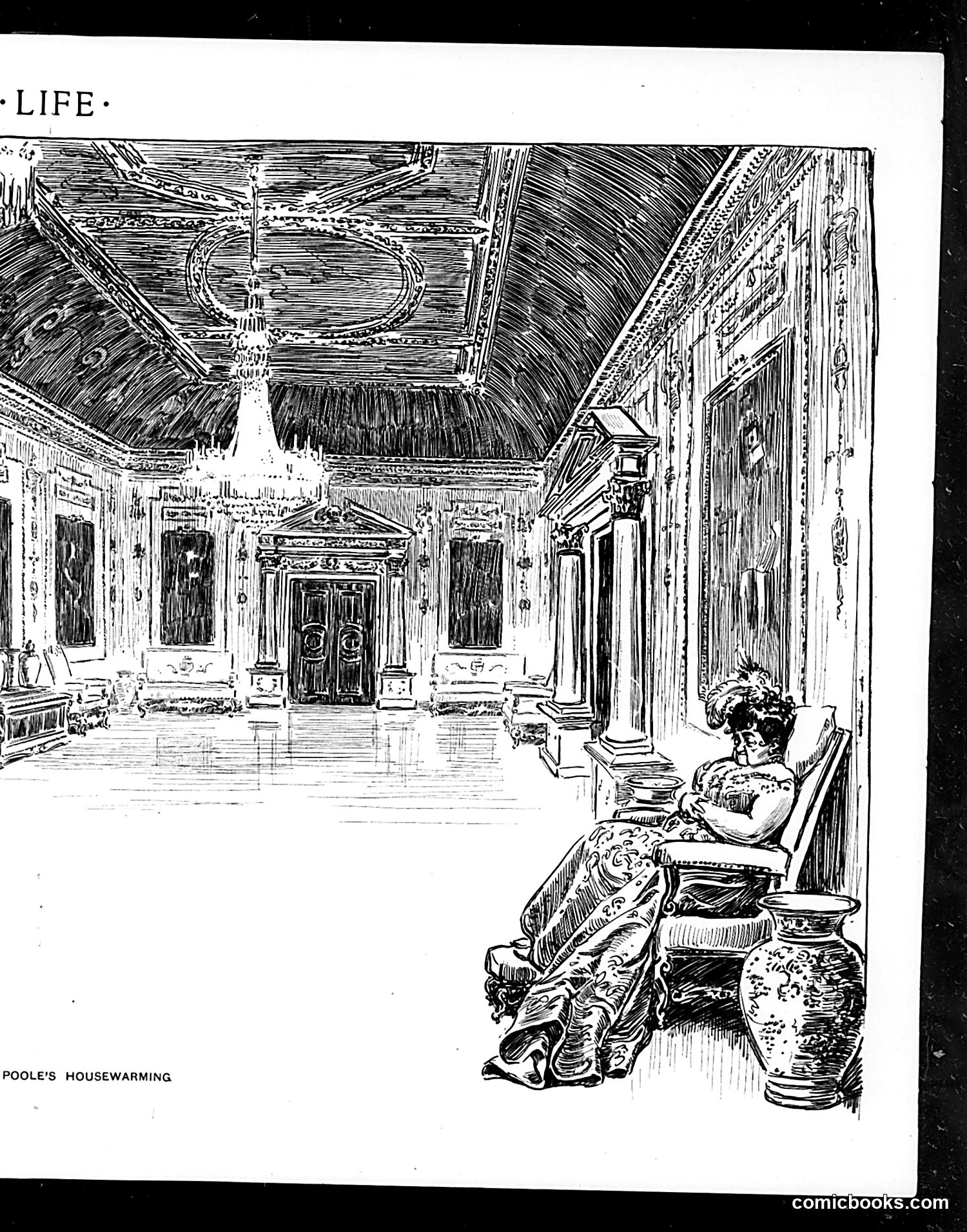
This page from *Life* magazine shows an illustration titled "Poole's Housewarming." The image depicts an elegant woman seated in an ornate interior—a grand room with decorative ceiling, columns, and classical architectural details. She reclines in a chair, surrounded by luxury furnishings including a decorative vase. The cartoon appears to be social satire about wealth and domesticity, likely commenting on the opulent lifestyle of someone named Poole during a housewarming celebration. The woman's leisured pose and the excessive ornamentation suggest the satire targets affluent society's materialism and pretension. Without additional context or visible text explaining the specific reference, the precise satirical point remains unclear, though it likely mocked contemporary high-society customs or a specific social figure known to *Life's* readership.
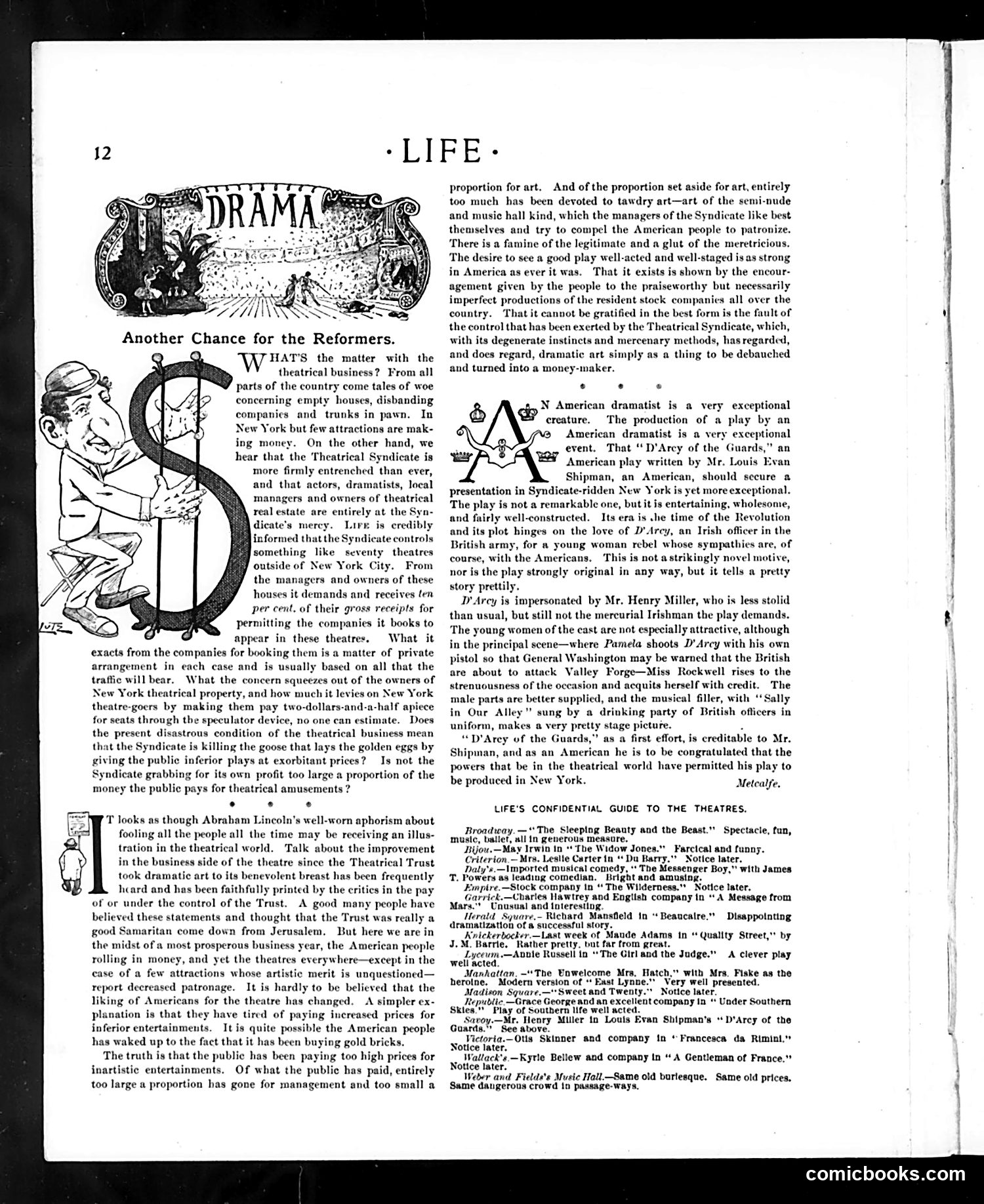
This satirical cartoon critiques the **Theatrical Syndicate**—a monopolistic booking organization controlling most American theaters outside New York City. The caricatured figure (left) appears to represent a theater manager or syndicate representative squeezing money from theatrical companies. The accompanying article argues the Syndicate exploits producers through exorbitant booking fees and control of theater access. The satire suggests "reformers" have an opportunity to challenge this monopoly, which the author presents as financially predatory—extracting excessive profits while offering inferior entertainment to the public. The piece criticizes how this system has inflated ticket prices and reduced theatrical quality, positioning syndicate control as a corrupt financial scheme harming both theater owners and audiences.
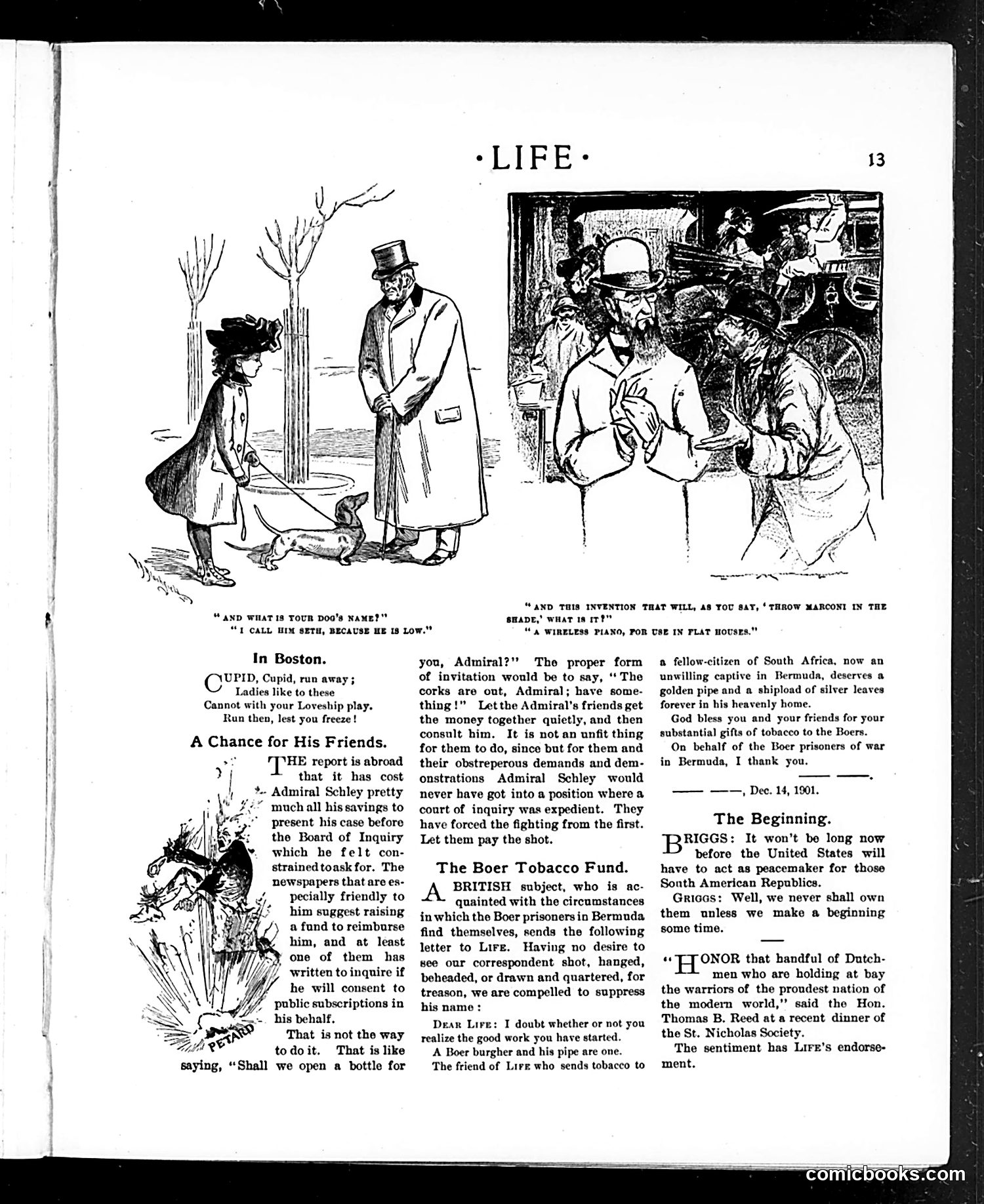
This page contains several satirical pieces from December 1901, during the Second Boer War. **"A Chance for His Friends"** critiques efforts to raise funds for Admiral Schley, who spent his savings defending himself before a Board of Inquiry (likely related to the Spanish-American War). Life mocks the fundraising approach as patronizing, arguing his supporters—who created his legal troubles through their "obstreperous demands"—should quietly pay his costs without making him feel obligated. **"The Boer Tobacco Fund"** presents a letter praising LIFE for sending tobacco to Boer prisoners held in Bermuda. The writer argues this aid honors the Boer fighters resisting British forces in South Africa. **"The Beginning"** dialogue suggests the U.S. will soon mediate conflicts between South American republics. The cartoons show period scenes: a Boston street encounter, and what appears to be a discussion of wireless technology ("Marconi"). The page reflects LIFE's anti-imperialist stance, sympathizing with Boer resistance to British power while critiquing American military establishment figures.
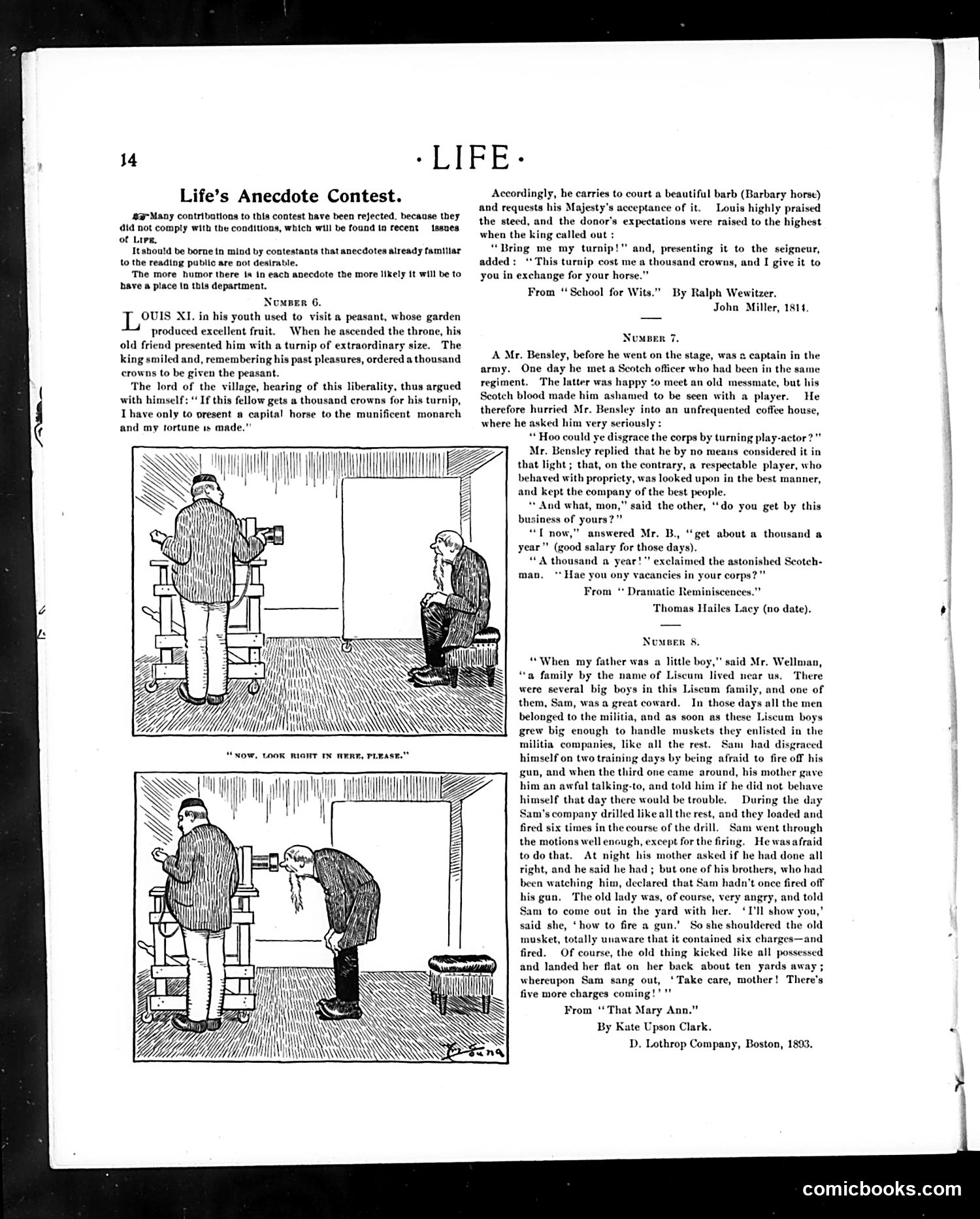
This page presents three humorous anecdotes submitted to Life's "Anecdote Contest," a regular feature encouraging readers to contribute witty stories. **Number 6** depicts Louis XI rewarding a peasant's extraordinary turnip with 1,000 crowns. A village nobleman, hearing this, assumes a fine horse will earn greater reward—but the king simply gives him the turnip in exchange, satirizing greedy courtiers who misjudge royal favor. **Number 7** recounts a Scottish army officer ashamed to associate with Mr. Bensley after he becomes an actor, reflecting 18th-century social prejudice against theater people. Bensley's retort that respectable actors earn good money (about 1,000 pounds annually) undercuts the officer's snobbery. **Number 8** begins a anecdote about "Sam," a cowardly militiaman afraid to fire his gun during training—a humorous story about masculine shame and maternal discipline. These anecdotes exemplify genteel Victorian humor: witty moral lessons about vanity, social pretension, and character flaws.
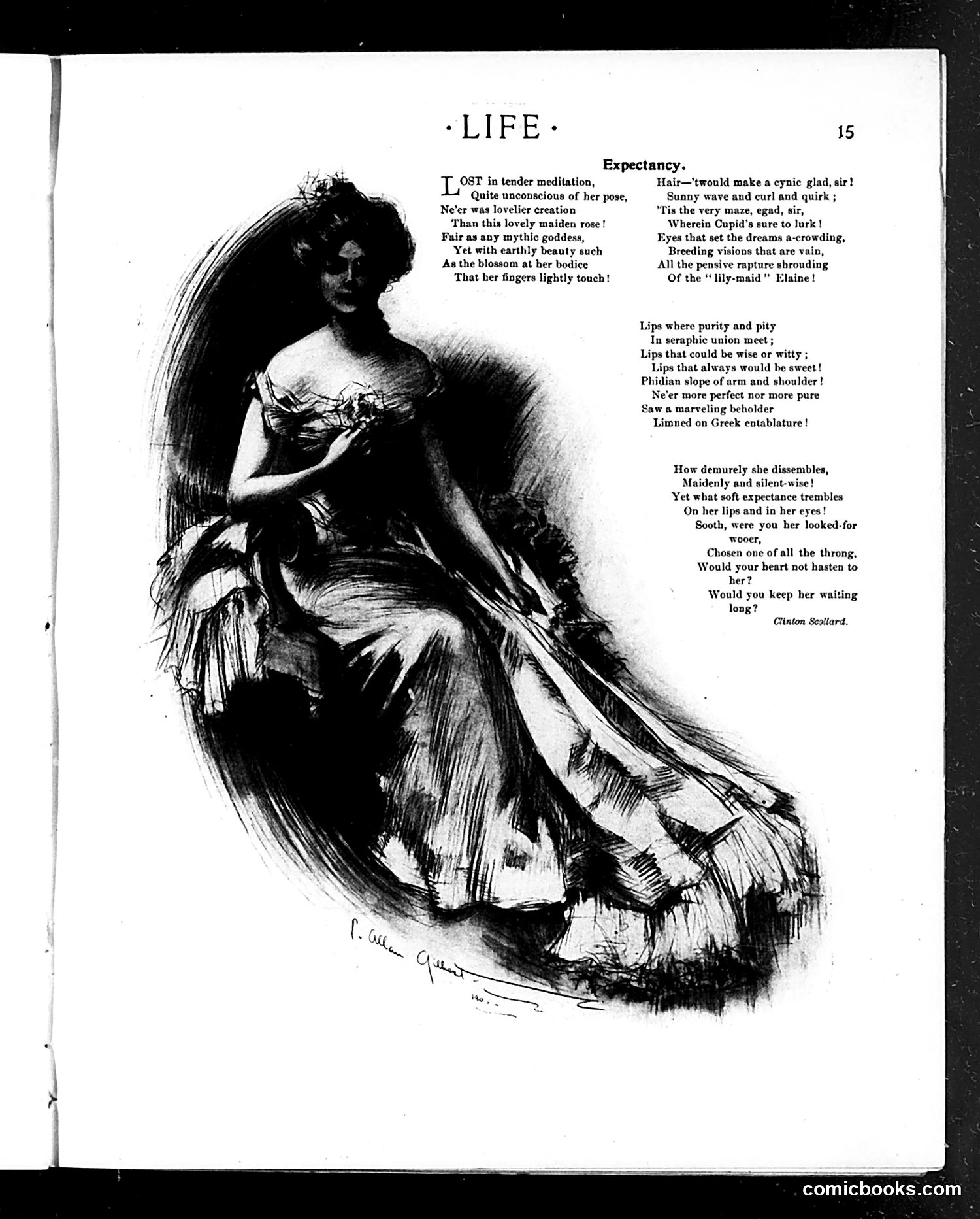
This page features a romantic illustration with accompanying poem titled "Expectancy," credited to Clinton Scollard. The image depicts an idealized young woman in contemplative pose, rendered in delicate sketch style. The poem is a conventional piece of Victorian-era romantic verse celebrating feminine beauty and virtue. It employs classical references (comparing her to "mythic goddess," invoking Greek aesthetics) and literary allusions (referencing Tennyson's "lily-maid Elaine"). The text praises her physical attributes—hair, eyes, lips, shoulders—while emphasizing her modest demeanor and emotional purity. The final stanza poses a rhetorical question to male readers: wouldn't you pursue such a woman? This reflects period attitudes toward courtship and gender roles. Rather than satire, this appears to be *earnest* romantic content typical of *Life* magazine's literary and artistic offerings in the early 20th century. There is no apparent political commentary or mockery—it represents the sentimental, idealized view of womanhood common to the era.
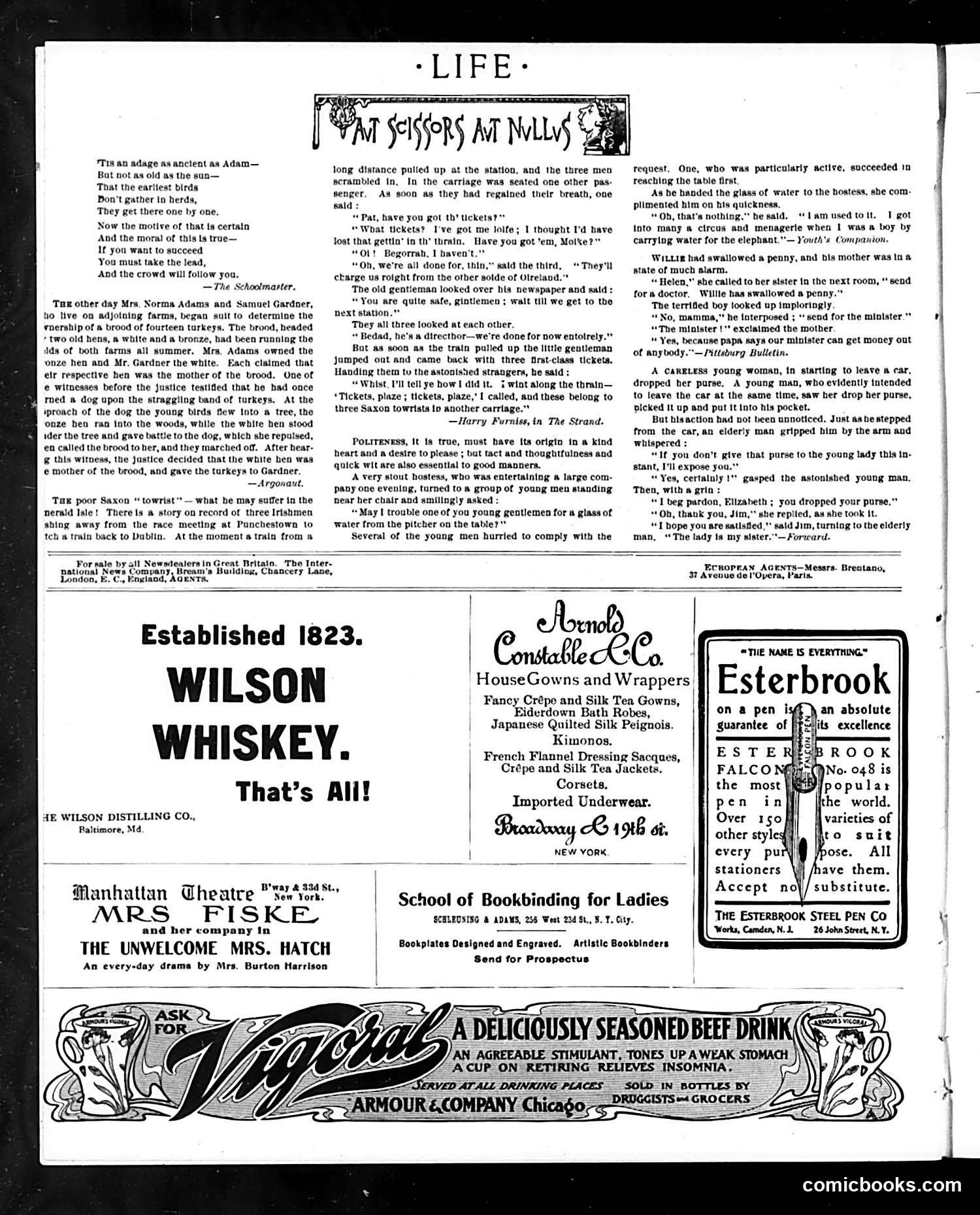
This page from **Life** magazine (a satirical publication) contains three separate humorous anecdotes rather than political cartoons: 1. **The Turkeys Dispute**: A legal case where neighboring farmers argue over ownership of fourteen turkeys. A justice decides based on which hen defended the brood from a dog—the white hen stood and fought, so she's the "real mother." The satire mocks both property disputes and anthropomorphizing animals. 2. **Irish Train Passengers**: Three Irishmen board a train without tickets, panicking until a gentleman passenger reveals he collected their tickets from "Saxon tourists" in another carriage—using their own con-artist logic against them. This plays on period stereotypes about Irish travelers and cleverness. 3. **Brief Anecdotes**: Short humorous stories about politeness, a child swallowing a penny, and similar domestic comedies. The page is primarily **advertising-heavy**, featuring whiskey, theater, bookbinding school, and other period products. The satirical content reflects turn-of-century American humor focused on class, nationality, and everyday mishaps.
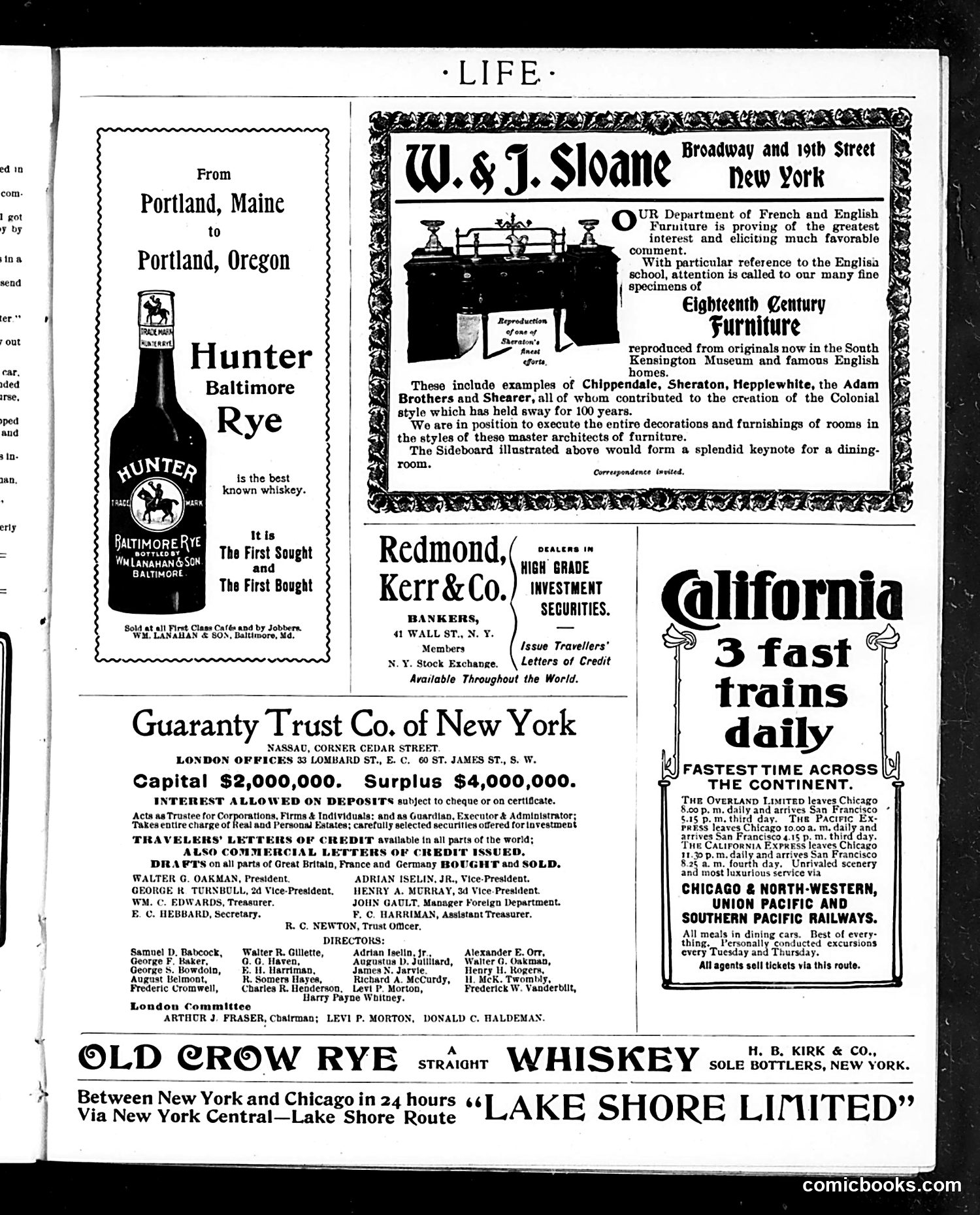
This page from *Life* magazine is **primarily advertising**, not satirical content or political cartoons. The page contains commercial advertisements for: - **Hunter Baltimore Rye whiskey** (left column) — promoting travel from Portland, Maine to Portland, Oregon - **W. & J. Sloane furniture** (top right) — showcasing 18th-century reproduction furniture styles - **Guaranty Trust Co. of New York** (center) — a major bank advertising financial services and travelers' letters of credit - **California rail service** (right) — promoting three daily fast trains across the continent - **Old Crow Rye whiskey** (bottom) — advertising the "Lake Shore Limited" train service between New York and Chicago The only potentially satirical element is implicit: the *juxtaposition* of luxury goods (fine furniture, whiskey, banking services, premium rail travel) reflects the aspirations and consumption patterns of early 20th-century American wealth and leisure culture. However, there is no overt cartoon, caricature, or explicit satire visible on this page.
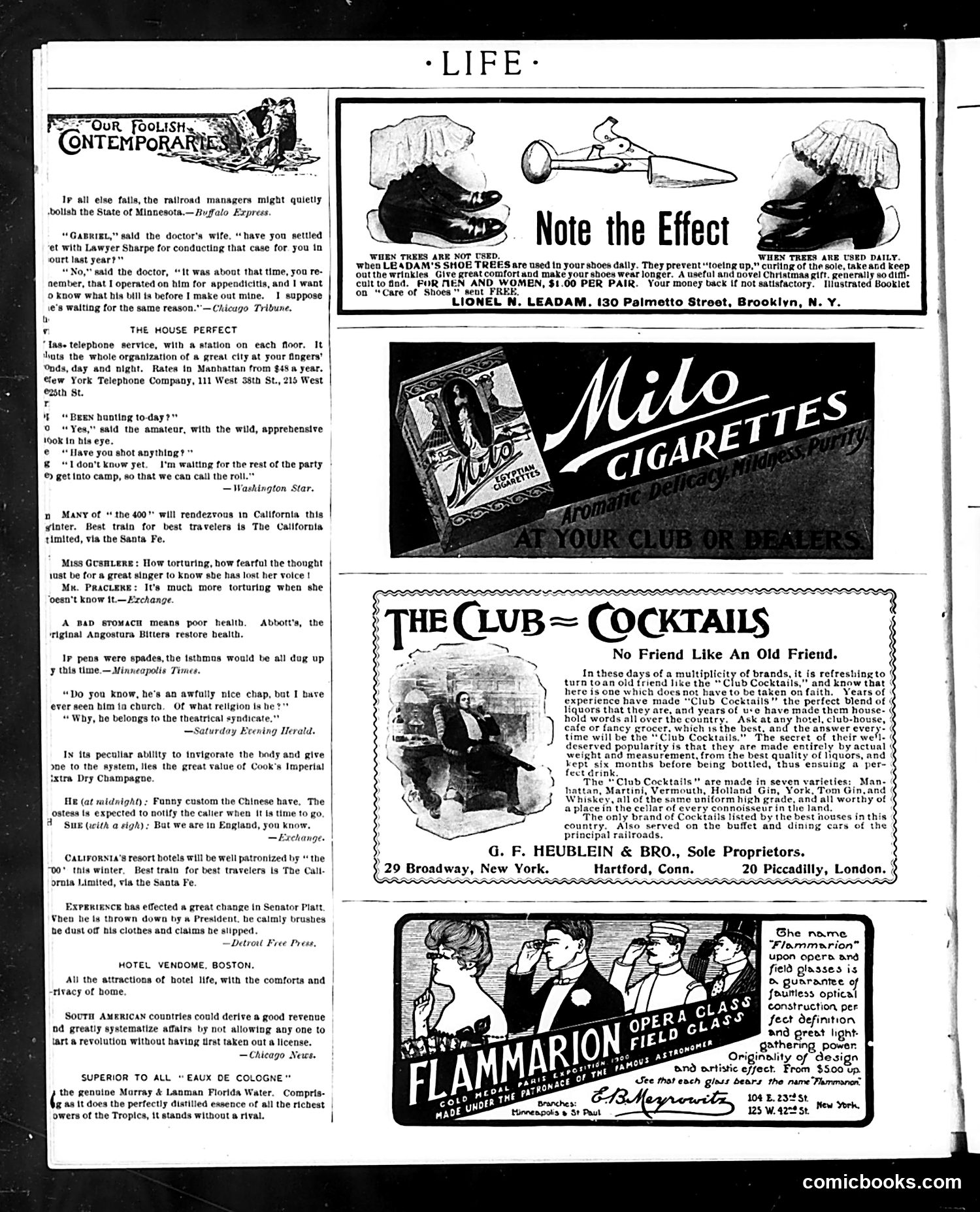
This page from *Life* magazine presents satirical commentary on contemporary issues mixed with advertisements. The left column contains short humorous anecdotes mocking various subjects: **Key satirical pieces include:** - Railroad managers and Minnesota's governance - A doctor and lawyer's fee dispute (each waiting for the other to bill first) - Hunting trips where nothing is caught - A singer losing her voice - Senator Platt's political defeats (he "claims he slipped") **The jokes target:** - Corporate inefficiency and state politics - Professional rivalry and fee disputes - Incompetent amateur hunters - The theatrical syndicate as a "religion" - Senator Platt's perceived weakness after defeats by the President The page is primarily **advertising-driven**, featuring promotions for shoe trees, cocktails, cigars, perfume, and hotels. The humor is genteel and topical rather than deeply political—typical of *Life*'s light satirical approach to everyday absurdities and current events. The Senator Platt reference appears to be the most pointed political commentary present.
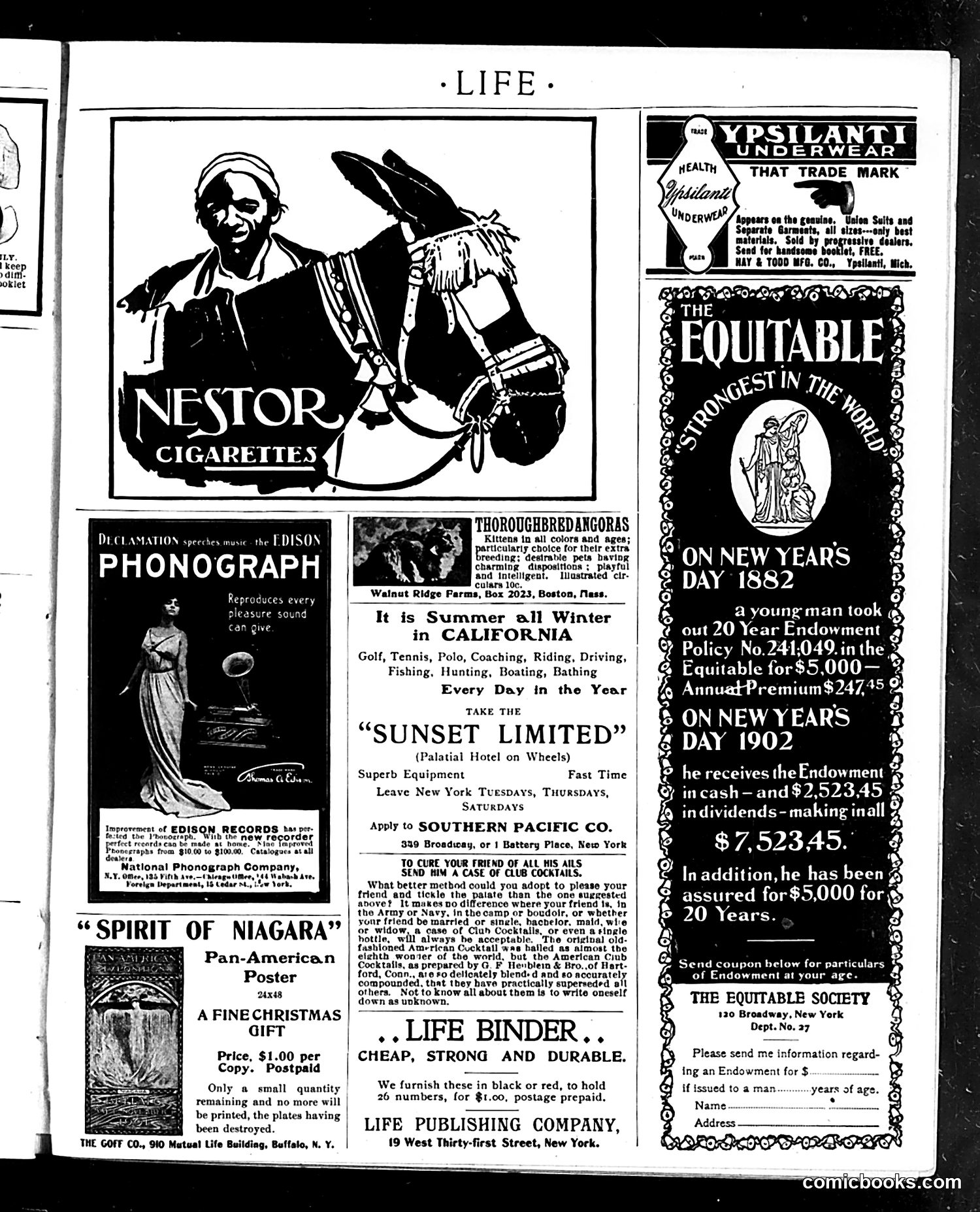
This is primarily an **advertising page** from an early 1900s issue of *Life* magazine, not a satirical cartoon page. The main illustration is a **Nestor Cigarettes advertisement** featuring a caricatured figure on horseback—likely a stereotypical "ethnic" or immigrant character (the exaggerated facial features and costume suggest this was meant as caricature, though identifying the specific stereotype requires historical context we should note carefully). The page contains various period advertisements: Edison phonographs, a Pan-American poster, California travel, Club Cocktails (humorously marketed as medical treatment for friends), and insurance products. Notably, the **Equitable Society endowment ad** promotes life insurance to young men, illustrated with a specific 1902 example of accumulated wealth. The **"Life Binder"** at bottom is simply a product for storing magazine issues. This reflects early 1900s advertising practices and consumer culture—before cigarettes faced health criticism, spirits were openly promoted as gifts, and insurance companies used testimonial-style marketing.
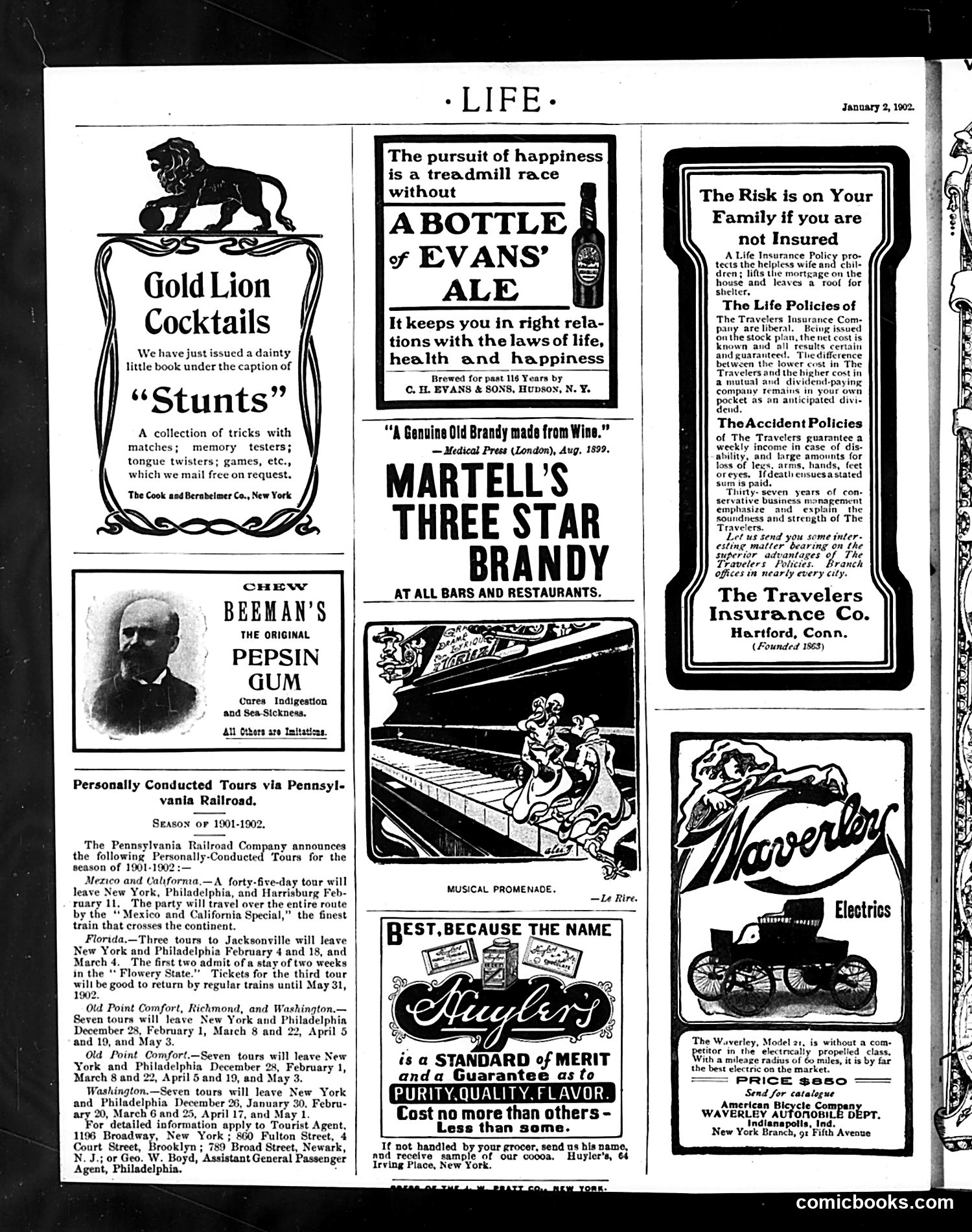
This is primarily an advertising page from *Life* magazine (January 2, 1902), containing no political cartoons. It consists entirely of commercial advertisements for the era's consumer goods: liquor (Evans' Ale, Martell's Brandy), gum and candy (Beeman's Pepsin Gum, Huyler's cocoa), patent medicines (promising to cure indigestion and seasickness), insurance (Travelers Insurance emphasizing protection for widows and children), tourist rail excursions (Pennsylvania Railroad's luxury tours to Florida, Mexico, and California), and an early electric automobile (the Waverley). The ads reflect early 1900s middle-class consumer culture and the advertising conventions of the period, mixing product pitches with moral appeals (insurance protecting family welfare). There is no satirical content or political commentary visible on this page.