
Life, 1902-01-02 · page 14 of 20
Life — January 2, 1902 — page 14: what you’re looking at
What you’re looking at
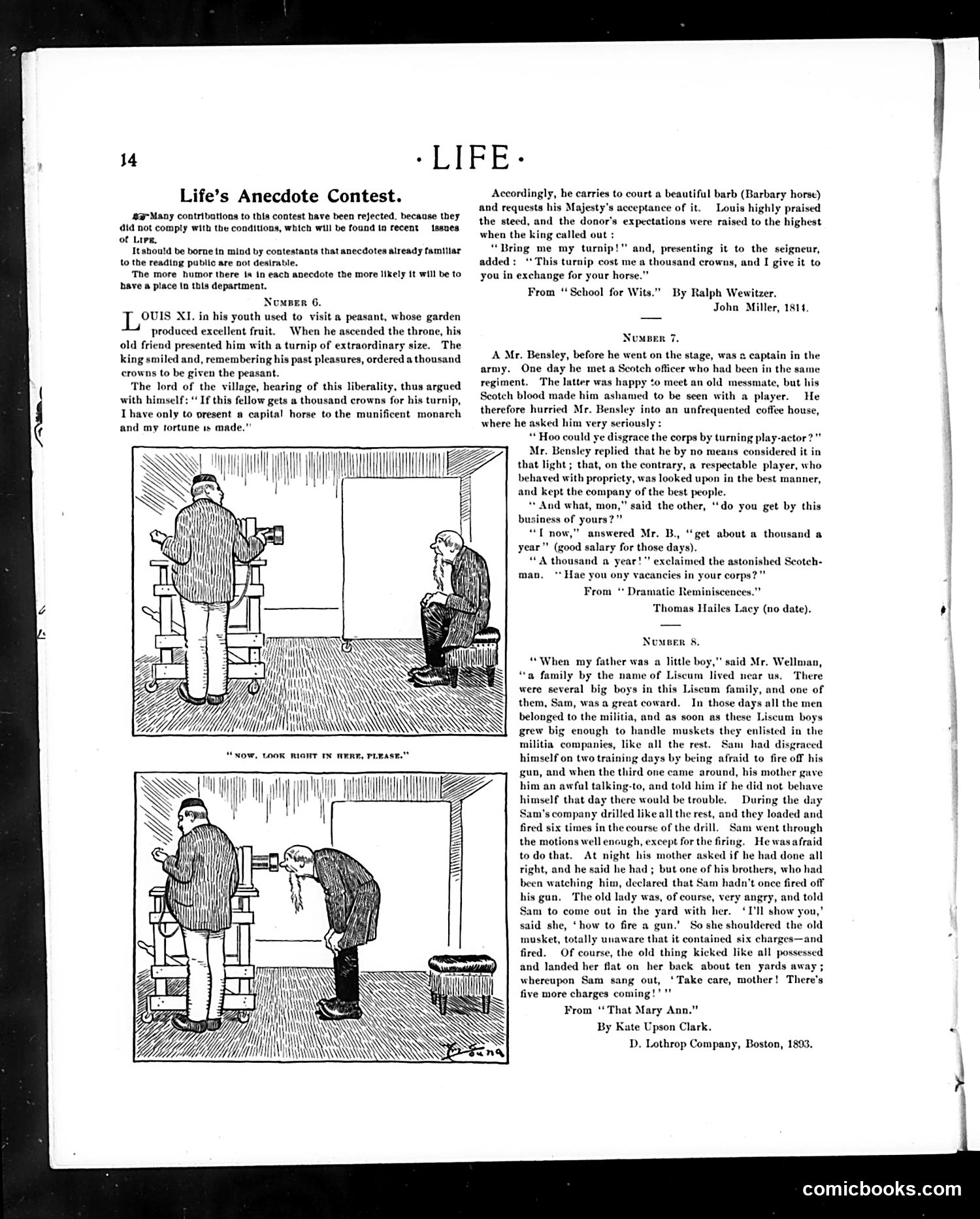
This page presents three humorous anecdotes submitted to Life's "Anecdote Contest," a regular feature encouraging readers to contribute witty stories. **Number 6** depicts Louis XI rewarding a peasant's extraordinary turnip with 1,000 crowns. A village nobleman, hearing this, assumes a fine horse will earn greater reward—but the king simply gives him the turnip in exchange, satirizing greedy courtiers who misjudge royal favor. **Number 7** recounts a Scottish army officer ashamed to associate with Mr. Bensley after he becomes an actor, reflecting 18th-century social prejudice against theater people. Bensley's retort that respectable actors earn good money (about 1,000 pounds annually) undercuts the officer's snobbery. **Number 8** begins a anecdote about "Sam," a cowardly militiaman afraid to fire his gun during training—a humorous story about masculine shame and maternal discipline. These anecdotes exemplify genteel Victorian humor: witty moral lessons about vanity, social pretension, and character flaws.
📄 Transcribed text from this page (OCR, searchable)
Machine-transcribed from the original scan — historical spelling and the odd misread are preserved.
Life’s Anecdote Contest. sa-Many contribations to this contest have been rejected. because they did not comply with the conditions, which will be found tn recent tssues of Lis, Itshould be borne in mind by contestants that anecdotes already familiar to the reading public are not desirable. ‘The more humor there ts in each anecdote the more likely it will be to have a place In this department. Nomper 6. LOUIS Xt. in his youth used to visit a peasant, whose garden produced excellent fruit. When he ascended the throne, his old friend presented him with a turnip of extraordinary size. The king smiled and, remembering his past pleasures, ordered a thousand crowns to be given the peasant. The lord of the village, hearing of this liberality, thus argued with himself; “If this fellow gets a thousand crowns for his turnip, Thave only to present a capital horse to the munificent monarch q and my fortune is made.” WW AMT ANT a ie ; y | TAT HINA TAN AN \ INR ¥ \\\ Yi YO AN Yyyy Zan WN NAW 14 -LIFE- HN A NE S pei MIS Y Li MAT NW \ \ AS MWS Accordingly, he carries to court a beautiful barb (Barbary horse) and requests his Majesty's acceptance of it. Louis highly praised the steed, and the donor's expectations were raised to the highest when the king called out : “Bring me my turnip!” and, presenting it to the seigneur, added: ‘This turnip cost me a thousand crowns, and I give it to you in exchange for your horse From ‘School for Wits.” By Ralph We: r. John Miller, 1814. Number 7. A Mr. Bensley, before he went on the stage, was s captain in the army. One day he met a Scotch officer who had been in the same regiment. The latter was happy to meet an old messmate, but his Scotch blood made him ashamed to be seen with a player. He therefore hurried Mr. Bensley into an unfrequented coffee house, where he asked him very seriously : “ Hoo could ye disgrace the corps by turning play-actor?” Mr. Bensley replied that he by no means considered it in that light; that, on the contrary, a respectable player, who behaved with propriety, was looked upon in the best manner, and kept the company of the best people. nd what, mon,” said the other, “do you get by this 8 of yours?” “T now,” answered Mr. B., ‘‘get about a thousand a year" (good salary for those days). “A thousand a year!” exclaimed the astonished Seotch- man, ** Hae you ony vacan ur corps?” bi From ‘ Dramatic Re jiscences."” Thomas Hailes Lacy (no date). Numper 8. “When my father was a little boy,” said Mr. Wellman, “a family by the name of Liscum lived near us. There were several big boys in this Liscum family, and one of them, Sam, was a great coward. In those days all the men belonged to the militia, and as soon as these Liscum boys grew big enough to handle muskets they enlisted in the militia companies, like all the rest. Sam had disgraced himself on two training days by being afraid to fire off his gun, and when the third one came around, his mother gave him an awful talking-to, and told him if he did not behave himself that day there would be trouble. During the day Sam's company drilled like all the rest, and they loaded and fired six times in the course of the drill. Sam went through the motions well enough, except for the firing. He wasafraid todo that. At night his mother asked if he had done all right, and he said he had ; but one of his brothers, who had been watching him, declared that Sam hadn't once fired off his gun. The old lady was, of course, very angry, and told Sam to come out in the yard with her. ‘I'll show you,’ said she, ‘how to fire a gun.’ So she shouldered the old musket, totally unaware that it contained six charges—and fired. Of course, the old thing kicked like all possessed and landed her flat on her back about ten yards away ; whereupon Sam sang out, ‘Take care, mother! There's five more charges coming!’ ”” From ‘That Mary Ann.” By Kate Upson Clark. D. Lothrop Company, Boston, 1893. comicbooks.com