
Life, 1902-01-02 · page 6 of 20
Life — January 2, 1902 — page 6: what you’re looking at
What you’re looking at
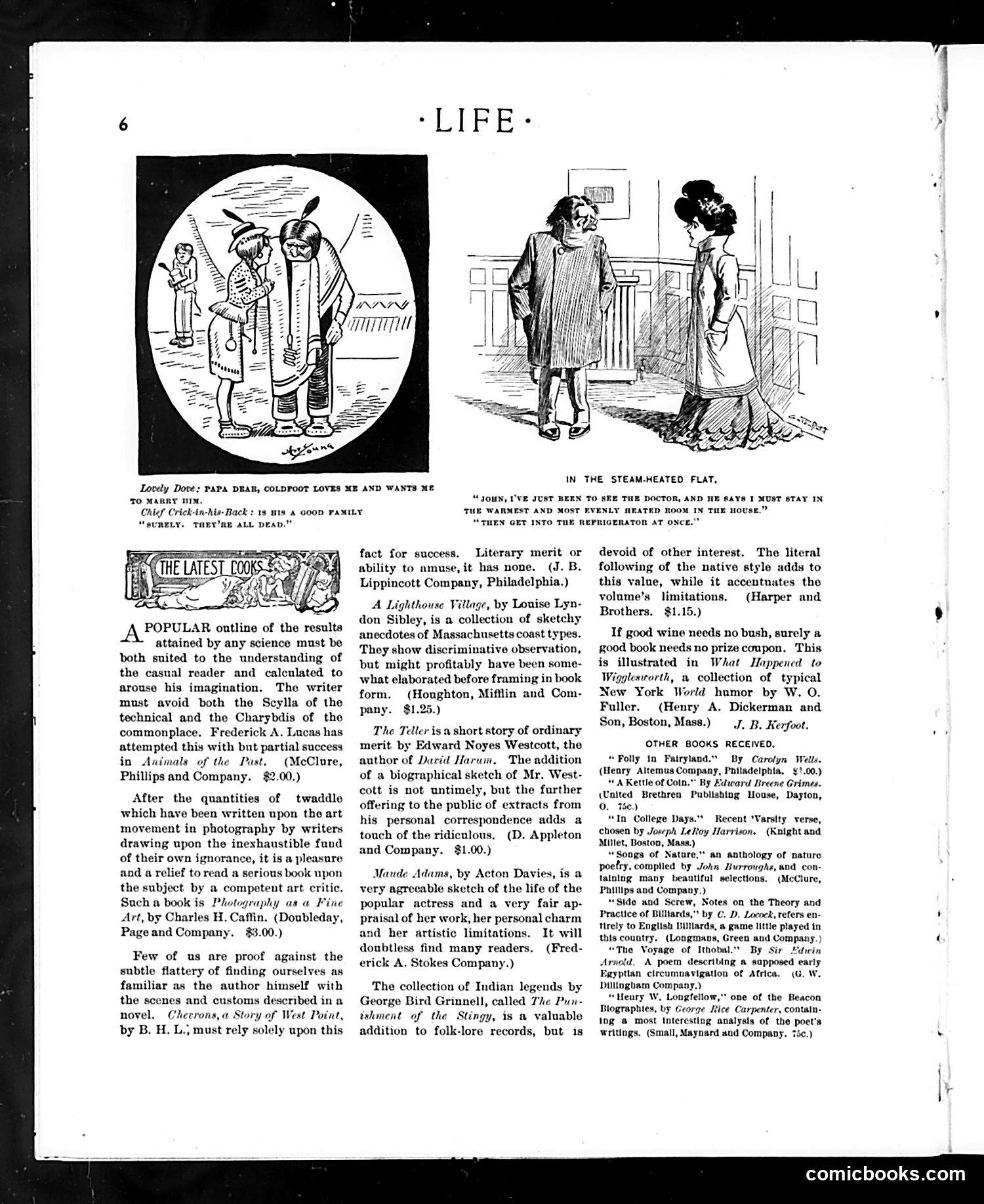
This page contains two editorial cartoons and a book review section rather than political satire. **Left cartoon** ("Lovely Dove"): Depicts a Native American family group, labeled with references to "Papa Dear, Coldfoot Loves Me and Wants Me" and "Chief Cries-in-his-Back." The style reflects early 20th-century stereotypical portrayals of Indigenous peoples common in American humor publications. **Right cartoon** ("In the Steam-Heated Flat"): Shows a domestic scene where a woman tells a man to visit a doctor in "the warmest and most evenly heated room in the house"—the refrigerator. This jokes about inadequate heating in urban apartments, a genuine housing complaint of the era. Both cartoons use gentle humor about contemporary social conditions rather than sharp political commentary.
📄 Transcribed text from this page (OCR, searchable)
Machine-transcribed from the original scan — historical spelling and the odd misread are preserved.
IN THE STEAM.HEATED FLAT. Lovely Dove; PAPA DEAR, COLDPOOT LOVES ME AND WANTS ME ‘TO MARRY MIM. Chief Crick-in-his-Back : 18 18 & GOOD FAMILY THEY'RE ALL DEAD.” “JOUN, I'VE JUST BEEN TO SEE THE DOCTOR, AND IE SAYS T MUST STAY IN, ‘TUE WARMEST AND MOST RVENLY AEATED ROOM IN THE HOUSE.” “suRELY. “THEN GET INTO THE REPRIGERATOR AT ONCE.” A POFULAR outline of the results attained by any science must be both suited to the understanding of the casual reader and calculated to arouse his imagination. The writer must avoid both the Scylla of the technical and the Charybdis of the commonplace. Frederick A. Lucas has attempted this with but partial success in Animals of the Past. (McClure, Phillips and Company. $2.00.) After the quantities of twaddle which have been written upon the art movement in photography by writers drawing upon the inexhaustible fund of their own ignorance, it is a pleasure and a relief to read a serious book upon the subject by a competent art critic. Such a book is Photography asa Fine t, by Charles H. Caffin. (Doubleday, Page and Company. $3.00.) Few of us are proof against the subtle flattery of finding ourselves as familiar as the author himself with the scenes and customs described in a novel. Checrons,a Story of West Point, by B. H. L., must rely solely upon this fact for success. Literary merit or ability to amuse, it has none. (J. B. Lippincott Company, Philadelphia.) A Lighthouse Village, by Louise Lyn- don Sibley, is a collection of sketchy anecdotes of Massachusetts coast types. They show discriminative observation, but might profitably have been some- what elaborated before framing in book form. (Houghton, Mifflin and Com- pany. $1.25.) The Teller is a short story of ordinary merit by Edward Noyes Westcott, the author of Dacid Harum, The addition of a biographical sketch of Mr, West- cott is not untimely, but the further offering to the public of extracts from his personal correspondence adds a touch of the ridiculous, (D. Appleton and Company. $1.00.) Maude Adams, by Acton Davies, is a very agreeable sketch of the life of the popular actress and a very fair ap- praisal of her work, her personal charm and her artistic limitations. It will doubtless find many readers. (Fred- erick A. Stokes Company.) The collection of Indian legends by George Bird Grinnell, called 7he Pun- tshment of the Stingy, is a valuable addition to folk-lore records, but is devoid of other interest. The literal following of the native style adds to this value, while it accentuates the volume’s limitations. (Harper and Brothers. $1.15.) If good wine needs no bush, surely a good book needs no prize coupon. This is illustrated in What Happened to Wigglesrorth, a collection of typical New York World humor by W. O. Fuller. (Henry A. Dickerman and Son, Boston, Mass.) 47, 3, Kerfoot, OTHER BOOKS RECEIVED. “Folly in Fairyland." By Carolyn Wells. (Henry Altemus Company, Philadelphia, $1.00.) «A Kettle of Coin.” By Edward Breene Grimes. (United Brethren Publishing House, Dayton, 0. ie) “In College Days.” Recent 'Varalty verve, chosen by Joerph LeRoy Harrison, (Knight and Millet, Boston, Mass.) “Songs of Nature,"’ an anthology of nature poetry, compiled by John Burroughs, and con- tatning many beautiful selections. (McClure, Phillips and Company.) “Side and Screw, Notes on the Theory and Practice of Billiards,” by C. D. Locock, refers en- trely to English Billiards, a game ittle played in this country. (Longmans, Green and Company.) “The Voyage of Ithobal.” By Sir Fdvin Arnold. A poem describing ® supposed early Egyptian circumnavigation of Africa. (G. W. DUllingham Company.) “Meury W. Longfellow,” one of the Beacon Blographies, by George Rice Carpenter, contatn- ing @ most Interesting analysis of the poet's writings. (Small, Maynard and Company. 7c. comicbooks.com