
Life, 1902-01-02 · page 12 of 20
Life — January 2, 1902 — page 12: what you’re looking at
What you’re looking at
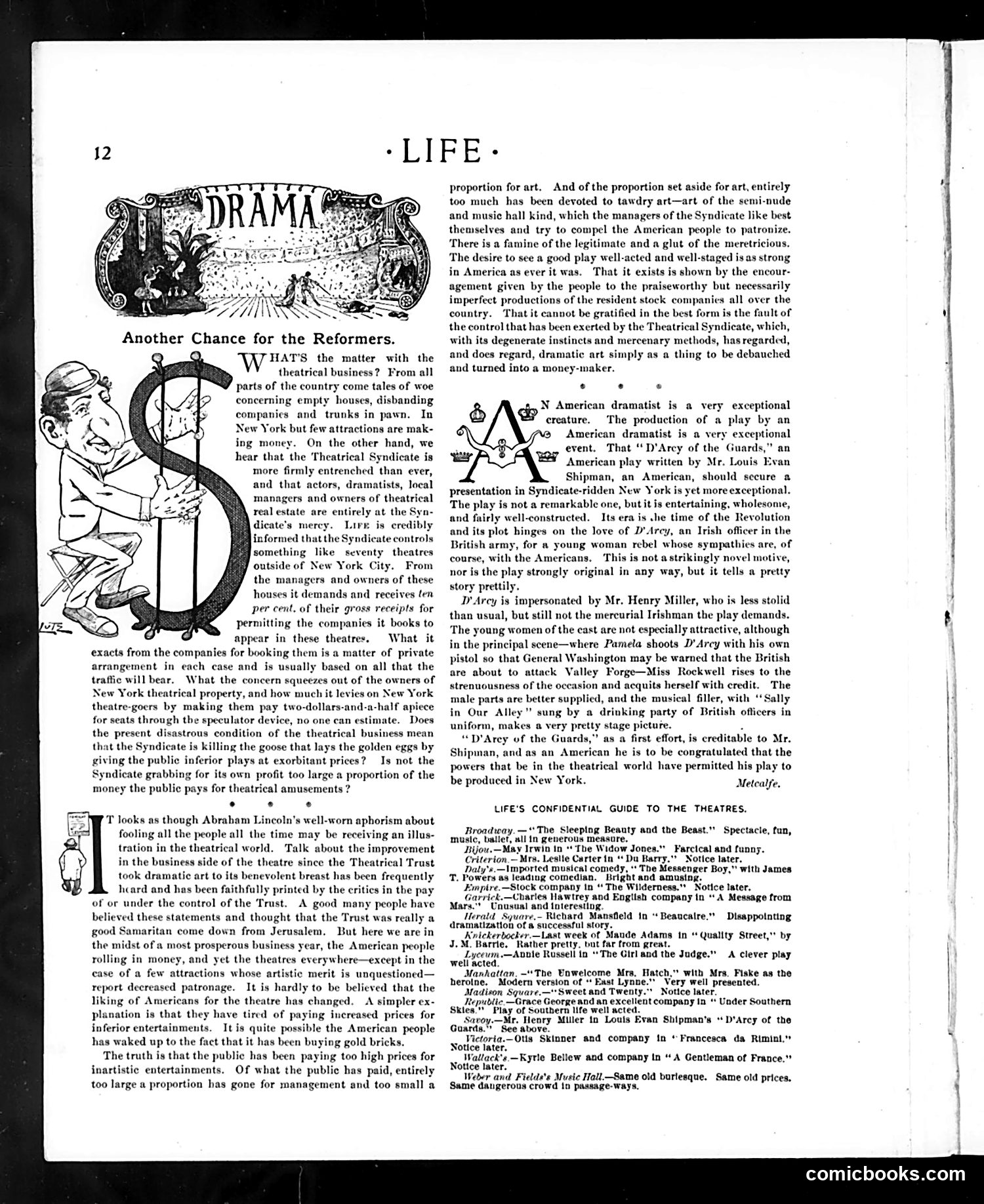
This satirical cartoon critiques the **Theatrical Syndicate**—a monopolistic booking organization controlling most American theaters outside New York City. The caricatured figure (left) appears to represent a theater manager or syndicate representative squeezing money from theatrical companies. The accompanying article argues the Syndicate exploits producers through exorbitant booking fees and control of theater access. The satire suggests "reformers" have an opportunity to challenge this monopoly, which the author presents as financially predatory—extracting excessive profits while offering inferior entertainment to the public. The piece criticizes how this system has inflated ticket prices and reduced theatrical quality, positioning syndicate control as a corrupt financial scheme harming both theater owners and audiences.
📄 Transcribed text from this page (OCR, searchable)
Machine-transcribed from the original scan — historical spelling and the odd misread are preserved.
HAT'S the matter with the theatrical business? From all parts of the country come tales of woe concerning empty houses, disbanding companies and trunks in pawn. In New York but few attractions are mak- ing money. On the other hand, we hear that the Theatrical Syndicate is more firmly entrenched than ever, and that actors, dramatists, local managers and owners of theatrical realestate are entirely at the Syn- dicate’s me: Lire is credibly informed that the Syndicate controls something like seventy theatres J outside of New York City, From the managers and owners of these houses it demands and receives fen per cent, of their gross receipts for permitting the companies it books to appear in these theatres. What it exacts from the companies for booking them is a matter of private arrangement in each case and is usually based on all that the traffic will bear. What the concern squeezes out of the owners of New York theatrical property, and how much it levies on New York theatre-goers by making them pay two-dollars-and-a-half apiece for seats through the speculator device, no one can estimate. Does the present disastrous condition of the theatrical business m that the Syndicate is killing the goose that lays the golden eggs by giving the public inferior plays at exorbitant prices? Is not the Syndicate grabbing for its own profit too large a proportion of the money the public pays for theatrical amusements ? . ° e T looks as though Abraham Lincoln's well-worn aphorism about fooling all the people all the time may be receiving an illus- tration in the theatrical world. Talk about the improvement in the business side of the theatre since the Theatrical Trust took dramatic art to its benevolent breast has been frequently hcard and has been faithfully printed by the critics in the pay of or under the control of the Trust. A good many people have believed these statements and thought that the Trust was really a good Samaritan come down from Jerusalem, But here we are in the midst of a most prosperous business year, the American people rolling in money, and yet the theatres everywhere—except in the case of a few attractions whose artistic merit is unquestioned— report decreased patronage. It is hardly to be believed that the liking of Americans for the theatre has changed. A simpler ex- planation is that they have tired of paying increased prices for inferior entertainments. It is quite possible the American people has waked up to the fact that it has been buying gold bri The truth is that the public has been paying too high prices for inartistic entertainments. Of what the public has paid, entirely too large a proportion has gone for management and too small a LIFE proportion for art. And of the proportion set aside for art, entirely too much has been devoted to tawdry art—art of the semi-nude and music hall kind, which the managers of the Syndicate like best themselves and try to compel the American people to patronize. ‘There is a famine of the legitimate and a glut of the meretricious. ‘The desire to see a good play well-acted and well-staged isas strong in America as ever it was. That it exists is shown by the encour- agement given by the people to the praiseworthy but necessarily imperfect productions of the resident stock companies all over the country. That it cannot be gratified in the best form is the fault of the control that has been exerted by the Theatrical Syndicate, which, with its degenerate instincts and mercenary methods, has regarded, and does regard, dramatic art simply as a thing to be debauched and turned into a money-maker. eo 8 6 & N American dramatist is a very exceptional creature. The production of a play by an American dramatist is a very exceptional 5 event. That “D'Arcy of the Guards,” an = YAY American play written by Mr. Louis Evan Shipman, an American, should secure a presentation in Syndicate-ridden New York is yet more exceptional. The play is not a remarkable one, but it is entertaining, wholesome, and fairly well-constructed. Its era is .he time of the Revolution and its plot hinges on the love of D'Arcy, an Irish officer in the British army, for a young woman rebel whose sympathies are, of course, with the Americans. This is not a strikingly novel motive, nor is the play strongly original in any way, but it tells a pretty story prettily. D'Arcy is impersonated by Mr. Henry Miller, who is less stolid than usual, but still not the mercurial Irishman the play demands, The young women of the cast are not especially attractive, although in the principal scene—where Pamela shoots D’Arcy with his own pistol so that General Washington may be warned that the British are about to attack Valley Forge—Miss Rockwell rises to the strenuousness of the occasion and acquits herself with credit. The male parts are better supplied, and the musical filler, with “Sally in Our Alley” sung by a drinking party of British officers in uniform, makes a very pretty stage picture. “D'Arcy of the Guards,” as a first effort, is creditable to Mr. Shipman, and as an American he is to be congratulated that the powers that be in the theatrical world have permitted his play to be produced in New York. Metcalfe, LIFE'S CONFIDENTIAL GUIDE TO THE THEATRES. Broadway. —“The Sleeping Beauty and the Beast." Spectacle, fun, ballet, all In generous measure, ‘Bijou.—May Irwin in “The Widow Jones.” Farctcal and funny. Criterion. — Mra. Lesite Carter in“ Du Barry," Notice later. Daly's.—\mported musical comedy, ** The Messenger Boy,” with James T. Powers a3 leading comedian. Bright and amusing. Empire.—Stock company in“ The Wilderness." Notice later. Garrick.—Charies Hawtrey and English company tn “A Message from Mars." Unusual and {nteresilng. Herald Square. Richard Mansfield tn “Beaucalre.” Disappotnting dramatization of a successful story. Knickerbocker.—Last week of Maude Adams in “Quallty Street,"* by SoM Barton Haines prety, bat far trom great Lyceum.—Annte Russell in “The Gtrl and the Judge." A clever play weil acted. Manhatyan, —“The Lowelcome Mrs. Hatch,” with Mrs. Flake as the heroine. Modern version of * East Lynn Madison Square.—"Sweet and Twenty. Republic. —Grace George and an excellent cot Skies." Play of Southern life well acted. Mr. Henry Miller in Louls Evan Shipman’s “D*arcy of the "See above. Victoria.—Otis Skinner and company in ‘Francesca da Rimini."* Notice later. Wallack’e —Kytle Bellew and company in “A Gentleman of France." Notice later. Weber and Fields's Music Hall—Same old burlesque. Same old prices. Same dangerous crowd in passage-ways, ny in “ Under Southern comicbooks.com