
Life, 1902-01-02 · page 8 of 20
Life — January 2, 1902 — page 8: what you’re looking at
What you’re looking at
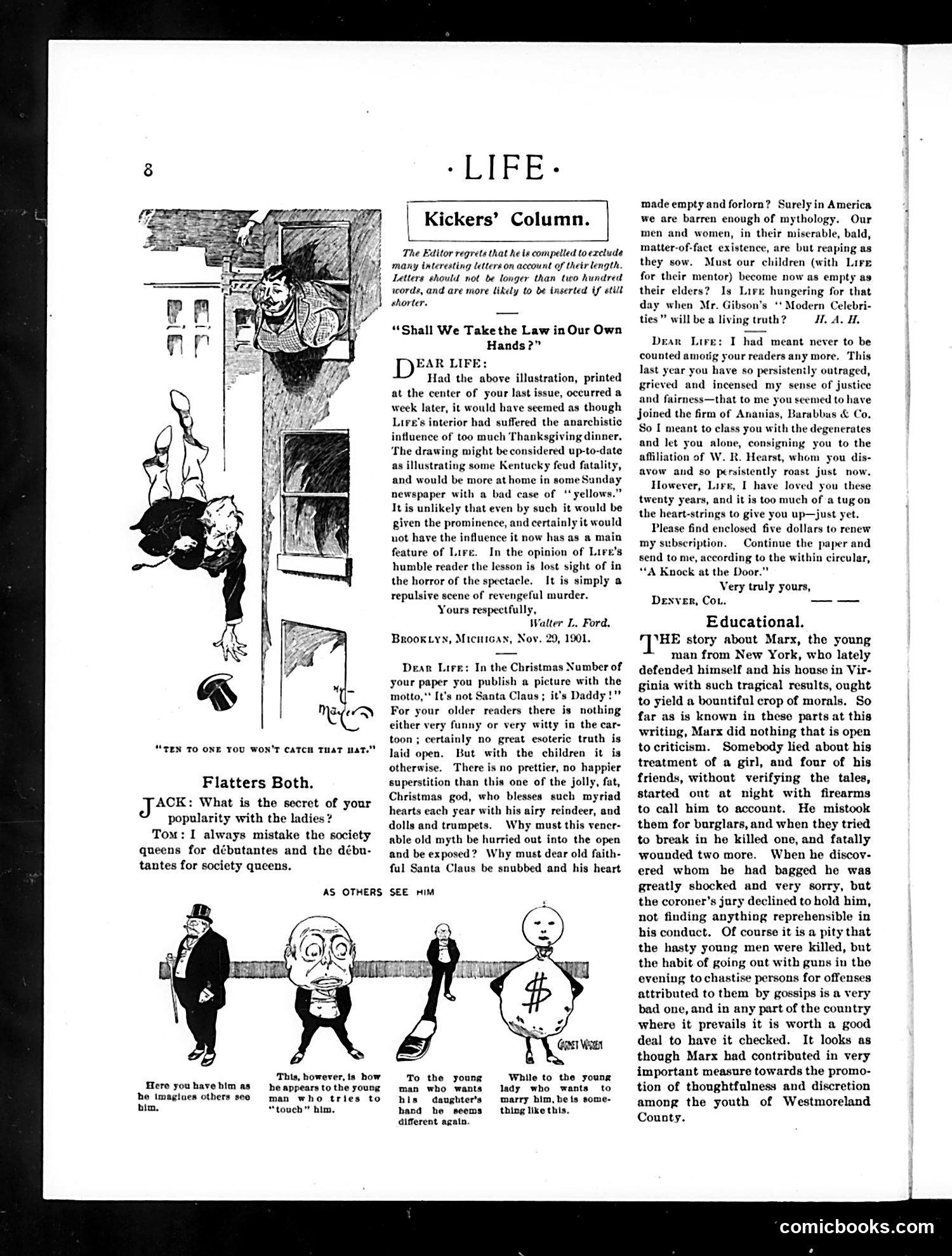
This page contains reader letters and a section titled "Flatters Both" with accompanying cartoons about social etiquette. The cartoons illustrate contrasting male types and their appeal to different social circles. The left figure (labeled as someone who "imagines others see him") appears to be a working-class or common man, while subsequent figures represent wealthier or more refined types. The final figure sports a dollar sign, satirizing materialism. The satire critiques how social status—particularly wealth—determines acceptance in high society, while simultaneously mocking both the pretentiousness of the wealthy and the delusions of those who aspire to their station. The point appears to be that regardless of class pretensions, money ultimately buys social access in American society.
📄 Transcribed text from this page (OCR, searchable)
Machine-transcribed from the original scan — historical spelling and the odd misread are preserved.
“TEN TO ONE YOU WON'T CATCH THAT HAT.” Flatters Both. ACK: What is the secret of your popularity with the ladies? Tom: I always mistake the society queens for débutantes and the débu- tantes for society queens, AS OTHERS »LIFE: | Kickers’ Column. L The Editor regrets that he ts compelled toexetude many interesting letters on account of their length. Letters should not be longer than tio hundred words, and are more likely to be inserted Uf stilt shorter. “Shall We Take the Law in Our Own Hands?” D* R LIFE: Had the above illustration, printed at the center of your last issue, occurred a week later, it would have seemed as though Lire’s interior had suffered the anarchistic influence of too much Thanksgiving dinner. ‘The drawing might be considered up-to-date as illustrating some Kentucky feud fatality, and would be more athome in some Sunday newspaper with a bad case of “yellows.” It is unlikely that even by such it would be given the prominence, and certainly it would uot have the influence it now has as a main feature of Lire. In the opinion of Lire’s humble reader the lesson is lost sight of in the horror of the spectacle. It is simply a repulsive scene of revengeful murder. Yours respectfully, Walter L, Ford. Noy. 29, 1901. Dear Lire: In the Christmas Number of your paper you publish a picture with the motto," [t's not Santa Claus; it’s Daddy!" For your older readers there is nothing either very funny or very witty in the car- toon; certainly no great esoteric truth is laid open. But with the children it is otherwise. There is no prettier, no happier superstition than this one of the jolly, fat, Christmas god, who blesses such myriad hearts each year with his airy reindeer, and dolls and trumpets. Why must this vener- able old myth be hurried out into the open and be exposed? Why must dear old faith- ful Santa Claus be snubbed and his heart SEE HIM ‘This, however, is how he appears to the young man who tries to “touch” him, Here you have bim as he imagines others see bin. To the young man who wants his daughter's hand he seems different again. While to the young Indy who wants to marry bim, bets some- thing like this. made empty and forlorn? Surely in America we are barren enough of mythology. Our men and women, in their miserable, bald, matter-of-fact existence, are but reaping as they sow. Must our children (with Lire for their mentor) become now as empty as their elders? Is Lire hungering for that day when Mr. Gibson's ‘* Modern Celebri- ties” be a living truth? A. HH. Dear Lire: I had meant never to be counted amotig your readers any more. This last year you have so persistently outraged, grieved and incensed my sense of justice and fairness—that to me you seemed to have joined the firm of Ananias, Barabbus & Co. So I meant to class you with the degenerates and let you alone, consigning you to the affiliation of W. R. Hearst, whom you dis- avow and so persistently roast just now. However, Lire, I have loved you these twenty years, and it is too much of a tugon the heart-strings to give you up—just yet. Please find enclosed five dollars to renew my subscription. Continue the paper and send to me, according to the within circular, ‘*A Knock at the Door.” Very truly yours, Dexver, Cou. Educational. ‘HE story about Marx, the young man from New York, who lately defended himself and his house in Vir- ginia with such tragical results, ought to yield a bountiful crop of morals. So far as is known in these parts at this writing, Marx did nothing that is open to criticism. Somebody lied about his treatment of a girl, and four of his friends, without verifying the tales, started out at night with firearms to call him to account. He mistook them for burglars, and when they tried to break in he killed one, and fatally wounded two more. When he discov- ered whom he had bagged he was greatly shocked and very sorry, but the coroner’s jury declined to hold him, not finding anything reprehensible in his conduct. Of course it is a pity that the hasty young men were killed, but the habit of going out with guns in the evening to chastise persons for offenses attributed to them by gossips is a very bad one, and in any part of the country where it prevails it is worth a good deal to have it checked. It looks as though Marx had contributed in very important measure towards the promo- tion of thoughtfulness and discretion among the youth of Westmoreland County. comicbooks.com e