
Life, 1902-01-02 · page 4 of 20
Life — January 2, 1902 — page 4: what you’re looking at
What you’re looking at
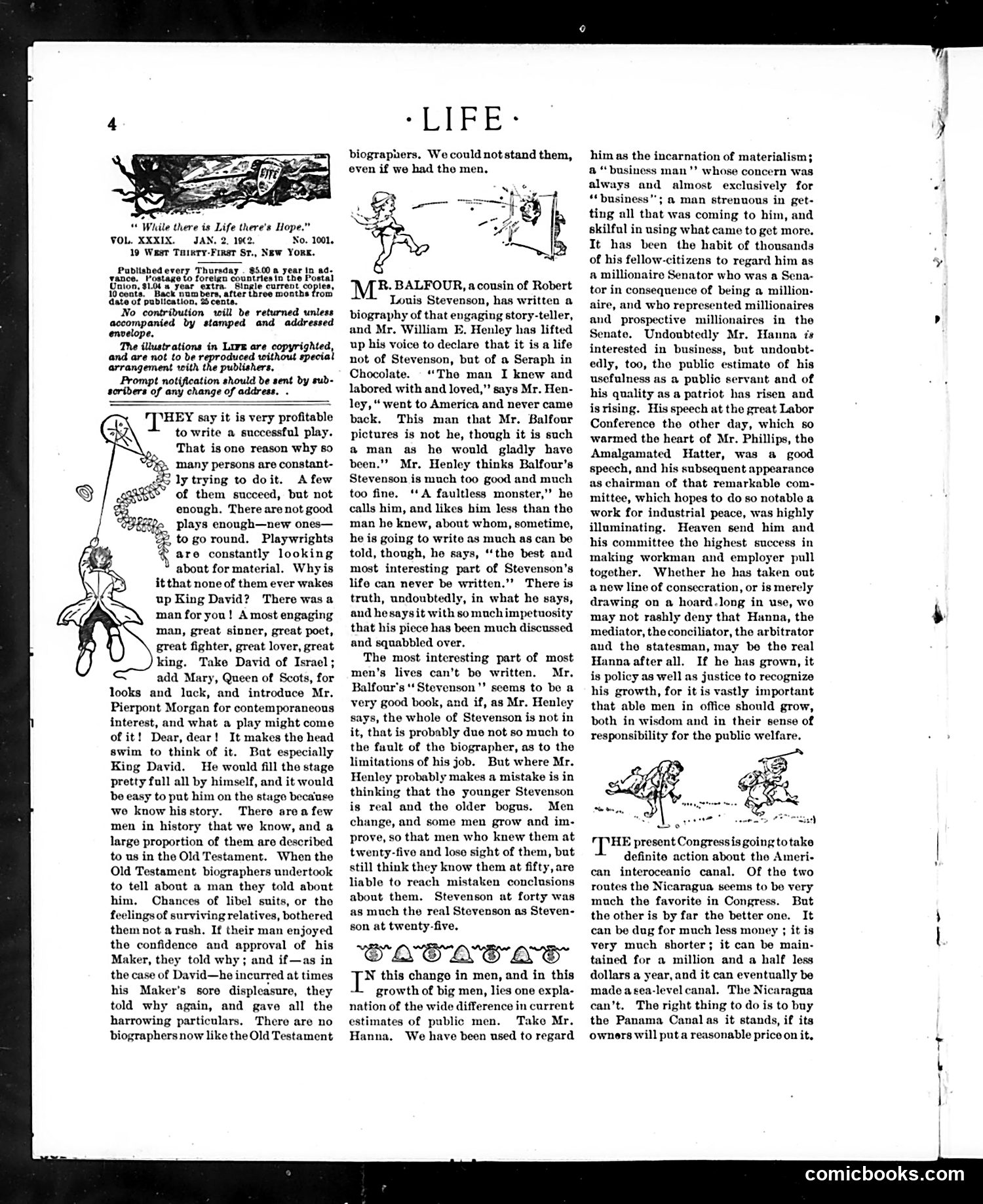
This page discusses **Robert Louis Stevenson's biography** by William E. Henley, critiquing both the book and biographical writing generally. The text debates whether Stevenson's life was truly as interesting as his fiction. The **left margin contains decorative illustrations** of figures in action poses—appearing to be generic artistic flourishes rather than specific political caricatures. The **lower section** transitions to discussion of **Congressional action on an American canal** (likely the Nicaragua Canal, mentioned explicitly). The satire compares canal-building options: one route "can be dogged for much less money"; another "can be much shorter." The point mocks Congress's indecision and cost-consciousness regarding major infrastructure projects—suggesting political gridlock over practical engineering decisions.
📄 Transcribed text from this page (OCR, searchable)
Machine-transcribed from the original scan — historical spelling and the odd misread are preserved.
“ While there is Life there's Hope.” VOL. XXXIX. JAN, 2. 102. No, 1001, 19 Wast Taikty-First St., New YORK. Published every Thursday . $5.00 a year In ad. \c8. Postage to foreign countries in the Postal Cnion, $1.06 4 year extra. Single current copies, 10 conts. “Back numbers, after three months from ate of publication, 2 cents, No contribution will be returned unless accompanied by stamped and addressed envelope. ‘The illustrations in Lure are copyrighted, and are not to be reproduced without special arrangement with the publishers, Prompt notification should be sent by sud- soribers of any change of address. . rPaEr say it is very profitable to write a successful play. That is one reason why 80 many persons are constant- 3 ly trying to doit. Afew AKT” of them succeed, but not & enough. There are not good ‘Saez. plays enough—new ones— &® to go round. Playwrights @ are constantly looking abont for material. Why is it that none of them ever wakes up King David? There wasa man for you! A most engaging man, great sinner, great poet, great fighter, great lover, great king. Take David of Israel; add Mary, Queen of Scots, for looks and luck, and introduce Mr. Pierpont Morgan for contemporaneous interest, and what a play might come of it! Dear, dear! It makes the head swim to think of it. But especially King David. He would fill the stage pretty fall all by himself, and it would be easy to put him on the stage because wo know his story. There area few men in history that we know, and a large proportion of them are described to us in the Old Testament. When the Old Testament biographers undertook to tell about a man they told about him. Chances of libel suits, or the feelings of surviving relatives, bothered them not a rush. If their man enjoyed the confidence and approval of his Maker, they told wh: nd if—as in the case of David—he incurred at times his Maker's sore displeasure, they told why again, and gave all the harrowing particulars, There are no biographers now like the Old Testament * LEE biographers, We could not stand them, even if we had the men, R. BALFOUR, acousin of Robert Louis Stevenson, has written a biography of that engaging story-teller, and Mr, William E. Henley has lifted up his voice to declare that it is a life not of Stevenson, but of a Seraph in Chocolate. ‘The man I knew and labored with and loved,”’ says Mr. Hen- ley, “ went to America and never came back, This man that Mr. Balfour pictures is not he, though it is such @ man as he would gladly have been."? Mr. Henley thinks Balfour’s Stevenson is much too good and much too fine. ‘A faultless monster,” he calls him, and likes him less than the man he knew, about whom, sometime, he is going to write as much as can be told, though, he says, ‘‘the best and most interesting part of Stevenson’s life can never be written.’’ There is truth, undoubtedly, in what he says, and hesaysit with somuchimpetuosity that his piece has been much discussed and squabbled over. The most interesting part of most men’s lives can’t bo written. Mr, Balfour's ‘Stevenson’ seems to be a very good book, and if, as Mr. Henley says, the whole of Stevenson is not in it, that is probably due not so much to the fault of the biographer, as to the limitations of his job. But where Mr. Henley probably makes a mistake is in thinking that the younger Stevenson is real and the older bogus. Men change, and some men grow and im- prove, so that men who knew them at twenty-five and lose sight of them, but still think they know them at fifty, are liable to reach mistaken conclusions about them. Stevenson at forty was as much the real Stevenson as Steven- son at twenty-five. SLOEOS OS - this chango in men, and in this growth of big men, lies one expla- nation of the wide difference in current estimates of public men. Take Mr. Hanna, We have been used to regard him as the incarnation of materialism; a “business man’? whose concern was always and almost exclusively for “business”; a man strenuous in get- ting all that was coming to him, and skilful in using what came to get more. It has been the habit of thousands of his fellow-citizens to regard him as a millionaire Senator who was a Sena- tor in consequence of being a million- aire, and who represented millionaires and prospective millionaires in the Senate, Undoubtedly Mr. Hanna ts interested in business, but undoubt- edly, too, the public estimate of his usefulness as a public servant and of his quality as a patriot has risen and is rising. His speech at the great Labor Conference the other day, which so warmed the heart of Mr. Phillips, the Amalgamated Hatter, was a good specch, and his subsequent appearance as chairman of that remarkable com- mittee, which hopes to do so notable a work for industrial peace, was highly illuminating. Heaven send him and his committee the highest success in making workman and employer pull together. Whether he has taken out a new line of consecration, or is merely drawing on a hoard.long in use, wo may not rashly deny that Hanna, the mediator, the conciliator, the arbitrator and the statesman, may be the real Hanna after all. If he has grown, it is policy as well as justice to recognize his growth, for it is vastly important that able men in office should grow, both in wisdom and in their sense of responsibility for the public welfare. HE present Congressis going totake definite action about the Ameri- can interoceanio canal. Of the two routes the Nicaragua seems to be very much the favorite in Congress. But the other is by far the better one. It can be dug for much less money ; it is very much shorter; it can be main- tained for a million and a half less dollars a year, and it can eventually be made asea-level canal. The Nicaragua can’t. The right thing to do is to buy the Panama Canal as it stands, if its owners will put a reasonable price on it. comicbooks.com Sa