
A complete issue · 20 pages · 1901
Life — November 21, 1901
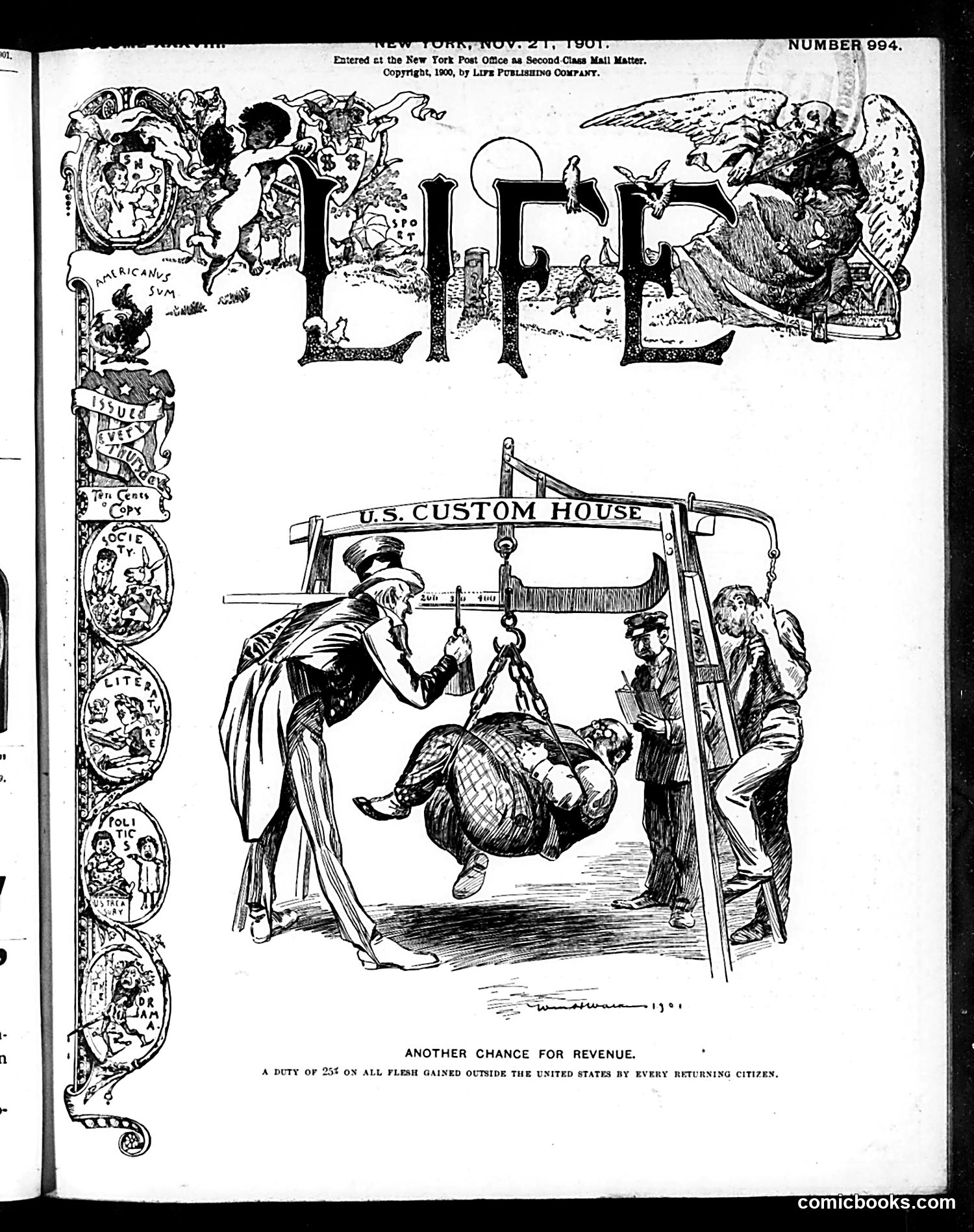
This political cartoon satirizes U.S. Customs enforcement at the border. It depicts a customs official at a weighing scale labeled "U.S. CUSTOM HOUSE," examining what appears to be a returning American citizen carrying meat or provisions from abroad. The caption reads: "A DUTY OF 25¢ ON ALL FLESH GAINED OUTSIDE THE UNITED STATES BY EVERY RETURNING CITIZEN." The satire targets tariff policy—specifically, the practice of taxing goods (and here, absurdly, the physical weight gained from eating foreign food) that Americans bring back home. It mocks the government's relentless pursuit of revenue through tariffs and customs duties, suggesting the policy has become so excessive it borders on the ridiculous.
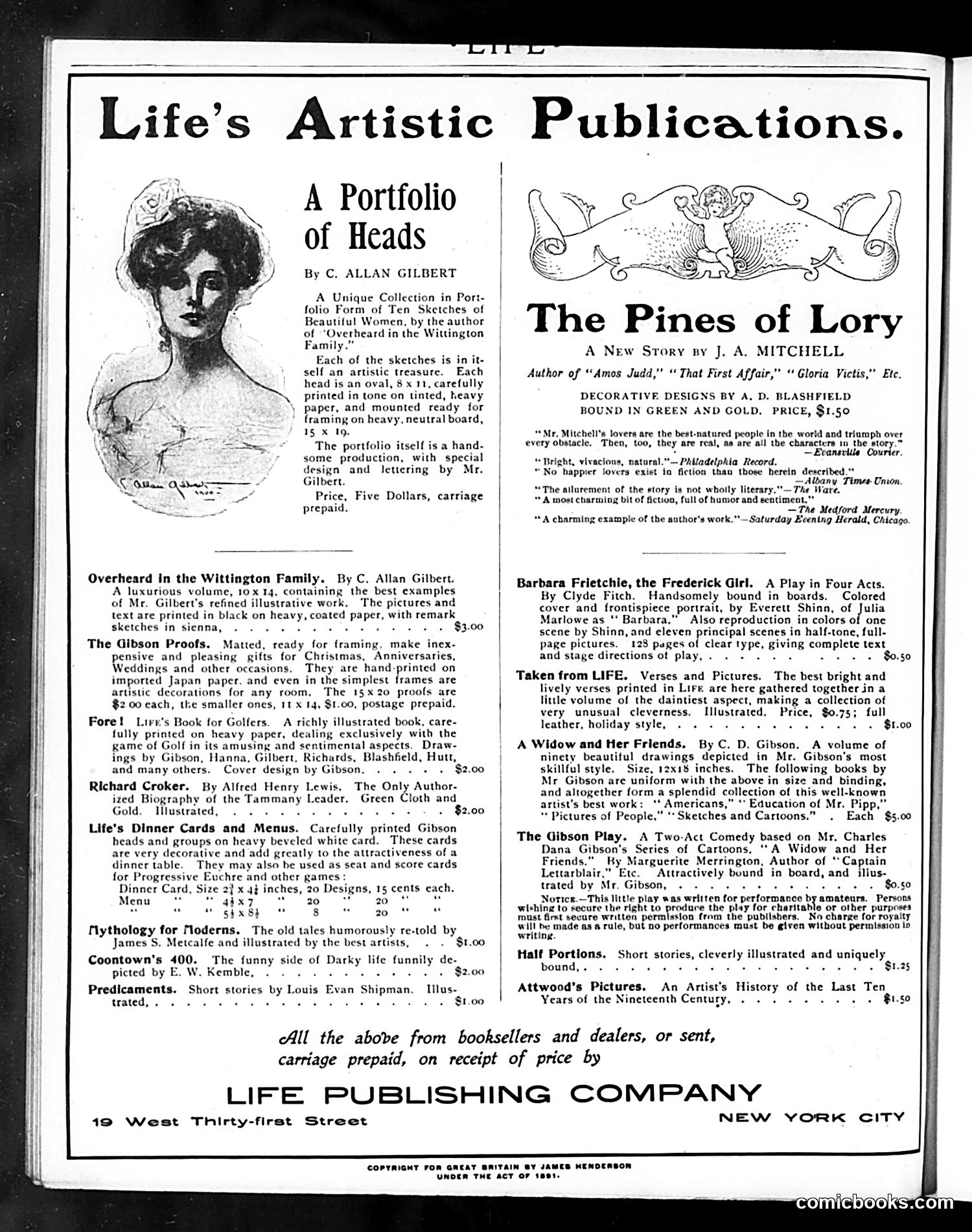
This page is primarily **advertising** for Life Publishing Company's artistic publications, rather than political cartoons or satire. The featured image shows a sketched portrait of an elegant woman's head, illustrating "A Portfolio of Heads" by C. Allan Gilbert. The advertisement emphasizes this as "a unique collection in Portfolio Form of Ten Sketches of Beautiful Women." The page catalogs various Life publications available for purchase, including illustrated books, plays, and story collections. All items are described with prices and can be ordered through booksellers or directly from Life Publishing Company at 19 West Thirty-first Street, New York City. There is no apparent political satire or social commentary on this page—it functions simply as a commercial catalog of the publisher's artistic merchandise.
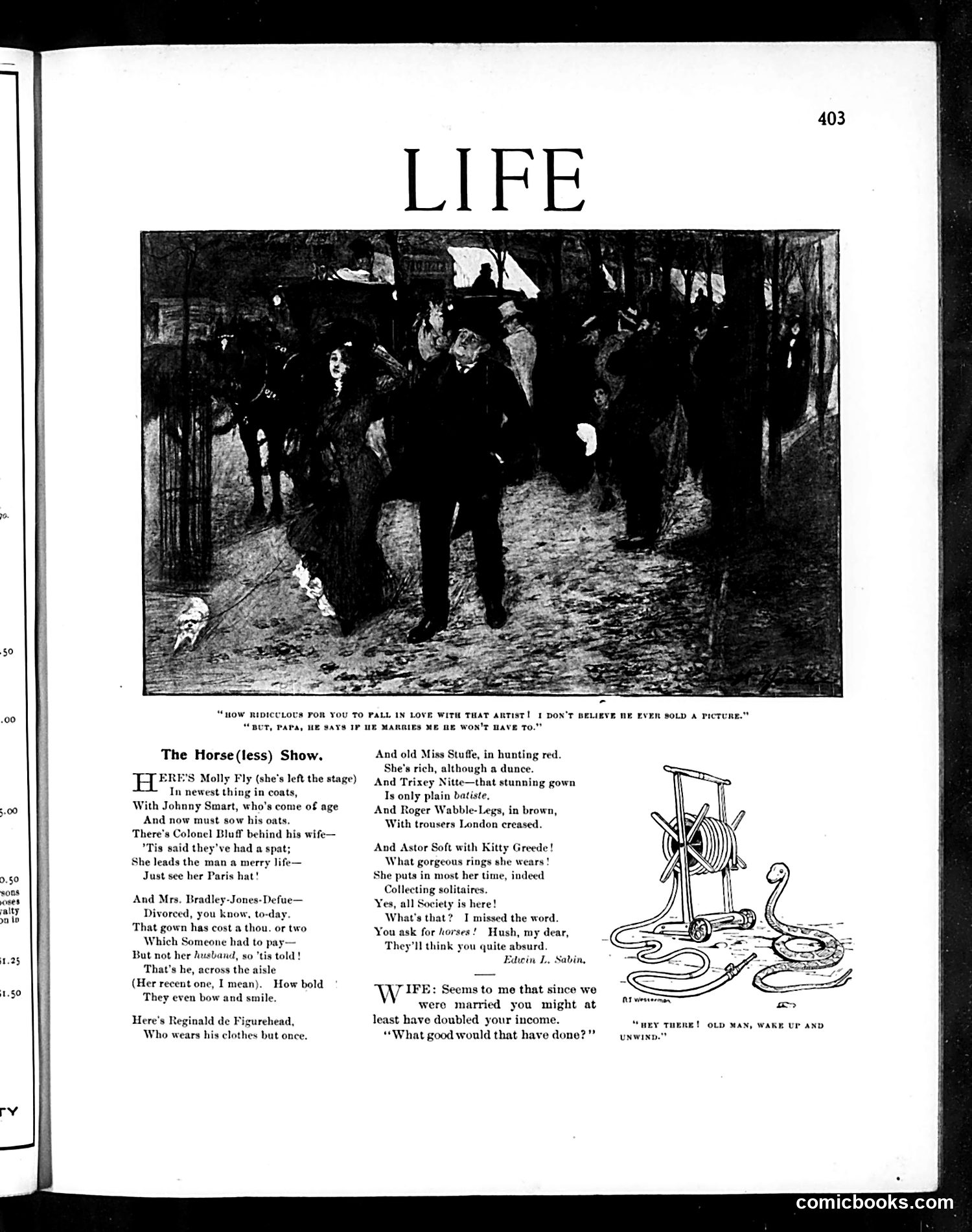
This page satirizes high society's adoption of the automobile, mocking the wealthy socialites who've abandoned horse-drawn carriages. The poem catalogs fashionable people attending what appears to be a motorcar exhibition or social event, with names like "Miss Stuffe," "Tracey Nobs," and "Roger Wabble-Legs"—transparent ridicules of the elite classes. The title "Horse(less) Show" is a pun: it mimics traditional horse shows while emphasizing cars' novelty. The satirical tone mocks both the pretension of Society attending this new technology event and the absurdity that wealthy people now must learn to drive rather than simply ride horses. The cartoon's dialogue about doubling income reflects anxieties about automobiles' cost and the economic implications of this emerging technology for the upper class.
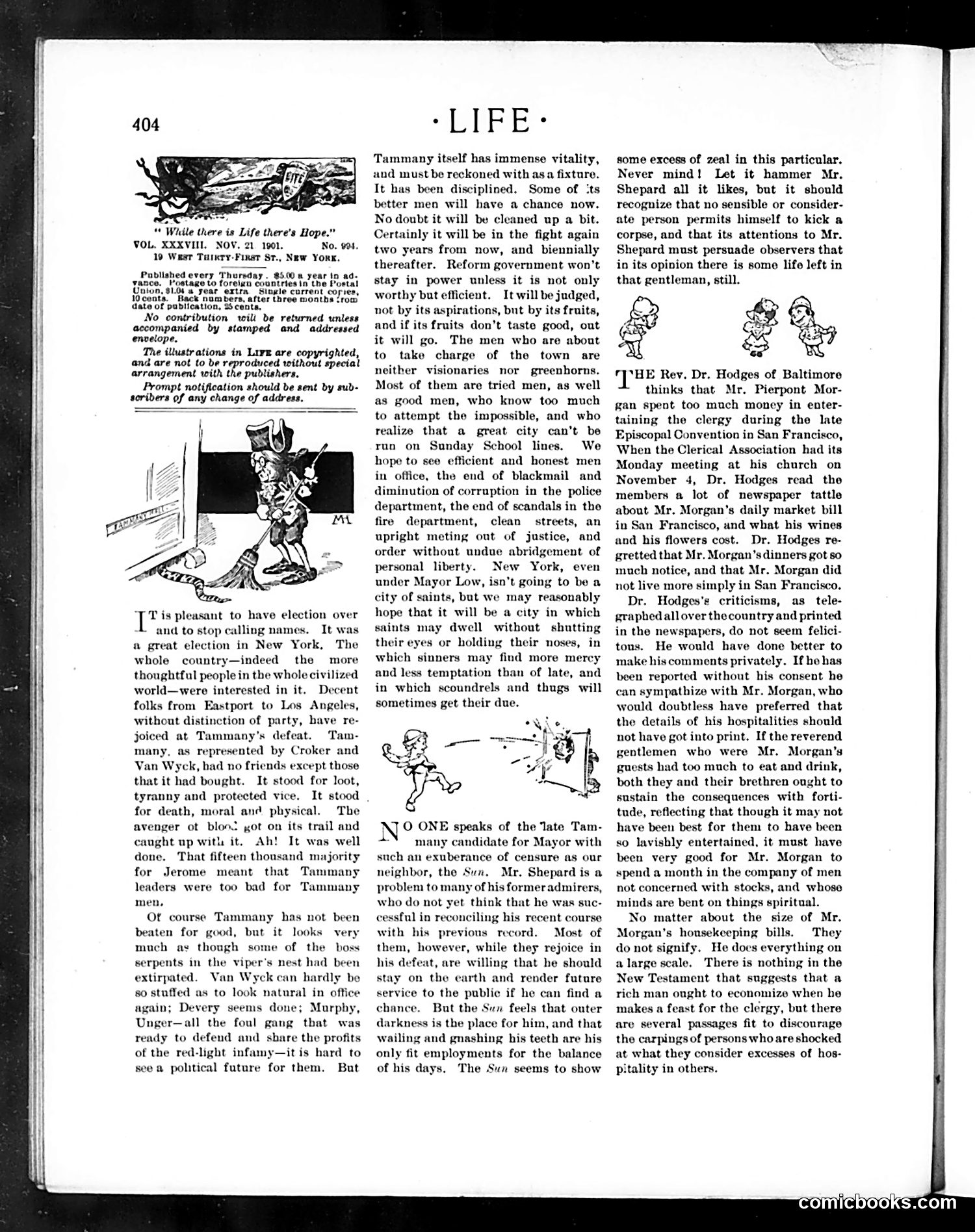
This page critiques New York City politics during what appears to be a mayoral election. The text discusses Tammany Hall's influence and corruption, referencing candidate Mr. Shepard and concerns about whether reform is possible under the current political machine. The left illustration shows a figure at a desk labeled "LIFE," appearing to represent the magazine's editorial stance on civic matters. The page also includes commentary on Rev. Dr. Hodges of Baltimore's criticism of Mr. Pierpont Morgan's spending on clergy entertainment and daily market bills in San Francisco—suggesting wealthy individuals' ostentatious religious patronage while neglecting broader moral reform. The overall tone satirizes both urban political corruption and wealthy philanthropists' selective charity, questioning whether real civic improvement is possible under existing power structures.
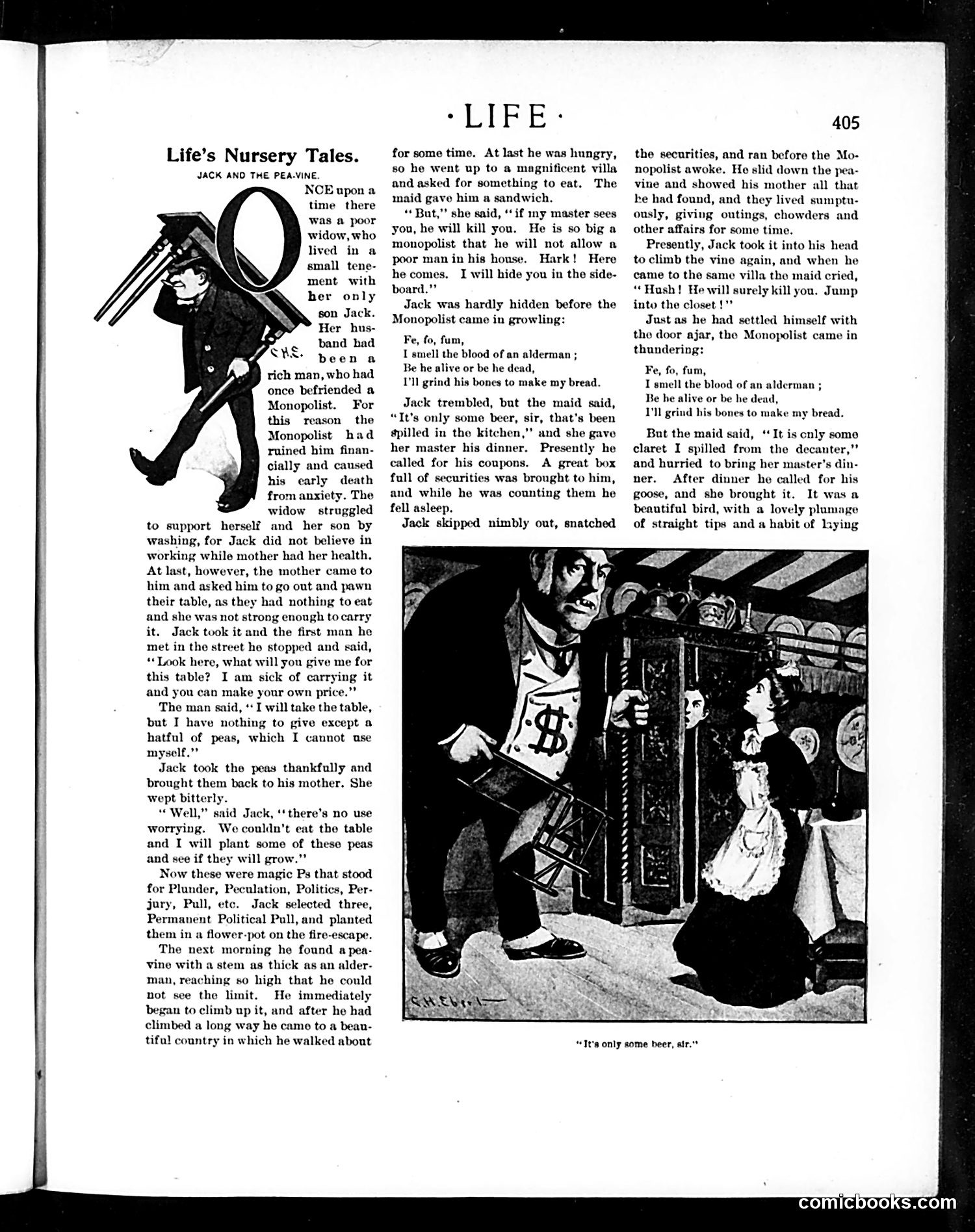
This is a political allegory disguised as a nursery tale retelling. Jack plants magic peas that grow into a massive vine—a metaphor for monopolistic corporate power. The story satirizes **monopolists** who exploit poor people and accumulate obscene wealth. The illustration shows a confrontation between Jack (representing the common man) and a figure labeled with a "$" symbol (the monopolist). The maid's repeated warning—"I smell the blood of an alderman"—appears to mock corrupt city officials in league with big business. The satire's core message: monopolies strangle ordinary people's economic survival, while politicians either collude with or ignore the problem. This reflects Progressive Era anxieties about unchecked corporate power and its corrupting influence on government.
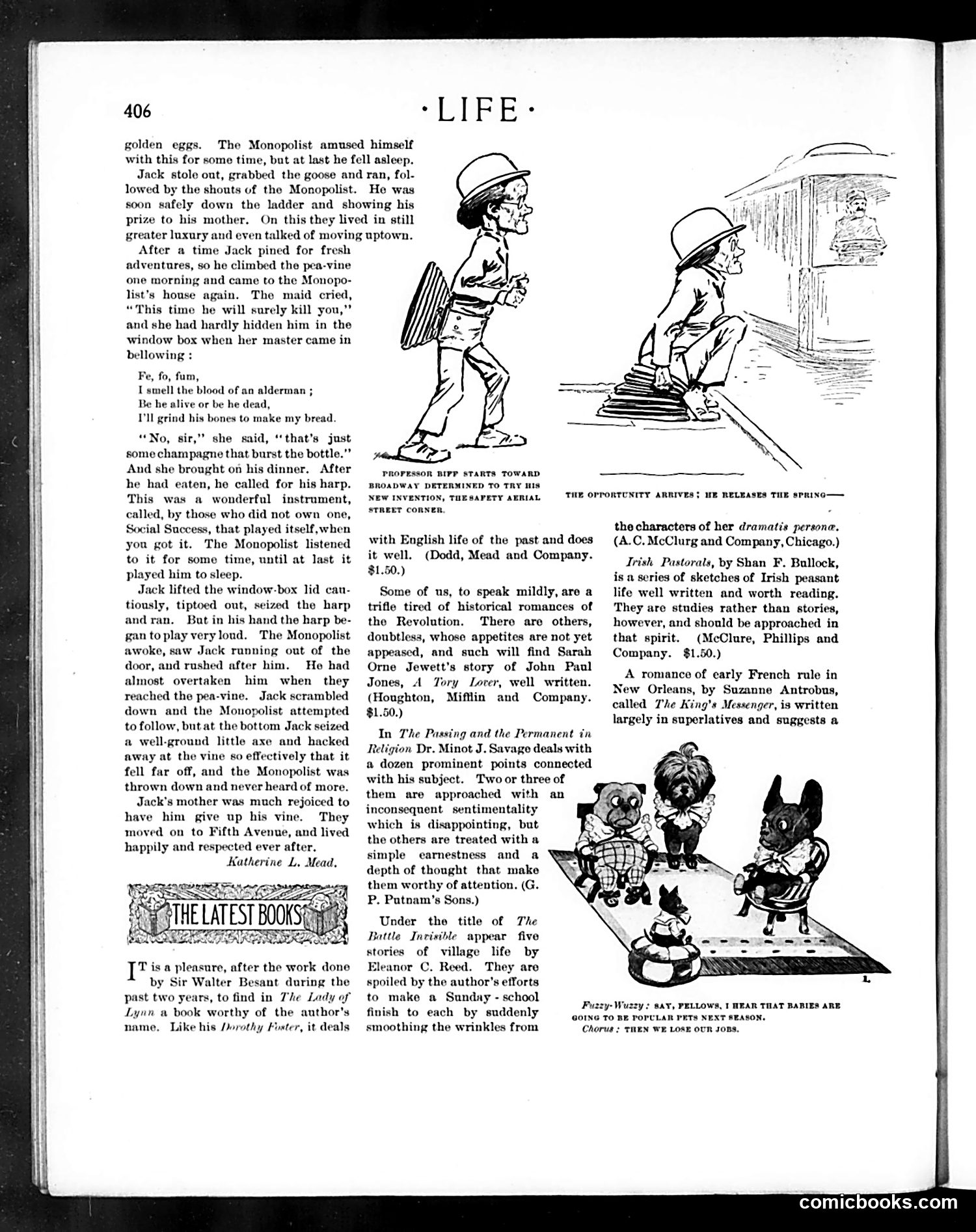
This page consists primarily of a book review section titled "The Latest Books" rather than political satire. The main illustration shows two figures in early 20th-century dress on what appears to be a street corner or building entrance—one climbing or descending while the other waits below. The caption references "Professor on his way toward Broadway determined to try his new pneumatic tire safety aerial street corner," suggesting the cartoon satirizes a new safety invention or urban transportation method, likely pneumatic (air-filled) tire technology applied to pedestrian safety devices. The reviews discuss various contemporary novels, including works about Irish life and French colonial history. The page appears to be from a cultural magazine focused on literature rather than political commentary.
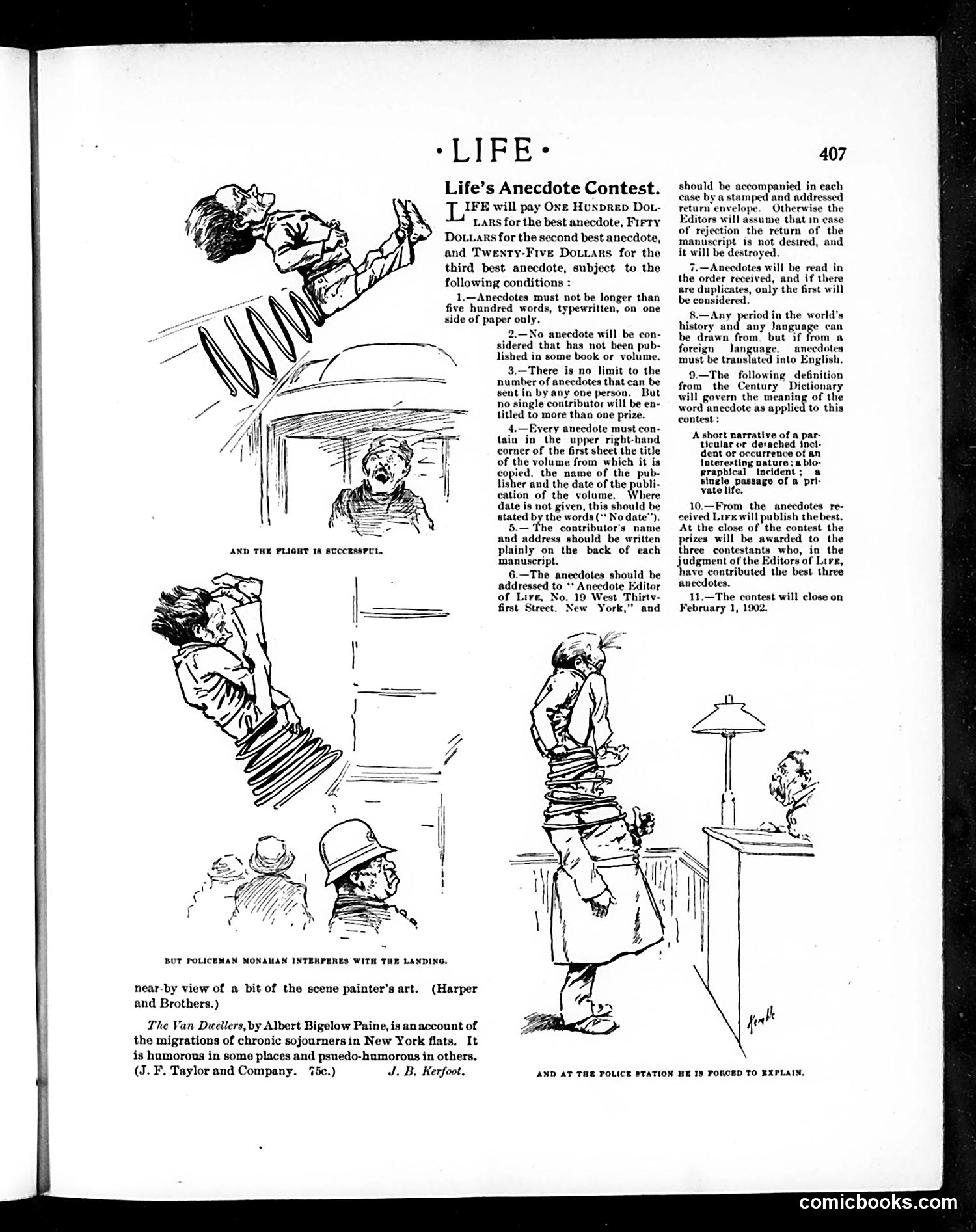
This page announces **Life's Anecdote Contest**, offering prizes ($100, $50, $25) for the best humorous short stories. The accompanying illustrations satirize **urban life in New York**, depicting various comedic scenarios: a figure in flight (top), a policeman interfering with a landing or arrest (middle), and a man being forcibly removed at a police station (bottom). The cartoons mock **Gilded Age urban chaos**—likely referencing the tensions between police authority, immigrant populations, and public disorder in turn-of-the-century New York City. The text mentions "The Van Deetlers," a book about "chronic sojourners in New York flats," suggesting the humor targets transient urban residents and police misconduct. The overall tone is satirical commentary on city life's absurdities.
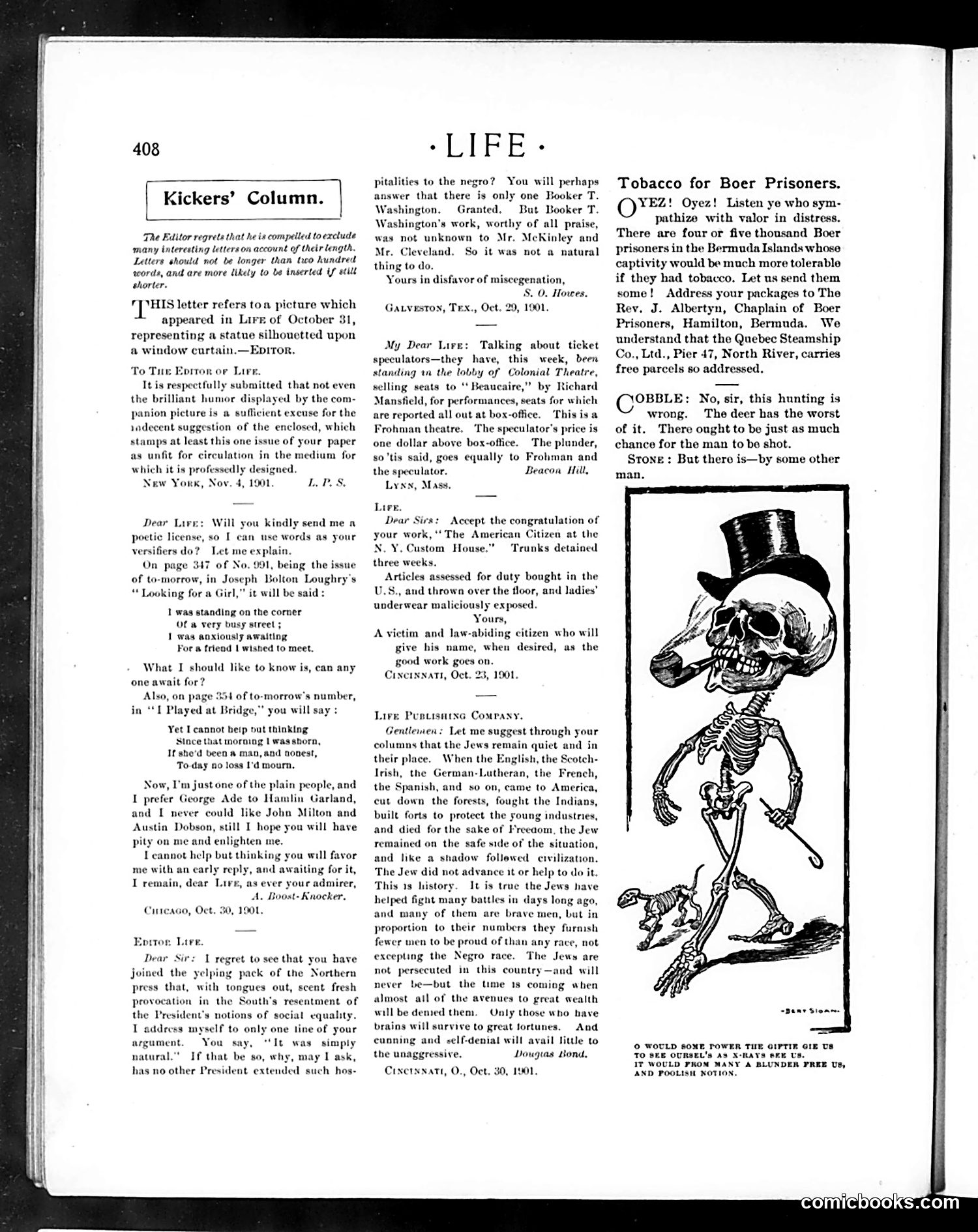
This page features "Kickers' Column," a letters section, alongside a prominent skeleton illustration wearing a top hat. The skeleton cartoon satirizes wealth inequality and predatory capitalism. The caption states: "O would some power the gifle gie us / To see ourself as others see us, / If would some want a blunder free us / And foolish notion." The skeleton—a memento mori symbol—represents death and decay, suggesting that unchecked greed and social exploitation lead to societal collapse. The top hat marks the figure as wealthy or upper-class. The accompanying letters debate racial hierarchies, immigration, and labor issues characteristic of early 1900s progressive criticism. The cartoon's message appears to be a warning about the moral bankruptcy of unregulated wealth accumulation in the Gilded Age.
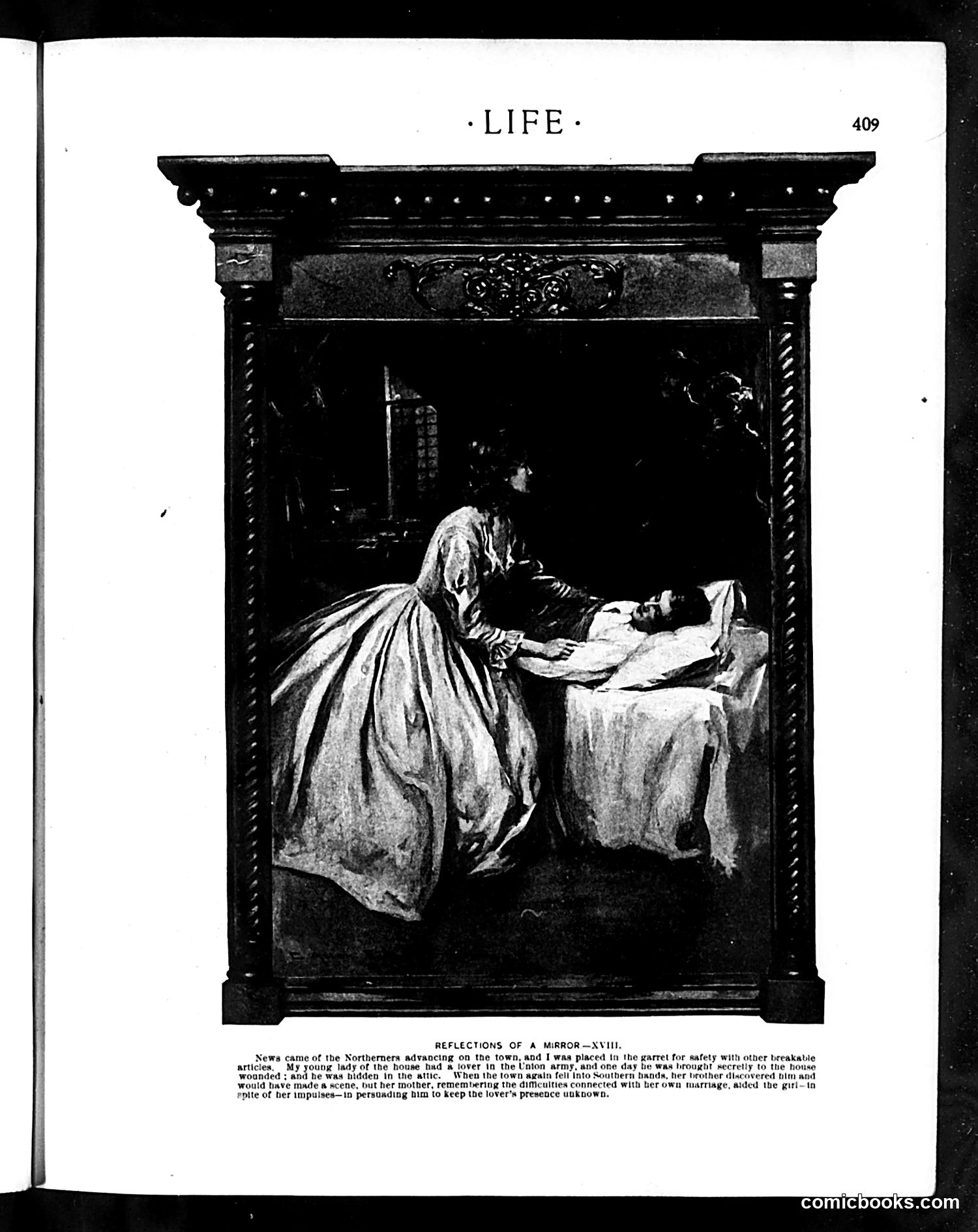
This is a narrative illustration rather than political satire. The caption describes a Civil War-era story: a woman from the North hides a wounded Union soldier in her attic during a Southern occupation. When the town falls to Union forces again, her Southern lover discovers the soldier's presence. Rather than betray her, the lover helps her keep the soldier's presence secret to preserve their relationship. The image shows an intimate domestic scene—an older woman tending to a bedridden young man—rendered in dramatic chiaroscuro. It's a sentimental tale about competing loyalties (North vs. South, duty vs. love) during the war, presented as moral narrative rather than comedic satire. The ornate frame emphasizes the story's dramatic, theatrical quality.
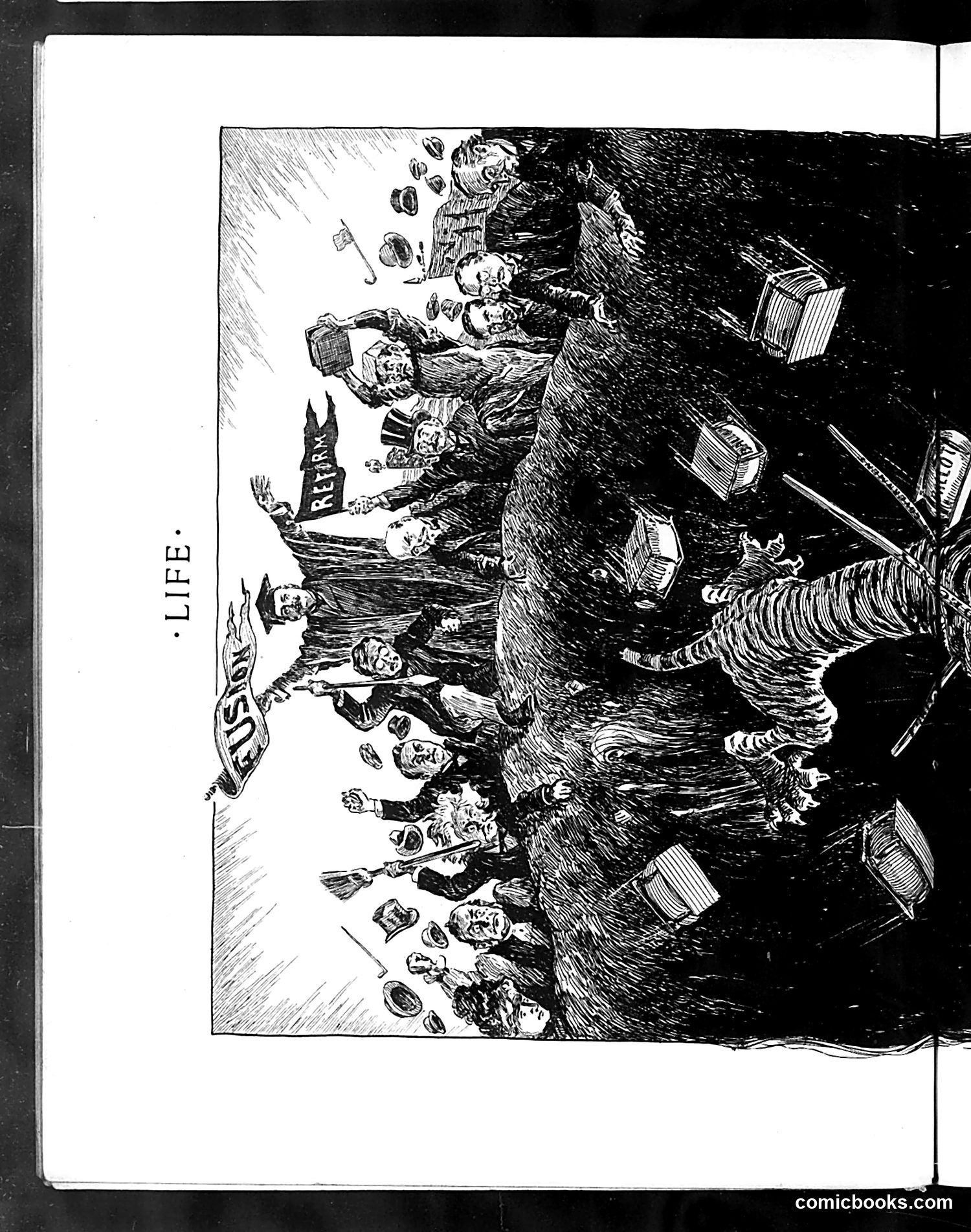
This appears to be a political cartoon from *Life* magazine (a satirical publication that ran from 1883-1936). The image is oriented sideways and depicts a large, menacing figure labeled "BOSS" towering over numerous smaller human figures who appear distressed or fleeing. Books or documents are scattered around them. The cartoon satirizes **political corruption and boss rule** — likely referencing machine politics and the power of political "bosses" who controlled urban political systems in early 20th-century America. The tiny figures represent ordinary citizens being dominated or exploited by the powerful political boss above them. The scattered books/papers suggest disruption of legitimate civic institutions or education. This reflects *Life*'s satirical critique of urban political corruption and the concentration of power in few hands.
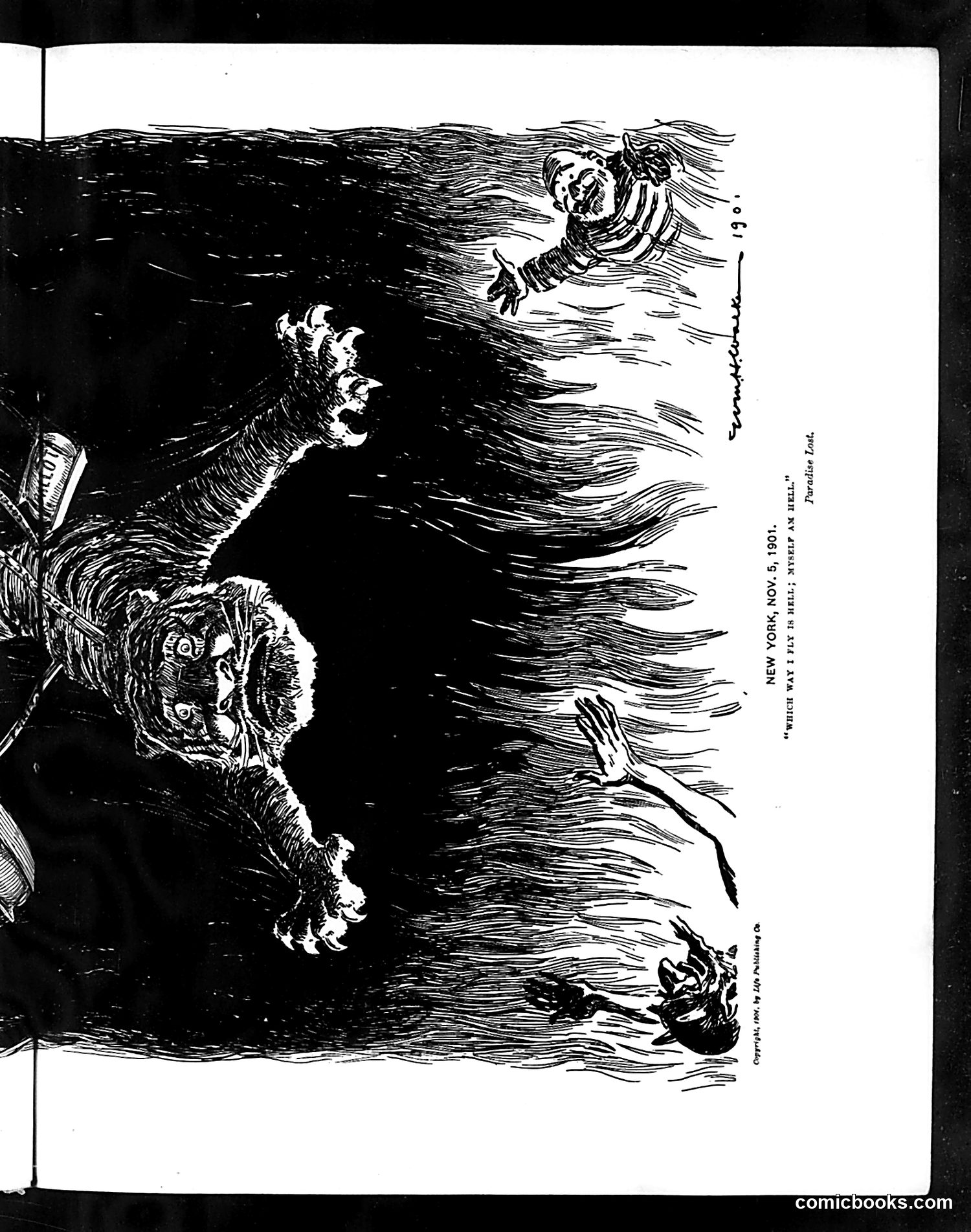
This appears to be a satirical illustration from *Life* magazine dated November 5, 1903. The cartoon depicts an underwater or aquatic scene with exaggerated, grotesque figures engaged in what appears to be a chaotic struggle or battle. The left side shows a figure with an ornate, elaborately decorated costume or armor, while the right features a figure in mid-air appearing distressed. Multiple other figures populate the composition in dynamic, struggling poses. Without clearer text attribution or visible identifying marks on the figures themselves, I cannot confidently identify the specific political figures or events being satirized. The artistic style and composition suggest commentary on contemporary political conflict or international affairs, but the specific reference remains **unclear from the image alone**. The ornate costume details and aquatic setting may carry symbolic meaning typical of Gilded Age political cartooning that modern viewers would need additional historical context to decode.
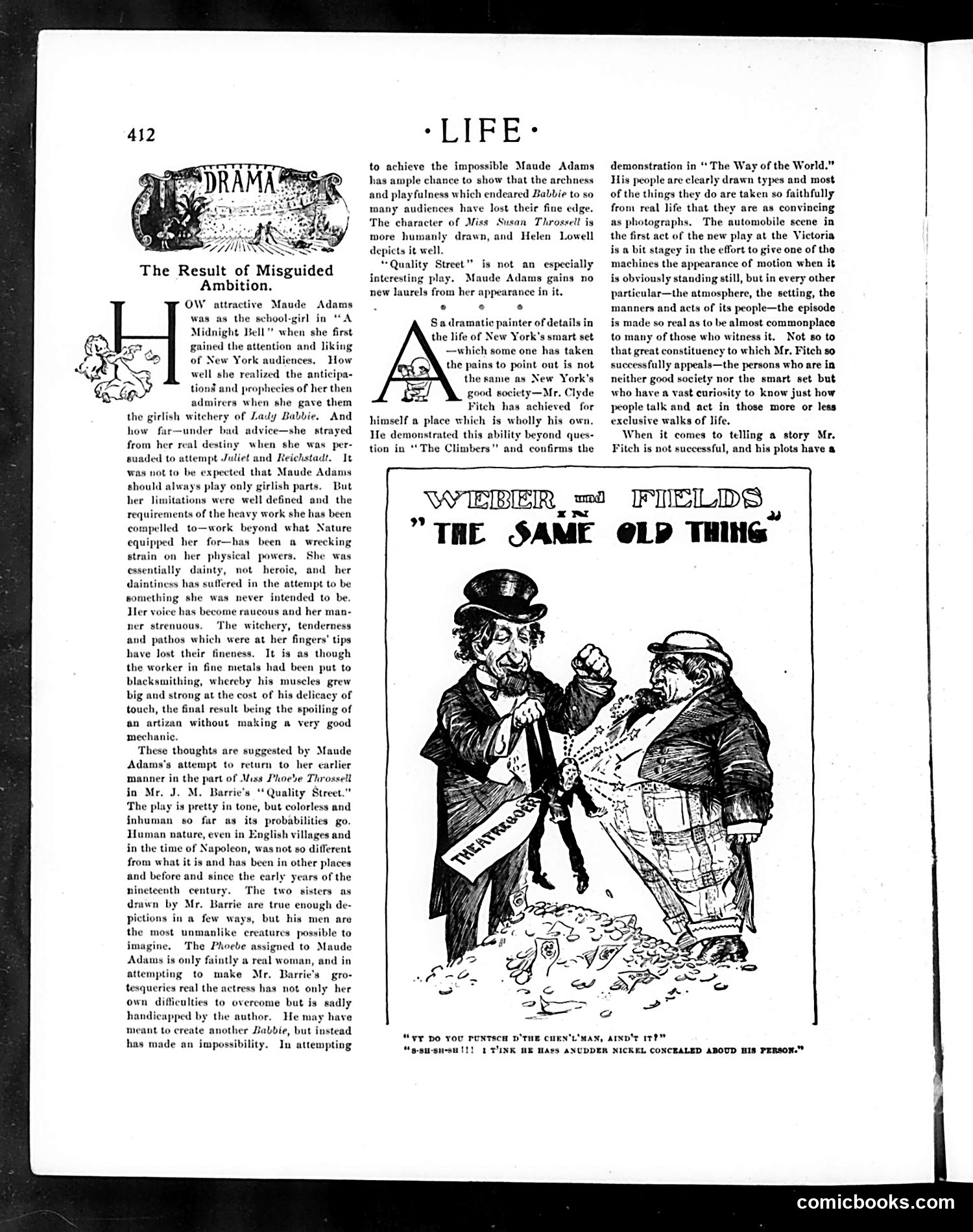
This cartoon satirizes a theatrical sketch by the comedy duo **Weber and Fields**, popular vaudeville performers of the early 1900s. The image shows two shabby, working-class men in worn clothing and hats, apparently engaged in some kind of street hustle or con involving money scattered on the ground. The caption's dialogue—"Et do you puncher d'the chen'man, ain't it?" and "Shtop it! I t'ink he has a nickel concealed aboud his person"—uses exaggerated ethnic dialect (likely mocking German or Eastern European immigrants), which was standard for their comedy routines. The satire targets how Weber and Fields recycled the same basic character types and comedic formulas repeatedly, hence the title "The Same Old Thing."
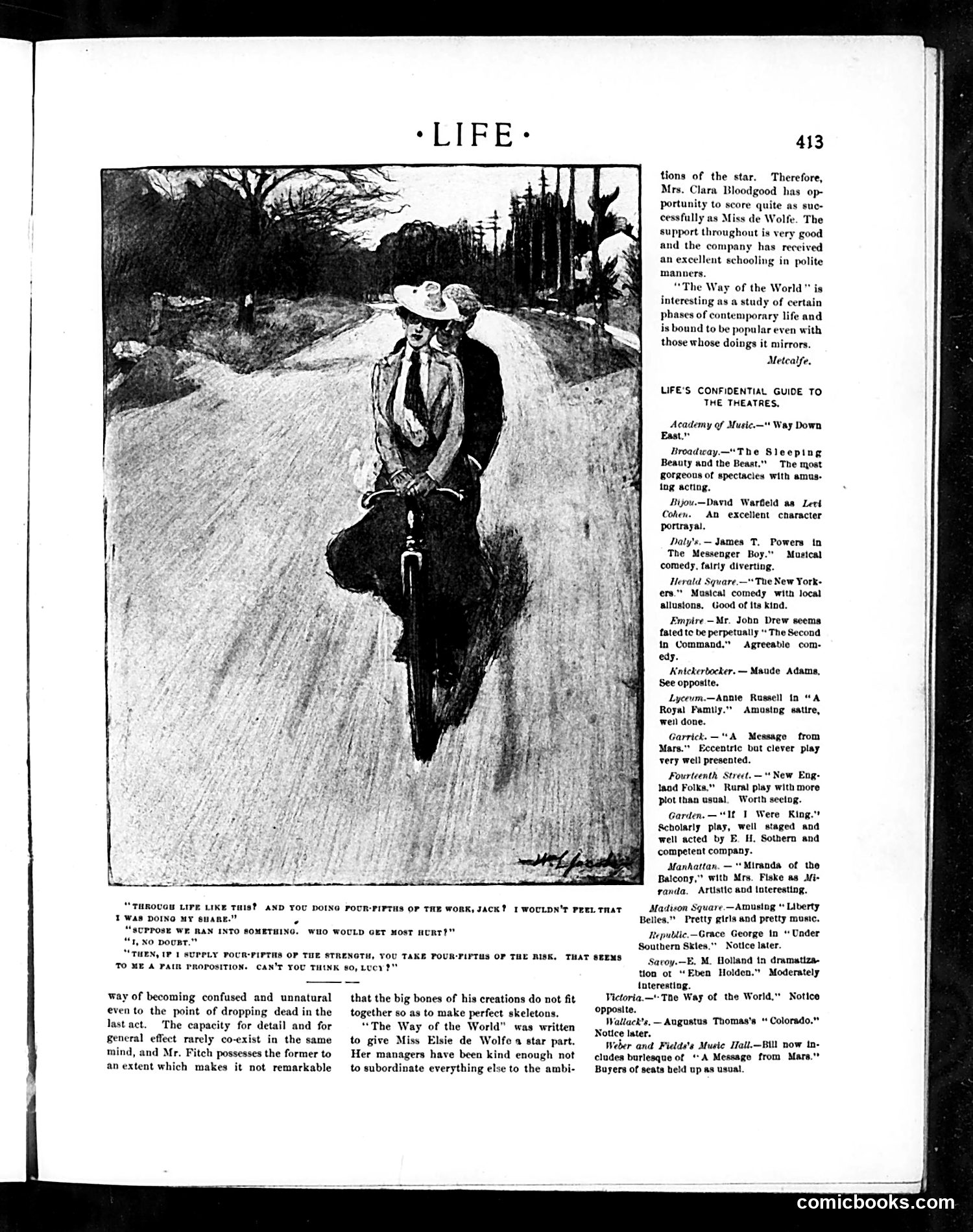
This page from *Life* magazine contains a single-panel cartoon at top and theatre reviews below. **The Cartoon:** The image shows two figures on a bicycle—a man pedaling and a woman sitting behind. The dialogue reveals a negotiation: the man complains about doing all the work while the woman does "four-fifths," but when she points out she'd bear "four-fifths of the risk" if they hit something, he agrees it's "a fair proposition." The satire appears to critique **gender dynamics and unequal burden-sharing in relationships**. The woman logically exposes the man's inconsistency: he wants credit for effort while avoiding proportional risk. The joke's irony—that he only accepts fairness when his own safety is threatened—reflects contemporary attitudes about male privilege and resistance to equality. **Below:** Theatre reviews for shows including *The Way of the World* (featuring Elsie de Wolfe and Clara Bloodgood) and various Broadway productions with brief critical assessments.
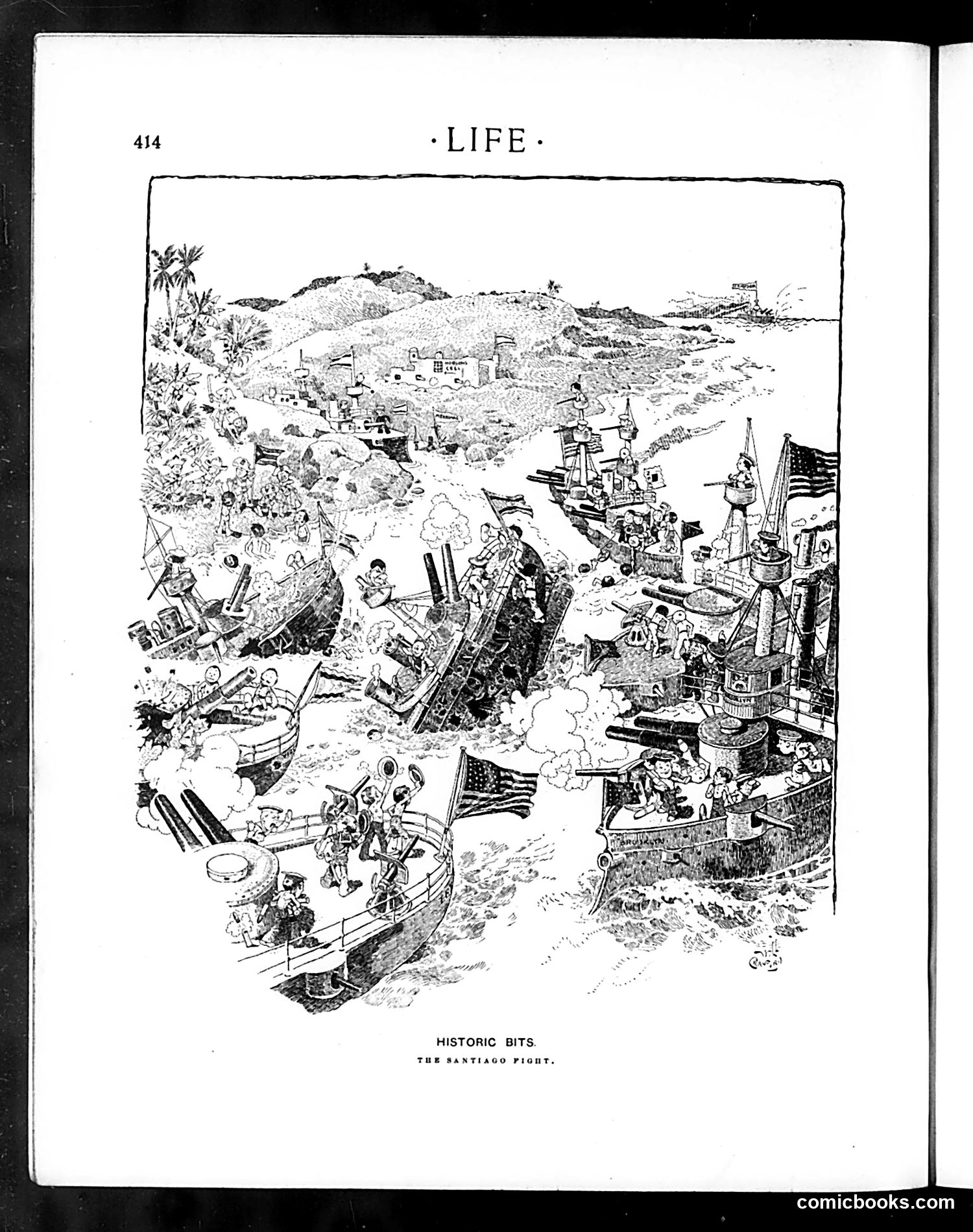
This illustration depicts "The Santiago Fight," labeled as a "Historic Bit" from Life magazine. The detailed engraving shows a naval battle scene with multiple American warships (identifiable by American flags) engaged in combat near a coastal settlement. The composition includes: - Several military vessels with visible gun turrets and smokestacks - Soldiers and sailors actively fighting - Explosions and combat action throughout the scene - Hillside terrain with fortifications in the background "Santiago" refers to the Spanish-American War's decisive naval battle (July 1898) off Santiago de Cuba, where the U.S. destroyed the Spanish fleet. This was a major American military victory that effectively ended the war. The illustration celebrates this "historic" American military triumph, depicting the intensity and scale of the naval engagement that secured American dominance in the Caribbean.
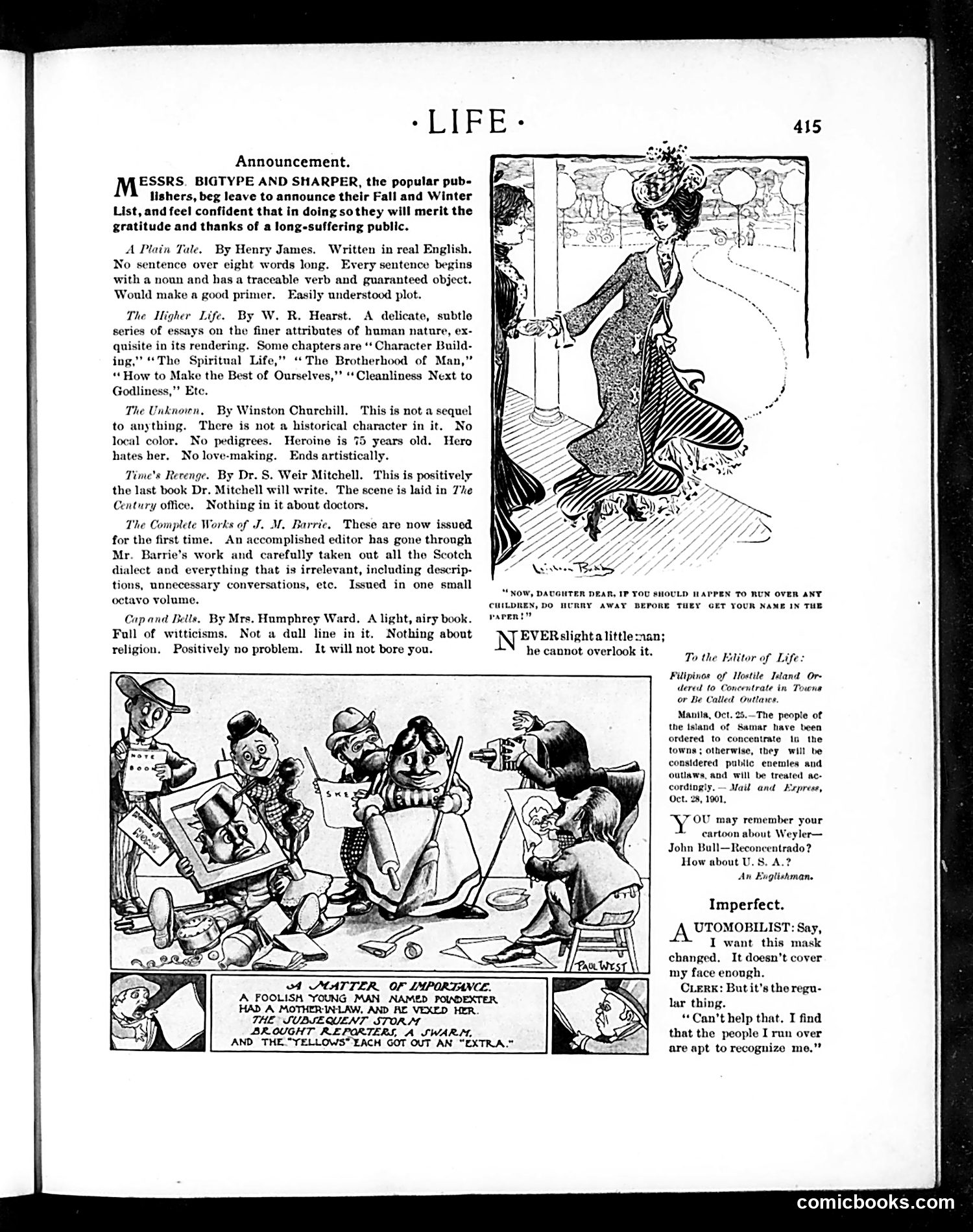
This page contains **mock book announcements** satirizing famous contemporary authors (Henry James, Winston Churchill, W.R. Hearst, J.M. Barrie, Mrs. Humphrey Ward) by describing absurdly altered versions of their works—stripping them of their actual characteristics (James's complexity, Barrie's Scots dialect, etc.). The joke mocks both the authors' styles and publisher sensationalism. The **cartoons below** lampoon different targets: one depicts careless automobile drivers, and another references the "yellow press" (sensationalist newspapers) exaggerating minor incidents into front-page stories. Most significantly, the **letters section** critiques U.S. policy in the Philippines (1901), comparing American "reconcentrado" orders (forcing civilians into towns)—a tactic Spain's Weyler infamously used in Cuba—to British imperialism. This accuses the U.S. of hypocritical colonialism.
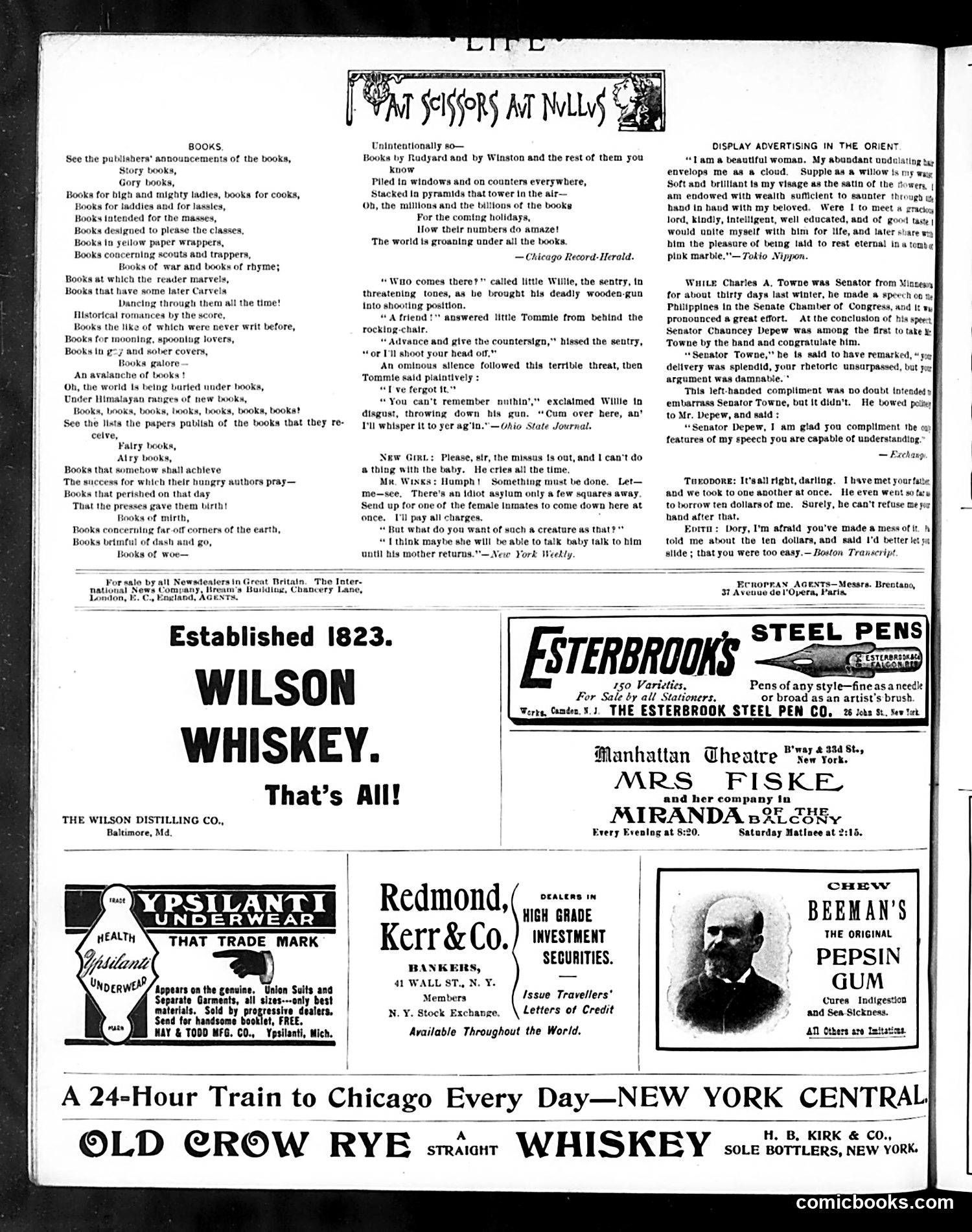
This page is primarily **advertisements and filler content** interspersed with brief humorous anecdotes—typical of *Life* magazine's format. The main satirical piece is a poem about the explosion of published books, comparing their accumulation to an "avalanche" burying the world. It mocks the publishing industry's output and the Christmas book-buying season, playing on contemporary anxiety about mass print culture. Below are brief jokes: one about children playing soldiers and forgetting a countersign; another about a new maid unable to manage a crying baby; and a story about Senator Charles A. Towne receiving backhanded praise from Senator Chauncey Depew after a congressional speech on the Philippines—Depew compliments his delivery while calling his argument "damnable." The remainder is advertising (Wilson Whiskey, Esterbrook pens, theater listings, etc.). **For modern readers:** The book joke reflects early-1900s concerns about information overload and commercialization. The Towne/Depew anecdote references actual contemporary political figures and early-20th-century Senate debates about American imperialism in the Philippines.
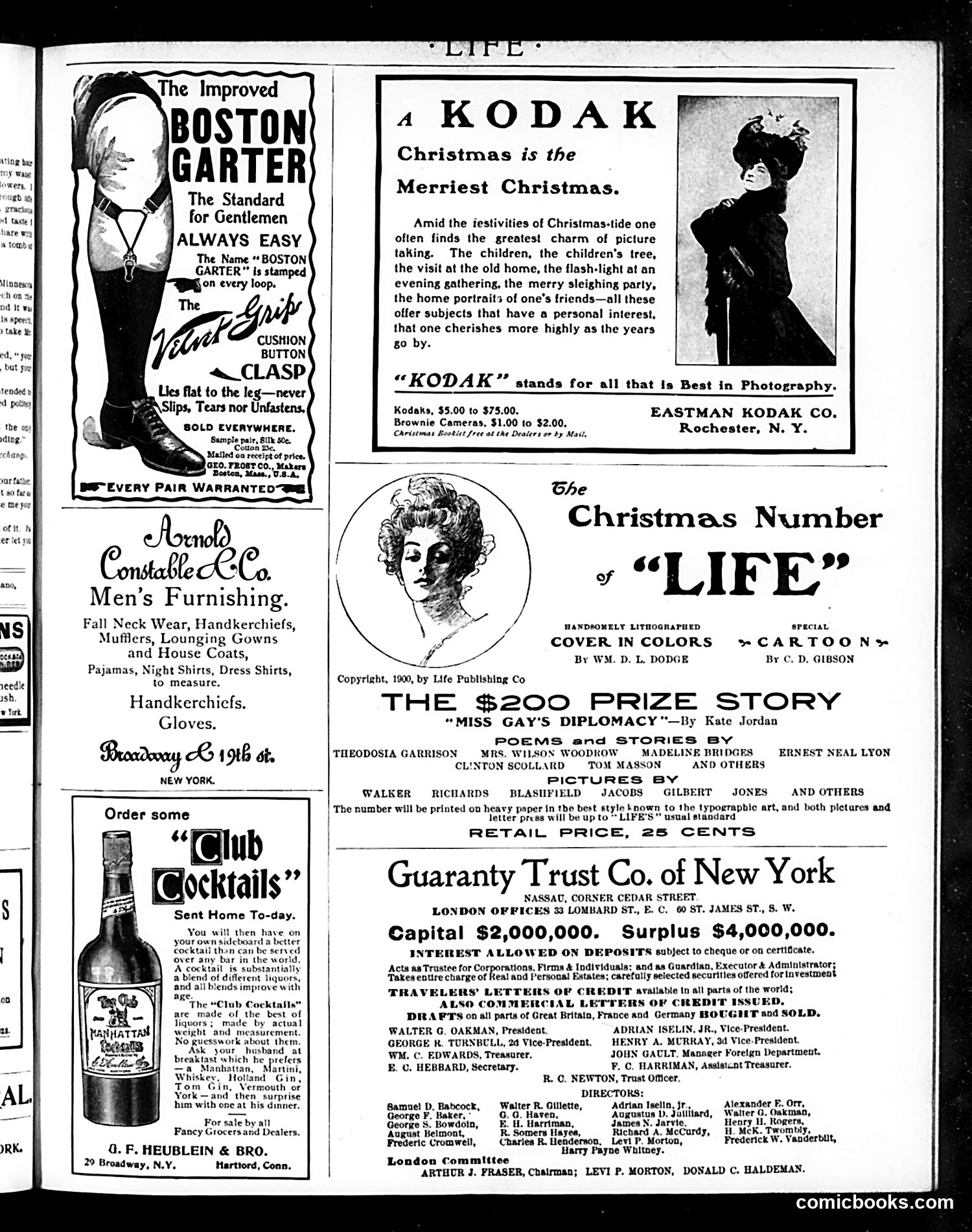
This is primarily a Christmas issue table of contents and advertisement page from *Life* magazine (circa 1900, based on the Guaranty Trust Co. establishment date visible). The main content announces *Life*'s Christmas Number featuring a $200 prize story titled "Miss Gay's Diplomacy," poems and stories by various period authors, and artwork including a cover illustration by C. D. Gibson. The page is dominated by period advertisements: Boston Garters for men, Arnold Constable men's furnishings, Kodak cameras (promoting their utility for Christmas photography), Club Cocktails (pre-mixed drinks), and a prominent banking advertisement for Guaranty Trust Co. of New York. There is no political cartoon or satire visible on this page—it functions as a commercial/promotional page announcing the holiday issue's contents and advertising luxury goods to *Life*'s affluent readership.
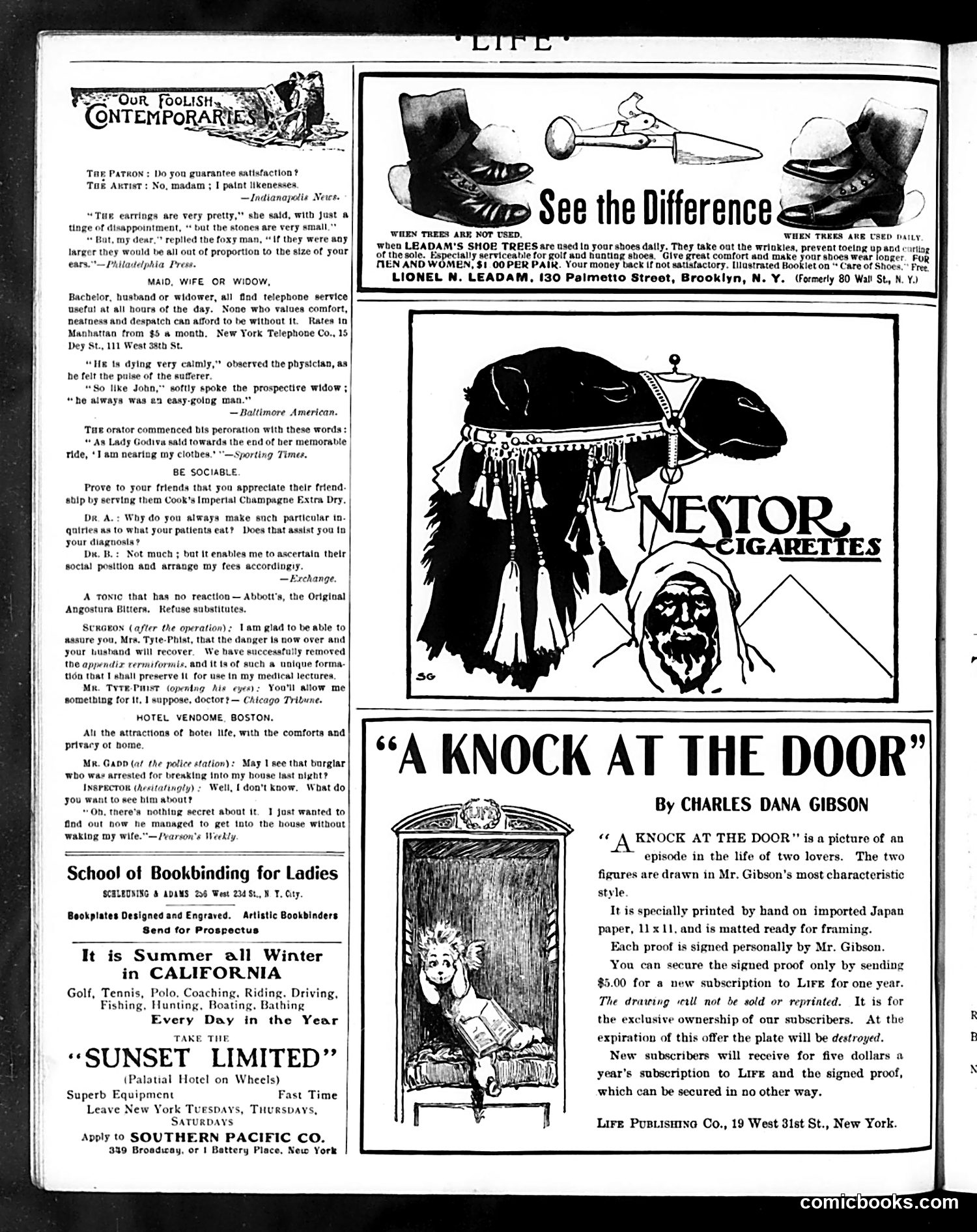
This page from *Life* magazine contains satirical humor columns mocking human foibles, plus period advertisements. The "Foolish Contemporaries" section presents short jokes about vanity, incompetence, and social pretension. Examples include: a portrait artist who paints unflattering likenesses; a woman disappointed her earrings are small (a man tactlessly suggests her ears are too large); a widow calmly watching her husband die because he's always been "easy-going"; and a doctor who charges fees based on patients' social class rather than medical need. The advertisements showcase early 1900s products: shoe trees, champagne, a California train trip, telephone service, and a bookbinding school—typical consumer goods of the era. Charles Dana Gibson's illustration "A Knock at the Door" depicts a romantic scene between two lovers, available as a signed print for new *Life* magazine subscriptions ($5 for one year). The humor reflects turn-of-the-century attitudes about class, gender roles, and material consumption.
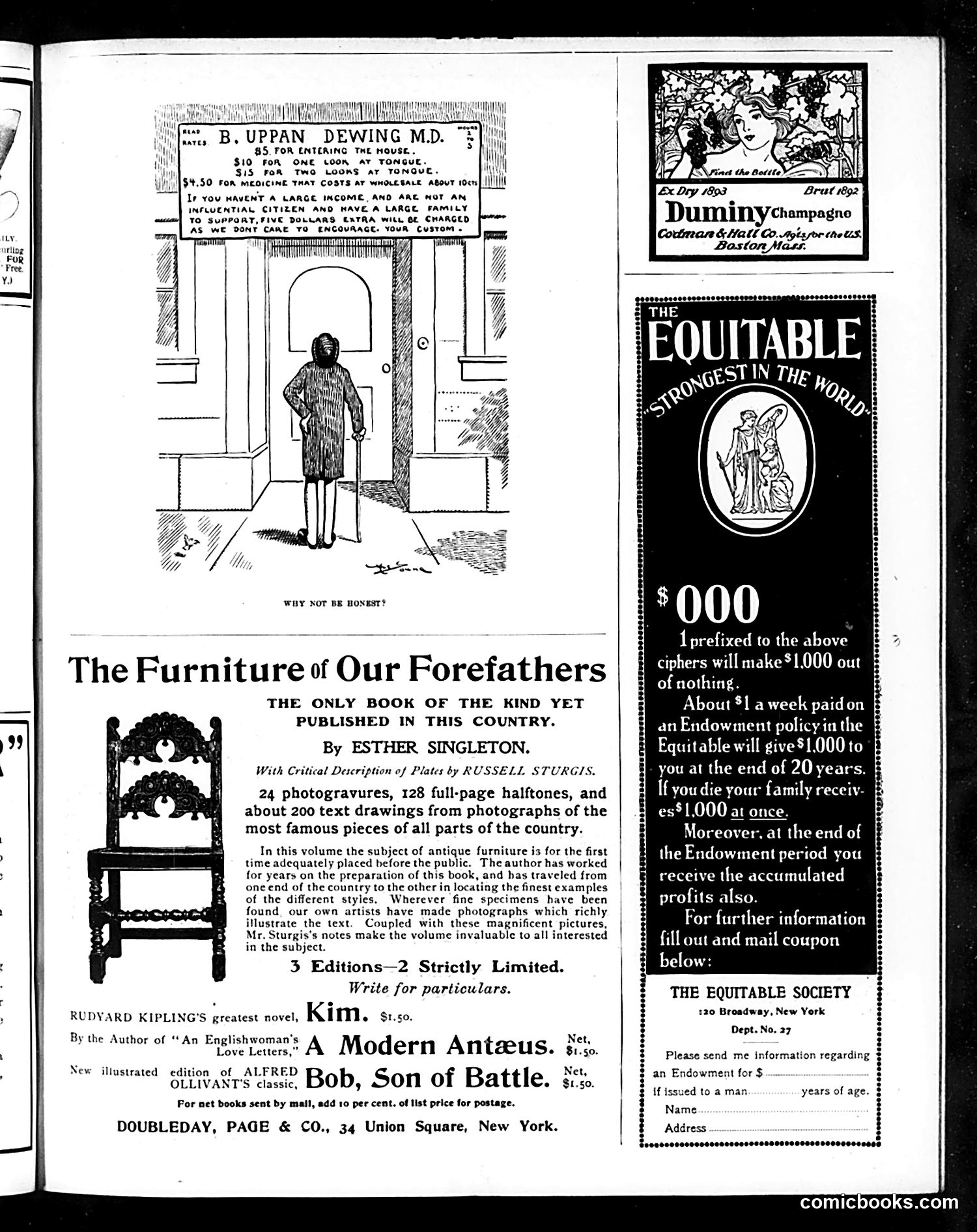
The main cartoon, titled "Why Not Be Honest?", satirizes unethical medical pricing practices. It depicts Dr. B. Uppan Dewey, M.D., charging exorbitant fees for minimal services: $5 just to enter his house, $10 for looking at a patient's tongue, $15 for two looks, and $4.50 for medicine costing roughly 10 cents wholesale. The caption's sarcastic question mocks the doctor's lack of transparency. The text below exposes the hypocrisy: he explicitly states he won't serve poor families with dependents, only wealthy "influential citizens"—yet calls himself honest. This critiques early-20th-century medical profiteering and class-based healthcare discrimination. The joke hinges on the doctor's oblivious contradiction between his pricing scheme and his claimed honesty. The cartoon attacks both medical price-gouging and doctors who exploited vulnerable patients unable to afford care.
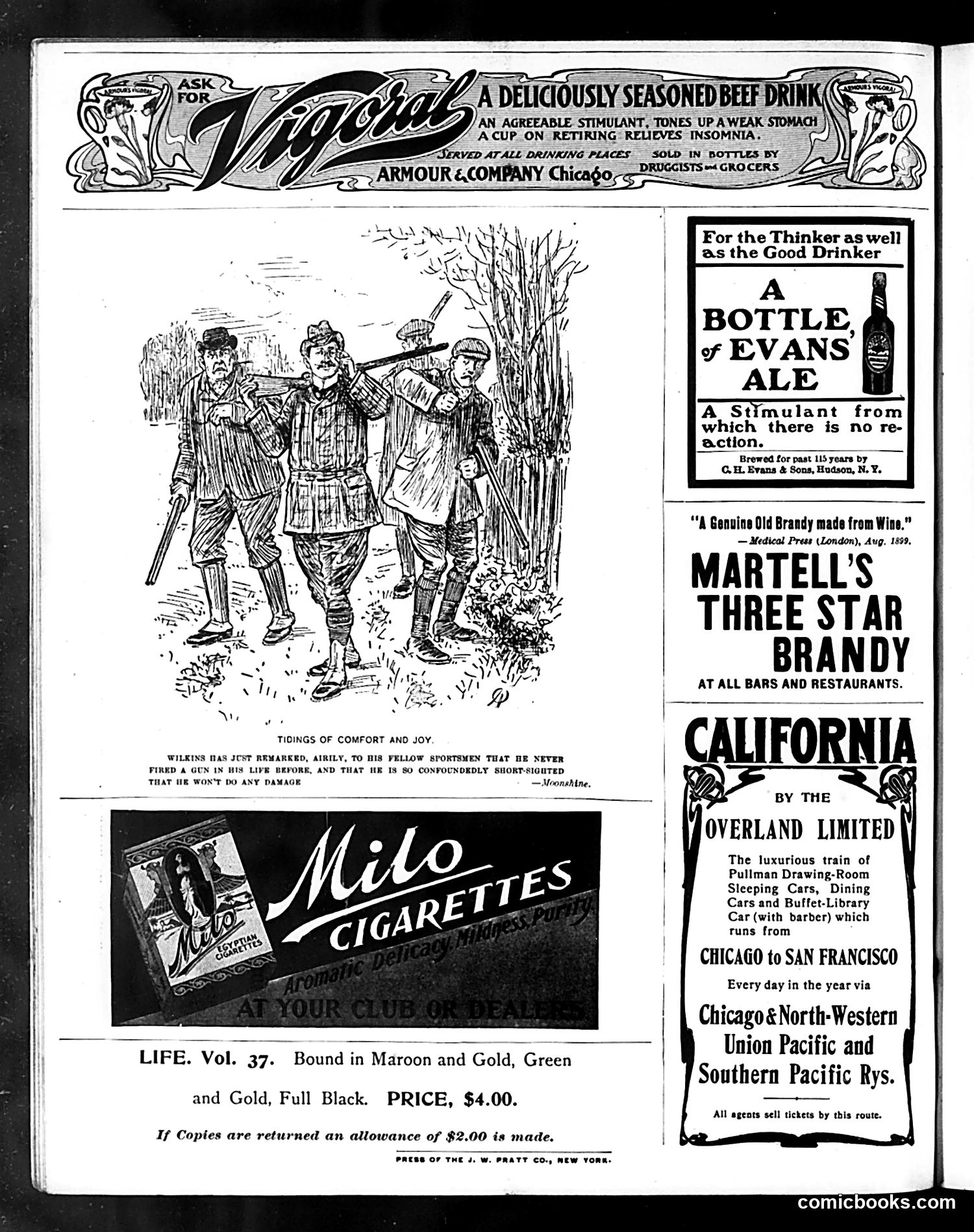
This page from *Life* magazine (Vol. 37) is primarily **advertising** mixed with one small cartoon. The main content consists of ads for alcoholic beverages (Vigorlac beef drink, Evans Ale, Martell's brandy) and Milo cigarettes—typical of early 1900s publications. The single cartoon titled "Tidings of Comfort and Joy" depicts a humorous hunting scene. A man named Wilkins (appearing to be a novice hunter) reassures fellow sportsmen that he's harmless despite never firing a gun before and being severely nearsighted. The joke is dark comedy: his poor marksmanship and vision mean he won't hit anything—a relief to those around him. The Overland Limited railroad ad occupies the right side, promoting luxury train service between Chicago and San Francisco. The page reflects early 1900s consumer culture and casual attitudes toward alcohol and danger that modern readers would find striking.