
Life, 1901-11-21 · page 12 of 20
Life — November 21, 1901 — page 12: what you’re looking at
What you’re looking at
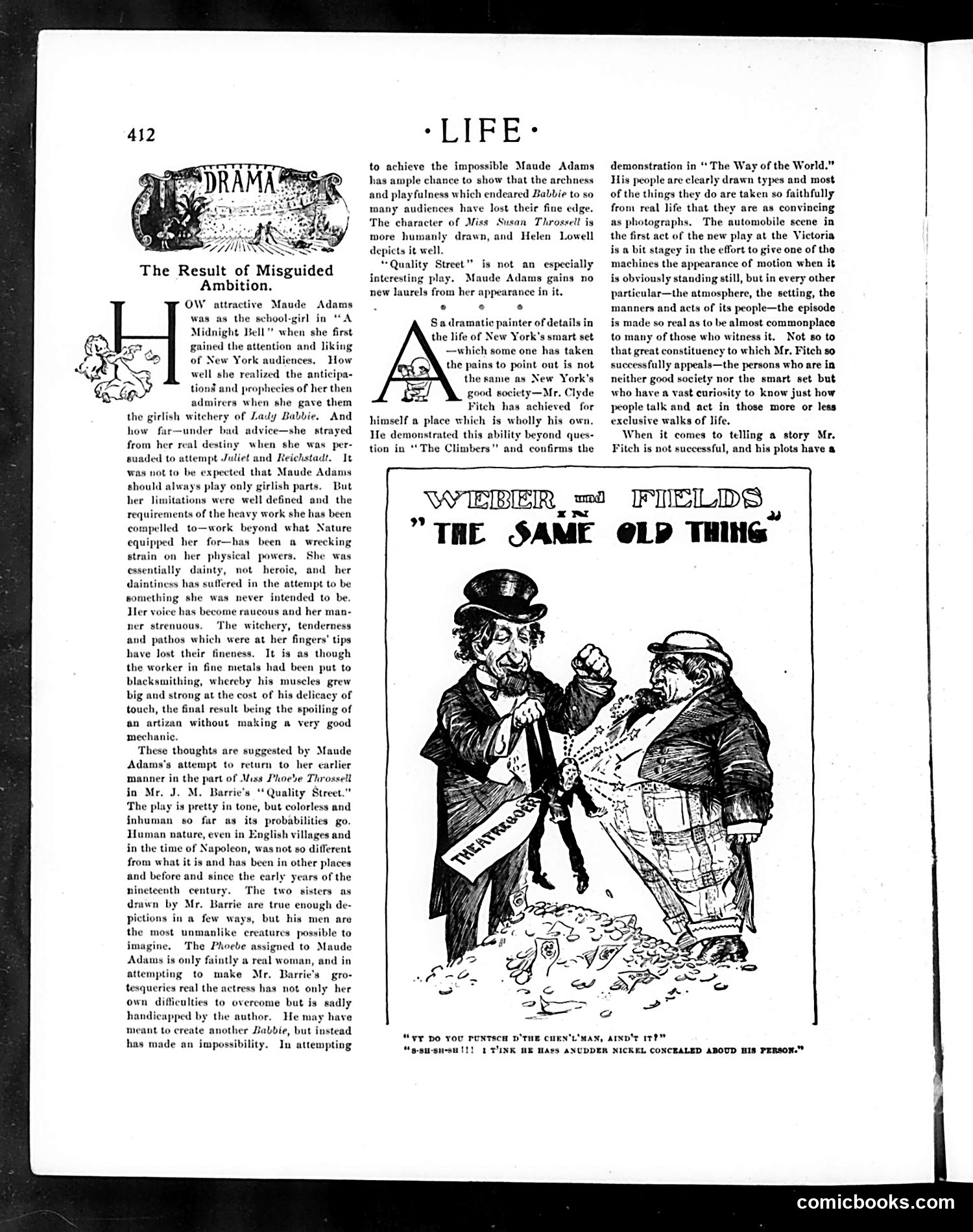
This cartoon satirizes a theatrical sketch by the comedy duo **Weber and Fields**, popular vaudeville performers of the early 1900s. The image shows two shabby, working-class men in worn clothing and hats, apparently engaged in some kind of street hustle or con involving money scattered on the ground. The caption's dialogue—"Et do you puncher d'the chen'man, ain't it?" and "Shtop it! I t'ink he has a nickel concealed aboud his person"—uses exaggerated ethnic dialect (likely mocking German or Eastern European immigrants), which was standard for their comedy routines. The satire targets how Weber and Fields recycled the same basic character types and comedic formulas repeatedly, hence the title "The Same Old Thing."
📄 Transcribed text from this page (OCR, searchable)
Machine-transcribed from the original scan — historical spelling and the odd misread are preserved.
The Result of tated Ambition. OW attractive Maude Adams was as the school-girl in “A Midnight Bell when she first gained the attention and liking of New York audiences. How well she realized the anticipa- tion# and prophecies of her then admirers when she gave them the girlish witchery of Lady Babbie. And how far—under bad advice—she strayed from her real destiny when she was per- suaded to attempt Juliet and Reichstadt. It was not to be expected that Maude Adams should always play only girlish parts. But her limitations were well defined and the requirements of the heavy work she has been compelled to—work beyond what Nature equipped her for—has been a wrecking strain on her physical powers. She was essentially dainty, not heroic, and her daintiness has suffered in the attempt to be something she was never intended to be. Her voice has become raucous and her man- ner strenuous. The witchery, tenderness and pathos which were at her fingers’ tips have lost their fineness. It is as though the worker in fine metals had been put to blacksmithing, whereby his muscles grew big and strong at the cost of his delicacy of touch, the final result being the spoiling of an artizan without making a very good mechanic. These thoughts are suggested by Maude Adams's attempt to return to her earlier manner in the part of Muss Phoebe Throssell in Mr, J. M. Barrie's ‘‘ Quality Street.” The play is pretty in tone, but colorless and inhuman so fur as its probabilities go. Hur ature, English villages and in the time of Napoleon, was not so different from what it is and has been in other places and before and since the early years of the nineteenth century, The two sisters as drawn by Mr. Barrie are true enough de- pictions in a few ways, but his men are the most unmanlike creatures possible to imagine. The Phoebe assigned to Maude Adams is only faintly a real woman, and in attempting to make Mr. Barrie's gro- tesqueries real the actress has not only her own difficulties to overcome but is sadly handicapped by the author. He may have meant to create another Labbie, but instead has made an impossibility. In attempting EIPE to achieve the impossible Maude Adams has ample chance to show that the archness and playfulness which endeared Babvie to so many audiences have lost their fine edge. The character of Miss Susan Throssell is more humanly drawn, and Helen Lowell depicts it well. “Quality Street” is not an especially interesting play. Maude Adams gains no new laurels from her appearance in it. ° ° ° Sa dramatic painter of details in the life of New York's smart set —which some one has taken the pains to point out is not the same as New York's good society—Mr. Clyde Fitch has achieved for himself a place which is wholly his own. He demonstrated this ability beyond ques- tion in ‘The Climbers" and confirms the demonstration in ‘‘ The Way of the World.” His people are clearly drawn types and most of the things they do are taken so faithfully from real life that they are as convincing as photographs. The automobile scene in the first act of the new play at the Victoria is a bit stagey in the effort to give one of the machines the appearance of motion when it is obviously standing still, but in every other particular—the atmosphere, the setting, the manners and acts of its people—the episode is made so real as to be almost commonplace to many of those who witness it. Not so to that great constituency to which Mr. Fitch so successfully appeals—the persons who are in neither good society nor the smart set but who have a vast curiosity to know just how people talk and act in those more or less exclusive walks of life. When it comes to telling a story Mr. is not successful, and his plots have @ WEBER, mand) FIELDS | "THE SAME @LD THING VY DO YOU PUNTSCH D'THE CHEN'L'MAN, AIND'T IT?” 1 TINK HE Hass ANUDDER NICKEL CONCEALED ABOUD HIS PERSON.” comicbooks.com