
Life, 1901-11-21 · page 7 of 20
Life — November 21, 1901 — page 7: what you’re looking at
What you’re looking at
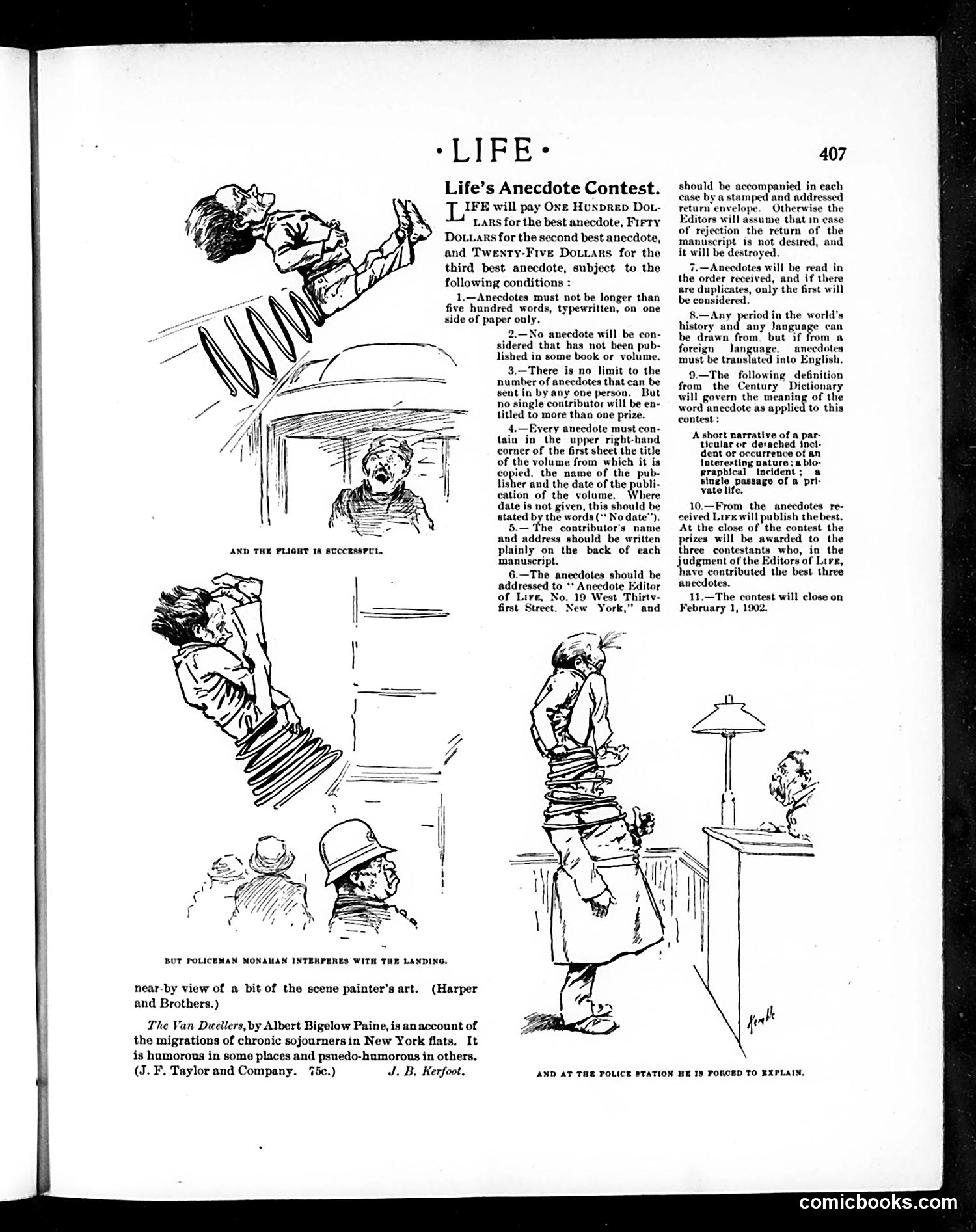
This page announces **Life's Anecdote Contest**, offering prizes ($100, $50, $25) for the best humorous short stories. The accompanying illustrations satirize **urban life in New York**, depicting various comedic scenarios: a figure in flight (top), a policeman interfering with a landing or arrest (middle), and a man being forcibly removed at a police station (bottom). The cartoons mock **Gilded Age urban chaos**—likely referencing the tensions between police authority, immigrant populations, and public disorder in turn-of-the-century New York City. The text mentions "The Van Deetlers," a book about "chronic sojourners in New York flats," suggesting the humor targets transient urban residents and police misconduct. The overall tone is satirical commentary on city life's absurdities.
📄 Transcribed text from this page (OCR, searchable)
Machine-transcribed from the original scan — historical spelling and the odd misread are preserved.
“ETBIES Life’s Anecdote Contest. ‘Tze will pay One Hunprep Dot- Lars for the best anecdote, Firty Dottars for the second best anecdote, and Twenty-Five Dottars for the third best anecdote, subject to the following conditions : 1.—Anecdotes must not be longer than five hundred words, typewritten, on one side of paper only. BUT POLICEMAN MONAMAN INTERFERES WITH THE LANDING. near-by view of a bit of the scene painter's art. and Brothers.) (Harper The Van Duellers, by Albert Bigelow Paine, is anaccount of the migrations of chronic sojourners in New York flats. It is humorous in some places and psuedo-hamorons in others. (J. F, Taylor and Company. 5c.) J. B. Kerfoot, No anecdote will be con- sidered that has not been pub- lished in some book or volume. 3.—There is no limit to the number of anecdotes that can be sent in by any one person. But no single contributor will be en- titled to more than one prize. 4.—Every anecdote must con- tain in the upper right-hand corner of the first sheet the title of the volume from which it copied, the name of the pub- lisher and the date of the publi- cation of the volume, Where date is not given, this should be stated by the words ("* No date”). 5.— The contributor's name and address should be written plainly on the back of each manuscript. 6.—The anecdotes should be addressed to ** Anecdote Editor of Lire, No. 19 West Thirtv- first Street. New York," and nal aa 407 should be accompanied in each case by a stamped and addressed return envelope. Otherwise the Editors will assume that in case of rejection the return of the manuscript is not desired, and it will be destroyed. 7.—Aneedotes will be read in the order received, and if there are duplicates, only the first will be considered. 8.—Any peed in the world's history and any Janguage can be drawn from: but if from a foreign language, anecdotes must be translated into English. 9.—The following definition from the Century Dictionary will govern the meaning of the word anecdote as applied to this contest : A short narrative of a par- ticular or detached incl- deat of occurrence of an plo- loteresting nature: grapbical incident; a sinele passage of a pri- vate life. 10.—From the anecdotes re- ceived Lire will publish the best. At the close of the contest the prizes will be awarded to the three contestants who, in the judgment of the Editors of Livg, have contributed the best three anecdotes. 11.—The contest will close on February 1, 1902. AND AT THE POLICE @TATION HE 18 PORCED TO EXPLAIN. comicbooks.com