
Life, 1901-11-21 · page 6 of 20
Life — November 21, 1901 — page 6: what you’re looking at
What you’re looking at
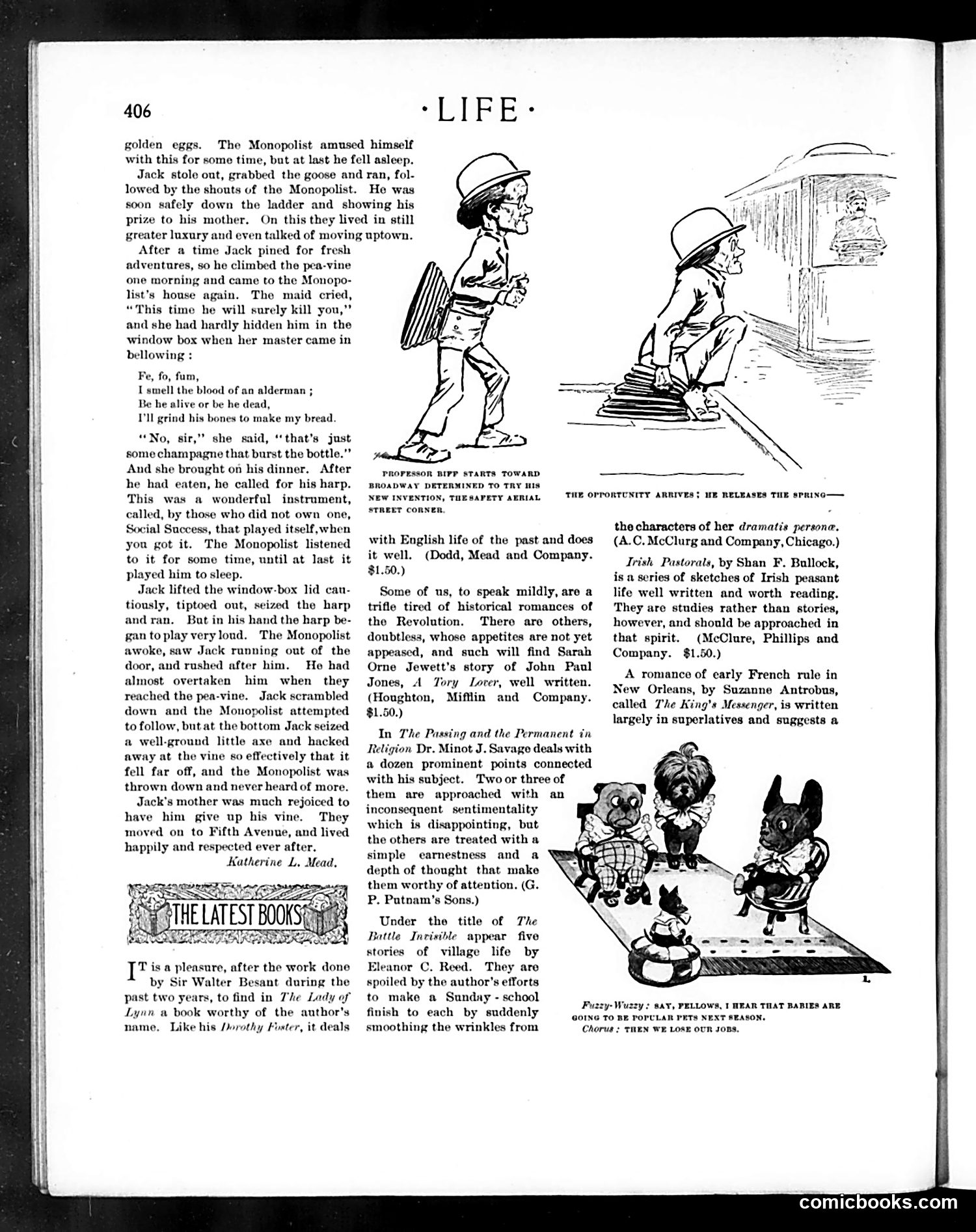
This page consists primarily of a book review section titled "The Latest Books" rather than political satire. The main illustration shows two figures in early 20th-century dress on what appears to be a street corner or building entrance—one climbing or descending while the other waits below. The caption references "Professor on his way toward Broadway determined to try his new pneumatic tire safety aerial street corner," suggesting the cartoon satirizes a new safety invention or urban transportation method, likely pneumatic (air-filled) tire technology applied to pedestrian safety devices. The reviews discuss various contemporary novels, including works about Irish life and French colonial history. The page appears to be from a cultural magazine focused on literature rather than political commentary.
📄 Transcribed text from this page (OCR, searchable)
Machine-transcribed from the original scan — historical spelling and the odd misread are preserved.
406 golden eggs. The Monopolist amused himself with this for some time, but at last he fell asleep, Jack stole out, grabbed the goose and ran, fol- lowed by the shouts of the Monopolist. He was soon safely down the ladder and showing his prize to his mother. On this they lived in still greater luxury and even talked of moving uptown. After a time Jack pined for fresh adventures, so he climbed the pea-vine one morning and came to the Monopo- list’s house again. The maid cried, “This time he will surely kill you,” and she had hardly hidden him in the window box when her master came in bellowing : Fe, fo, fam, I smell the blood of an alderman ; Be he alive or be he dead, I'll grind his bones to make my bread. “No, sir,” she said, ‘that’s just some champagne that burst the bottle.” And she brought on his dinner. After he had eaten, he called for his harp. This was a wonderful instrument, called, by those who did not own one, Social Success, that played itself, when you got it. The Monopolist listened to it for some time, until at last it played him to sleep. Jack lifted the window-box lid cau- tiously, tiptoed out, seized the harp and ran. But in his hand the harp be- gan to play very loud. The Monopolist awoke, saw Jack running out of the door, and rushed after him. He had almost overtaken him when they reached the pea-vine. Jack scrambled down and the Monopolist attempted to follow, but at the bottom Jack seized a well-ground little axe and hacked away at the vine so effectively that it fell far off, and the Monopolist was thrown down and never heard of more. Jack's mother was much rejoiced to have him give up his vine. They moved on to Fifth Avenue, and lived happily and respected ever after. Katherine L, Mead, ka is a pleasure, after the work done by Sir Walter Besant during the past two years, to find in The Lady of Lynn a book worthy of the name. Like his Dorothy Fuster, PROFESSOR BIPP STARTS TOWARD BROADWAY DETERMINED TO TRY W118 NEW INVENTION, THESAPETY AERIAL STREET CORNER, with English life of the past and does it well, (Dodd, Mead and Company. $1.50.) Some of us, to speak mildly, are a trifle tired of historical romances of the Revolution. There are others, doubtless, whose appetites are not yet appeased, and such will find Sarah Orne Jewett’s story of John Paul Jones, A Tory Lover, well written. (Houghton, Mifflin and Company. $1.50.) In The Passing and the Permanent in Religion Dr. Minot J. Savage deals with a dozen prominent points connected with his subject. Two or three of them are approached with an inconsequent sentimentality which is disappointing, but the others are treated with a simple earnestness and a depth of thought that make them worthy of attention. (G. P. Putnam’s Sons.) Under the title of The Battle Invisible appear five stories of village life by Eleanor C. Reed. They are spoiled by the author's efforts THE OPPORTUNITY ARRIVES; WE RELEASES THE sPrixo— the charactors of her dramatis persona. (A.C. McClurg and Company, Chicago.) Trish Pastorals, by Shan F. Bullock, is a series of sketches of Irish peasant life well written and worth reading. They are studies rather than stories, however, and should be approached in that spirit. (McClure, Phillips and Company. $1.50.) A romance of early French rule in New Orleans, by Suzanne Antrobus, called The King’s Messenger, is written largely in superlatives and suggests a to make a Sunday - school finish to each by suddenly smoothing the wrinkles from Fuzzy: Wuzzy : 8a¥, PELLOWS, 1 HEAR THAT BABIES ARE GOING TO RE POPULAR PETS NEXT SEASON, Chorus : THEN WE LOSE OUR JOBS. comicbooks.com