
Life, 1901-11-21 · page 4 of 20
Life — November 21, 1901 — page 4: what you’re looking at
What you’re looking at
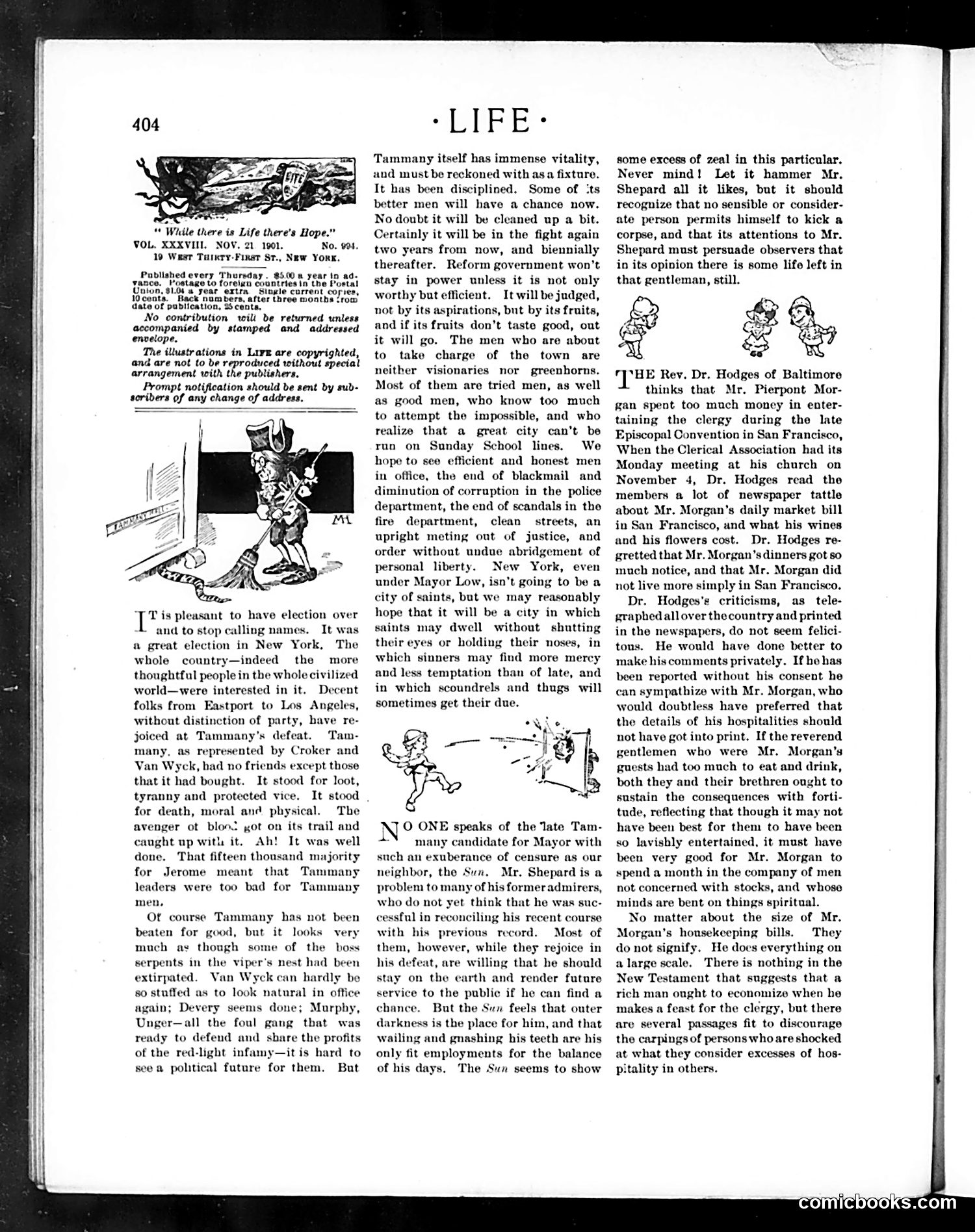
This page critiques New York City politics during what appears to be a mayoral election. The text discusses Tammany Hall's influence and corruption, referencing candidate Mr. Shepard and concerns about whether reform is possible under the current political machine. The left illustration shows a figure at a desk labeled "LIFE," appearing to represent the magazine's editorial stance on civic matters. The page also includes commentary on Rev. Dr. Hodges of Baltimore's criticism of Mr. Pierpont Morgan's spending on clergy entertainment and daily market bills in San Francisco—suggesting wealthy individuals' ostentatious religious patronage while neglecting broader moral reform. The overall tone satirizes both urban political corruption and wealthy philanthropists' selective charity, questioning whether real civic improvement is possible under existing power structures.
📄 Transcribed text from this page (OCR, searchable)
Machine-transcribed from the original scan — historical spelling and the odd misread are preserved.
“ While (ere is Life there's Hope.” VOL, XXXVIIL NOV. a 19 West Tarery-Finst St., New Youn, Published every Thursday . $5.00 a year vance. Vostage to foreign countries tn the P Ui a year extra Single current copies, 1Ocents. “Back nambers, after three months crow date of publication, 2 cents, No contribution wilt be returned unless accompanied by stamped and addressed envelope. ‘The illustrations in Lure are copyrighted, and are not to be reproduced without special arrangement with the publishers, Prompt notification should be sent by sub- soribers of any change of address. JT is pleasant to have election over and to stop calling names. It was a great election in New York, The whole country—indeed the more thoughtful people in the whole civilized world—were interested in it. Decent folks from Eastport to Los Angel without distinction of party, have re joiced at Tammany's defeat. Tam- many, as represented by Croker and Van Wyck, bad no friends except those that it had bought. It stood for loot, tyranny and protected vice. It stood for death, moral ane physical. The avenger ot blon2 yot on its trail and caught up with it. Ah! It was well done. That fifteen thousand majority for Jerome meant that Tammany leaders were too bad for Tammany men, Of course Tammany has not been beaten for good, but it looks very much ay though some of the boss serpents in the viper’s nest had been extirpated. Van Wyck can hardly be 8o stuffed as to look natural in office again; Devery seems done; Murphy, Unger—all the foul gang that was ready to defend and share the profits of the red-light infamy—it is hard to see a political future for them, But RIE Tammany itself has immense vitality, and must be reckoned with as a fixture. It has been disciplined. Some of ‘ts better men will have a chance now. No doubt it will be cleaned up a bit. Certainly it will be in the fight again two years from now, and biennially thereafter. Reform government won't stay in power unless it is not only worthy but efficient. It will be judged, not by its aspirations, but by its fruits, and if its fruits don’t taste good, out it will go. The men who are about to take charge of the town are neither visionaries nor greenhorns. Most of them are tried men, as well as good men, who know too much to attempt the impossible, and who realize that a great city can't be run on Sunday School lines. We hope to see efficient and honest men in office, the end of blackmail and diminution of corruption in the police department, the end of scandals in the fire department, clean streets, an upright meting out of justice, and order without undue abridgement of personal liberty. New York, even under Mayor Low, isn’t going to be a city of saints, but we may reasonably hope that it will be a city in which saints may dwell without shutting their eyes or holding their noses, in which sinners may find more mercy and less temptation than of late, and in which scoundrels and thugs will sometimes get their due. N O ONE speaks of the ‘late Tam- 4 many candidate for Mayor with such an exuberance of censure as our neighbor, the Sun. Mr. Shepard is a problem to many of his formeradmirers, who do not yet think that he was suc- cessful in reconciling his recent course with his previous record. Most of them, however, while they rejoice in his defeat, are willing that he should stay on the earth and render future service to the public if he can find a chance. But the Sux feels that outer darkness is the place for him, and that wailing and gnashing his teeth are his only fit employments for the balance of his days. The Sun seems to show some excess of zeal in this particular. Never mind! Let it hammer Mr. Shepard all it likes, but it should recognize that no sensible or consider- ate person permits himself to kick a corpse, and that its attentions to Mr. Shepard must persuade observers that in its opinion there is some life left in that gentleman, still. T]‘HE Rev. Dr. Hodges of Baltimore thinks that Mr. Pierpont Mor- gan spent too much money in enter- taining the clergy during the late Episcopal Convention in San Francisco, When the Clerical Association had its Monday meeting at his church on November 4, Dr. Hodges read the members a lot of newspaper tattle about Mr. Morgan’s daily market bill in San Francisco, and what his wines and his flowers cost. Dr. Hodges re- gretted that Mr. Morgan’sdinners got so much notice, and that Mr. Morgan did not live more simply in San Francisco. Dr. Hodges's criticisms, as tele- graphed allover thecountry and printed in the newspapers, do not seem felici- tous. He would have done better to make his comments privately. If he has been reported without his consent he can sympathize with Mr. Morgan, who would doubtless have preferred that the details of his hospitalities should not have got into print. If the reverend gentlemen who were Mr. Morgan’s guests had too much to eat and drink, both they and their brethren ought to sustain the consequences with forti- tude, reflecting that though it may not have been best for them to have been so lavishly entertained, it must have been very good for Mr. Morgan to spend a month in the company of men not concerned with stocks, and whose minds are bent on things spiritual. No matter about the size of Mr. Morgan's housekeeping bills. They do not signify, He does everything on alarge scale. There is nothing in the New Testament that suggests that a rich man ought to economize when he makes a feast for the clergy, but there are several passages fit to discourage the carpings of persons who are shocked at what they consider excesses of hos- pitality in others.