
A complete issue · 20 pages · 1901
Life — October 31, 1901
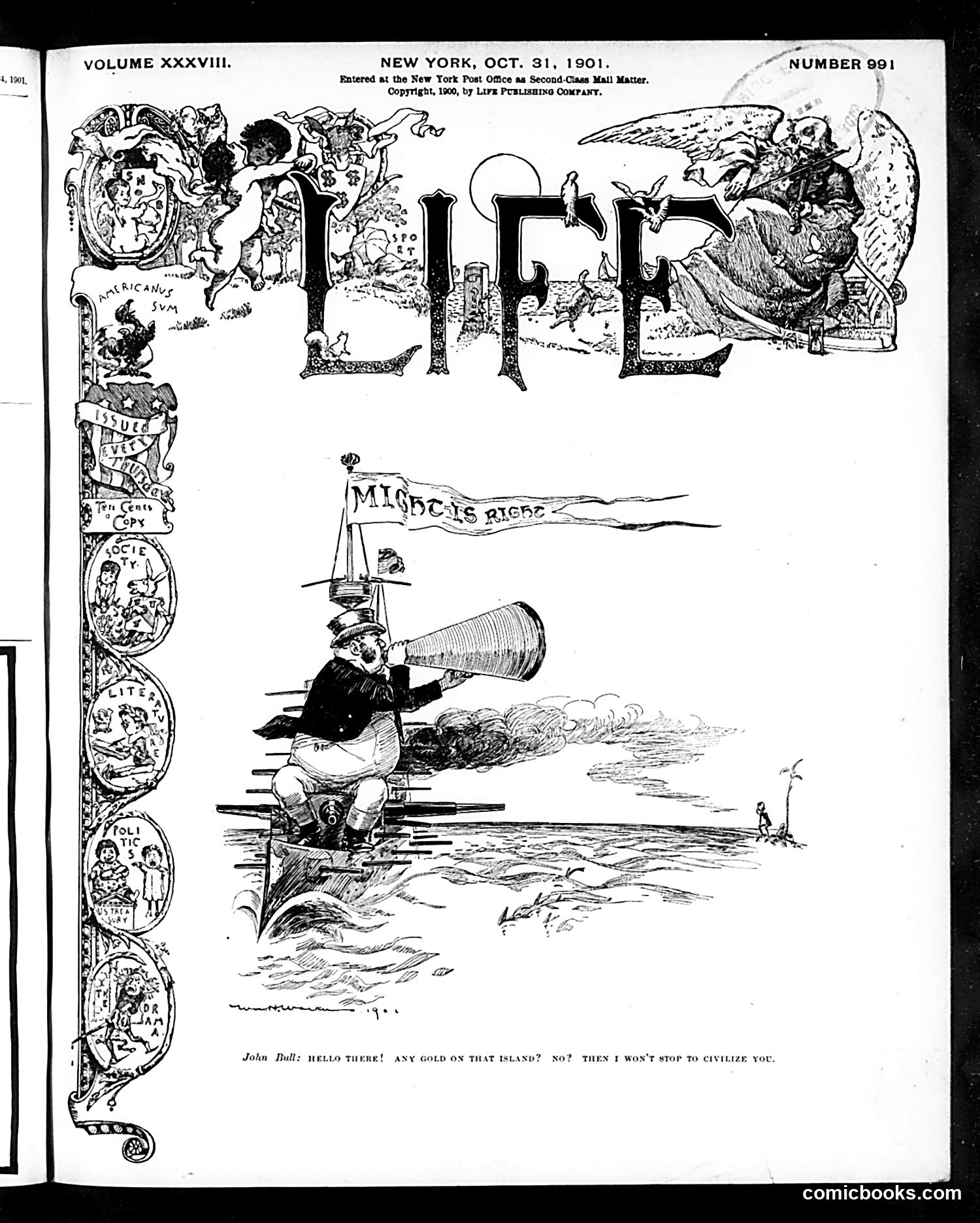
The main cartoon depicts a figure labeled "John Bull" (personification of Britain) on a small island in water, using a telescope/spyglass. A banner reads "MINDS RIGHTS" above him. The caption states: "HELLO THERE! ANY GOLD ON THAT ISLAND? NO? THEN I WON'T STOP TO CIVILIZE YOU." **Meaning**: This satirizes British imperialism and colonial expansion. The joke critiques Britain's selective "civilizing mission"—suggesting Britain only colonized territories for economic gain (gold/resources), not genuine humanitarian motives. The sarcastic caption exposes the hypocrisy of imperial justifications. The ornate left border contains decorative medallions typical of Life's design aesthetic. This appears connected to post-Boer War British imperialism (1901).
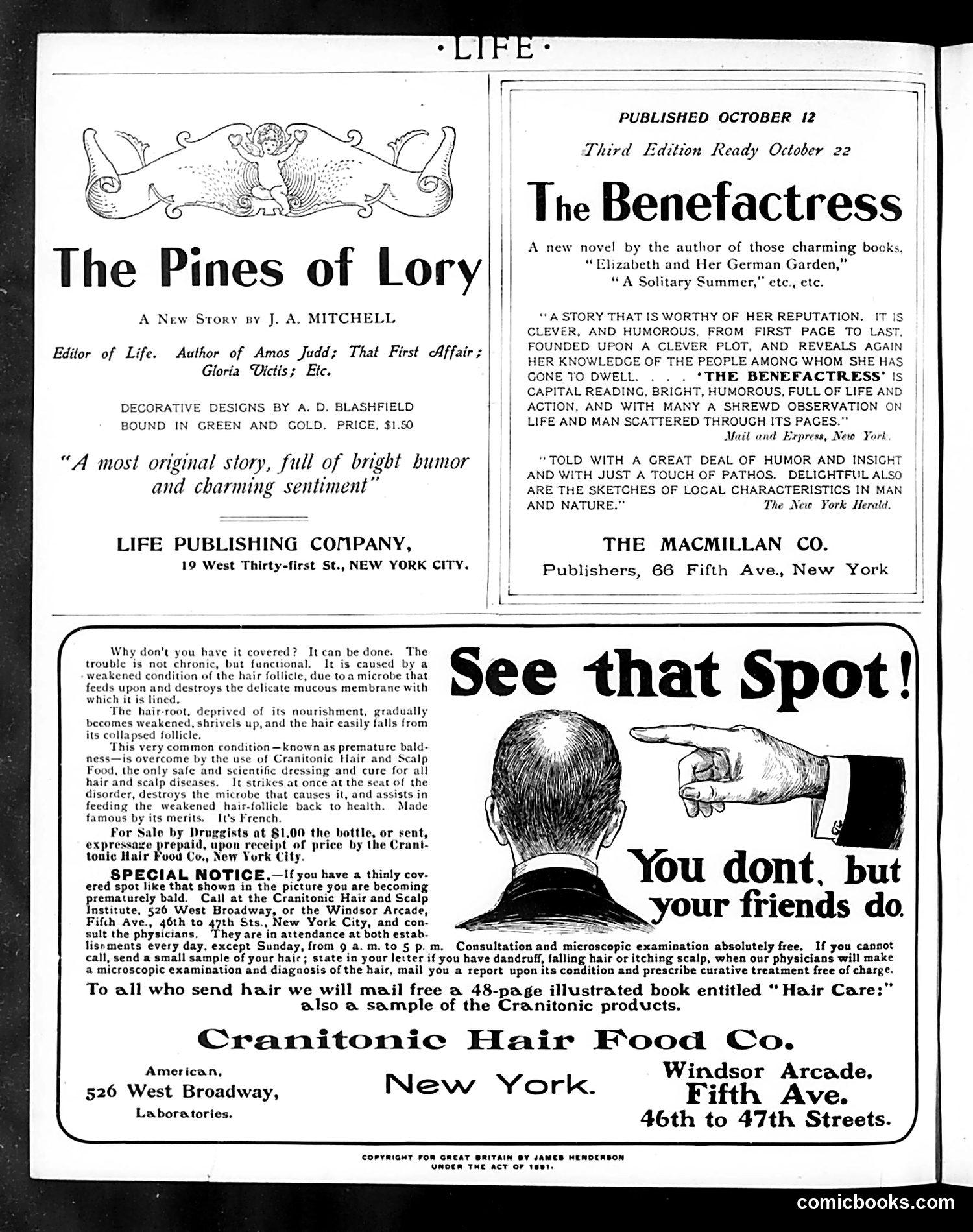
This page contains **book advertisements** (left and right) and a **medical/commercial advertisement** (center-bottom) rather than political satire. The dominant ad is for **Cranitonic Hair Food Co.**, a patent medicine claiming to treat hair loss and scalp conditions. The cartoon shows a pointing hand with the caption "See that Spot! You don't, but your friends do"—a shame-based sales tactic suggesting the viewer has noticeable baldness others perceive. The ad promises free consultations and a 48-page book on "Hair Care," offering what appears to be pseudo-scientific treatment. This reflects early 20th-century **patent medicine marketing**, exploiting insecurities about appearance to sell dubious remedies. The surrounding book ads (novels by J.A. Mitchell and "The Benefactress") are typical period literature promotions, not satirical content.
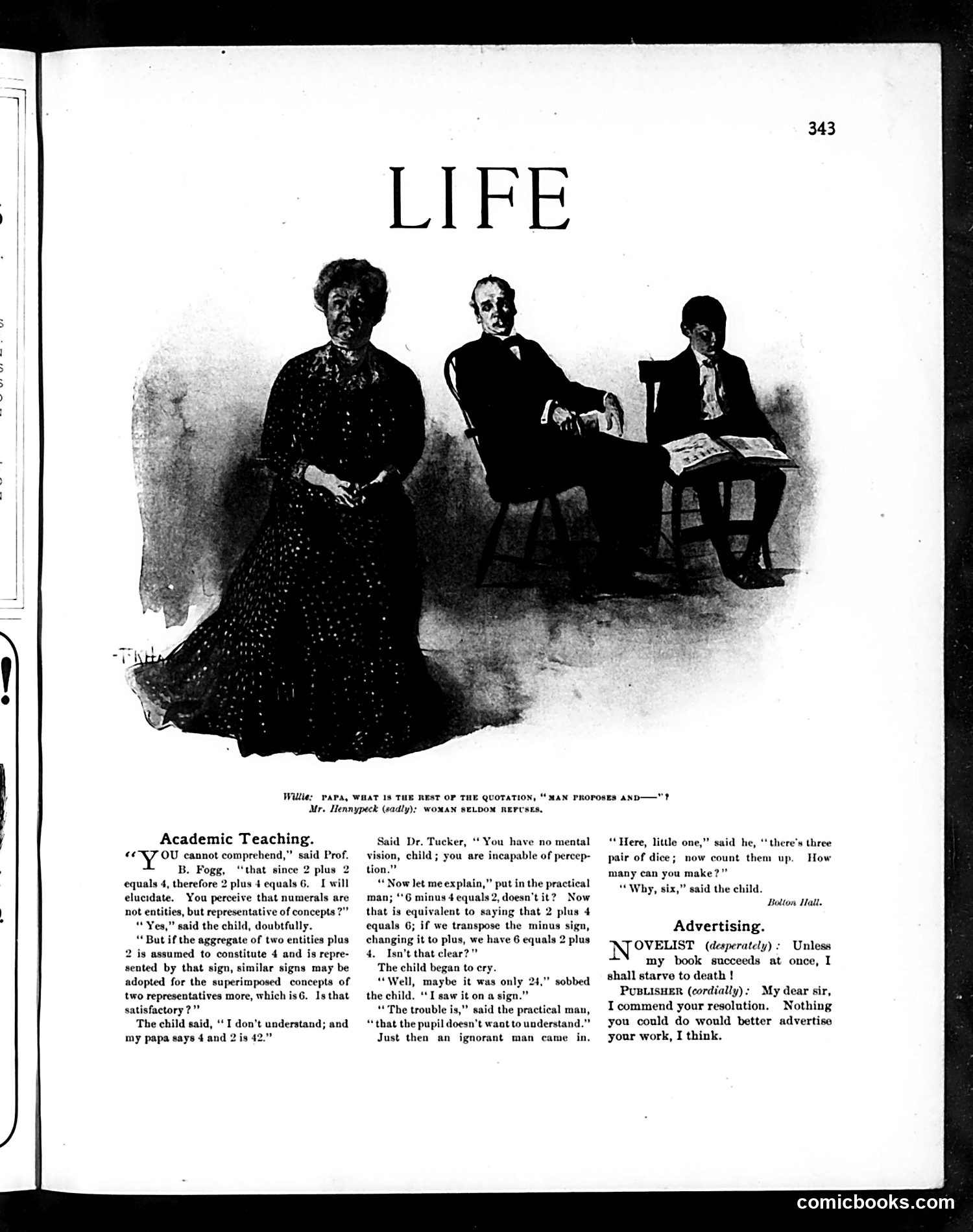
This page contains two distinct sections: **Top Illustration:** A satirical cartoon showing three men in formal dress. The caption references "Papa" proposing something and a woman's refusal, suggesting commentary on romantic or social negotiation—likely mocking Victorian courtship conventions. **"Academic Teaching" Section:** A dialogue satirizing rigid mathematics instruction. A professor insists 2+2=4 through abstract theory rather than practical demonstration. When a child questions the logic and proposes alternative equations, the "practical man" dismisses understanding itself. The humor targets pedantic education that prioritizes rote rules over comprehension—a common Progressive-era critique of American schooling. **"Advertising" Section:** A brief exchange mocking the publishing industry, where a publisher refuses to advertise a novelist's work, suggesting satire of commercial literary gatekeeping.
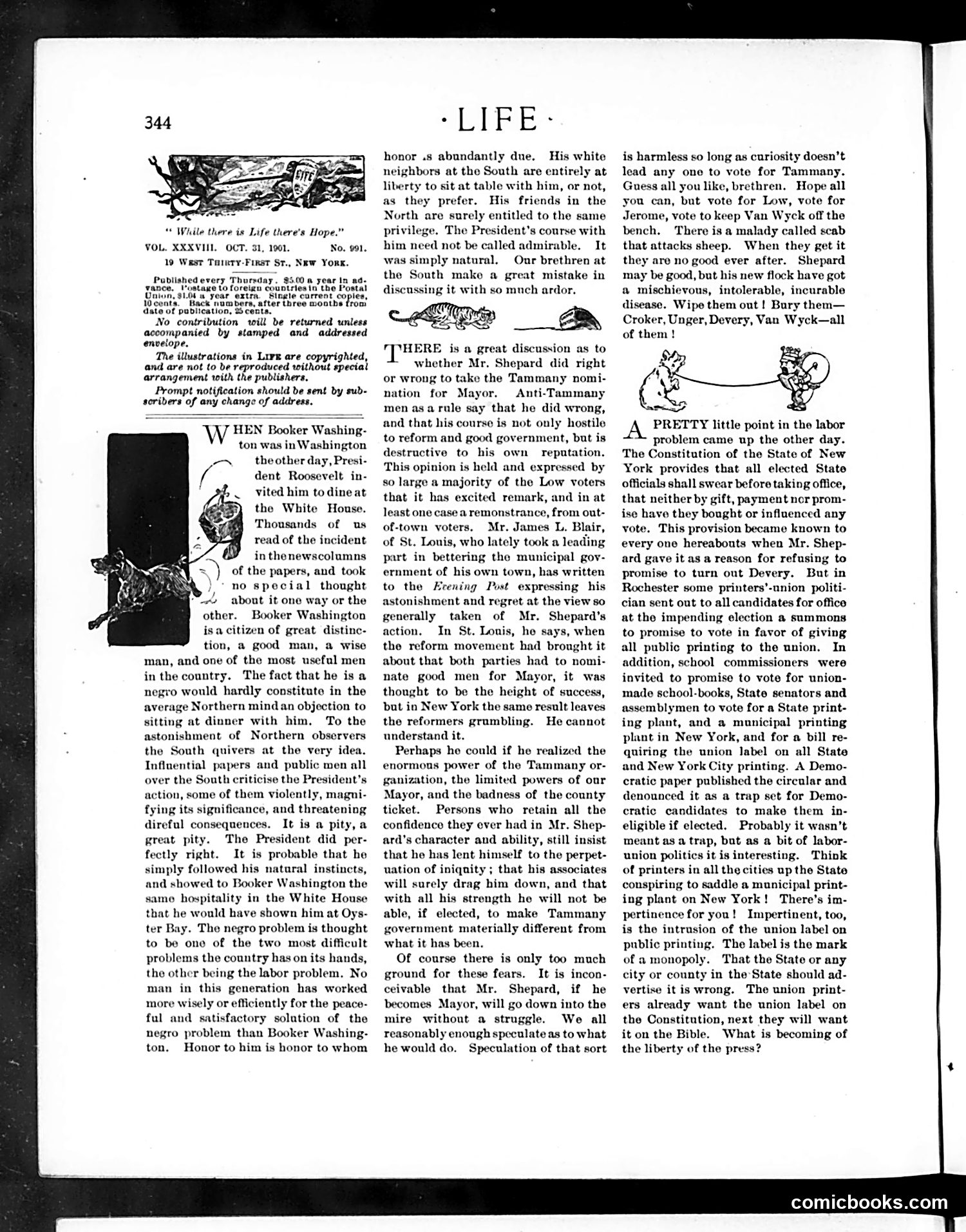
This page contains two political cartoons and accompanying commentary from early 20th-century American politics. The left cartoon depicts **Booker T. Washington's visit to the White House**, where he dined with President Roosevelt. The text explains this caused significant controversy: Southern white newspapers magnified its importance as a racial transgression, while Northern observers debated whether Roosevelt's hospitality was appropriate. The cartoon satirizes how this simple dinner became a major political incident. The right section discusses **Mr. Shepard's nomination for Mayor of New York** and the controversy surrounding union labels in printing. The text critiques how various political factions exploited these issues for electoral advantage, satirizing the gap between stated principles and political opportunism among Democratic candidates and their backers. Both pieces exemplify *Life*'s role as a satirical commentary on contemporary political hypocrisy.
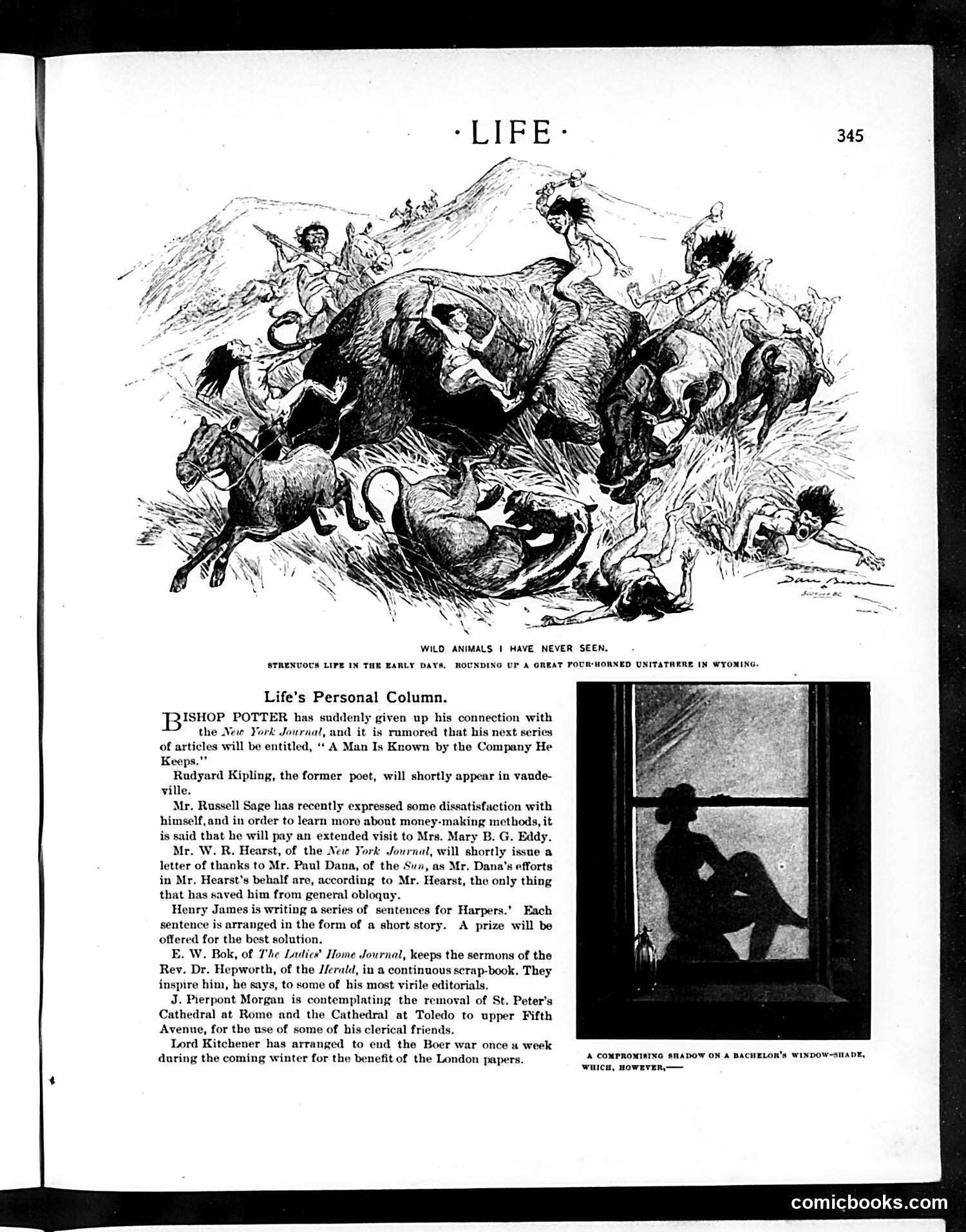
The main illustration depicts a chaotic scene titled "Wild Animals I Have Never Seen: Strenuous Life in the Early Days. Rounding Up a Great Four-Horned Ungulate in Wyoming." This appears to be satirical commentary on Theodore Roosevelt's famous "strenuous life" philosophy and his ranching experiences in Wyoming during the 1880s. The cartoon mocks the physical dangers and wild frontier conditions Roosevelt romanticized through exaggerated imagery of people being thrown by bucking animals and thrown about violently. The "Life's Personal Column" below contains gossip about various literary and journalistic figures, including references to Rudyard Kipling and Henry James. The right side features a silhouette photograph titled "A Compromising Shadow on a Bachelor's Window-Shade, Which, However—" with an incomplete joke relying on reader imagination about impropriety.
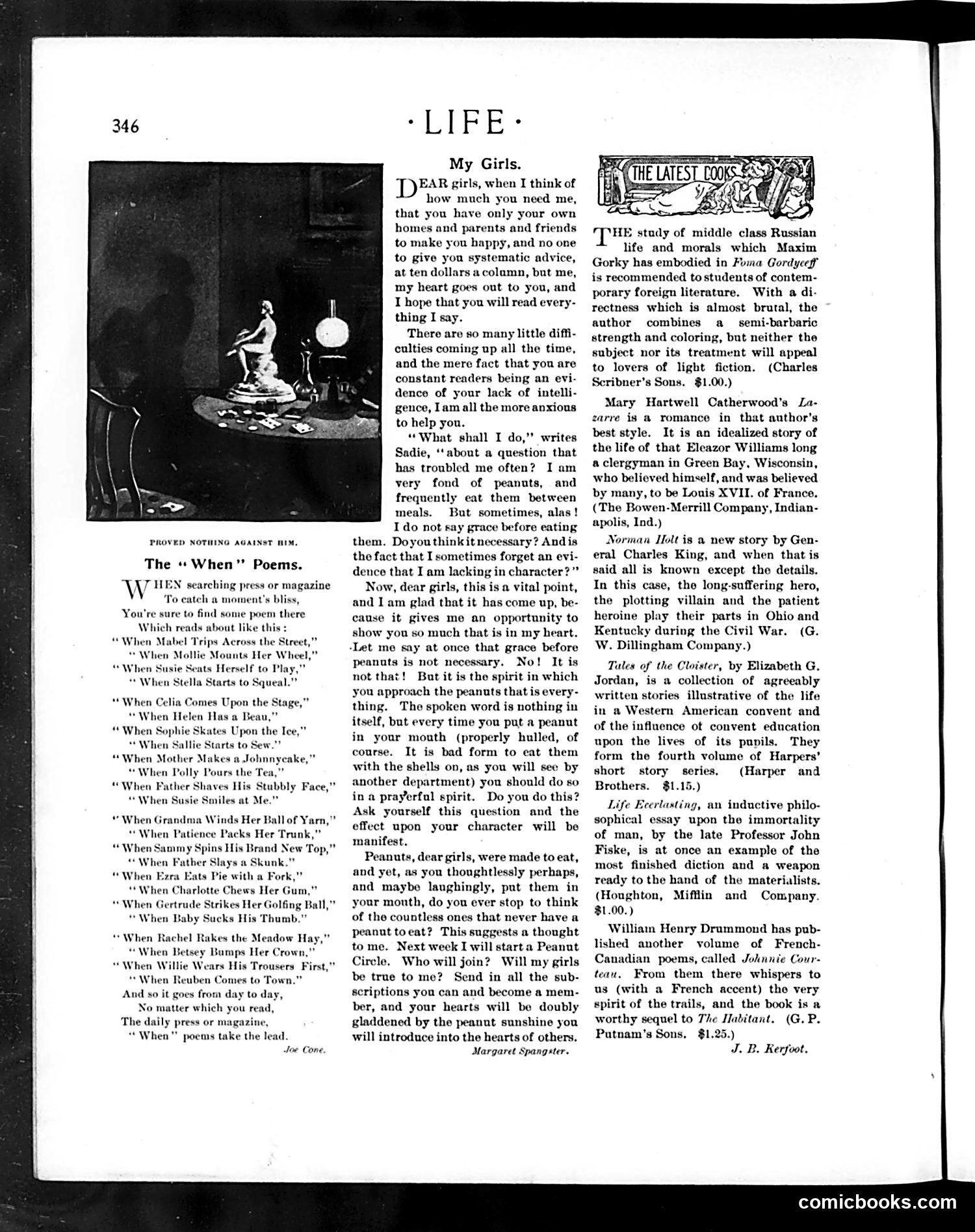
The main illustration, captioned "PROVED NOTHING AGAINST HIM," shows a figure in formal dress seated while another figure appears to be striking or confronting them with what looks like a club or weapon. The caption's meaning is unclear without additional context—it's uncertain what incident or person is being referenced or satirized. The image appears to depict some form of confrontation or scandal, with the caption suggesting that despite apparent wrongdoing or accusation, no proof was established against the subject. The rest of the page contains book reviews under "THE LATEST BOOKS" and a column titled "My Girls" offering advice to young women. Without clearer context about the specific historical moment, the cartoon's exact political or social reference remains ambiguous.
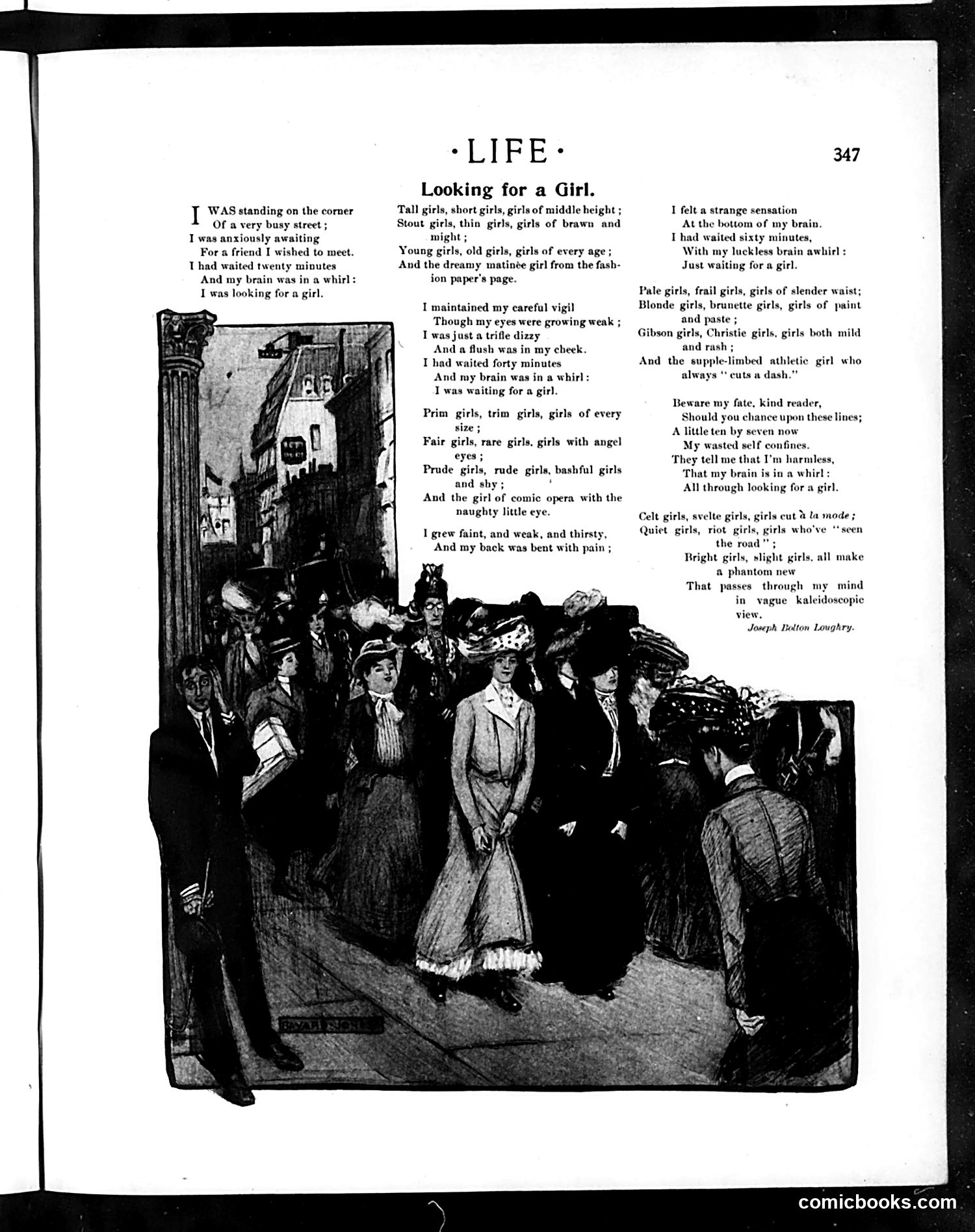
This page satirizes a young man's fruitless search for a romantic partner on a busy city street. The poem describes his increasingly desperate mental state—a "whirl" of consciousness—as he encounters various types of girls (tall, short, shy, bold, etc.) without finding "the one." The illustration shows a crowded urban street scene with a solitary figure in the center, surrounded by well-dressed pedestrians and onlookers, emphasizing his isolation amid the crowd. The satire mocks both romantic idealization and the modern urban dating experience. The protagonist's obsessive, almost delirious search—and his detailed mental cataloging of female "types"—parodies male courtship anxiety and the bewildering abundance of choices in city life, suggesting romantic fulfillment remains elusive despite opportunity.
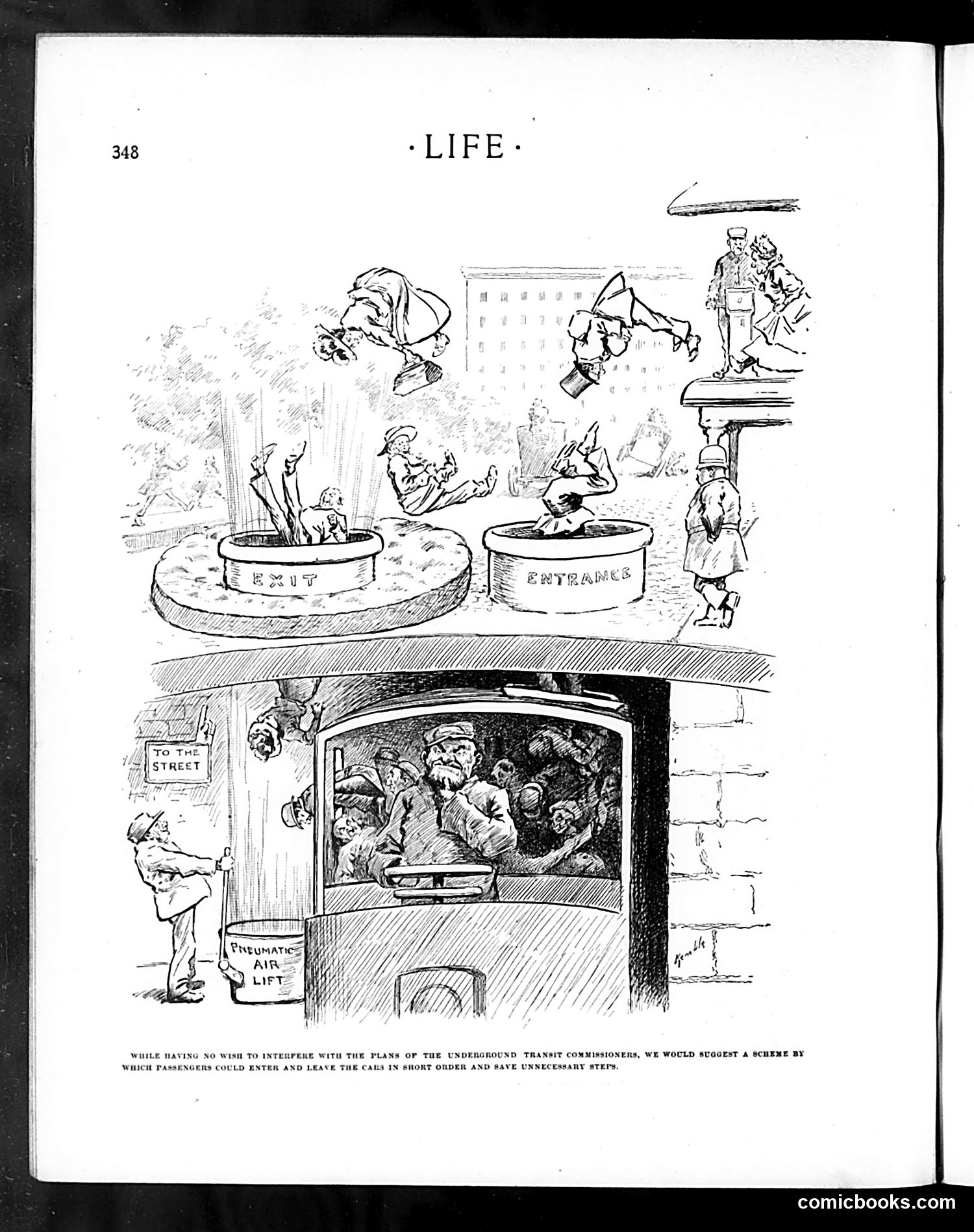
This is a satirical cartoon about New York City's underground transit system. The image shows an elevated street-level scene with two circular pools labeled "EXIT" and "ENTRANCE," where tiny figures of pedestrians are depicted jumping in and out like fountain water—suggesting chaotic, inefficient passenger flow. Below, a crowded subway car sits on a street, packed with passengers, while a man outside gestures in frustration near a sign reading "PNEUMATIC MAIL LIFT." The caption proposes an alternative transit scheme: allowing passengers to enter and exit subway cars quickly without unnecessary steps. The satire mocks the underground transit commissioners' plans as overly complicated, suggesting a simpler, more absurd solution—treating passengers like pneumatic mail being shot through tubes—to highlight the impracticality of the existing system's design.
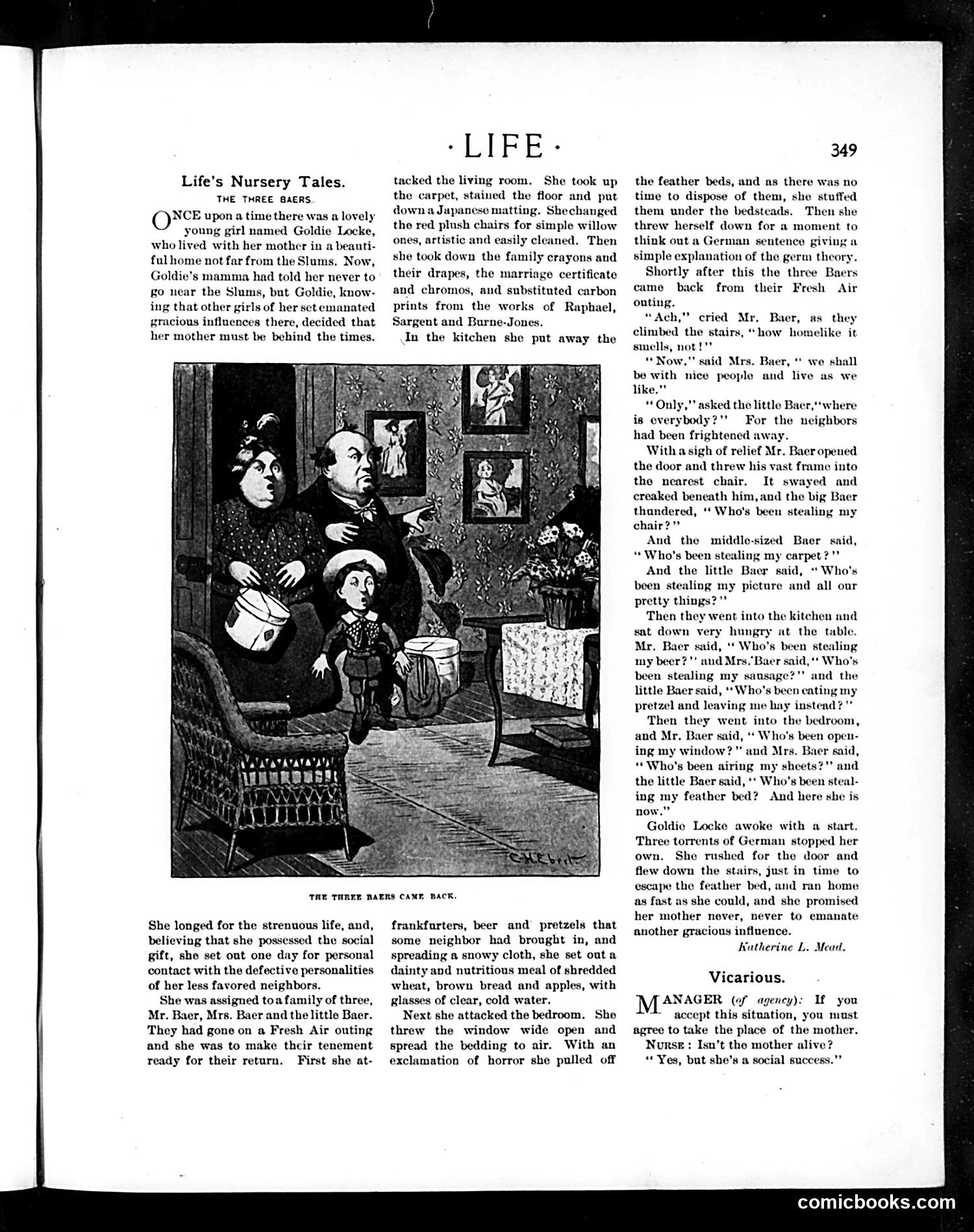
This is a humorous story titled "Life's Nursery Tales: The Three Baers," a parody of Goldilocks and the Three Bears. The narrative and illustration satirize middle-class domestic life through the familiar fairy tale framework. The joke centers on a young woman named Goldie Locke who disrupts the Baer family's home during their absence, but the social satire becomes clear: the family discovers she's been "stealing" their possessions—carpet, furniture, pictures, food, and household goods. Rather than depicting a fairy-tale intrusion, the story mocks contemporary concerns about theft, working-class anxieties about property, and perhaps social climbing or class anxiety among the urban middle class. The exaggerated German surnames and domestic details suggest this reflects turn-of-the-century American immigrant household concerns.
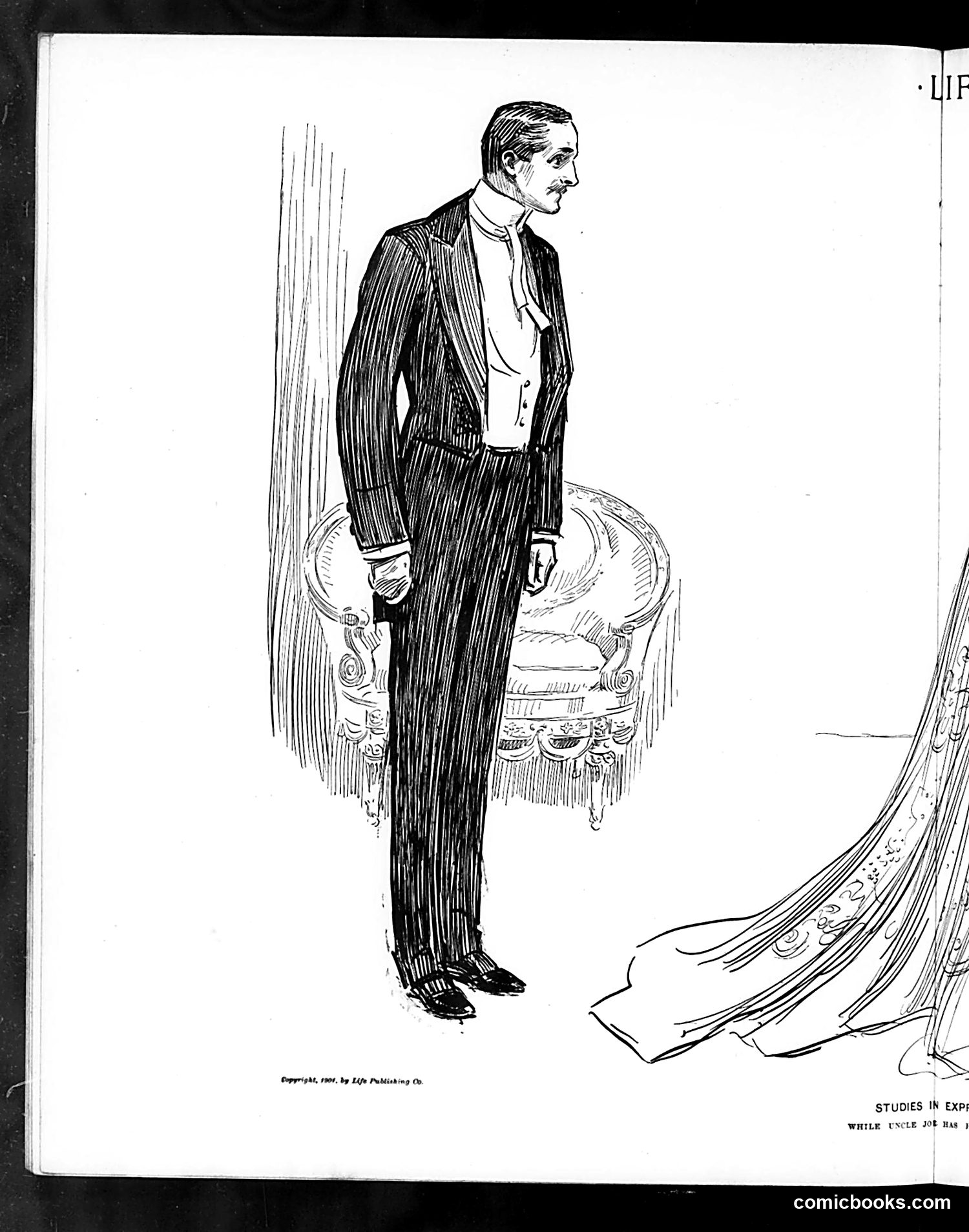
This page contains a single ink illustration titled "Studies in Expression" (partially visible at bottom right, with text mentioning "While Uncle Joe Has"). The drawing depicts a tall, thin man in formal evening wear—a pinstriped suit with white shirt front—standing in profile. He appears aristocratic and somewhat aloof. Behind him is a decorative chair with ornate upholstery, suggesting an elegant interior setting. The satirical intent appears to target a specific public figure through exaggeration of physical proportions and formal mannerisms, likely commenting on their pretentiousness or social bearing. However, without the complete caption ("Uncle Joe Has..."), I cannot definitively identify the subject or explain the specific political or social critique this drawing makes.
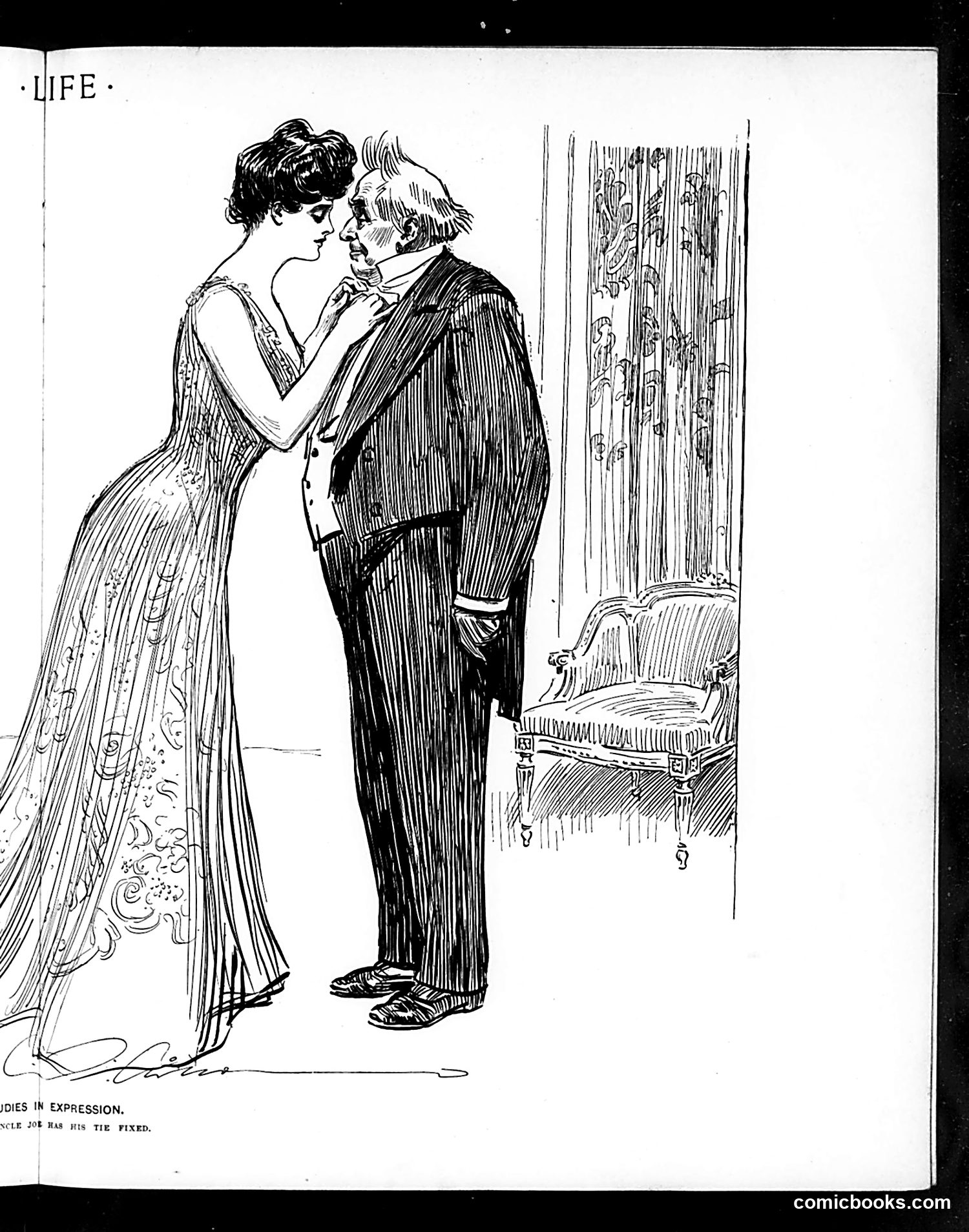
This appears to be an illustration from *Life* magazine's "Studies in Expression" series. The image shows a well-dressed couple in an intimate moment—a woman in an elegant gown touching a man's face or tie. The man's expression suggests bashfulness or discomfort. The partially visible caption at bottom references "Uncle Joe" and "his tie fixed," though the complete text is cut off. The humor likely derives from the contrast between the woman's forward behavior and the man's nervous reaction, satirizing social dynamics of courtship or domestic relations in the early 20th century. Without the full caption or date visible, the specific identity of "Uncle Joe" and the precise social commentary remain unclear, but the illustration exemplifies *Life*'s tradition of satirizing gender relations and social awkwardness through character sketches.
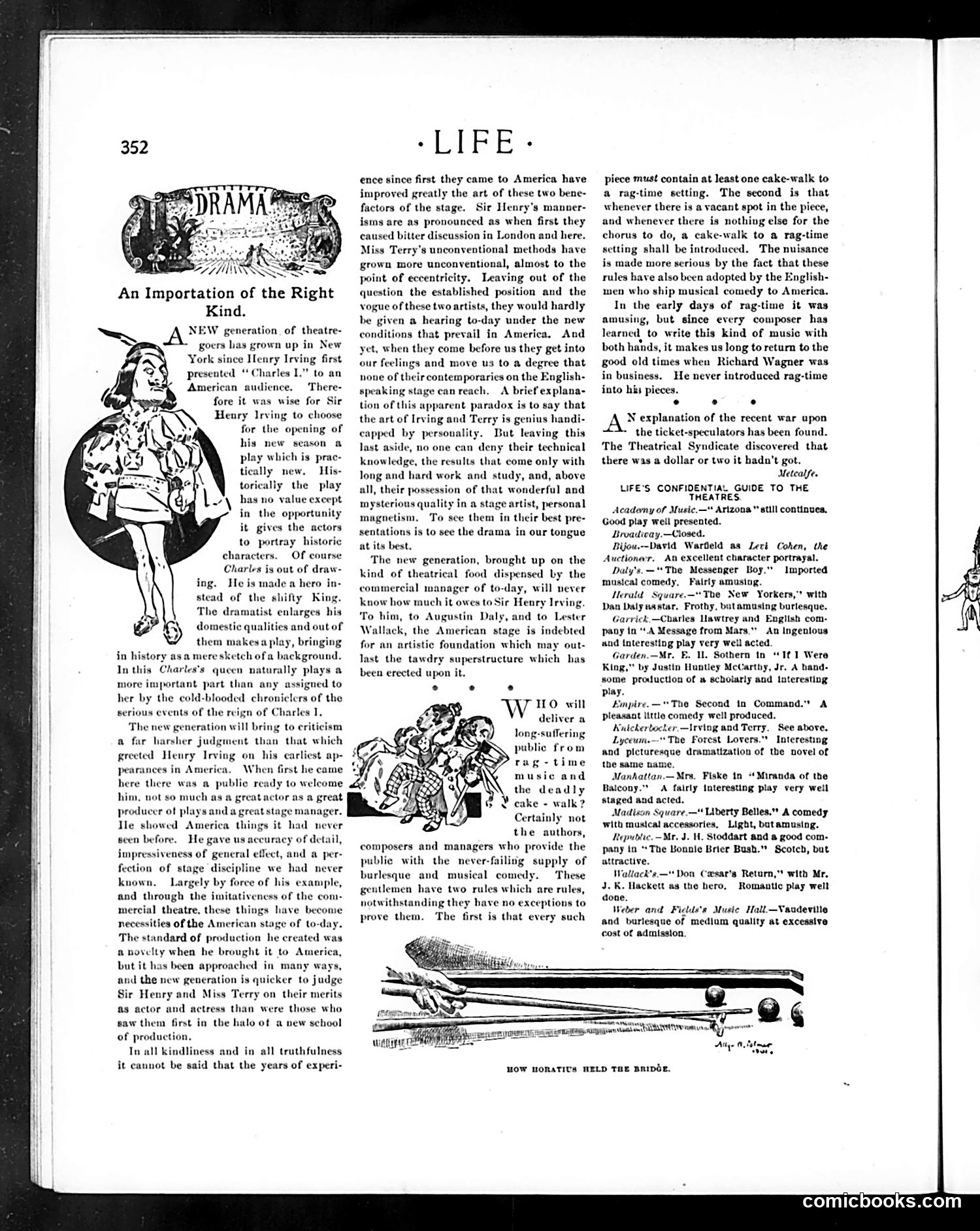
This page features a drama criticism article praising Henry Irving's London production of "Charles I," performed for American audiences. The accompanying illustration depicts a figure in elaborate period costume—likely representing Charles I or a theatrical character from the play. The satire critiques the commercial theater of early 20th-century America, suggesting that Irving's prestigious, historically-grounded dramatic work represents superior theatrical standards compared to contemporary American productions. The piece argues that Irving and Miss Terry demonstrated "technical knowledge" and "study" that American theater managers too often neglected in favor of commercial spectacle. The bottom illustration shows "How Horacius Held the Bridge," a classical historical reference reinforcing the article's theme about the value of serious, culturally significant theatrical productions.
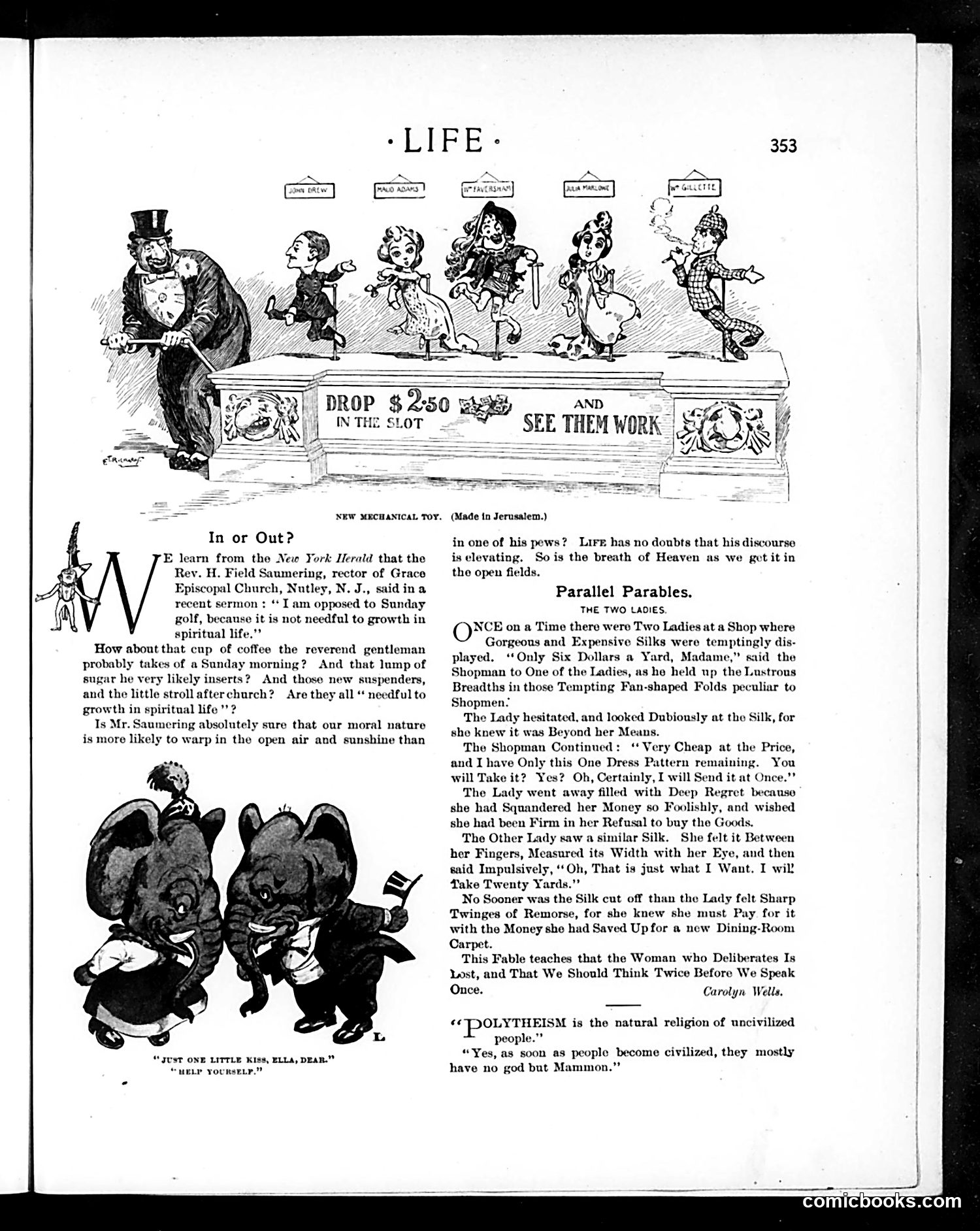
**Top Cartoon:** A mechanical toy depicts a man operating a slot machine labeled "Drop $2.50 and See Them Work." Five caricatured figures perform on top—likely representing stereotypical ethnic or social types (the labels are small but appear to reference various nationalities). This mocks both the dehumanizing nature of mechanical entertainment and the era's casual ethnic stereotyping. **"In or Out?" Editorial:** Life critiques Reverend Saumering's sermon opposing Sunday golf as "unspiritual." The satire argues his logic is hypocritical: if outdoor recreation harms spirituality, why doesn't his Sunday coffee, sugar, suspenders, and post-church walks? The piece defends leisure and natural air as spiritually beneficial. **"Parallel Parables":** Two cautionary tales about women's shopping decisions. One regrets impulsive silk purchases; the other buys excessively. The moral warns women against both indecision and impulse spending. **Bottom Quote:** A cynical exchange suggesting that "civilized" people replace religious faith with materialism (worship of "Mammon"/money).
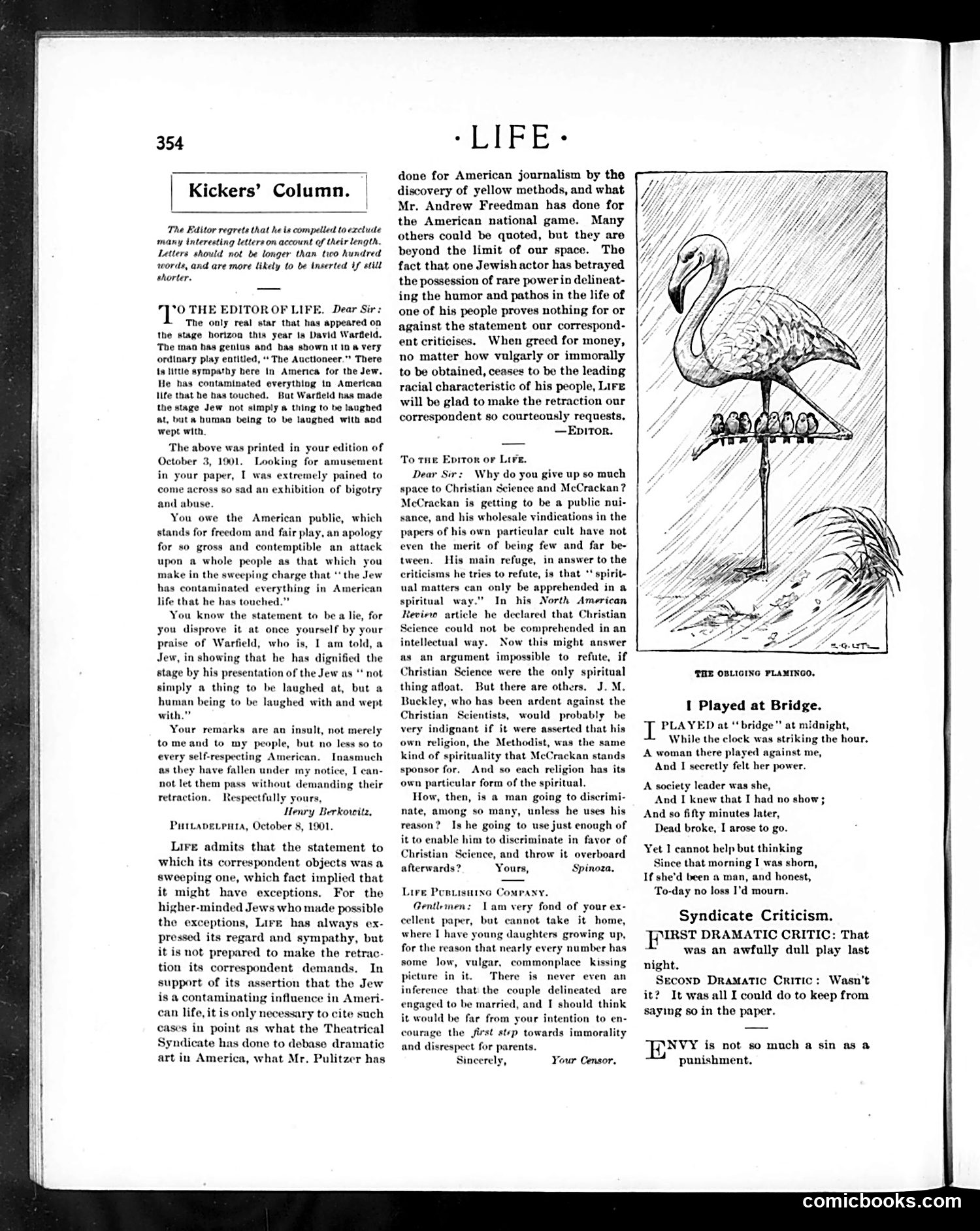
This page features satirical correspondence about anti-Semitism. A letter-writer praises actor David Warfield (a Jewish performer) while simultaneously claiming Jews have "contaminated everything in American life." A responsive letter from Henry Berkowitz calls out this hypocrisy—praising one Jewish person while condemning the entire group is logically contradictory. Life's editorial response is notably defensive and offensive by modern standards: it refuses retraction, instead citing alleged Jewish wrongdoing by Joseph Pulitzer (newspaper "yellow journalism"), Andrew Freedman (baseball), and theatrical syndicates, portraying greed as a "racial characteristic." The cartoon titled "The Obliging Flamingo" (right) appears unrelated to this debate—it shows a flamingo on a pole with birds below, likely a separate satirical comment, though its specific meaning is unclear without additional context. The page reveals early 1900s American anti-Semitic attitudes coexisting with grudging acknowledgment of Jewish talent and contribution.
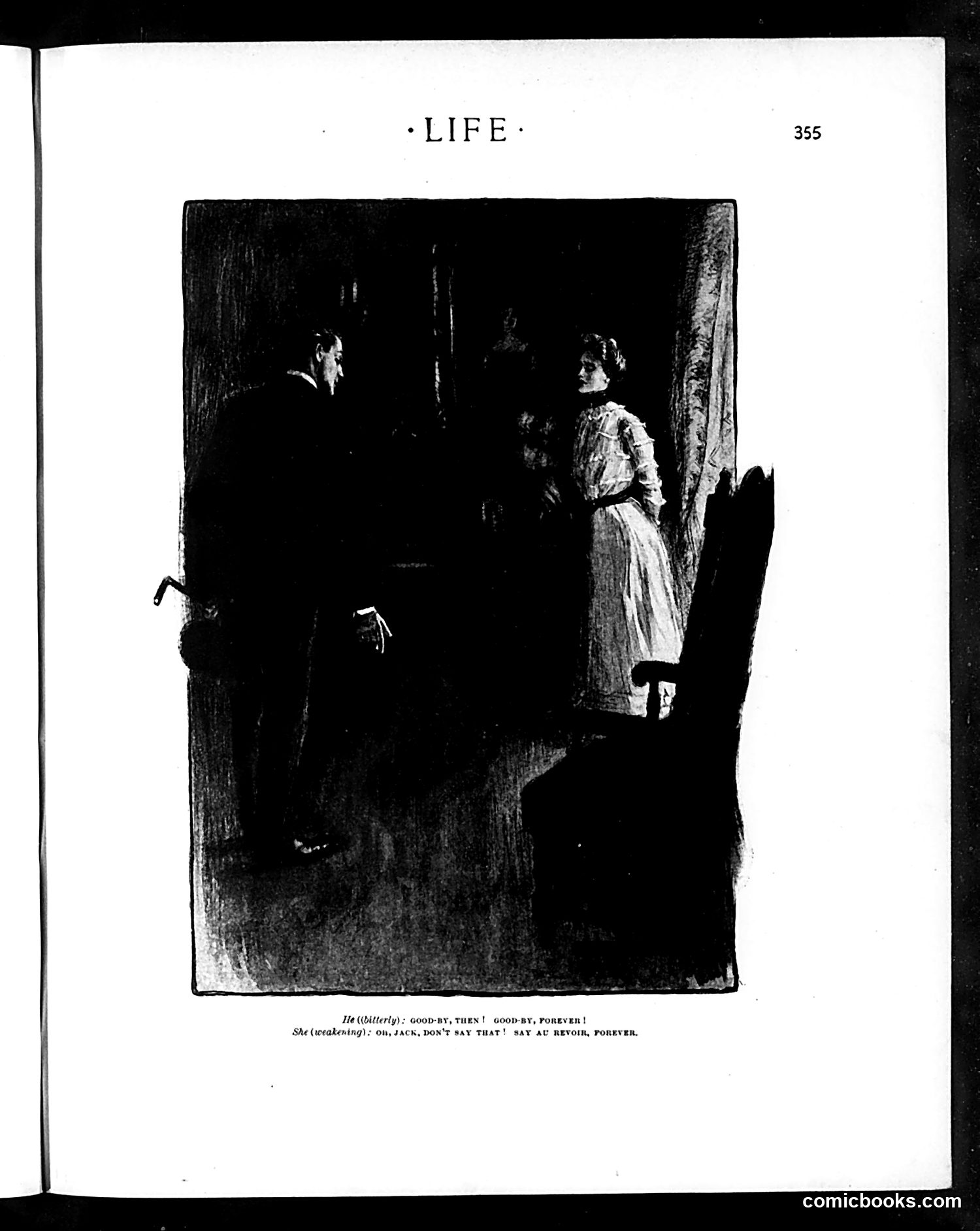
This illustration depicts a romantic farewell scene between a man and woman. The dialogue reveals the satire: he says "Good-by, then! Good-by, forever!" while she protests, asking him to say "Au revoir, forever" instead—French for "until we meet again." The joke satirizes sentimental romanticism and linguistic affectation. The woman's insistence on the French phrase suggests she wants emotional drama softened by sophistication. She's weakening emotionally but clinging to genteel language to maintain composure during their parting. This likely mocks either wartime separations (common in Life's era) or the theatrical performances of romantic breakups among the upper classes, using foreign phrases to add poignancy to what may be a temporary separation presented as permanent.
This page is primarily **advertising and anecdotes**, not political cartoons. It contains three humorous stories about judges and legal figures, likely from Irish and American sources. The main content features witty exchanges involving **Lord Morris and Killanin**, an Irish judge known for clever courtroom retorts. The anecdotes illustrate his sharp humor: mocking a pompous doctor, dismissing false deference to legal authority, and making a pointed political joke about "simple and honest people" (the Irish) trying to govern "quick-witted and dishonest ones" against their will—a dig at English rule. The other stories joke about a hotel owner's advertising backfiring legally, and a Russian immigrant struggling with a telephone receiver that "kinks" from the stress of the Slavic language—a crude ethnic humor common to the era. **The satire targets** pomposity, legal absurdity, and ethnic stereotypes typical of early 20th-century American magazines. The page is otherwise filled with period advertisements for whiskey, theater, and chocolates.
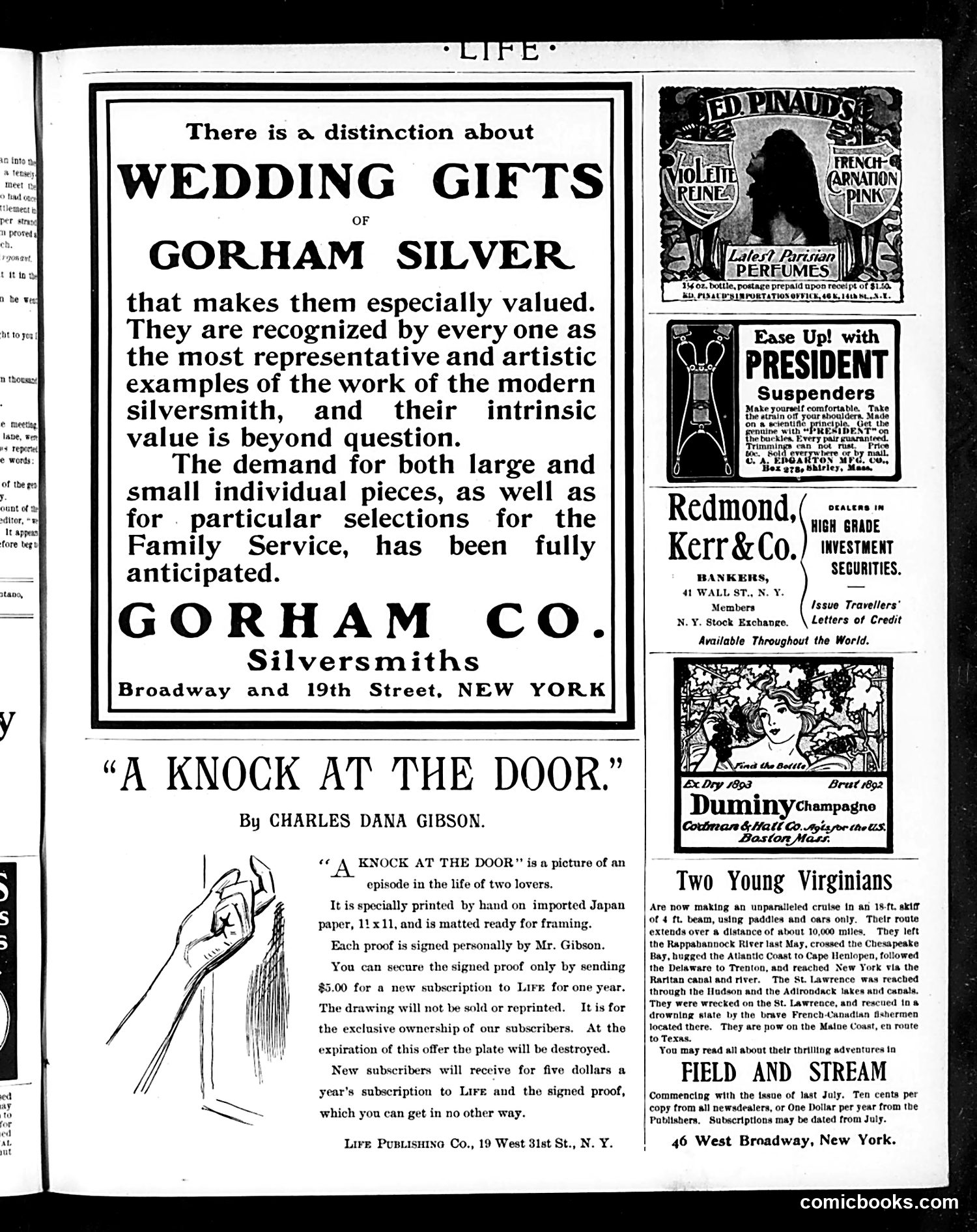
This page is primarily **advertising and editorial promotion** rather than political satire. **Main Content:** - A large **Gorham Company advertisement** for luxury silver wedding gifts, emphasizing their prestige and artistic value - **"A Knock at the Door"** — a Charles Dana Gibson drawing available as a signed, hand-printed proof. Gibson was Life's famous illustrator known for depicting romantic encounters; this appears to be one such scene. The offer incentivizes new subscriptions ($5) to obtain the exclusive signed proof. **Side Advertisements:** Include perfume, President suspenders, investment banking services, and champagne — typical luxury goods marketed to Life's affluent readership. **"Two Young Virginians"** — A brief feature about two young men undertaking an ambitious 10,000-mile canoe and kayak journey, promoted as part of the *Field and Stream* magazine's adventure coverage. **Overall:** This is a typical turn-of-the-century luxury magazine page targeting wealthy readers with fine goods, exclusive artwork, and aspirational adventure stories.
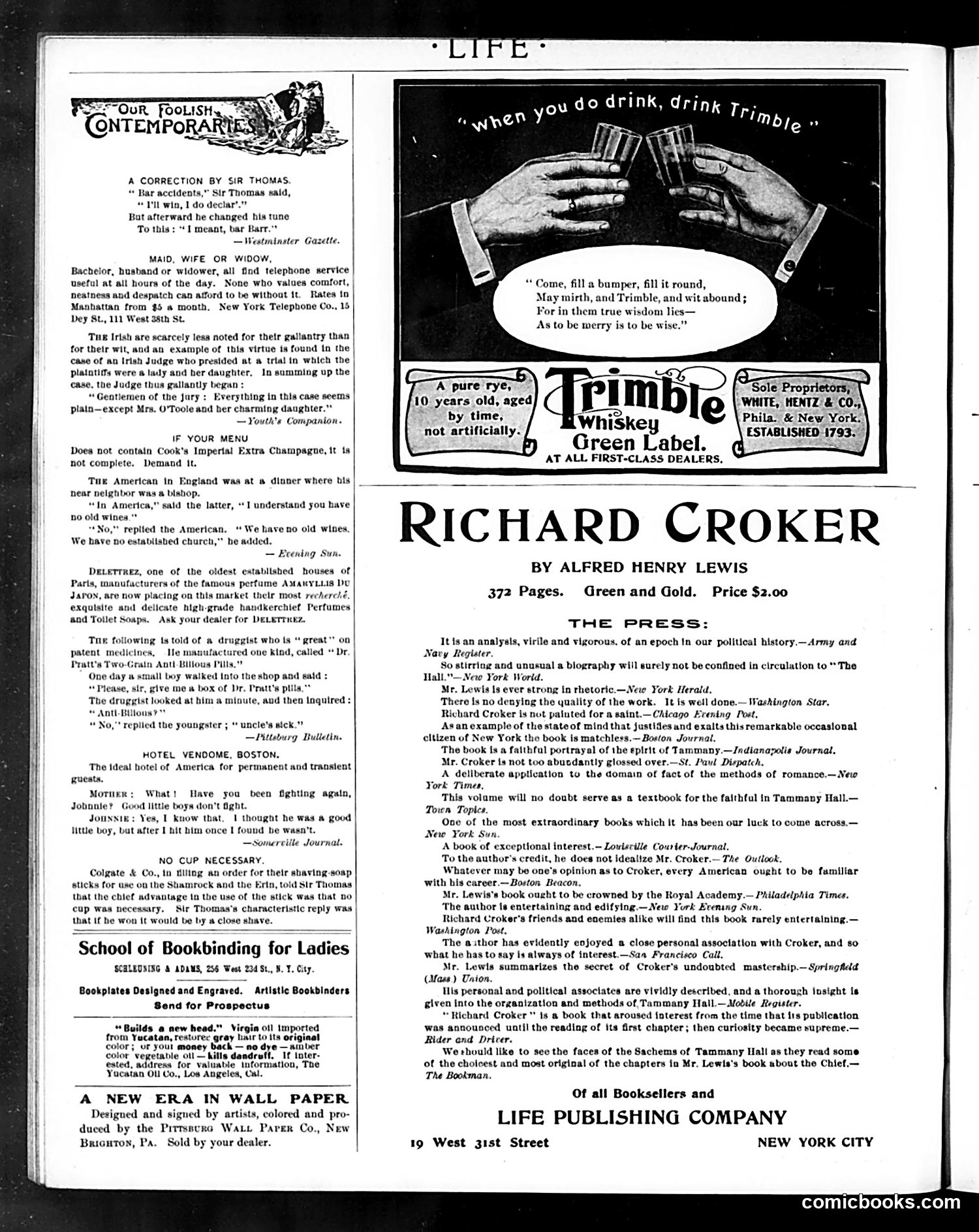
This is primarily a **book advertisement page** mixed with period humor and smaller ads. The main feature advertises *Richard Croker* by Alfred Henry Lewis—a biography of the notorious Tammany Hall political boss who controlled New York City Democratic politics in the 1890s-1900s. The scattered jokes are typical of *Life* magazine's style: brief anecdotes mocking Irish accents/stereotypes, judges' gallantry, Americans' cultural inferiority to England, and naval officers. The "Sir Thomas" correction joke appears to reference a political figure correcting himself (unclear which Thomas without more context). The **Trimble Whiskey ad** uses the period's rhetorical flourish about "wisdom" and merriment—standard liquor marketing of the era. Most notable: this page shows how 19th-century American satire magazines mixed advertising, political commentary, and ethnic humor in ways that would be considered offensive today, while still addressing serious subjects like political corruption through book reviews.
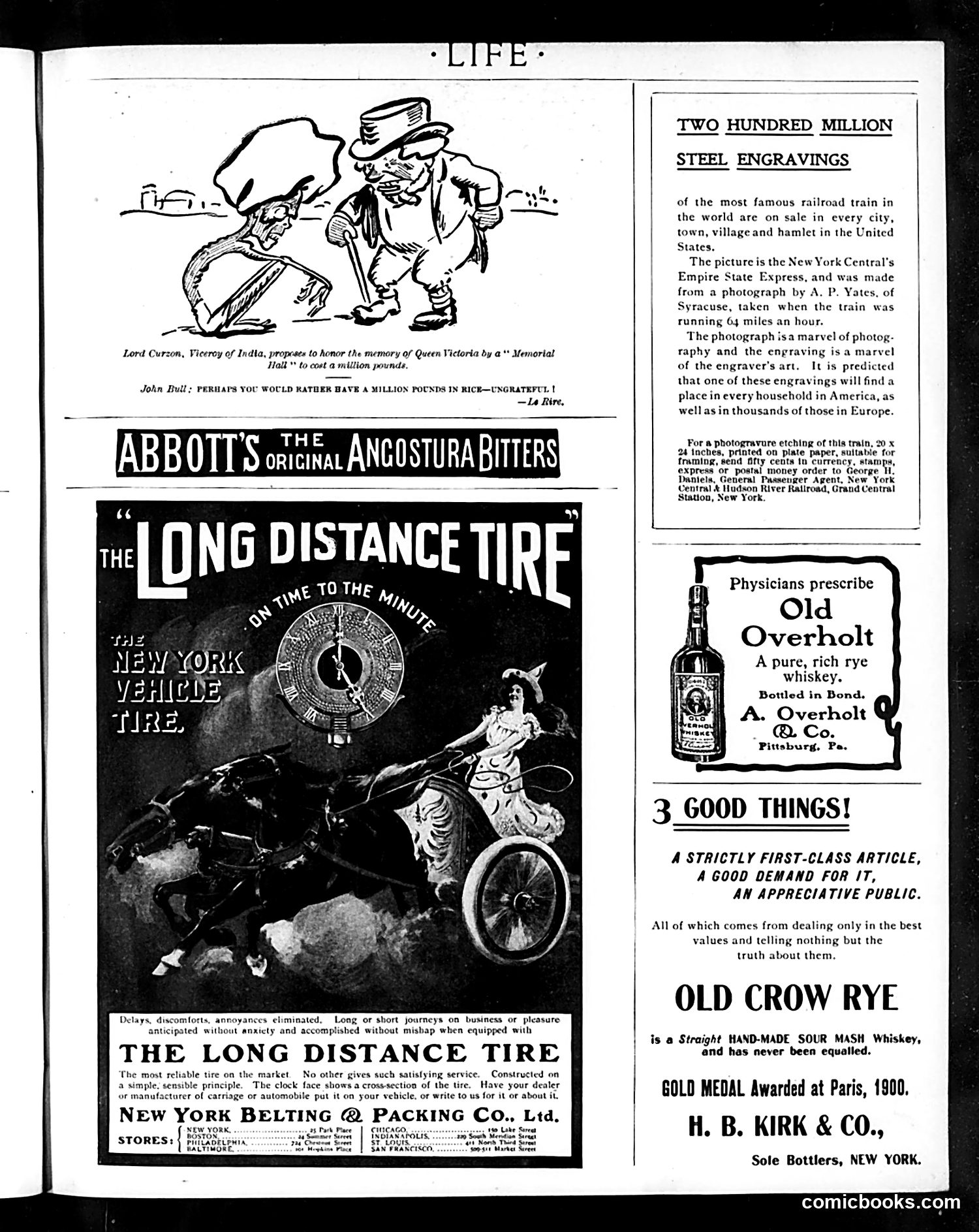
**The Cartoon (Top):** This political cartoon satirizes Lord Curzon, British Viceroy of India, who proposed spending one million pounds on a memorial hall honoring Queen Victoria. The caption, attributed to *Le Rire* (French satirical magazine), shows "John Bull" (personification of Britain) sarcastically suggesting Curzon would prefer having a million pounds in his pocket rather than spending it on monuments. The joke criticizes the extravagance of colonial administrators—suggesting self-interest over public commemoration. **The Advertisements:** The page is primarily advertising: tires, whiskeys (*Old Overholt*, *Old Crow Rye*), and railroad engravings of the Empire State Express. These reflect early-1900s consumer goods and mass marketing. **Historical Context:** This appears to be early-20th-century *Life*, when the magazine was primarily satirical and advertiser-supported, before becoming a photo-journalism publication.
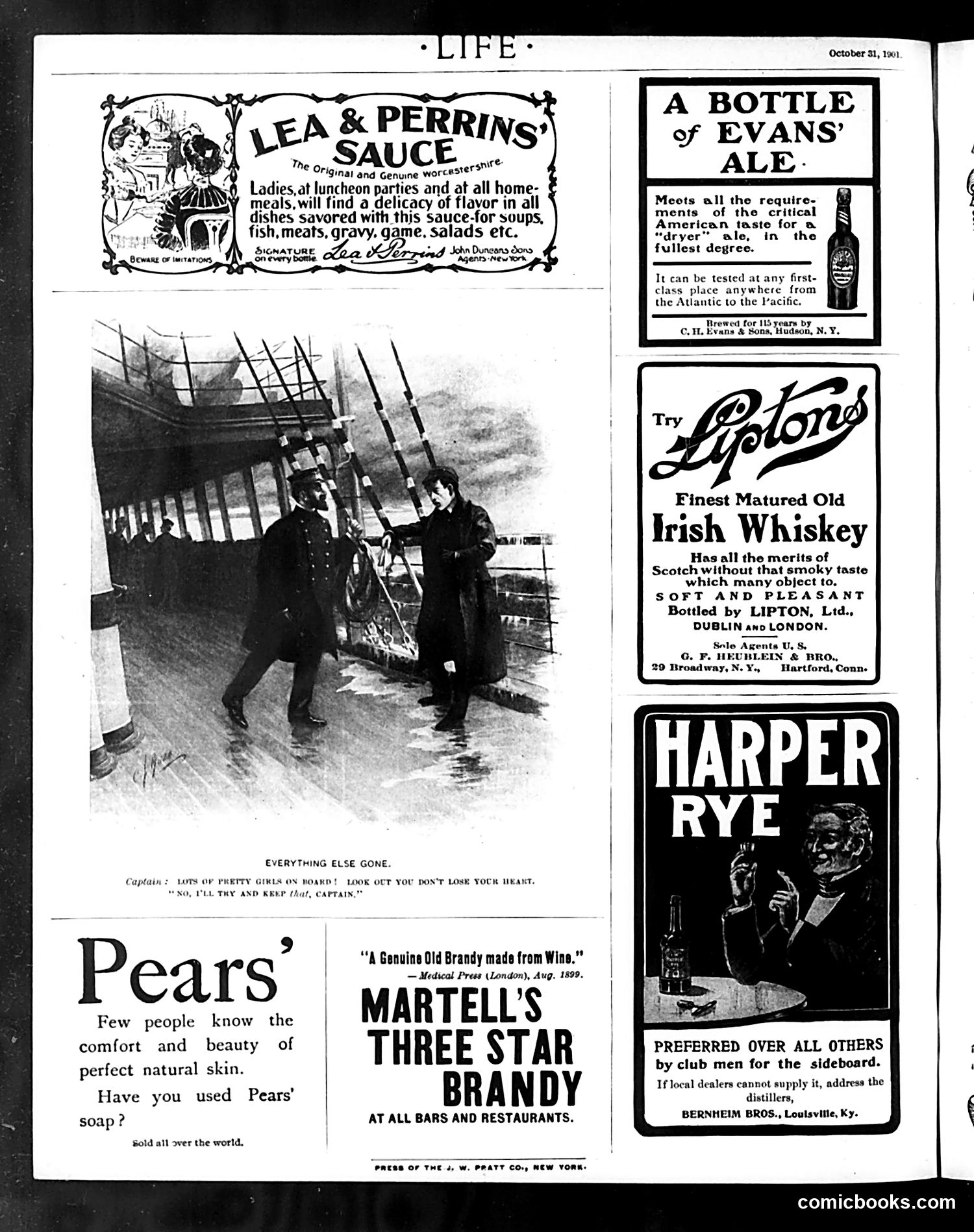
This page is primarily **advertisements** with one small cartoon. The cartoon depicts two men aboard a ship in rough seas, captioned "Everything Else Gone." A captain warns a subordinate about "pretty girls on board," and the man replies he'll "try and keep that, captain"—a joke about maintaining order and protecting female passengers during a disaster when all else is lost. The page otherwise features period liquor and consumer product ads (Lea & Perrins sauce, Evans' ale, Lipton's Irish whiskey, Martell's brandy, Harper Rye, and Pears' soap). These ads reflect early 1900s consumer culture and marketing aimed at middle and upper-class readers. The cartoon's humor relies on the juxtaposition of catastrophe with romantic concern—a mild Victorian-era joke about misplaced priorities during crisis.