
Life, 1901-10-31 · page 4 of 20
Life — October 31, 1901 — page 4: what you’re looking at
What you’re looking at
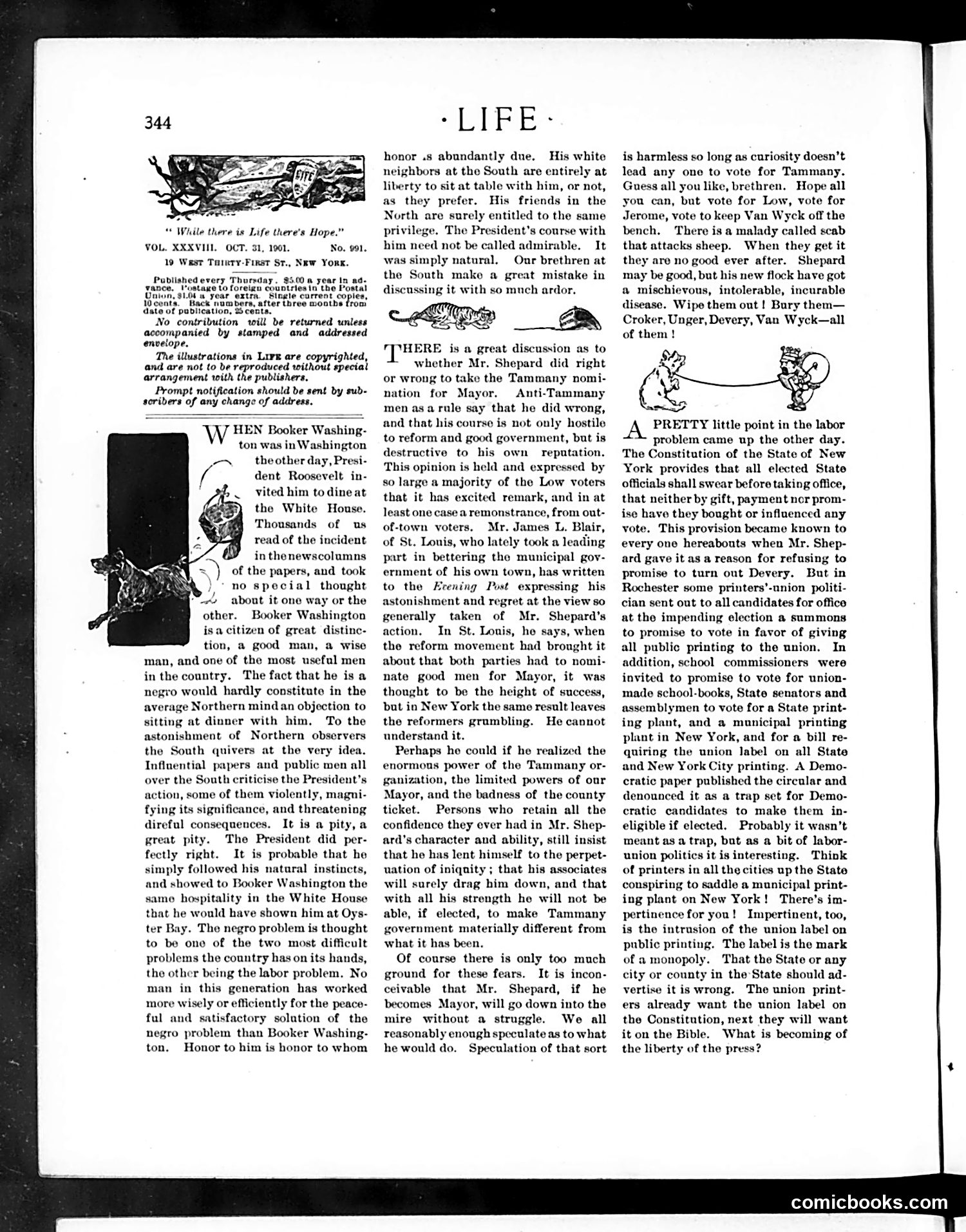
This page contains two political cartoons and accompanying commentary from early 20th-century American politics. The left cartoon depicts **Booker T. Washington's visit to the White House**, where he dined with President Roosevelt. The text explains this caused significant controversy: Southern white newspapers magnified its importance as a racial transgression, while Northern observers debated whether Roosevelt's hospitality was appropriate. The cartoon satirizes how this simple dinner became a major political incident. The right section discusses **Mr. Shepard's nomination for Mayor of New York** and the controversy surrounding union labels in printing. The text critiques how various political factions exploited these issues for electoral advantage, satirizing the gap between stated principles and political opportunism among Democratic candidates and their backers. Both pieces exemplify *Life*'s role as a satirical commentary on contemporary political hypocrisy.
📄 Transcribed text from this page (OCR, searchable)
Machine-transcribed from the original scan — historical spelling and the odd misread are preserved.
“ While there is Life there's Hope.” VOL. XXXVIII. OCT. 31, 1901. No, 991. 19 Wast Taiery-First St., New Yorx. ihublished every ‘Thursday. $5000 year In ad ance, Mostage to foreign countries to the Postal ui $1.06 4 year extra. Single current co) . ee, ib Back utbers, after three months {rom date of publication, scents. No contribution twill be returned unless accompanied by stamped and addressed envelope. The illustrations in Lire are copyrighted, and are not to be reproduced without special arrangement with the publishers. Prompt notification should be sent by sub- soribers of any change of address. HEN Booker Washing: ton was in Washington the other day, Presi- dent Roosevelt in- vited him to dine at the White House. Thousands of us read of the incident in thenewscolumns of the papers, and took no special thought ~~) about it one way or the other. Booker Washington isa citizen of great distinc- tion, a good man, a wise man, and one of the most useful men in the country. The fact that he is a negro would hardly constitute in the average Northern mind an objection to sitting at dinner with him. To the astonishment of Northern observers the South quivers at the very idea. Influential papers and public men all over the South criticise the President’s jon, some of them violently, magni- ng its significance, and threatening direful consequences. It is a pity, a great pity. The President did per- fectly right. It is probable that he simply followed his natural instincts, and showed to Booker Washington the samo hospitality in the White House that he would have shown him at Oys- ter Bay. The negro problem is thought. to be one of the two most difficult problems the country has on its hands, the other being the labor problem, No man in this generation has worked more wisely or efficiently for the peace- ful and satisfactory solution of the negro problem than Booker Washing- ton. Honor to him is honor to whom LIPE honor .s abundantly due. His white neighbors at the South are entirely at liberty to sit at table with him, or not, as they prefer. His friends in the North are surely entitled to the same privilege. The President's course with him need not be called admirable. It was simply natural, Our brethren at the South make a great mistake in discussing it with so much ardor, HERE is a great discussion as to whether Mr, Shepard did right or wrong to take the Tammany nomi- nation for Mayor, Anti-Tammany men asarule say that he did wrong, and that his course is not only hostile to reform and good government, but is destructive to his own reputation. This opinion is held and expressed by so large a majority of the Low voters that it has excited remark, and in at least one case a remonstrance, from out- of-town voters, Mr. James L. Blair, of St. Louis, who lately took a leading part in bettering the municipal gov- ernment of his own town, has written to the Evening Post expressing his astonishment and regret at the view so generally taken of Mr. Shepard’s action. In St. Lonis, he says, when the reform movement had brought it about that both parties had to nomi- nate good men for Mayor, it was thonght to be the height of success, but in New York the same result leaves the reformers grumbling. He cannot understand it. Perhaps ho could if he realized the enormous power of the Tammany or- ganization, the limited powers of our Mayor, and the badness of the county ticket. Persons who retain all the confidence they ever had in Mr. Shep- ard’s character and ability, still insist that he has lent himself to the perpet- uation of iniquity ; that his associates will surely drag him down, and that with all his strength ho will not be able, if elected, to make Tammany government materially different from what it has been. Of course there is only too much ground for these fears. It is incon- ceivable that Mr. Shepard, if he becomes Mayor, will go down into the mire without a struggle. We all reasonably enough speculate as to what he would do. Speculation of that sort is harmless so long as curiosity doesn’t lead any one to vote for Tammany. Guess all you like, brethren. Hope all you can, but vote for Low, vote for Jerome, vote to keep Van Wyck off the bench, There is a malady called scab that attacks sheep. When they get it they are no good ever after. Shepard may be good, but his new flock have got a mischievous, intolerable, incurable disease. Wipe them out ! Bury them— Croker, Unger, Devery, Van Wyck—all of them ! PRETTY little point in the labor problem came up the other day. The Constitution of the State of New York provides that all elected State officials shall swear before taking office, that neither by gift, payment nor prom- ise have they bought or influenced any vote. This provision became known to every one hereabouts when Mr. Shep- ard gave it as a reason for refusing to promise to turn out Devery. But in Rochester some printers’-nnion politi- cian sent out to all candidates for office at the impending election a summons to promise to vote in favor of giving all public printing to the union, In addition, school commissioners were invited to promise to vote for union- made school-books, State senators and assemblymen to vote for a State print- ing plant, and a municipal printing plant in New York, and for a bill re- quiring the union label on all State and New York City printing. A Demo- cratic paper published the circular and denounced it as a trap set for Demo- cratic candidates to make them in- eligible if elected. Probably it wasn’t meant as a trap, but as a bit of labor- union politics it is interesting. Think of printers in all the cities up the State conspiring to saddle a municipal print- ing plant on New York! There’s im- pertinence for you! Impertinent, too, is the intrusion of the union label on public printing. The label is the mark of a monopoly, That the State or any i unty in the State should ad- i The union print- ers already want the union label on the Constitution, next they will want it on the Bible. What is becoming of the liberty of the press? comicbooks.com