
Life, 1901-10-31 · page 6 of 20
Life — October 31, 1901 — page 6: what you’re looking at
What you’re looking at
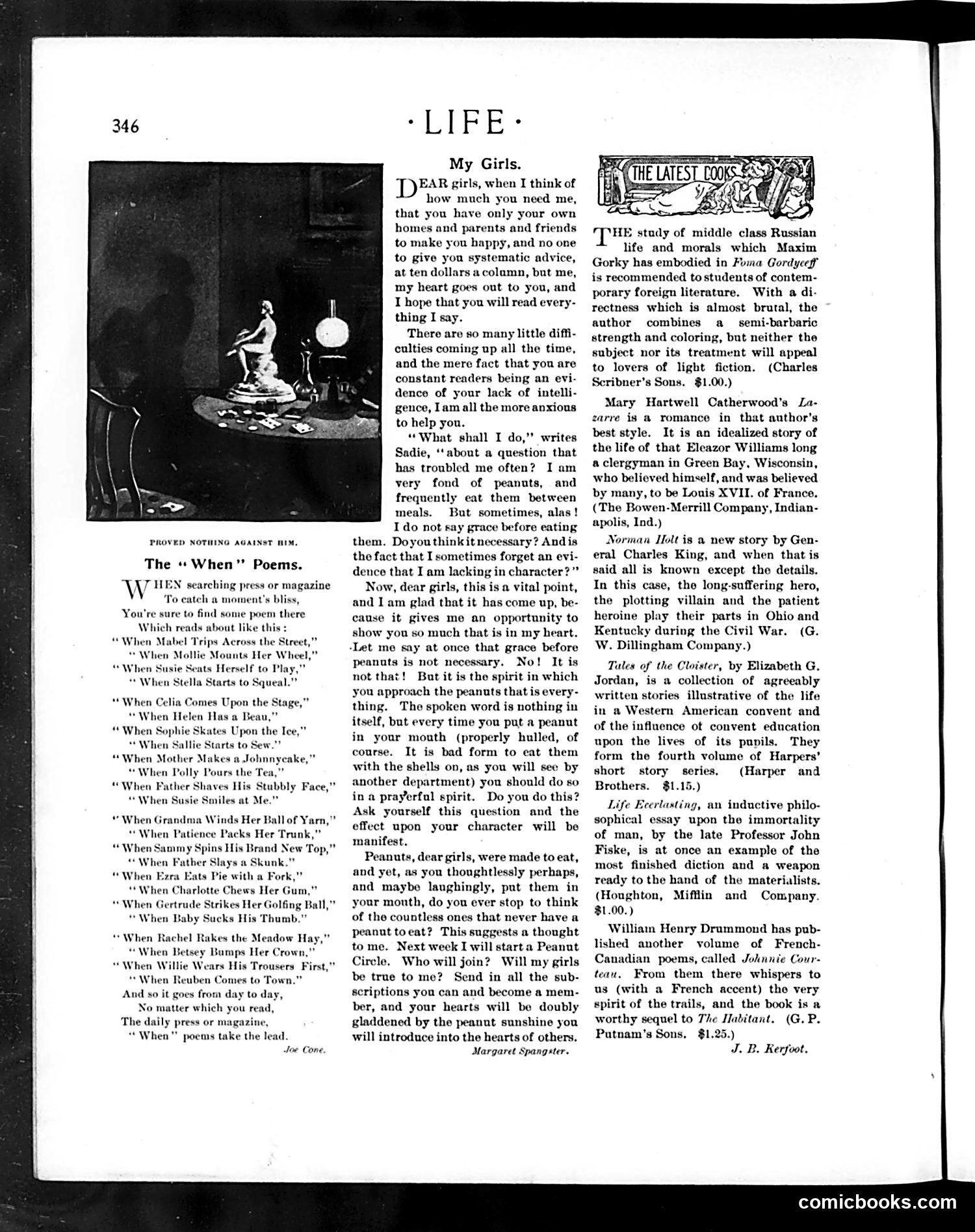
The main illustration, captioned "PROVED NOTHING AGAINST HIM," shows a figure in formal dress seated while another figure appears to be striking or confronting them with what looks like a club or weapon. The caption's meaning is unclear without additional context—it's uncertain what incident or person is being referenced or satirized. The image appears to depict some form of confrontation or scandal, with the caption suggesting that despite apparent wrongdoing or accusation, no proof was established against the subject. The rest of the page contains book reviews under "THE LATEST BOOKS" and a column titled "My Girls" offering advice to young women. Without clearer context about the specific historical moment, the cartoon's exact political or social reference remains ambiguous.
📄 Transcribed text from this page (OCR, searchable)
Machine-transcribed from the original scan — historical spelling and the odd misread are preserved.
PROVED NOTHING AGAINST HIM. The « When” Poems. “WV HEN searching press or magazine ‘To catch a moment's bliss, You're sure to find some poem there Which reads about like this : “When Mabel Trips Across the Street,” “When Mollie Mounts Her Wheel,” “When Susie Seats Herself to Play,” When Stella Starts to Squeal. “ When Celia Comes Upon the Stage,” “When Helen Has a Beau,” “ When Sophie Skates Upon the Ice,” “When Sallie Starts to Sew.” “When Mother Makes a John “When Polly Pours the Tea,” “When Father Shaves His Stubbly Face,” “ When Susie Smiles at Me.” 1s Her Ball of Yarn,” ence Packs Her Trunk, “When Sammy Spins His Brand New Top,” “When Father Slays a Skunk.” “When Ezra Eats Pie with a Fork,” “When Charlotte Chews Her Gum,” “ When Gertrude Strikes Her Golfing Ball,” “When Baby Sucks His Thumb.” “ When Rachel Rakes the Meadow Hay,” Bumps Her Crown,” cars His Trousers First,” uben Comes to Town.” o day, matter which you ily press or ma “When” poems take the lead. Joe Cone ‘LIFE « My Girls. DFR girls, when I think of “how much you need me, that you have only your own homes and parents and friends to make you happy, and no one to give you systematic advice, at ten dollars acolamn, but me, my heart goes out to you, and I hope that you will read every- thing I say. There are so many little diffi- culties coming up all the time, and the mere fact that you are constant readers being an evi- dence of your lack of intelli- gence, Iam all the more anxious to help you. “What shall I do,” writes Sadie, ‘about a question that has troubled me often? I am very fond of peanuts, and frequently eat them between meals. But sometimes, alas ! I do not say grace before eating them. Doyouthink it necessary? Andis the fact that I sometimes forget an evi- dence that I am lacking in character?” Now, dear girls, this is a vital point, and 1 am glad that it has come up, be- cause it gives me an opportunity to show you so much that is in my heart. -Let me say at once that grace before peanuts is not necessary. No! It is not that! But it is the spirit in which you approach the peanuts that is every- thing. The spoken word is nothing in itself, but every time you put a peanut in your mouth (properly hulled, of course. It is bad form to eat them with the shells on, as you will see by another department) you should do so ina prayerfal spirit. Do you do this? Ask yourself this question and the effect upon your character will be manifest. Peanuts, dear girls, were made to eat, and yet, as you thoughtlessly perhaps, and maybe laughingly, put them in your mouth, do you ever stop to think of the countless ones that never have a peanut toeat? This suggests a thought tome. Next week I will starta Peanut Cire Who will join? Will my girls be true to me? Send in all the sub- scriptions you can and become a mem- ber, and your hearts will be doubly gladdened by the peanut sunshine you will introduce into the hearts of others. Margaret Spangster. HE study of middle class Russian life and morals which Maxim Gorky has embodied in Foma Gordycef! is recommended to students of contem- porary foreign literature. With a di- rectness which is almost brutal, the author combines a semi-barbaric strength and coloring, but neither the subject nor its treatment will appeal to lovers of light fiction. (Charles Scribner’s Sons. $1.00.) Mary Hartwell Catherwood’s La- zarre is a romance in that author's best style. It is an idealized story of the life of that Eleazor Williams long a clergyman in Green Bay, Wisconsin, who believed himself, and was believed by many, to be Louis XVII. of France. (The Bowen-Merrill Company, Indian- apolis, Ind.) Norman Iblt is a new story by Gen- eral Charles King, and when that is said all is known except the details. In this case, the long-suffering hero, the plotting villain and the patient heroine play their parts in Ohio and Kentucky during the Civil War. (G. W. Dillingham Company.) Tales of the Cloister, by Elizabeth G. Jordan, is a collection of agreeably written stories illustrative of the life in a Western American convent and of the influence ot convent education upon the lives of its pupils. They form the fourth volume of Harpers’ short story series. (Harper and Brothers. $1.15.) Life Everlasting, an inductive philo- sophical essay upon the immortality of man, by the late Professor John Fiske, is at once an example of the most finished diction and a weapon ready to the hand of the materialists. (Houghton, Mifflin and Company. 31.00.) Willian Henry Drummond has pub- lished another volume of French- Canadian poems, called Johnnie Cour- teau. From them there whispers to us (with a French accent) the very spirit of the trails, and the book is a worthy sequel to The Iabitant. (G.P. Putnam's Sons, $1.25.) J. B. Rerfoot. comicbooks.com