
Life, 1901-10-31 · page 12 of 20
Life — October 31, 1901 — page 12: what you’re looking at
What you’re looking at
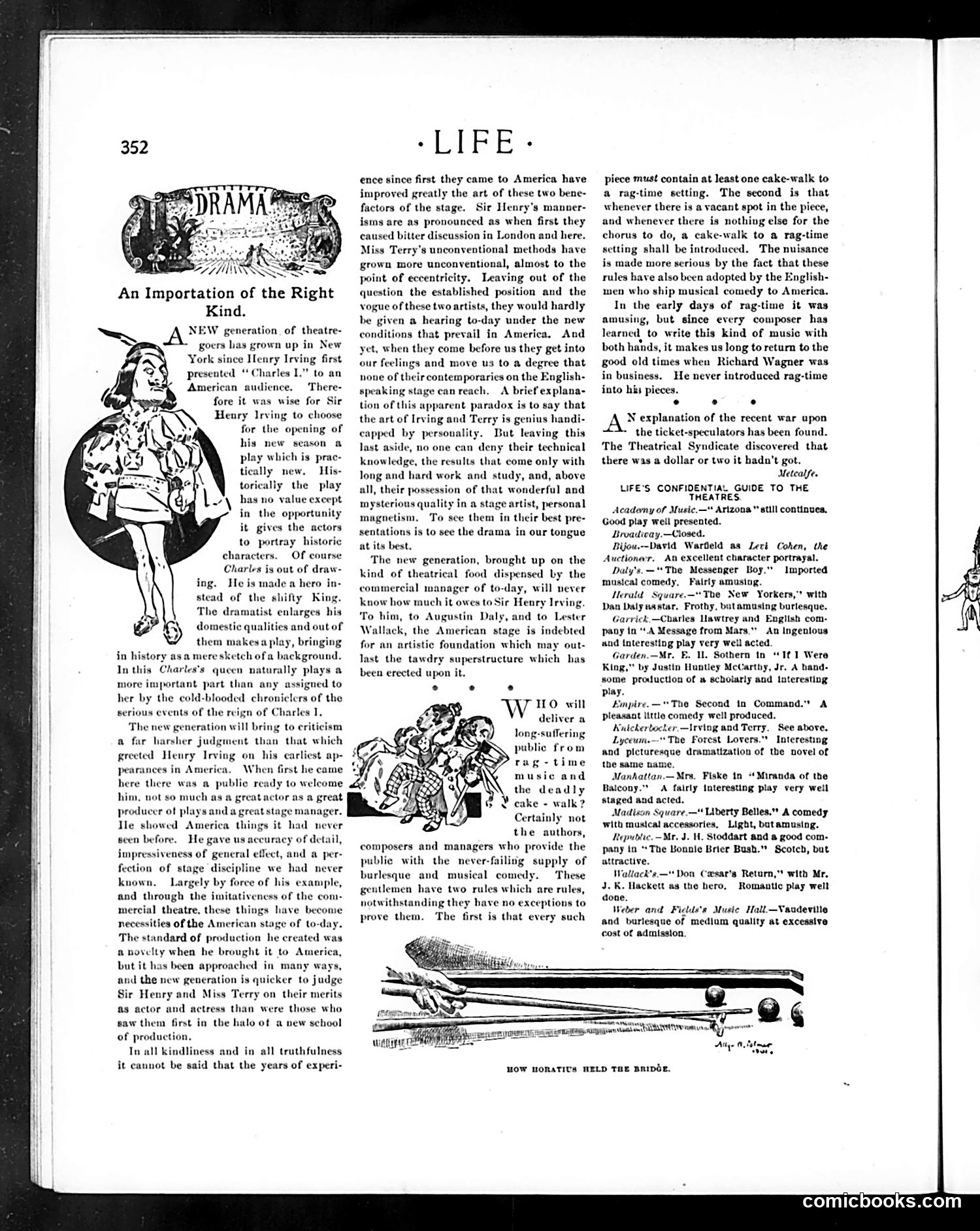
This page features a drama criticism article praising Henry Irving's London production of "Charles I," performed for American audiences. The accompanying illustration depicts a figure in elaborate period costume—likely representing Charles I or a theatrical character from the play. The satire critiques the commercial theater of early 20th-century America, suggesting that Irving's prestigious, historically-grounded dramatic work represents superior theatrical standards compared to contemporary American productions. The piece argues that Irving and Miss Terry demonstrated "technical knowledge" and "study" that American theater managers too often neglected in favor of commercial spectacle. The bottom illustration shows "How Horacius Held the Bridge," a classical historical reference reinforcing the article's theme about the value of serious, culturally significant theatrical productions.
📄 Transcribed text from this page (OCR, searchable)
Machine-transcribed from the original scan — historical spelling and the odd misread are preserved.
An Importation of the Right Kind. NEW generation of theatre- goers has grown up in New York since Henry Irving first presented “Charles I.” to an There- fore it was wise for Sir Henry Irving to choose for the opening of his new season a play which is prac- tically new. His- torically the play has no value except in the opportunity it gives the actors to portray historic characters. Of course Charles is out of draw- ing. He is made a hero in- stead of the shifty King. The dramatist enlarges his domestic qualities and out of them makesaplay, bringing in history asa mere sketch of a background. In this Charles's queen naturally plays a. more important part than any assigned to her by the cold-blooded chroniclers of the serious events of the reign of Charles I, ‘The new generation will bring to criticism a far harsher judgment than that which greeted Henry Irving on his earliest ap- pearances in America, When first he came here there was a publi Jy to welcome . hot so much as a great actor as a great producer of plays andag: ager. He showed America things it had never He gave us accuracy of detail, impressiveness of general effect, and a per- fection of stage discipline we had never known. Largely by force of his example, and through the imitati mercial theatre, these things have become necessities of the Ameri ‘The standard of production he created was a novelty when he brought it to America, but it has been approached in many ways, and the new generation is quicker to judge Sir Henry and Miss Terry on their merits as actor and actress th saw them first in the halo of a new school of production In all kindliness and in all truthfulness it cannot be said that the years of experi- stage ma seen before. ness of the co an stage of to-day. n were those who »LIPE - ence since first they came to America have improved greatly the art of these two bene- factors of the stage. Sir Henry's manner- isms are as pronounced as when first they caused bitter discussion in London and here Miss Terry’s unconventional methods h: grown more unconventional, almost to the point of eccentricity. Leaving out of the question the established position and the vogue of these two artists, they would hardly be given a hearing to-day under the new conditions that prevail in America, And yet, when they come before us they get into our feelings and move us to a degree that none of their contemporaries on the English- speaking stage can reach. A brief explana- tion of this apparent paradox is to say that the art of Irving and Terry is genius handi- capped by personality. But leaving this last aside, no one can deny their technical knowledge, the results that come only with long and hard work and study, and, above all, their possession of that wonderful and mysterious qu: in a stage artist, personal magnetism, To them in their best pre sentations is to see the drama in our tongue at its best The new generation, brought up on the kind of theatrical food dispensed Ly the commercial manager of to-day, will never know how much it owes to Sie Henry Irving. To him, to Augustin Daly, and to Lester Wallack, the American stage is indebted for an artistic foundation which may out- last the tawdry superstructure which has been erected upon it. W Ho wit deliver a long-suffering public from rag-time music and the deadly @ Y cake - walk? Certainly not the authors, composers and managers who provide the public with the never-failing supply of burlesque and musical comedy. These gentlemen have two rules which are rules, notwithstanding they have no exceptions to prove them. The first is that every such piece must contain at least one cake-walk to a rag-time setting. The second is that whenever there is a vacant spot in the piece, and whenever there is nothing else for the chorus to do, a cake-walk to a rag-time setting shall be introduced. The nuisance is made more serious by the fact that these rules have also been adopted by the English- men who ship musical comedy to America. In the early days of rag-time it was amusing, but since every composer has learned to write this kind of music with both hands, it makes us long to return to the good old times when Richard Wagner was in business. He never introduced rag-time into his pieces. . ° . N explanation of the recent war upon the ticket-speculators has been found. The Theatrical Syndicate discovered that there was a dollar or two it hadn't got. Metcalfe. LIFES CONFIDENTIAL GUIDE TO THE THEATRES. Acadeny of Music.— Arizona ™ still continues, Good play weil presented. Broadicay.—Ciosed. Bijou.—David Warbeld as Leri Cohen, the Auctioner, An excellent character portrayal. Daly's. "The Messenger Boy." Imported musical comedy, Fairly amusing. Herald Square.—"The New Yorkers,* with Dan Daly aastar, Frothy, batamusing burlesque. Garrick.—Charles Hawtrey and English com- pany in “.A Message from Mars." An Ingentous and Interesting play very well acted. Garden.—Mr. E. M. Sothern tn “If 1 Were King,” by Justin Huntiey McCarthy, Jr. A band- some production of # scholarly and tateresting play. Empire. —* The Second tn Command. A pleasant little comedy well produced. Nnickertocker.—Irving and Terry. See above. Lyceum.—" The Forest Lovers." Interesting and plcturesque dramatization of the novel of the same name, Manhattan.—Mrs. Fiske tn “Miranda of the Balcony.” A fairly interesting play very well staged and acted. Madison Square.—" Liberty Belles.” A comedy with musical accessories, Light, bat amusing. Republic.—Mr. J. 1, Stoddart and a good com- pany in “The Bonnle Brier Bush." Scotch, but attractive, Wallack’e—" Don Czsar's Return,” with Mr. J.K. Hackett as the hero, Romantic play well done. Weber and Fielus's Muste Hall.—Vandevitte and burlesque of medium quality at excessive cost of admission. NOW HORATICS HELD THE BaiDdz. comicbooks.com