
A complete issue · 20 pages · 1901
Life — October 3, 1901
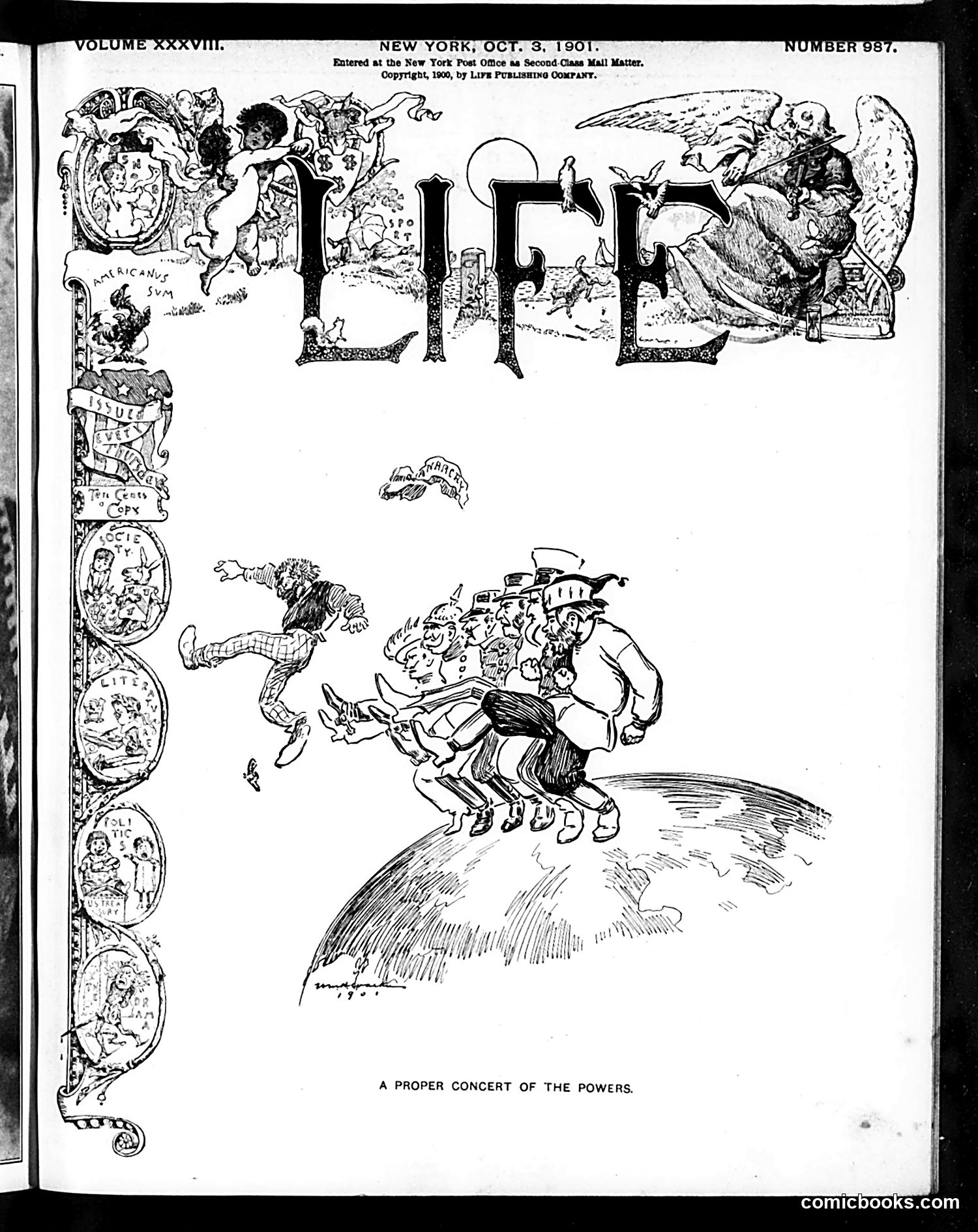
This October 1901 *Life* magazine cover satirizes international diplomatic tensions, likely referencing the Boxer Rebellion aftermath in China and competing imperial interests. The central image shows a horse-drawn carriage driven by a figure in a top hat (appearing to represent a political leader or national power) careening wildly, with passengers tumbling chaotically. The title "A Proper Concert of the Powers" ironically mocks the supposed coordination among major nations—Britain, France, Germany, Russia, and others—who ostensibly worked together diplomatically but pursued conflicting imperial agendas. The ornate left border contains decorative vignettes typical of *Life's* satirical style. The cartoon suggests these powers cannot maintain orderly cooperation; their competing interests create dangerous, uncontrolled chaos rather than harmonious "concert."
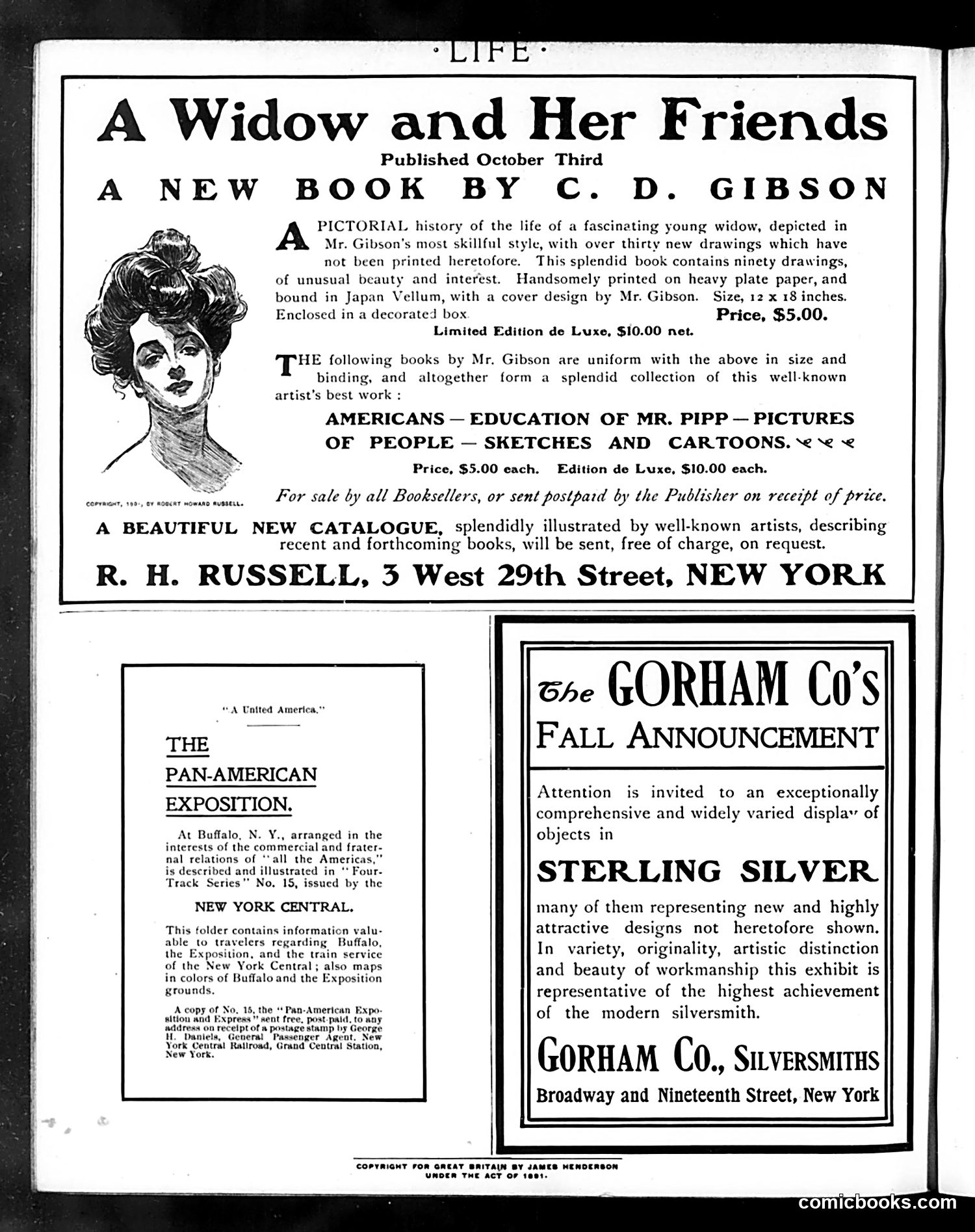
This page is **primarily advertising**, not political satire. It contains three advertisements: 1. **Top**: C.D. Gibson's new book "A Widow and Her Friends" — a collection of ninety drawings by the famous illustrator, priced at $5.00, published October Third by R.H. Russell (New York). 2. **Bottom left**: Information about the Pan-American Exposition in Buffalo, New York, with details on the New York Central train service. 3. **Bottom right**: Gorham Co.'s fall announcement of sterling silver designs and silversmith work at their Broadway location. The Gibson illustration shows a fashionable young woman's portrait—typical of Gibson's "Gibson Girl" style popular in that era. No political content or satire is evident on this page.
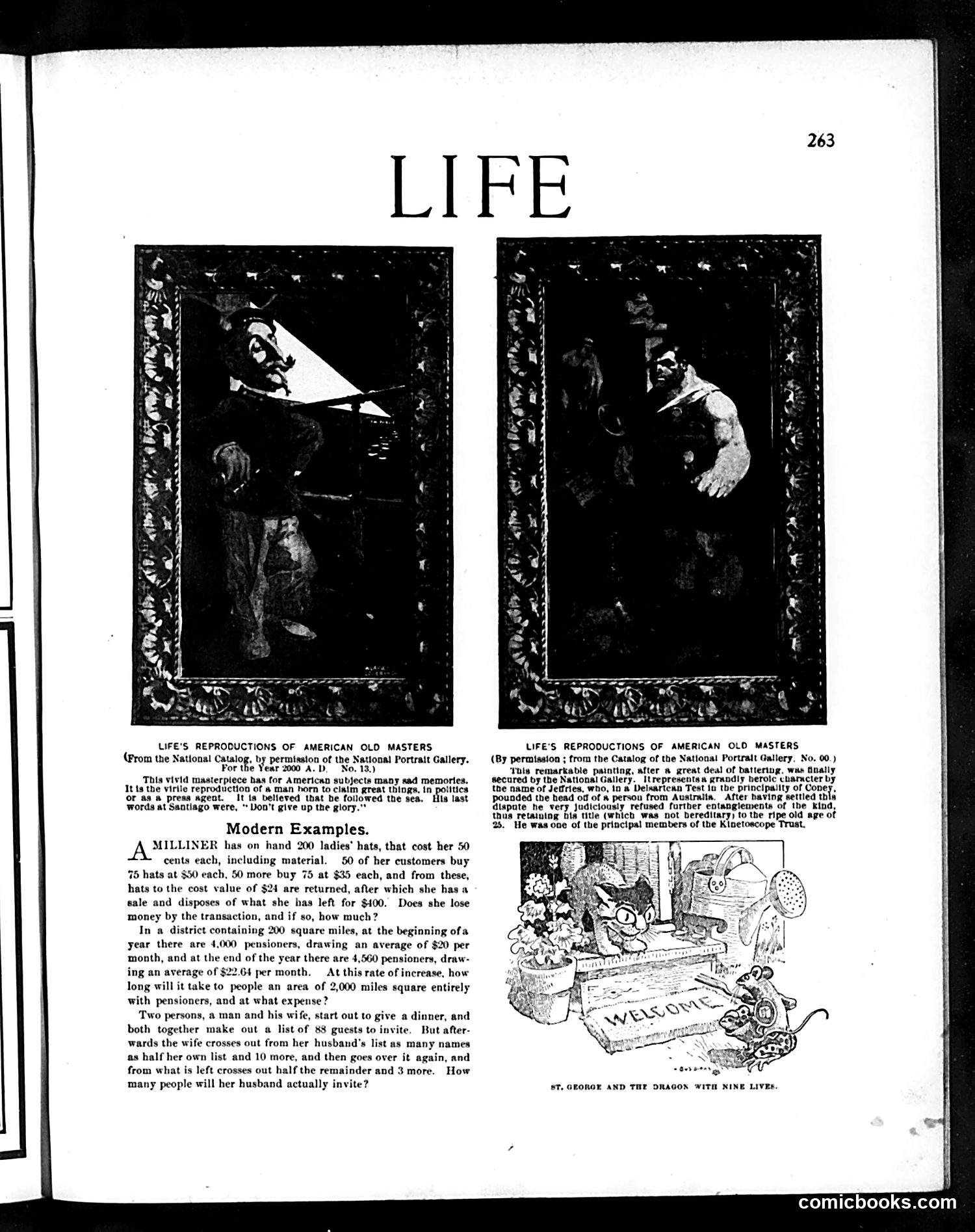
The page contains two sections: **Top: Two framed paintings** labeled "Life's Reproductions of American Old Masters." These appear to be satirical reproductions critiquing art or social commentary, though the specific subjects are difficult to discern in this reproduction quality. **Bottom: "Modern Examples"** section with three separate items: 1. A math problem about a milliner (hat-maker) managing inventory and pricing—a practical arithmetic puzzle for readers. 2. A logic problem about a dinner guest list and name-crossing, another mathematical brain-teaser. 3. An illustration labeled "ST. GEORGE AND THE DRAGON WITH NINE LIVES," depicting what appears to be a humorous reinterpretation of the classic legend, likely playing on the "nine lives" concept (cats, perhaps). The page functions primarily as a puzzle/problem section rather than political satire, showcasing Life magazine's entertainment and educational content.
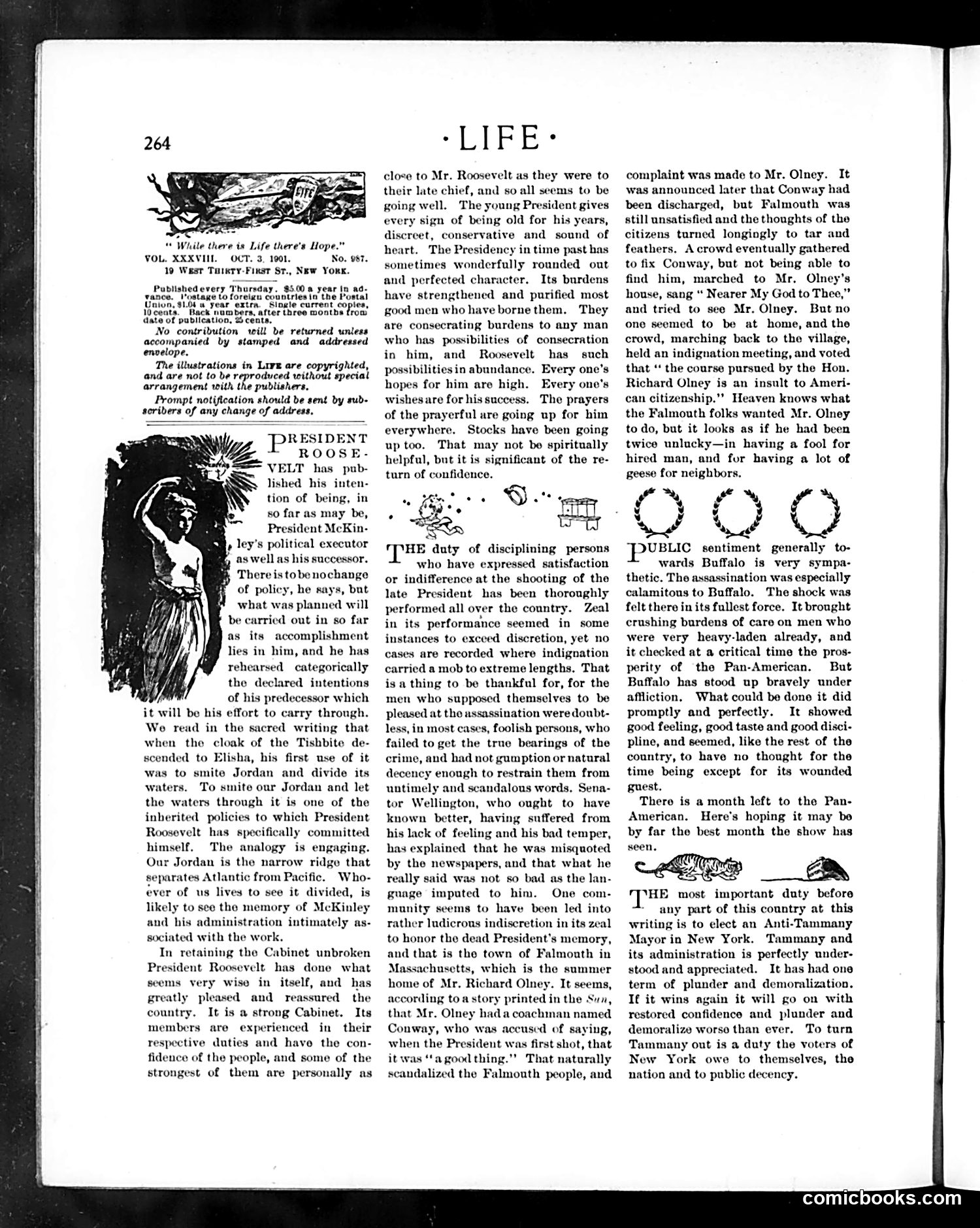
The main illustration depicts **President Theodore Roosevelt** as a classical figure holding a torch—representing his leadership and vision. The accompanying text praises Roosevelt's Cabinet and administration as "strong," noting its members are "experienced" and possess "personal strength." The content addresses the **assassination of President McKinley** (Roosevelt's predecessor) and discusses the anxiety this created. The text defends Roosevelt's steady leadership, noting that stocks recovered and public confidence returned—described as "significant of the return of confidence." A secondary discussion criticizes **Richard Olney** (likely a political figure) regarding incidents in Falmouth, Massachusetts, using the assassination context to debate proper government conduct and restraint during national crisis. The overall message: Roosevelt's competent administration has stabilized the nation after McKinley's death.
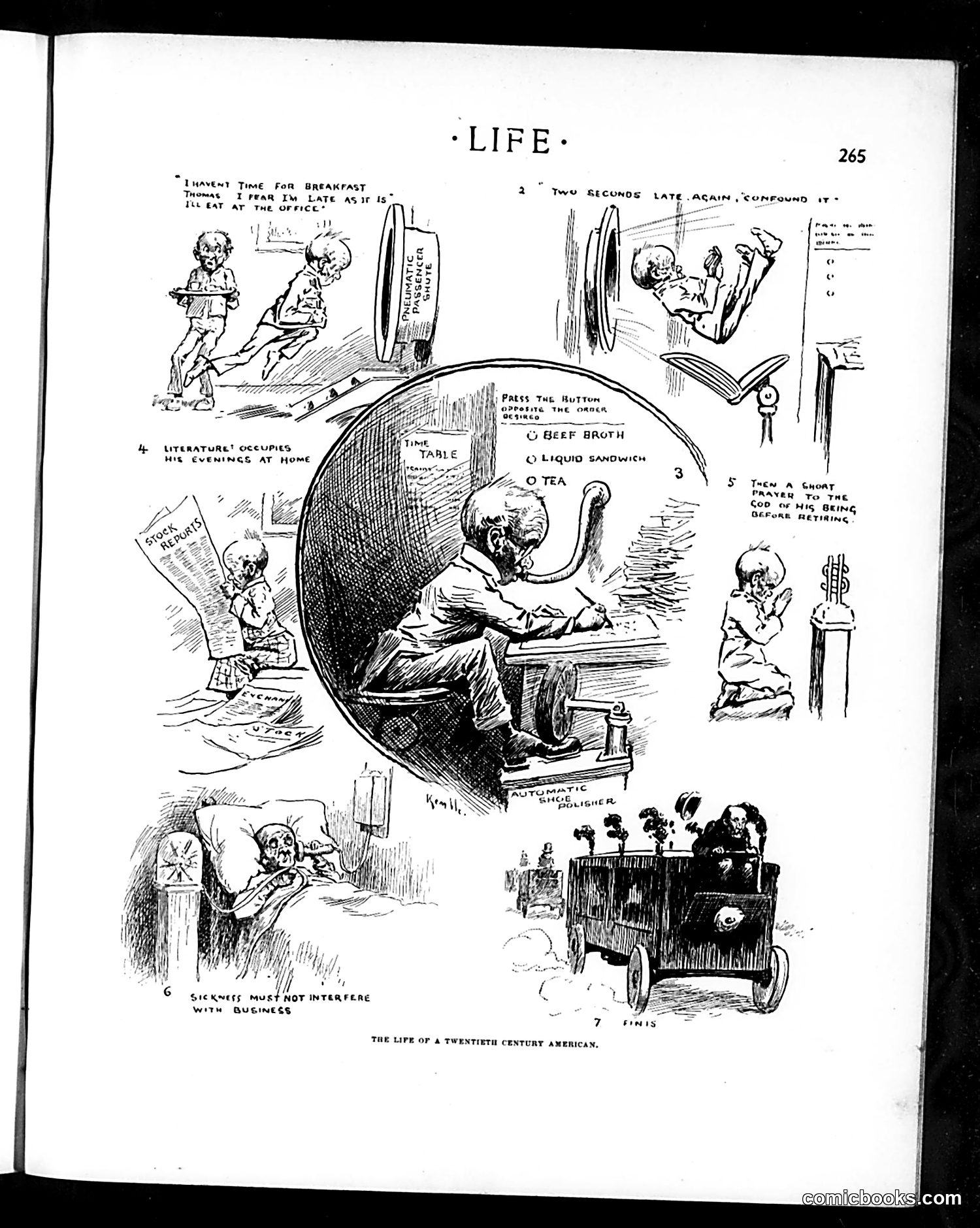
This satirical page depicts the daily routine of an early 1900s American, organized in seven numbered panels: 1. **Breakfast rush**: A man eats hurriedly at the office rather than at home 2. **Two seclusions**: He repeats this pattern, "compounded" 3. **Meager lunch**: Limited to beef broth, liquid sandwich, and tea 4. **Literature occupies his evenings at home**: Suggesting he's too exhausted for family 5. **Short prayer**: A dutiful but hurried gesture before bed 6. **Sickness must not interfere with business**: Showing illness doesn't stop work 7. **Finish**: A hearse, implying death from overwork The cartoon satirizes the grueling, dehumanizing pace of modern American business life—where work consumes everything: meals, family time, health, and ultimately life itself. It critiques industrialization's toll on workers' well-being and family life.
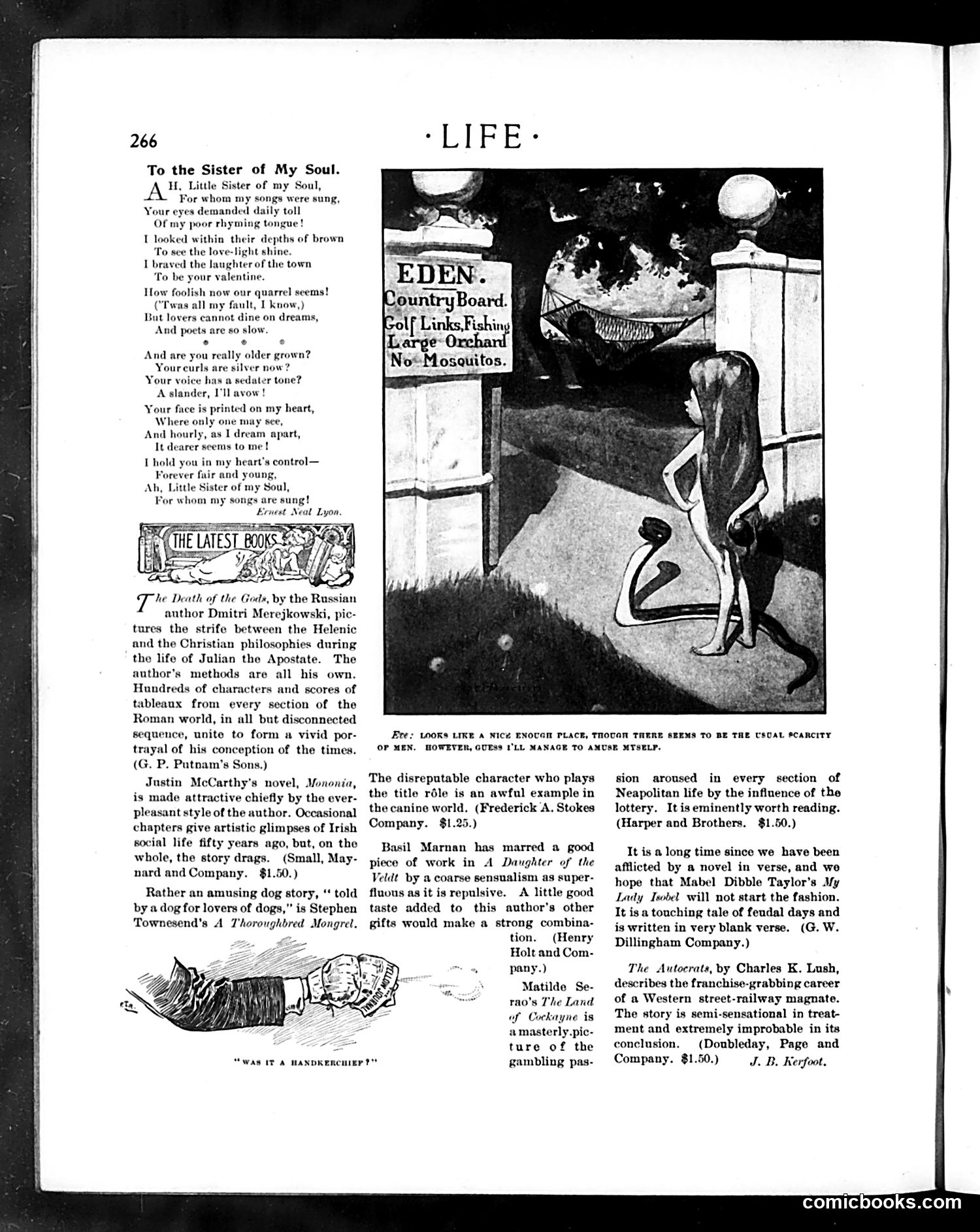
This page combines poetry and book reviews rather than political cartoons. "To the Sister of My Soul" is a sentimental poem by Ernest Noel Lyon dedicated to a sister, expressing nostalgic affection. The main illustration shows a woman at a window looking at an "Eden" country board advertising golf, fishing, and "No Mosquitos"—likely satirizing idealized rural retreat marketing to city dwellers. Below is a small cartoon captioned "WAS IT A HANDKERCHIEF?" depicting a person who appears to have lost or found something, possibly commenting on a social misunderstanding or romantic mix-up. The remainder consists of book reviews discussing recent publications, including works by Russian author Dmitri Merejkowski and others, typical of Life's literary coverage during this period.
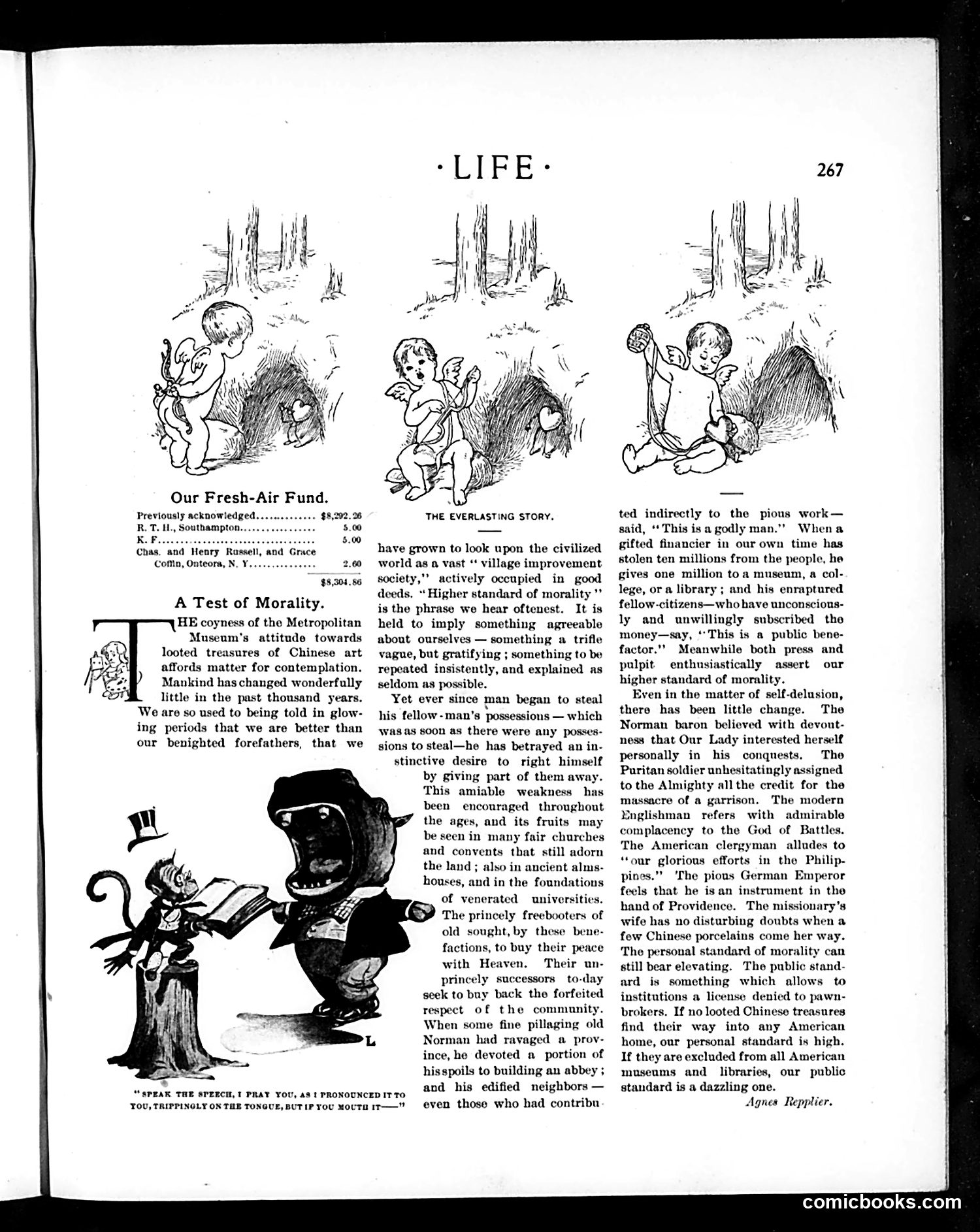
The page contains three sections: **Top**: "Our Fresh-Air Fund" shows cherubs in woodland settings—a charitable fundraising appeal for children's outdoor recreation programs. **Left cartoon**: "A Test of Morality" depicts a monkey in formal dress reading a book, satirizing Victorian moral pretensions. The caption reads: "SPEAK THE SPEECH, I PRAY YOU, AS I PRONOUNCED IT TO YOU, TRIPPINGLY ON THE TONGUE, BUT IF YOU MOUTH IT—" (Shakespeare's *Hamlet*). The monkey represents humanity mimicking cultured behavior while remaining fundamentally base. **Right article**: "The Everlasting Story" critiques Western hypocrisy regarding Chinese art treasures and cultural property. It mocks the contradiction between professed "higher morality" and actual theft/exploitation of colonial spoils by Western institutions and collectors. The overall theme: Western civilization's self-righteous moral claims mask fundamental dishonesty and theft.
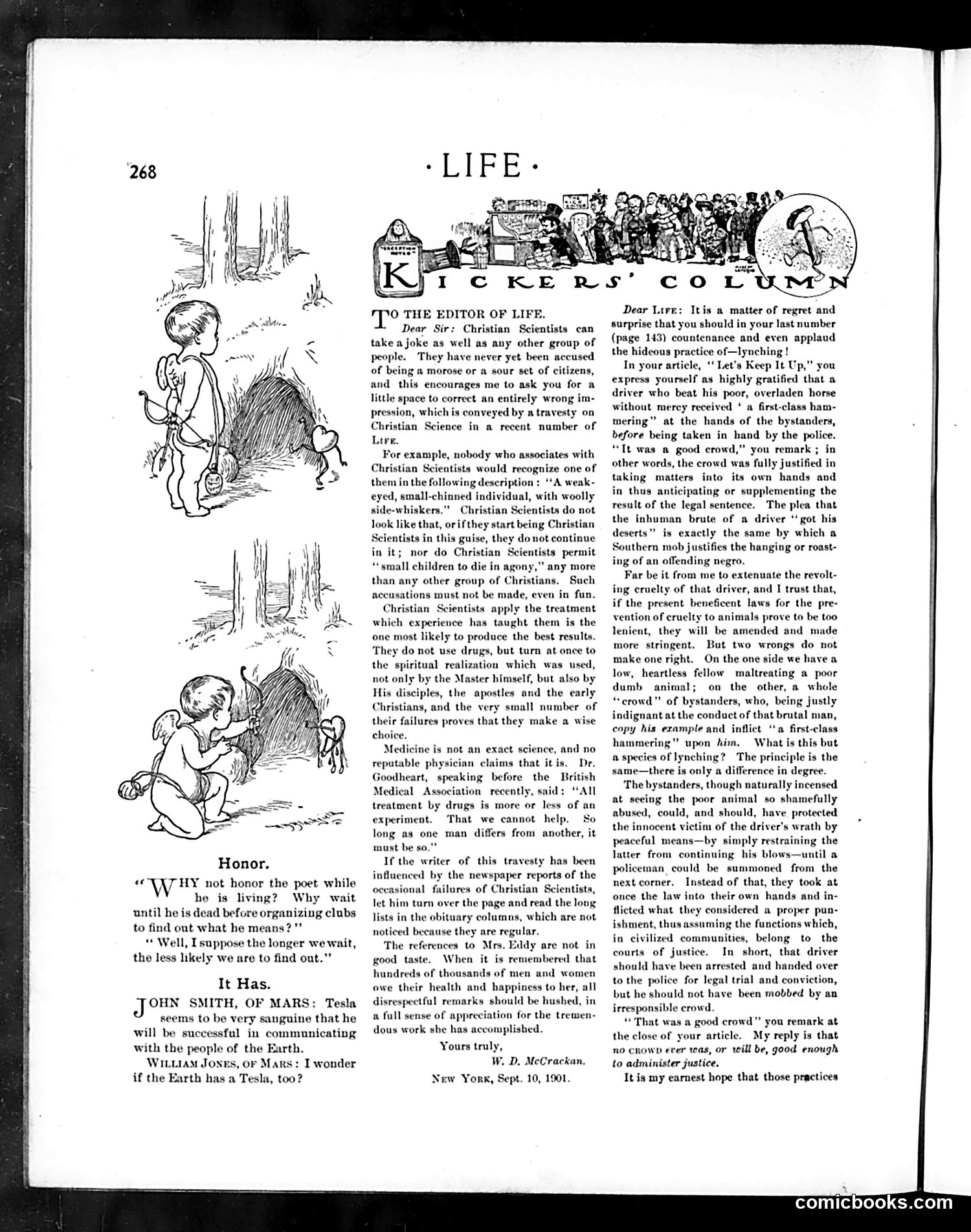
This page contains two sections: a "Kickers' Column" (readers' letters) and a poem titled "Honor." The **cartoon illustrations** (left side) depict a cherubic child figure interacting with animals in pastoral settings—these appear to be generic whimsical illustrations rather than political satire. The **Kickers' Column** letter criticizes Life magazine's recent article defending Christian Scientists against accusations of cruelty. The writer (W.D. McCrackan, Sept. 10, 1901) argues that Christian Scientists shouldn't be exempt from accountability, citing a specific case of a driver beating a horse. He contends that spiritual treatment shouldn't replace legal consequences for animal cruelty. The **"Honor" poem** below references John Smith of Mars and Tesla, likely contemporary figures, though the specific context is unclear from this excerpt alone.
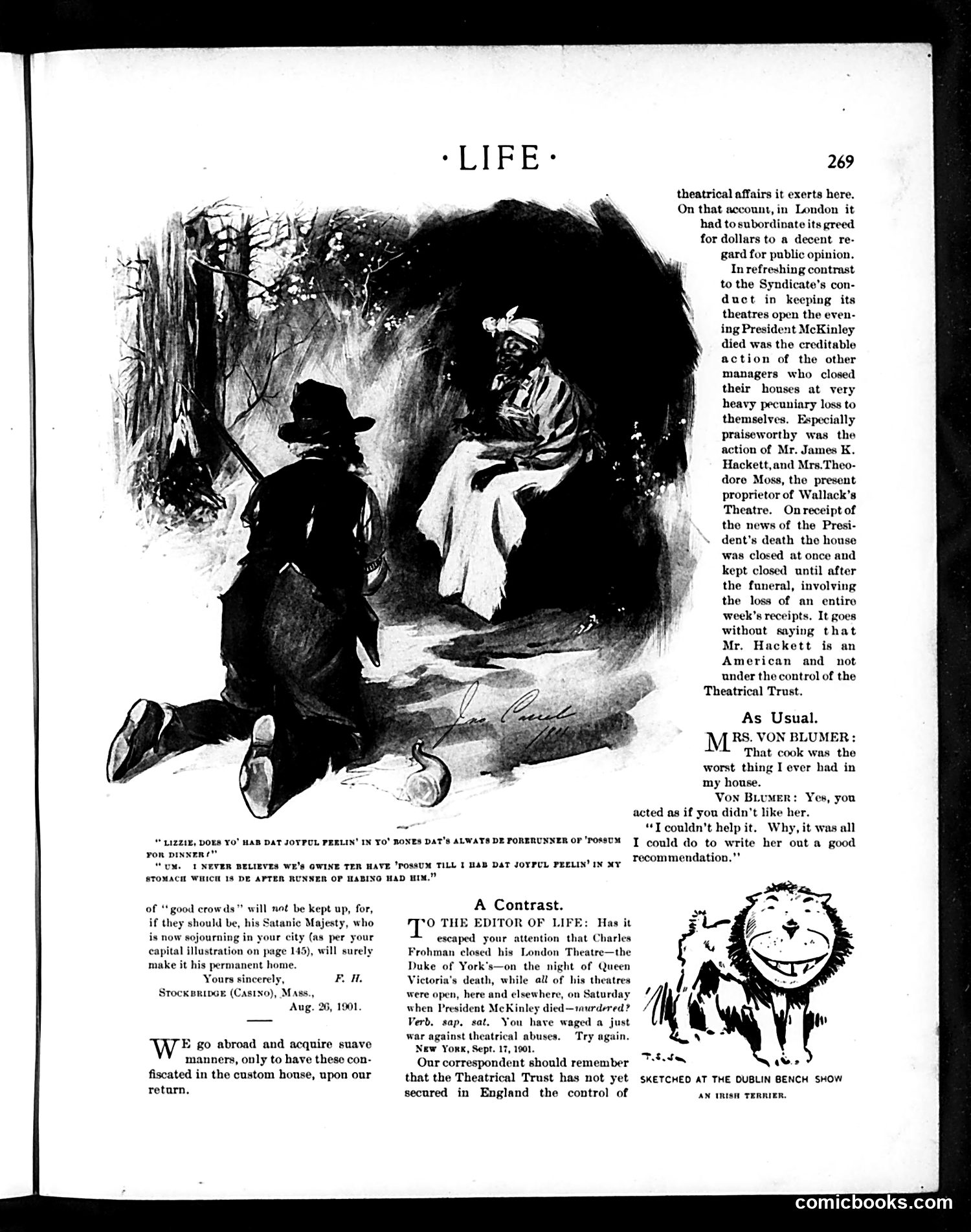
This page contains theatrical commentary and a sketch. The main illustration depicts a dramatic scene—likely from a stage production—showing a man in a hat confronting a woman in period dress, with gothic shadowing suggesting melodrama. The text discusses **President McKinley's death** and its impact on theatrical operations in London. The commentary criticizes how London theaters closed out of respect while American theaters (under manager James K. Hackett) remained open, viewing this as a contrast in propriety. Below, "As Usual" presents dialogue between characters Mrs. von Blumer and Von Blumer regarding her theatrical acting performance and negative reviews. A small sketch at bottom right shows "An Irish Terrier" from the Dublin Bench Show. The page primarily addresses early-1900s theatrical business practices and professional conduct standards.
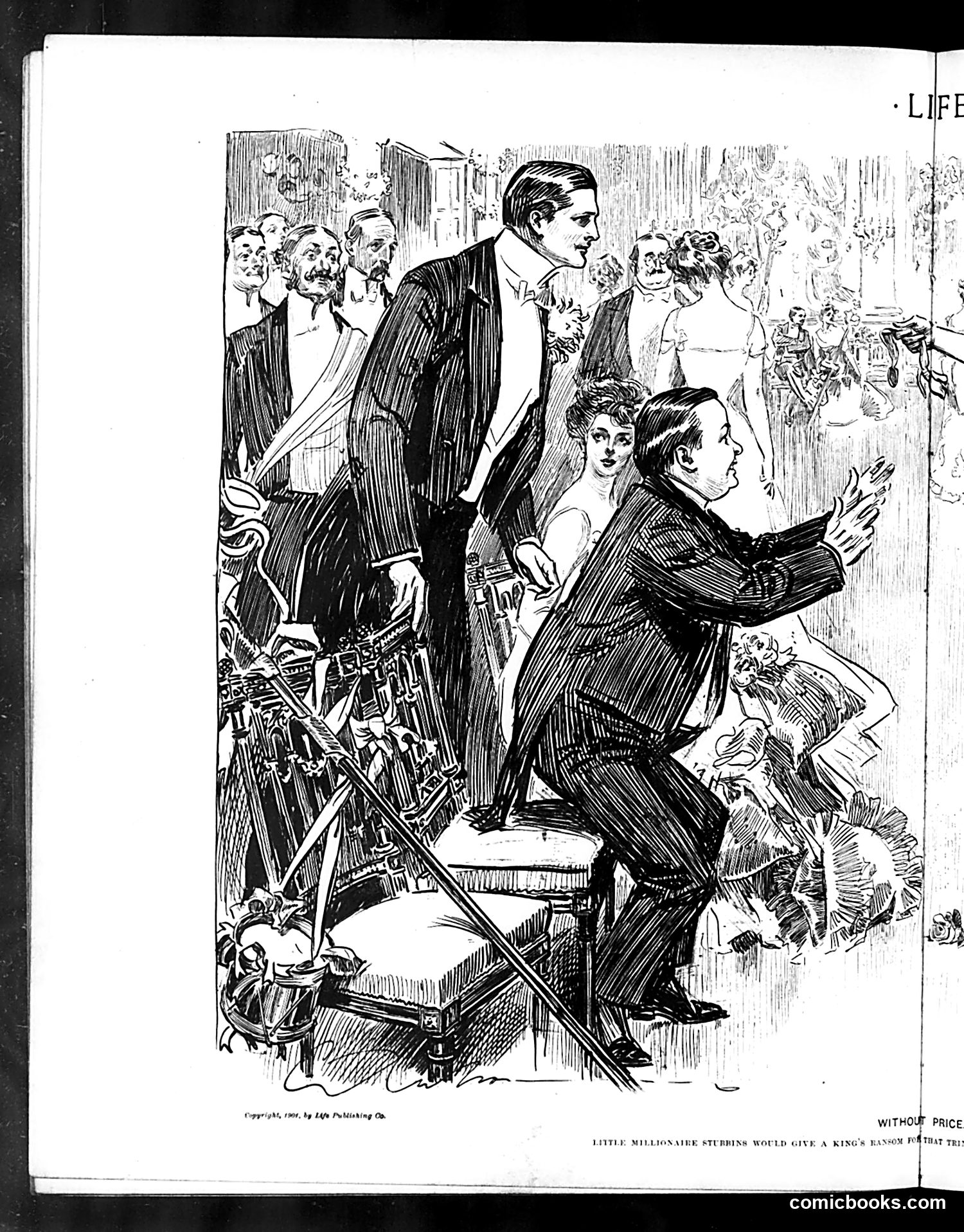
The caption reads: "LITTLE MILLIONAIRE STEERINGS WOULD GIVE A KING'S RANSOM FOR THAT TRIO" This is a satirical cartoon about wealth and social hierarchy. It depicts what appears to be wealthy businessmen or "little millionaires" (likely Gilded Age industrialists) viewing three figures with great interest or envy—the "trio" referenced in the caption. The joke hinges on irony: despite their considerable fortunes, these millionaires would surrender vast sums ("a king's ransom") to possess or acquire whatever the trio represents. The specific identity of the three figures is unclear from the image alone, but they likely represent something of greater value than money—possibly talent, status, beauty, or social position that wealth cannot simply buy. This reflects period anxiety about wealth's limits and social mobility.
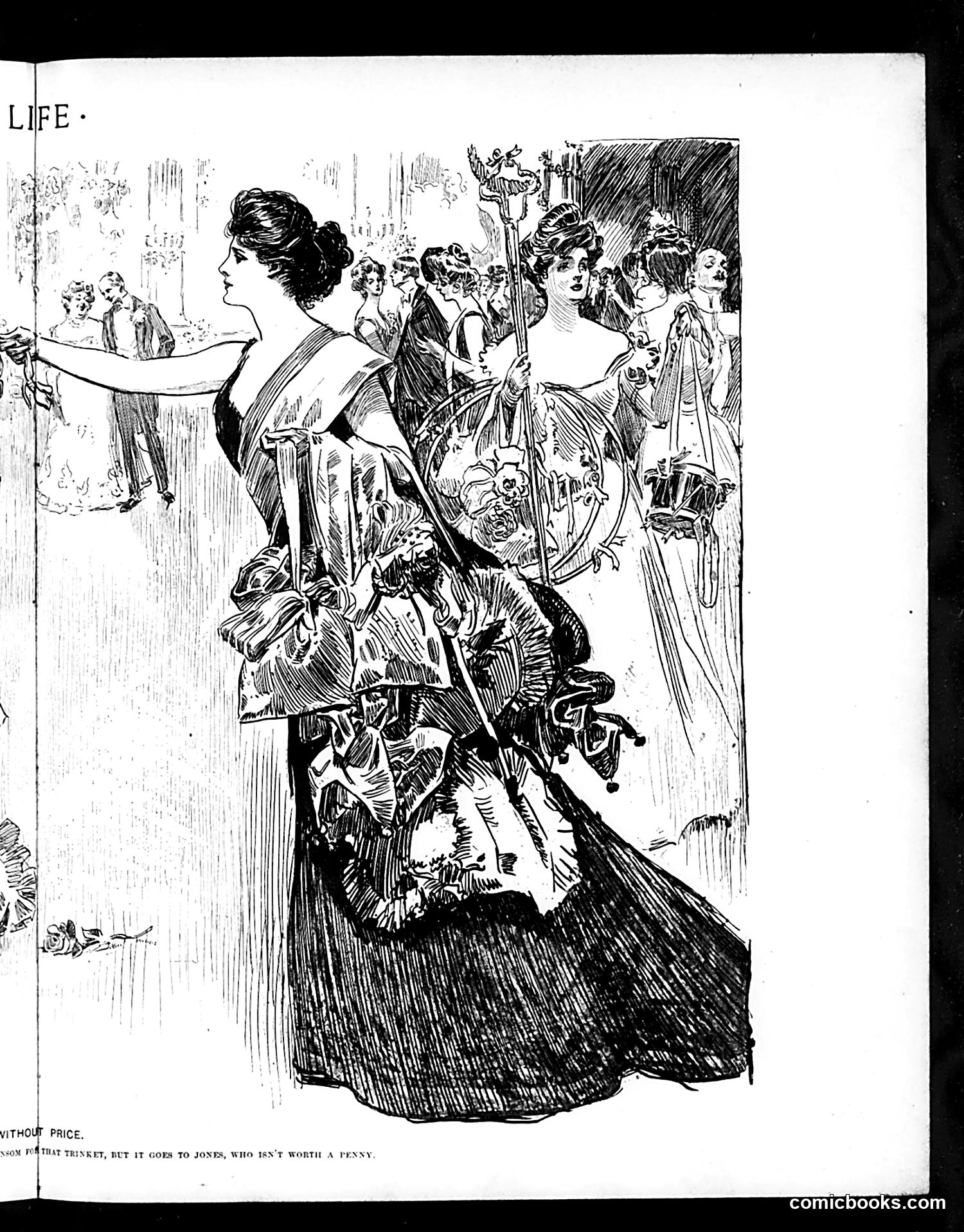
This is a satirical illustration from *Life* magazine titled "WITHOUT PRICE," with a caption reading: "A SON FOR THAT TRINKET, BUT IT GOES TO JONES, WHO ISN'T WORTH A PENNY." The cartoon depicts an elegantly dressed woman in Edwardian-era clothing, prominently displaying elaborate jewelry and feathered accessories while leading a procession of society figures. The satire critiques wealthy women who ostentatiously display expensive jewelry and luxury goods—particularly those who marry or associate with wealthy but morally questionable men (here referenced as "Jones"). The joke appears to mock the contradiction between the trinket's monetary value and the worthlessness of the man receiving it, suggesting that status-conscious women waste their wealth on undeserving men. This reflects early 20th-century social commentary on materialism and the role of women in upper-class society.
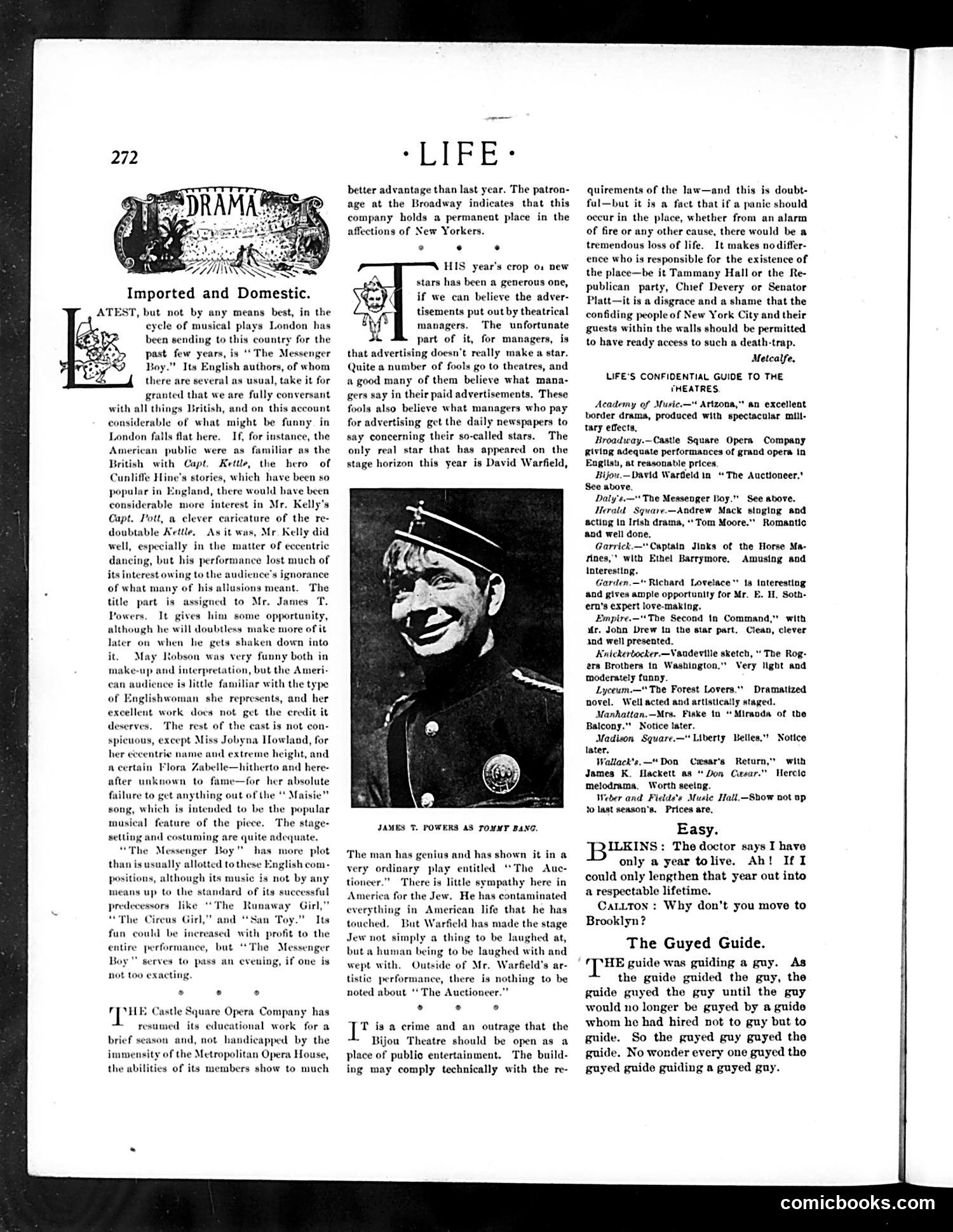
This page contains theater reviews and criticism, not political cartoons. The central image shows **James T. Powers as "Pommey Rand,"** a character in what appears to be a musical comedy. Powers was a well-known American performer of this era. The reviews discuss various Broadway productions, including criticism of "The Auctioneer" (featuring David Warfield) and other plays. The text critiques theatrical advertising practices and discusses which performers genuinely deserve their promoted "star" status versus those who receive unmerited publicity. The section also includes a humorous anecdote called "The Guyed Guide" about tour guides—wordplay on "guy" and "guide." This is standard entertainment journalism rather than satirical commentary on political or social issues.
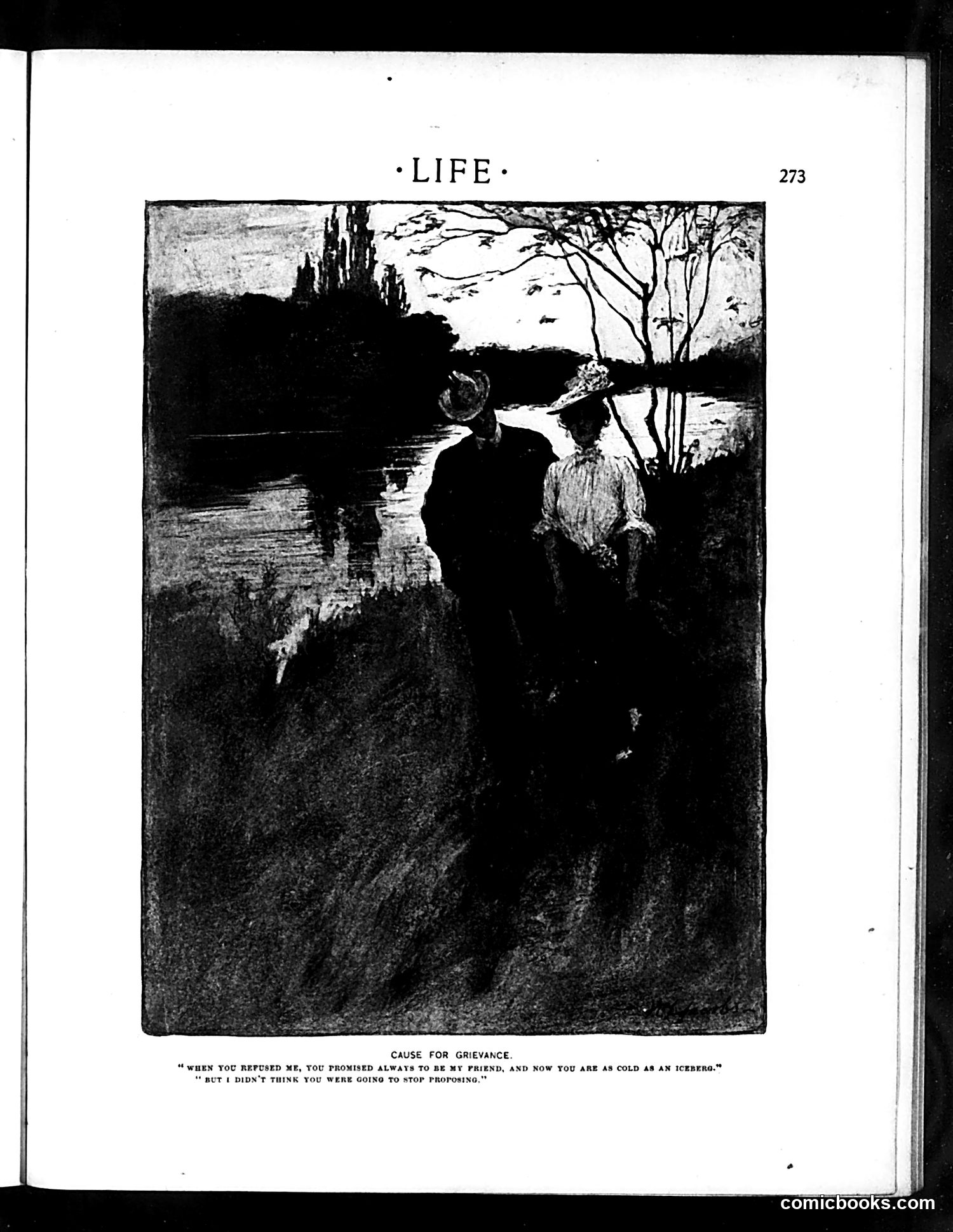
This illustration depicts a romantic dispute between two figures by a riverside. A woman reproaches a man for becoming emotionally distant after she rejected his marriage proposal, reminding him he promised to remain her friend. His retort—"I didn't think you were going to stop proposing"—suggests she has repeatedly turned down his proposals, implying her rejection was not definitive. The satire mocks the awkward social dynamics of courtship, particularly the tension between unrequited romantic persistence and the expectation of platonic friendship after rejection. It captures the male perspective humorously: his implication being that constant proposals create an expectation of eventual acceptance. The cartoon satirizes both romantic obstinacy and the uncomfortable limbo between rejected suitors and jilted lovers.
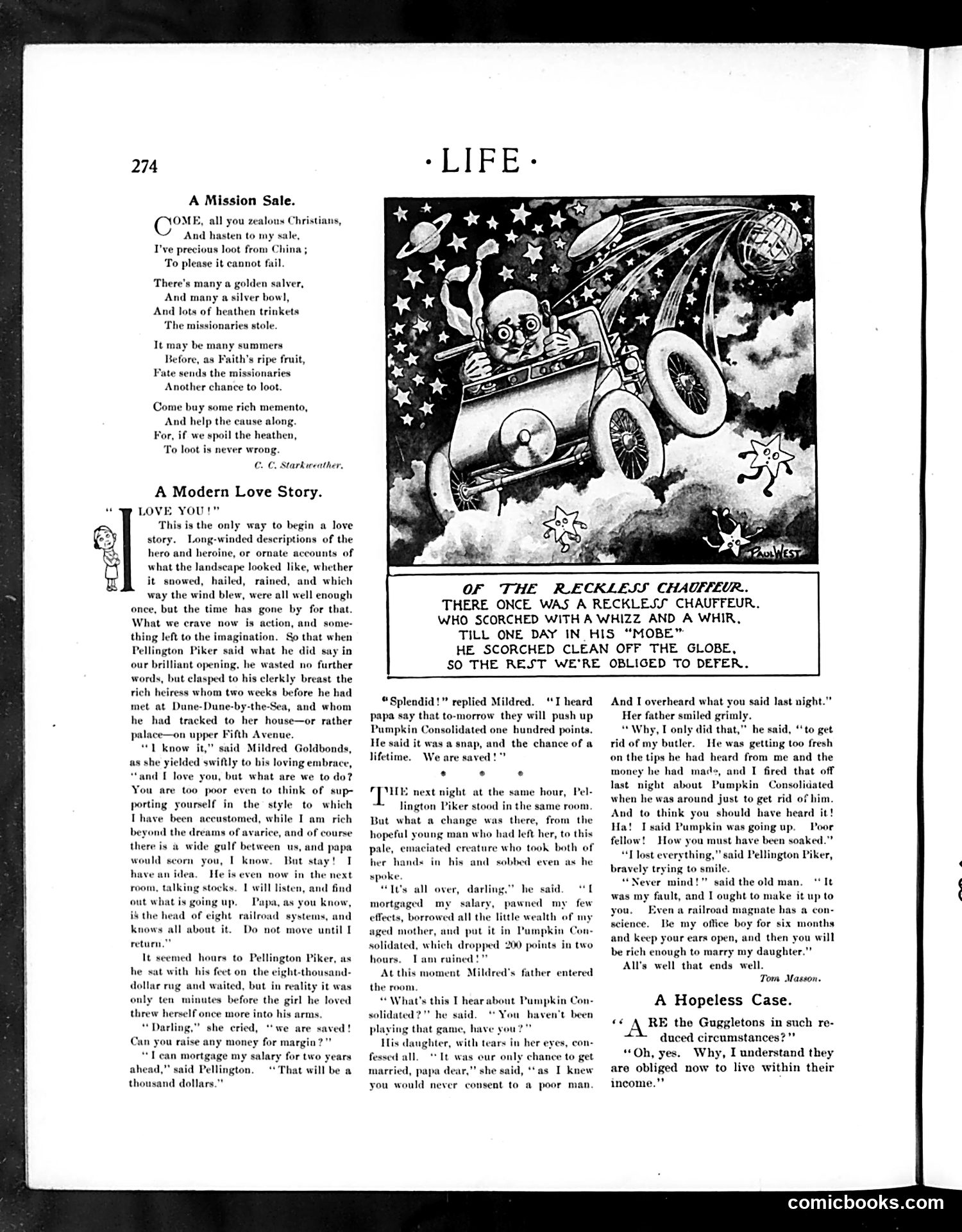
This page from *Life* satirizes American attitudes toward missionary work and capitalism through verse and fiction. **"A Mission Sale"** (poem) mocks Christian missionaries' colonial exploitation. The satire suggests missionaries justify stealing "heathen trinkets" from China as righteous religious work, then sell the plunder back home to fund further missionary efforts. The phrase "if we spoil the heathen, to loot is never wrong" exposes the hypocrisy: religious duty becomes a cover for greed. **"A Modern Love Story"** parodies both romance fiction and stock-market obsession. Two wealthy characters (Pellington Piker and Mildred Goldbonds) base their relationship entirely on financial scheming rather than emotion. The satire targets the era's speculation fever—they gamble Piker's entire salary on "Pumpkin Consolidated" stock, which crashes, ruining him. The joke: wealth matters more than love in this society. **"Of the Reckless Chauffeur"** is a brief comic verse about a speeding driver who "scorched clean off the globe"—absurdist humor about dangerous driving. Together, these pieces critique American materialism, religious hypocrisy, and get-rich-quick culture.
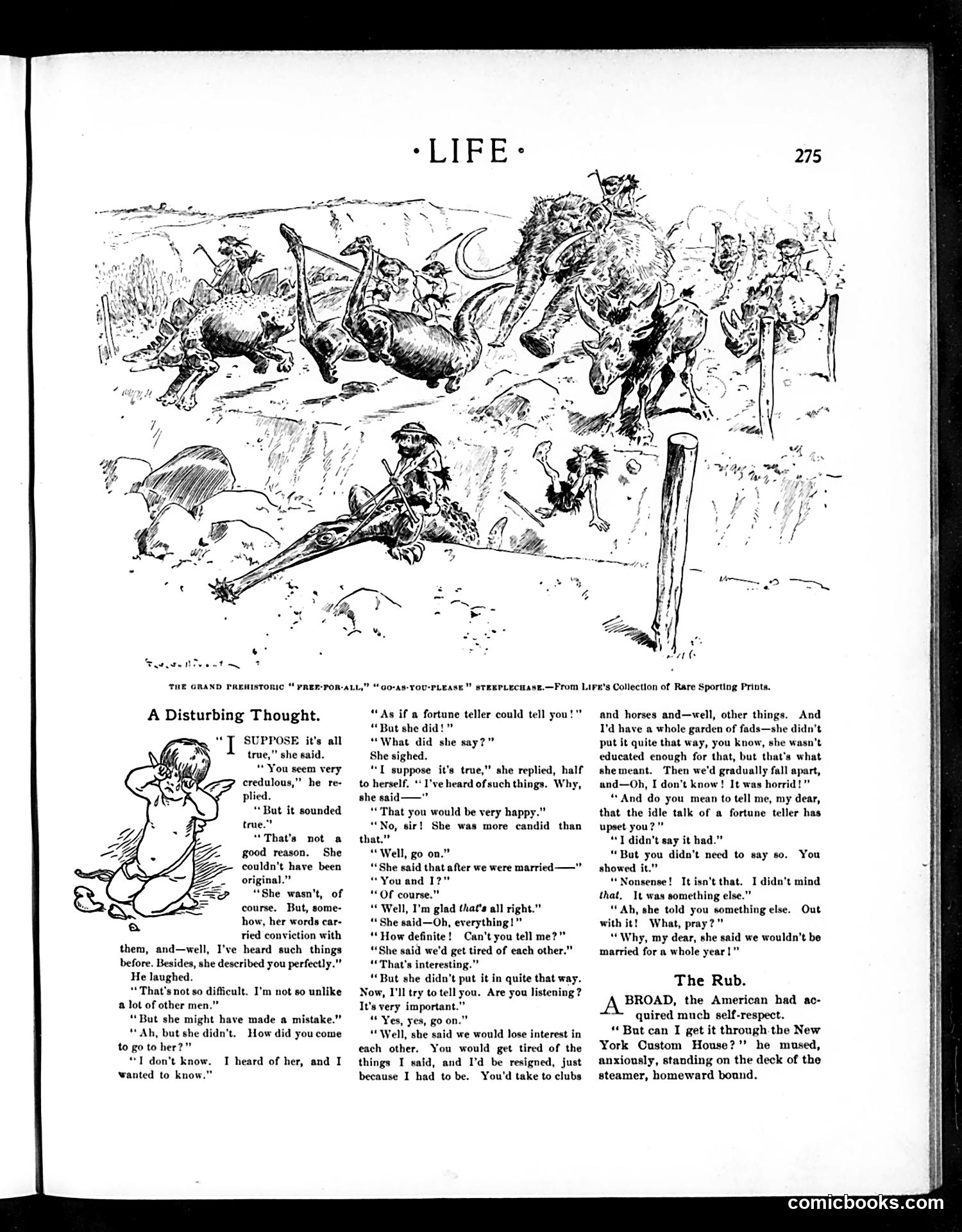
**The Top Cartoon:** A prehistoric "free-for-all" steeplechase depicts primitive humans and animals in chaotic competition—a satirical jab at the brutishness of unregulated competition or sporting excess. **"A Disturbing Thought":** A couple discusses a fortune teller's prediction that they'll drift apart after marriage—he'll pursue clubs and horses, she'll develop idle hobbies, they'll lose interest in each other. The woman is upset, but the man dismisses fortune-telling as nonsense. The joke's dark edge: the prediction's vagueness makes it *seem* prophetic because it describes common marital decay, yet he's confident it won't happen to them. The final twist—the fortune teller also predicted they won't marry for a year—undermines his certainty entirely. **"The Rub":** An American returning home with something "broad" (unclear what) worries whether he can smuggle it through U.S. Customs. A simple joke about import regulations and travelers' concerns about declaring goods.
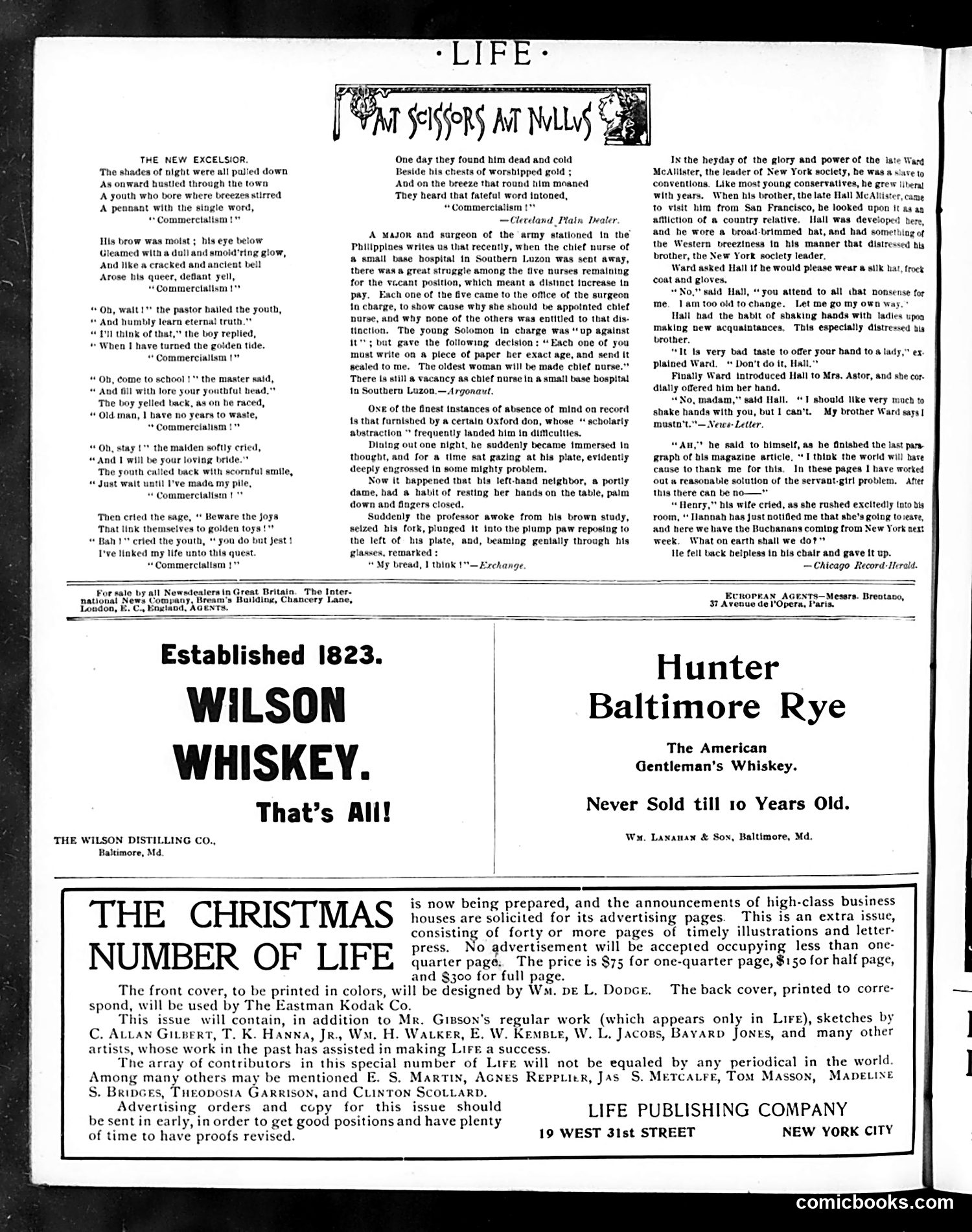
This page contains three distinct pieces of satirical content: **"The New Excelsior"** (main cartoon/poem): A young man obsessively pursues wealth and commercial success, rejecting calls to education, love, and spiritual guidance. Religious figures, teachers, and a young woman all plead with him to abandon "Commercialism," but he ignores them. He dies clutching his gold. The satire critiques the era's materialistic obsession at the expense of traditional values—a common Progressive Era complaint about American society's spiritual decay. **Three brief anecdotes**: Comic stories mocking absent-mindedness and social pretension (a professor absent-mindedly forks a woman's hand; a San Francisco visitor resists Eastern social conventions). **Context**: This reflects turn-of-20th-century concerns that industrial capitalism and wealth-seeking were corrupting American morality and threatening established social order.
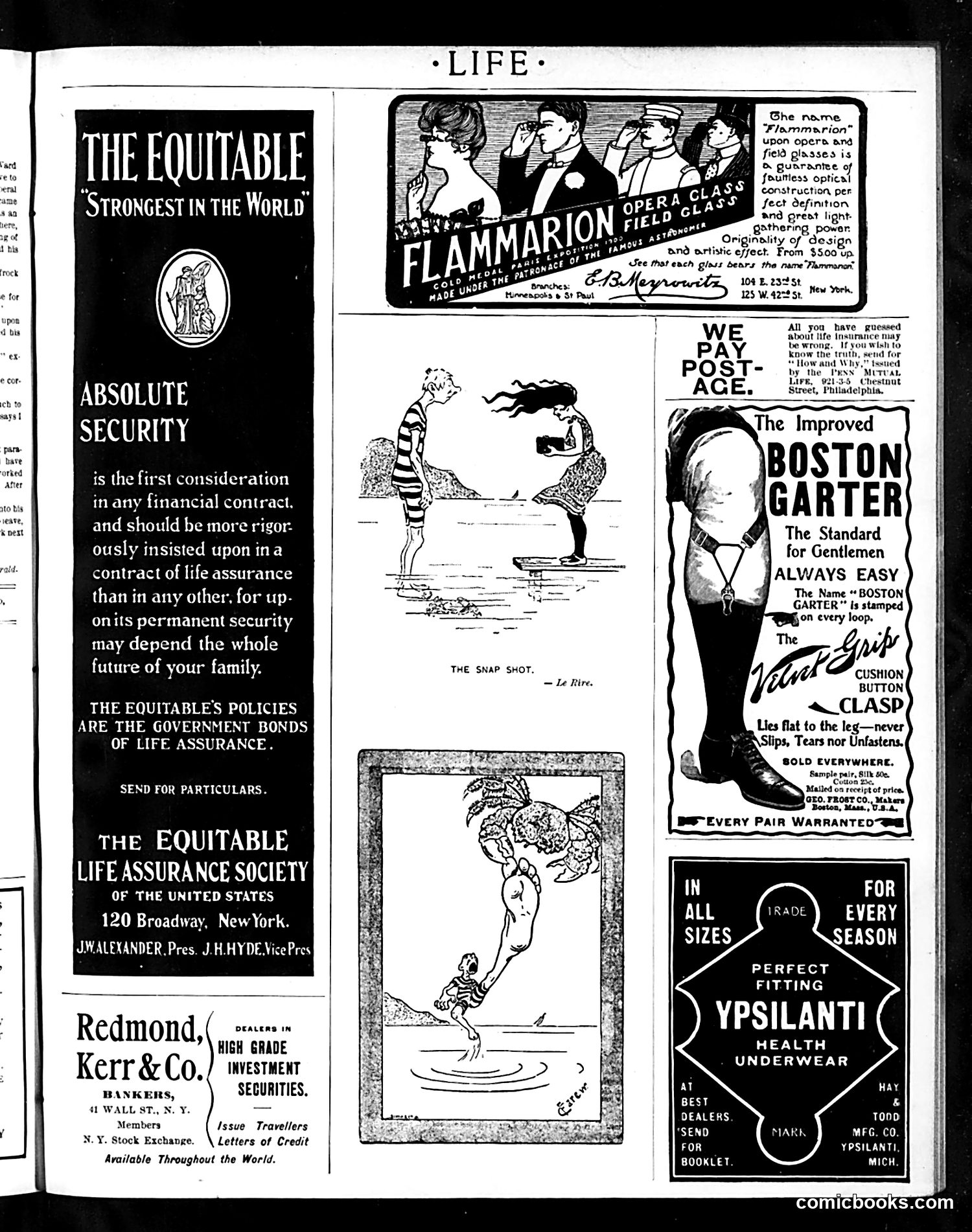
This page is primarily **advertising**, with one central cartoon titled "The Snap Shot" credited to *Le Rire* (a French satirical magazine). The cartoon depicts two figures at a beach or seaside: one in a striped bathing costume striking a pose, while another (appearing to be a photographer or observer) reacts with apparent shock or dismay. The joke likely plays on the absurdity of early bathing costumes—the striped suit was considered scandalous or ridiculous by period standards, making the "snap shot" (photograph) a comedic moment of embarrassment. The surrounding ads promote financial security (life insurance), opera glasses, garters, and underwear—typical early 20th-century products. The cartoons humorously illustrate social anxieties about propriety, fashion, and masculinity rather than overt political satire.
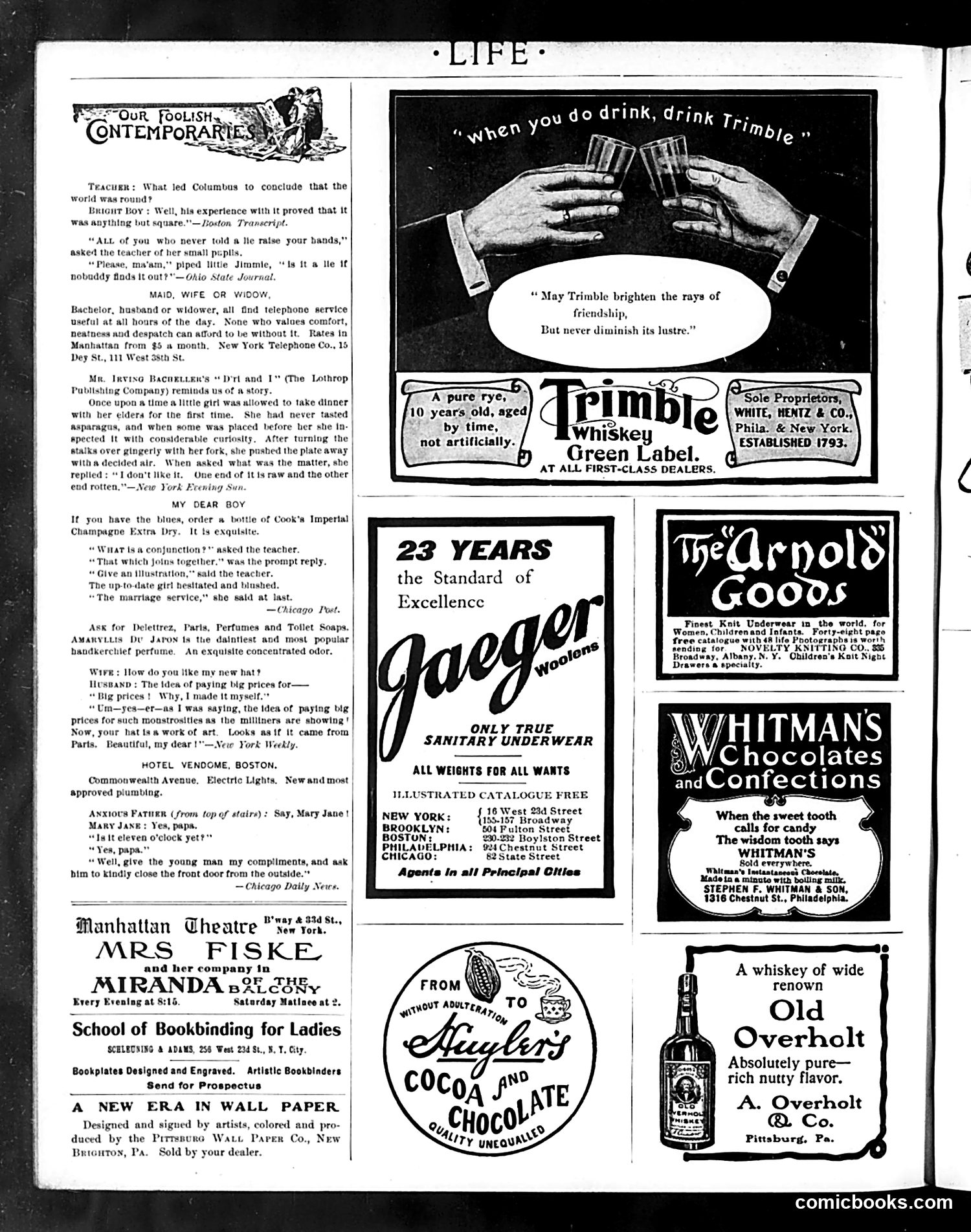
This page is primarily **advertising and humorous anecdotes**, not political satire. The "Our Foolish Contemporary" section collects brief jokes about children's innocent logic—a Columbus joke about the world being "round" not "square," a child's confusion about asparagus (raw on one end, cooked on the other), and wordplay about conjunctions and marriage. The cartoon content is minimal. The main visual is a **Trimble Whiskey advertisement** showing hands toasting, with the slogan "when you do drink, drink Trimble"—typical product placement messaging. The page reflects **turn-of-the-century American consumer culture**, featuring advertisements for whiskey, underwear, chocolates, theater, and perfume. The humor targets genteel middle-class anxieties: telephone etiquette, hat fashion, servants, and courtship conventions. There is no identifiable political commentary or caricature of public figures—this is a lifestyle and entertainment page aimed at affluent readers.
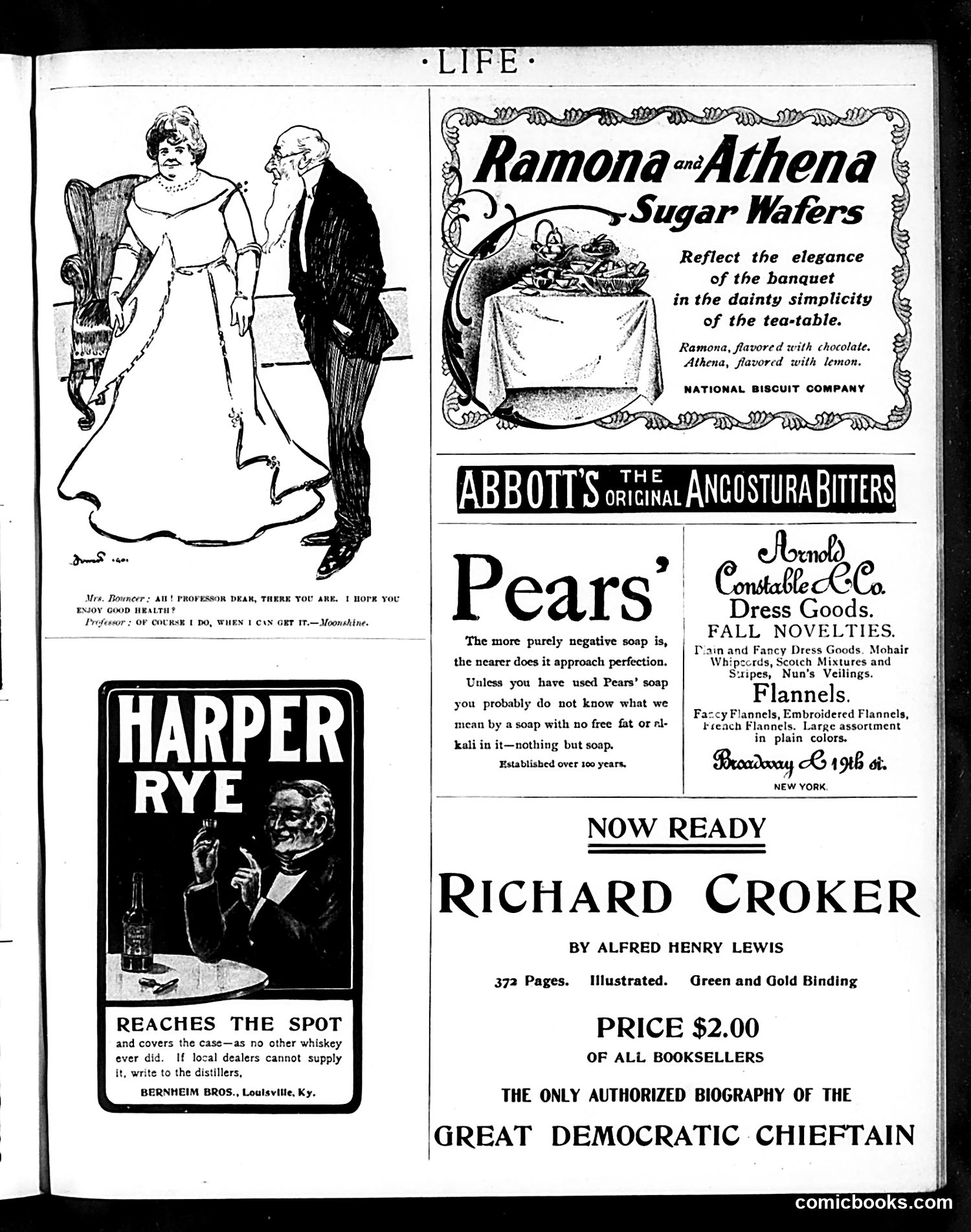
This page is primarily **advertising**, not satirical commentary. The small cartoon at top left shows a domestic scene where a professor jokes to his landlady "Mrs. Bouncer" that he enjoys good health "when I can get it"—a mild quip about boarding-house life, likely mocking sparse or poor meals. The page's main content advertises consumer goods (sugar wafers, soap, whiskey, dress goods, flannels) and promotes a biography of **Richard Croker**, identified as "the Great Democratic Chieftain." Croker was a prominent Tammany Hall political boss in late 19th-century New York. The biography's promotional language suggests this is earnest advertising rather than satire, though calling a machine politician a "chieftain" borders on ironic. The Harper Rye whiskey ad plays on Prohibition-era concerns, emphasizing the product "reaches the spot" and provides instructions for obtaining it.
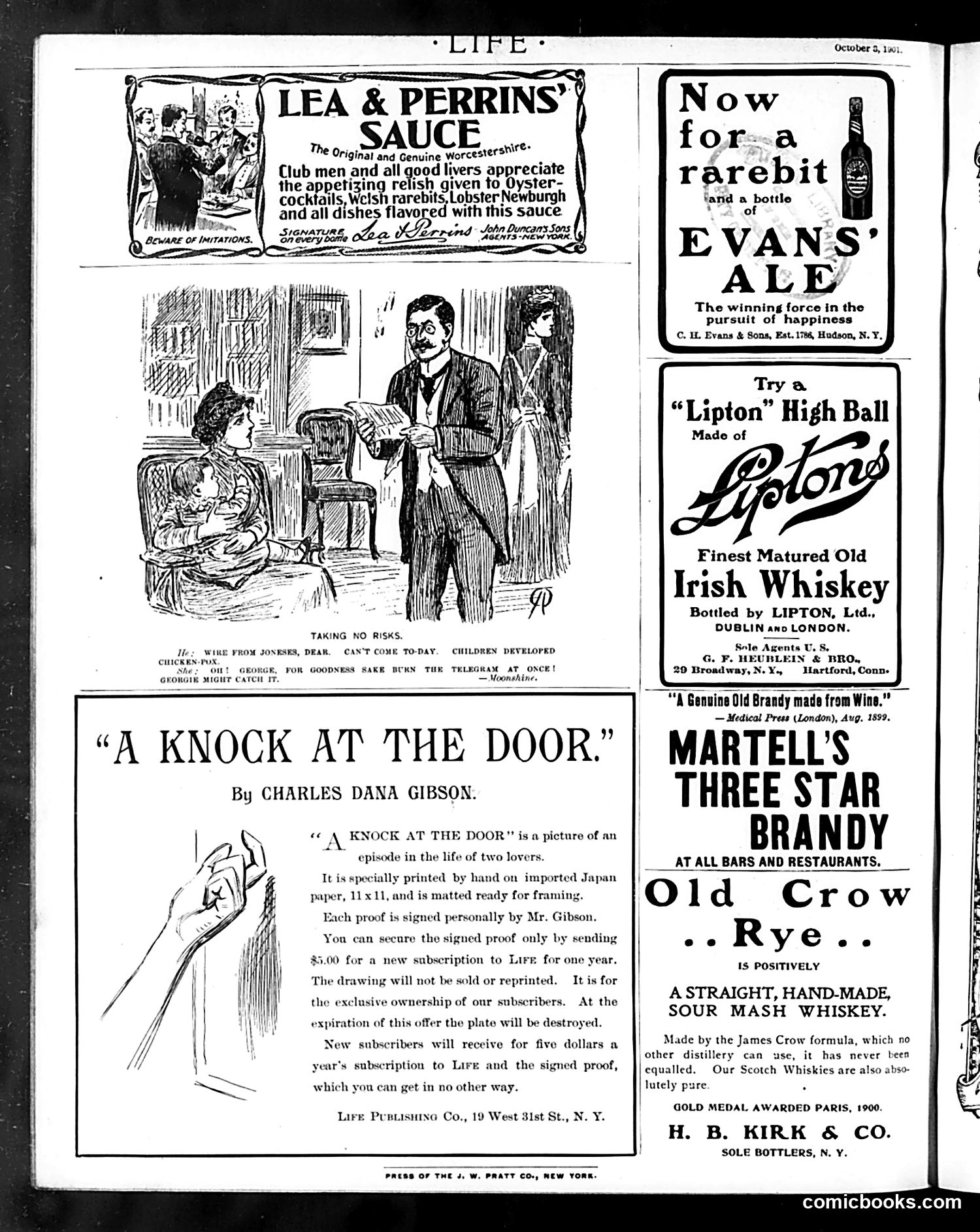
This page is primarily **advertising** for liquor and a special subscription offer, with one editorial cartoon. The cartoon "A Knock at the Door" by Charles Dana Gibson depicts a domestic scene: a woman sits holding a child while a man stands nearby; another figure (likely a servant) enters. The caption references "wire from Joneses, dear" and suggests burning telegrams to hide something from children—implying infidelity or scandal. The joke appears to be about marital deception and the anxiety of discretion. Gibson offers signed prints exclusively to new Life subscribers for $5 (or $10 for a year's subscription). The plate will be destroyed after the offer expires, making it a limited collectible. The surrounding advertisements promote Lea & Perrins Sauce, Evans' Ale, Lipton Irish Whiskey, Martell's Brandy, and Old Crow Rye—typical period liquor marketing targeting "club men and all good livers."