
Life, 1901-10-03 · page 8 of 20
Life — October 3, 1901 — page 8: what you’re looking at
What you’re looking at
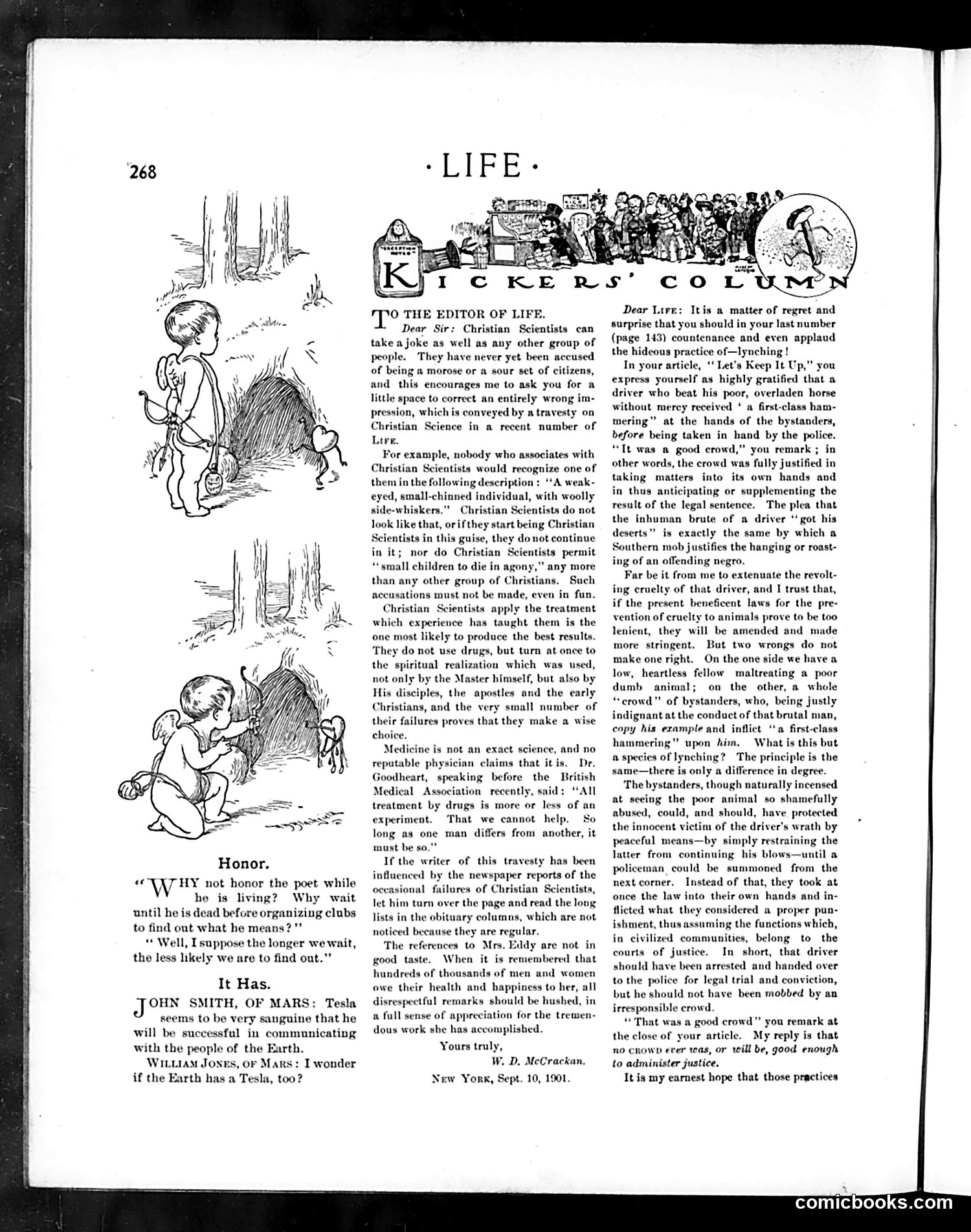
This page contains two sections: a "Kickers' Column" (readers' letters) and a poem titled "Honor." The **cartoon illustrations** (left side) depict a cherubic child figure interacting with animals in pastoral settings—these appear to be generic whimsical illustrations rather than political satire. The **Kickers' Column** letter criticizes Life magazine's recent article defending Christian Scientists against accusations of cruelty. The writer (W.D. McCrackan, Sept. 10, 1901) argues that Christian Scientists shouldn't be exempt from accountability, citing a specific case of a driver beating a horse. He contends that spiritual treatment shouldn't replace legal consequences for animal cruelty. The **"Honor" poem** below references John Smith of Mars and Tesla, likely contemporary figures, though the specific context is unclear from this excerpt alone.
📄 Transcribed text from this page (OCR, searchable)
Machine-transcribed from the original scan — historical spelling and the odd misread are preserved.
“ WwW HY not honor the poet while he is living? Why wait until he is dead before organizing clubs to find out what he means?” ‘ Well, [suppose the longer we wait, the less likely we are to find out.” It Has. OHN SMITH, OF MARS: Tesla seems to be very sanguine that he will be successful in communicating with the people of the Earth. WILLIAM Jones, OF Mak if the Earth has a Tesla, too? I wonder ‘0 THE EDITOR OF LIFE. Dear Sir: Christian Scientists can take ajoke as well as any other group of people. They have never yet been accused of being a morose or a sour set of citizens, and this encourages me to ask you for a little space to correct an entirely wrong im- pression, which is conveyed by a travesty on Christian Science in a recent number of Lire. For example, nobody who associates with Christian Scientists would recognize one of them in the following description : “A weak- eyed, small-chinned individual, with woolly side-whiskers.” Christian Scientists do not look like that, orifthey start being Christian Scientists in this guise, they donot continue in it; nor do Christian Scientists permit “ small children to die in agony,” any more than any other group of Christians. Such accusations must not be made, even in fun. Christian Scientists apply the treatment which experience has taught them is the one most likely to produce the best results. They do not use drugs, but turn at once to the spiritual realization which was used, not only by the Master himself, but also by His disciples, the apostles and the early Christians, and the very small number of their failures proves that they make a wise choice. Medicine is not an exact science, and no reputable physician claims that itis. Dr. Goodheart, speaking before the British Medical Association recently, said: “All treatment by drugs is more or less of an experiment. That we cannot help. So long as one man differs from another, it must be so." If the writer of this travesty has been influenced by the newspaper reports of the occasional failures of Christian Scientists, let him turn over the page and read the long lists in the obituary columns, which are not noticed because they are regular. ‘The references to Mrs. Eddy are not in good taste. When it is remembered that hundreds of thousands of men and women owe their health and happiness to her, all disrespectful remarks should be hushed, in a full sense of appreciation for the tremen- dous work she has accomplished. Yours truly, W. D, McCrackan, York, Sept. 10, 1901. Dear Lire: Itis a matter of regret and surprise that you should in your last number (page 143) countenance and even applaud the hideous practice of—lynching ! In your article, ‘Let's Keep It Up,” you express yourself as highly gratified that a driver who beat his poor, overladen horse without mercy received ‘ a first-class ham- mering” at the hands of the bystanders, before being taken in hand by the police. “Tt was a good crowd,” you remark ; in other words, the crowd was fully justified in taking matters into its own hands and in thus anticipating or supplementing the result of the legal sentence. The plea that the inhuman brute of a driver ‘got his deserts" is exactly the same by which a Southern mob justifies the hanging or roast- ing of an offending negro. Far be it from me to extenuate the revolt- ing cruelty of that driver, and I trust that, if the present beneficent laws for the pre- vention of cruelty to animals prove to be too lenient, they will be amended and made more stringent. But two wrongs do not make one right. On the one side we have a low, heartless fellow maltreating a poor dumb animal; on the other, a whole “crowd” of bystanders, who, being justly indignant at the conduct of that brutal man, copy his ezample and inflict ‘‘a first-class hammering” upon Aim. What is this but a species of lynching? The principle is the same—there is only a difference degree. The bystanders, though naturally incensed. at seeing the poor animal so shamefully abused, could, and should, have. protected the innocent victim of the driver's wrath by, peaceful means—by simply restraining the latter from continuing his blows—until a policeman could be summoned from the next corner. Instead of that, they took at once the law into their own hands and in- flicted what they considered a proper pun- ishment, thus assuming the functions which, in civilized communities, belong to the courts of justice. In short, that driver should have been arrested and handed over to the police for legal trial and conviction, but he should not have been mobbed by an irresponsible crowd. “That was a good crowd” you remark at the close of your article. My reply is that no crown ever tas, or will be, good enough to administer justice. It is my earnest hope that those practices comicbooks.com