
Life, 1901-10-03 · page 12 of 20
Life — October 3, 1901 — page 12: what you’re looking at
What you’re looking at
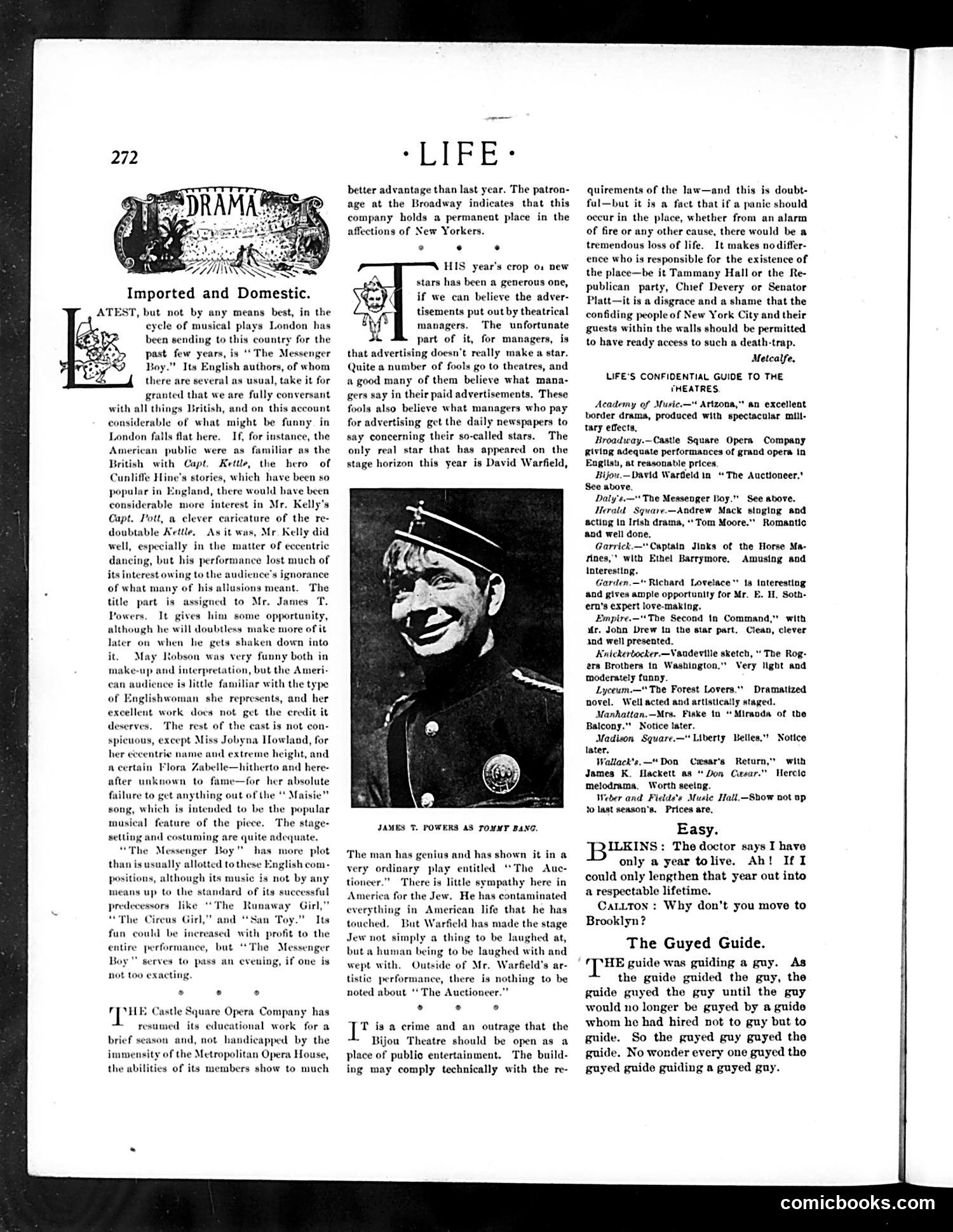
This page contains theater reviews and criticism, not political cartoons. The central image shows **James T. Powers as "Pommey Rand,"** a character in what appears to be a musical comedy. Powers was a well-known American performer of this era. The reviews discuss various Broadway productions, including criticism of "The Auctioneer" (featuring David Warfield) and other plays. The text critiques theatrical advertising practices and discusses which performers genuinely deserve their promoted "star" status versus those who receive unmerited publicity. The section also includes a humorous anecdote called "The Guyed Guide" about tour guides—wordplay on "guy" and "guide." This is standard entertainment journalism rather than satirical commentary on political or social issues.
📄 Transcribed text from this page (OCR, searchable)
Machine-transcribed from the original scan — historical spelling and the odd misread are preserved.
Imported and Domestic. ATEST, but not by any means best, in the cycle of musical plays London has been sending to this country for the past few years, is “The Messenger Boy.” Its English authors, of whom there are se’ al, take it for granted that we are fully conversant with all things British, and on this account considerable of what might be funny in London falls flat here. If, for instance, the American public were as familiar as the British with Capt. Kettle, the hero of Cunliffe Hine’s stories, which have been so popular in England, there would have been considerable more interest in Mr. Kelly's Capt. Pott, a clever caricature of the re- doubtable Aettle, As it was, Mr Kelly did well, especially in the matter of eccentric dancing, but his performance lost much of its interest owing to the audience's ignorance t many of his allusions meant. The i igned to Mr. James T. It gives him some opportunity, although he will doubtless 1 more of it later on when he gets shaken down into terpretation, but the Ameri- little familiar with the type ishwoman she represents, and her. ellent work docs not get the credit it The rest of the cast is not con- Miss Jobyna Howland, for e and extreme height, and Zabelle—hitherto and here- after unknown to fame—for her absolute failure to get anything out of the " Maisie” song, which is intended to be the popular musical feature of the piece. The sta setting and costuming are quite adequate The Messenger Boy” has more pl than is usually allotted to these English com- positions, although its musie is not by any means up to the standard of its succes predecessors Ii “The Circus Girl,” and Id be increased with profi performance, but “The Messeng serves to pass an evening, if one is [HE Castle Square Opera Company has resumed its educational work for a brief season and, not handicapped by the immensity of the Metropolitan Opera House, the abilities of its members show to much ° ° vLIEE « better advantage than last year. The patron- age at the Broadway indicates that this company holds a permanent place in the affections of New Yorkers. ° . . HIS year's crop o: new stars has been a generous one, if we can believe the adver- tisements put out by theatrical managers. The unfortunate part of it, for managers, is that advertising doesn’t really make a star. Quite a number of fools go to theatres, and a good many of them believe what mana- gers say in their paid advertisements. These fools also believe what managers who pay for advertising get the daily newspapers to say concerning their so-called stars. The only real star that has appeared on the stage horizon this year is David Warfield, JAMES T. POWERS AS TOMMY BANG. ‘The man has genius and has shown it in a very ordinary play entitled “The Auc- ‘There is little sympathy here in America for the Jew. He has contaminated everything in American life that he has touched. But Warfield has made the stage Jew not simply a thing to be laughed at, but a human being to be laughed with and wept with, Outside of Mr. Warfield’s ar- tistic performance, there is nothing to be noted about ‘The Auctioneer.” ° . ° tioncer.” JT is a crime and an outrage that the Bijou Theatre should be open as a place of public entertainment. The build- ing may comply technically with the re- quirements of the law—and this is doubt- ful—but it is a fact that if a panic should occur in the place, whether from an alarm of fire or any other cause, there would be a tremendous loss of life. It makes no differ- ence who is responsible for the existence of the place—be it Tammany Hall or the Re- publican party, Chief Devery or Senator Platt—it is a disgrace and a shame that the confiding people of New York City and their guests within the walls should be permitted to have ready access to such a death-trap. Metcalfe, LIFES CONFIDENTIAL GUIDE TO THE THEATRES. Academy of Musie.— Arizona,” an excellent border drama, produced with spectacular mill- tary effects, Broadway.—Castle Square Opera Company giving adequate performances of grand opera in Engitsu, at reasonable prices. Bijou.—David Warfeld in “The Auctioneer.’ See above. Daty's,—" The Messenger Boy." See above. Herald Square.—Andrew Mack stoging and ‘acting In Irish drama, “Tom Moore." Romantic and well done, Garrick. —" Captain Jinks of the Horse Ma- fines," with Ethel Barrymore, Amusing and Interesting. Garden.—" Richard Lovelace 1s Interesting and gives ample opportunity for Mr. E. H. Soth- ern’s expert love-making. Empire.—"The Second In Command,” with wir. John Drew in the star part. Clean, clever and well presented. Knickerbocker —Vandeville sketch, “The Rog: era Brothers in Washington.” Very light and moderately funny. Lyceum.—" The Forest Lovers." Dramatized novel. Well acted and artisticaily staged. Manhattan.—Mra. Flake tn “ Miranda of the Balcony." Notice tater. Madison Square.—" Liberty Belles,” Notice later. Wallack’s,—“ Don Cwsar's Return,” James K. Hackett as “Don wear." melodrama, Worth seeing. Weber and Fields's Music Halt,—Show not ap to last season's, Prices are, Easy. BEEINS : The doctor says I have only a year tolive. Ah! IfI could only lengthen that year out into a respectable lifetime. CaLLtoy : Why don't you move to Brooklyn? The Guyed Guide. [ss guide was guiding a guy. As the guide guided the guy, the guide guyed the guy until the guy would no longer be guyed by a guide whom he had hired not to guy but to guide. So the guyed guy guyed the guide. No wonder every one guyed the guyed guide guiding a guyed guy. with Hercte comicbooks.com