
Life, 1901-10-03 · page 7 of 20
Life — October 3, 1901 — page 7: what you’re looking at
What you’re looking at
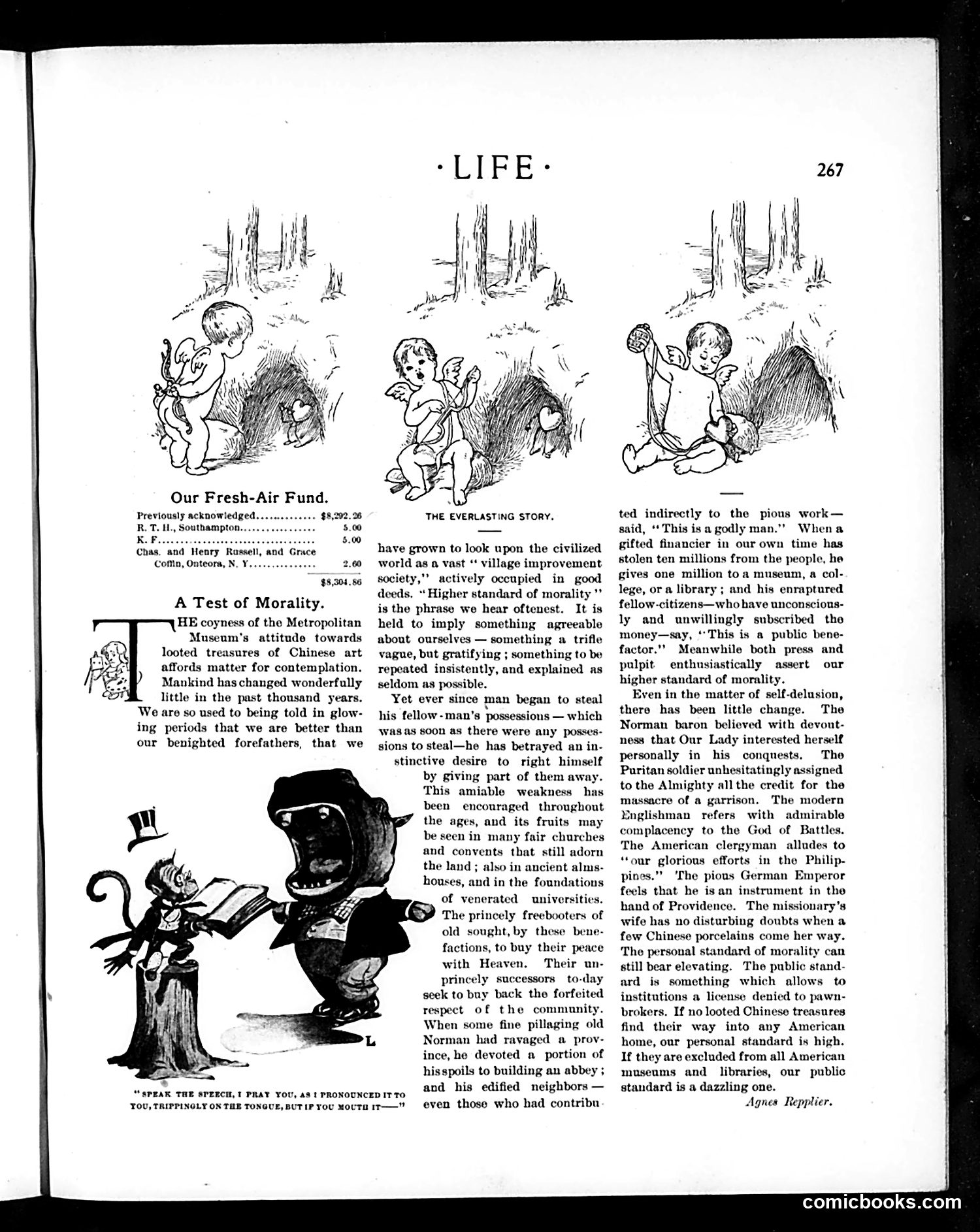
The page contains three sections: **Top**: "Our Fresh-Air Fund" shows cherubs in woodland settings—a charitable fundraising appeal for children's outdoor recreation programs. **Left cartoon**: "A Test of Morality" depicts a monkey in formal dress reading a book, satirizing Victorian moral pretensions. The caption reads: "SPEAK THE SPEECH, I PRAY YOU, AS I PRONOUNCED IT TO YOU, TRIPPINGLY ON THE TONGUE, BUT IF YOU MOUTH IT—" (Shakespeare's *Hamlet*). The monkey represents humanity mimicking cultured behavior while remaining fundamentally base. **Right article**: "The Everlasting Story" critiques Western hypocrisy regarding Chinese art treasures and cultural property. It mocks the contradiction between professed "higher morality" and actual theft/exploitation of colonial spoils by Western institutions and collectors. The overall theme: Western civilization's self-righteous moral claims mask fundamental dishonesty and theft.
📄 Transcribed text from this page (OCR, searchable)
Machine-transcribed from the original scan — historical spelling and the odd misread are preserved.
Our Fresh-Air Fund. Previously acknowledged + $8,202.28 R. T. H1., Southampton. 5.00 KF. Chas, and Henry Rassell, and Grace Comin, Onteora, N. A Test of Morality. HE coyness of the Metropolitan Museum's attitude towards looted treasures of Chinese art affords matter for contemplation. Mankind has changed wonderfully little in the past thousand years. We are so used to being told in glow- ing periods that we are better than our benighted forefathers, that we “SPEAK THE SPEECH, PRAY YOU, a8 1 PRONOUNCED IT TO YOU, TRIFPINOLY ON THE TONGUE, BUT IP YoU MOUTH IT—" THE EVERLASTING STORY. have grown to look upon the civilized world as a vast “ village improvement society,” actively occupied in good deeds. “Higher standard of morality’ is the phrase we hear oftenest. It is held to imply something agreeable about ourselves — something a trifle vague, but gratifying ; something to be repeated insistently, and explained as seldom as possible. Yet ever since man began to steal his fellow-man's possessions — which Was as soon as there were any posses- sions to steal—he has betrayed an in- stinctive desire to right himself by giving part of them away. This amiable weakness has been encouraged throughout the ages, and its fruits may be seen in many fair churches and convents that still adorn the land ; also in ancient alms- houses, and in the foundations of venerated universities. The princely freebooters of old sought, by these bene- factions, to buy their peace with Heaven. Their un- princely successors to-day seek to buy back the forfeited respect of the community. When some fine pillaging old Norman had ravaged a prov- ince, he devoted a portion of hisspoils to building an abbey ; and his edified neighbors — even those who had contribu ted indirectly to the pious work— said, ‘ This is a godly man.” Whena gifted financier in our own time has stolen ten millions from the people, he gives one million toa museum, a col- lege, or a library ; and his enraptured fellow-citizens—who have unconscious- ly and unwillingly subscribed tho money—say, ‘This is a public bene- factor.” Meanwhile both press and pulpit enthusiastically assert our higher standard of morality. Even in the matter of self-delusion, there has been little change. The Norman baron believed with devout- ness that Our Lady interested herself personally in his conquests. The Puritan soldier unhesitatingly assigned to the Almighty all the credit for the massacre of a garrison. The modern Englishman refers with admirable cency to the God of Battles. rican clergyman alludes to ‘our glorious efforts in the Philip- pines.” ‘The pious German Emperor feels that he is an instrument in the hand of Providence. The missionary's wife has no disturbing doubts when a few Chinese porcelains come her way. The personal standard of morality can still bear elevating. The public stand- ard is something which allows to institutions a license denied to pawn- brokers. If no looted Chinese treasures find their way into any American home, our personal standard is high. If they are excluded from all American museums and libraries, our public standard is a dazzling one. Agnes Repplier. comicbooks.com