
Life, 1901-10-03 · page 6 of 20
Life — October 3, 1901 — page 6: what you’re looking at
What you’re looking at
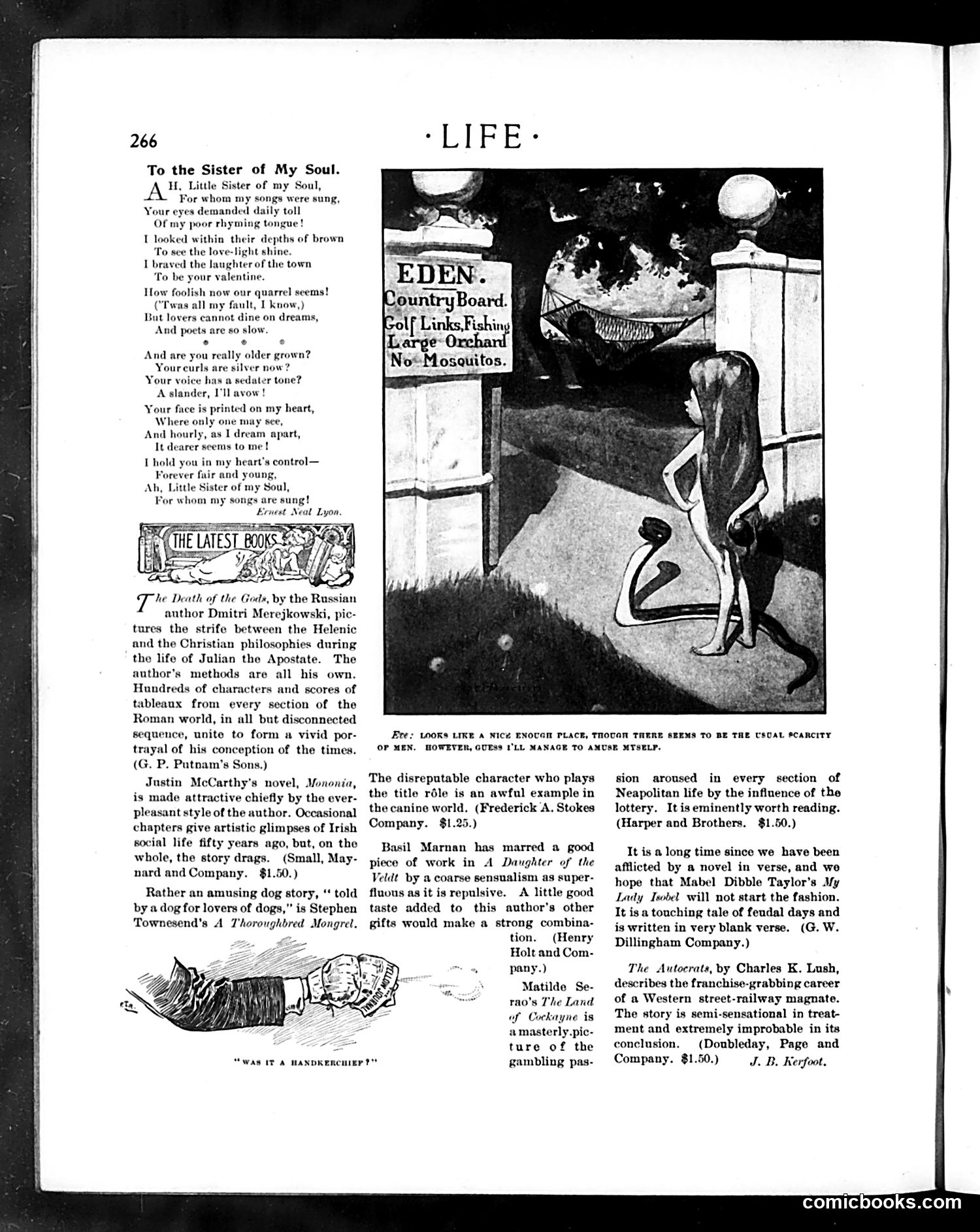
This page combines poetry and book reviews rather than political cartoons. "To the Sister of My Soul" is a sentimental poem by Ernest Noel Lyon dedicated to a sister, expressing nostalgic affection. The main illustration shows a woman at a window looking at an "Eden" country board advertising golf, fishing, and "No Mosquitos"—likely satirizing idealized rural retreat marketing to city dwellers. Below is a small cartoon captioned "WAS IT A HANDKERCHIEF?" depicting a person who appears to have lost or found something, possibly commenting on a social misunderstanding or romantic mix-up. The remainder consists of book reviews discussing recent publications, including works by Russian author Dmitri Merejkowski and others, typical of Life's literary coverage during this period.
📄 Transcribed text from this page (OCR, searchable)
Machine-transcribed from the original scan — historical spelling and the odd misread are preserved.
266 To the Sister of My Soul. H, Little Sister of my Soul, or whom my songs were sung, s demanded daily toll Of my poor rhyming tongue! I looked within their depths of brown To sce the love-light shine. I braved the laughter of the town To be your valentine. How foolish now our quarrel seems! (Twas all my fault, I know,) But lovers cannot dine on dreams, And poets are so slow. ° ° ° And are you really older grown? Your curls are silver now? Your voice has a sedater tone? Tl avow ! only one may see, rly, as I dream apart, parer seems to me! I hold you in my heart's control— Forever fair and young, Ah, Little Sister of my Soul, For whom my songs are sung! ‘nest Neat Lyon. y as Death of the Gods, by the Russian author Dmitri Merejkowski, pi tures the strife between the Helenic and the Christian philosophies during the life of Julian the Apostate. The author's methods are all his own. Hundreds of characters and scores of tableaux from every section of the Roman world, in all but disconnected sequence, unite to form a vivid por- trayal of his conception of the times. (G. P. Putnam's Sons.) Justin McCarthy's novel, Mononia, is made attractive chiefly by the ever- pleasant style of the author. Occasional chapters give artistic glimpses of Irish social life fifty years ago, but, on the whole, the story drags. (Small, May- nard andCompany. $1.50.) Rather an amusing dog story, ‘‘ told by a dog for lovers of dogs,” is Stephen Townesend’s A T'horoughbred Mongrel. “Was IT A MANDKERCHIEY ?”* EDEN. ountry Board. olf Links Fishin oye Cnchari: ‘Nos Mosauitos. Eve: oKs LIKE A NICe ENOUGH PLACE, THOCAN THERE SEEMS TO BE THE CSOAL SCARCITY OF MEN. HOWEVER, GUESS I'LL MANAGE TO AMUSE MYSELF. The disreputable character who plays the title réle is an awful example in the canine world. (Frederick A. Stokes Company. $1.25.) Basil Marnan has marred a good piece of work in A Daughter of the Veldt by a coarse sensualism as super- fluous as it is repulsive. A little good taste added to this author's other gifts would make a strong combina- tion. (Henry Holt and Com- pany.) Matilde Se- rao's The Land of Cockayne is amasterly.pic- ture of the gambling pas- sion aroused in every section of Neapolitan life by the influence of the lottery. It is eminently worth reading. (Harper and Brothers. $1.50.) It is a long time since we have been afflicted by a novel in verse, and we hope that Mabel Dibble Taylor's My Lady Tsobel will not start the fashion. It is a touching tale of feudal days and is written in very blank verse. (G. W. Dillingham Company.) The Autocrats, by Charles K. Lush, describes the franchise-grabbing career of a Western street-railway magnate. The story is semi-sensational in treat- ment and extremely improbable in its conclusion. (Doubleday, Page and Company. $1.50.) J. B. Kerfoot, comicbooks.com