
A complete issue · 20 pages · 1901
Life — September 26, 1901
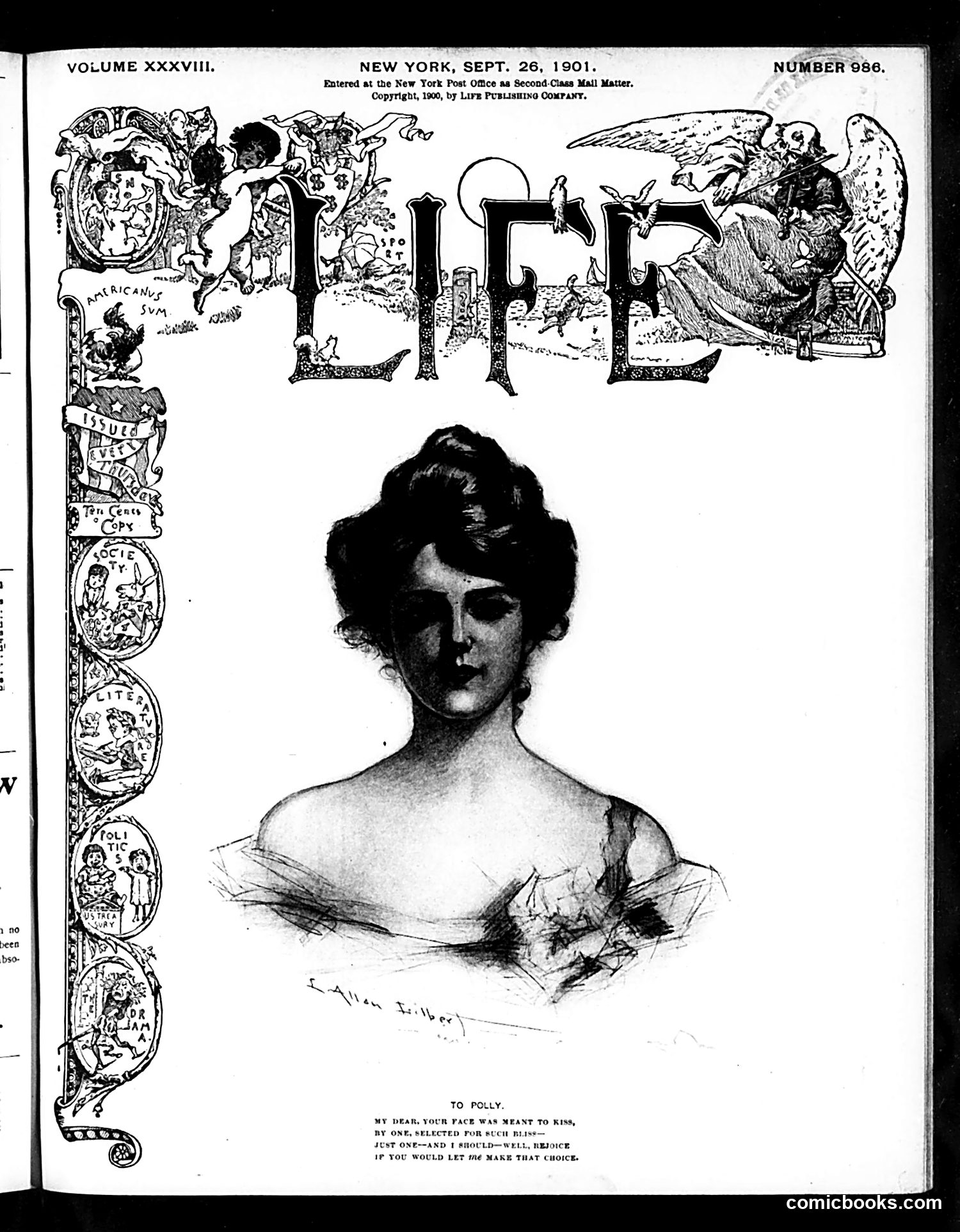
This page features a portrait sketch titled "To Polly" with an accompanying poem. The decorative header reads "LIFE" with ornamental cherubs and classical motifs. The left margin contains a vertical column of small circular illustrations with classical/mythological themes. The poem beneath the portrait ("TO POLLY") addresses a woman, referencing her face being "meant to kiss" and suggesting she was "selected for such bliss" — implying romantic admiration or courtship. The artwork is signed by what appears to be "Allen Millett." This appears to be a society/social commentary piece rather than political satire, likely featuring a notable woman of the era, though the specific identity cannot be confirmed from the image alone. The ornate decorative framing suggests this was a featured or prestigious contribution to the magazine.
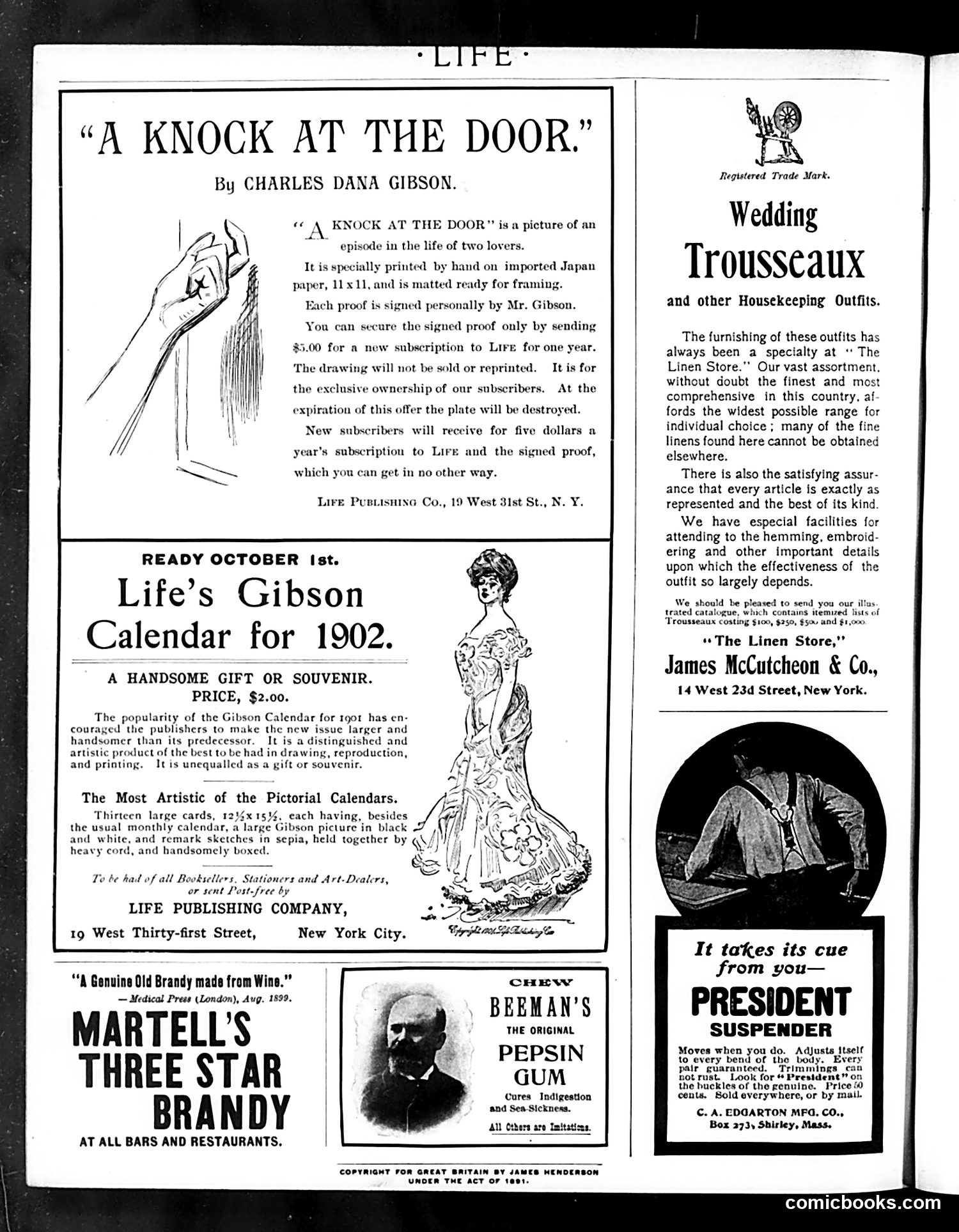
This page is primarily **advertising**, not satirical content. The main feature is "A Knock at the Door," a drawing by Charles Dana Gibson (the famous "Gibson Girl" illustrator) offered as a signed print to Life magazine subscribers for $3.00 annually. The image shows a hand knocking at a door—described as depicting "an episode in the life of two lovers." Below that, Life advertises its 1902 Gibson Calendar, priced at $2.00, featuring thirteen large illustrated cards. The remaining space contains product advertisements: Martell's Three Star Brandy, Beeman's Pepsin Gum, Wedding Trousseaux from "The Linen Store," and President Suspenders. There is no political satire on this page—it's a commercial publication showcasing Gibson's popular artwork and various goods.
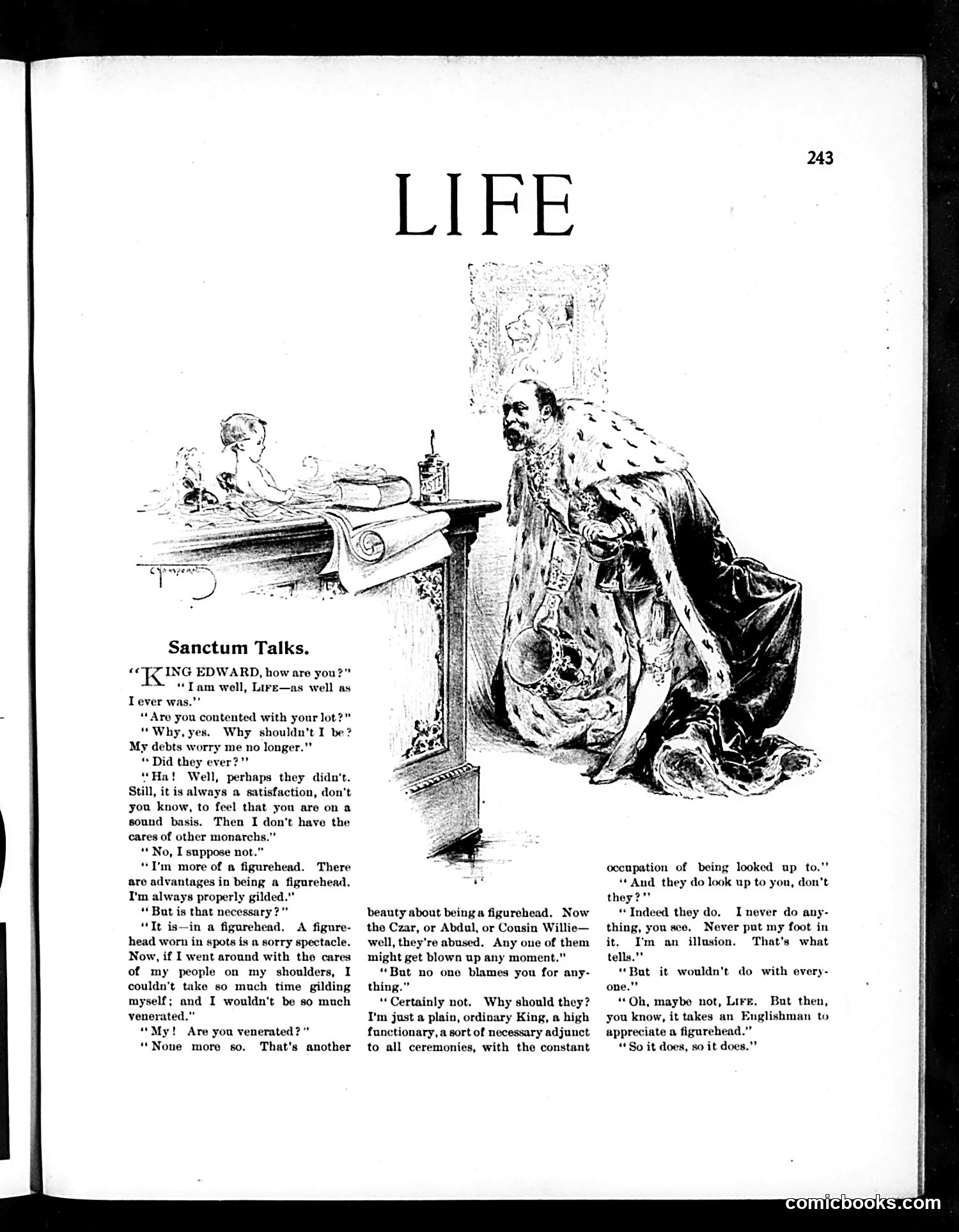
This is a "Sanctum Talks" dialogue piece where King Edward (likely Edward VII, who reigned 1901-1910) converses with "Life," personified as a somewhat dissolute figure in ornate robes. The satire mocks Edward's self-justification for his indulgent lifestyle. Edward claims he's "always properly gilded" and shouldn't be blamed for enjoying luxuries—he's merely a "figurehead" with ceremonial duties. Life counters that being a figurehead requires maintaining dignity and setting proper examples, arguing "it takes an Englishman to appreciate a figurehead." The joke satirizes Edward's reputation for extravagant living and womanizing, suggesting his role demands better conduct than his actual behavior demonstrates. The ornate, somewhat shabby costume emphasizes the critique of hollow royal pretense.
The small cartoon at the top left appears to show a figure in motion, though details are unclear from this reproduction. The main content is editorial text discussing President McKinley's political challenges during his first term. The author defends McKinley against criticism regarding the Spanish-American War and its complications, arguing that the President faced impossible choices and that his honest critics should not be disparaged. The piece then pivots to praising President Roosevelt, suggesting he is "a good man, and an able man" capable of wisely administering the country. The cartoon and text together form a political defense of McKinley's record while expressing optimism about Roosevelt's leadership—likely from the early Roosevelt administration (post-1901).
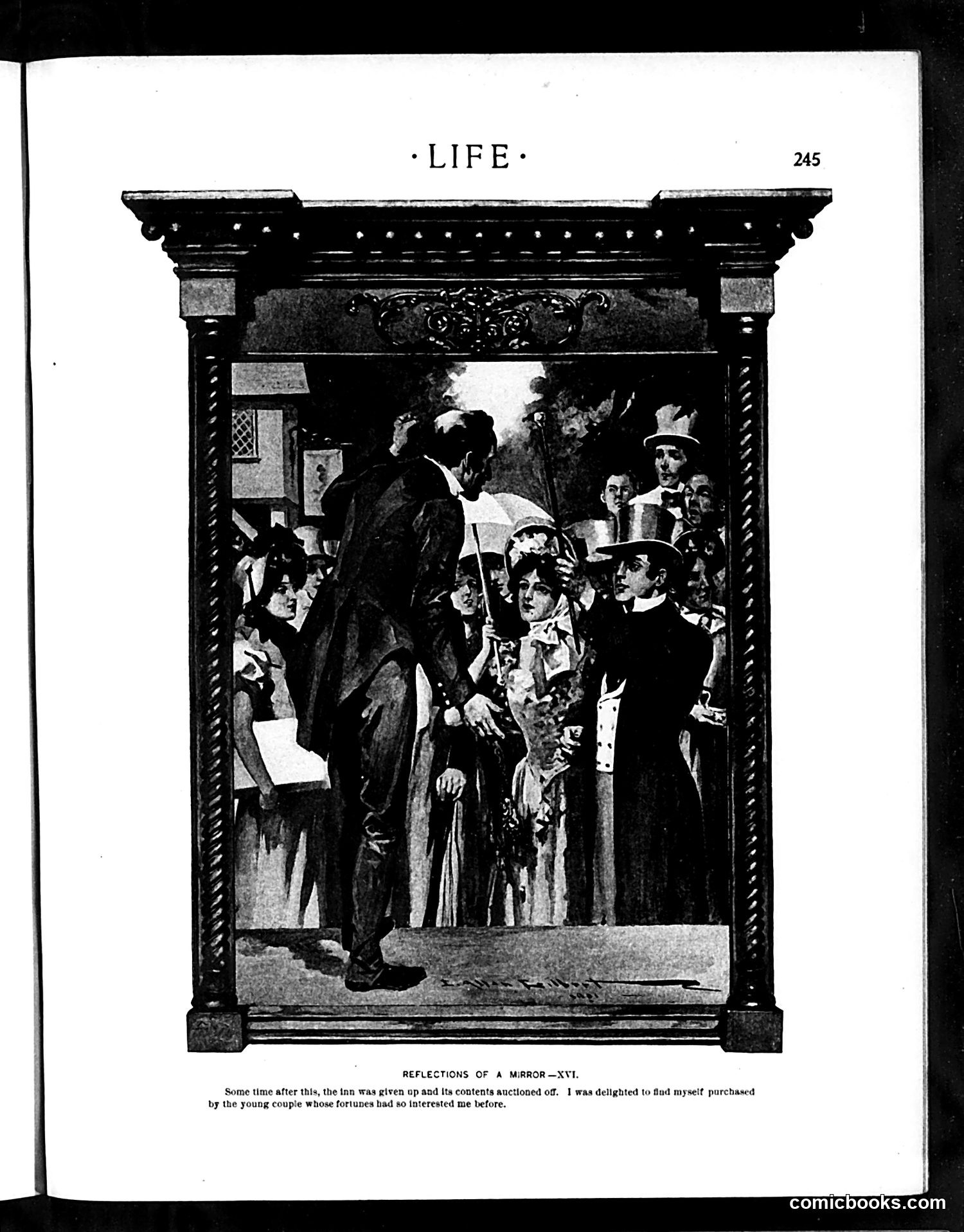
This satirical illustration depicts an indoor auction or estate sale scene. The caption indicates the narrator purchased items from a young couple's auctioned fortune, finding the acquisition "delighted" them. The scene shows well-dressed figures of varying social status gathered around what appears to be auction activities. The title "Reflections of a Mirror" suggests social commentary on wealth, class, and fortune—likely critiquing the era's economic disparities or the fate of once-wealthy families facing financial ruin. The ornate frame treatment and formal composition emphasize the scene's significance as social observation. Without additional context about the specific couple or event referenced, the broader satire appears to target early 20th-century attitudes toward inherited wealth and sudden financial reversal among the upper classes.
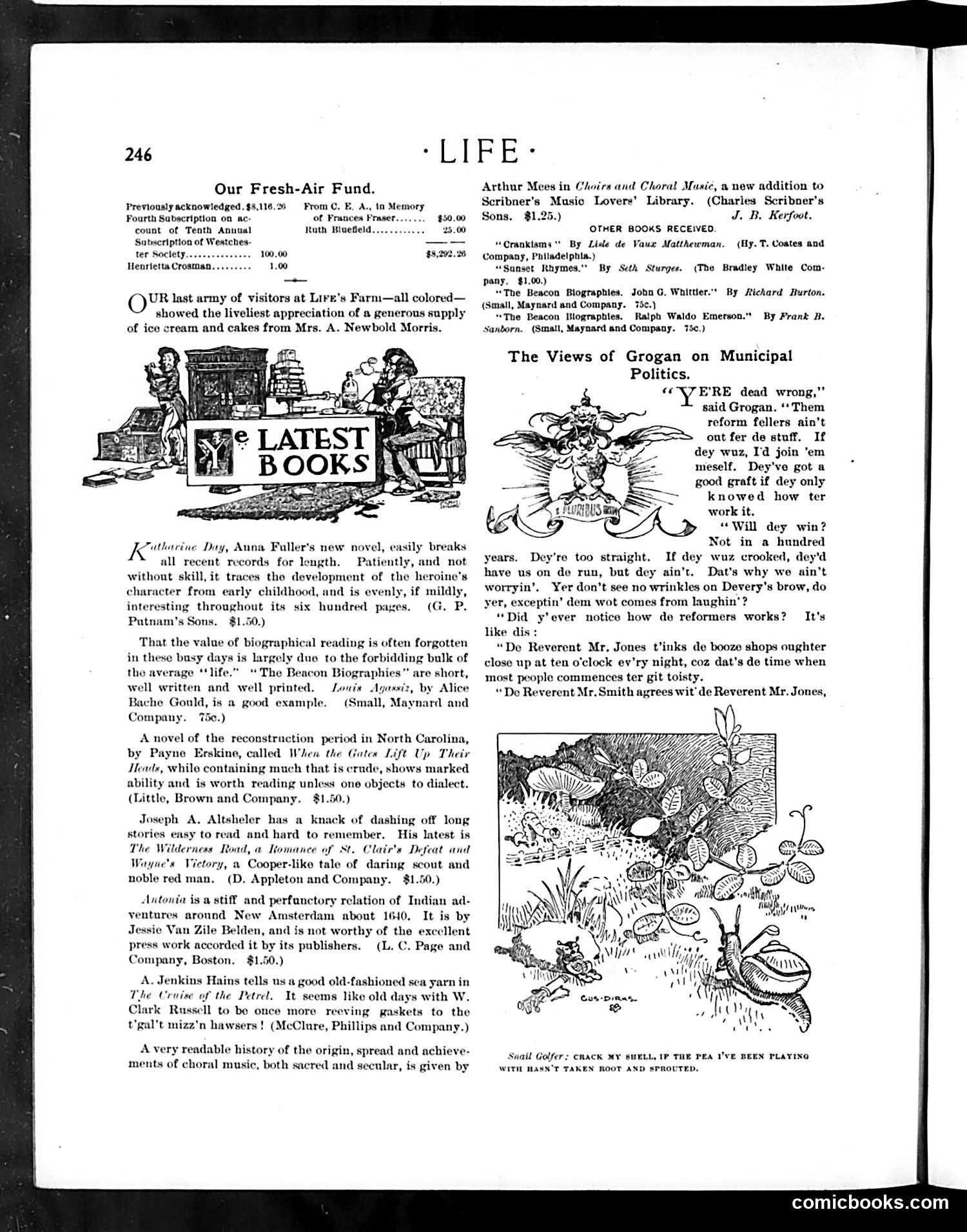
This cartoon satirizes a character named Grogan, depicted as a snail, offering cynical commentary on municipal reform. Grogan dismisses reform activists as ineffectual, claiming they lack practical knowledge of how government actually works. His specific examples target local corruption: he notes that reform-minded reverends drink at bars after hours and that reform candidates make false promises about closing saloons. The satire targets the gap between reform ideology and urban political reality—reformers appear naive about entrenched corruption and the complicity of respectable citizens in maintaining it. The snail imagery suggests Grogan's slow, worldly skepticism contrasts with reformers' idealistic but naive activism. The joke reflects early 20th-century American tensions between Progressive reform movements and political machine realism.
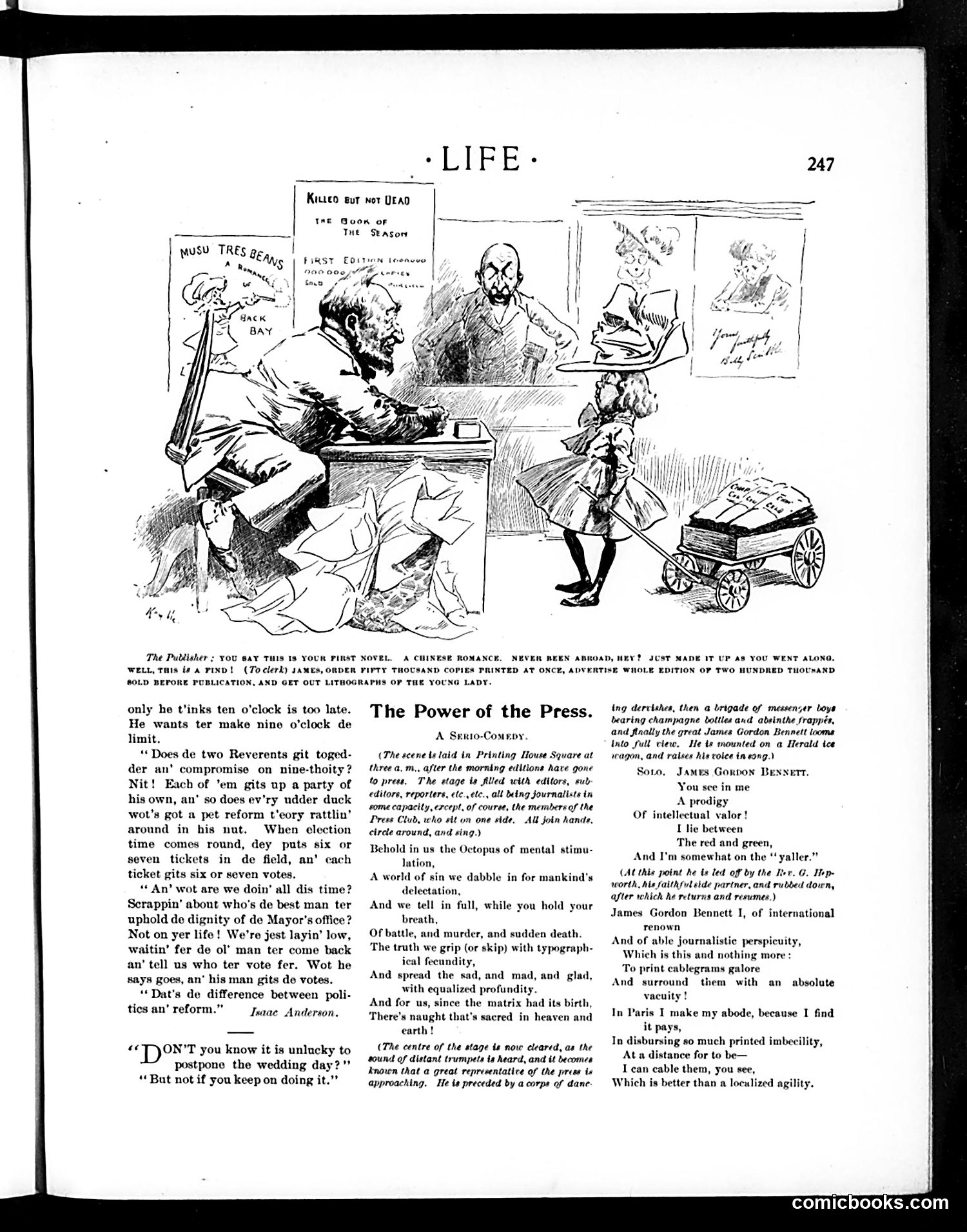
This page presents a serialized comedic sketch mocking the publishing industry. The cartoon depicts a publisher offering a naive young woman a lucrative book deal—promising fifty thousand copies printed immediately, substantial advertising, and two hundred thousand copies sold in advance. The satire targets the publisher's exaggerated sales promises and the manufactured nature of the publishing business. The accompanying dialogue mocks journalistic pretension, referencing "the Octopus of mental stimulation" and critiquing how the press spreads sensationalism about "battle, and murder, and sudden death" while claiming journalistic integrity. The sketch satirizes both opportunistic publishers exploiting inexperienced authors and the press's role in sensationalizing content for profit rather than truth.
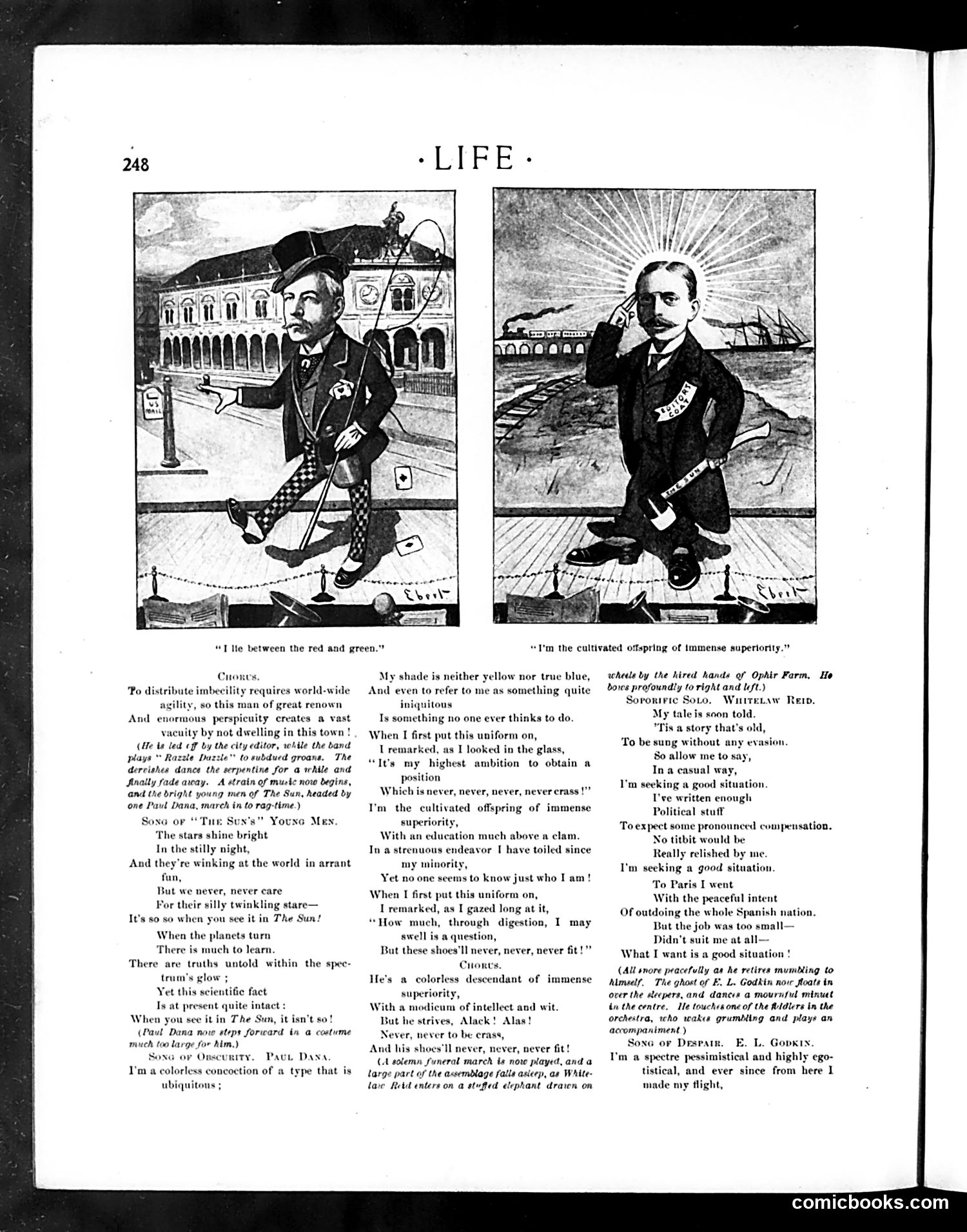
This page contains two political cartoons satirizing figures described as "colorless" descendants of "immense superiority" with pretensions to intellectual distinction. The left cartoon depicts a man in formal dress gesturing toward an ornate building, while the right shows a similarly dressed figure in a contemplative pose near a ship. The accompanying verse mocks both figures for claiming superiority while being unremarkable—one seeks a "good situation" (employment), the other claims to be "a spectre pessimist and highly egotistical." The satire targets individuals who boast of refined breeding and education yet lack substance, achievement, or self-awareness. The repeated refrain "never, never crass" suggests ironic commentary on pretentious social climbing among the idle aristocratic or upper-class set. Without identifying the specific individuals caricatured, the satire clearly ridicules inherited privilege disconnected from genuine merit.
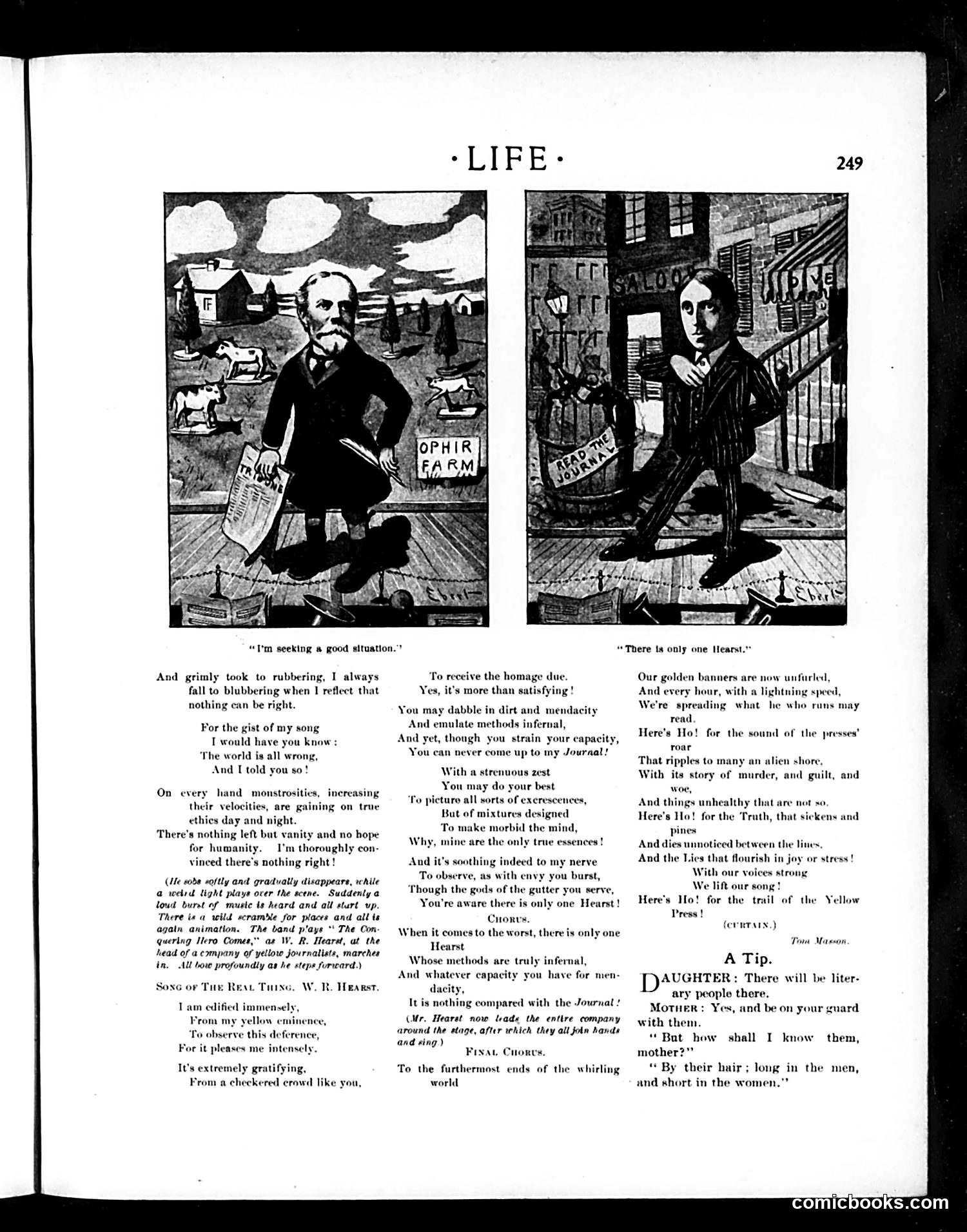
This page from *Life* magazine contains two woodcut-style cartoons satirizing journalism and sensationalism. The left cartoon shows a man labeled "OPHIR FARM" reading a newspaper while seeking "a good situation." The accompanying poem critiques yellow journalism and the corrupting influence of the press on society. The right cartoon depicts a man in an urban setting with the caption "There is only one Heart." The accompanying verse mocks the press's hypocritical morality—claiming to champion truth while spreading rumors and scandal. Both pieces attack newspapers for sensationalism and ethical hypocrisy. The final section includes "A Tip," a brief satirical dialogue about identifying strangers by physical characteristics—likely mocking prejudiced stereotyping common in the era. The satire targets media manipulation and societal judgment rather than specific named individuals.
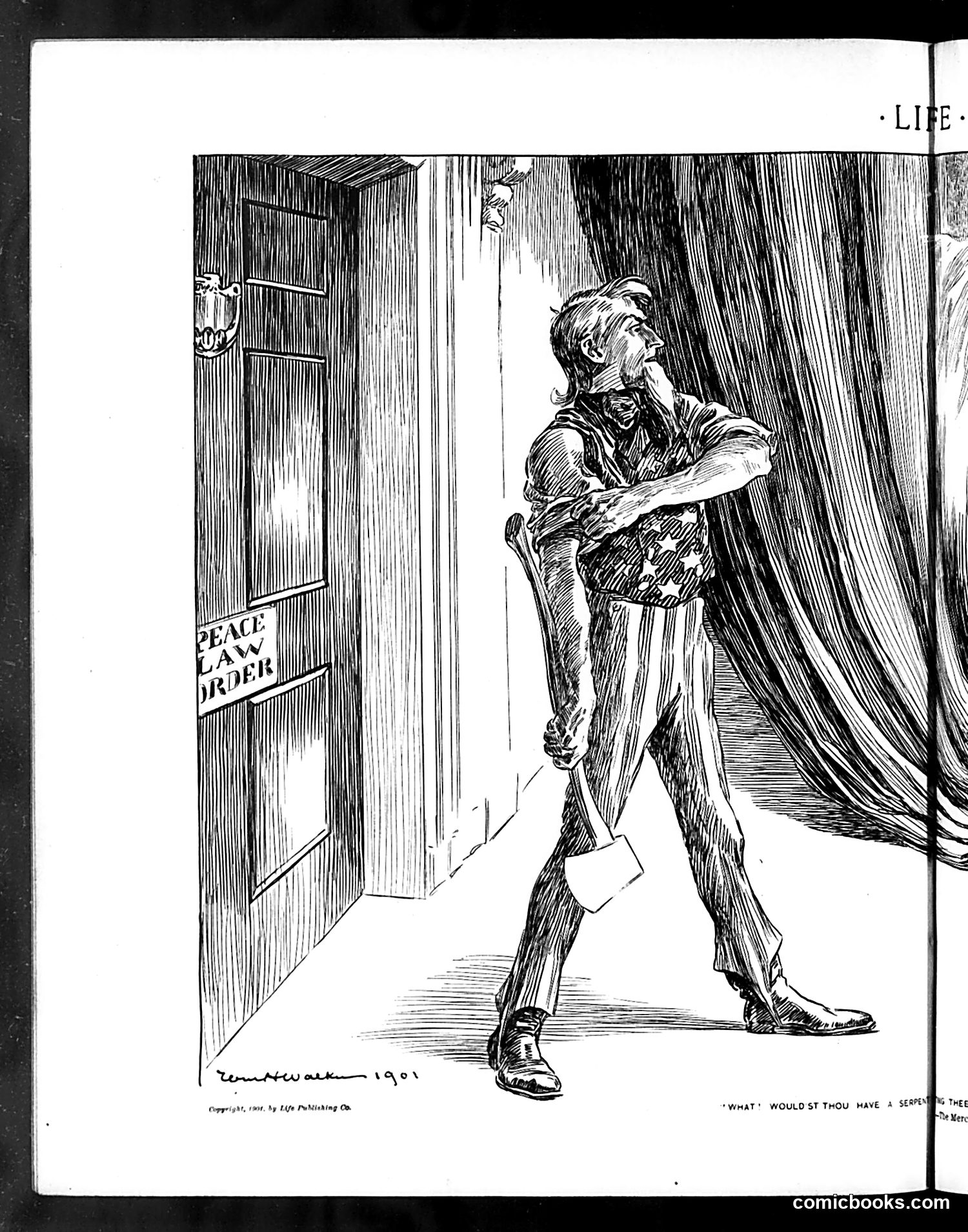
This 1901 Life magazine cartoon depicts a bearded man in military uniform confronting a door labeled "PEACE LAW ORDER." The figure appears anxious or distressed, holding what looks like a document or notice. The partially visible caption asks "WHAT WOULD ST THOU HAVE A SECRET IN THEE" (likely a Shakespeare reference). The cartoon likely satirizes military or political authority grappling with peace enforcement during the early 20th century—possibly referencing the Boer War aftermath or domestic labor/social unrest. The "Peace Law Order" door suggests tension between military power and civilian governance. The soldier's agitation implies discomfort with transitioning from wartime to peacetime administration. Without clearer context about which specific conflict or figure is referenced, the precise target remains somewhat unclear.
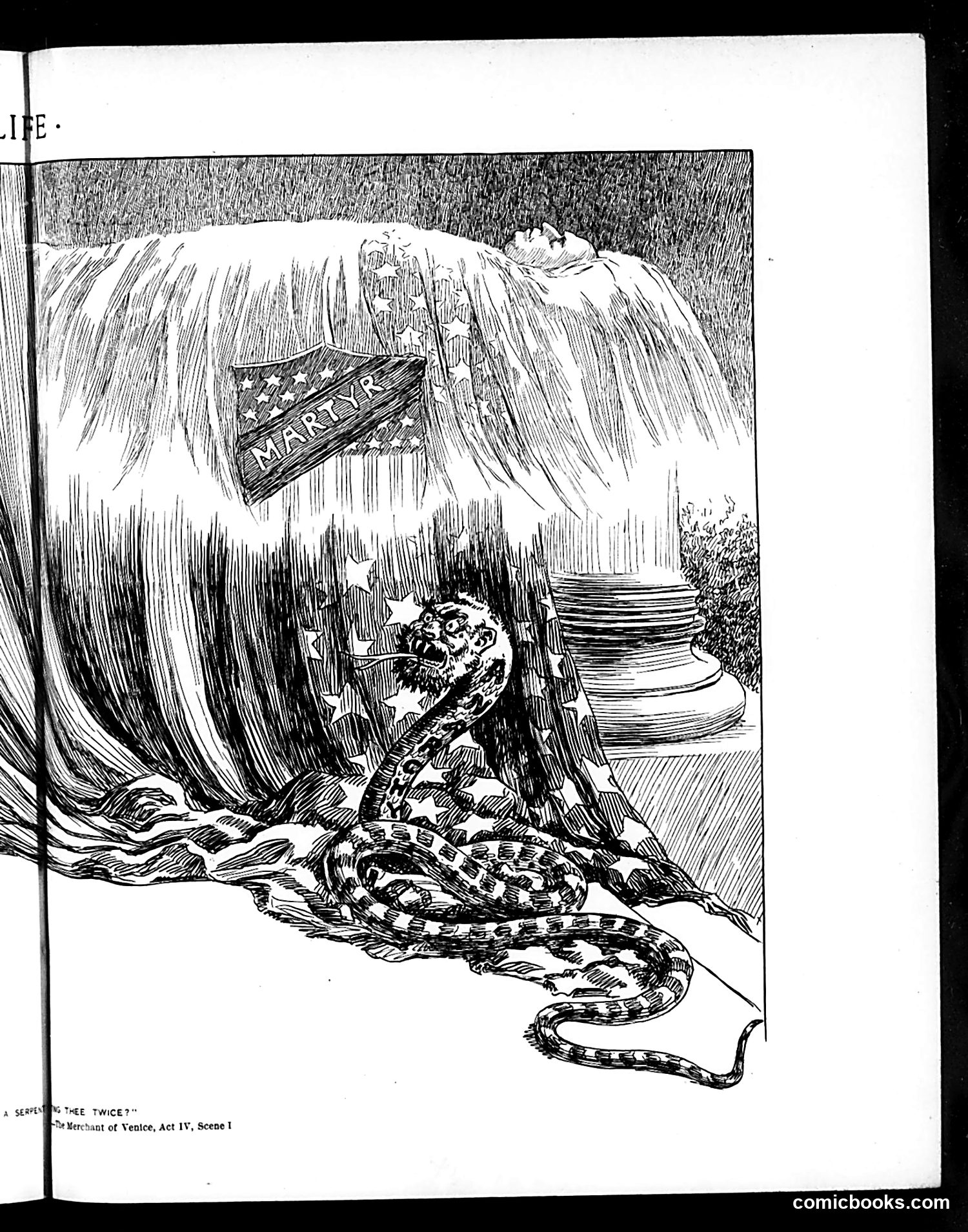
This illustration references Shakespeare's *The Merchant of Venice*, Act IV, Scene 1—the famous "pound of flesh" scene. A serpent coils beneath a coffin labeled "MARTYR," positioned under a large angelic wing. The caption reads "A SERPENT IN THEE TWICE," quoting the play. The satire appears to conflate Shakespeare's treacherous character (likely Shylock) with contemporary political betrayal. The "martyr" coffin suggests someone who died for a cause, while the serpent represents deception or hypocrisy hidden within. The Shakespearean reference elevates the criticism, comparing modern political treachery to classic literary villainy. Without additional context from the magazine's date, the specific political event referenced remains unclear, though the imagery suggests accusations of hidden malice beneath claims of martyrdom.
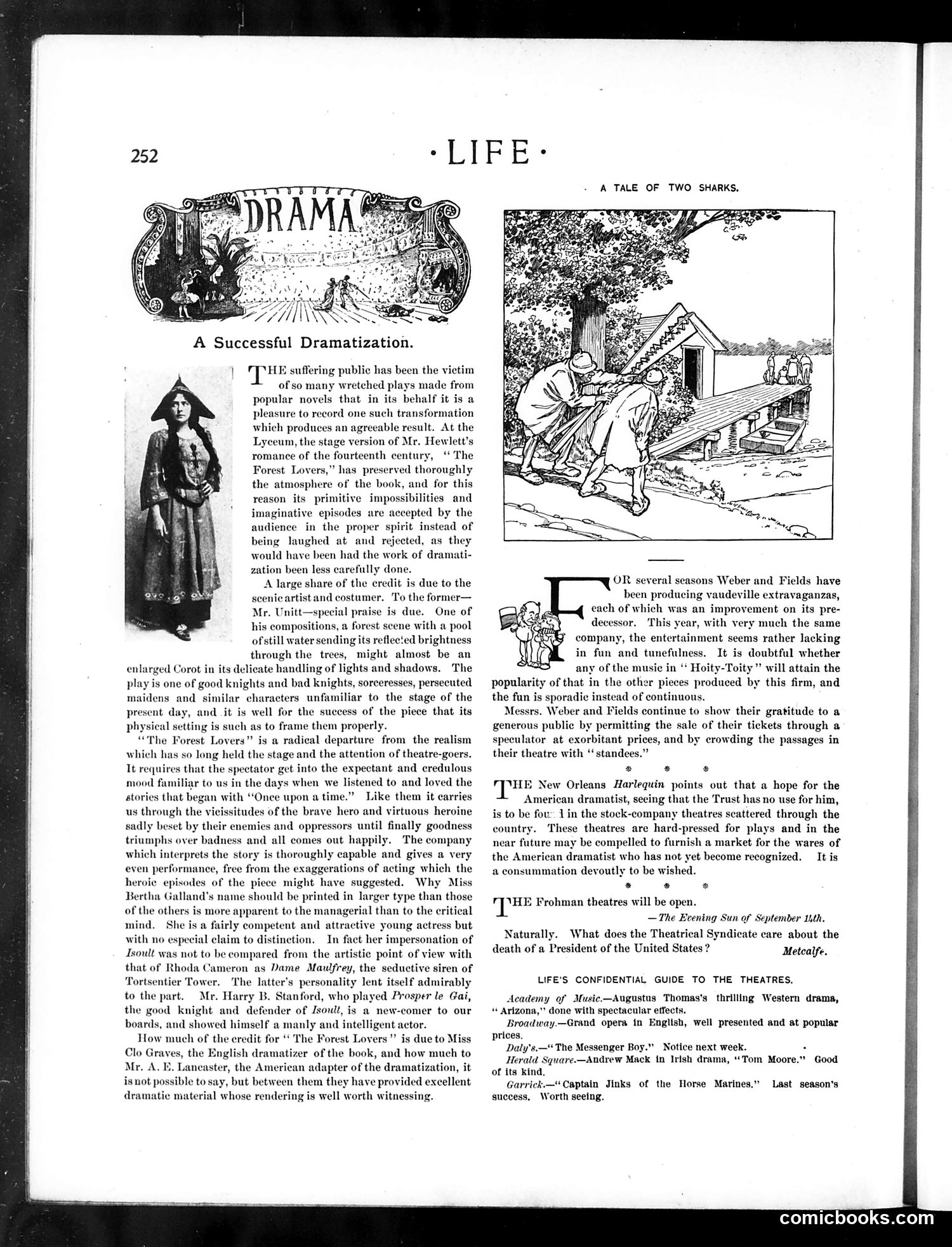
This page discusses theatrical adaptations of popular novels, focusing on "The Forest Lovers," a 14th-century romance. The text praises the dramatization for preserving the book's atmosphere while making it stage-appropriate through careful adaptation. The left column features a photograph of an actress (likely Miss Bertha Galland, mentioned in the text) in costume as a character from the play. The right side includes "A Tale of Two Sharks"—an illustration showing two men examining or working on what appears to be a boat or structure. This appears to be satirizing theatrical producers Weber and Fields, who are criticized for repeatedly producing similar vaudeville shows, with the "sharks" metaphor suggesting they're exploiting audiences' patience and wallets through formulaic entertainment.
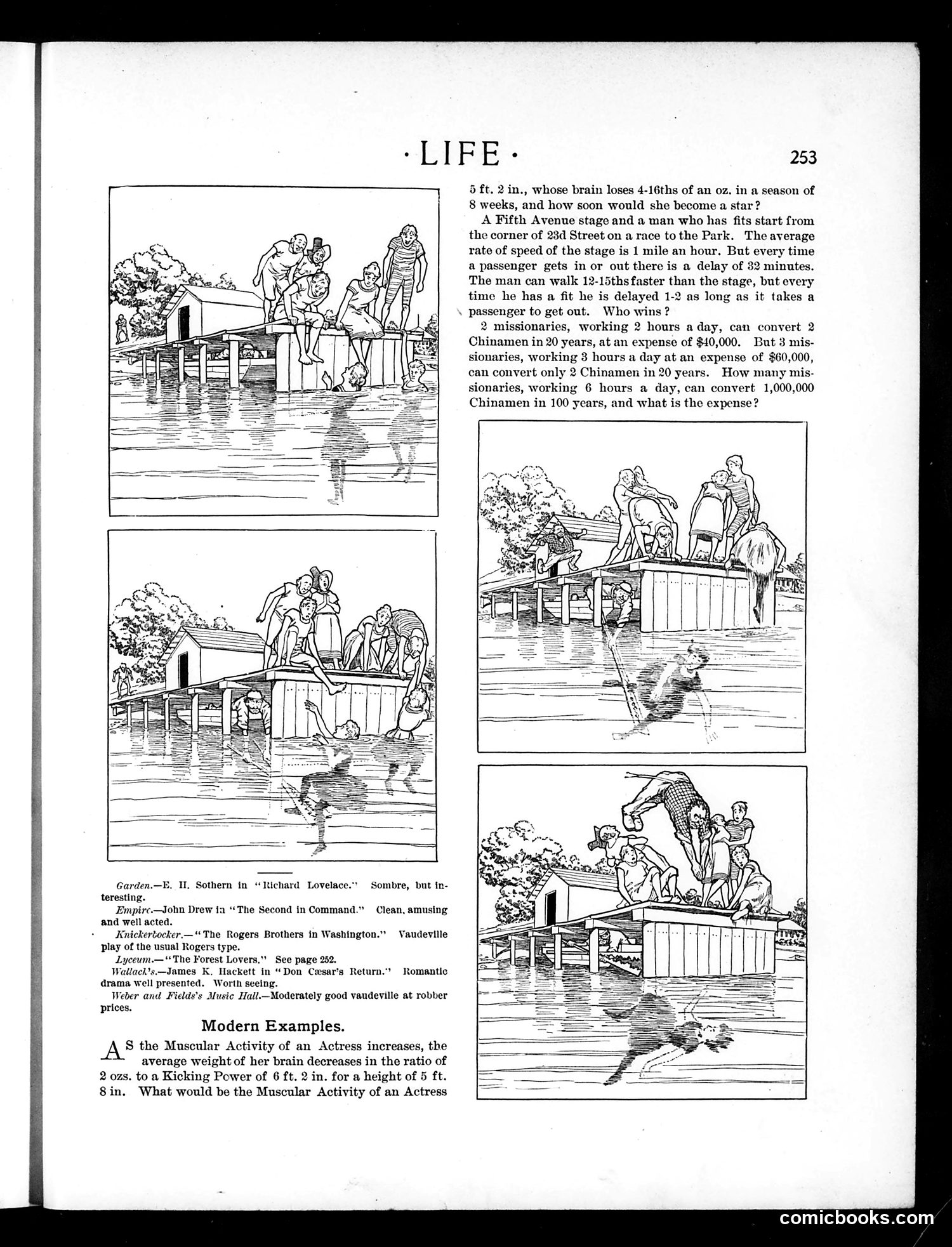
This page from *Life* magazine combines two satirical sections mocking American culture circa early 1900s. The **top section** presents absurdist math word problems ridiculing contemporary obsessions: missionary conversion efforts in China (shown to be inefficient), Fifth Avenue stage transportation delays, and pseudoscientific theories about actresses' brains shrinking with physical exertion. The humor lies in applying absurd logic to serious topics—suggesting that converting Chinese people was as mechanically calculable as calculating stage delays. The **illustrations** depict people at a dock or riverside, apparently engaged in recreational activities (swimming, boating), rendered in period-appropriate satirical style. The **bottom section** lists theater reviews for popular New York venues (Garden, Empire, Knickerbocker, Lyceum, Weber and Fields), with brief, dismissive commentary typical of *Life*'s irreverent theater criticism. Overall, this page satirizes American quantification mania, ineffective missionary work, and urban theater culture.
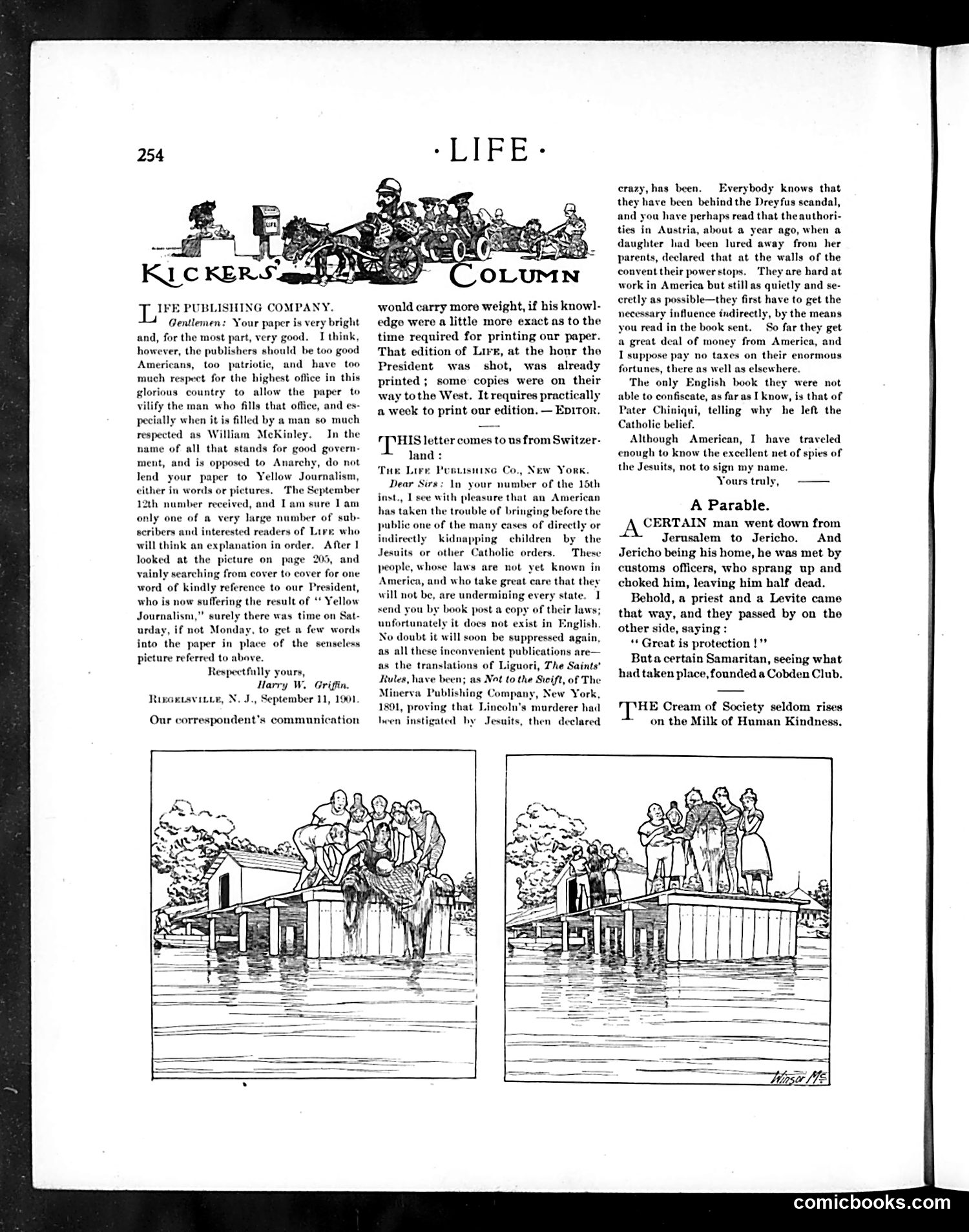
This page contains reader letters responding to Life's coverage of **President William McKinley's assassination** (September 6, 1901). **The Letters:** 1. **Harry W. Griffin's complaint**: A subscriber protests Life's "yellow journalism" for criticizing McKinley. Life's editor tersely responds that the criticized illustration was printed *before* the shooting, explaining the week-long print lag. 2. **Swiss correspondent's anti-Catholic screed**: An anonymous letter promotes conspiracy theories blaming Jesuits for undermining nations, mentions the Dreyfus scandal, and claims Lincoln's assassination was instigated by Catholics. Life prints this without editorial comment or rebuttal. 3. **"A Parable"**: A satirical retelling of the Good Samaritan parable, where the helpful figure founds a "Cobden Club" (a free-trade organization) instead of helping—mocking ineffectual charitable responses to injustice. The page illustrates Life's role as a satirical voice during a tense moment, balancing criticism of power with contemporary prejudices (particularly anti-Catholic sentiment).
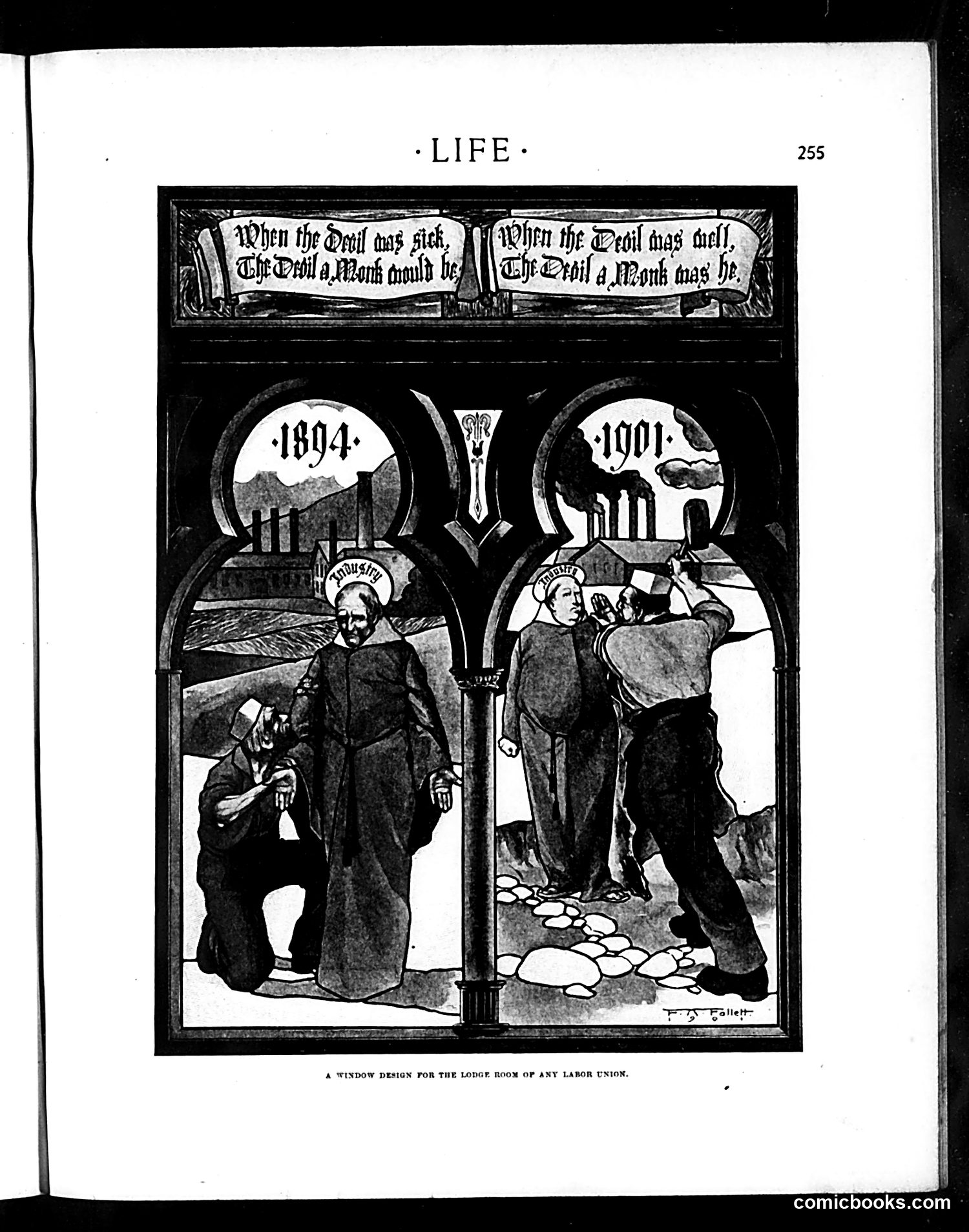
This is a stained-glass window design titled "A Window Design for the Lodge Room of Any Labor Union," comparing labor conditions in 1894 versus 1901. The **left panel (1894)** shows industrial smokestacks and a kneeling worker in apparent distress or supplication before a stern figure labeled "Industry." The **right panel (1901)** depicts similar industrial scenes with workers in confrontational poses. The caption above reads: "When the Devil was sick, / The Devil a Monk would be" — a proverb meaning people reform only during hardship. This satirizes labor unions' inconsistent demands and worker behavior across economic cycles. The seven-year gap likely references shifts in labor militancy or union effectiveness. The stained-glass format mockingly elevates labor disputes to religious significance, suggesting the cartoon criticizes unions' moral posturing.
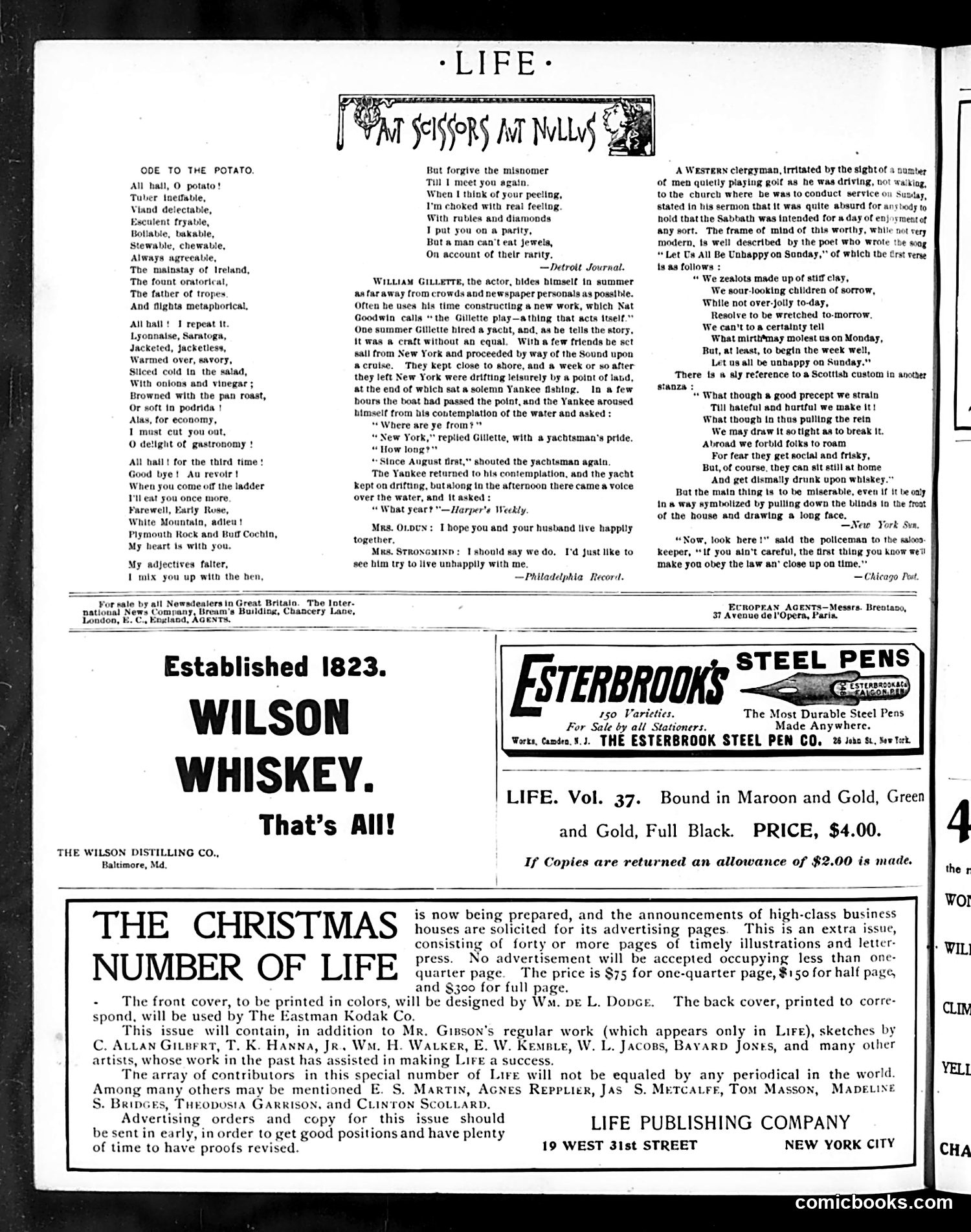
This page primarily contains **humorous poetry and anecdotes** rather than political cartoons. The main content includes: 1. **"Ode to the Potato"** — A mock-heroic poem celebrating the potato in all its culinary forms, ending with a wistful farewell as the author must "cut you out" for economic reasons. This satirizes both flowery Victorian verse and Irish dependence on the potato as a staple food. 2. **Anecdotes about actor William Gillette and others** — Brief humorous stories including a Yankee fisherman's deadpan response to a yacht's arrival ("What year?"), poking fun at rural skepticism toward urban pretension. 3. **Commentary on Sabbath observance** — A satirical poem criticizing religious zealots who insist on gloominess on Sundays, mocking their joyless interpretation of religious duty. The page reflects late-19th/early-20th-century American humor: gentle social satire, class commentary, and mockery of both rural simplicity and urban affectation.
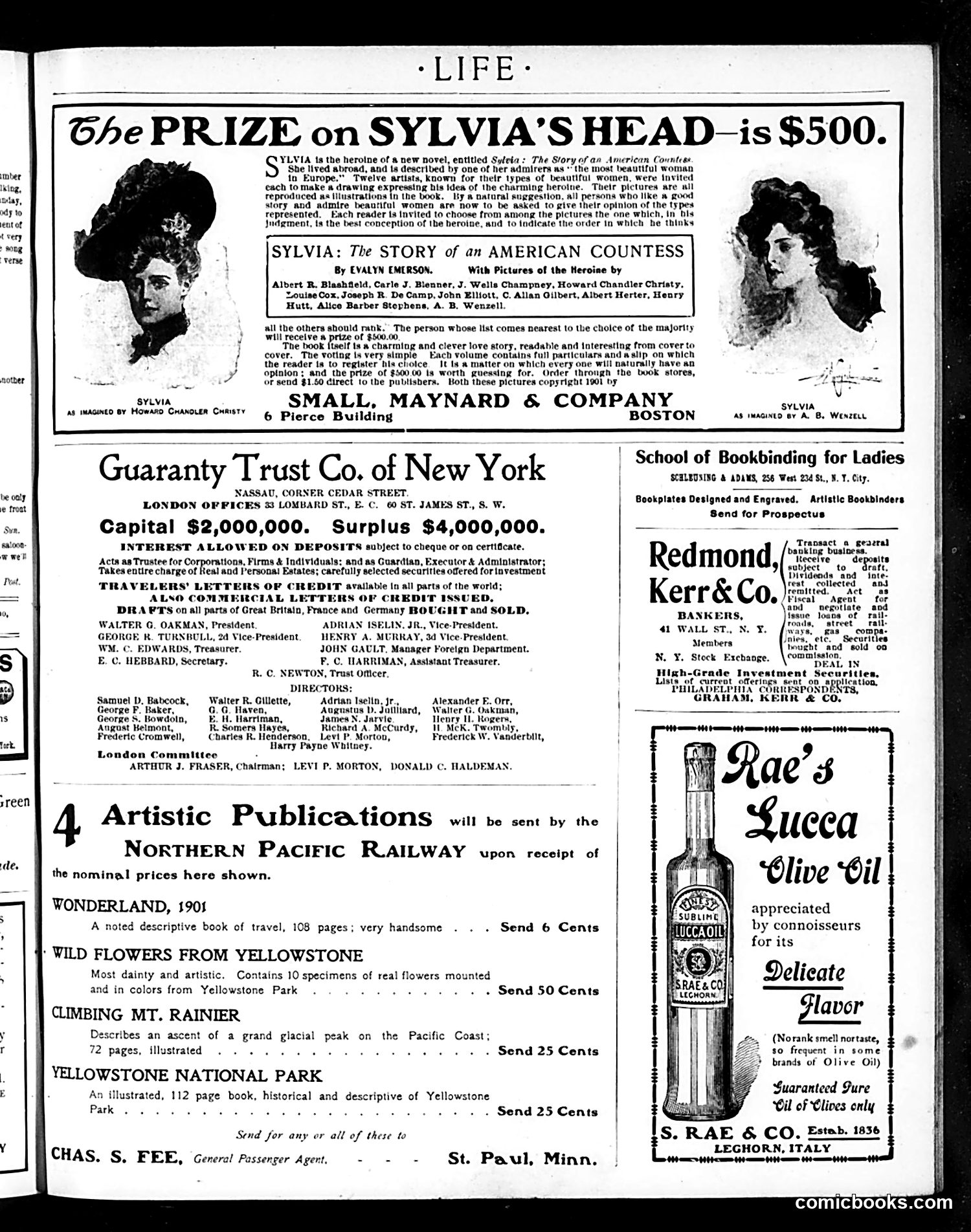
This page advertises a prize contest for novelist Evalyn Emerson's new book "Sylvia: The Story of an American Countess." Twelve prominent illustrators—including Howard Chandler Christy and Albert Herter—each drew their interpretation of the beautiful female protagonist. Readers who purchase the book receive a ballot allowing them to vote on which artist's depiction best captures "Sylvia." The person whose ranking comes closest to the majority vote wins $500. This is essentially a marketing gimmick combining popular fiction, artistic competition, and reader engagement—a clever early 1900s promotional tool targeting audiences who enjoyed both romantic novels and beautiful women's portraiture. The contest incentivizes book sales by inviting consumers to participate as judges of aesthetic merit.
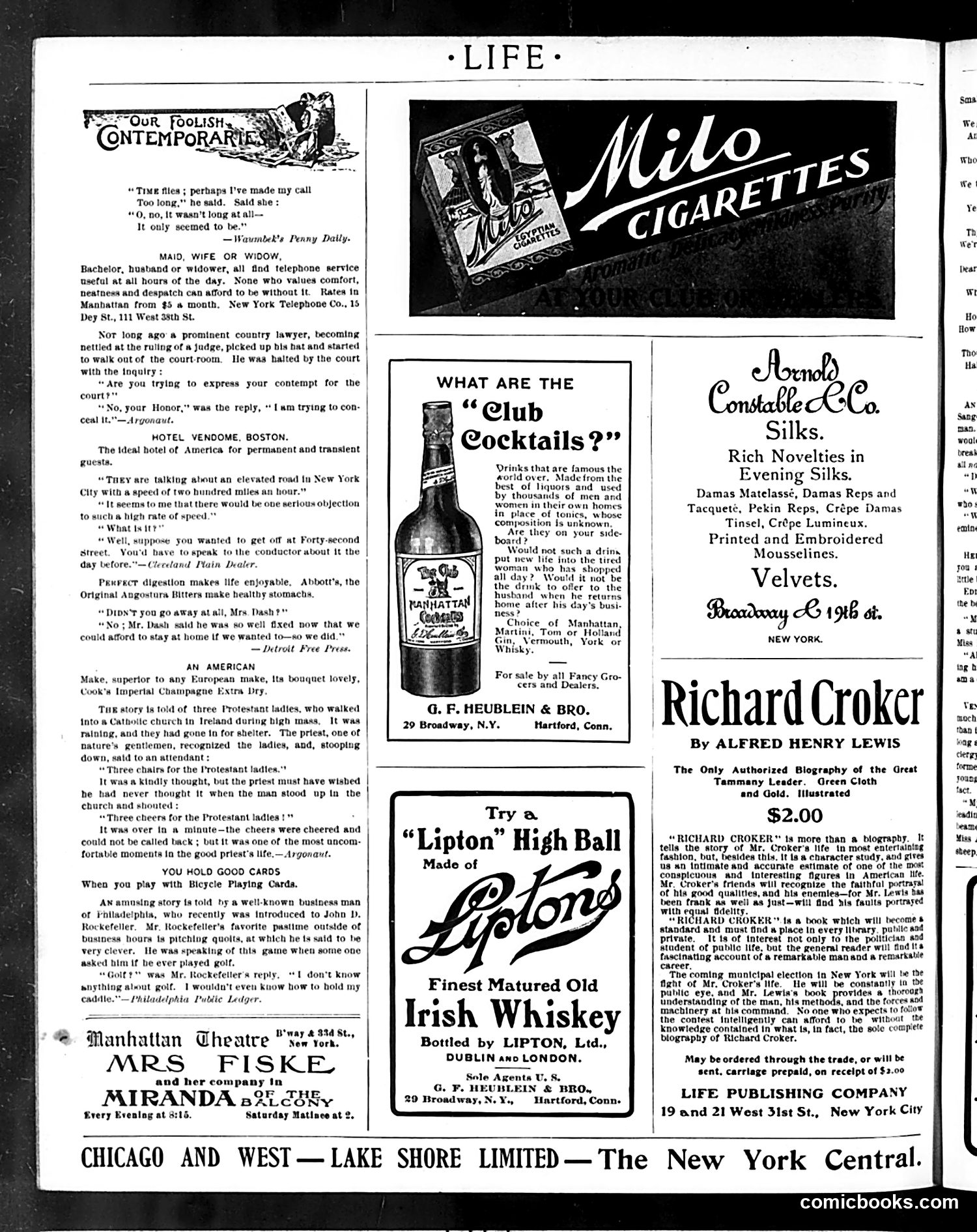
This page from *Life* magazine contains several brief satirical jokes mocking everyday social situations and human nature. The main cartoon section, "Our Foolish Contemporaries," presents short humorous anecdotes: 1. **The telephone call joke**: A woman reassures a man his visit wasn't too long, though it "seemed to be"—poking fun at social awkwardness and insincere politeness. 2. **The lawyer and judge**: A country lawyer tries to hide (rather than express) contempt for a judge's ruling—satirizing legal decorum and suppressed frustration. 3. **The elevated train**: A joke about a proposed 200-mph train to New York, mocking the impracticality of such speed for urban stops. 4. **The Protestant ladies**: An anecdote about a priest's well-intentioned gesture toward visiting Protestant women during Catholic mass that backfires when shouted aloud—satirizing religious tension and awkward charity in early-20th-century America. The page also contains period advertisements for whiskey, cigarettes, and theater productions, typical of *Life*'s mixed editorial-advertising format.
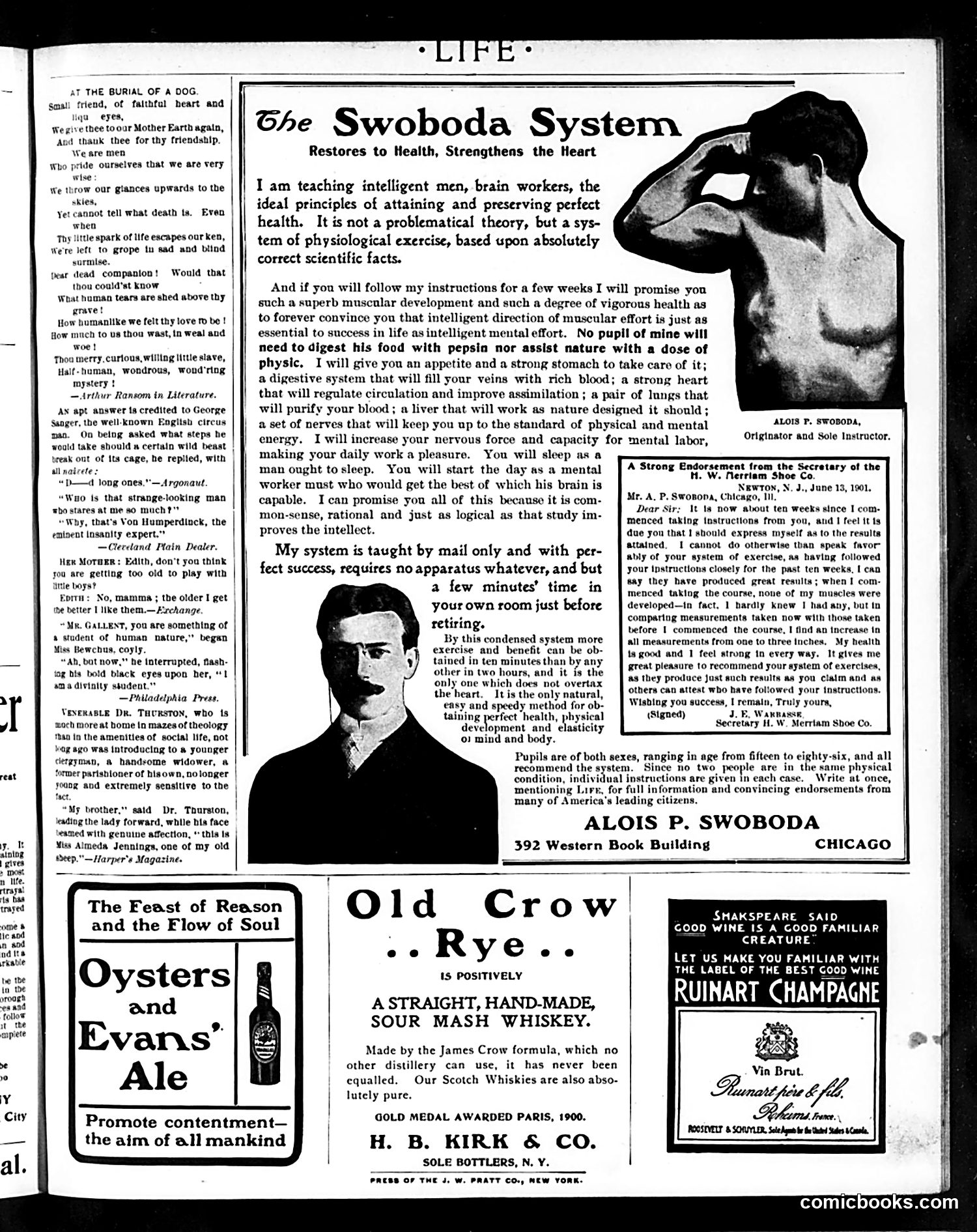
This page is primarily **advertising** rather than editorial satire. The dominant feature is a large advertisement for the **Swoboda System**, a mail-order physical fitness and health program offered by Alois P. Swoboda from Chicago. The Swoboda ad represents **turn-of-the-century pseudoscientific health marketing**—promising muscular development, perfect digestion, strong heart, and mental vigor through a mysterious "system" requiring only "a few minutes' time" in one's room before bed. The vague language ("absolutely correct scientific facts," "common-sense, rational") and testimonial from a shoe company secretary typify dubious wellness schemes of the era. The page also contains lighter content: a sentimental poem about burying a dog, humorous short quips, and advertisements for Evans' Ale and Old Crow Rye whiskey. For modern readers, this illustrates how early 1900s publications freely promoted health claims we'd now consider snake oil—with no regulatory oversight protecting consumers from exaggerated promises.
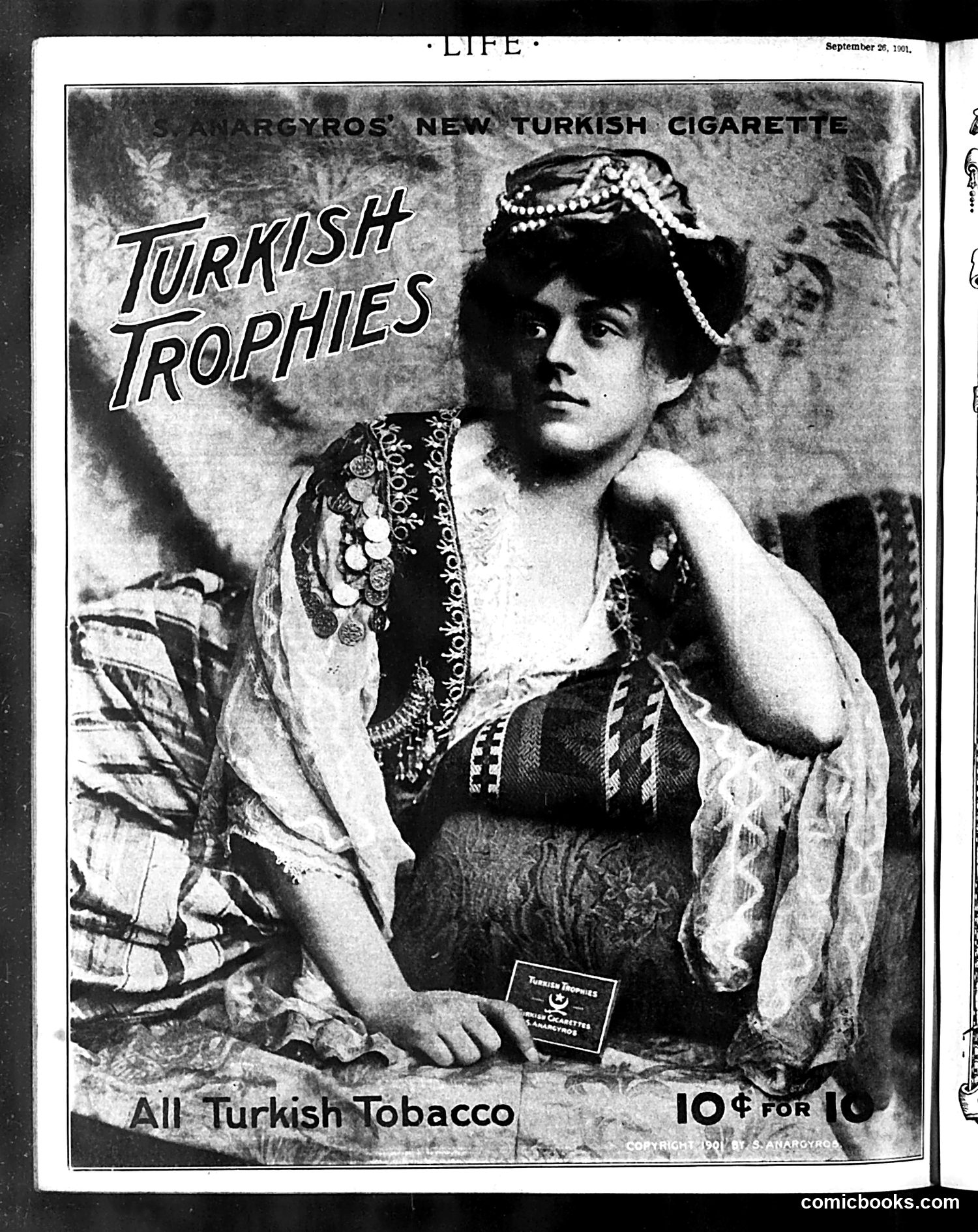
This is an advertisement for Anargyros' Turkish Trophies cigarettes, dated September 29, 1901. The ad features a woman in elaborate Turkish costume—including a decorative headpiece, embroidered vest, and flowing fabrics—posed dramatically. The "Turkish Trophies" branding plays on early 20th-century Western fascination with "Oriental" exoticism. The woman represents an idealized, romanticized vision of Turkish femininity meant to appeal to American smokers. The imagery exploits Orientalist stereotypes common in that era. The price ("10¢ for 10") and emphasis on "All Turkish Tobacco" suggest the product's appeal relied partly on exotic marketing rather than superior quality. This reflects how cigarette companies used ethnic and gendered imagery to attract consumers—a marketing strategy that would be considered inappropriate today.