
Life, 1901-09-26 · page 12 of 20
Life — September 26, 1901 — page 12: what you’re looking at
What you’re looking at
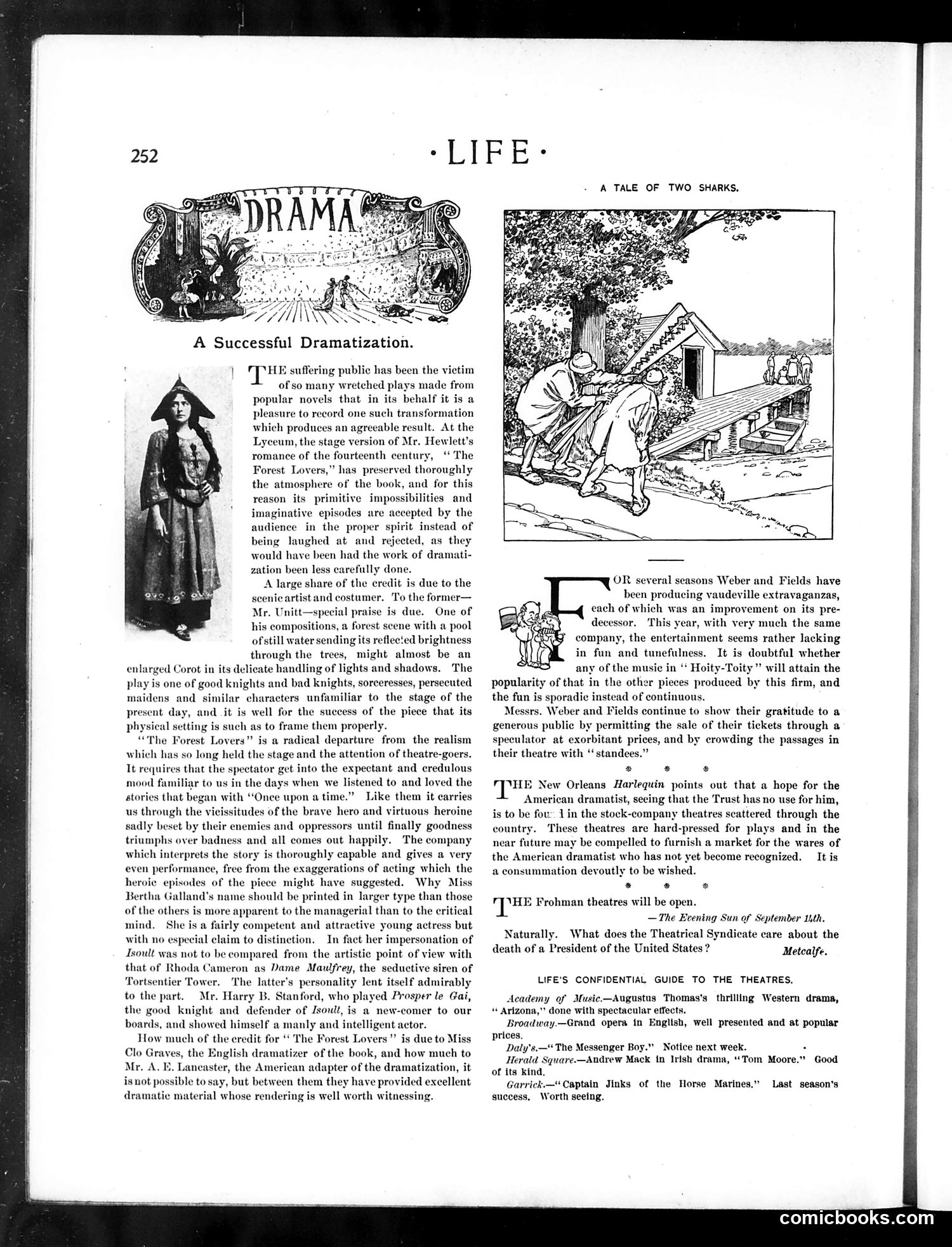
This page discusses theatrical adaptations of popular novels, focusing on "The Forest Lovers," a 14th-century romance. The text praises the dramatization for preserving the book's atmosphere while making it stage-appropriate through careful adaptation. The left column features a photograph of an actress (likely Miss Bertha Galland, mentioned in the text) in costume as a character from the play. The right side includes "A Tale of Two Sharks"—an illustration showing two men examining or working on what appears to be a boat or structure. This appears to be satirizing theatrical producers Weber and Fields, who are criticized for repeatedly producing similar vaudeville shows, with the "sharks" metaphor suggesting they're exploiting audiences' patience and wallets through formulaic entertainment.
📄 Transcribed text from this page (OCR, searchable)
Machine-transcribed from the original scan — historical spelling and the odd misread are preserved.
1 T HE suffering public has been the victim of so many wretched plays made from popular novels that in its behalf it is a pleasure to record one such transformation which produces an agreeable result. At the Lyceum, the stage version of Mr. Hewlett’s romance of the fourteenth century, “ The Forest Lovers,” has preserved thoroughly the atmosphere of the book, and for this reason its primitive impossibilities and imaginative episodes are accepted by the audience in the proper spirit instead of being laughed at and rejected, as they would e been had the work of dramati- zation been less carefully done. ‘A large share of the eredit is due to the scenicartist and costumer. ‘To the former— Mr. Unitt—special praise is due. One of his compositions, a forest scene with a pool of still water sending its reflected brightness through the trees, might almost be an enlarged Corot in its delicate handling of lights and shadows. The play is one of good knights and bad knights, sorceresses, persecuted maidens and similar characters unfamiliar to the stage of the present day, and it is well for the success of the piece that its physical setting is such as to frame them properly. “The Forest Lovers” is a radical departure from the realism which has so long held the stage and the attention of theatre-goers. It requires that the spectator get into the expectant and credulous mood familiar to us in the days when we listened to and loved the stories that began with “Once upon atime.” Like them it carries us through the vicissitudes of the brave hero and virtuous heroine sadly beset by their enemies and oppressors until finally goodness triumphs over badness and all comes out happily. The company which interprets the story is thoroughly capable and gives a very even performance, free from the exaggerations of acting which the heroie episodes of the piece might have suggested. Why Miss Bertha Galland’s name should be printed in larger type than those of the othe: more apparent to the managerial than to the critical mind. She is a fairly competent and attractive young actress but with no especial claim to distinction. In fact her impersonation of Jsoult was not to be compared from the artistie point of view with that of Rhoda Cameron as Dame Maulfrey, the seductive siren of Tortsentier Tower. The latter's personality lent itself admirably to the part. Mr. Harry B. Stanford, who played Prosper le Gai, the good knight and defender of Jsowl, is a ne’ mer to our boards, and showed himself a manly and intelligent actor. How much of the credit for ‘‘ The Forest Lovers” is due to Miss Clo Graves, the English dramatizer of the book, and how much to Mr. A. E, Lancaster, the Ameriean adapter of the dramatization, it say, but between them they have provided excellent OR several seasons Weber and Fields have been producing vaudeville extravaganzas, each of which was an improvement on its pre- decessor. Thi , With very much the same company, the entertainment seems rather lacking in fun and tunefulness. It is doubtful whether any of the music in “‘ Hoity-Toity ” will attain the popularity of that in the other pieces produced by this firm, and the fun is sporadic instead of continuous. Messrs. Weber and Fields continue to show their gratitude to a generous public by permitting the sale of their tickets through a speculator at exorbitant prices, and by crowding the passages in their theatre with ‘‘standees.” * * * HE New Orleans Harlequin points out that a hope for the American dramatist, seeing that the Trust has no use for him, is to be fow 1 in the stock-company theatres scattered through the These theatres are hard-pressed for plays and in the h a market for the wares of It is country. near future may be compelled to furn the American dramatist who has not yet become recognized. a consummation devoutly to be wished. * 8 28 [HE Frohman theatres will be open. —The Evening Sun of September tth. Naturally. What does the Theatrical Syndicate care about the death of a President of the United States ? Metcalfe, LIFE'S CONFIDENTIAL GUIDE TO THE THEATRES. Academy of Music.—Augustus Thomas's thrilling Western drama, “ arizona,” done with spectacular effects. Broadway.—Grand opera in English, well presented and at popular —“The Messenger Boy.” Notice next week. : uare.—Andrew Mack in Irish drama, “Tom Moore.” Good “Captain Jinks of the Horse Marines.” Last season's success, Worth seeing. comicbooks.com