
A complete issue · 20 pages · 1901
Life — June 13, 1901
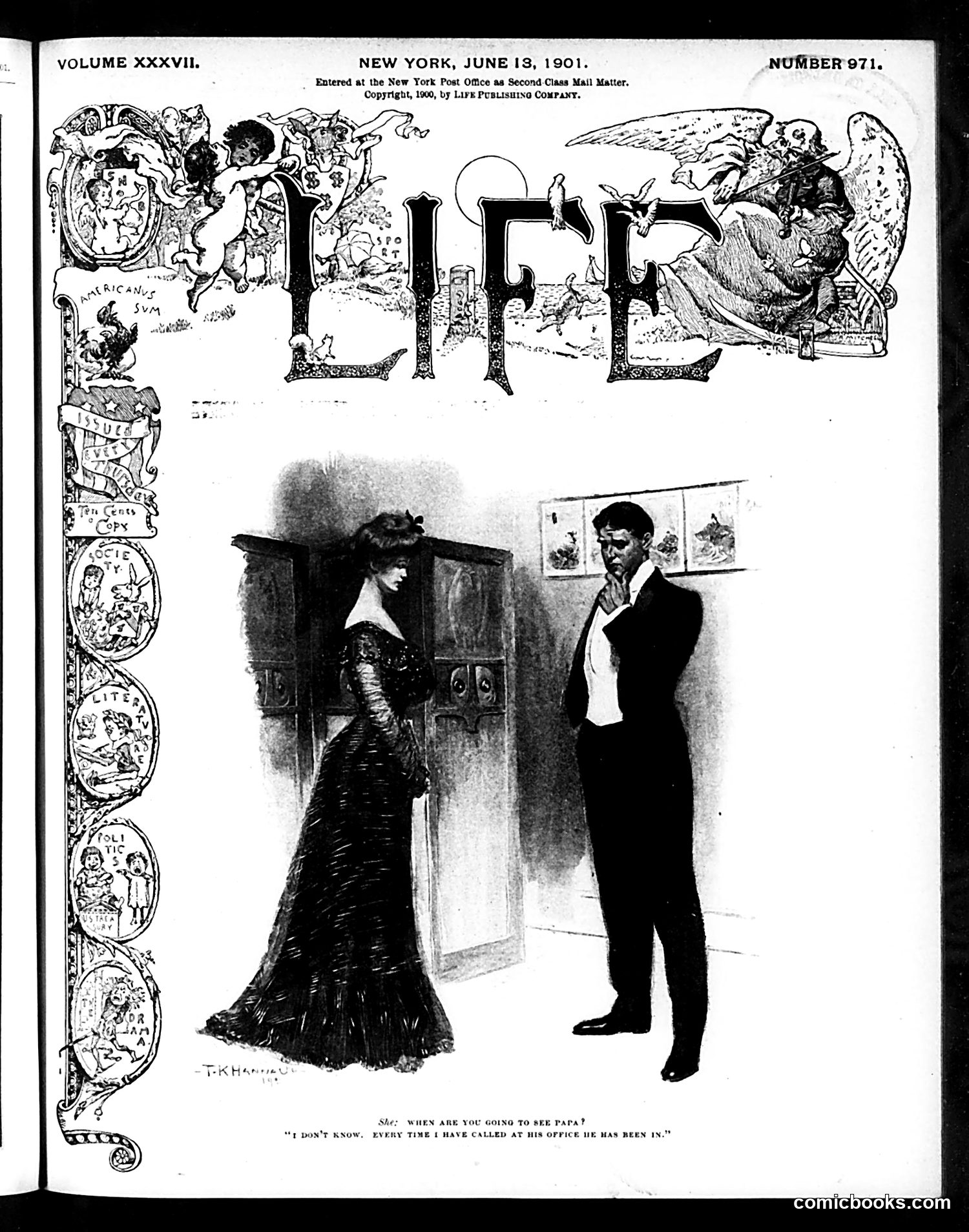
This page features a single cartoon by T.K. Hanna depicting a domestic scene. A woman in an elegant black evening gown stands near a doorway while a man in formal attire (tuxedo) stands at a distance, appearing somewhat awkward or defensive. The caption reads: "She: 'When are you going to see papa? Every time I have called at his office he has been in.'" The joke targets a husband avoiding his father-in-law. The woman is pointedly noting that her father is always at his office when she visits—implying the husband is deliberately avoiding him by not calling. This reflects early 1900s social expectations about family visits and the humorous domestic tension between spouses regarding in-laws.
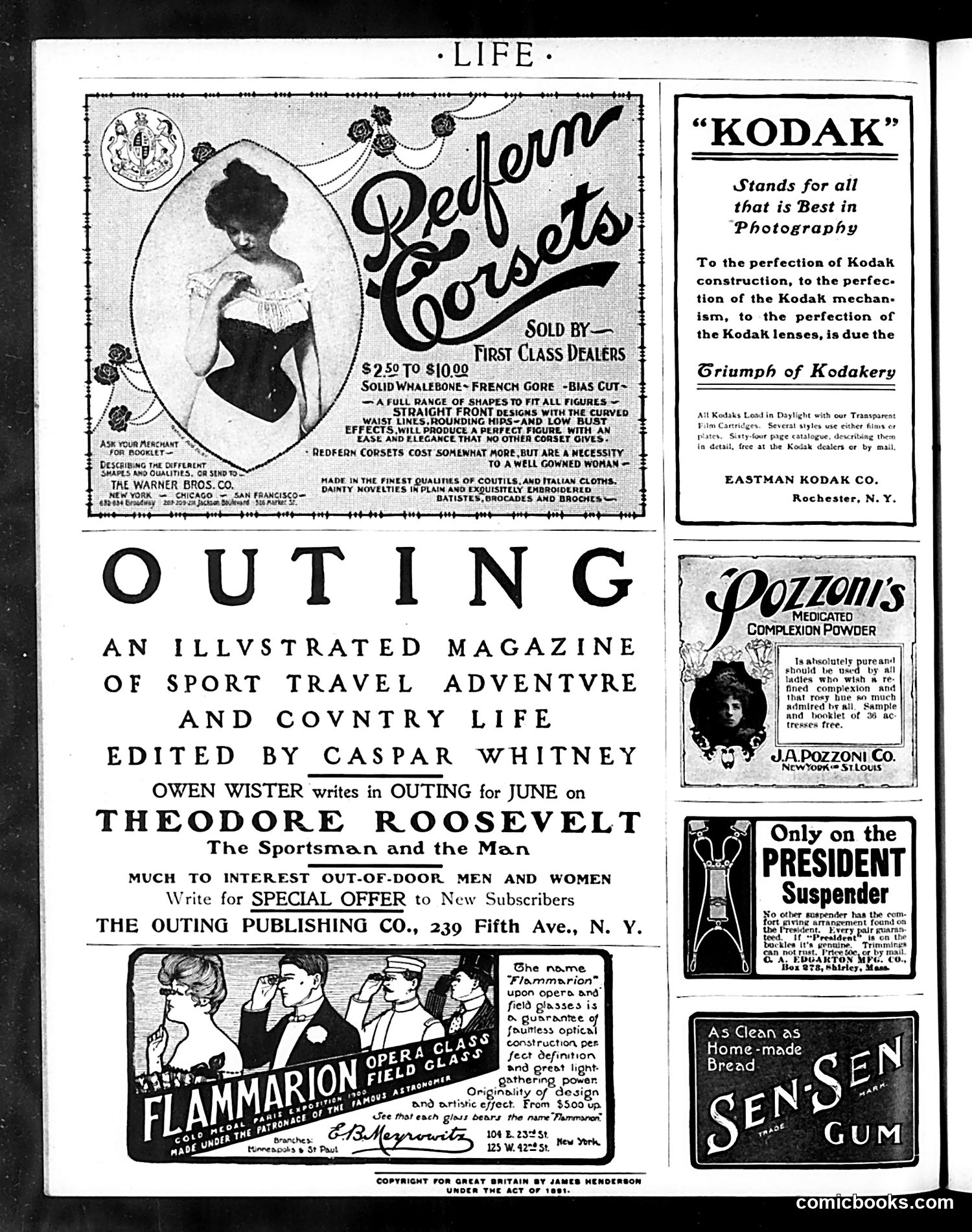
This page is primarily **advertising**, not satirical content. The top features a Redfern Corsets ad with a woman in Victorian dress, emphasizing figure-shaping garments. Side advertisements promote Kodak cameras, Pozzoni's complexion powder, a "President Suspender," and Sen-Sen gum. The main editorial content announces *Outing* magazine, edited by Caspar Whitney, featuring an article by Owen Wister about **Theodore Roosevelt** titled "The Sportsman and the Man." This appears to be promoting Roosevelt's outdoors/hunting credentials during his presidency or public life. A Flammarion Opera Glass advertisement at bottom shows fashionably dressed people at what appears to be a theater or social event. The page reflects early 1900s consumer culture and Roosevelt's popular image as a robust outdoorsman.
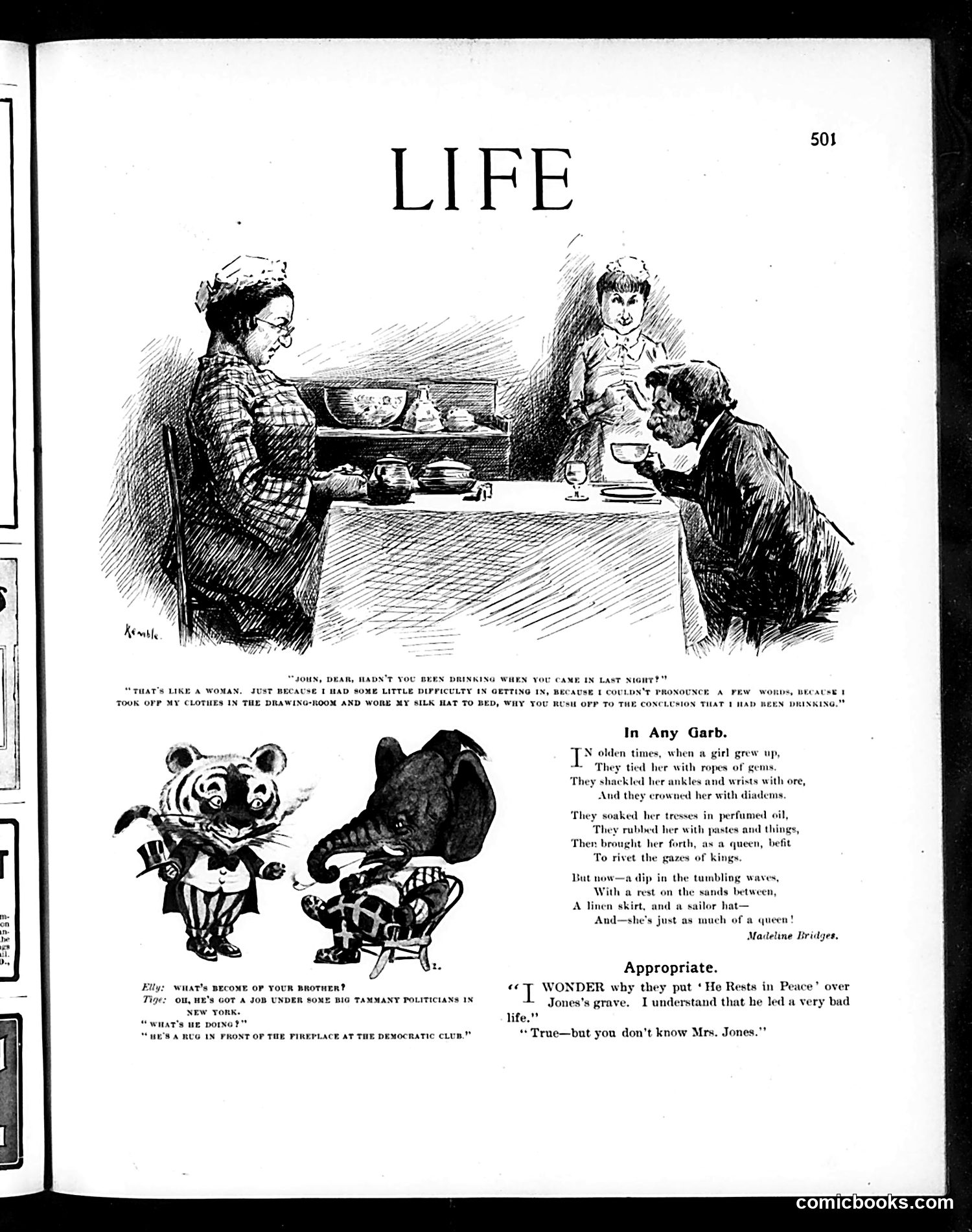
The top cartoon satirizes domestic marital dynamics. A woman serves dinner while her husband complains about her drinking the previous night—yet his monologue reveals his own hypocrisy: he undressed in the drawing room, wore his hat to bed, and rushed to conclusions. The satire targets the double standard where men criticize women's behavior while excusing their own misconduct. The animal cartoon below appears to reference New York politicians, with one character noting another "got a job under some big Tammany politicians." This likely references Tammany Hall, the notoriously corrupt Democratic political machine controlling New York City politics. The "In Any Garb" poem and "Appropriate" anecdote continue themes of social hypocrisy and ironic commentary on contemporary life.
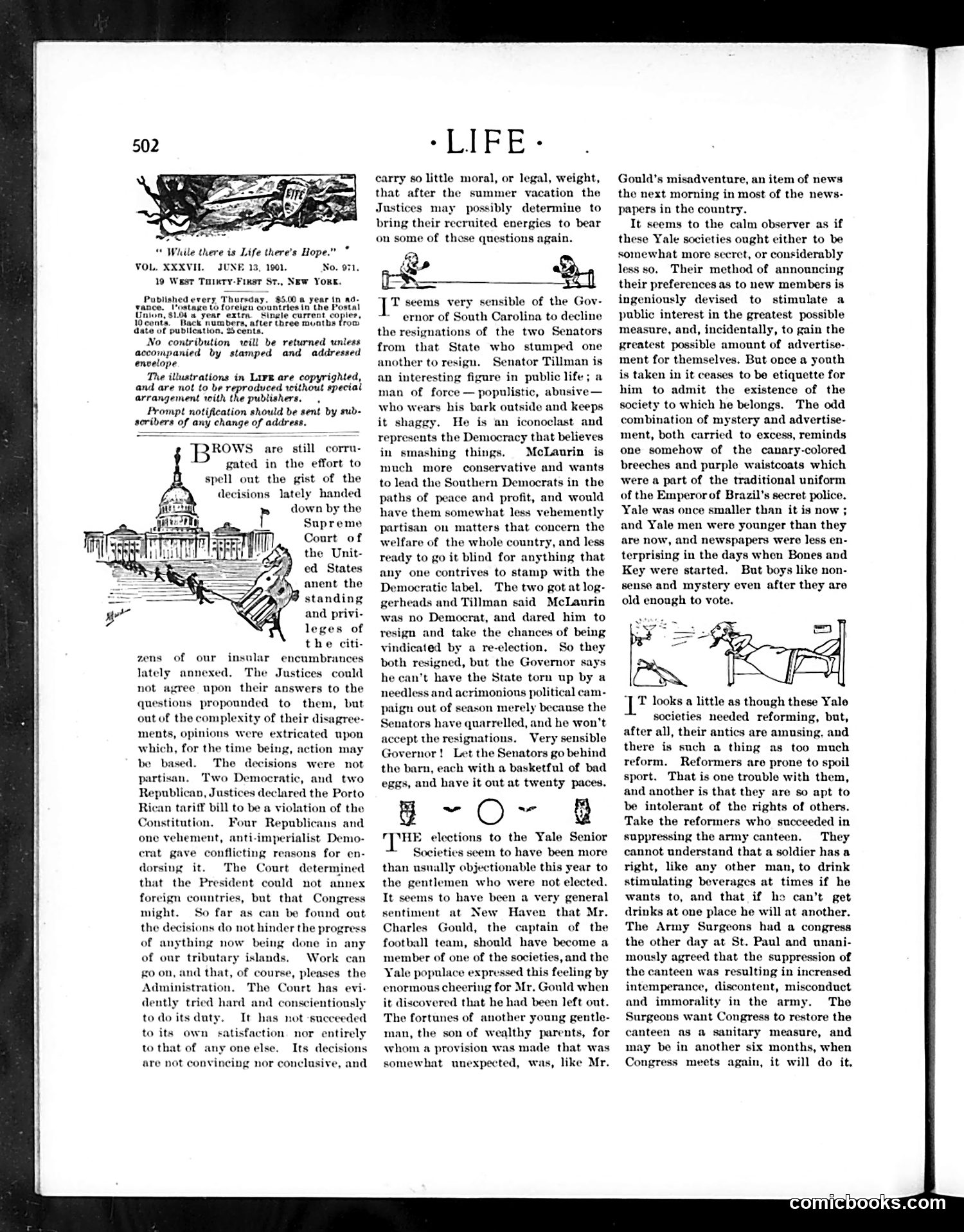
This page contains political commentary rather than comics. The main illustration shows the U.S. Capitol building, accompanying discussion of a Supreme Court decision regarding Puerto Rico's constitutional status and Congressional powers over insular territories. The text discusses South Carolina senators (likely referencing Senator Tillman), contrasting Democratic and Republican approaches to governance. It also covers Yale Senior Society elections, specifically mentioning Charles Gould's omission from a society despite his football captaincy—presented as absurdly controversial. The final section addresses Army surgeon concerns about soldier alcohol consumption, advocating Congressional action on "intemperance, discontent, misconduct and immorality." The satire targets both political hypocrisy and social reformers' inconsistent priorities—criticizing excessive focus on minor issues while serious matters are neglected.
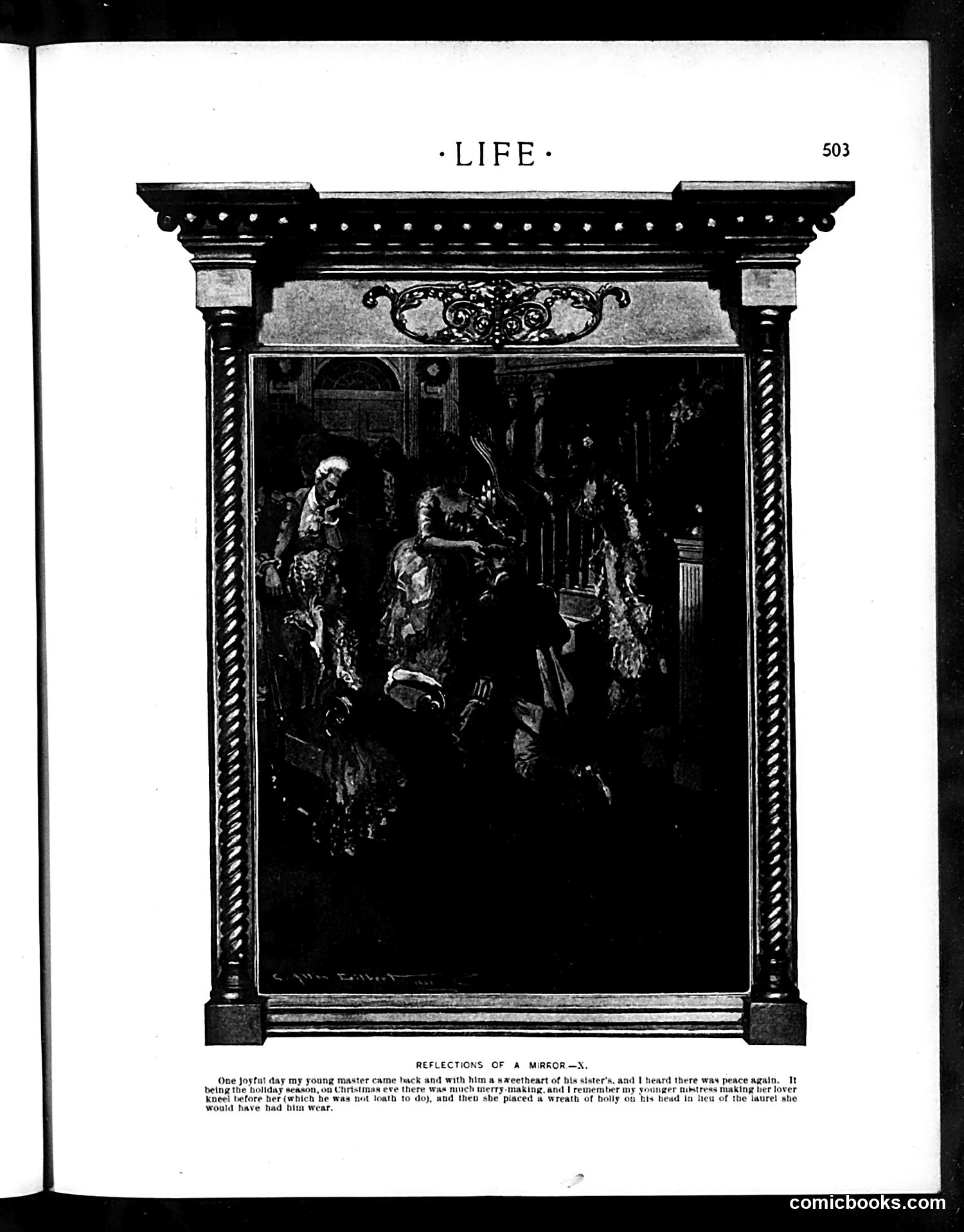
This illustration depicts a domestic holiday scene, likely Christmas Eve based on the caption's reference. The artwork shows a young master returning home with a sweetheart and his sister. According to the text, upon his arrival, the household staff (including servants) welcome him back, placing a wreath of holly on his head in celebration. The satire appears gentle and sentimental rather than sharp political commentary. The "mirror" framing device suggests the image reflects common Victorian-era Christmas traditions and domestic rituals—the joy of homecoming, family reunions, and servant participation in holiday festivities. The dark artistic rendering emphasizes the warm, intimate nature of these domestic moments. This represents Life magazine's frequent turn toward heartfelt social observation rather than biting satire.
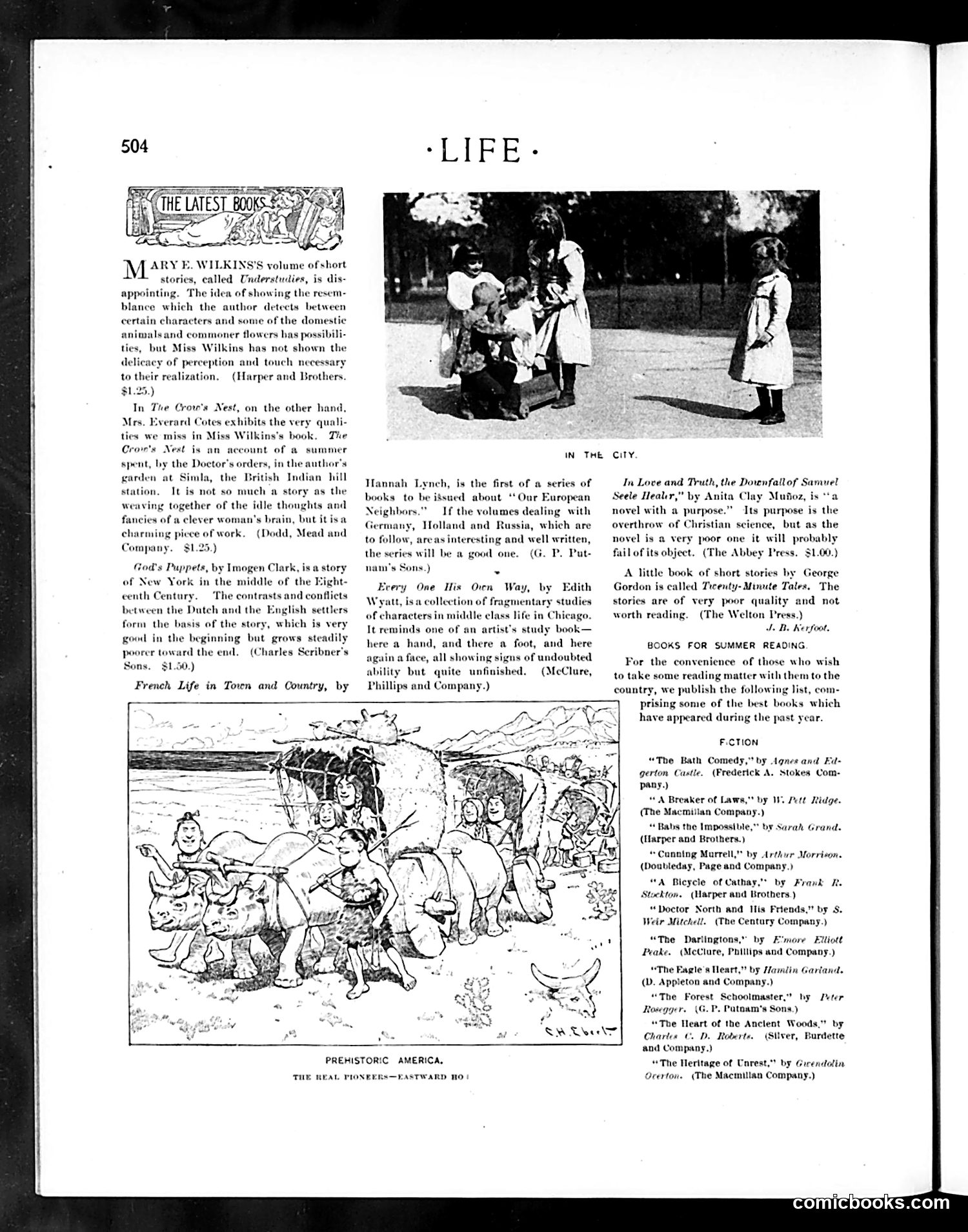
This page is primarily a **book review section** rather than political satire. It discusses new publications including Mary E. Wilkins's short story collection *Understudies*, Mrs. Everard Cotes's *The Crow's Nest*, and works by Imogen Clark and Edith Wharton. The main illustration, captioned "Prehistoric America: The Real Pioneers—Eastward Ho," depicts **cavemen or prehistoric figures** in a humorous scene, likely satirizing westward expansion by presenting primitive ancestors as "pioneers." This is a lighthearted visual pun rather than sharp political commentary. The page concludes with a **"Books for Summer Reading"** list featuring fiction titles from various publishers. Overall, this is a cultural/literary review page with gentle humor rather than pointed satire.
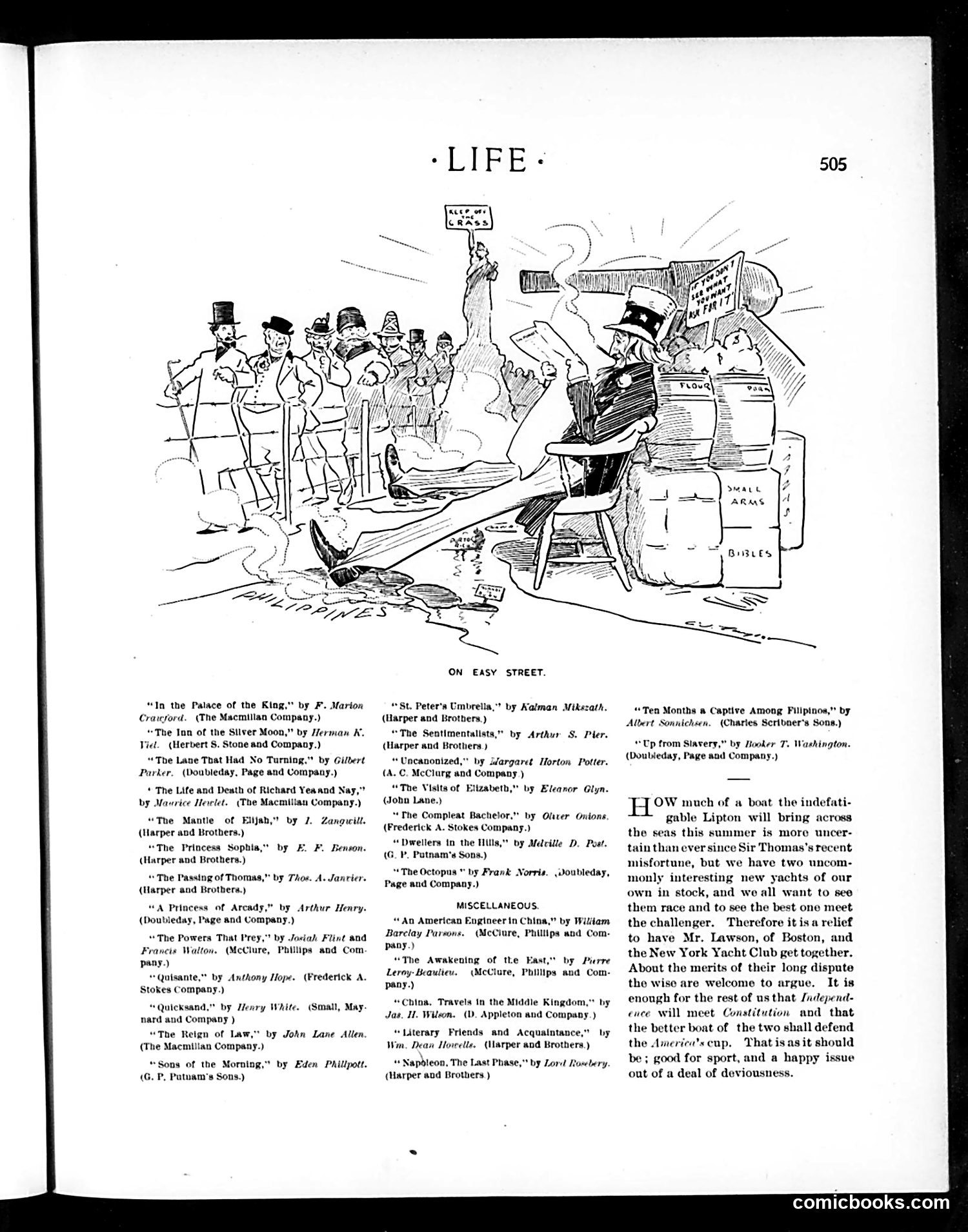
This political cartoon satirizes wealth inequality and corporate power during the Gilded Age. The image depicts a stark contrast: on the left, well-dressed gentlemen in top hats stand on solid ground, while on the right, a figure (likely representing labor or the working class) sits precariously on a seesaw balanced over a chasm labeled "Hard Times," surrounded by symbols of corporate control—barrels marked "Small Arms" and "Rifles," suggesting militarized suppression of workers. The title "On Easy Street" is ironic: while the wealthy enjoy comfort, ordinary citizens teeter on economic instability, dependent on corporate goodwill. The militaristic imagery implies threats used against labor movements. The cartoon critiques how capitalists literally held workers' livelihoods in balance.
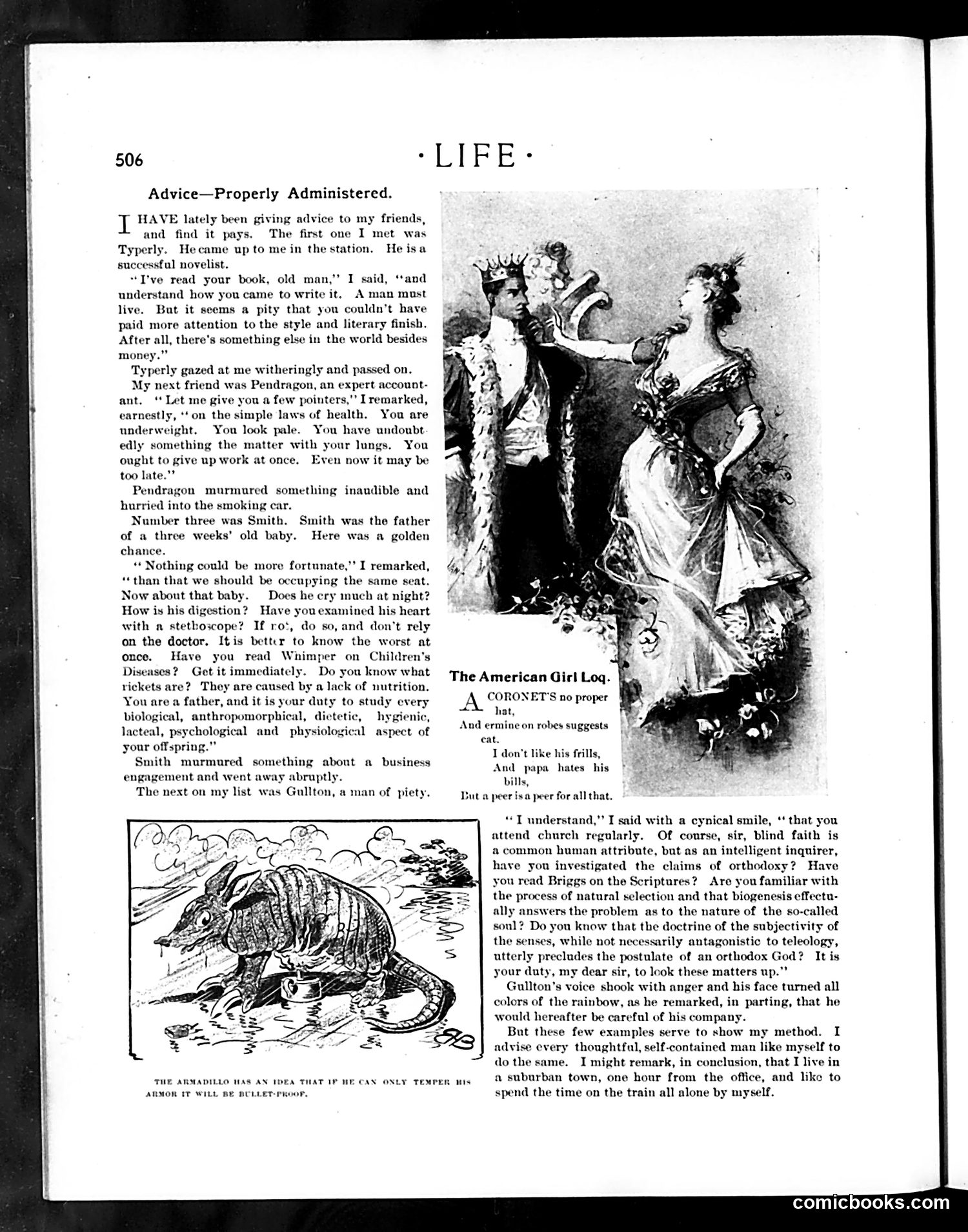
This page contains three distinct pieces: 1. **"Advice—Properly Administered"** (text): A satirical anecdote about the narrator giving unsolicited advice to acquaintances—a novelist, an accountant, and a man of piety—each encounter revealing the absurdity of dispensing lifestyle guidance to strangers on trains. 2. **"The American Girl Loq." (right): A poetic tribute to American girls, celebrating their appearance and charm while gently mocking their social habits (attending church, disliking frills). 3. **Armadillo cartoon** (bottom): Shows an armadillo in defensive posture. The caption jokes that the creature believes it can achieve "bullet-proof" protection by curling into a ball—satirizing false confidence in ineffective defensive strategies. The page exemplifies Life's characteristic blend of social satire and light humor targeting American manners and pretensions.
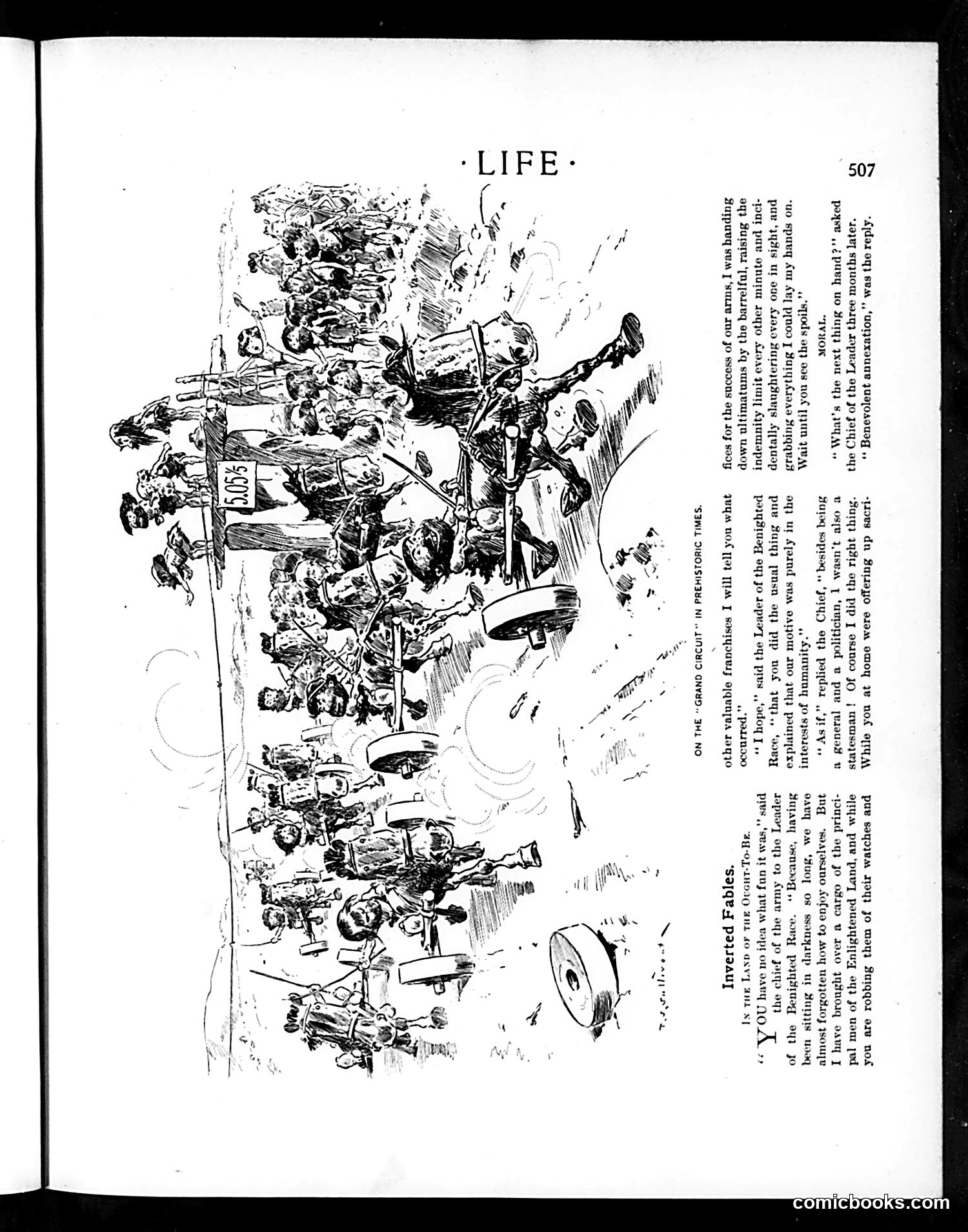
This page contains a satirical illustration titled "Inverted Fables" depicting what appears to be a chaotic circus or carnival scene. The drawing shows numerous figures in absurd situations arranged vertically—people falling, tumbling, and in disarray around various mechanical or structural elements. The accompanying text suggests this is social satire commenting on reversed moral or behavioral outcomes—"inverted" situations where expected consequences are turned upside down. The specific references in the OCR'd text are fragmentary and difficult to parse clearly, but the visual chaos and the fable framework suggest commentary on social disorder or topsy-turvy logic in contemporary society. Without clearer OCR text or visible attribution, the precise political targets remain unclear, though the general approach mocks confused or backwards social conditions.
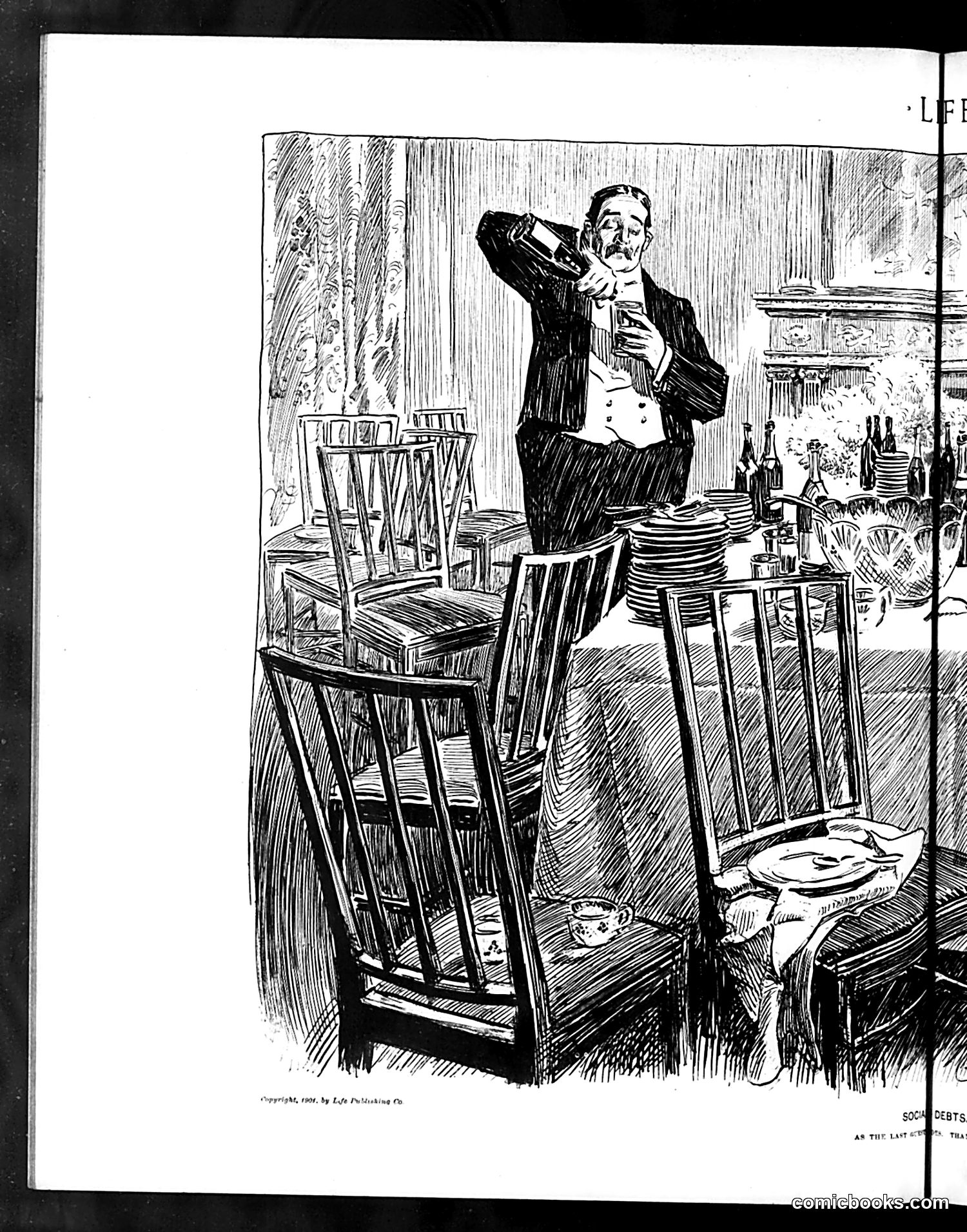
This is a satirical illustration depicting a well-dressed man in formal evening attire (tuxedo with white shirt front) standing among empty chairs at what appears to be a dining table. The setting suggests an elegant dinner or social gathering, with bottles visible in the background and draped curtains. The visible text at bottom references "SOCIAL DEBTS" and "AS THE LAST OF..." (text cut off), indicating this cartoon comments on social obligations and entertaining. The satire likely mocks the pretense or burden of maintaining social standing through formal dinner parties—the numerous empty chairs suggest either the man's difficulty attracting guests or the hollowness of such social rituals. The figure's self-conscious pose reinforces commentary on social performance and the anxieties surrounding entertaining in upper-class society. The specific copyright notice and publication details are partially visible but incomplete.
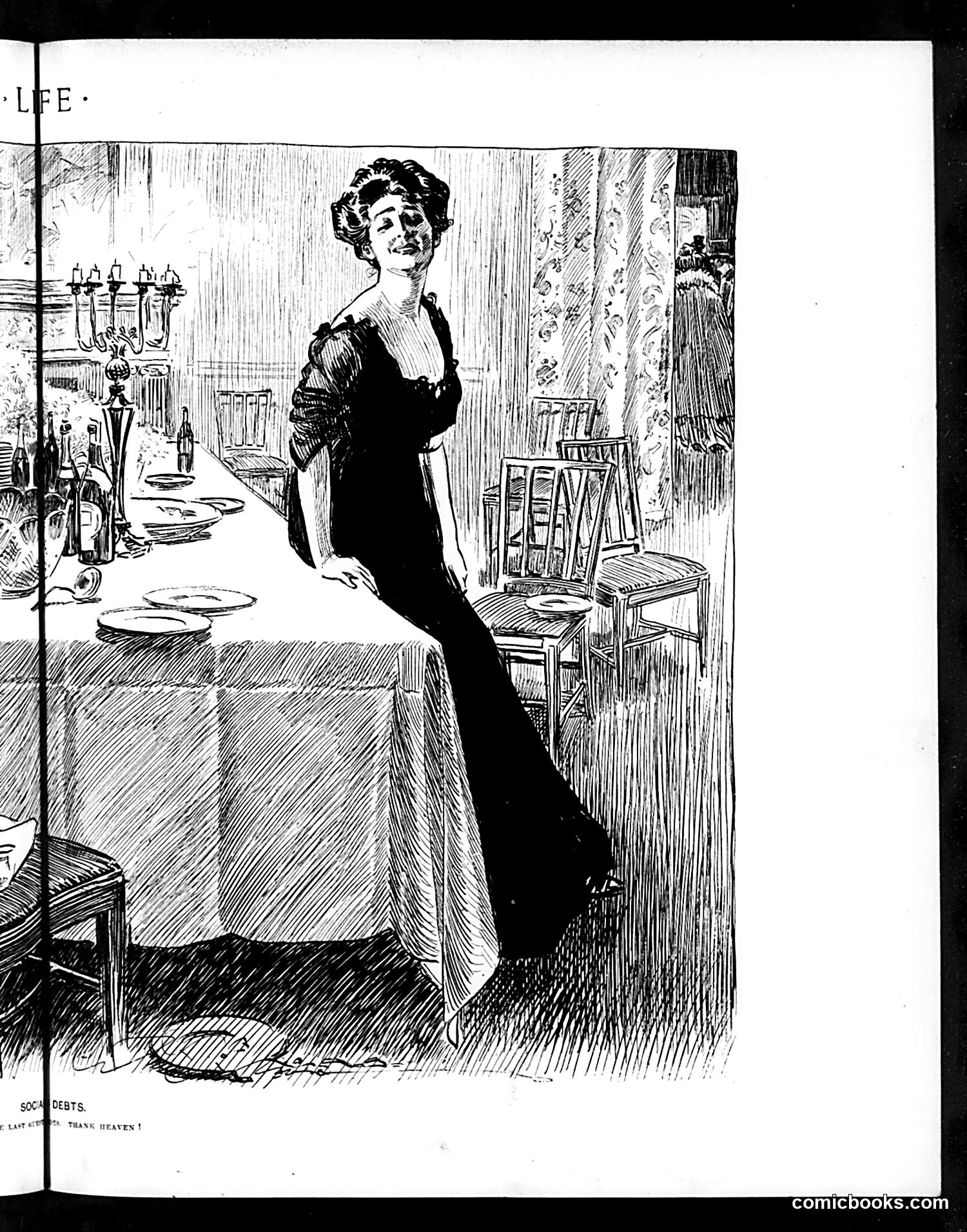
This is a black and white illustration from Life magazine showing an elegantly dressed woman in a formal dining room, standing beside a table set for dinner. The partial text visible at the bottom mentions "SOCIAL DEBTS" and "THANK HEAVENS!" The cartoon appears to satirize upper-class social obligations, specifically the burden of formal entertaining and dinner hosting. The woman's composed but somewhat resigned expression, combined with the caption referencing "social debts" and relief ("Thank Heavens!"), suggests the joke concerns the tiresome nature of maintaining social standing through elaborate dinner parties—a significant obligation for wealthy women of the era. The detailed interior setting emphasizes the formality and labor required for such "social debt" maintenance among the privileged classes.
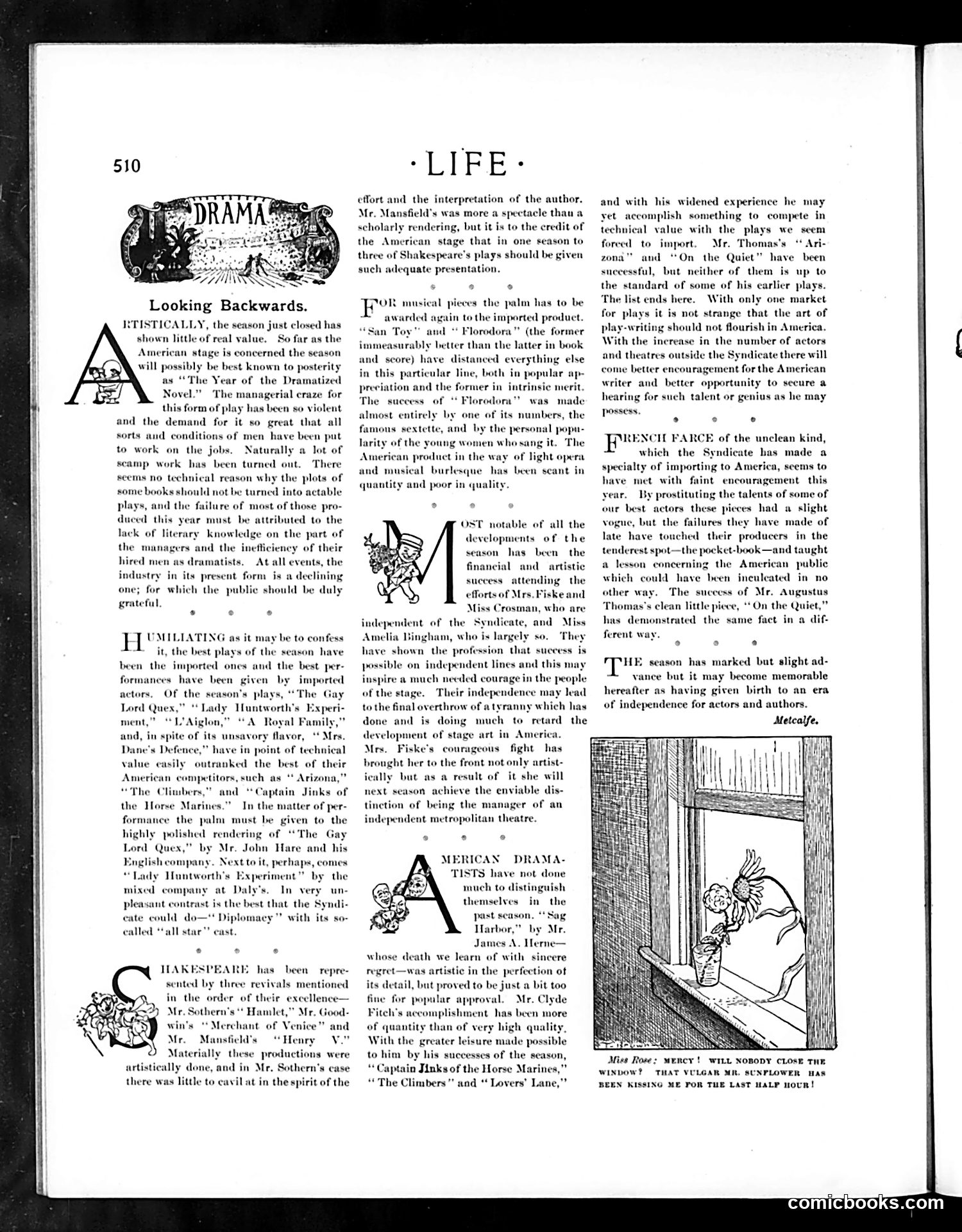
This page is a theater review section titled "Looking Backwards," discussing the dramatic season. The main illustration shows a woman in a bedroom window being kissed by a man—likely depicting a scene from a contemporary play. The text reviews recent theatrical productions, praising imported actors and works like Shakespeare revivals. It critiques American dramatic output as inferior, noting that successful productions often depend on foreign talent or established literary sources rather than original American writing. The cartoon illustrates a romantic/comedic scene typical of period theater—possibly from a farce or light comedy. The review's tone suggests skepticism about American playwrights' ability to create sophisticated original drama, comparing unfavorably to European theatrical traditions.
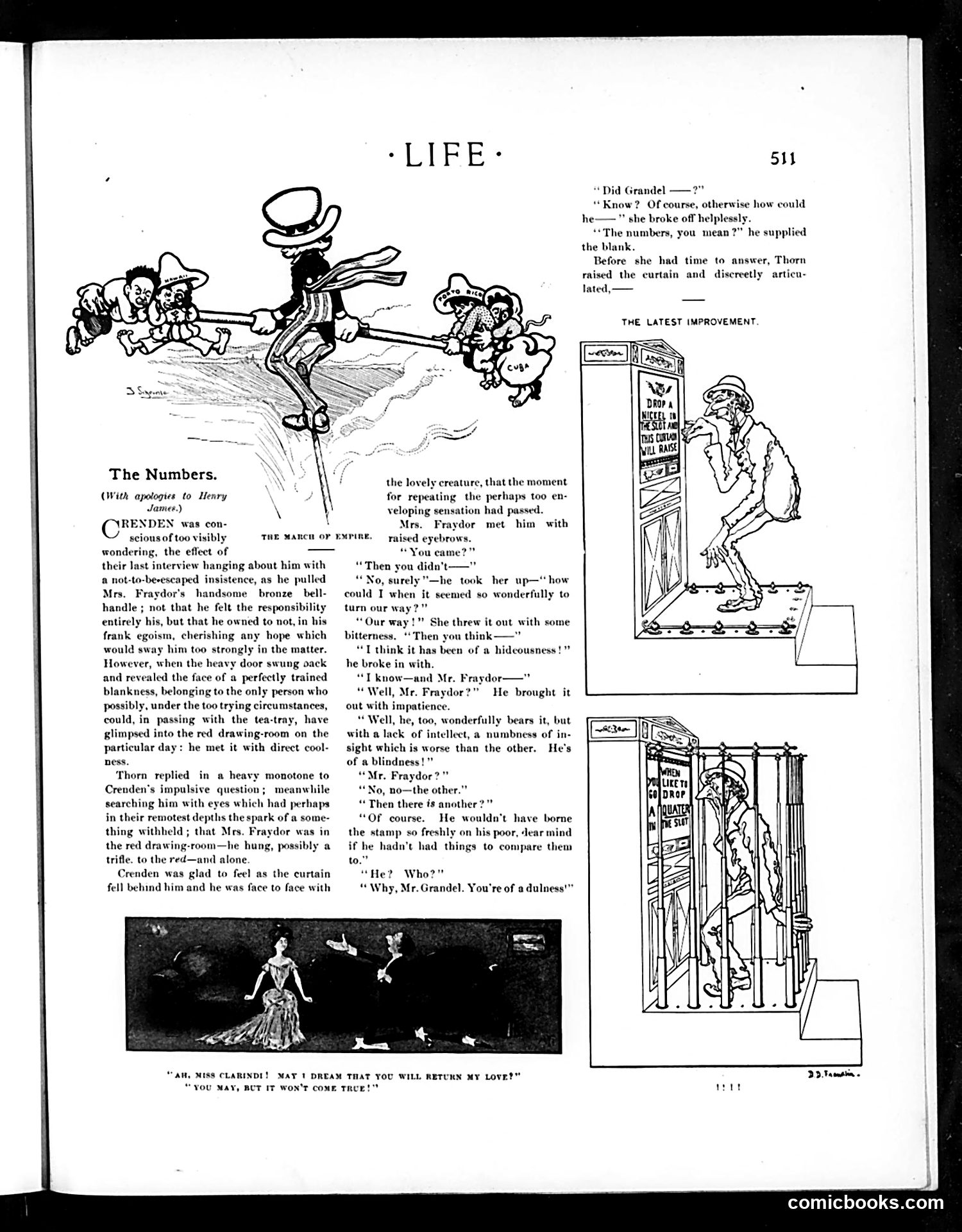
This page contains two distinct satirical pieces: **"The Numbers"** (left): A parody of Henry James's elaborate, psychologically dense prose style. The dense text mockingly imitates James's tortured sentence construction and obsession with characters' internal states and social subtleties. The joke is the overwrought complexity applied to what appears to be an affair involving multiple characters (Crenden, Mrs. Fraydor, Mr. Fraydor, and Mr. Grandel), treating mundane infidelity with pseudo-intellectual pretension. **"The Latest Improvement"** (right): Cartoons showing a woman operating a vending machine or similar device labeled "DROP A NICKEL." The humor appears to satirize modern conveniences and mechanical solutions to everyday problems, rendered absurdist through the woman's exaggerated posture and the machine's comedic prominence. Both pieces mock contemporary American culture—one literary pretension, one mechanical modernity—typical of Life magazine's satirical approach to early 20th-century society.
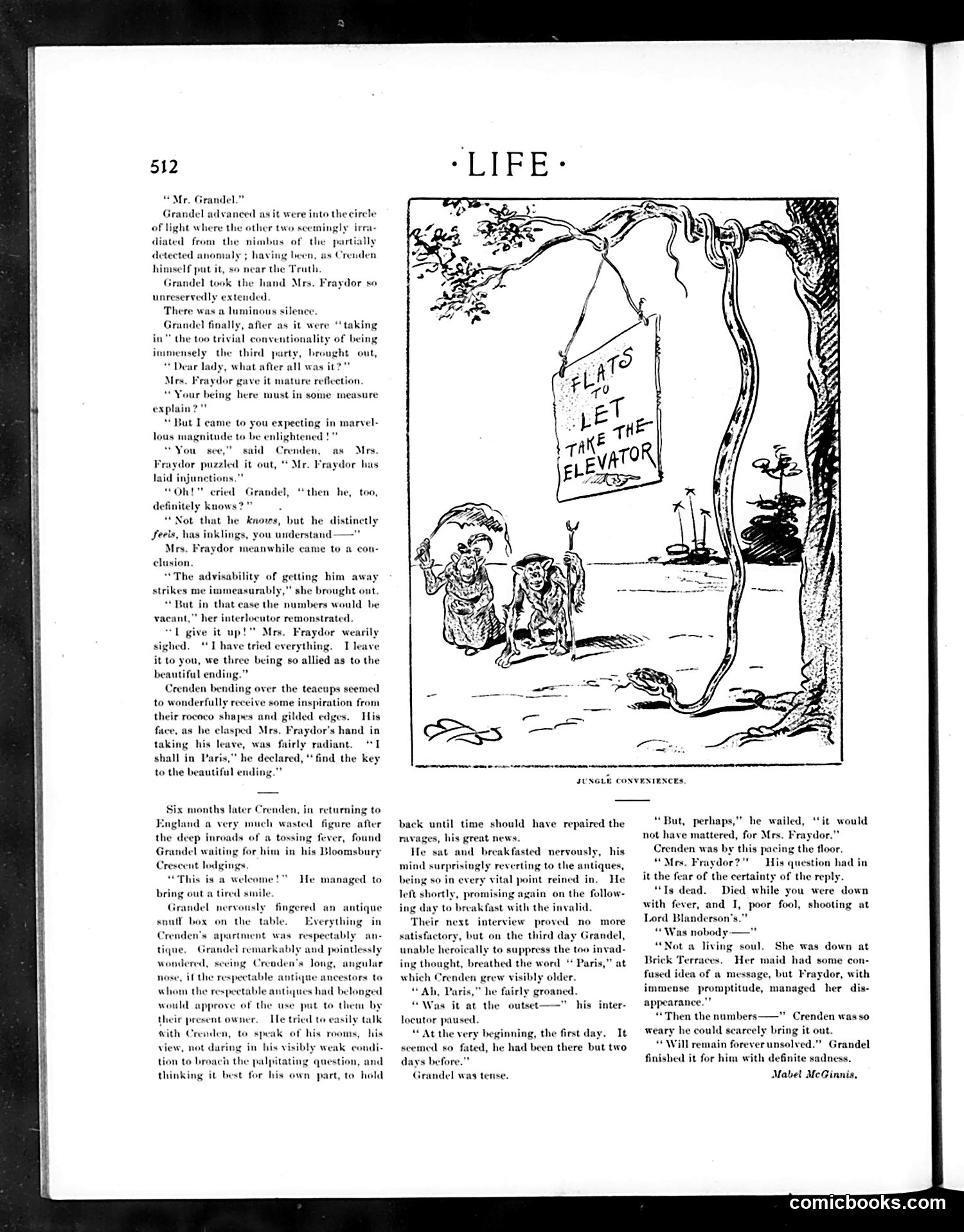
This is a fictional story titled "Mr. Grandel," illustrated with a cartoon showing two figures discovering a sign reading "Flats to Let Take the Elevator." The narrative concerns a woman (Mrs. Fraydor) who invites a man (Crenden) to solve some mysterious "numbers" or puzzle. After she mysteriously dies while Crenden is away with fever, his friend Grandel must inform him that Mrs. Fraydor is dead and the solution remains "forever unsolved." The cartoon's relevance to the text is unclear—it appears to be satirizing urban apartment-hunting or elevator inconveniences rather than directly illustrating the story. The page is primarily **literary fiction** rather than political satire. Without additional context about the story's original publication date or Mrs. Fraydor's identity, the deeper meaning remains obscure. This reads as sentimental melodrama rather than social commentary.
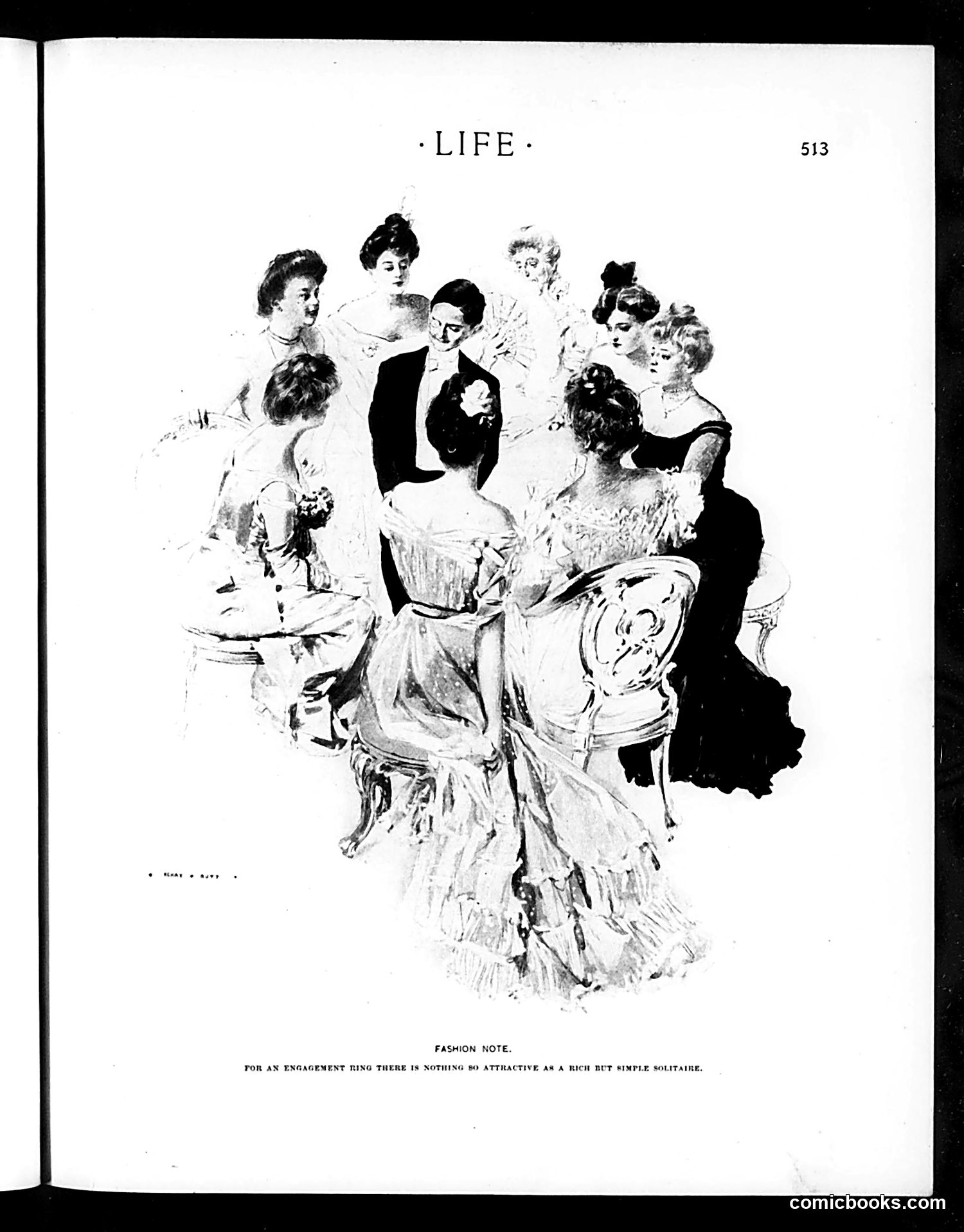
This is a fashion illustration and social commentary from *Life* magazine (page 513). The sketch shows a well-dressed man in dark formal attire surrounded by elegantly dressed women in white gowns and fashionable hats, arranged in an admiring circle around him. The caption satirizes engagement ring conventions by praising "a rich but simple solitaire" as the most attractive choice. The humor lies in the irony: the illustration depicts multiple women fawning over a single man, implying that what's actually "attractive" in winning a husband is displaying wealth—specifically through an expensive diamond solitaire ring. The cartoon mocks both marriage market dynamics and materialistic courtship practices of the era, suggesting women's primary interest in engagement is the visible symbol of a man's financial resources rather than romantic attachment.
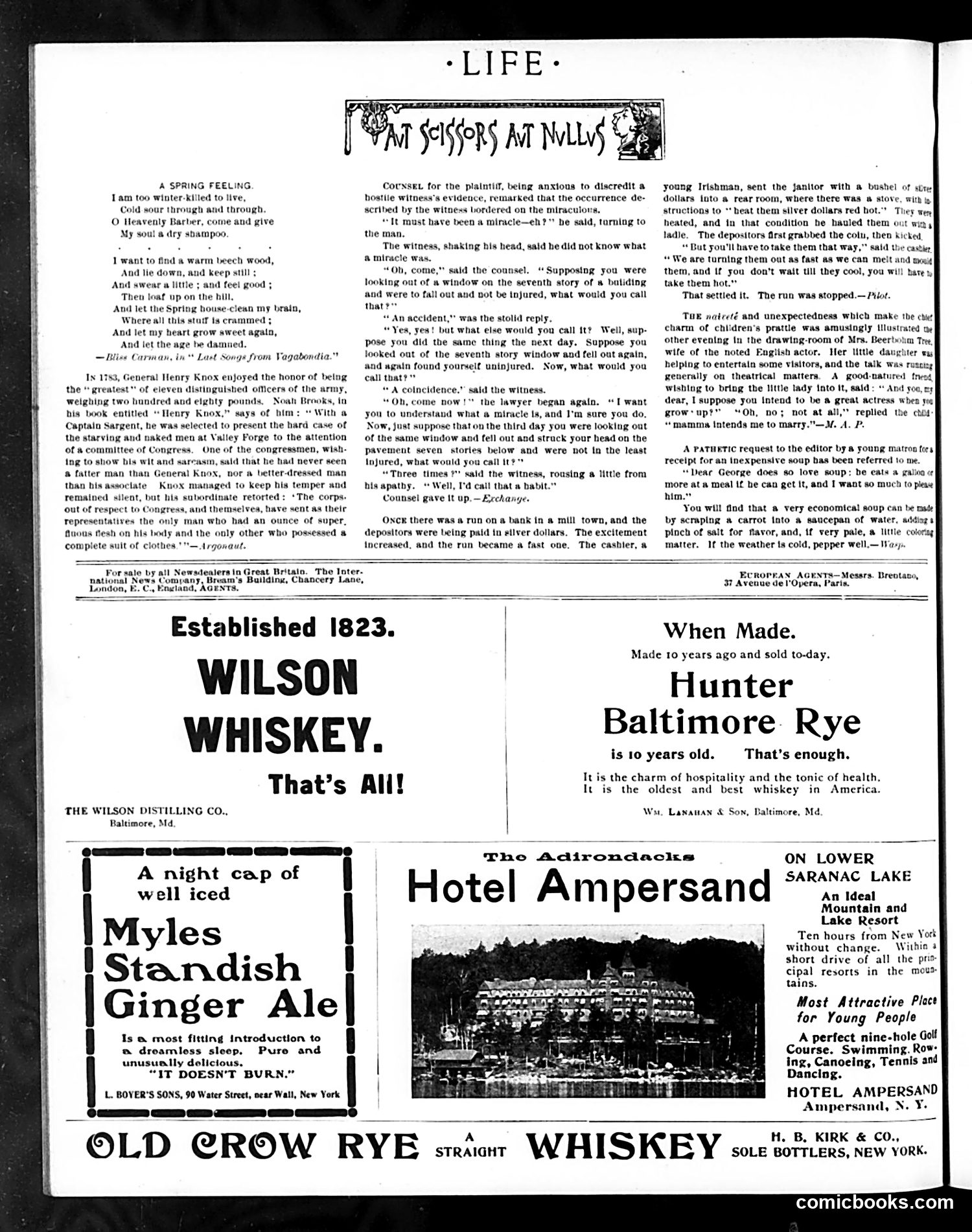
This page from *Life* magazine is primarily **advertising and light humor pieces**, not political cartoons. The content includes: 1. **"A Spring Feeling"** — A sentimental poem about winter fatigue and longing for renewal, attributed to Bliss Carman. 2. **Historical anecdote about General Henry Knox** (1783) — A story illustrating Knox's quick wit when a congressman mocked his weight; Knox's subordinate retorted that they'd sent their only well-dressed and substantial men to Congress. 3. **Three short humorous tales** — A lawyer questioning a witness about miracles (who calls repeated accidents a "habit"), and an Irishman cashier solving a bank run by heating silver dollars. The bottom half is **commercial advertising** for whiskey (*Wilson*, *Hunter Baltimore Rye*, *Old Crow*), ginger ale, and the Hotel Ampersand in the Adirondacks. No identifiable political figures or social movements are referenced. This appears to be a typical *Life* issue blending genteel humor with period advertising.
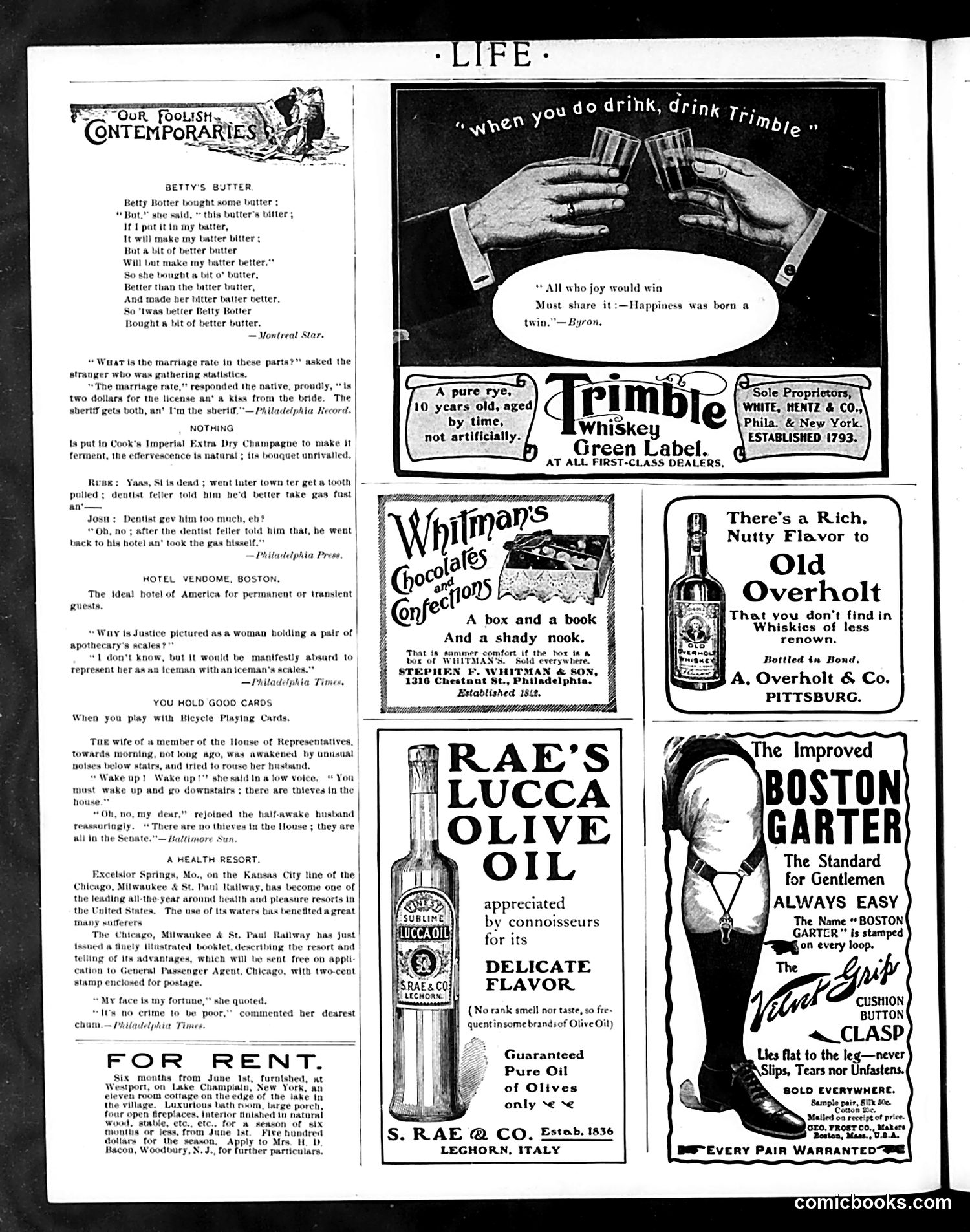
This page primarily contains **advertisements and light humor**, rather than political satire. It includes: **Humorous anecdotes:** - "Betty Botter" (tongue twister about bitter butter) - Jokes about marriage licenses, dentists, and Senate corruption ("there are no thieves in the House; they are all in the Senate"—a mild jab at Congress's reputation) - A hotel manager's quip about "Justice as a woman with scales" **Product advertisements** dominate the lower half: Trimble Whiskey, Whitman's Chocolates, Old Overholt whiskey, Rae's Lucca Olive Oil, and Boston Garter (men's suspenders). These ads reflect early 1900s consumer goods. The Senate joke provides the only genuine political reference—a contemporary criticism of legislative corruption. Otherwise, this is a typical Life magazine page mixing light verse, domestic humor, and brand advertising from the period when Life was primarily a humor and satire weekly, before becoming a photojournalism publication.
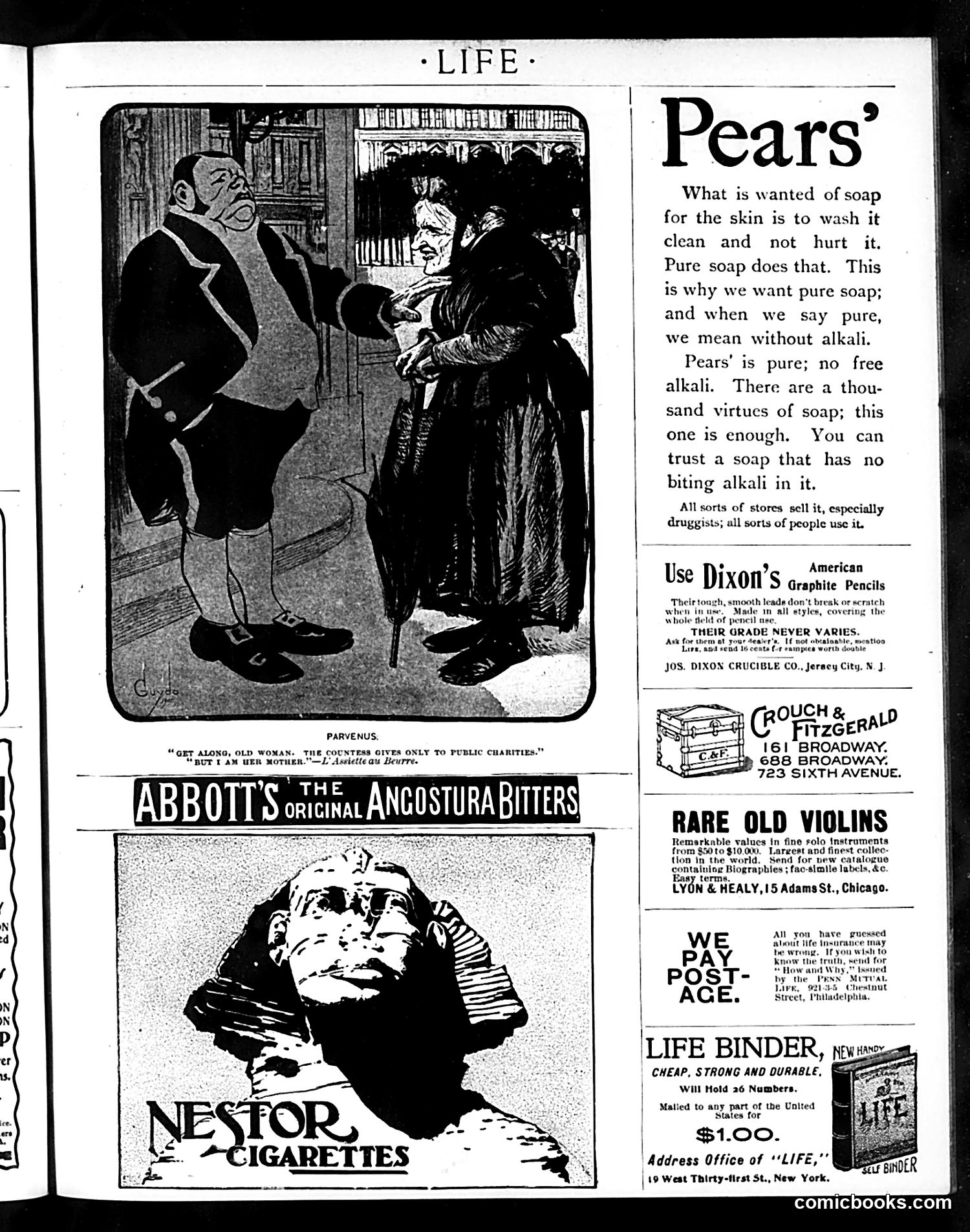
This page consists primarily of **advertisements** rather than editorial cartoons. The main visual element is a satirical cartoon labeled "PARVENUES" depicting two wealthy women—one appearing nouveau riche and ostentatious, the other more refined—with the caption "'Get along, old woman. The countess uses only to public charities.' But I am her mother." The joke targets **social climbing and pretension**: the nouveau riche woman claims charitable giving as a status marker, while her mother (presumably from humble origins) undercuts this pretense by revealing their actual relationship. The page includes ads for Pears' soap (emphasizing purity without alkali), Dixon's pencils, Abbott's Angostura Bitters, Nestor Cigarettes, and other consumer goods. The context reflects **early 20th-century consumer culture** and anxieties about class mobility and authenticity in rapidly industrializing America.
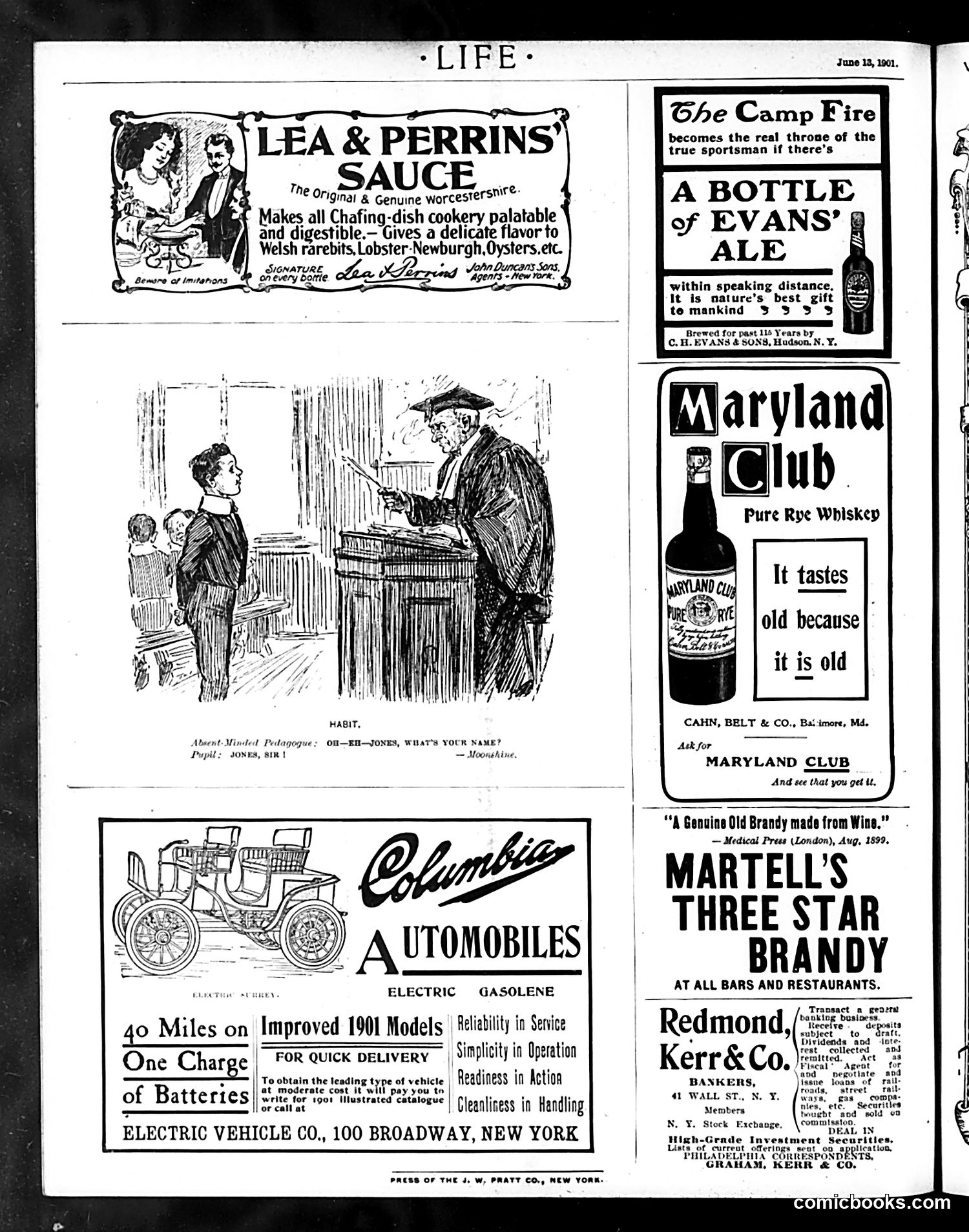
This page is primarily **advertising**, though it contains one cartoon of social satire. The main cartoon depicts an "Absent-Minded Pedagogue" (teacher) questioning a pupil named Jones about his name. The pupil responds "JONES, SIR!" but the caption attributes the answer to "Moonshine"—a joke suggesting the teacher is so absent-minded he mishears, or that the pupil's response is nonsensical/drunk-sounding. The satire mocks ineffectual educators and classroom absurdity. The rest of the page consists of period advertisements: Lea & Perrins Sauce, Columbia Automobiles (promoting both electric and gasoline models), Evans' Ale, Maryland Club Whiskey, Martell's Brandy, and Redmond Kerr & Co. banking services. These ads reflect 1901 consumer culture and emerging automobile technology, which a modern reader would recognize as early automotive marketing alongside alcoholic beverage promotion.