
Life, 1901-06-13 · page 7 of 20
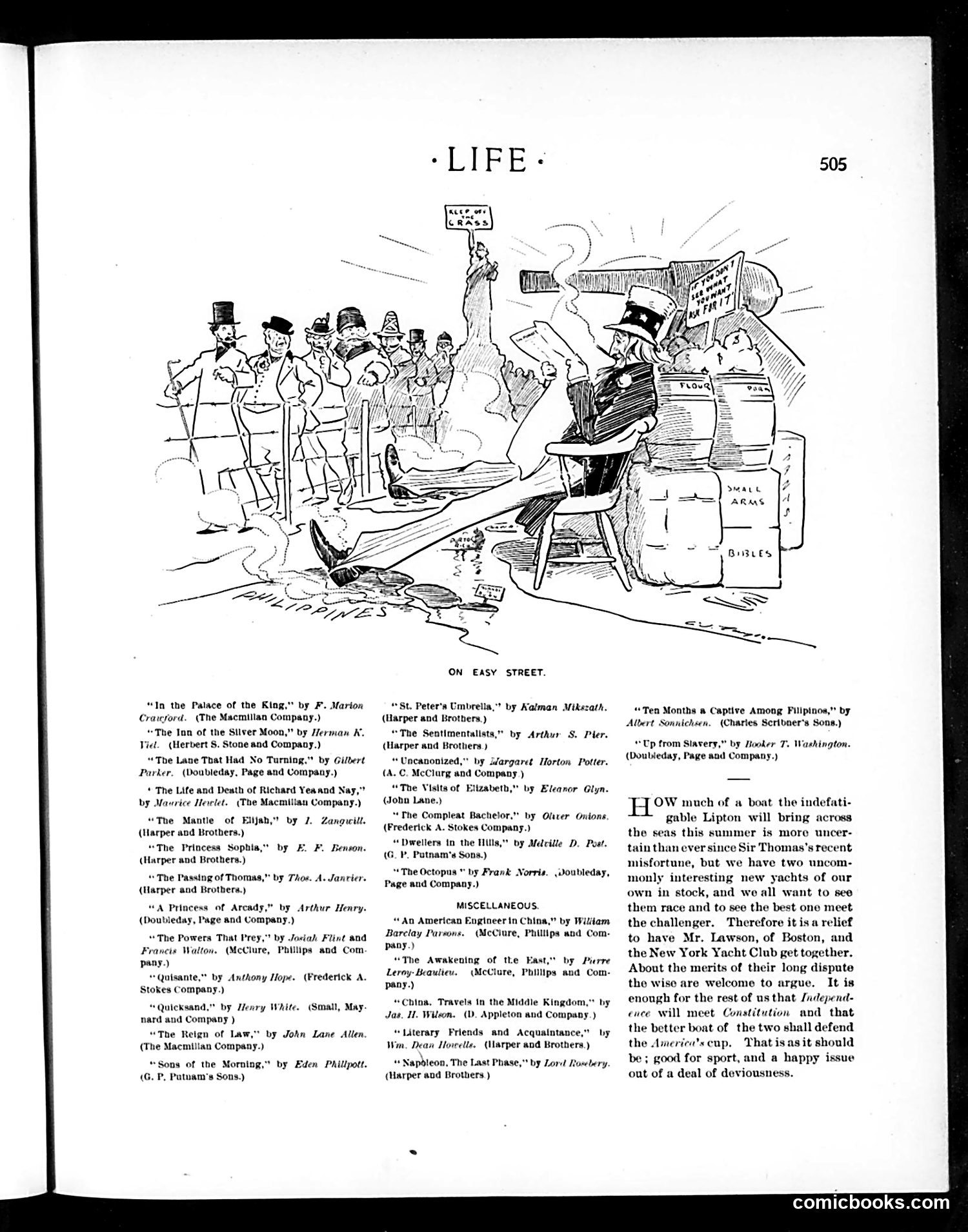
Life — June 13, 1901 — page 7: what you’re looking at
What you’re looking at
This political cartoon satirizes wealth inequality and corporate power during the Gilded Age. The image depicts a stark contrast: on the left, well-dressed gentlemen in top hats stand on solid ground, while on the right, a figure (likely representing labor or the working class) sits precariously on a seesaw balanced over a chasm labeled "Hard Times," surrounded by symbols of corporate control—barrels marked "Small Arms" and "Rifles," suggesting militarized suppression of workers. The title "On Easy Street" is ironic: while the wealthy enjoy comfort, ordinary citizens teeter on economic instability, dependent on corporate goodwill. The militaristic imagery implies threats used against labor movements. The cartoon critiques how capitalists literally held workers' livelihoods in balance.
📄 Transcribed text from this page (OCR, searchable)
Machine-transcribed from the original scan — historical spelling and the odd misread are preserved.
“In the Palace of the King," by F. Marton Crawyord. (The Macmillan Company.) “The Inn of the Silver Moon,” by Herman K. Viel. (Herbert 8. Stone and Company.) “The Lane That Had No Turning.” by Giltert Parker. (Doubleday, Page and Company.) + The Life and Death of Richard Yeaand Nay,” by Maurice Hertet. (The Macmilian Company.) “The Mantle of Elijah,” by 2. Zanguill. (Harper and Brothers.) “The Princess Sophia," by #. F. Benson. (Harper and Brothers.) + The Passing of Thomas,” by Thos. A. Janrier. (Harper and Brothers.) “A Princess of Arcady,” by Arthur Henry. (Doubleday, Page and Company.) “The Powers That Prey,” by Josiah Flint and Francis Walton, (McClure, Phillips and Com pany.) *Quisante,” by Anthony Hope. (Frederick A. Stokes Company.) “Quicksand,” by Henry White. (Small, May- pard and Company ) “The Reign of Law," by John Lane Allen. (The Macmiiian Company.) “Sons of the Morning,” by Eden Phillpott. «G. P, Putuam’s Sons.) ON EASY STREET. “St. Peter's Umbrelta,* by Kalman Mikszath. (Harper and Brothers.) “The Sentimentalists," by Arthur S. Pier. (Harper and Brothers.) “ Uncanonized,” by L/argaret Horton Potter. (A. C. McClurg and Company ) “The Visita of Elizabeth,” by Eleanor Glyn. (Jobn Lane.) “The Compleat Bachelor." by Olarer Onions, (Frederick A. Stokes Company.) “Dwellers in the Hills," by Melville D. Post. Putnam's Sons.) “The Octopus * by Frank Norris, oubleday, Page and Company.) MISCELLANEOUS. “An American Engineer in China,” by Widdam Barclay Parsons, (McClure, Phillips and Com- pany.) “The Awakening of the East," by Pierre Leroy-Beaulieu. (McClure, Phillips and Com- pany.) “China, Travels in the Middle Kingdom,” by Jas. H. Wilton. (D. Appleton and Company.) “Literary Friends and Acquaintance,” by Wm, Dean Horwelle. (Marper and Brothers.) “ Napdleon, The Last Phase," by Lord Rosebery. (Harper and Brothers) “Ten Months a Captive Among Filipinos," by Altert Sonnichsen, (Caries Scribner's Sons.) + Up from Slavery,” by Hooker T, Washington. (Doubleday, Page and Company.) “J OW much of a boat the indefati- gable Lipton will bring across the seas this summer is more uncer- tain than ever since Sir Thomas's recent, misfortune, but we have two uncom- monly interesting new yachts of our own in stock, and we all want to see them race and to see the best one meet the challenger. Therefore it isa relief to have Mr. Lawson, of Boston, and the New York Yacht Club get together. About the merits of their long dispute the wise are welcome to argue. It is enough for the rest of us that Jndepend- will meet Constitution and that the better boat of the two shall defend the America’scup. Thatisasit should be; good for sport, and a happy issue out of a deal of deviousness. euce comicbooks.com