
Life, 1901-06-13 · page 4 of 20
Life — June 13, 1901 — page 4: what you’re looking at
What you’re looking at
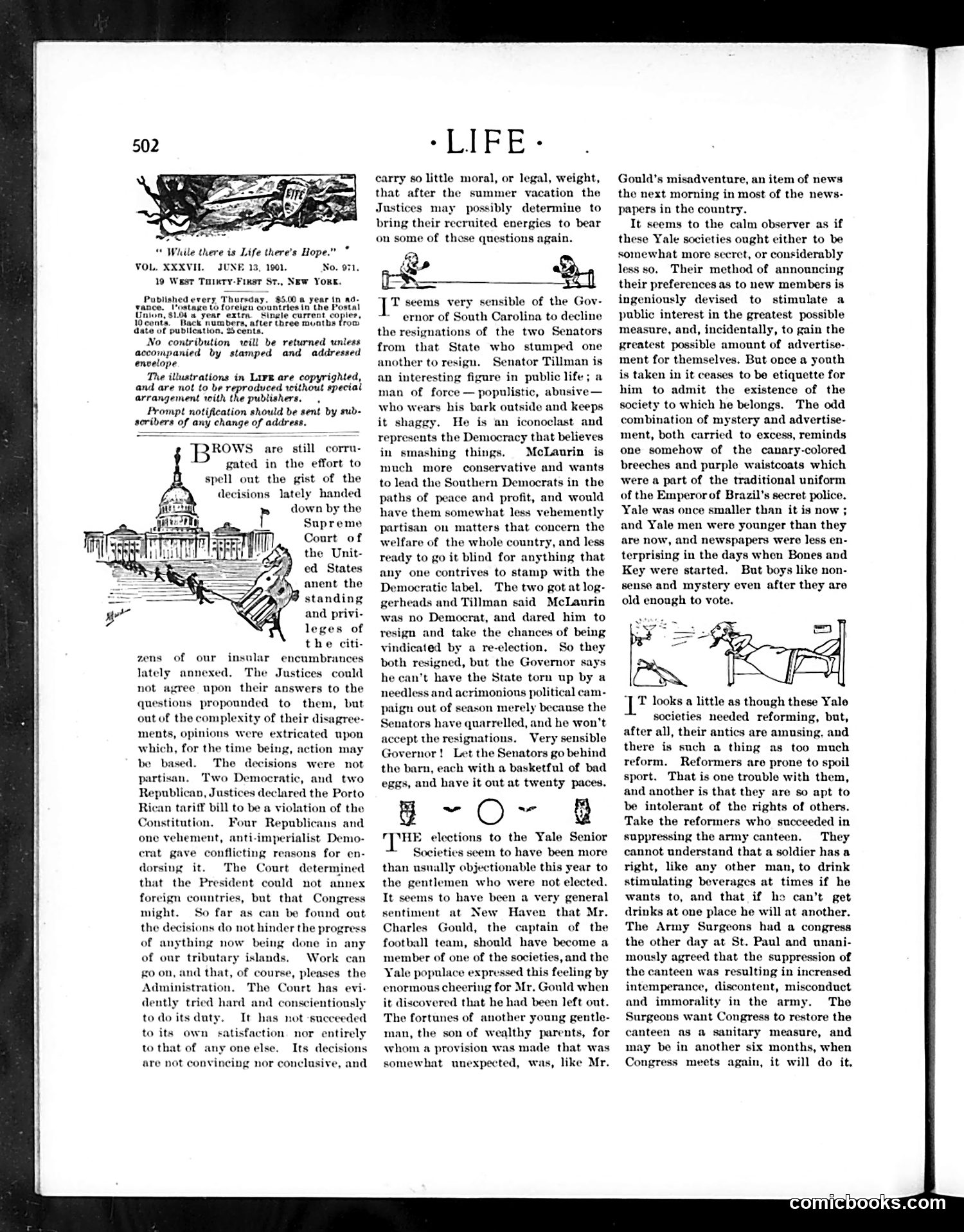
This page contains political commentary rather than comics. The main illustration shows the U.S. Capitol building, accompanying discussion of a Supreme Court decision regarding Puerto Rico's constitutional status and Congressional powers over insular territories. The text discusses South Carolina senators (likely referencing Senator Tillman), contrasting Democratic and Republican approaches to governance. It also covers Yale Senior Society elections, specifically mentioning Charles Gould's omission from a society despite his football captaincy—presented as absurdly controversial. The final section addresses Army surgeon concerns about soldier alcohol consumption, advocating Congressional action on "intemperance, discontent, misconduct and immorality." The satire targets both political hypocrisy and social reformers' inconsistent priorities—criticizing excessive focus on minor issues while serious matters are neglected.
📄 Transcribed text from this page (OCR, searchable)
Machine-transcribed from the original scan — historical spelling and the odd misread are preserved.
“ While there is Life there’s Hope. VOL. XXXVI. JUNE 13, 1901. 19 Wast Taikry-Fi Published every Thursday. $5.00 @ year in ad. Vostage to foreign countries in the Postat $1.06 year extra Single current copier, 10 Back numbers, after three munths trom date of publication, % cents. No contribution will be returned unless accomp. a by stamped and addressed envelope The illustrations in Lure are copyrighted, and are not to be reproduced without special arrangement with the publishers. , Prompt notification should be sent by sub- soribers of any change of address. I ROWS are still corru- gated in the effort to spell out the gist of the decisions lately handed wy down by the Supreme Court of the Unit- ed States anent the standing and privi- leges of the citi- insular encumbrances annexed, The Justices could not agree upon their answers to the questions propounded to them, but out of the complexity of their disagree- ments, opinions were extricated upon which, for the time being, action may be based. The decisions were not partisan. Two Democratic, and two Republican, Justices declared the Porto Rican tariff bill to be a violation of the Constitution, Four Republicans and one vehement, anti-imperialist Demo- crat gave conflicting reasons for en- dorsing it. The Court determined that the President could not annex foreign countries, but that Congress might. » far as can be found out the dec! zens of lately our ns do not hinder the progress of anything now being done in any of our tributary islands. Work can go on, and that, of course, pleases the Administration, The Court has evi- dently tried hard and conscientiously todo its duty. It has not ‘succeeded to its own satisfaction nor entirely to that of any one else. Its decisions are not convincing nor conclusive, and LIFE carry so little moral, or legal, weight, that after the summer vacation the Tustices x possibly determine to bring their recruited energies to bear on some of these questions again. pe __@s T seems very sensible of the Gov- ernor of South Carolina to decline the resignations of the two Senators from that State who stumped one another to resign. Senator Tillman is an interesting figure in public life; a man of force — populistic, abusive — who wears his bark outside and keeps it shaggy. He is an iconoclast and represents the Democracy that believes in smashing things. McLaurin is much more conservative and wants to lead the Southern Democrats in the paths of peace and profit, and would have them somewhat less vehemently partisan on matters that concern the welfare of the whole country, and less ready to go it blind for anything that any one contrives to stamp with the Democratic label. The two got at log- gerheads and Tillman said McLaurin was no Democrat, and dared him to resign and take the chances of being vindicated by a re-election, So they both resigned, but the Governor says he can’t have the State torn up by a needless and acrimonious political cam- paign out of season merely because the Senators have quarrelled, and he won't accept the resignations, Very sensible Governor! Let the Senators go behind the barn, each with a basketful of bad eggs, and have it out at twenty paces. G~O~ @ HE elections to the Yale Senior Societies seem to have been more than usnally objectionable this year to the gentlemen who were not elected. It seems to have been a very general sentiment at New Haver that Mr. Charles Gould, the captain of the football team, should have become a member of one of the societies, and the Yale populace expressed this feeling by enormous cheering for Mr. Gould when it discovered that he had been left out. The fortunes of another young gentle- man, the son of wealthy parents, for whom a provision was made that was somewhat unexpected, was, like Mr. Gould's misadventure, an item of news the next morning in most of the news- papers in the country. It seems to the calm observer as if these Yale societies ought either to be somewhat more secret, or considerably less so. Their method of announcing their preferences as to new members is ingeniously devised to stimulate a public interest in the greatest possible measure, and, incidentally, to gain the greatest possible amount of advertise- ment for themselves. But once a youth is taken in it ceases to be etiquette for him to admit the existence of the society to which he belongs. The odd combination of mystery and advertise- ment, both carried to excess, reminds one somehow of the canary-colored breeches and purple waistcoats which were a part of the traditional uniform of the Emperor of Brazil's secret police. Yale was once smaller than it is now ; and Yale men were younger than they are now, and newspapers were less en- terprising in the days when Bones and Key were started. But boys like non- sense and mystery even after they are old enough to vote. T looks a little as though these Yale societies needed reforming, but, after all, their antics are amusing. and there is such a thing as too much reform. Reformers are prone to spoil sport, That is one trouble with them, and another is that they are so apt to be intolerant of the rights of others. Take the reformers who succeeded in suppressing the army canteen. They cannot understand that a soldier has a right, like any other man, to drink stimulating beverages at times if he wants to, and that if ho can’t get drinks at one place he will at another. The Army Surgeons had a congress the other day at St. Paul and unani- mously agreed that the suppression of the canteen was resulting in increased intemperance, discontent, misconduct and immorality in the army. The Surgeons want Congress to restore the canteen as a sanitary measure, and may be in another six months, when Congress meets again, it will do it,