
A complete issue · 22 pages · 1901
Life — March 21, 1901
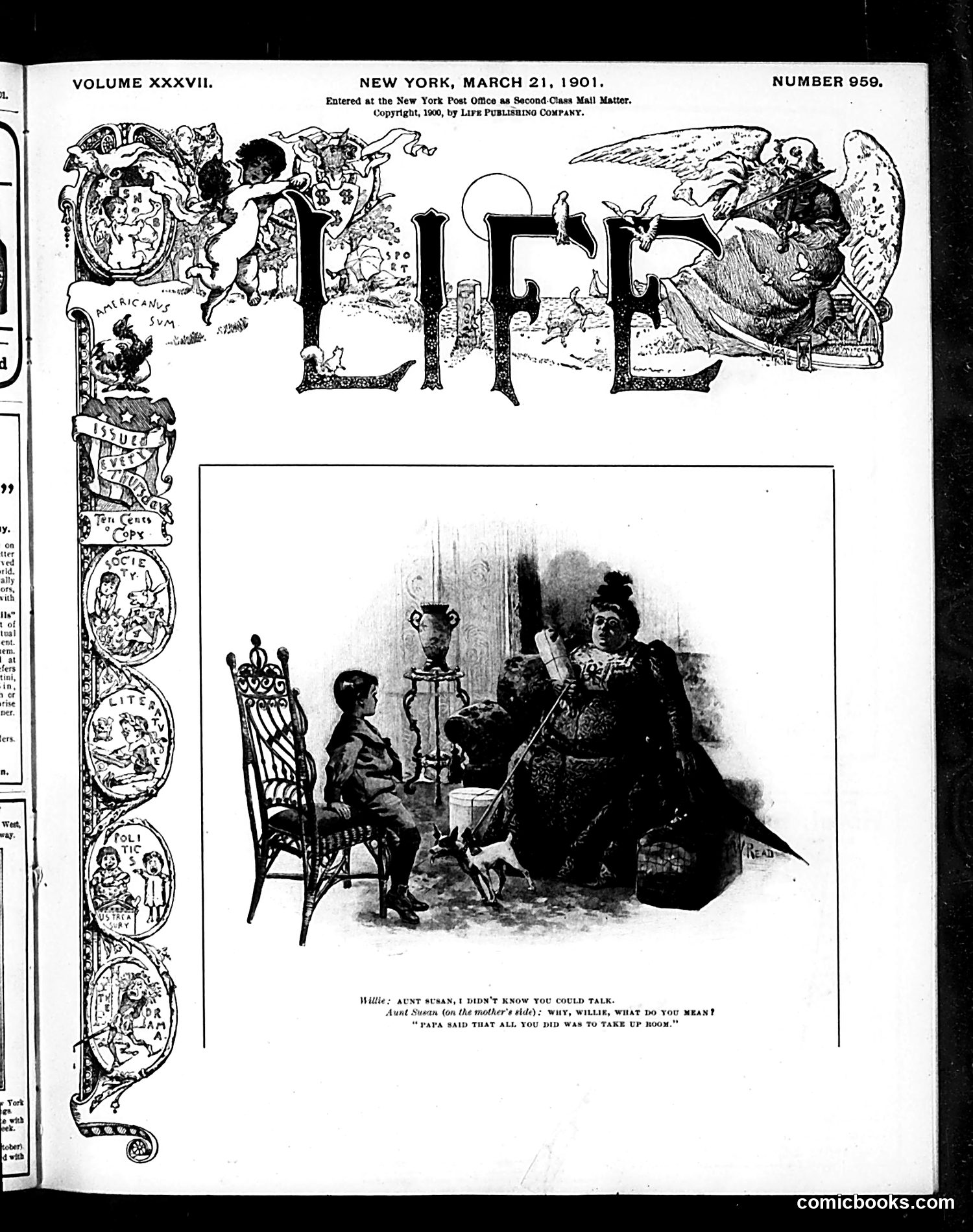
This page features a domestic humor cartoon depicting a child (Willie) being scolded by his aunt and mother. The caption reads: "Willie: Aunt Susan, I didn't know you could talk. / Aunt Susan (on the mother's side): Why, Willie, what do you mean? / 'Papa said that all you did was to take up room.'" The joke relies on a contemporary insult—that the aunt is silent, decorative, and essentially useless. This reflects early 20th-century attitudes toward unmarried women or spinster aunts as burdensome family members. The child's innocent repetition of his father's cruel remark creates the humor. The satirical point appears to target either unproductive female relatives or, possibly, critiques the dismissive attitudes men held toward women who didn't fulfill traditional roles.
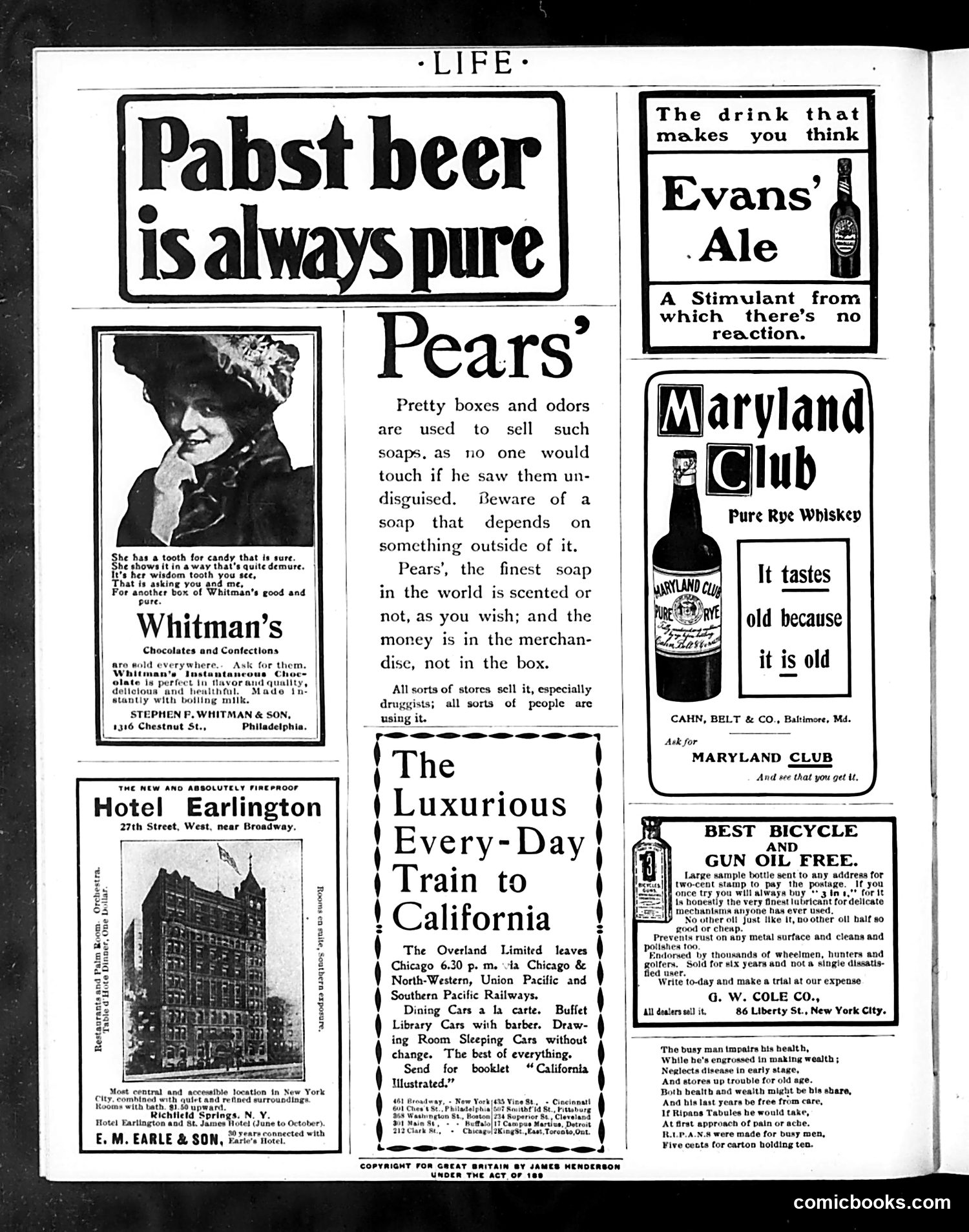
This page is primarily **advertising, not political satire**. It contains five product advertisements from the early 20th century: 1. **Pabst Beer** — claims purity 2. **Whitman's Chocolates** — features a woman eating candy, with text suggesting she uses it to appear demure while actually being wise 3. **Pears' Soap** — discusses marketing tactics, claiming real quality matters over packaging 4. **Evans' Ale** — marketed as a mental stimulant 5. **Maryland Club Whiskey**, **Hotel Earlington**, **Luxurious California Train**, and **Best Bicycle Gun Oil** The only quasi-satirical element is the Pears' ad's commentary on deceptive packaging—suggesting companies use attractive boxes to disguise inferior products. Otherwise, this is straightforward period advertising reflecting contemporary consumer culture and product claims.
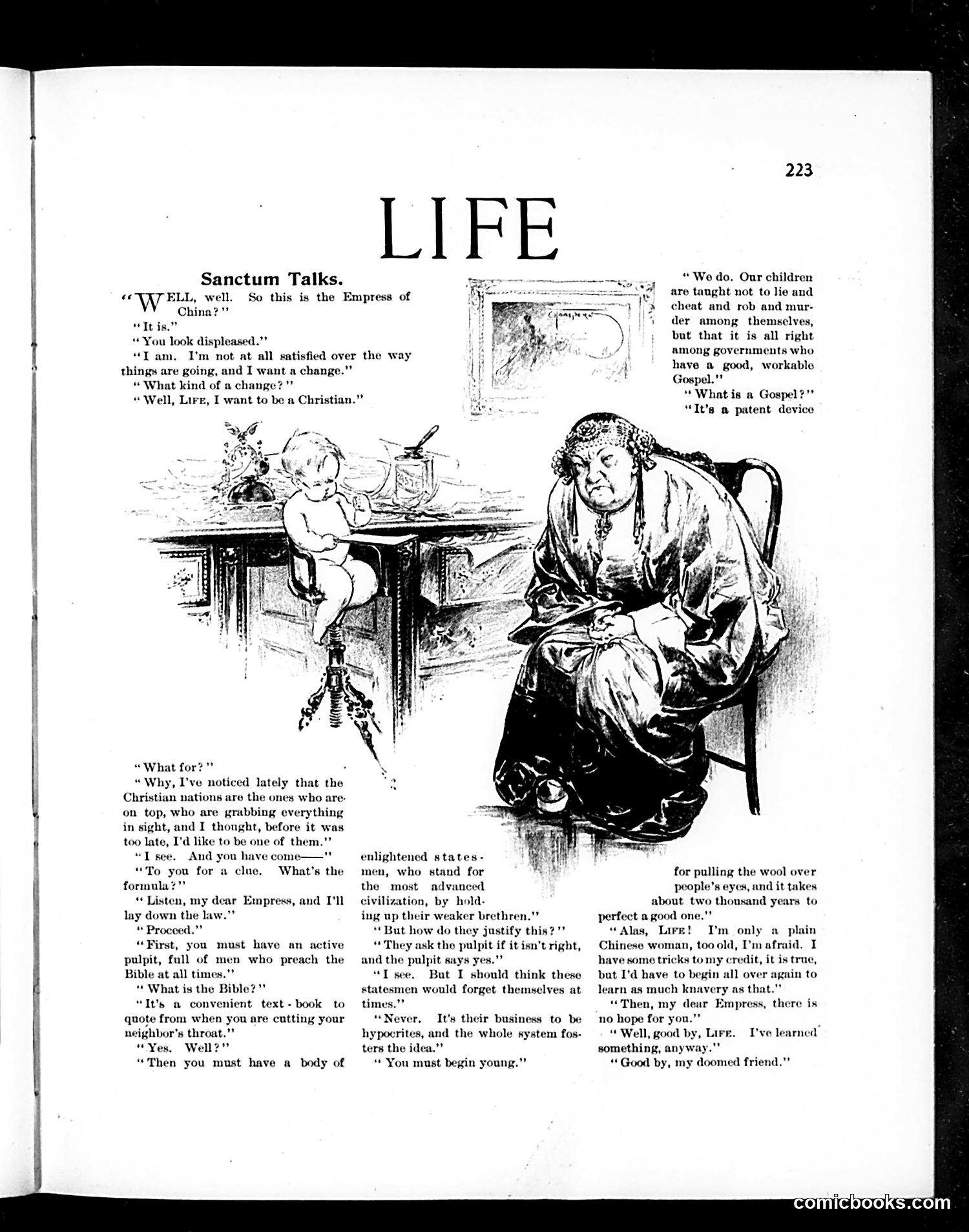
This page features a satirical dialogue between the Empress of China and a character named "Life," who wants to become Christian. The cartoon mocks Christian missionary activity in China by having Life explain Christianity through contradictions: Christians preach the Bible but practice hypocrisy; they claim moral superiority while grabbing resources ("grabbing everything in sight"). The Empress seeks a "formula" for Christianity, and Life cynically suggests she needs "an active pulpit, full of men who preach the Bible at all times"—exposing the gap between Christian preaching and actual conduct. The satire critiques both Western imperialism disguised as religious conversion and the perceived hypocrisy of Christian nations and missionaries operating in China during this period of Western colonial expansion.
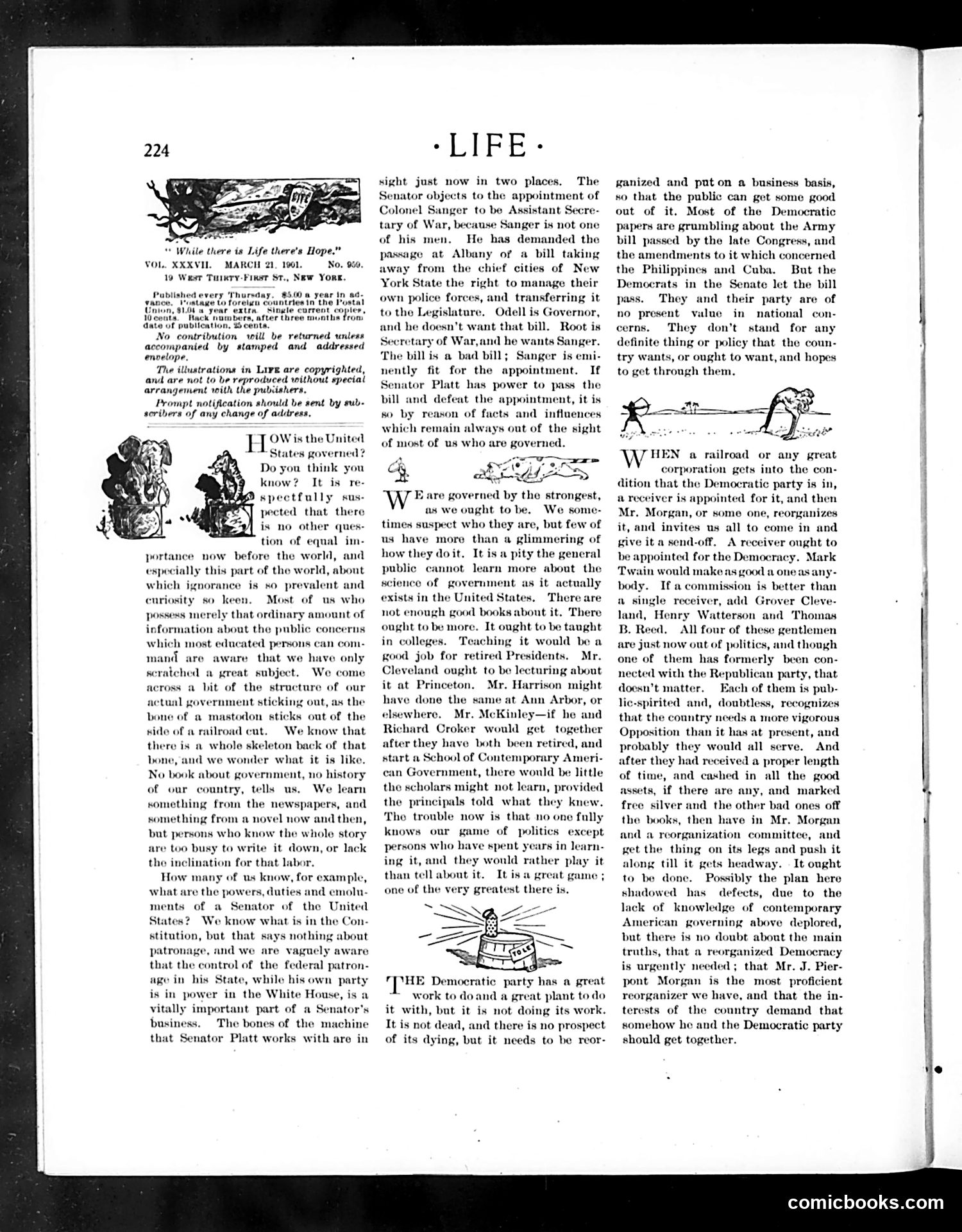
This page critiques U.S. government and Democratic Party organization through satirical commentary rather than traditional political cartoons. The text discusses how Americans poorly understand their own government, suggesting the public needs better civic education. It specifically criticizes the Democratic Party's disorganization and lack of coherent platform, noting it's "not dead" but needs reorganization. The passage mentions J. Pierpont Morgan reorganizing the Democratic Party after various politicians (including Mark Twain, allegedly) were consulted. This appears satirical—suggesting a wealthy industrialist stepping in to fix political dysfunction. Small decorative illustrations punctuate the text but don't constitute standalone cartoons with identifiable caricatures. The satire targets political incompetence and the influence of wealthy interests on American governance, typical Life magazine themes from this era.
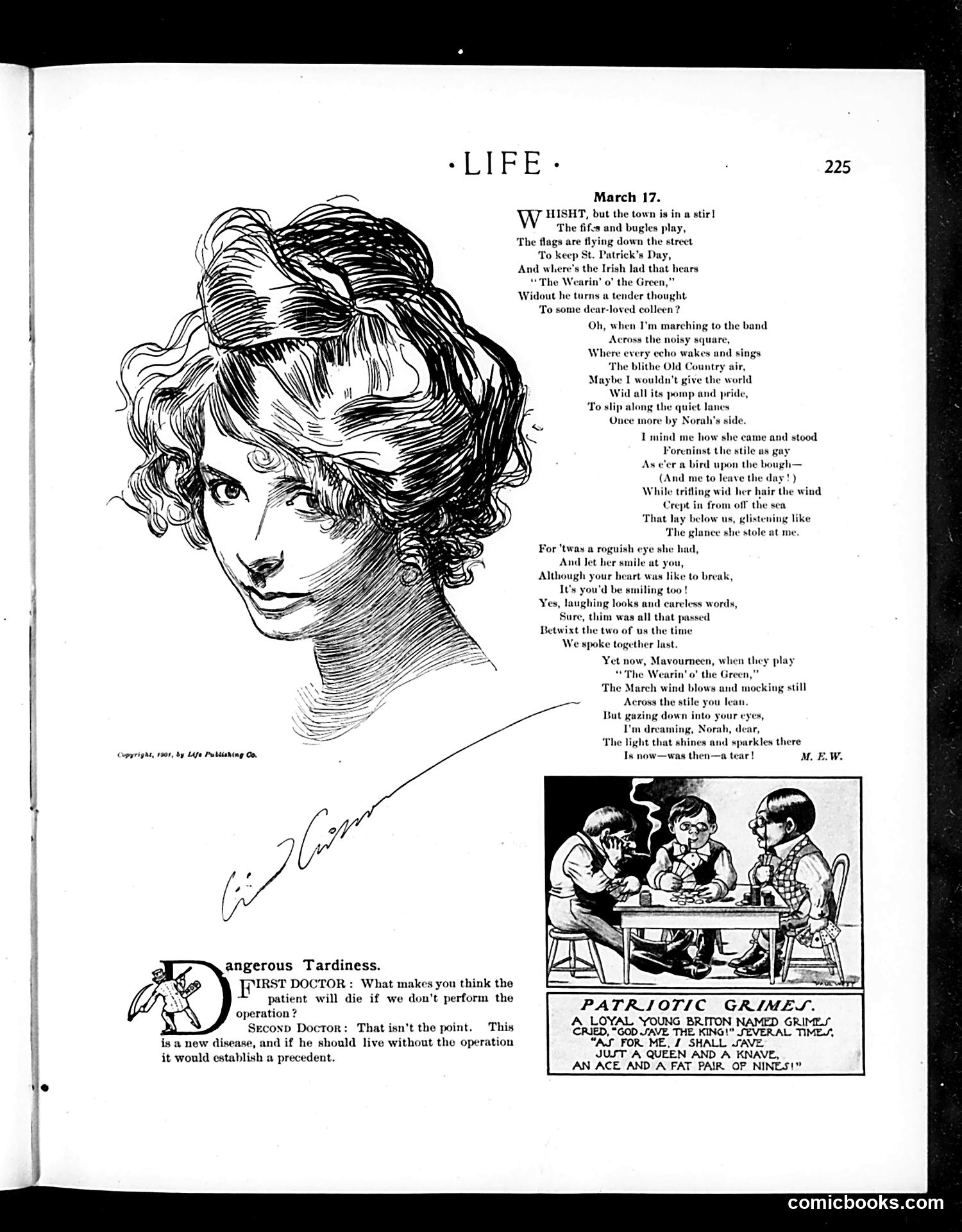
**Main Content:** The page features a poem titled "March 17" (St. Patrick's Day) by M.E.W., expressing nostalgia for marching in parades with someone named Norah. The sentimental verse reflects on absent companionship during Irish celebrations. **Cartoon Section:** A small comic titled "Dangerous Tardiness" depicts two doctors debating whether to operate on a patient. The second doctor argues that performing surgery would establish a dangerous precedent—suggesting the joke concerns medical ethics or the absurdity of justifying risky procedures through legal precedent. **Comic Strip:** "Patriotic Grimes" shows children playing, with dialogue referencing British royalty and playing cards, appearing to be a children's humor strip. The page emphasizes nostalgic sentiment and gentle satire typical of early 20th-century Life magazine.
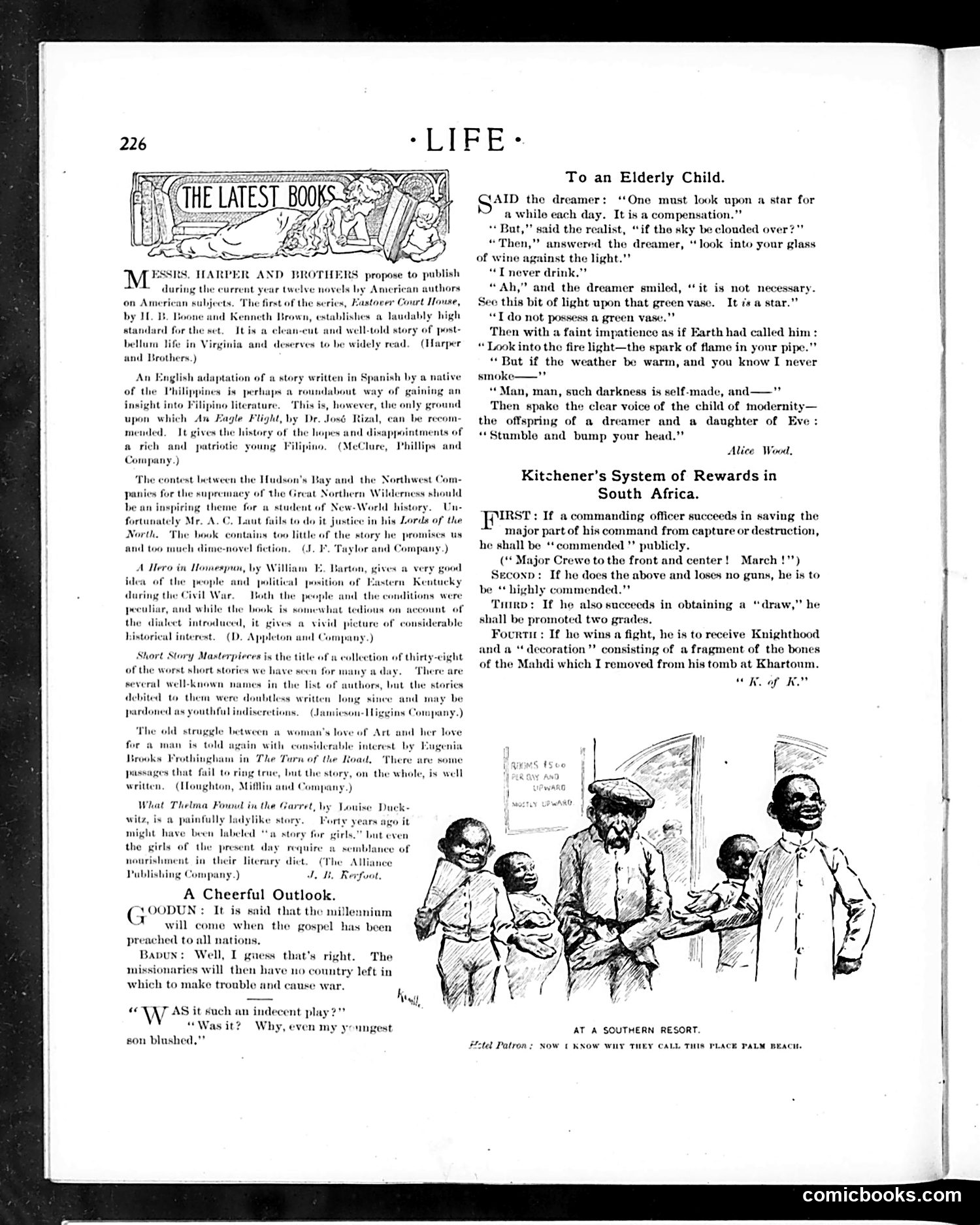
This page contains book reviews and literary commentary rather than political cartoons. The main visual element is a sketch titled "At a Southern Resort" showing Black individuals at what appears to be a beach or resort setting, with a caption reading "Hotel Patron: Now I know why they call this place PALM BEACH." The humor relies on a racial stereotype—the implication being a crude pun on "palm" (the tree associated with tropical locations) and a derogatory reference to Black skin color. This reflects the casual racism embedded in early-20th-century American publications, even those considered sophisticated or literary. The cartoon exemplifies how racial caricature was normalized in mainstream media of this era, presenting dehumanizing stereotypes as acceptable humor.
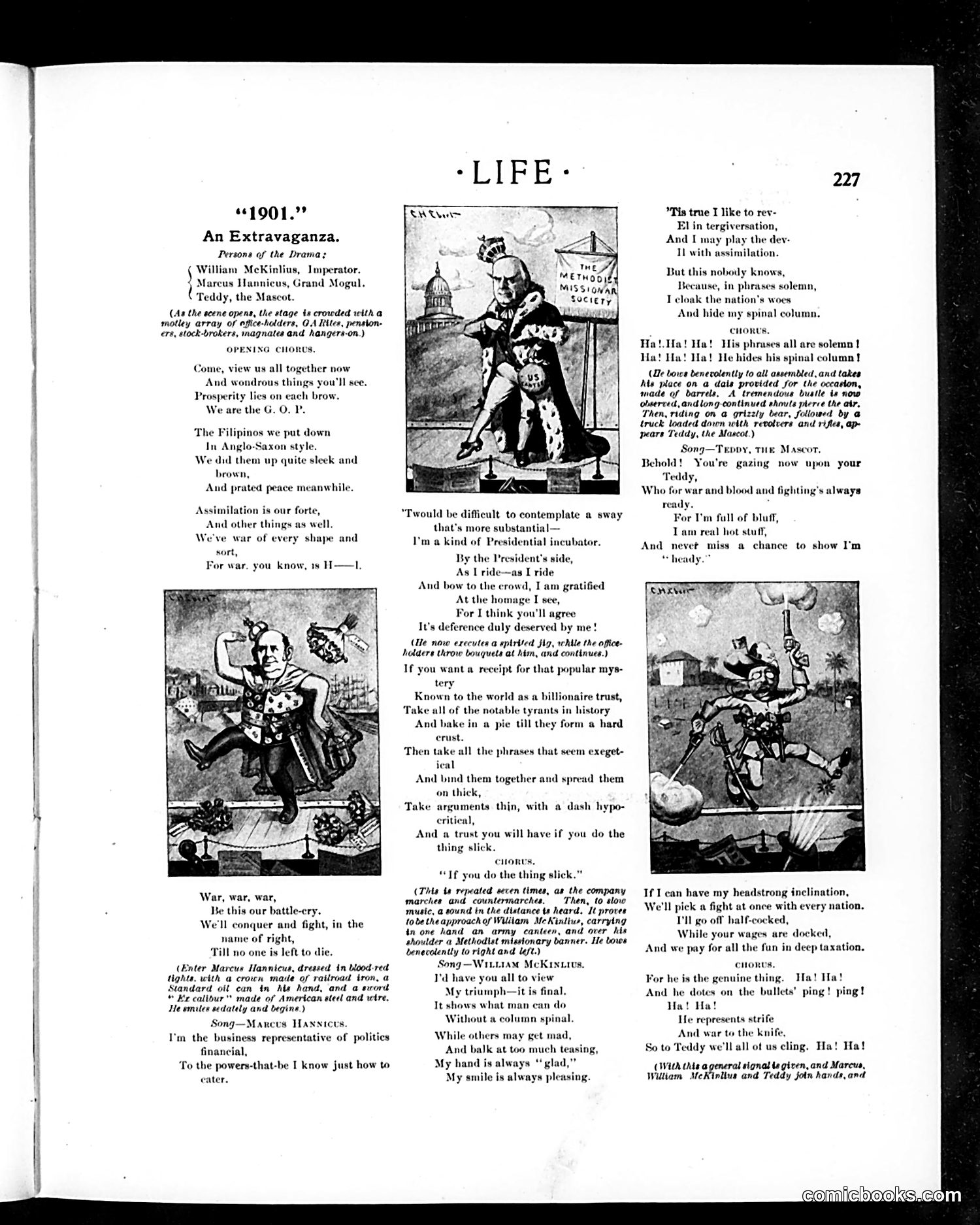
This satirical drama mocks American imperialism and Philippine colonization. The caricatures appear to represent U.S. political figures engaged in justifying military intervention. The central figure, labeled a "Presidential incubator," suggests critique of how political leaders rationalize overseas expansion. References to "assimilation" and military conquest indicate satire of American claims that colonization benefits conquered peoples. The accompanying dialogue parodies political rhetoric—phrases about "spreading democracy" and military necessity are presented as hollow justifications. The choppy, contradictory verses mock the incoherent rationalizations politicians offer for imperialism. The overall effect ridicules American political hypocrisy: the pretense that violent military subjugation serves humanitarian purposes. The melodramatic theatrical framing emphasizes the absurdity of these justifications.
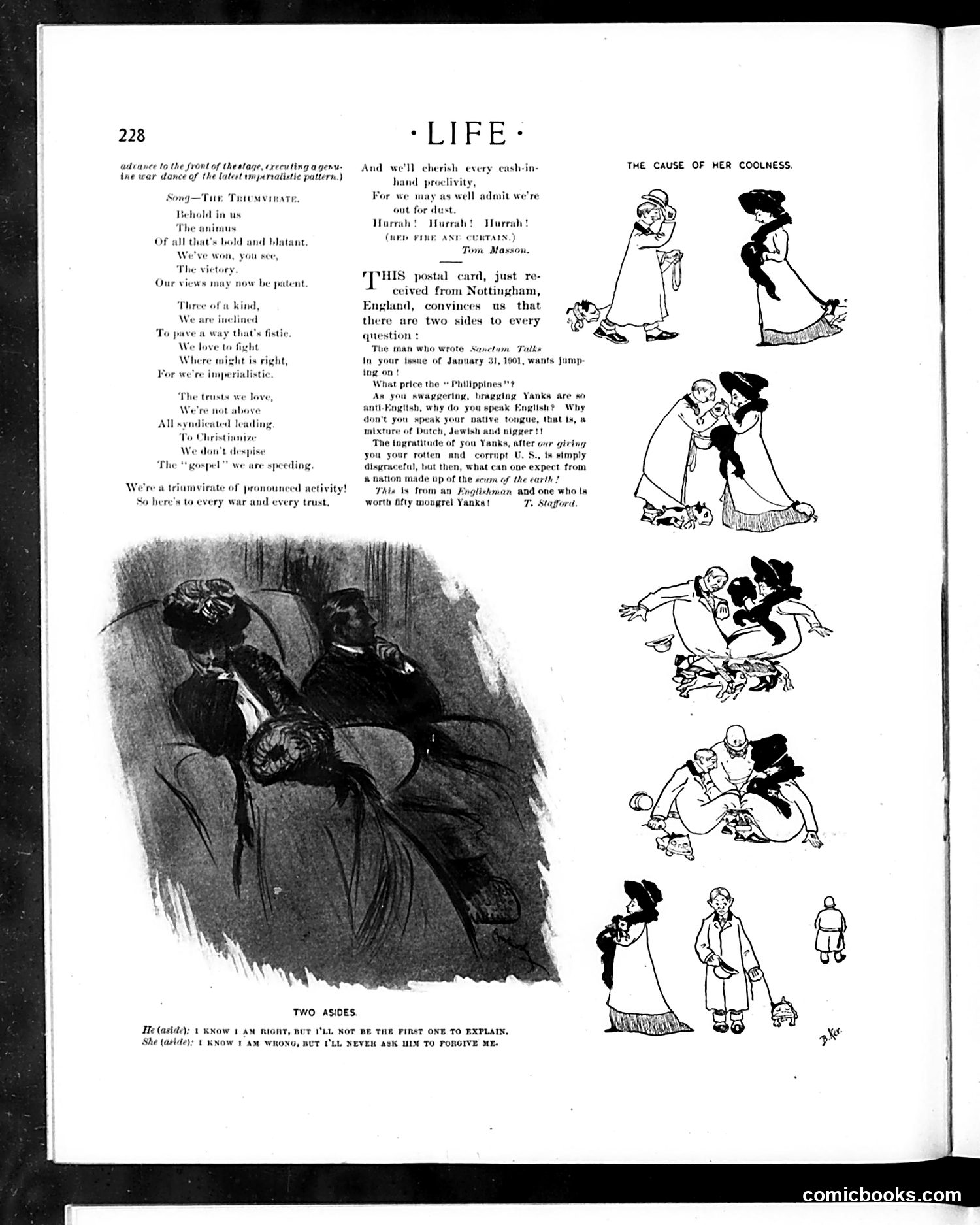
This page contains two distinct satirical sections: **"Two Asides"** (lower left): A sketch depicting two people in conflict with the caption presenting contrasting statements about fault and forgiveness—he claims righteousness, she refuses to forgive. This appears to be domestic satire about marital disputes and stubbornness. **"The Cause of Her Coolness"** (right side): A series of comic illustrations showing interactions between a woman (in a hat) and a man, depicting various playful or romantic scenarios. The visual progression suggests the woman's coldness toward the man stems from his behavior or attention toward other women or children, presented as humorous commentary on relationship dynamics and jealousy. Both sections use period-appropriate illustration styles typical of early 20th-century American satirical humor focused on gender relations and domestic life.
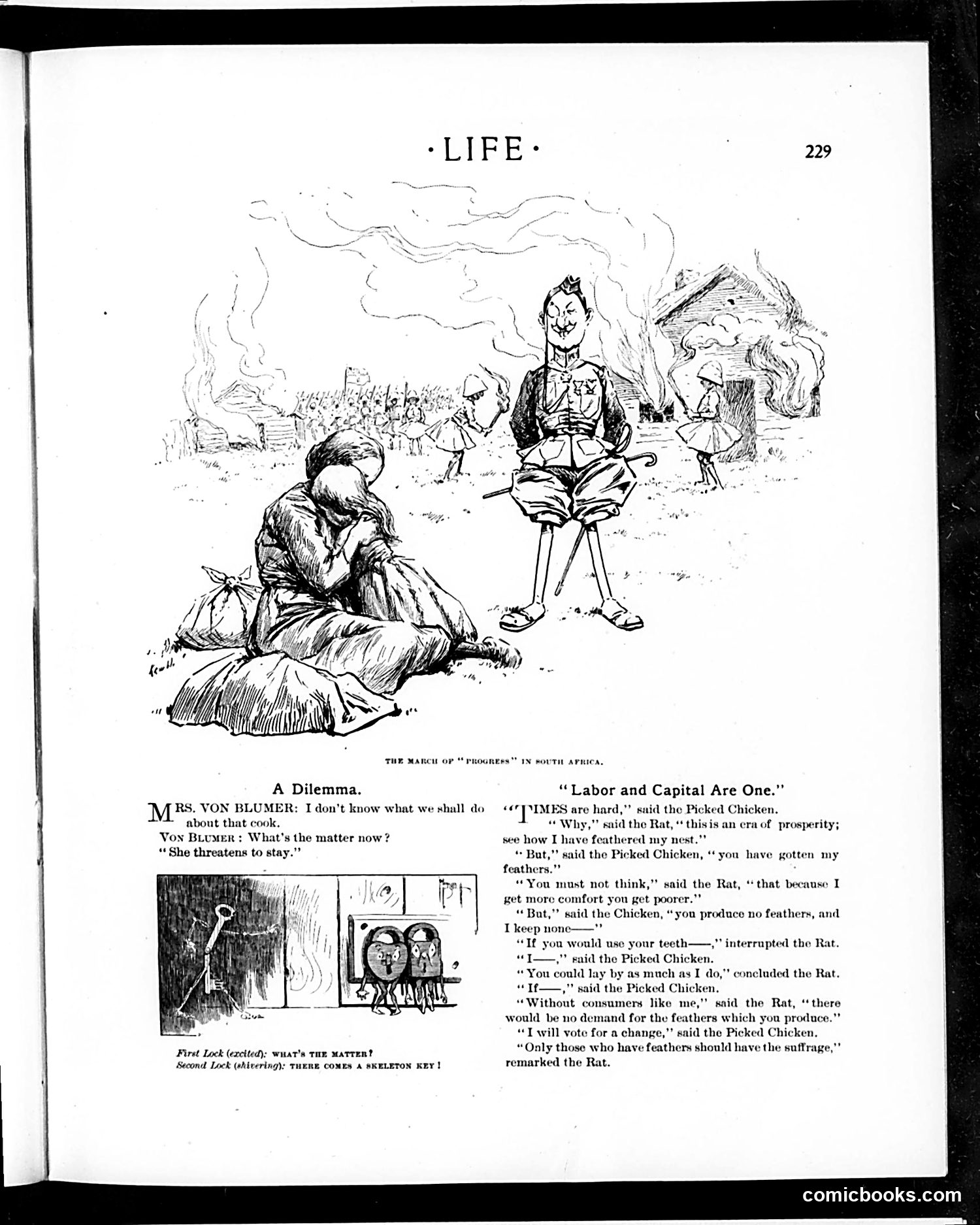
This political cartoon satirizes labor disputes in South Africa during what appears to be the Boer War era ("The March of 'Progress' in South Africa"). The main illustration shows a military officer confronting a woman and child in a war zone with burning buildings—depicting the conflict's impact on civilians. The accompanying dialogue between Mrs. von Blücher and Von Blücher, alongside the animal fable ("Labor and Capital Are One"), uses creatures debating economic production to mock capitalist justifications for exploitation. The Rat argues that poverty benefits workers through "comfort," while the Chicken counters that workers deserve fair compensation for their labor. The cartoon critiques how warring powers and capitalists rationalize harm to ordinary people as economically necessary.
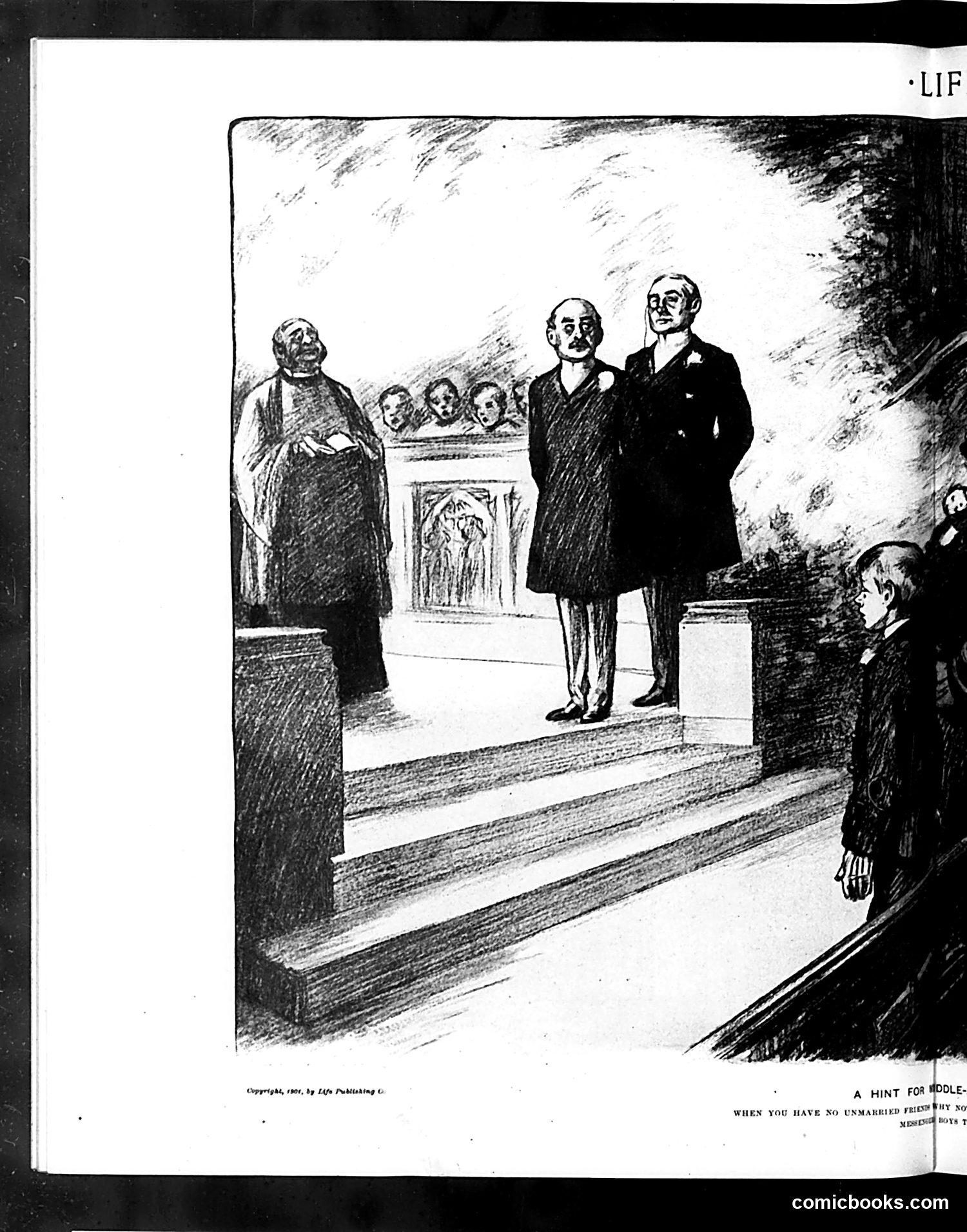
This appears to be a satirical cartoon from Life magazine titled "A Hint for Middle-Aged Bachelors: When You Have No Unmarried Female Relatives." The cartoon depicts what appears to be a formal religious or legal ceremony, with figures in dark formal wear standing before what looks like an altar or podium. The satire targets middle-aged unmarried men, suggesting they lack female relatives to arrange marriages with—a social concern of the era. The joke plays on the social expectation that bachelor men of a certain age should marry, and that female relatives traditionally helped facilitate such arrangements. The cartoon's implication is unclear from the image alone, but it appears to mock both the bachelor's predicament and the social conventions surrounding marriage of that period.
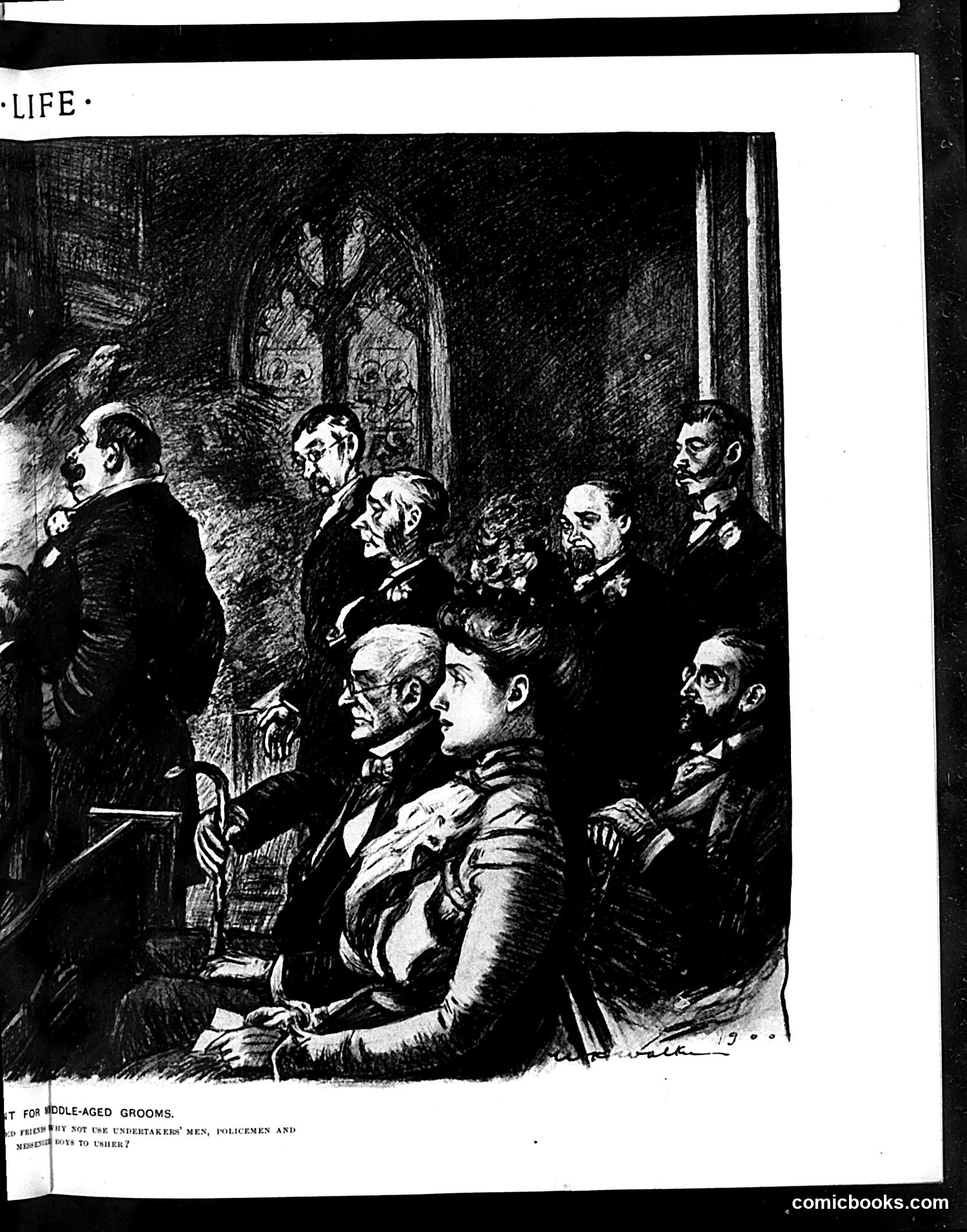
This cartoon satirizes the practice of hiring unmarried men—policemen and messengers—to serve as ushers at weddings, apparently considered inappropriate or risky. The image shows a formal church wedding scene with multiple military or official figures in dress uniforms standing around a seated couple (the bride and groom). The caption suggests the joke concerns using "undertakers' men, policemen and messengers" as wedding ushers, implying these working-class or morally questionable individuals might cause problems at an upscale wedding. The satire targets middle-aged grooms specifically, perhaps suggesting they're naive or foolish to trust their wedding to such attendants. The cartoon reflects early 20th-century class anxieties about propriety and social hierarchy in formal social events.
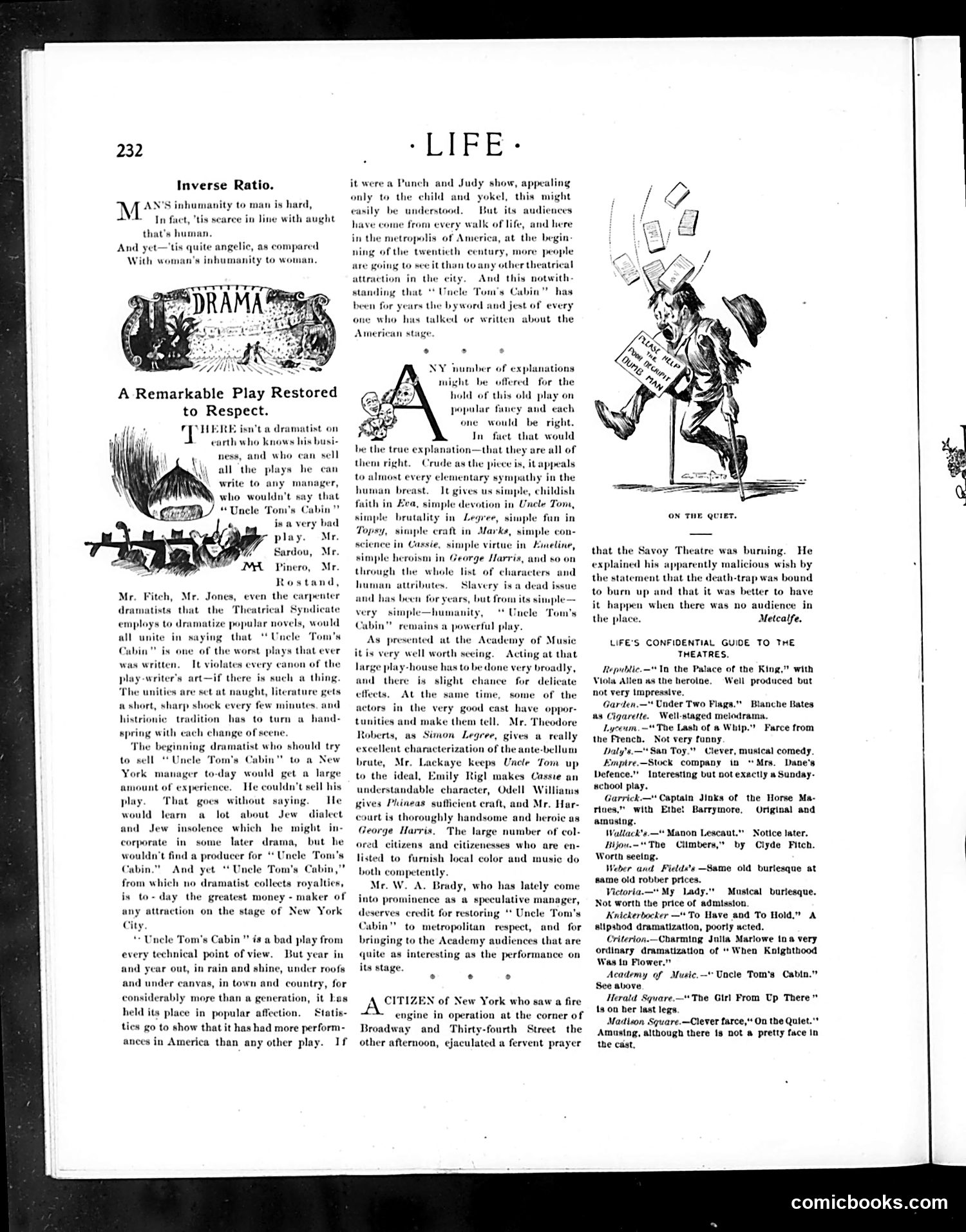
This cartoon depicts a man frantically fleeing while carrying bundles of papers or documents, with the caption "ON THE QUIET" (meaning secretly or discreetly). The illustration appears to be satirizing someone attempting to conduct illicit or shameful business away from public view. The accompanying text discusses the Savoy Theatre fire and mentions someone's "malicious wish" to burn down a building when there was no audience present—suggesting the cartoon relates to insurance fraud or property destruction motivated by financial gain rather than safety concerns. The figure's exaggerated, fleeing posture emphasizes the covert, underhanded nature of the scheme being satirized, likely targeting either theatrical management or criminal opportunism during this early 20th-century period.
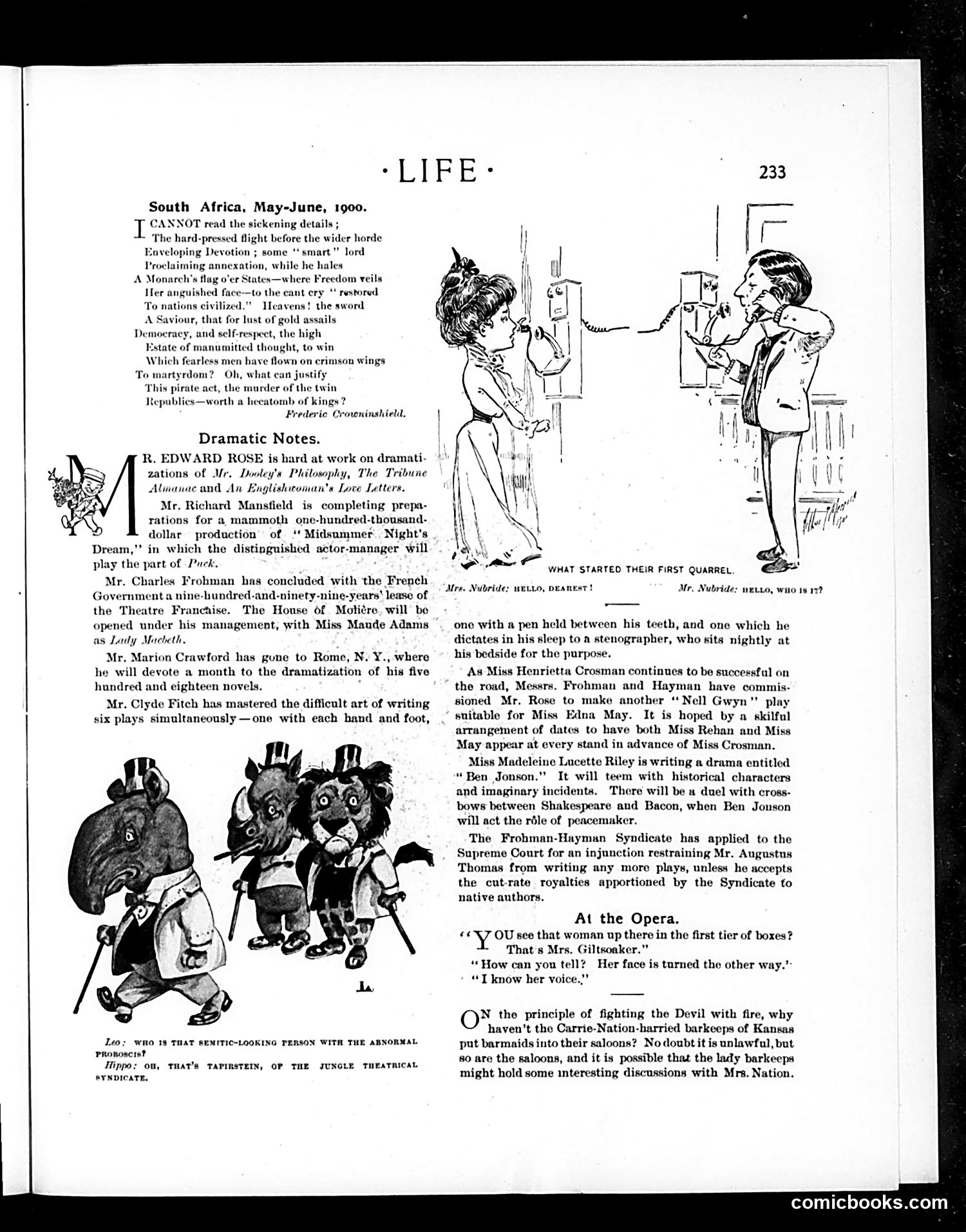
**The Poetry & Political Context:** The opening poem attacks the British conduct in the Second Boer War (1899-1902). "South Africa, May-June, 1900" references Britain's invasion of the Boer Republics. The author (Crowninshield) criticizes British imperial justifications—calling the annexation hypocritical, accusing Britain of murdering the "twin Republics" for gold, and condemning the rhetoric of "civilization" masking imperial greed. **The Cartoons:** The lower cartoon mocks theatrical impresario Charles Frohman's business dominance through a crude caricature labeled "Tapirstein" (an antisemitic stereotype suggesting a Jewish theater magnate). The "What Started Their First Quarrel" dialogue is satirical domestic humor—a newlywed couple's trivial opening argument. **The "At the Opera" section** jokes about recognizing a wealthy socialite (Mrs. Giltsoaker) by her voice rather than appearance, a class-conscious jab. The final item about Carrie Nation (temperance activist harassing saloons) uses dark humor suggesting female bartenders might distract Nation from her mission.
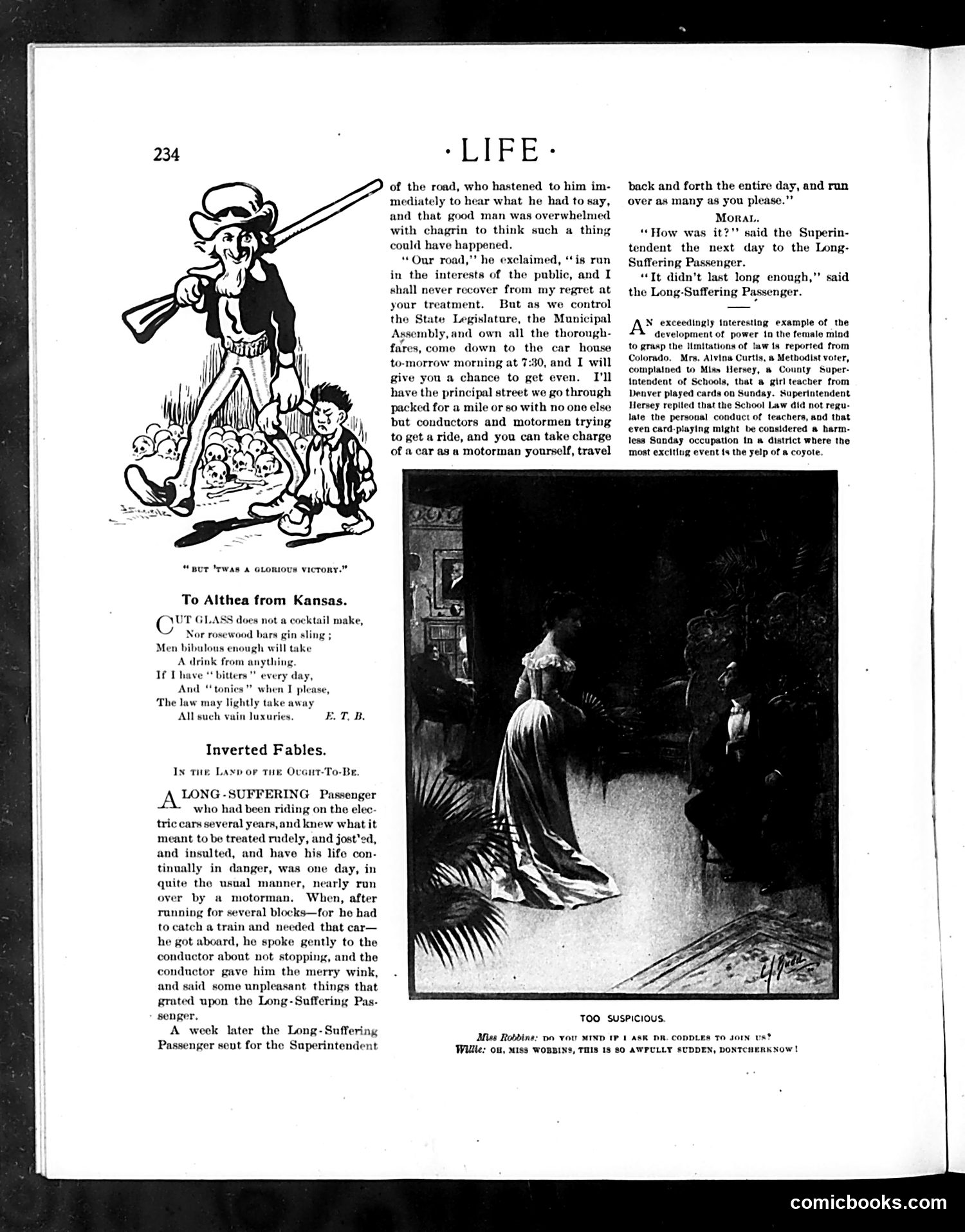
This page contains three satirical pieces critiquing American institutions circa early 1900s: **"Inverted Fables" (main story):** A streetcar passenger, repeatedly mistreated by conductors and motormen, complains to the superintendent. Rather than discipline staff, the superintendent offers him a day operating the car himself—implying the passenger will discover mistreatment is systemic and unavoidable. The joke satirizes corrupt transit monopolies ("we control the State Legislature") that exploit passengers while offering hollow gestures of recompense. The passenger's disappointed reaction ("didn't last long enough") suggests even one day revealed deeper problems. **"To Althea from Kansas" (poem):** A verse mocking Prohibition-era drinking laws, suggesting legal restrictions on alcohol are ineffective—determined drinkers will find ways regardless. **"Too Suspicious" (illustration):** A woman in formal dress appears to proposition a man, while another warns him it's "awfully sudden." The humor plays on social awkwardness and Victorian propriety around sudden romantic advances. All three pieces mock institutional hypocrisy and social pretense.
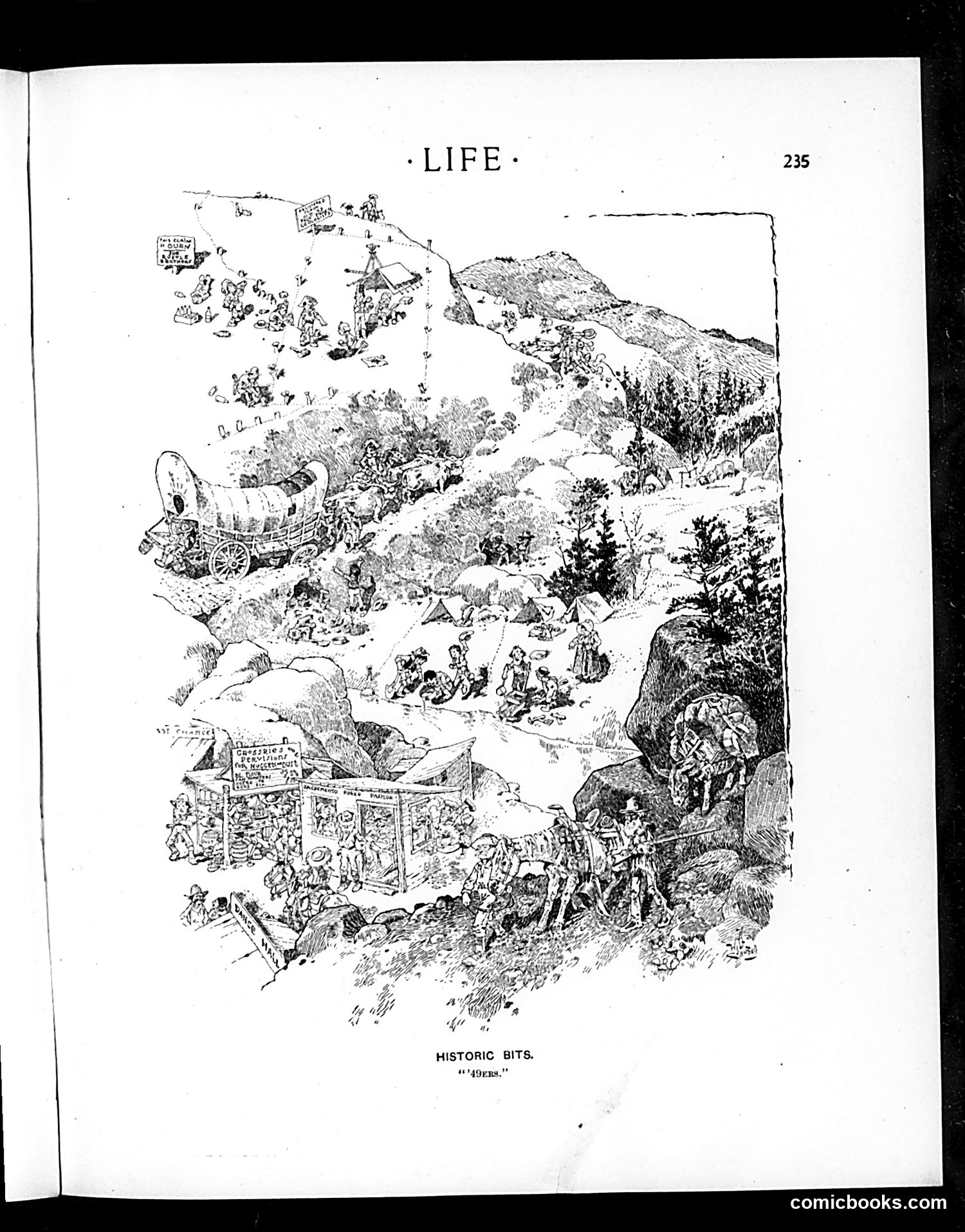
This illustration depicts the California Gold Rush of 1849, showing a frontier settlement bustling with prospectors and miners. The scene includes a covered wagon (left), makeshift structures, crowds of people, and mountainous terrain—typical imagery of '49ers seeking fortune during the gold rush. The title "Historic Bits" suggests this is part of a series in *Life* magazine reviewing American historical moments. The cartoon appears to be satirical commentary on the chaotic, informal nature of the Gold Rush era—depicting the disorder, hastily-constructed camps, and diverse crowd of fortune-seekers that characterized the period. The humor likely stems from contrasting this rough, lawless frontier moment with contemporary American civilization, or from satirizing romanticized notions of the Gold Rush period that *Life's* readers would have encountered in popular culture.
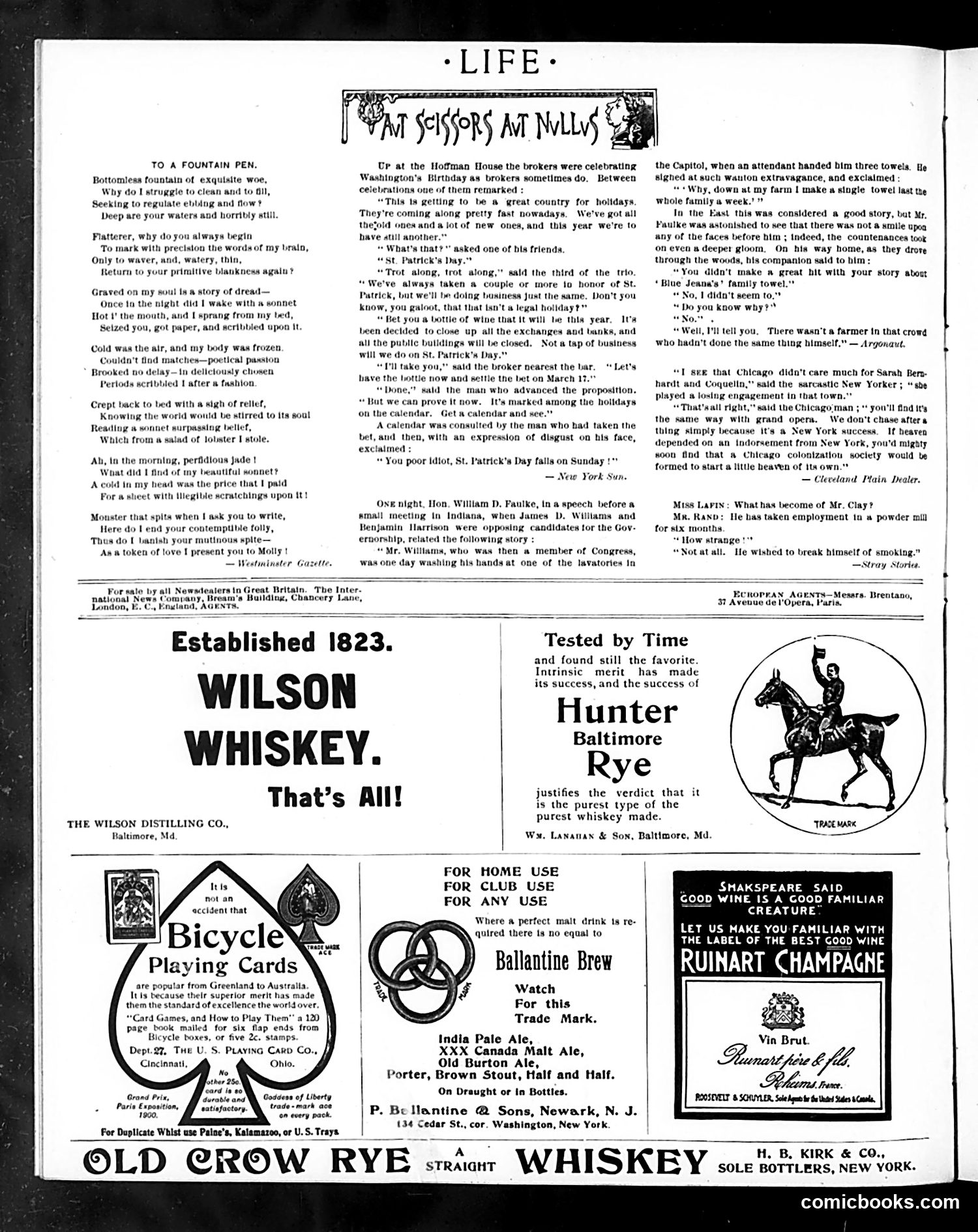
This page is primarily **humorous prose and verse** rather than political cartooning. The content includes: **Literary humor:** A comedic poem mocking fountain pens—their unreliability, leaking, and tendency to render carefully composed midnight sonnets illegible by morning. **Anecdotes:** Three separate humorous stories about everyday life: 1. Stock brokers debating whether St. Patrick's Day is a legal holiday (it falls on Sunday that year, making the bet meaningless) 2. A politician's farm-life anecdote that backfires when told to an audience of farmers who all do the same thing 3. A brief reference to Sarah Bernhardt's reception in Chicago **The satire** is gentle, targeting universal frustrations (unreliable pens, calendar confusion, audience miscalculation) rather than specific political figures or events. The page demonstrates Life's role as a general-interest humor magazine before it became primarily political. The advertisements (whiskey, champagne, playing cards) occupy the lower half, typical of period magazines.
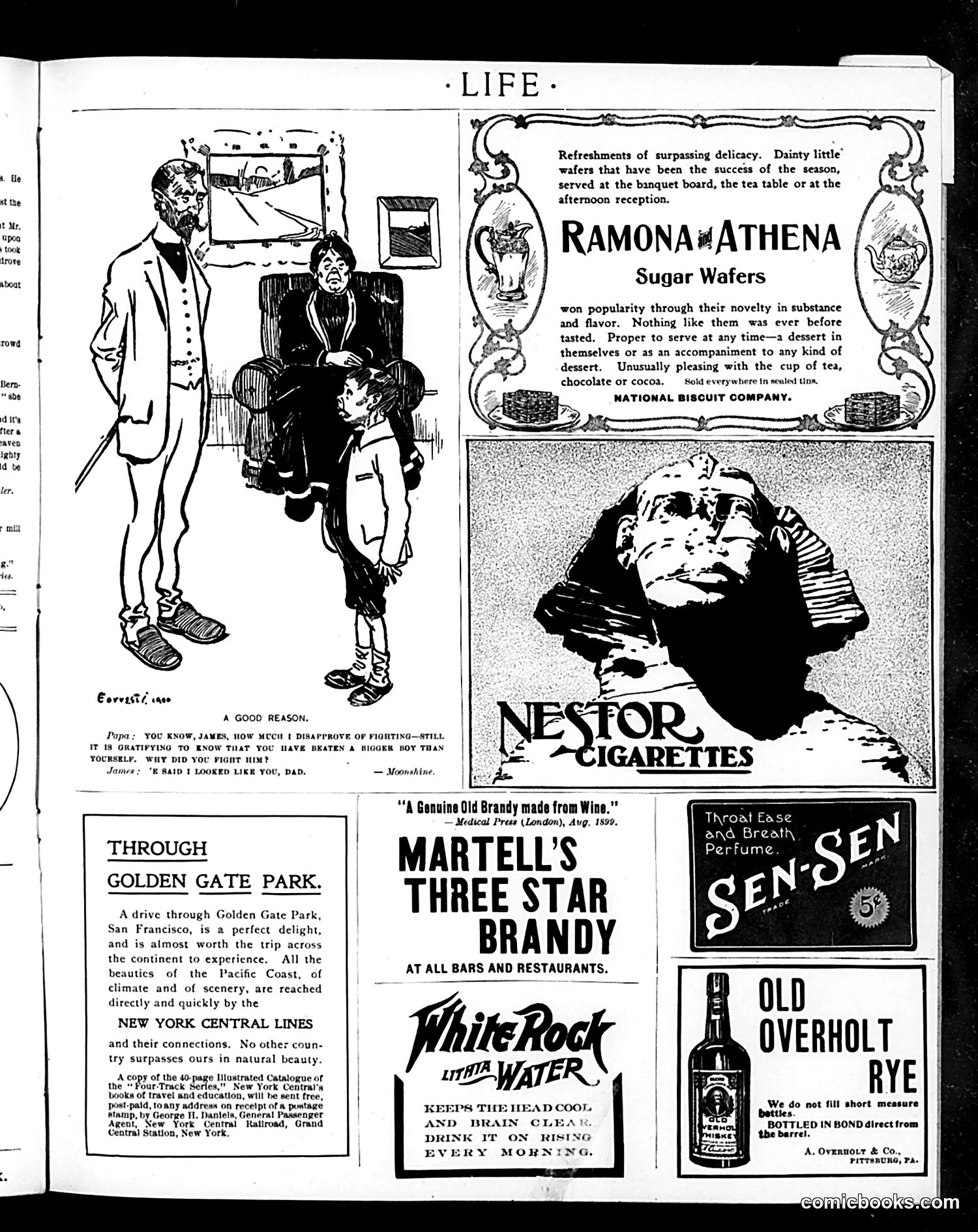
This page is primarily **advertisements** for consumer products, typical of early 20th-century American magazines. The one **cartoon** ("A Good Reason") depicts a father and son conversation. A father disapproves of fighting but is pleased his small son beat a larger boy. When asked why he fought, the boy says the other boy "looked like you, Dad"—implying the father looks rough or unpleasant. The joke mocks the father's appearance while also satirizing parental hypocrisy about violence. The advertisements promote luxury goods: **Ramona & Athena Sugar Wafers** (upscale biscuits), **Martell's Three Star Brandy**, **Nestor Cigarettes**, **Sen-Sen** breath mints, **White Rock Lithia Water**, and **Old Overholt Rye** whiskey. There's also a tourism ad for Golden Gate Park via New York Central Lines. These ads reflect Gilded Age consumer culture and the normalization of alcohol and tobacco marketing to general audiences—practices that would later face restriction.
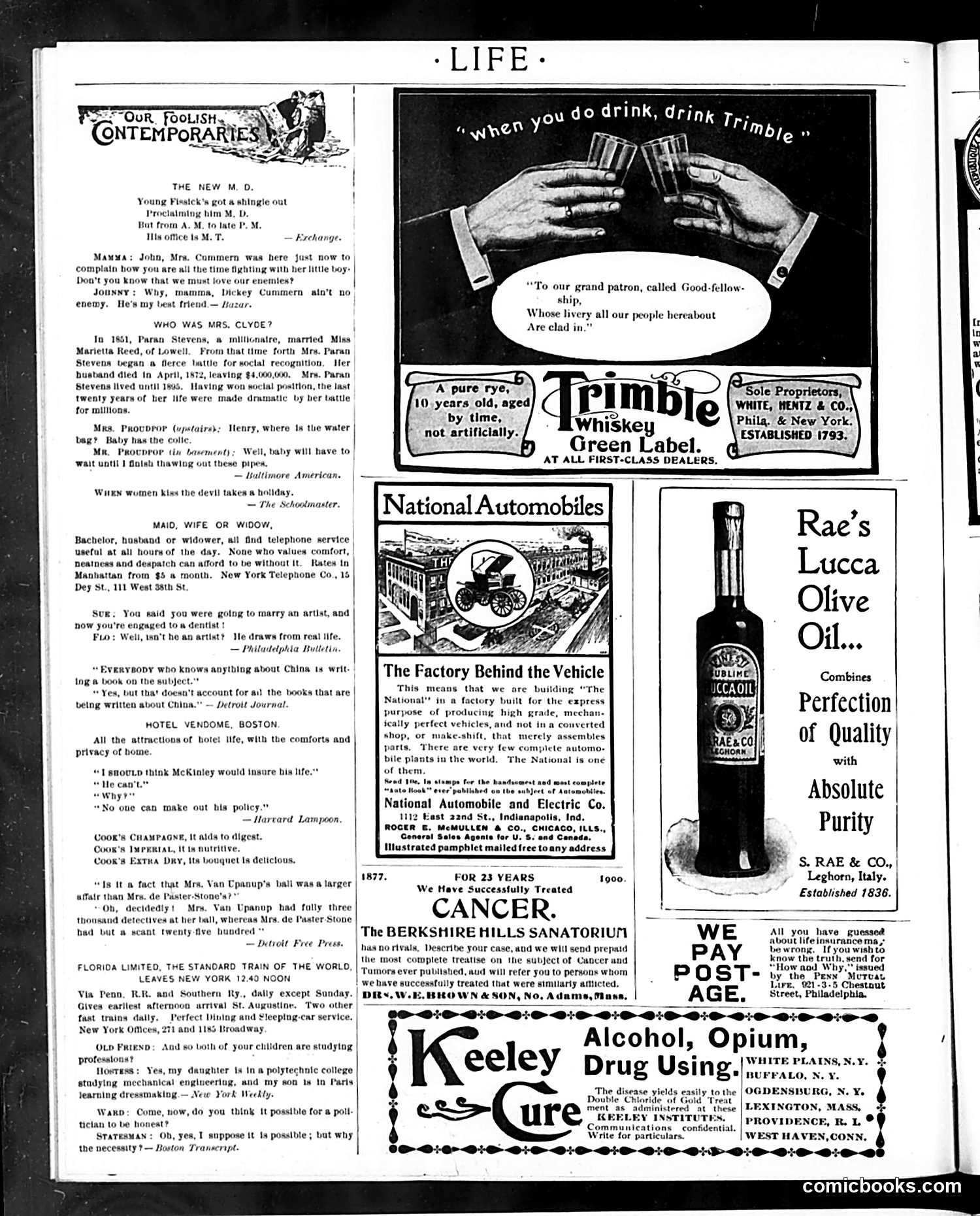
This page from *Life* magazine contains satirical commentary and period advertisements typical of early 1900s American humor. **"The New M.D."** mocks a young doctor (Fissick) who advertises as a physician but operates from a telegraph office—suggesting he's not a legitimate medical professional but merely uses the office as a front. **"Who Was Mrs. Clyde?"** presents a factual biographical account of Paran Stevens, a wealthy woman who fought for social recognition after her husband's death in 1872, gaining position through wealth rather than birth—satirizing nouveau-riche social climbing. **The humorous dialogues** include jokes about marital tension, children's behavior, and professional pretension (the dentist "artist" joke). **Advertisements** dominate the lower portion: Trimble Whiskey, National Automobiles, olive oil, and a "Keeley Cure" for alcohol and drug addiction—reflecting period concerns about substance abuse. The page exemplifies *Life's* blend of social satire targeting professional fraud, class aspiration, and commercial absurdity popular among educated readers of that era.
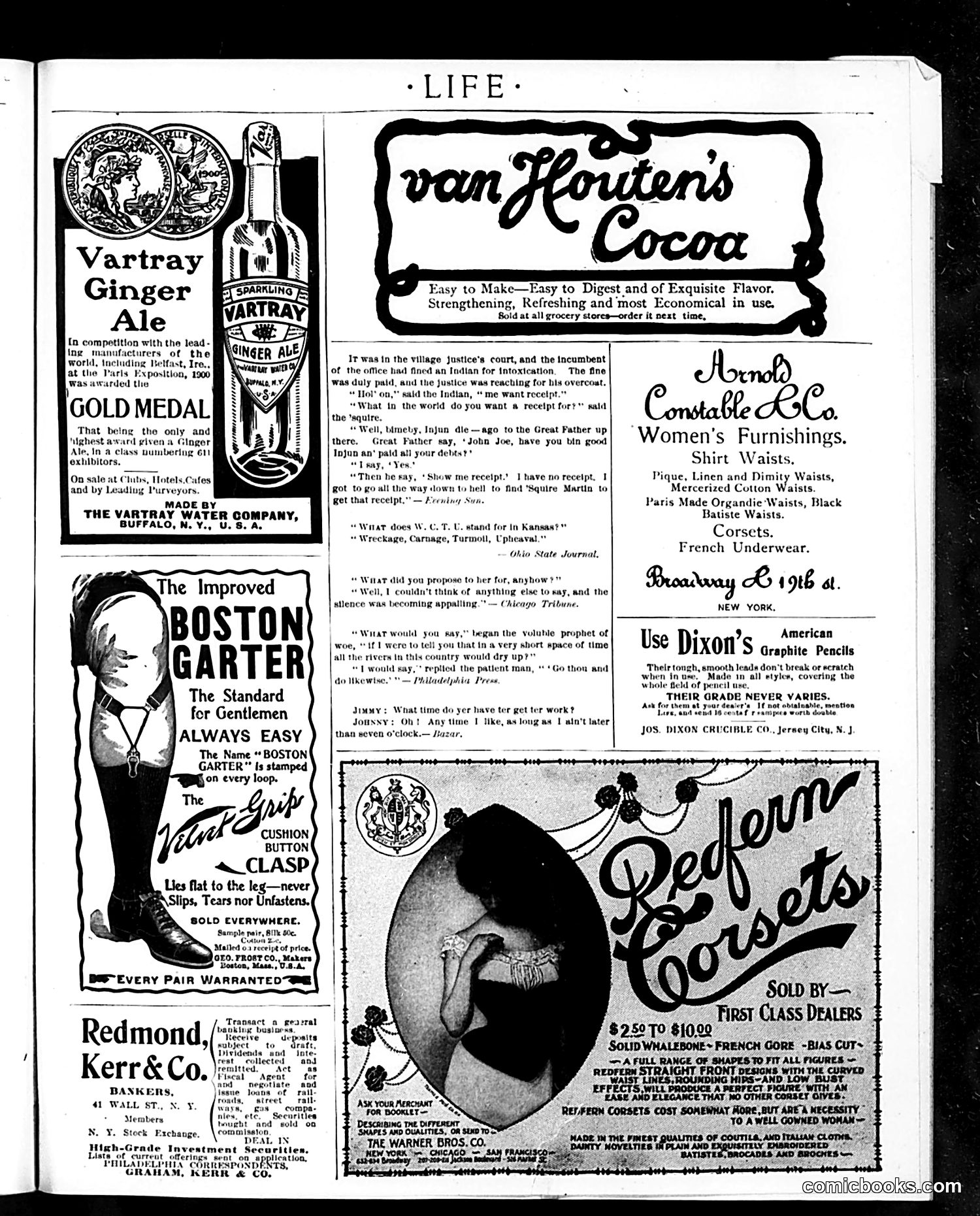
This page is primarily **advertising** with embedded **humor pieces** typical of early 1900s Life magazine. The main satirical content includes: 1. **"Indian Receipt" joke**: A Native American character insists on a receipt for a fine paid to a village justice, explaining he needs proof for the "Great Father" (God/afterlife authority). The humor relies on period stereotypes about Native Americans and their supposed spiritual worldview. 2. **Miscellaneous brief jokes** about: - The W.C.T.U. (Women's Christian Temperance Union) causing "wreckage, carnage, turmoil"—mocking temperance advocates - A proposal made out of conversational desperation - A employment timing question The **advertisements** hawk period products: Vartray Ginger Ale (gold medal winner), Boston Garters (men's suspenders), corsets, waists, and graphite pencils. The page reflects early-1900s commercial culture and casual use of ethnic stereotyping in humor—both now-dated conventions a modern reader would find offensive or confusing without historical context.
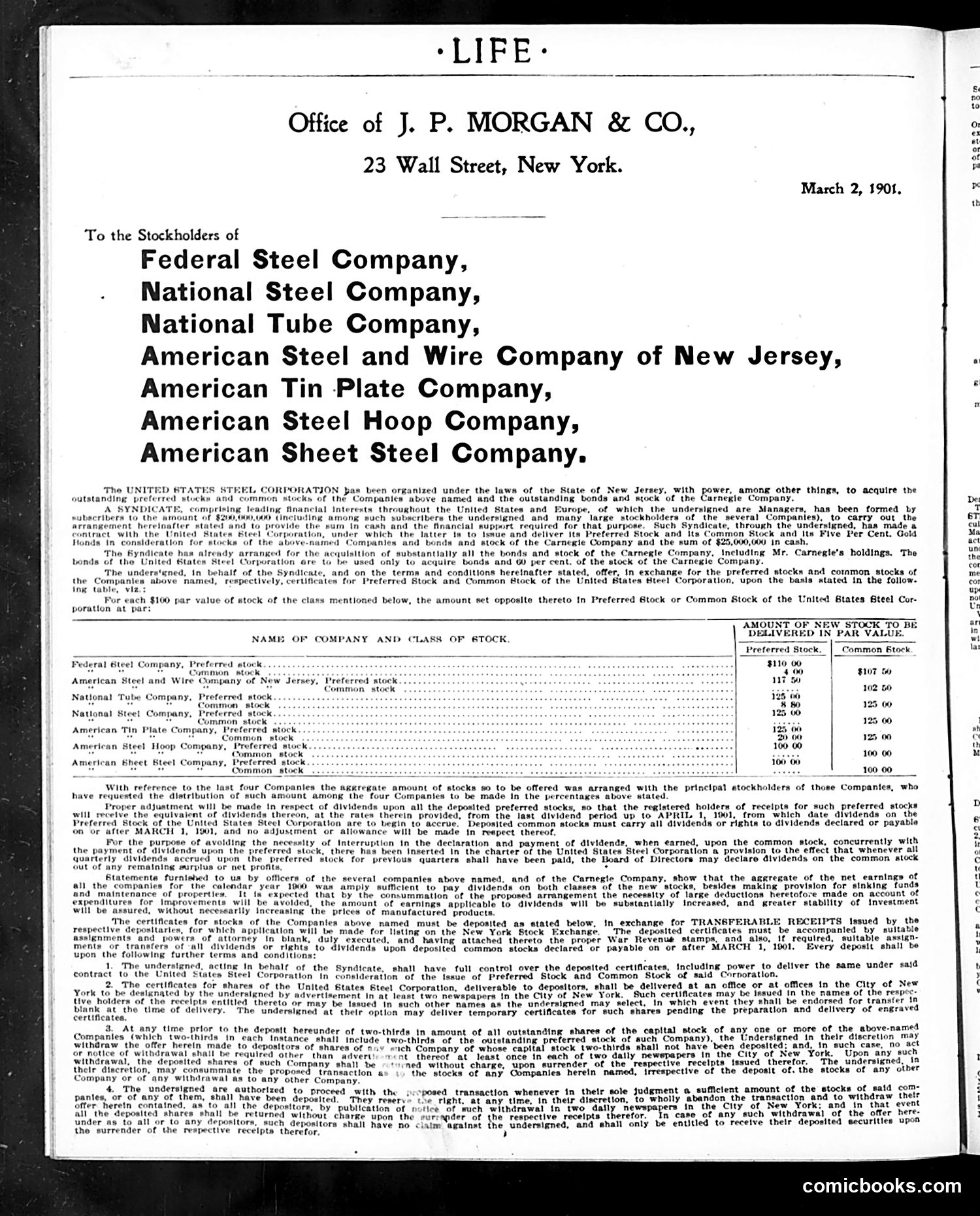
This is **not a cartoon page**—it's a financial prospectus/advertisement. The Office of J.P. Morgan & Co. announces the formation of the **United States Steel Corporation**, a massive merger combining seven major steel companies (Federal Steel, National Steel, National Tube, American Steel and Wire, American Tin Plate, American Steel Hoop, and American Sheet Steel). The document details a stock exchange offer whereby shareholders of these companies would receive preferred and common stock in the new consolidated corporation. Notably, it mentions acquiring **Carnegie Company** holdings—a reference to Andrew Carnegie's steel interests, which the Morgan syndicate was acquiring. **For modern readers:** This represents the birth of U.S. Steel, one of history's largest corporate consolidations, executed by financier J.P. Morgan. It exemplifies the Gilded Age "trust" movement that would later trigger antitrust legislation. The page is a primary historical document of American industrial monopoly-building.
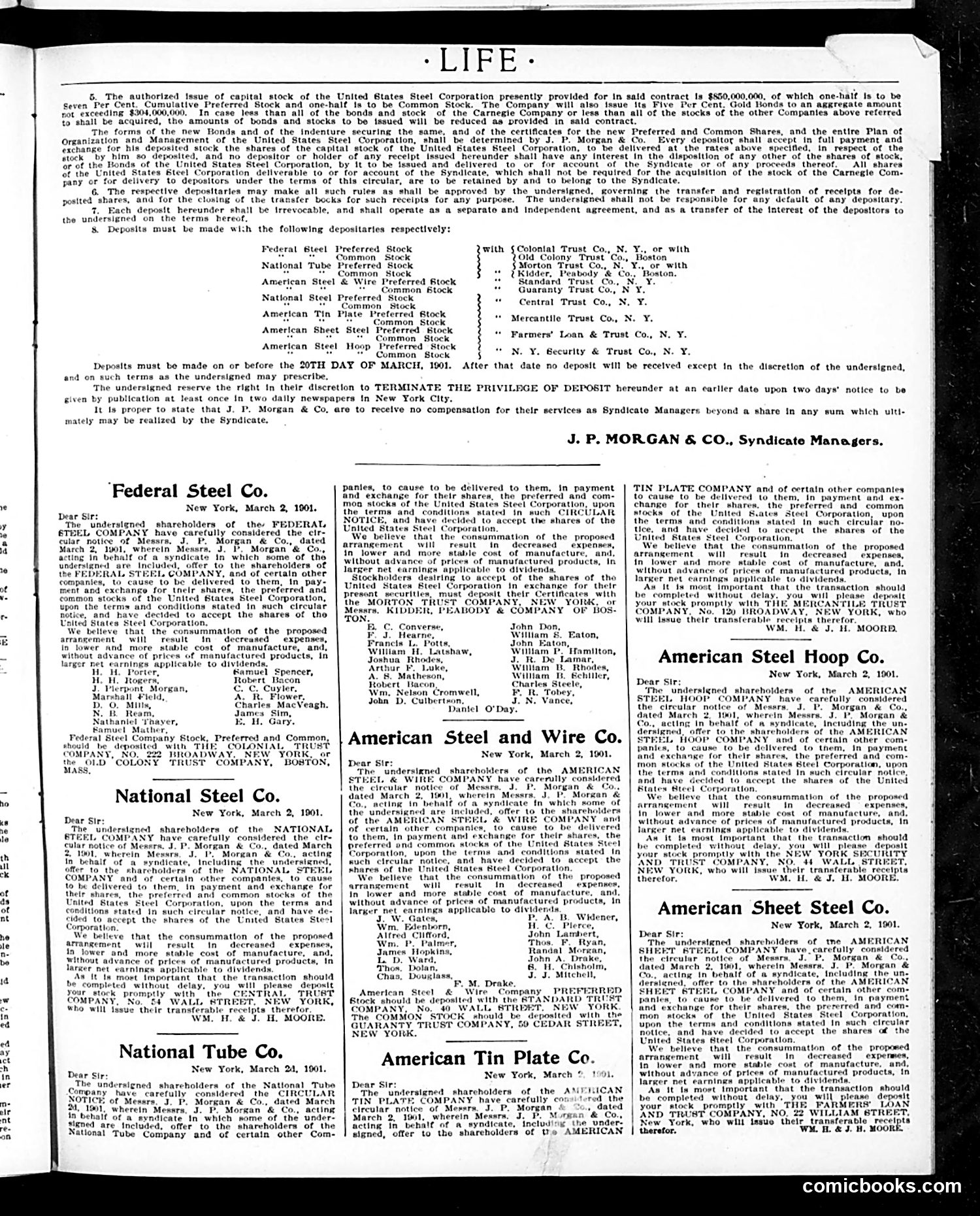
This page is primarily **financial documentation**, not a satirical cartoon. It consists of corporate notices and letters from major American steel companies (Federal Steel Co., National Steel Co., National Tube Co., American Steel and Wire Co., American Steel and Hoop Co., American Sheet Steel Co., and American Tin Plate Co.) dated March 1901. The document describes the formation of the **United States Steel Corporation** through a massive merger orchestrated by **J.P. Morgan & Co.** as syndicate managers. It outlines the exchange of stock, creation of bonds, and deposit procedures for shareholders. This reflects the "Gilded Age" era of massive industrial consolidation and the enormous power wielded by investment bankers like Morgan in reshaping American capitalism. The merger created what was then the world's largest steel company, consolidating competing firms into one monopolistic entity—a practice that would later trigger antitrust concerns.
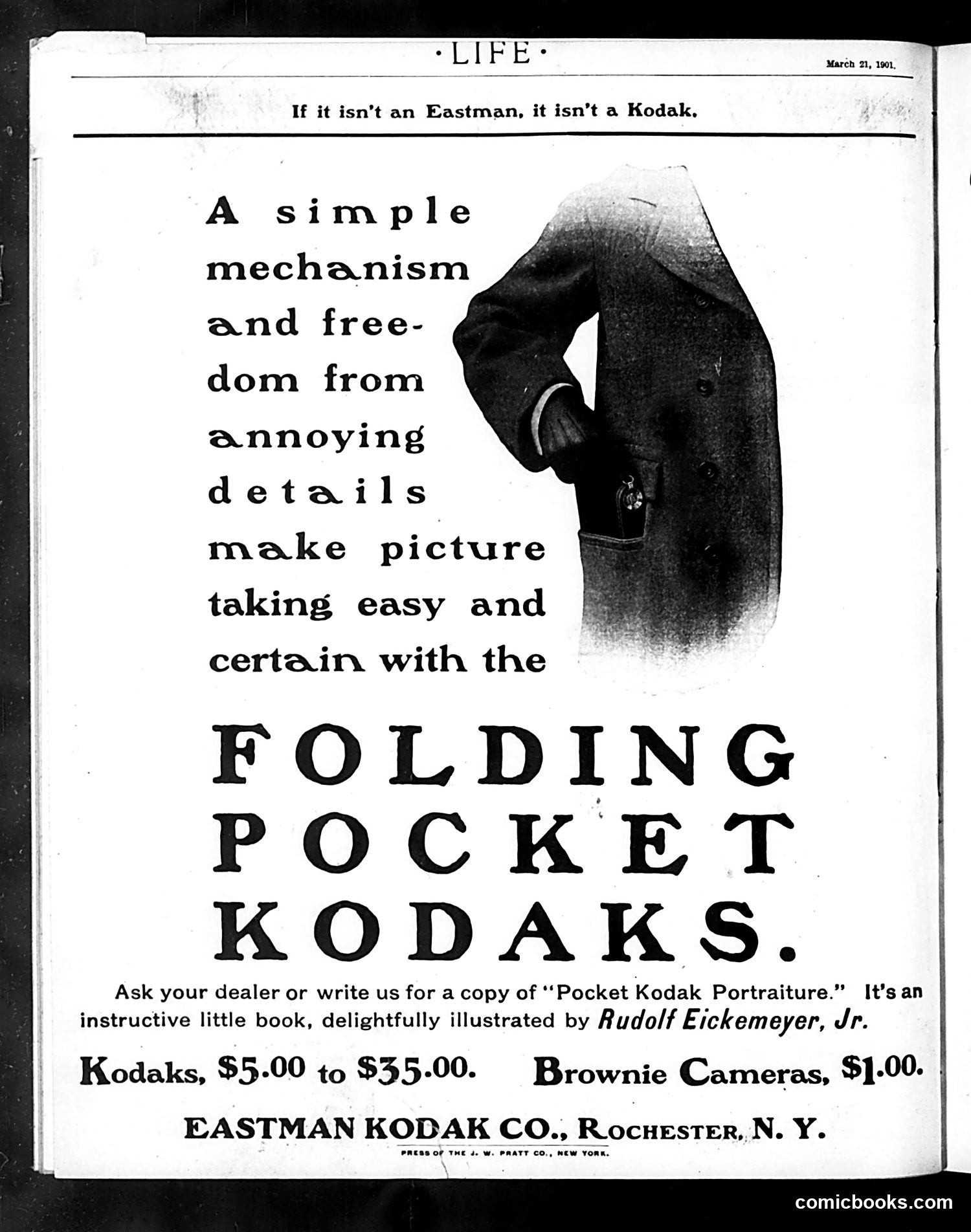
This is primarily a **Kodak camera advertisement**, not satire. The page promotes Eastman Kodak's "Folding Pocket Kodaks" to *Life* magazine readers. The image shows a **woman in period dress** (early 1900s) holding a folding camera, demonstrating the product's compact design. The ad emphasizes the camera's simplicity—"freedom from annoying details"—appealing to amateur photographers, particularly women, who were an emerging market for consumer cameras. The tagline "If it isn't an Eastman, it isn't a Kodak" establishes Kodak's market dominance. Prices ranged from $5-$35, with cheaper "Brownie Cameras" at $1.00, making photography accessible to middle-class consumers. The advertisement credits photographer **Rudolf Eickemeyer, Jr.**, suggesting professional endorsement. This represents early consumer marketing in the photography industry.