
Life, 1901-03-21 · page 4 of 22
Life — March 21, 1901 — page 4: what you’re looking at
What you’re looking at
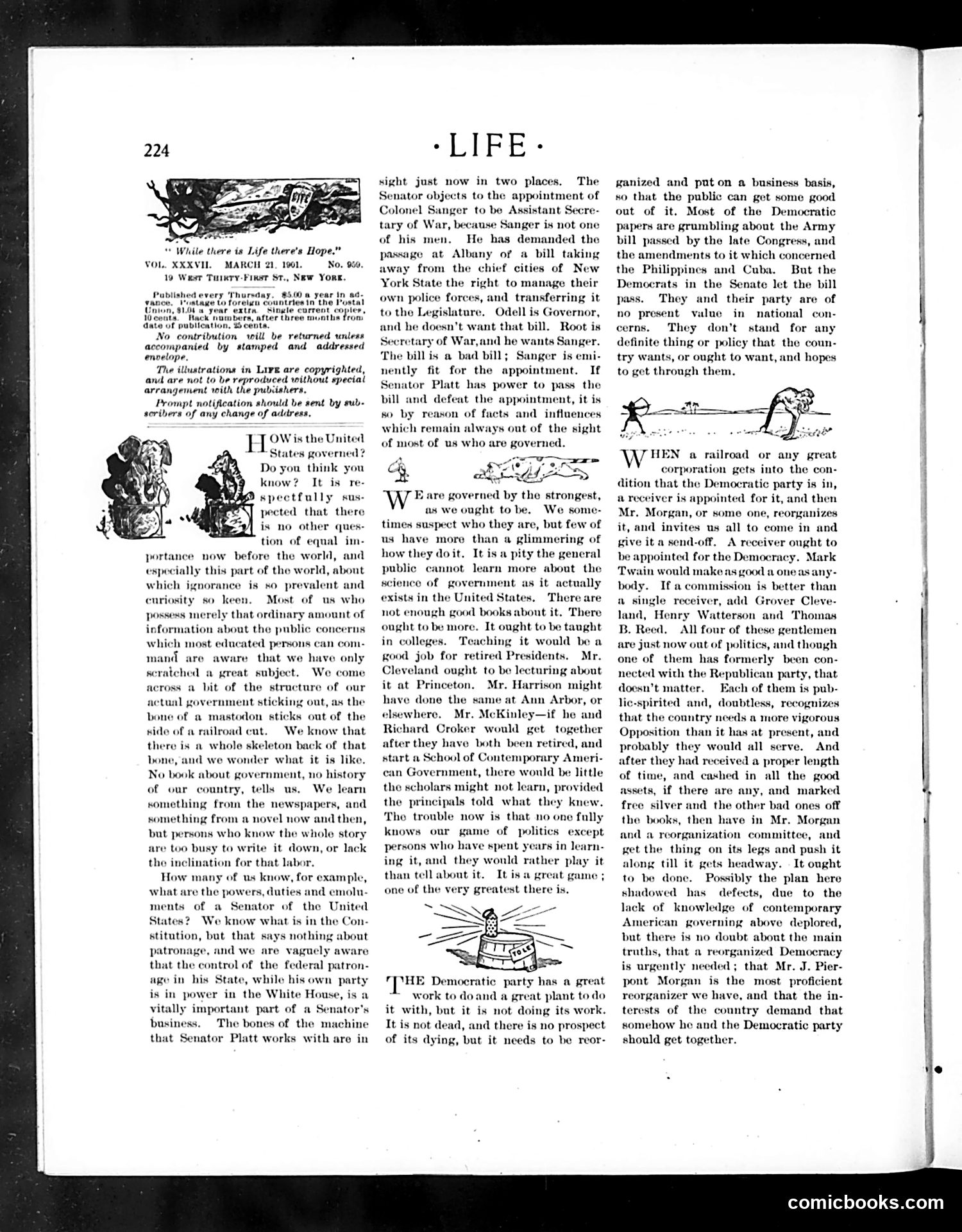
This page critiques U.S. government and Democratic Party organization through satirical commentary rather than traditional political cartoons. The text discusses how Americans poorly understand their own government, suggesting the public needs better civic education. It specifically criticizes the Democratic Party's disorganization and lack of coherent platform, noting it's "not dead" but needs reorganization. The passage mentions J. Pierpont Morgan reorganizing the Democratic Party after various politicians (including Mark Twain, allegedly) were consulted. This appears satirical—suggesting a wealthy industrialist stepping in to fix political dysfunction. Small decorative illustrations punctuate the text but don't constitute standalone cartoons with identifiable caricatures. The satire targets political incompetence and the influence of wealthy interests on American governance, typical Life magazine themes from this era.
📄 Transcribed text from this page (OCR, searchable)
Machine-transcribed from the original scan — historical spelling and the odd misread are preserved.
* While there is Life here's Hope.” VOL. XXXVI. MARCH 21. 1901, No. 90, 19 West Tuiwry-Fiast St., New York. Publish Z, Thursday. $510 a year in ad: ¥ ries in the Postal rent copter 9 months from" No contritution will be returned unless accompanied by stamped and addressed envelope. The illustrations in Live are copyrighted, and are not to be reproduced without special arrangement with the pubiishers. pt notification should be sent by sub- scribers of any change of address, I LY is the United governed? Do you think you know? It is. re- is no other ques- tion of equal iim- portance now before the world, and especially this part of the world, about which ignorance is so prevalent and curiosity so keen. Most of us who ly that ordinary amount of ormation about the public concerns which most educated persons can com- mand are aware that we have only xreat subject. We come across a bit of the structure of our actual government sticking out, as the bone of a mastodon sticks out of the sido of a railroad cut. We know that there is a whole skeleton back of that bone, and we wonder what it is like. No book about government, no history untry, tells us. We learn something from the nev pers, and something from a novel now and then, but persons who know the whole story are too busy to write it down, or lack the inclination for that labor. How many of us know, for example, what are the powers, duties and emolu- of a Senator of the United We know wi! is in the Con- nothing about and we are vaguely aware that the control of the federal patron- age in his State, while his own party is in power in the White House, is a vitally important part of a Senator's business. The bones of the machine tha nator Platt works with are in possess me of our c LIFE sight just now in two places. The Senator objects to the appointment of Colonel Sanger to be Assistant Secre- tary of War, because Sanger is not one of his men, He has demanded the passage at Albany of a bill taking away from the chief cities of New York State the right to manage their own police forces, and transferring it to the Legislature. Odell is Governor, and he doesn’t want that bill. Root is Secretary of War,and he wants Sanger. The bill is a bad bill; Sanger is emi- nently fit for the appointment. If Senator Platt has power to pass the bill and defeat the appointment, it is so by reason of facts and influences which remain always out of the sight of most of us who are governed. 4 or & aby es W Bate governed by the strongest, as we ought to be. We some- times suspect who they are, but few of us have more than a glimmering of how they doit. Itisa the general public cannot learn more about the science of government as it actually exists in the United States, There ar not enough good books about it. The ought to be more. It ought to be taught in colleges. Teaching it would be a good job for retired Presidents. Mr. Cleveland ought to be lecturing about it at Princeton. Mr. Harrison might have done the same at Ann Arbor, or elsewhere, Mr. McKinley—if he and Richard Croker would get together after they have both been retired, and t a School of Contemporary Ameri- can Government, there would be little the scholars might not learn, provided the principals told what th knew, The trouble now is that no one fully knows our game of politics except persons who have spent years in learn- ing it, and they would rather play it than tell about it. It is a great game ; one of the very greatest ther sta TPHE Democratic party has a great “ work to doand a great plant todo it with, but it is not doing its work. It is not dead, and there is no prospect of its dying, but it needs to be reor- ganized and puton a business basis, so that the public can get some good out of it. Most of the Democratic papers are grumbling about the Army bill passed by the late Congress, and the amendments to it which concerned the Philippines and Cuba. But the Democrats in the Senate let the bill pass. They and their party are of no present value in national con- cerns. They don’t stand for any definite thing or policy that the coun- try wants, or ought to want, and hopes to get through them, ‘W HEN a railroad or any great corporation gets into the cor dition that the Democratic party is in, a receiver is appointed for it, and then Mr. Morgan, or some one, reorganizes it, and invites us all to come in and give it a send-off. A receiver ought to be appointed for the Democracy. Mark Twain would makeas good a one asany- body. If a commission is better than a sin receiver, add Grover Cleve- land, Henry Watterson and Thomas B. Reed. All four of these gentlemen are just now out of politics, and though one of them has formerly been con- nected with the Republican party, that doesn’t matter. Each of them is pub- -spirited and, doubtless, recognizes that the country needs a more vigorous Opposition th it has at present, and probably they would all serve. And after they had received a proper length of time, and cashed in all the good assets, if there are any, and marked free silver and the other bad ones off the books, then have in Mr. Morgan and a reorganizat committee, and get the thing on its legs and push it along till it gets It ought to be done. Possibly the plan here shadowed has defects, due to the lack of knowledge of contemporary American governing above deplored, but there is no doubt about the main truths, that a reorganized Democracy is urgently needed ; that Mr. J. Pier- pont Morgan is the most. proficient reorganizer we have, and that the in- terests of the country demand that somehow he and the Democratic party should get together. | a comicbooks.com