
Life, 1901-03-21 · page 12 of 22
Life — March 21, 1901 — page 12: what you’re looking at
What you’re looking at
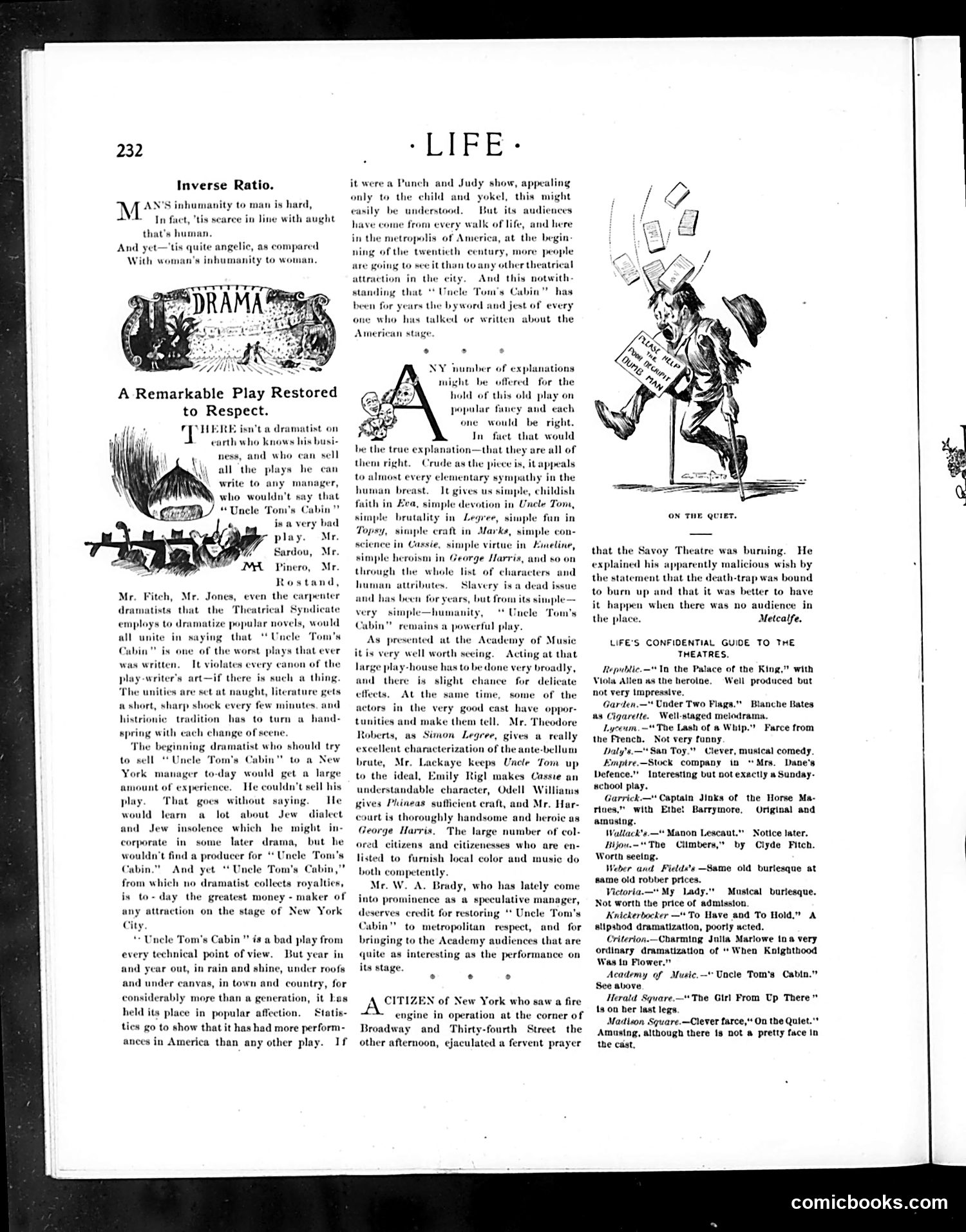
This cartoon depicts a man frantically fleeing while carrying bundles of papers or documents, with the caption "ON THE QUIET" (meaning secretly or discreetly). The illustration appears to be satirizing someone attempting to conduct illicit or shameful business away from public view. The accompanying text discusses the Savoy Theatre fire and mentions someone's "malicious wish" to burn down a building when there was no audience present—suggesting the cartoon relates to insurance fraud or property destruction motivated by financial gain rather than safety concerns. The figure's exaggerated, fleeing posture emphasizes the covert, underhanded nature of the scheme being satirized, likely targeting either theatrical management or criminal opportunism during this early 20th-century period.
📄 Transcribed text from this page (OCR, searchable)
Machine-transcribed from the original scan — historical spelling and the odd misread are preserved.
Inverse Ratio. inhumanity to man is hard, In fa that's human. And yet—'tis quite angelic, as compared t, ‘tis scarce in line with aught With woman's ii humanity to woman, eer A Remarkable Play Restored to Respect. Mi TP HERE isn't a dramatist on earth who knows his busi- ness, and who can sell all the plays he can write to any manager, who wouldn't say that “Unele Ton is a very bad 's Cabin” play. Mr. Sardou, Mr. Pinero, Mr. tostand, Mr. F Mr. Jones, even the carpenter dramatists that the Theatrical Syndicate employs to dramatize popular novels, would all unite in saying that "Unele Tom's Cabin" is one of the worst 4 was written. play -write Th ns hi spring with cach change of The beginning dramatist who should try to sell s that ever It violates every canon of the “s art—if there is » ch a thing unities are set at naught, literature gets ort, sharp shock every few minutes. and tradition hand- has to turn a trionie *Unele Tom's Cabin" to a New York manager to-day would get a large amount of experience. He couldn't sell play. That goes without saying. He would learn a lot about Jew dialect and Jew insolence which he might in- corporate in. some later drama, but he wouldn't find a producer for “Uncle Tom's Cabin.” And yet“ Unele Tom's Ca from which no dramatist collects royalties, is to-day the greatest money - maker any attraction on the stage of New York City * Uncle Tom's Cabin" és a bad play from every technical point of view. But year in and year out, in rain and shine, under roofs and unt in”? er canvas, in town and countr, for considerably more than a generation, it Les held its place in popular affe pn. Statis- ties go to show that it has had more perform- if ances in America than any other play. “LIFE « a Punch and Judy show, appealing y to the child and yokel, this might easily be un it wer But its audiences ne from every walk of life, and here metropolis of America, at the begi ning of the twenticth century, more people are g it than toany other theatrical attraction in the eity standing that wen for years the byword erstood, haw int ig to And this notwith- “Unele Tom's 1” has J jest of every one who hus talked of written about the Ameris un stage. r ° ° NY dumber of explanations might for the hold of thiy old play on popular fancy and one would be right. In fact that would be the true explanation—that they are all of, them right. be offered ach Crude as the piece is, it appeals thy in thy to almost every elementary symp human breast. It childish faith in Bea, simple devotion in Uncle Tom, simple brutality in Legree, simple fan in Topsy, simple craft in Marks, simple con- science in Cassie, simple virtue in. Emeline, George Harris, and soon whole list of characters and Slavery isa dei years, but from its sin humanity, "Ur powerful play. As presented at the Academy of Musi it is ve ves us simple heroism i through th Human attributes. and has been ay * remains a very s\ Tom's y well worth seeing. Acting at that y s to be done very broadly, and there is slight for delicate effets, At the same time, some of the actors in the very good cast have oppor- tunities and make them tell. Mr. Theodore Roberts, as Simon Legree, gives a really excellent characterization of the ante-bellum brute, Mr. Lackaye keeps Uncle Tom w to the ideal, ily Rigl makes Cassie an understandable character, Odell Williams gives Phineas sufficient craft, and Mr. Har- court is thoroughly handsome and heroic as George Harris, The large number of col- ored citizens and large play-house h Hee zenesses who are en- listed to furnish local color aud music do both competently. Mr. W. A. Brady, who has lately come into prominence as a speculative manager, deserves credit for restoring * Uncle Cabin” respect, and for ‘om's 2” to metropolitan ‘ing to the Academy audiences that are quite as interesting as the performance on its stage. A CITIZEN of New York who saw a fire ~L engine in operation at the corner of Broadway and Thirty-fourth Street. the other afternoon, ejaculated a fervent prayer ° . ° on The quiet. that the Savoy Theatre was burning. He explained his apparently malicious wish by the statement that the death-trap was bound to burn up and that it was better to have it happen when there was no audience in Metcalfe. the place. LIFES CONFIDENTIAL GUIDE TO THE THEATRES. Republic.—" In the Palace of the Kin Viola Allen as the herolne. not very impressive. 7 with Well produced but Garden.—"* Under Two Flags.” Blanche Bates as Cigarette. Well-staged melodrama. Lyceum. =" The Lash of a Whip. the French. Not very funny Daly’s.—" San Toy." Clever, musical comedy, Empire—Stock company in “Mrs. Dane's Defence." Interesting but not exactly a Sunday- schoo! play. Garrick.—" Captain Jinks of the Horse Ma- Fines.” with Ethe! Barrymore. Original and amusing. Wallack'a —“ Manon Lescaut.” Bijon.—""The Climbers,” by Worth seeing. Weber and Fietds’s Same old burlesque at same old robber prices. Victoria.—" My Lady." Mustcal burlesque. Not worth the price of admtsston. Knickerbocker —* To Have and To Hold.” A alipshod dramatization, poorly acted. Criterion.—Charming Julia Marlowe tna very ordinary dramatization of “When Knighthood Was tn Flower.” Academy of Music. See above Herald Square.—“The Girl From Up There" ts on her last legs. Madison Square.—Clever farce,“ On the Quiet."* Amusing, although there 1s not a pretty face In the cast, Notice later. Clyde Fitch. Uncle Tom's Cabin.” comicbooks.com