
A complete issue · 20 pages · 1901
Life — January 3, 1901
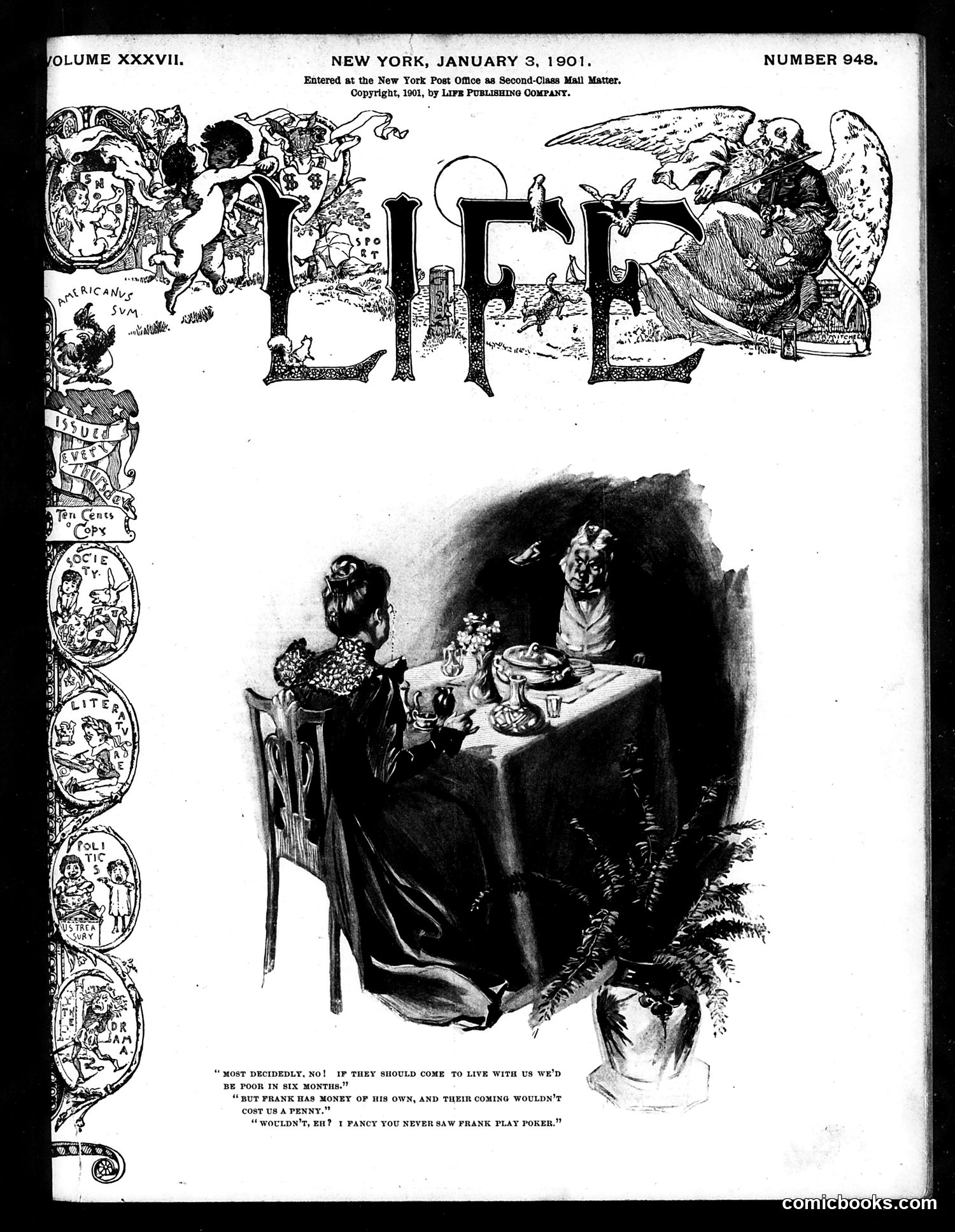
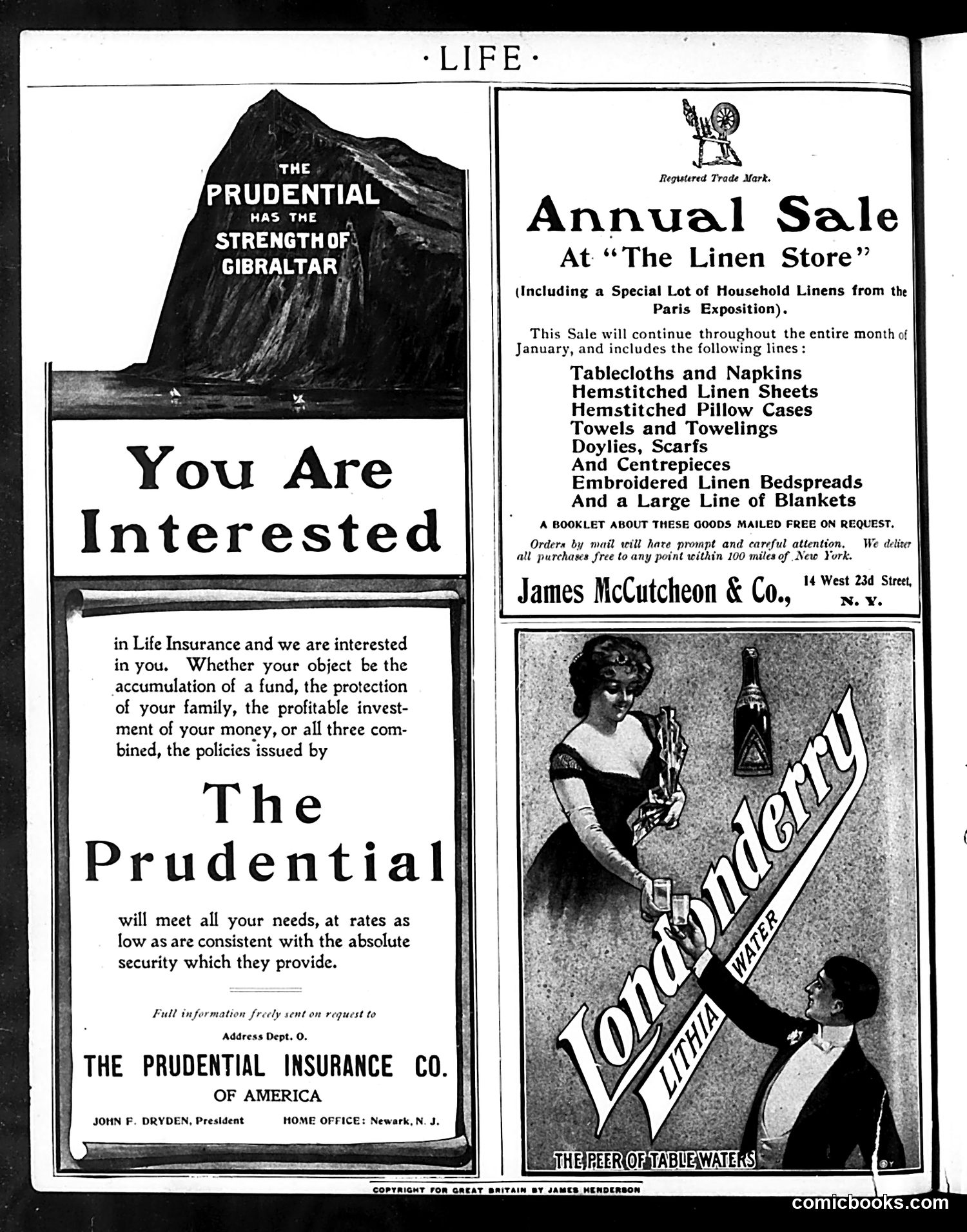
This page contains **advertising, not satire or political cartoons**. The left side advertises The Prudential Insurance Company of America, using an image of the Rock of Gibraltar to symbolize strength and stability—a common early-20th-century marketing strategy. The tagline "You Are Interested" addresses potential customers about life insurance benefits. The right side features two advertisements: James McCutcheon & Co. promotes a linen sale, while below that, "The Beer of Table Waters" shows two figures (a woman and man) with what appears to be a beverage product. These are straightforward commercial advertisements with no political or satirical intent. The page represents typical Life magazine advertising content from this era.
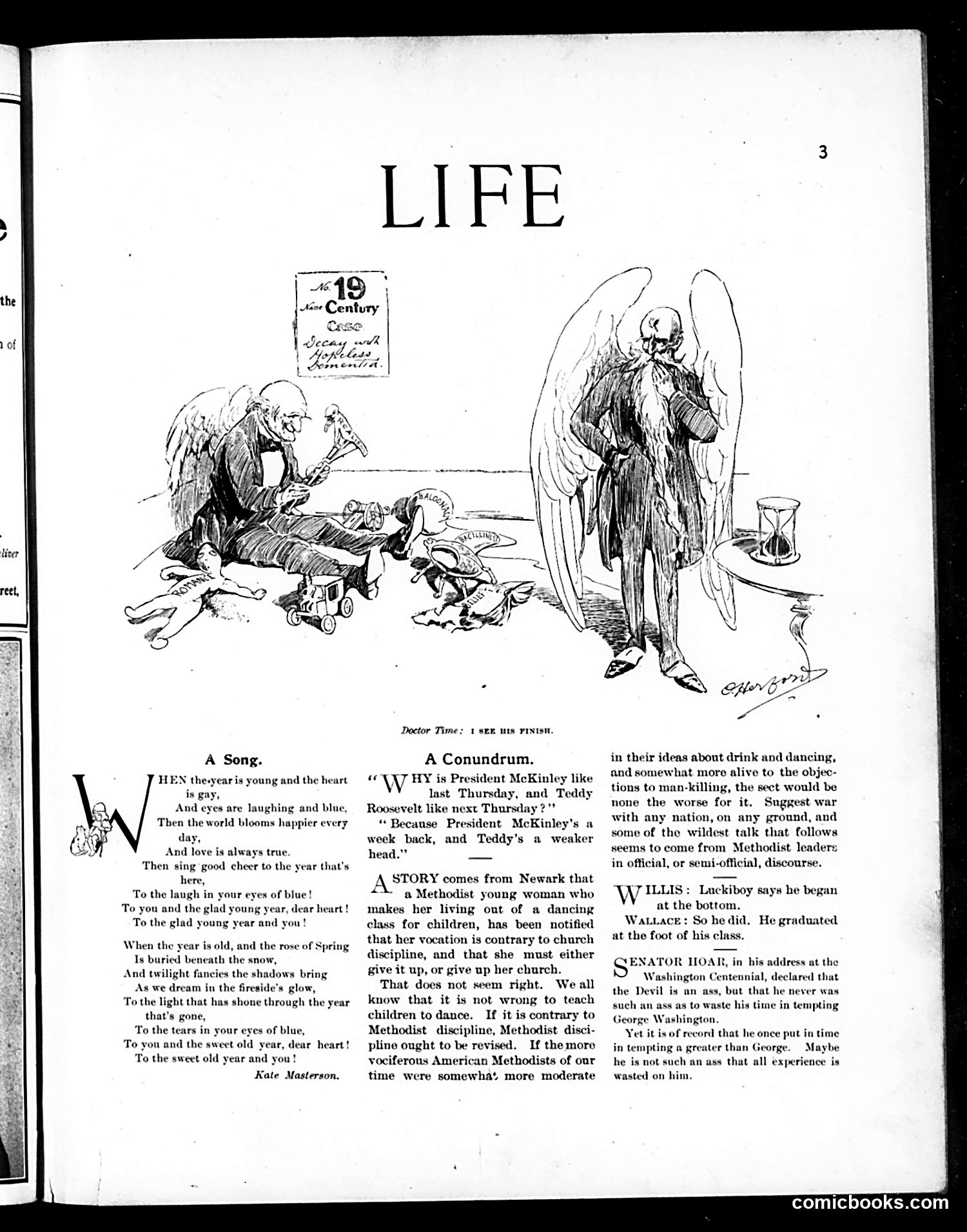
The main cartoon depicts "Doctor Time" observing two winged figures—one elderly and disheveled (left), one more dignified (right)—examining toys and items scattered on the ground. The caption reads "I see his finish." The accompanying text discusses Methodist church discipline, specifically criticizing a Newark Methodist woman teaching dance to children despite church prohibitions. The editorial argues Methodist doctrine should be modernized. References to Presidents McKinley and Theodore Roosevelt appear in "A Conundrum," playing on their relative ages and vigor. "A Song" by Kate Masterson provides sentimental verse about youth and love. The overall tone suggests early 20th-century debates about religious modernization versus tradition, and comments on aging leadership. The cartoons employ allegorical and satirical commentary on contemporary social and political issues.
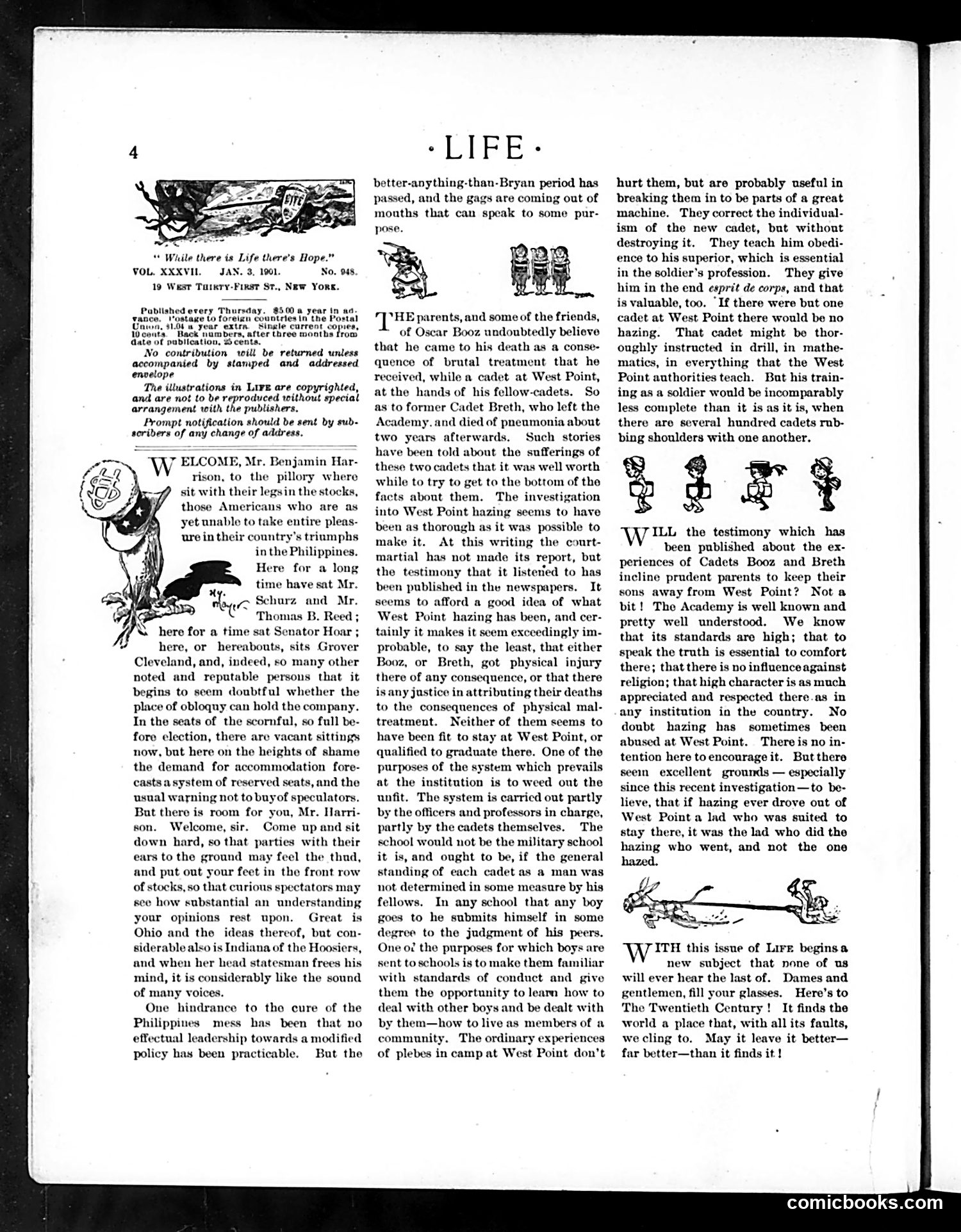
**Main Content:** This page discusses West Point hazing incidents involving cadets Oscar Booz and Breth, who reportedly suffered brutal treatment from fellow cadets. The text defends West Point's disciplinary system while acknowledging the investigation into these specific cases. **Left Cartoon:** Features a welcoming figure (possibly Uncle Sam or Columbia) greeting "Mr. Benjamin Harrison" to "the pillory"—a satirical critique suggesting Harrison's administration is being mocked or tested by the Philippine situation and other political challenges. **Small Illustrations:** Four figures appear to depict cadets or soldiers in various poses, likely illustrating the hazing discussion. **Context:** This reflects late-1890s concerns about military academy discipline and Harrison-era foreign policy controversies, particularly regarding the Philippines.
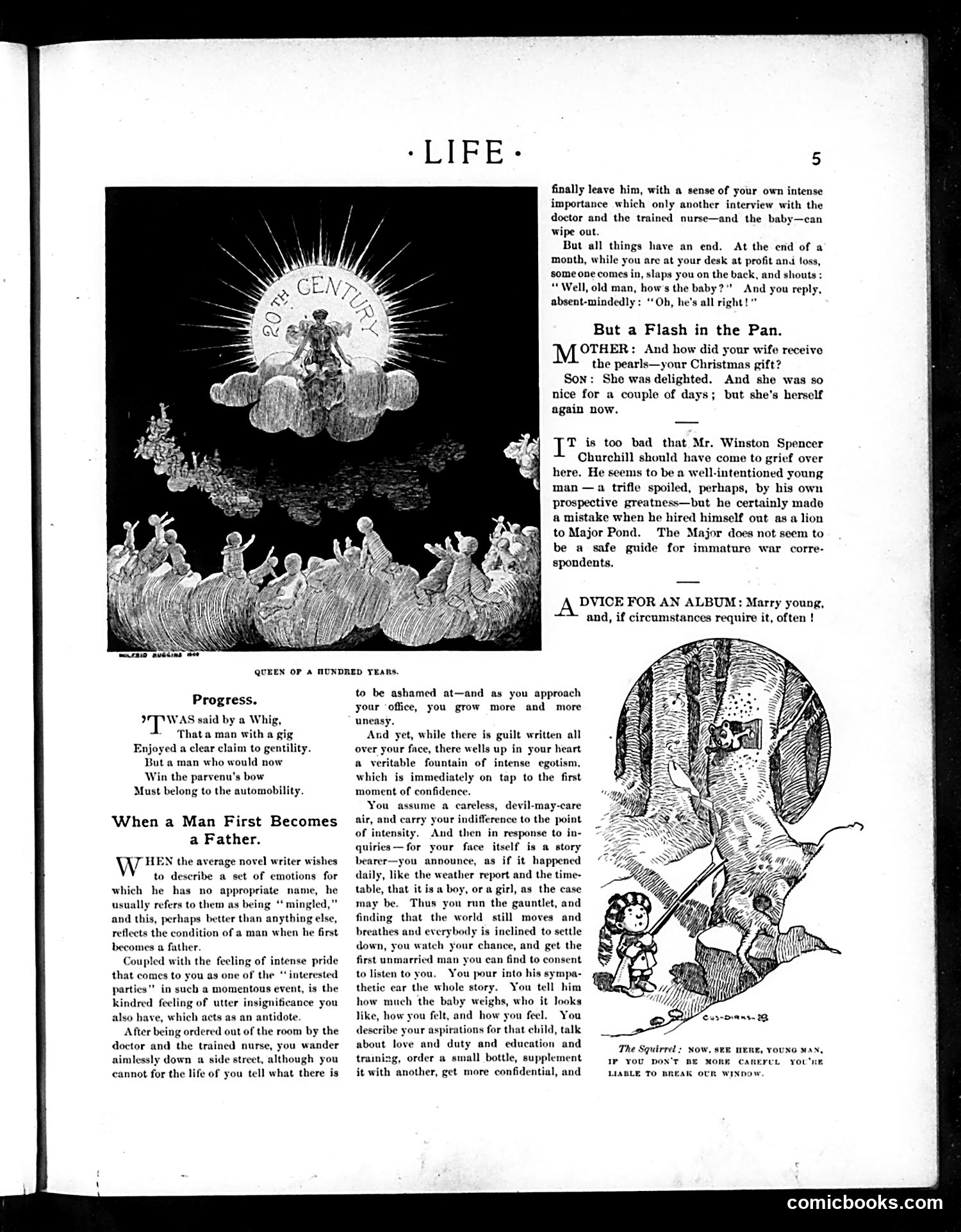
This page contains satirical commentary on early 20th-century American life, not political cartoons. The main illustration shows a cherub labeled "Queen of a Hundred Years" presiding over earthly figures below—likely representing Progress and humanity's advancement. The text discusses three topics: a man who must "belong to the automobile" (satirizing car culture's grip on society), becoming a father (mocking the emotional awkwardness men experience announcing births), and a dismissive comment about "Mr. Winston Spencer Churchill" as an "ill-adventioned young man" spoiled by wealth who made poor military decisions. The small illustration of an elephant with a child references the saying "liable to break our window"—a visual joke about size and danger. The satire targets social pretension, modern technology's dominance, and British political figures of the era.
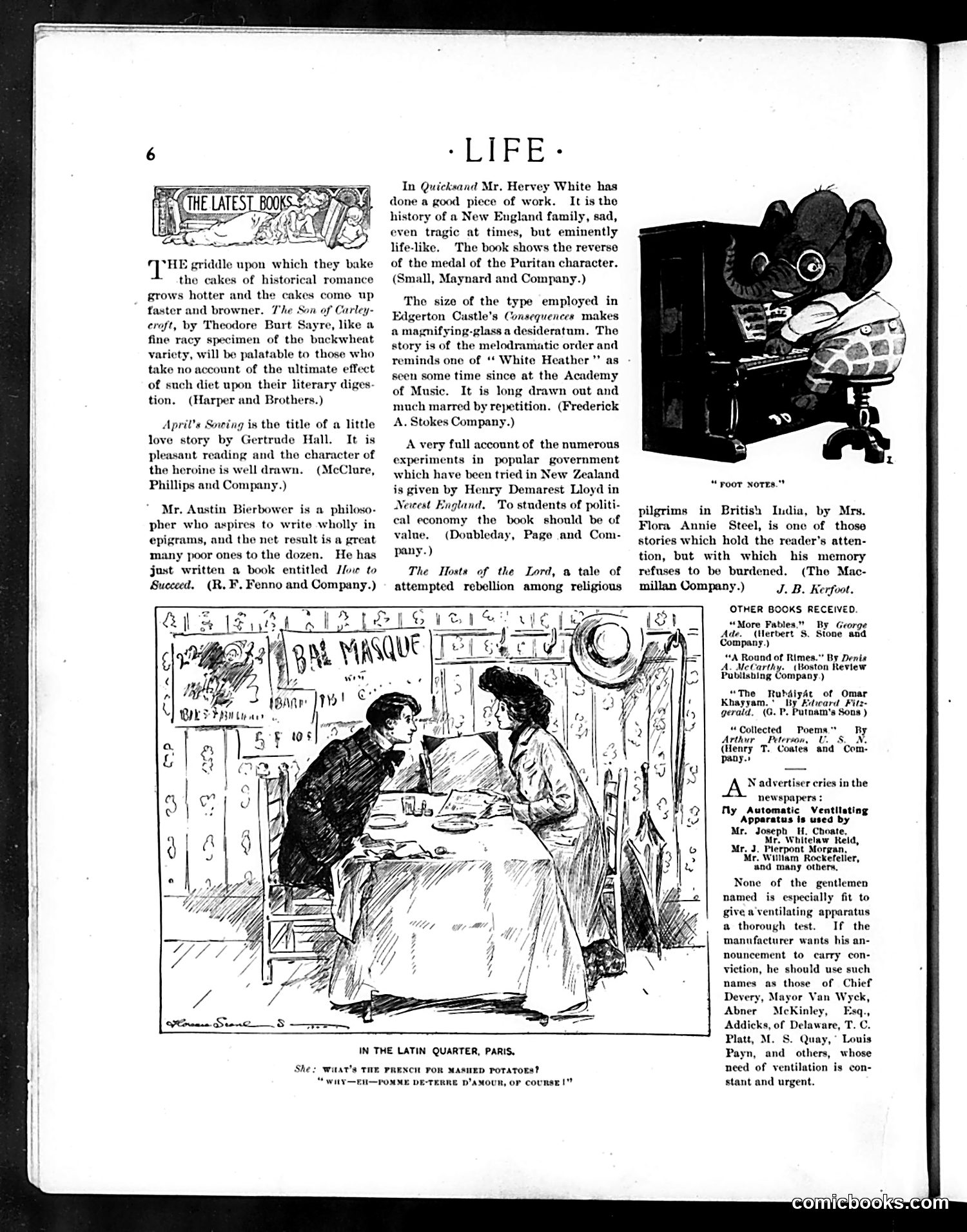
The main cartoon, titled "IN THE LATIN QUARTER, PARIS," depicts two figures in what appears to be a Parisian café or restaurant. The caption reads: "She: WHAT'S THE FRENCH FOR WASHED POTATOES? / 'WHY—EH—POMME-DE-TERRE D'AMOUR, OF COURSE!'" **The Joke:** This is a play on language and romantic stereotyping. "Pommes de terre" literally means "potatoes" in French (earth apples), but the male character humorously—and falsely—translates it as "pommes-de-terre d'amour" (potatoes of love), inventing a romantic-sounding phrase to impress the female companion. The satire mocks both the pretentiousness of Parisians and the gullibility of tourists who might be charmed by faux-romantic rebranding of mundane things. It's gentle social commentary on romance, deception, and cultural tourism.
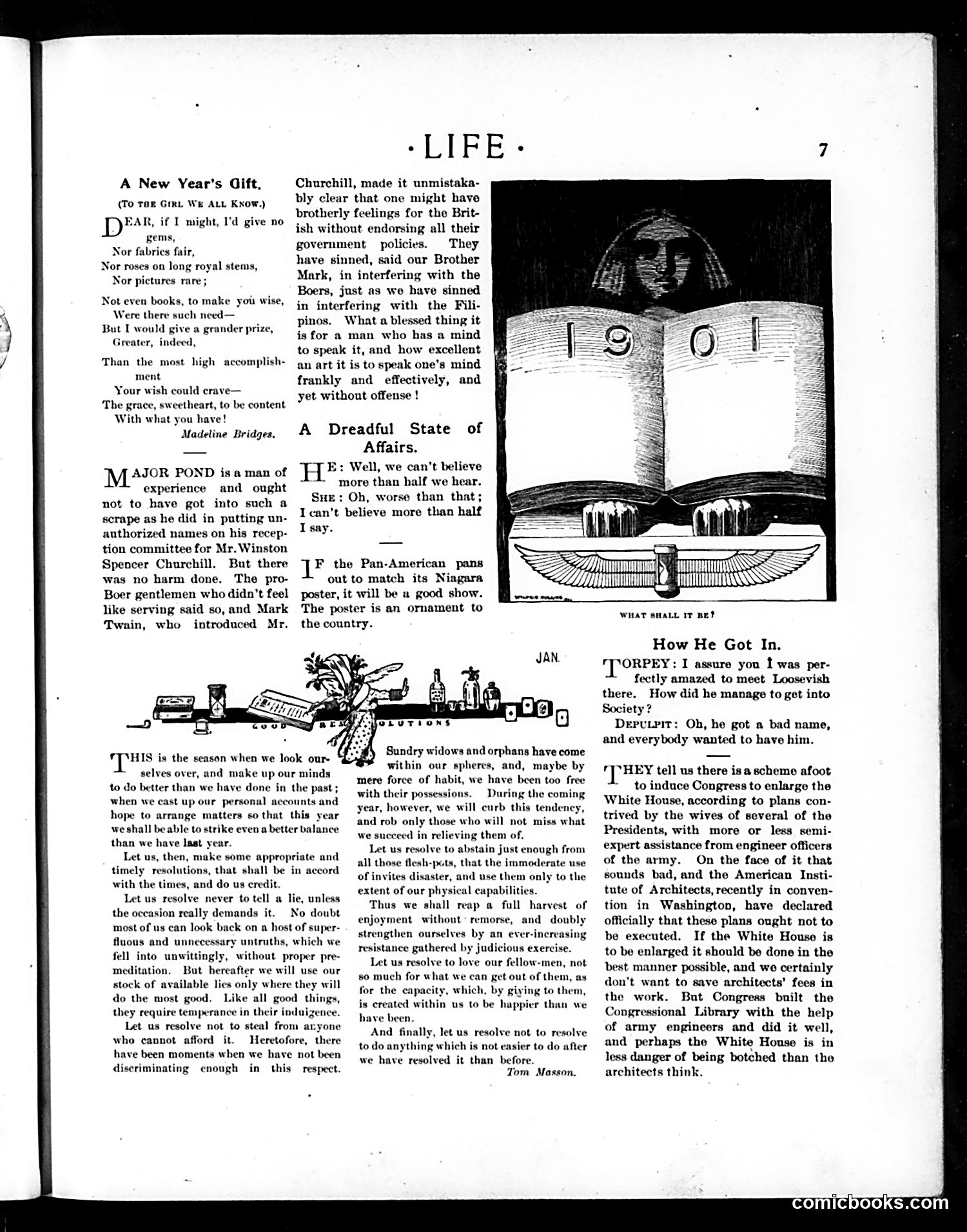
The cartoon depicts a large structure resembling a classical building or monument with the year "1900" prominently displayed. The image appears to be asking what America should construct or accomplish as the new century begins. The accompanying text discusses architectural proposals for enlarging the White House, apparently a topic of Congressional debate. The passage satirizes disagreements between politicians and architects about whether the expansion should proceed, with concerns that Congress might "botch" the project worse than professional architects could manage. The cartoon seems to represent the broader question facing America at the century's turn: what legacy or infrastructure will define the coming era? The tone is skeptical of governmental competence in such matters.
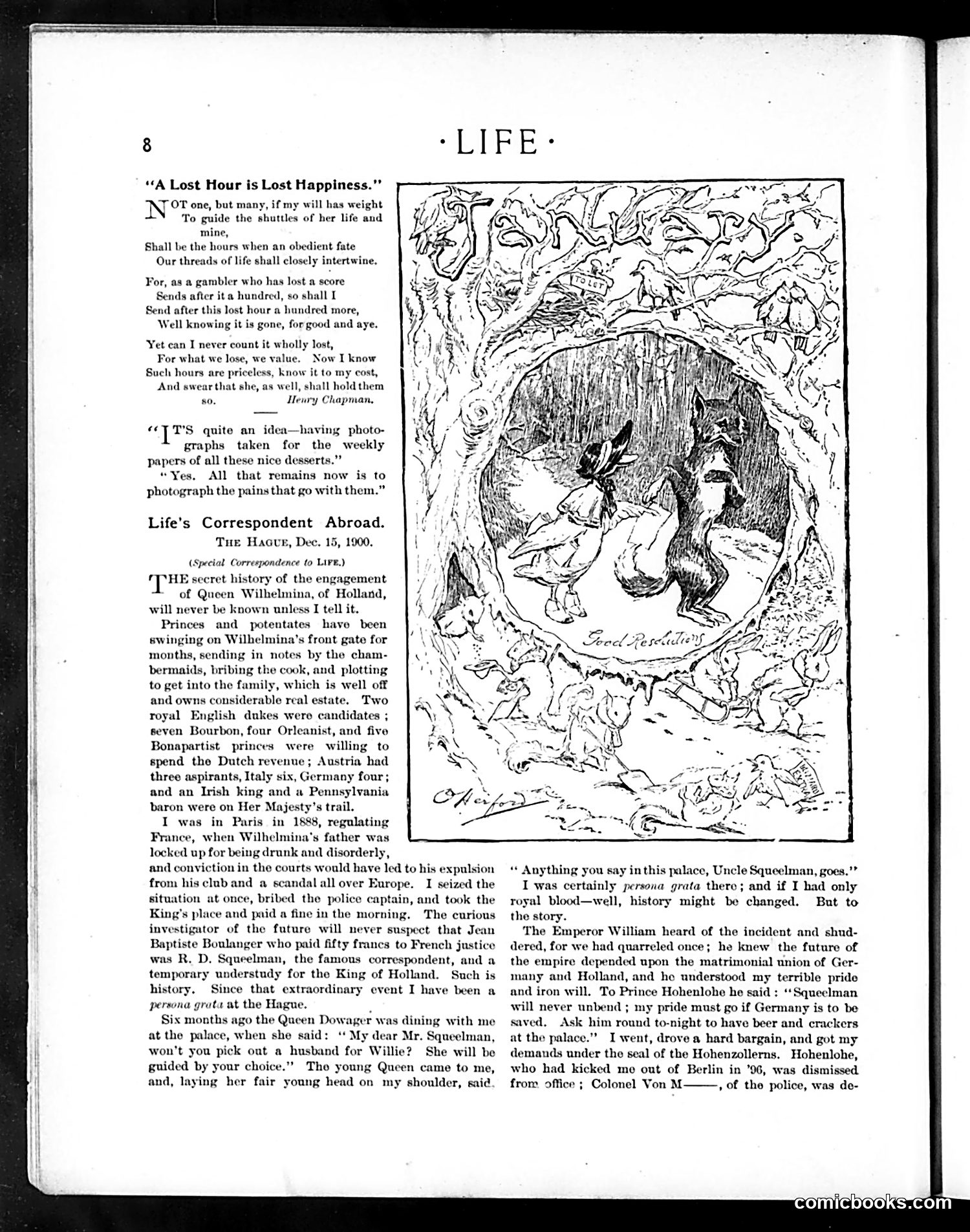
This page contains a poem titled "A Lost Hour is Lost Happiness" by Henry Chapman, paired with an illustration showing a woodland scene with animals (appears to be a badger and other creatures in a burrow or hollow tree). Below is a correspondent's dispatch from The Hague dated December 15, 1900, discussing Queen Wilhelmina of Holland's engagement. The article contains gossip about European royal intrigue—specifically an anecdote where the Queen supposedly told the correspondent "Mr. Squeelman" that she'd choose her own husband rather than accept a royal arranged marriage, defying pressure from various princes and Emperor William. The satirical point targets the machinations of European royalty and their marriages as political tools, while celebrating the young queen's independent spirit against imperial pressure.
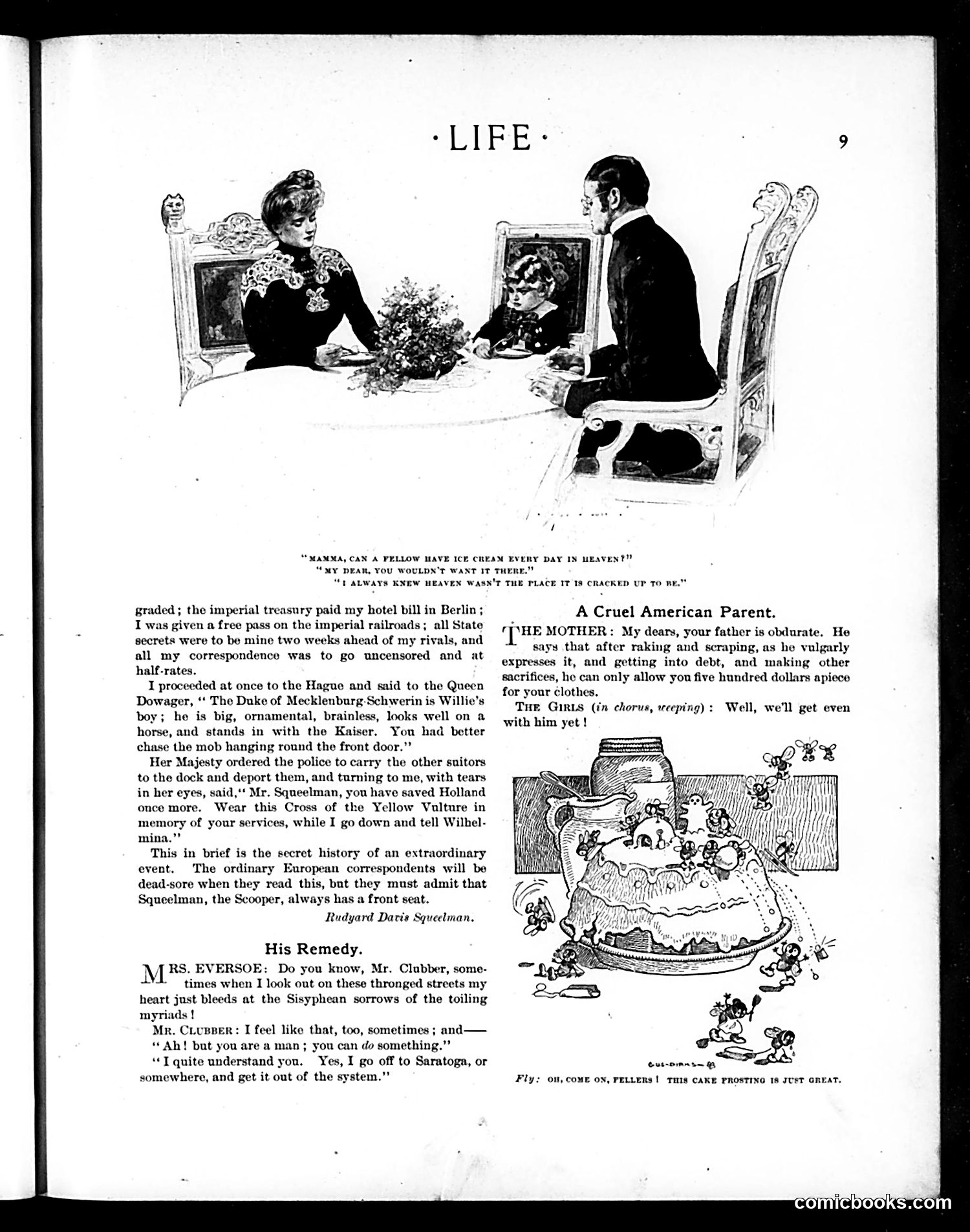
This page satirizes American parental stinginess. The sketch shows a mother telling her daughters their father will only allow them $100 annually for clothing—despite his wealth and "making and scraping" to get out of debt. The daughters' chorus response ("Well, we'll get even with him yet!") suggests they'll find ways around his restrictions. The accompanying story "His Remedy" features dialogue between Mrs. Eversoe and Mr. Clubber about the hardships of city life. Clubber suggests Saratoga (a wealthy resort destination) as an escape—implying leisure and spending as solutions to stress. Together, these pieces mock wealthy American fathers who accumulate money while denying their families reasonable luxuries, highlighting class tensions and family financial conflict in the Gilded Age.
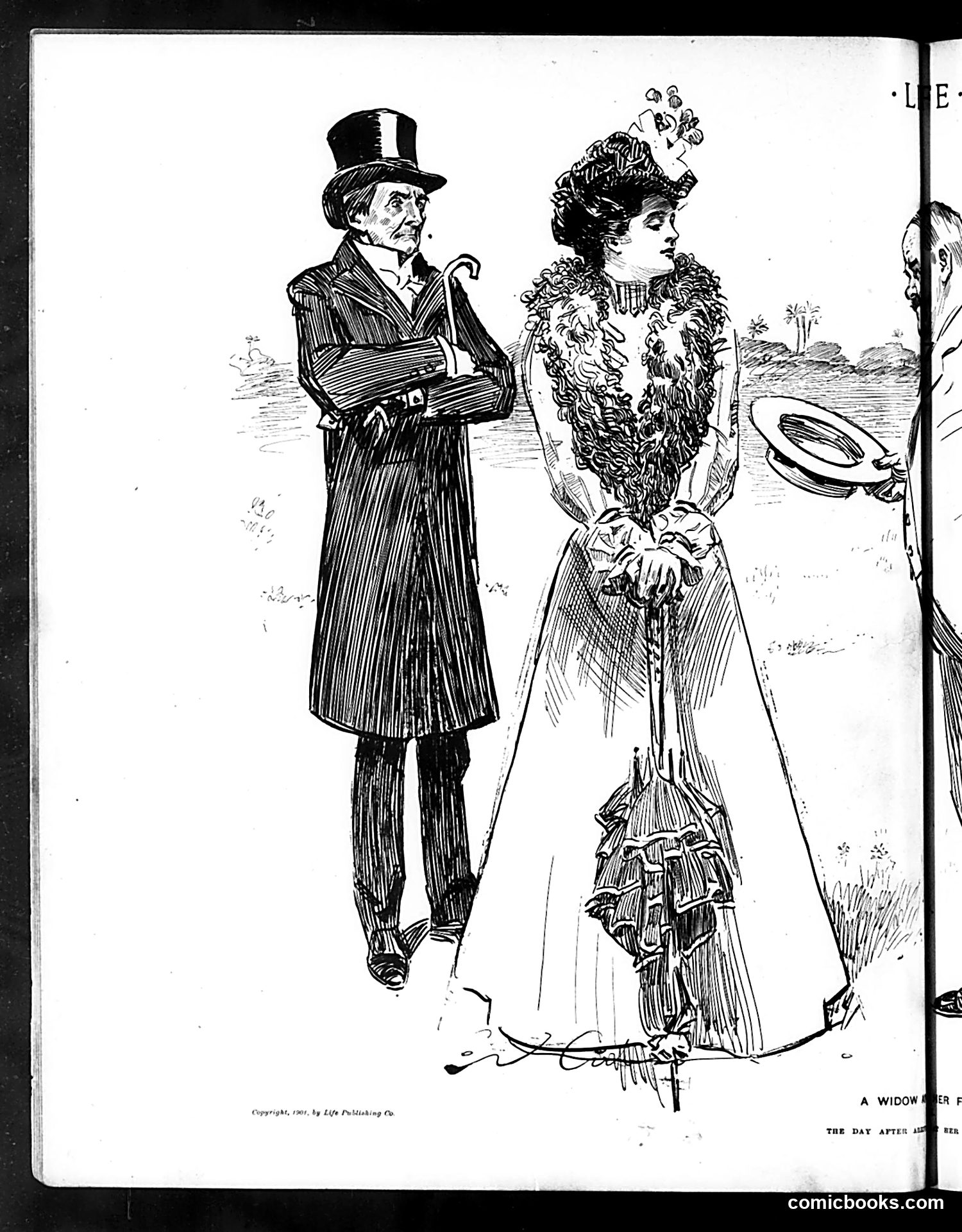
This is a satirical illustration from Life magazine (copyright 1907, by Life Publishing Co.). The image shows a fashionably dressed couple in Edwardian-era clothing. The woman wears an elaborate outfit with a large feathered hat, fur stole, and decorated skirt with ruffled train. The man wears a top hat, formal coat, and carries a walking stick. The visible caption reads "A WIDOW" and "THE DAY AFTER..." (text is partially cut off). This appears to be satirizing either the extravagance of wealthy widows' mourning fashion or mocking courtship/remarriage customs of the era. The juxtaposition of formal mourning attire with fashionable display suggests the cartoon criticizes either insincere grief or the rapid social recovery of widows, a topic Edwardian satirists frequently targeted.
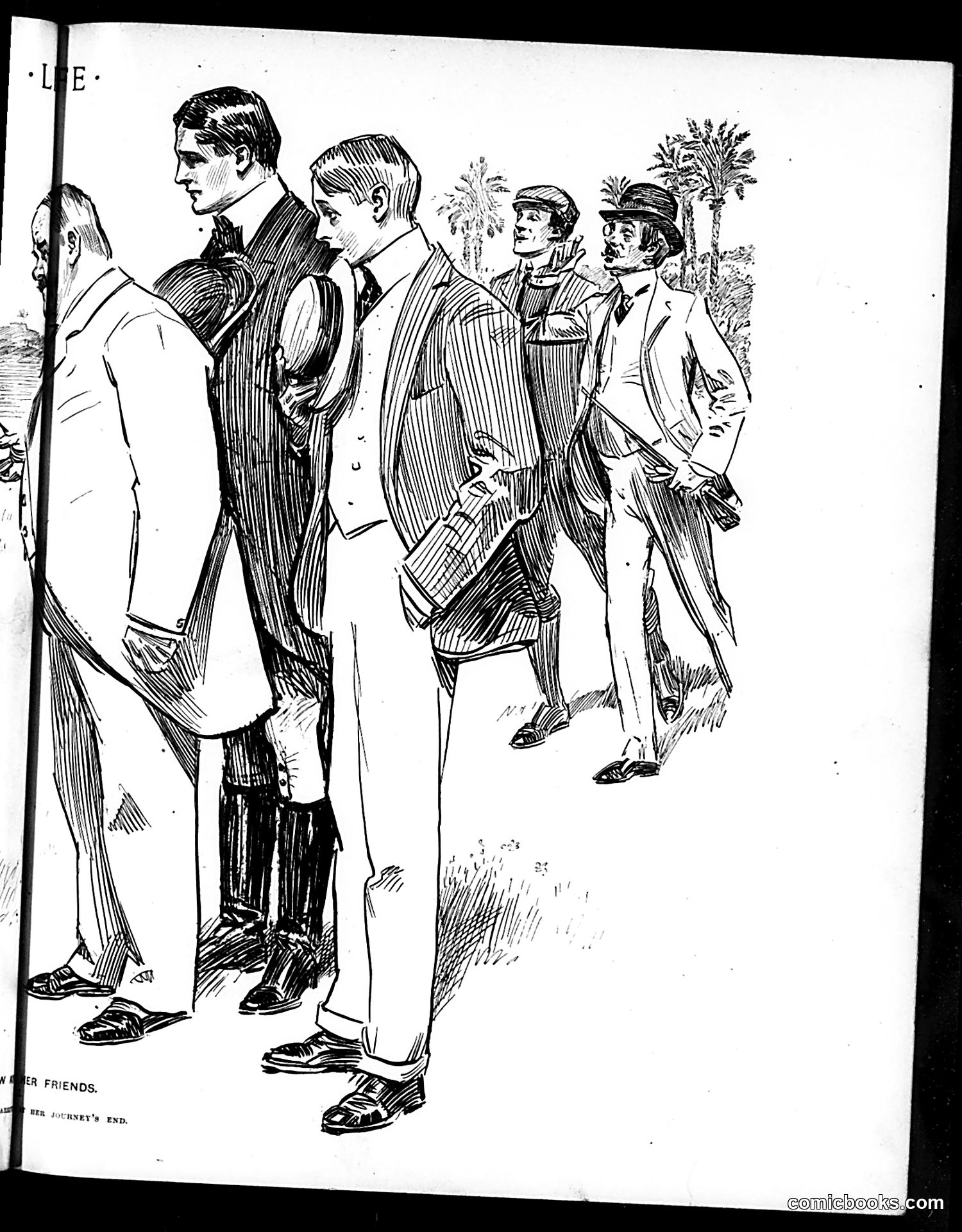
This appears to be an illustration from Life magazine's satirical section, likely early 20th century based on the drawing style and fashion depicted. The image shows five well-dressed men in suits standing together in what appears to be a tropical or colonial setting (palm trees visible in background). The partial text visible at bottom mentions "ER FRIENDS" and "ER JOURNEY'S END," suggesting this cartoon illustrates a narrative about a journey's conclusion with these gentleman companions. Without clearer OCR text or a visible caption, I cannot definitively identify the specific political figures or historical event being satirized. The formal dress and tropical setting suggest possible colonial or diplomatic themes, but the exact satirical point remains unclear from the visible information.
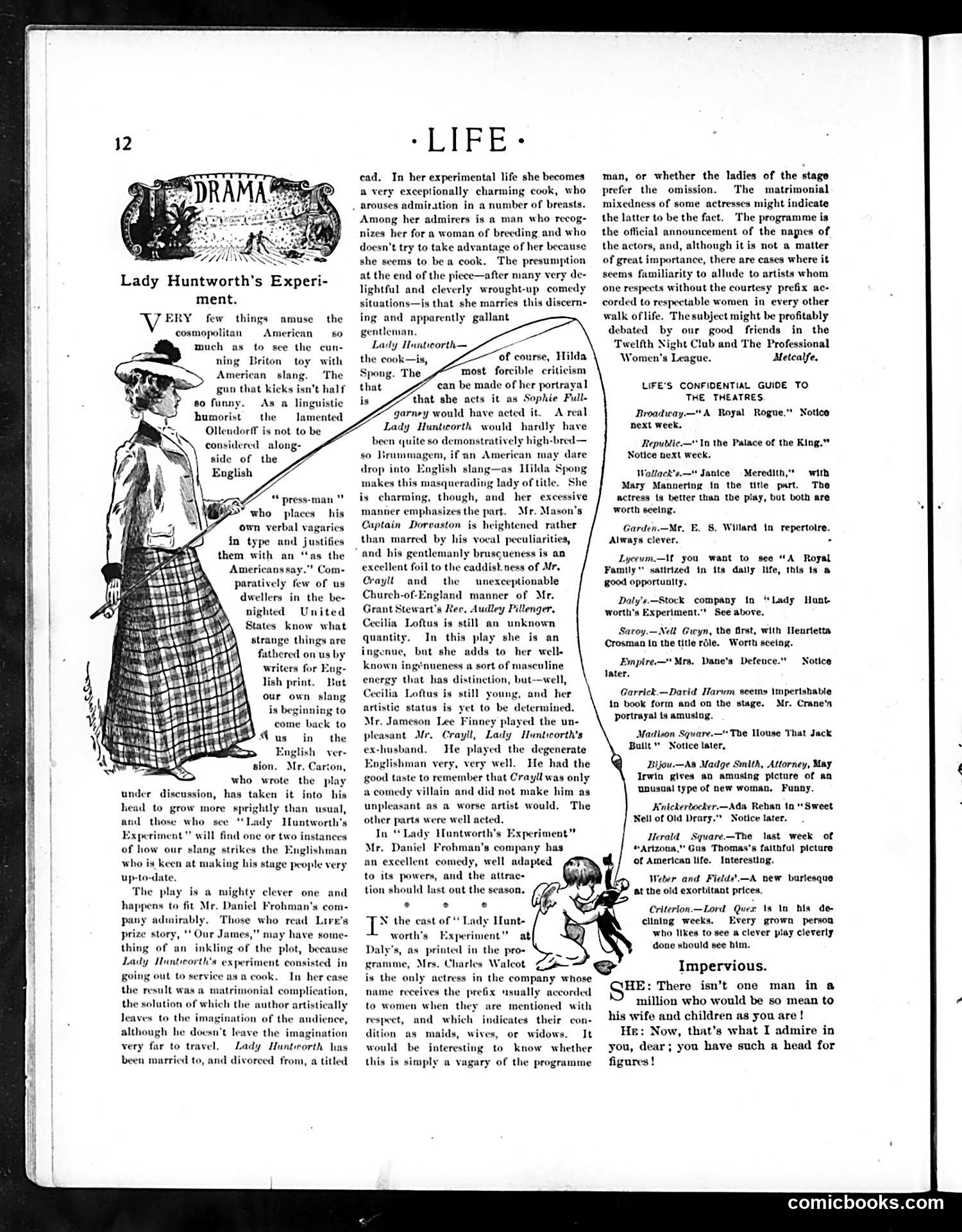
This page reviews "Lady Huntworth's Experiment," a theatrical comedy. The illustration shows a woman in period dress representing the play's protagonist. The satire targets how American audiences and critics view English society. The text notes that "Lady Huntworth" employs American slang and comic elements, which some find amusing but linguistically jarring. The review criticizes the play's portrayal of English characters—particularly how the actress playing Lady Huntworth "acts it as Sophie Fullarton would have acted it," suggesting overwrought performance rather than authentic characterization. The humor lies in mocking both the play's attempt to bridge American and English cultural sensibilities and the pretentious theatrical conventions of the era. The phrase "masquerading lady of title" indicates satire of aristocratic pretension on stage.
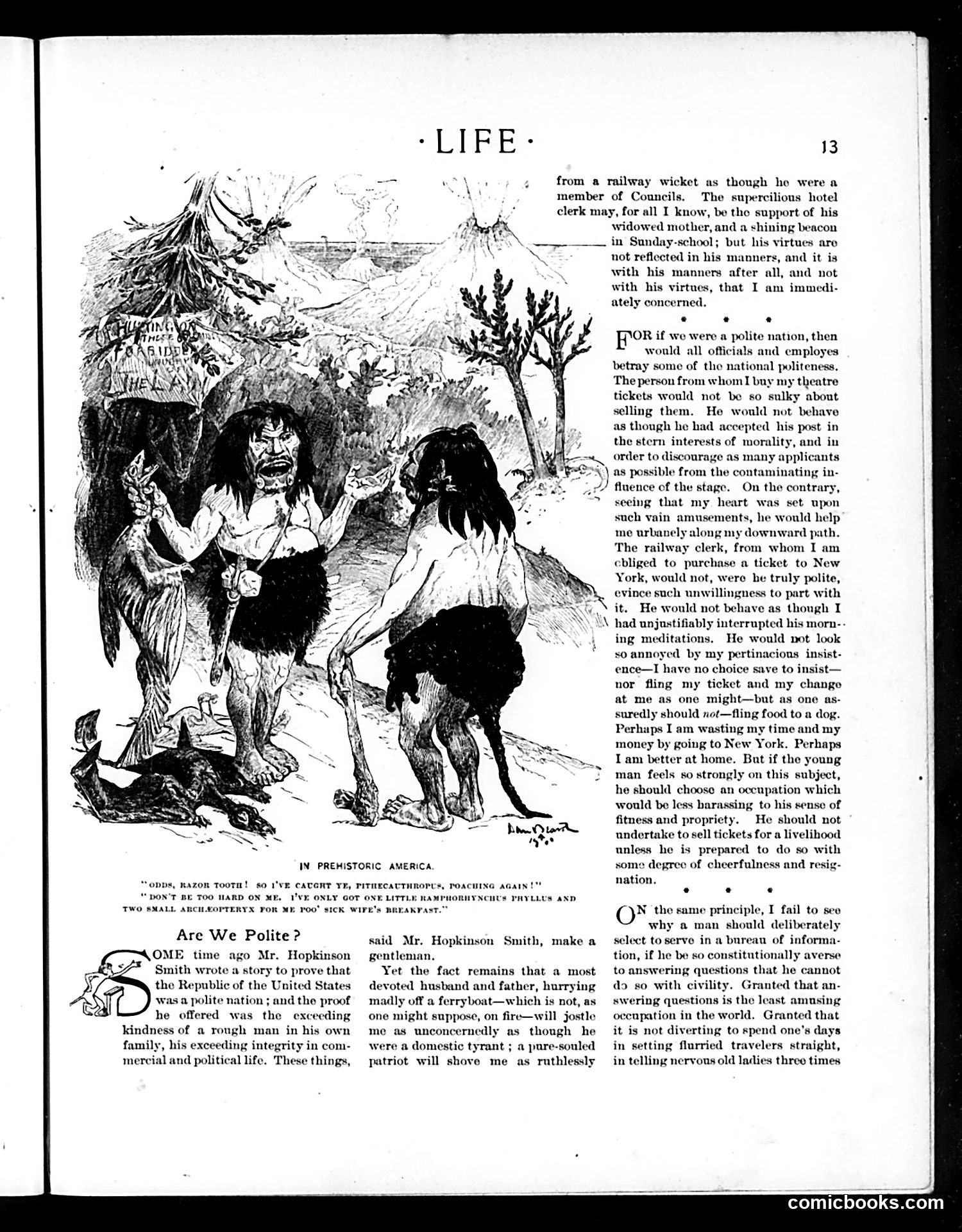
This page from Life magazine contains two satirical pieces about American politeness. **"In Prehistoric America"** (the cartoon): A caveman lecture satirizes writer Hopkinson Smith's claim that Americans are polite. The prehistoric setting undercuts his argument—depicting early humans stealing each other's food illustrates that rudeness is primordial, not uniquely modern. **"Are We Polite?"** (the essay): The author argues that while Smith claims rough working men can be gentlemen due to their integrity and kindness to family, this misses the point: *politeness means courtesy to strangers*. The piece mocks service workers—theater ticket sellers, railway clerks, information bureau staff—for treating customers with contempt and resentment, as if forced into servitude. The satirist contends that true national politeness would require these workers to serve the public cheerfully, not as though doing penance. The joke: America isn't polite to strangers, only to family.
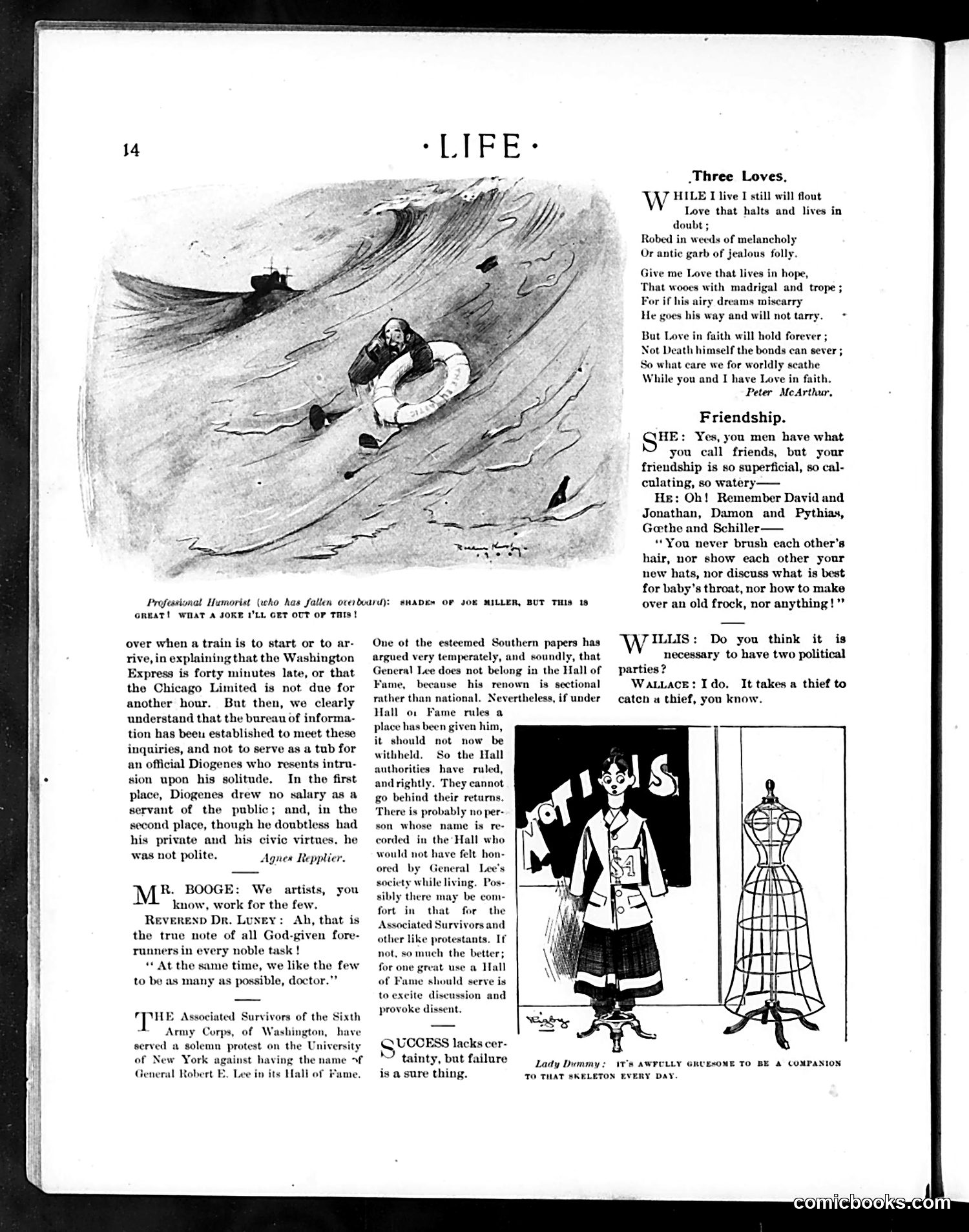
**Top cartoon**: A man overboard from a ship laughs about what a "joke" he'll get from the incident—mocking those who exploit tragedies for humorous anecdotes. The caption "Shades of Joe Miller" (referencing an 18th-century jester) suggests this is tired, recycled humor. **Middle section**: Commentary on General Robert E. Lee's inclusion in New York University's Hall of Fame. Southern protesters objected because Lee's fame is "sectional rather than national." The editors defend keeping him, arguing that removing him would violate the Hall's established rules—a principled but pragmatic position. **Lower cartoons**: Light satirical sketches on social matters: men's friendships (women claim men's friendships lack the depth of female bonds); political parties (Wallace argues two parties are necessary "like a thief to catch a thief"); and "Lady Dummy" mocking women bound to a corset/skeleton frame. The page mixes biting social criticism with gentler domestic humor typical of early 20th-century Life magazine's satirical approach.
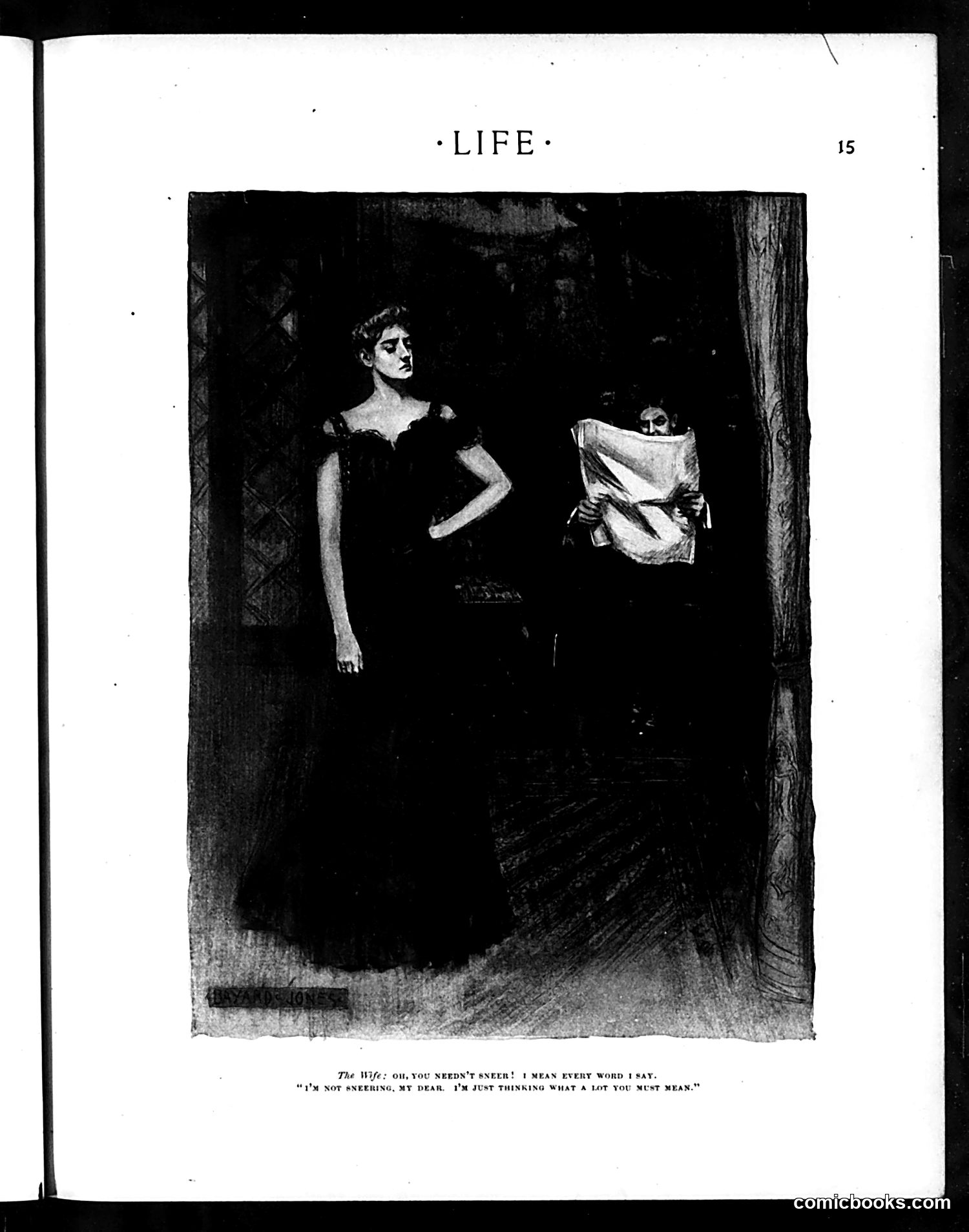
This is a satirical domestic scene from Life magazine depicting a marital argument. A woman in an elegant black evening gown stands confronting a man (partially obscured, holding what appears to be a newspaper). The caption reveals bitter sarcasm: when the wife says "you don't mean every word I say," the husband responds by questioning how much she *must* mean—implying her words lack sincerity or substance. The joke targets early 20th-century gender dynamics, mocking both spouses: the wife for superficial utterances, the husband for his dismissive skepticism. It's social commentary on marriage as performative rather than genuine, presented through the fashionable domestic setting that was typical of Life's satirical domestic humor cartoons of this era.
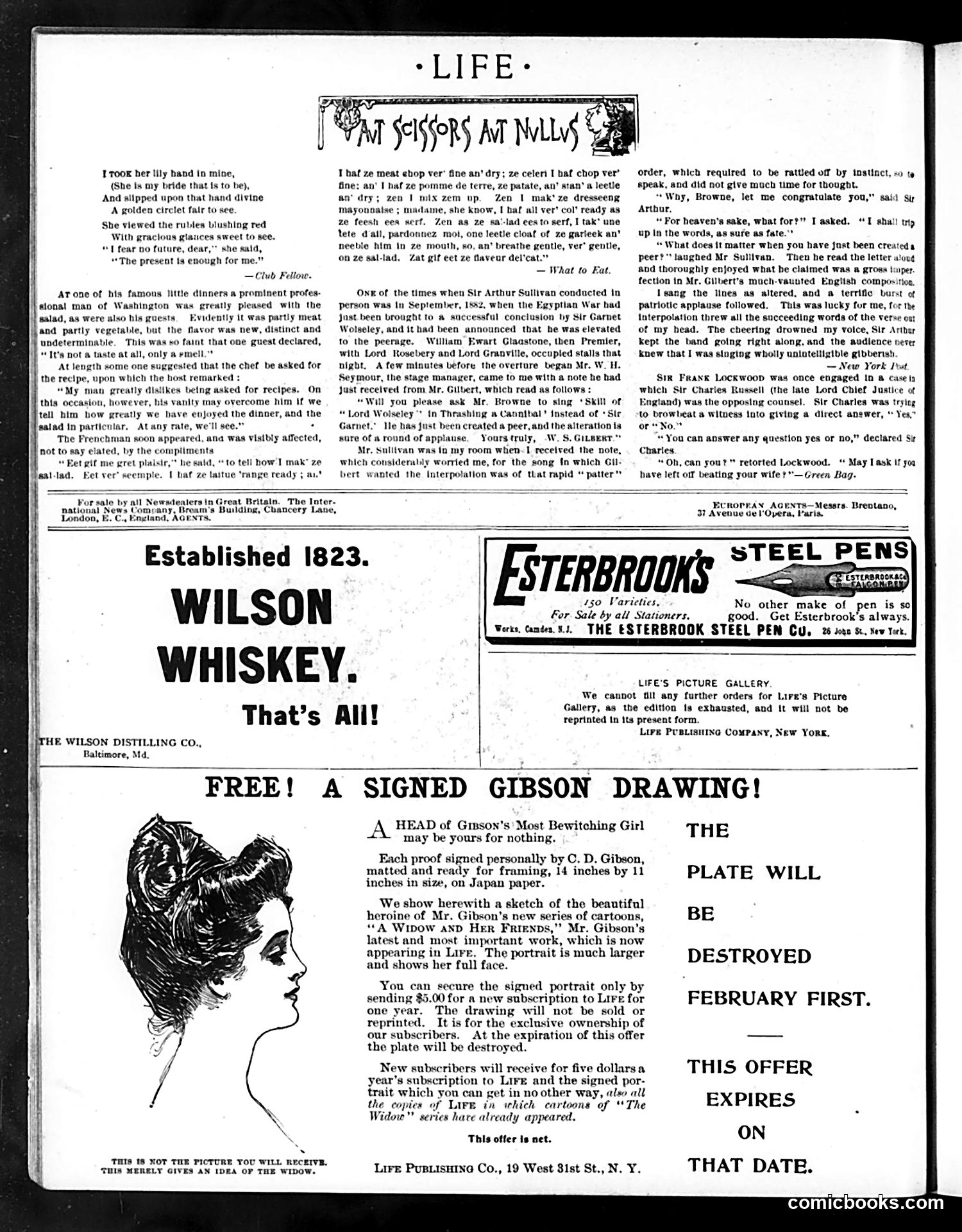
This page contains no political cartoons. Instead, it features three separate humorous anecdotes and several advertisements. The content includes: a romantic poem about an engagement ring; a story about a Washington dinner guest puzzled by an unusual salad (humorously explained by a French chef using exaggerated accent); and an account of Sir Arthur Sullivan's quick wit during a theatrical performance in 1882. When W.S. Gilbert requested last-minute lyric changes to reference the newly-elevated Sir Garnet Wolseley instead of Lord Wolseley, Sullivan's encouragement helped the performer navigate the difficult revision. The advertisements promote Wilson Whiskey (established 1823), Esterbrook Steel Pens, and a promotional offer of a signed C.D. Gibson drawing for new Life magazine subscribers—with a note warning the plate will be destroyed February 1st.
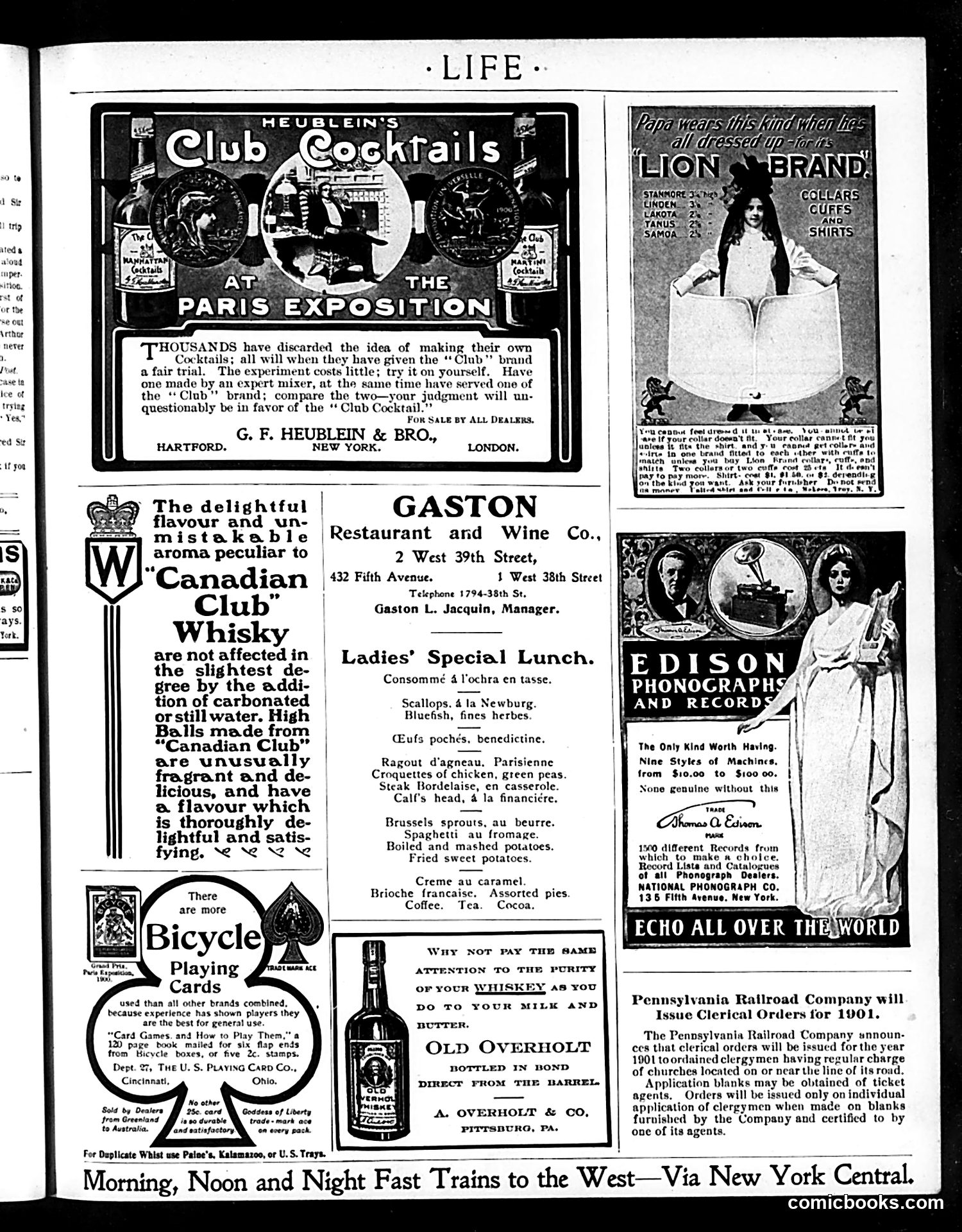
This page is primarily **advertising**, not political satire. It contains commercial ads from circa 1900-1901 for various products and services: The top features **Heublein's Club Cocktails** from the Paris Exposition, promoting pre-mixed cocktails as superior to homemade versions—a novelty pitch for the era. Other ads include **Canadian Club Whiskey**, **Bicycle Playing Cards**, **Gaston Restaurant**, **Old Overholt Whiskey**, **Edison Phonographs**, **Lion Brand Collars**, and a **Pennsylvania Railroad announcement** about clerical discount orders. The **Lion Brand ad** shows a woman modeling collars and cuffs, typical early 1900s fashion advertising emphasizing proper dress. There is **no political cartoon or satire** on this page. It's a standard Life magazine advertisement section reflecting consumer goods and services of the Edwardian era, with modest illustrations promoting products to affluent urban readers.
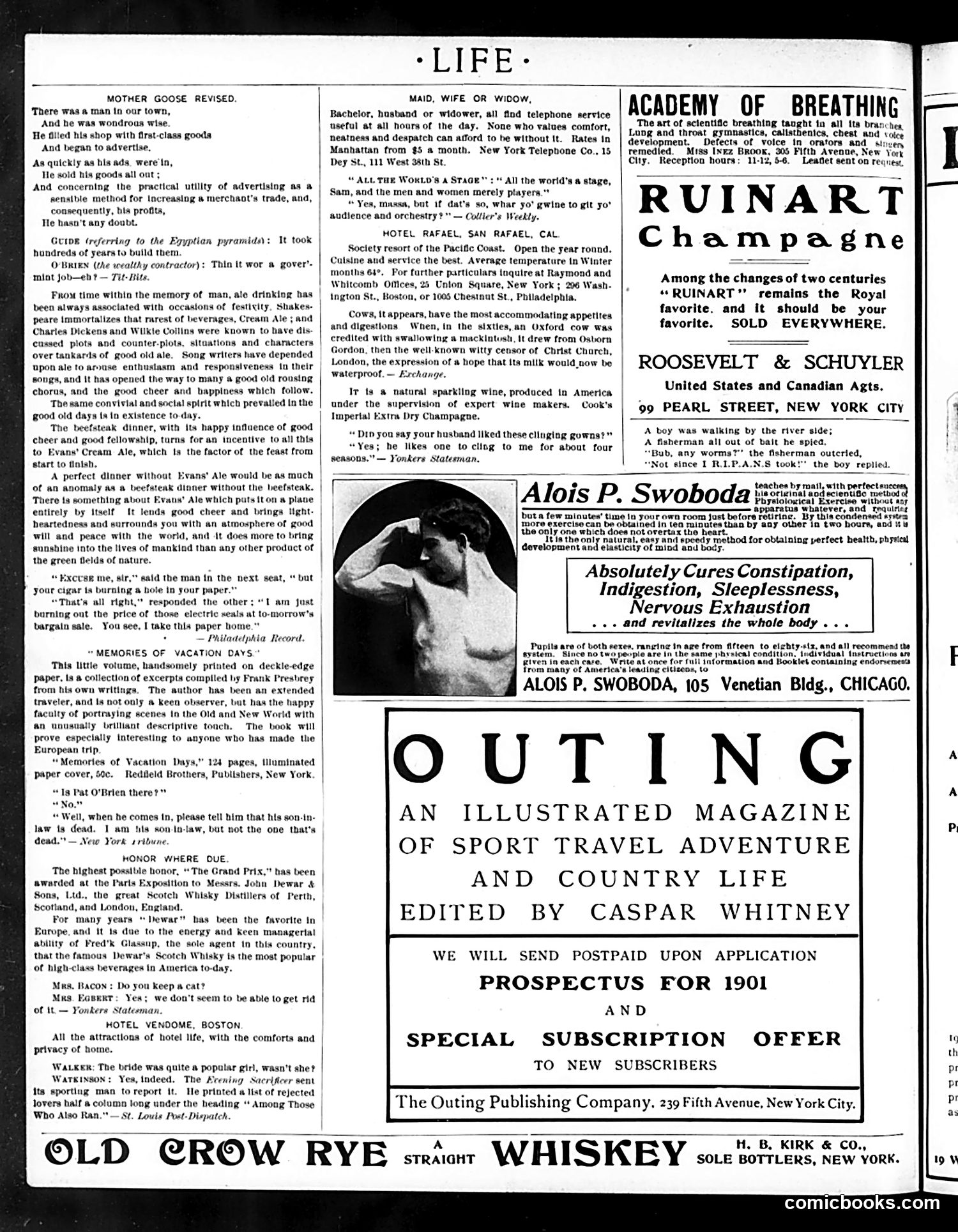
This page is primarily **advertisements and filler content** rather than political cartoons. However, it contains several brief humorous items: **"Mother Goose Revised"** satirizes advertising's effectiveness—a merchant fills his shop with quality goods, advertises aggressively, and sells out quickly. The satire suggests advertising has become the merchant's primary tool, not product quality. **The pyramid joke** involves "O'Brien" (a wealthy contractor), likely referencing a contemporary figure, making a crude joke that the Egyptian pyramids were a government project—implying wasteful public spending. **The cigar/newspaper joke** mocks penny-pinching: a man burns holes in his newspaper to destroy ads for cheap items he bought, treating the paper as garbage once he's extracted the bargains. The page is dominated by **product advertisements** (whisky, hotels, champagne, health remedies) typical of *Life* magazine's revenue model. These ads reflect turn-of-the-century consumer culture and dubious medical claims now illegal to advertise.
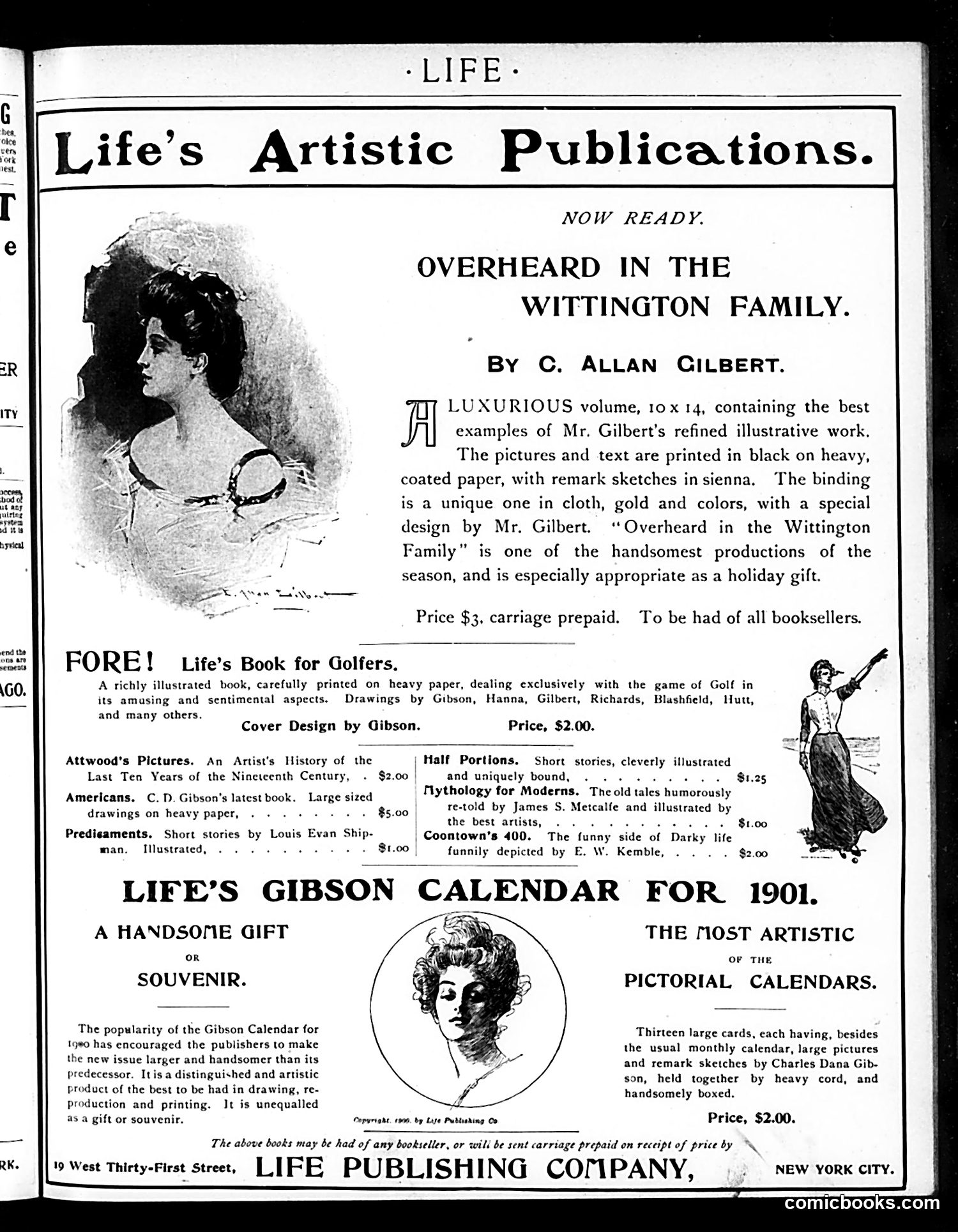
This is primarily an **advertising page** for Life Publishing Company's artistic books and calendars, not political satire. The page promotes illustrated gift books by prominent artists of the era, particularly C. Allan Gilbert and Charles Dana Gibson. Key offerings include: - **"Overheard in the Wittington Family"** by Gilbert—a luxury illustrated volume ($3) - **Gibson's Golf book** and **1901 Calendar**—featuring Gibson's famous refined pen-and-ink drawings of fashionable society - Various other illustrated collections on American life, mythology, and humor The single illustration shows a profile sketch of an elegant woman in Gibson's distinctive style—representing the refined, upper-class aesthetic these publications marketed. One advertisement, **"Coontown's 400,"** contains a racial caricature title (common to the 1900 era) depicting Black life for humor, reflecting attitudes of the period that modern readers would find offensive. The page reflects Life's positioning as a venue for sophisticated artistic and satirical work aimed at educated, affluent audiences.
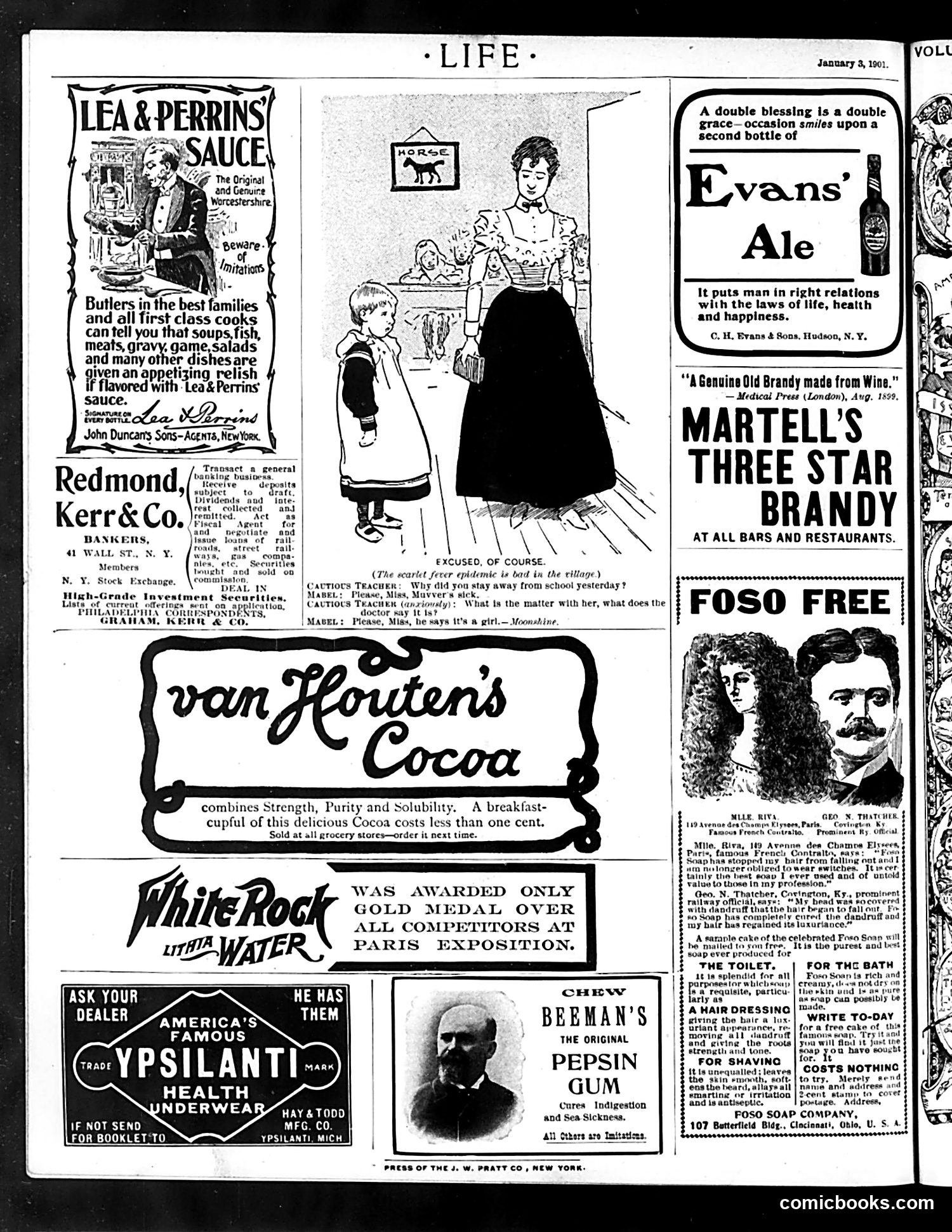
This page is primarily **advertisements**, not political cartoons. However, one small cartoon appears titled "Excused, of Course": ## The Cartoon A schoolteacher questions a boy about his absence, noting a scarlet fever epidemic in the village. The boy explains his mother is sick. When pressed about her condition, he responds: "Please, Miss, she says it's a girl." **The joke**: The boy misunderstands the teacher's inquiry. She's asking about scarlet fever; he reports his mother having a baby instead. The humor derives from the child's innocent misinterpretation—he thinks any illness explanation suffices, missing the specific concern about the contagious disease. The caption "Moonshine" suggests this is presented as absurdist humor. ## Context This reflects period anxieties about scarlet fever epidemics and the casual attitudes toward contagion in early 1900s society. The cartoon type—innocent child logic—was common in Life's satirical humor of the era. The remainder of the page consists of product advertisements (cocoa, brandy, soap, health products) typical of the magazine's revenue model.