
Life, 1901-01-03 · page 13 of 20
Life — January 3, 1901 — page 13: what you’re looking at
What you’re looking at
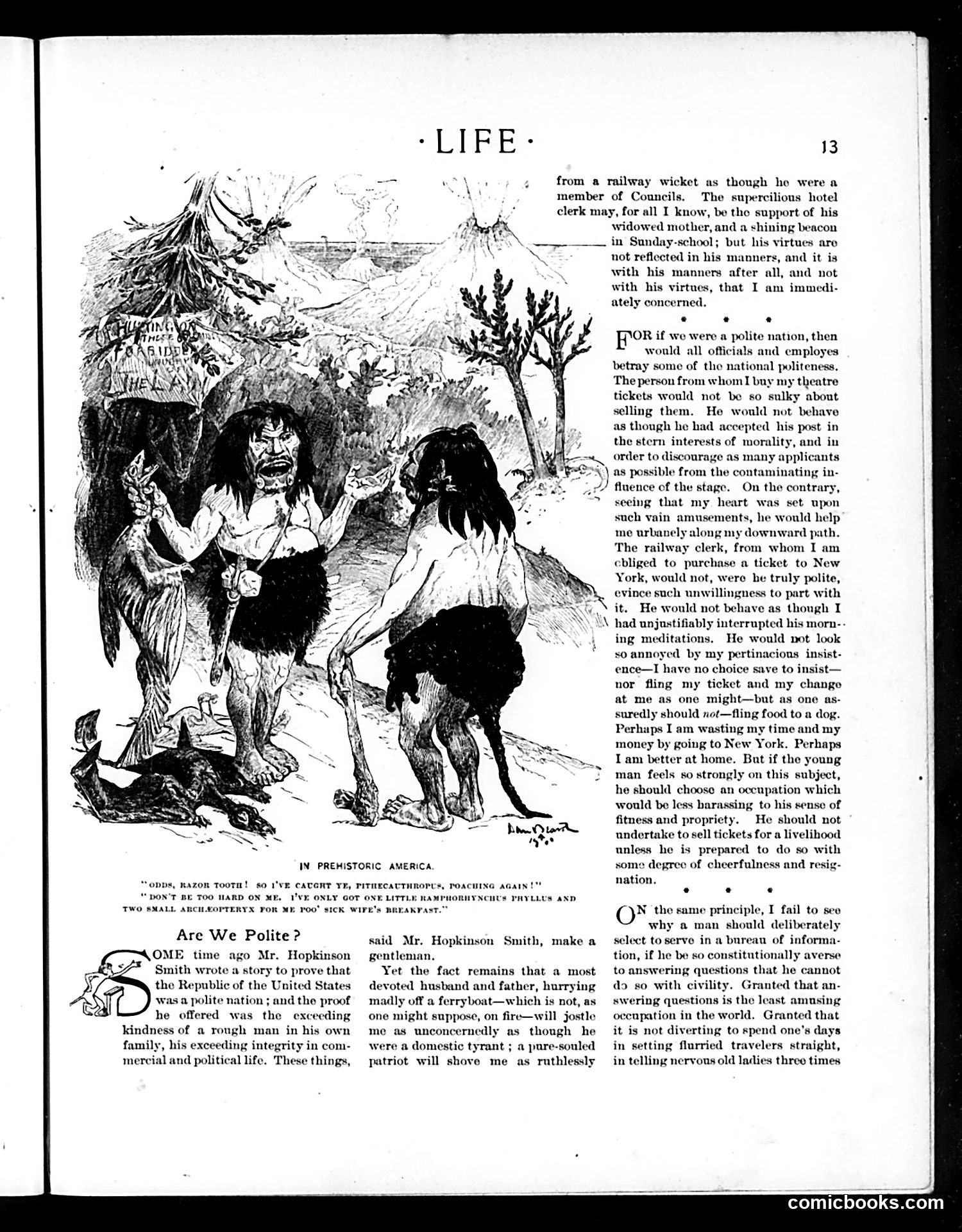
This page from Life magazine contains two satirical pieces about American politeness. **"In Prehistoric America"** (the cartoon): A caveman lecture satirizes writer Hopkinson Smith's claim that Americans are polite. The prehistoric setting undercuts his argument—depicting early humans stealing each other's food illustrates that rudeness is primordial, not uniquely modern. **"Are We Polite?"** (the essay): The author argues that while Smith claims rough working men can be gentlemen due to their integrity and kindness to family, this misses the point: *politeness means courtesy to strangers*. The piece mocks service workers—theater ticket sellers, railway clerks, information bureau staff—for treating customers with contempt and resentment, as if forced into servitude. The satirist contends that true national politeness would require these workers to serve the public cheerfully, not as though doing penance. The joke: America isn't polite to strangers, only to family.
📄 Transcribed text from this page (OCR, searchable)
Machine-transcribed from the original scan — historical spelling and the odd misread are preserved.
13 from a railway wicket as though ho were a member of Councils. Tho supercilious hotel clerk may, for all I know, be tho support of his —s Danton igtes IN PREHISTORIC AMERICA. “opps, nazon Toot! 80 1" “DON'T BE TOO HARD ON ME. TWO SMALL ARCH.OPTERYX FOR M Are We Polite? se time ago Mr. Hopkinson ® <Z* Smith wrote a story to prove that the Republic of the United States was a polite nation ; and the proof he offered was the exceeding kindness of a rough man in his own family, his exceeding integrity in com- mercial and political life. These things, CAUGHT YE, PITHECATTHROPUS, POACHING AGAIN!" ONLY GOT ONE LITTLE RAMPHORHYNCHUS PRYLLUS AND YO" SICK WIFE’s BREAK AST.” said Mr. Hopkinson Smith, make a gentleman, Yet the fact remains that a most devoted husband and father, hurrying madly off a ferryboat—which is not, as one might suppose, on fire—will jostle me as unconcernedly as though he were a domestic tyrant ; a pure-souled patriot will shove me as ruthlessly widowed mother, and a shining beacon in Sunday-school; but his virtues are not reflected in his manners, and it is with his manners after all, and not with his virtues, that I am immedi- ately concerned. . * * OR if we were a polite nation, then would all officials and employes betray some of tho national politeness. The person from whomI buy my theatre tickets would not be so sulky about selling them. He would not behave as though he had accepted his post in the stern interests of morality, and in -«__ order to discourage as many applicants Ks ©) as possible from the contaminating in- / fluence of the stage. On the contrary, seeing that my heart was set upon such vain amusements, he would help me urbanely along my downward path. The railway clerk, from whom I am cbliged to purchase a ticket to New York, would not, were he truly polite, evince such unwillingness to part with it. He would not behave as though I had unjustifiably interrupted his morn-- ing meditations, He would not look so annoyed by my pertinacions insist- ence—I have no choice save to ins nor fling my ticket and my change at me as one might—but as one as- suredly should not—fling food to a dog. Perhaps I am wasting my time and my money by going to New York. Perhaps Lam better at home. But if the young man feels so strongly on this subject, he should choose an occupation which would be less harassing to his sense of fitness and propriety. He should not undertake to sell tickets for a livelihood unless he is prepared to do so with some degree of cheerfulness and resig- nation. . * N tho same principle, I fail to see why a man should deliberately select to serve in a bureau of informa- tion, if he be so constitutionally averse to answering questions that he cannot do so with civility. Granted that an- swering questions is the least amusing occupation in the world. Granted that it is not diverting to spend one’s days in setting flurried travelers straight, in telling nervons old ladies three times comicbooks.com