
Life, 1901-01-03 · page 12 of 20
Life — January 3, 1901 — page 12: what you’re looking at
What you’re looking at
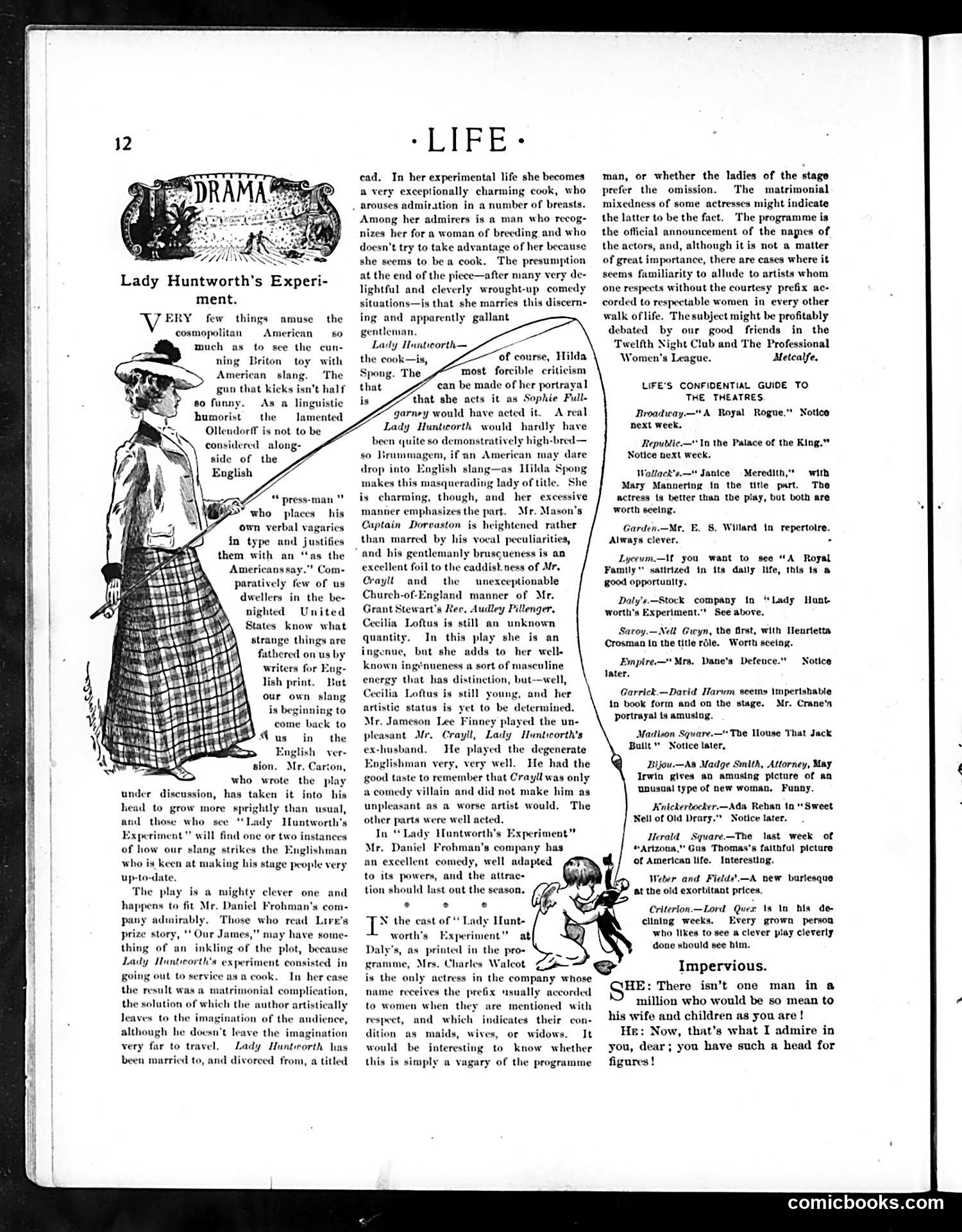
This page reviews "Lady Huntworth's Experiment," a theatrical comedy. The illustration shows a woman in period dress representing the play's protagonist. The satire targets how American audiences and critics view English society. The text notes that "Lady Huntworth" employs American slang and comic elements, which some find amusing but linguistically jarring. The review criticizes the play's portrayal of English characters—particularly how the actress playing Lady Huntworth "acts it as Sophie Fullarton would have acted it," suggesting overwrought performance rather than authentic characterization. The humor lies in mocking both the play's attempt to bridge American and English cultural sensibilities and the pretentious theatrical conventions of the era. The phrase "masquerading lady of title" indicates satire of aristocratic pretension on stage.
📄 Transcribed text from this page (OCR, searchable)
Machine-transcribed from the original scan — historical spelling and the odd misread are preserved.
Huntworth’s Experi- ment. RY few things cosmopolitan American 0 much as to see the ning Briton toy with American slang. The gun that kicks isn't half go funny. As a linguistic humorist the lamented Ollendorf is not to be considered along- side of the amuse the eun- ** press-man " places his in type and justifies them with an “as the paratively few of us \ dwellers in the be- AEA nighted United ay States know what " strange things are fathered on us by writers for Eng. lish print. But our own slang is beginning to come back to us in the English ver- sion. Mr. Carton, who wrote the y under discussion, has taken it into head to grow more sprightly than usual, and those who sce ‘Lady Muntworth’s Experiment" will find one or two instances of how our slang stril keen at making hi up-to-date. The play is a mighty clever one and to fit Mr. Daniel Frohman's ably, Those who read Lire Our James,” may have some- thing of an inkling of the plot, because Lady Huntworth's experiment consisted in going out to ser er case the result was at his 's the Englishma s stage people very utrimonial complication, the solution of which the author artistically Jeaves to the imagination of the audience, although he doesn't leave the imagination very far to travel, Lady Huntirorth has been married to, and divorced from, a titled -~LEFE cad. In her experimental life she becomes a very exceptionally charming cook, who arouses admiration in a number of breasts. Among her admirers is a man who recog- nizes her for a woman of breeding and who doesn't try to take advantage of her because she seems to bea cook. The presumption at the end of the piece—after many very de- lightful and cleverly wrought-up comedy situations—is that she marries this discern- ing and apparently gallant gentleman. Lady Hunticorth— = the cook—is, of course, Hilda Spong. The most forcible criticism that can be made of her portrayal is that she acts it as Sophie Full- garney would have acted it. A real Lady Hunteorth would hardly have been quite so demonstratively high-bred— so Brummagem, if an American ma drop into English slang—as H makes this masque is charming, though, and her excess manner emphasizes the part. Mr. Mason's Captain Dorcaston is heightened rather than marred by his vocal peculiarities, and his gentlemanly bruscueness is an excellent foil to the caddist.ness of Mr. Crayll and the — unexceptionable Church-of-England manner of Mr. Grant Stewart's Rec, Audley Pillenger. Cecilia Loftus is still an unknown quantity. In this play she is an i bat she adds to her well- nueness a sort of masculine energy that has distinction, but—well, Cecilia Loftus is still y and her artistic status is yet to be determined. Mr. Jameson Lee Finney played the ui pleasant Mr. Crayll, Lady Huntworth's ex-husband. He played the degenerate ishman very, very well. He had the good taste to remember that Crayll was only a comedy villain and did not make him as unpleasant as a worse artist would. The other parts were well acted. In ‘Lady Huntworth’s Experiment” Mr. Daniel Frohman’s company has an excellent comedy, well adapted to its powers, and the attrac tion should lust out the season, ° ° ° N the cast of * Lady Hunt- worth's Experiment” at} ay printed in the pros K gramme, Mrs, Charles Walcot @Z47= is the only actress in the company whose name receives the prefix usually accorded to women when they are mentioned with respect, and which indicates their con- dition as maids, wives, or widows. It would be interesting to know whether this is simply a vagary of the programme man, or whether the ladies of the stage prefer the omission. The matrimonial mixedness of some actresses might indicate the latter to be the fact. The programme is the official announcement of the names of the actors, and, although it is not a matter of great importance, there are cases where it seems familiarity to allude to artists whom one respects without the courtesy prefix ac- corded to respectable women in every other walk oflife. The subject might be profitably debated by our good friends in the Twelfth Night Club and The Professional Women’s League. Metcalfe. LIFE’S CONFIDENTIAL GUIDE TO THE THEATRES. Broadway—"A Royal Rogue.” Notice next week. Republic.—" In the Palace of the King.,* Notice next week. Waltack's.—" Janice Meredith," with Mary Mannering in the title part. The actress 1s better than the play, but both are ‘worth seeing. Garden.—Me, E, 8, Willard tn repertotre, Always clever. . Lyceum.—It you want to see “A Royal Family" satirized in its daily life, this ts a good opportunity. Daty's.—Stock company tn worth's Experiment.” See above. “Lady Hont Saroy.—Net Gwyn, the Orst, with Henrietta Crosman tn the title role. Worth aceing. Empire.—" Mra. Dane's Defeuce.” later. Notice Carrick.—David Harum sees tmpertshable in book form and on the stage. Mr. Crane's portrayal ts amusing. Madison Square.—" The House That Jack Built" Notice later, Bijou.—As Madge Smith, Attorney, May Irwin gives an amusing picture of an unusual type of new woman, Funny. Knickertocker.—Ada Rehan tn “Sweet Nell of Old Drary."* Notice later. Herald Square—The last week of “Arizona,” Gas Thomas's faithfal picture of American life. Interesting. Weber and Field#.—A new burlesque at the old exorbitant prices. Criterion.—Lord Quer 1s in hia de- clining weeks. Every grown person who Ikes to see a clever piay cleverly done should see him. Impervious. HE: There isn’t one man in a million who would be so mean to his wife and children as you are! He: Now, that’s what I admire in you, dear; you have such a head for figures! comicbooks.com