
Life, 1901-01-03 · page 8 of 20
Life — January 3, 1901 — page 8: what you’re looking at
What you’re looking at
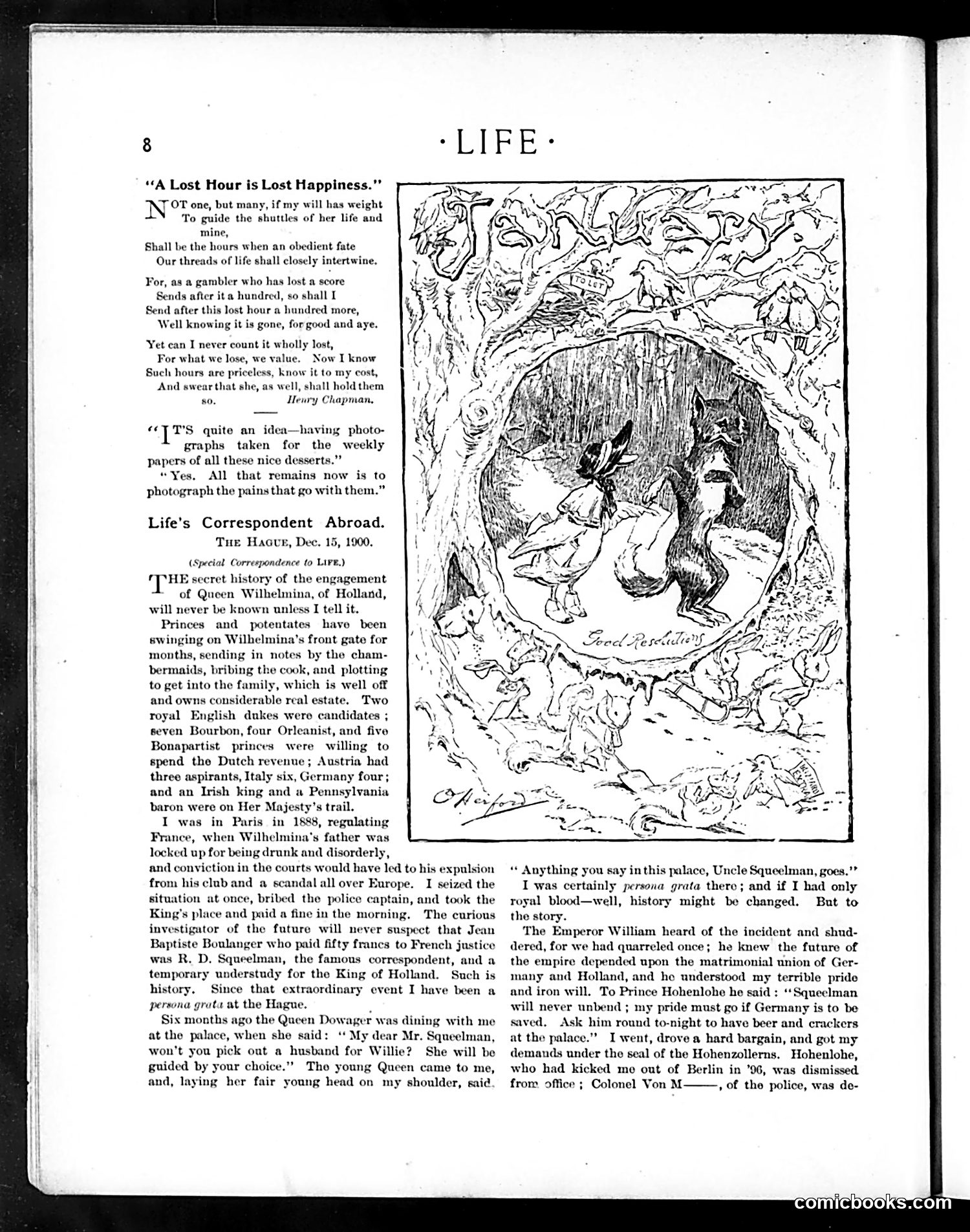
This page contains a poem titled "A Lost Hour is Lost Happiness" by Henry Chapman, paired with an illustration showing a woodland scene with animals (appears to be a badger and other creatures in a burrow or hollow tree). Below is a correspondent's dispatch from The Hague dated December 15, 1900, discussing Queen Wilhelmina of Holland's engagement. The article contains gossip about European royal intrigue—specifically an anecdote where the Queen supposedly told the correspondent "Mr. Squeelman" that she'd choose her own husband rather than accept a royal arranged marriage, defying pressure from various princes and Emperor William. The satirical point targets the machinations of European royalty and their marriages as political tools, while celebrating the young queen's independent spirit against imperial pressure.
📄 Transcribed text from this page (OCR, searchable)
Machine-transcribed from the original scan — historical spelling and the odd misread are preserved.
8 “(A Lost Hour is Lost Happiness."” DOT ones but many, if my will has weight To guide the shuttles of her life and mine, Shall be the hours when an obedient fate Our threads of life shall closely intertwine. For, as a gambler who has lost a score Sends after it a hundred, so shall I Send after this lost hour a hundred more, Well knowing it is gone, for good and aye. ‘Yet can I never count it wholly lost, For what we lose, we value. Now I know Such hours are priceless, know it to my cost, And swear that she, as well, shall holdthem 80. Henry Chapman, “TTS quite an idea—having photo- graphs taken for the weekly papers of all these nice de “Yes, All that remains now is to photograph the pains that go with them.” Life’s Correspondent Abroad. Tue Hacve, Dee. 15, 1900. (Special Correspondence to Live.) 'PHE secret history of the engagement of Queen Wilhelmina, of Holland, will never be known unless I tell it. Princes and potentates have been swinging on Wilhelmina’s front gate for months, sending in notes by the cham- bermaids, bribing the cook, and plotting to get into the family, which is well off and owns considerable real estate. Two royal English dukes wero candidates ; seven Bourbon, four Orleanist, and five Bonapartist princes were willing to spend the Dutch revenue; Austria had three aspirants, Italy six, Germany four; and an Irish king and a Pennsylvania baron were on Her Majesty’s trail. I was in Paris in 1888, regulating France, when Wilhelmina’s father was locked up for being drunk and disorderly, and conviction in the courts would have led to his expulsion from his club and a scandal all over Europe. I seized the situation at once, bribed the police captain, and took the place and paid a fine in the morning. The curious utor of the future will never suspect that Jean ste Boulanger who paid fifty francs to French justice was R. D. Squeelman, the famous correspondent, and a temporary understudy for the King of Holland. Such is history, Since that extraordinary event I have been a persona grata at the Hague. . Six months ago the Queen Dowager was dining with me at the palace, when she said: ‘ My dear Mr. Squeelman, won't you pick out a husband for Willie? She will be guided by your choice.” Tho young Queen came to me, and, laying her fair young head on my shoulder, said “* Anything you say inthis palace, Uncle Squeelman, goes.’” I was certainly persona grata there; and if I had only royal blood—well, history might be changed. But to the story. The Emperor William heard of the incident and shud- dered, for we had quarreled once; he knew the future of the empire depended upon the matrimonial union of Ger- many and Holland, and ho understood my terrible pride and iron will. To Prince Hohenlohe he said : “‘Squeelman will never unbend ; my pride must go if Germany is to be saved, Ask him round to-night to have beer and crackers at the palace.” I went, drove a hard bargain, and got my demands under the seal of the Hohenzollerns. Hohenlohe, who had kicked me out of Berlin in ’06, was dismissed. from office ; Colonel Von M , of the police, was de-