
Life, 1901-01-03 · page 4 of 20
Life — January 3, 1901 — page 4: what you’re looking at
What you’re looking at
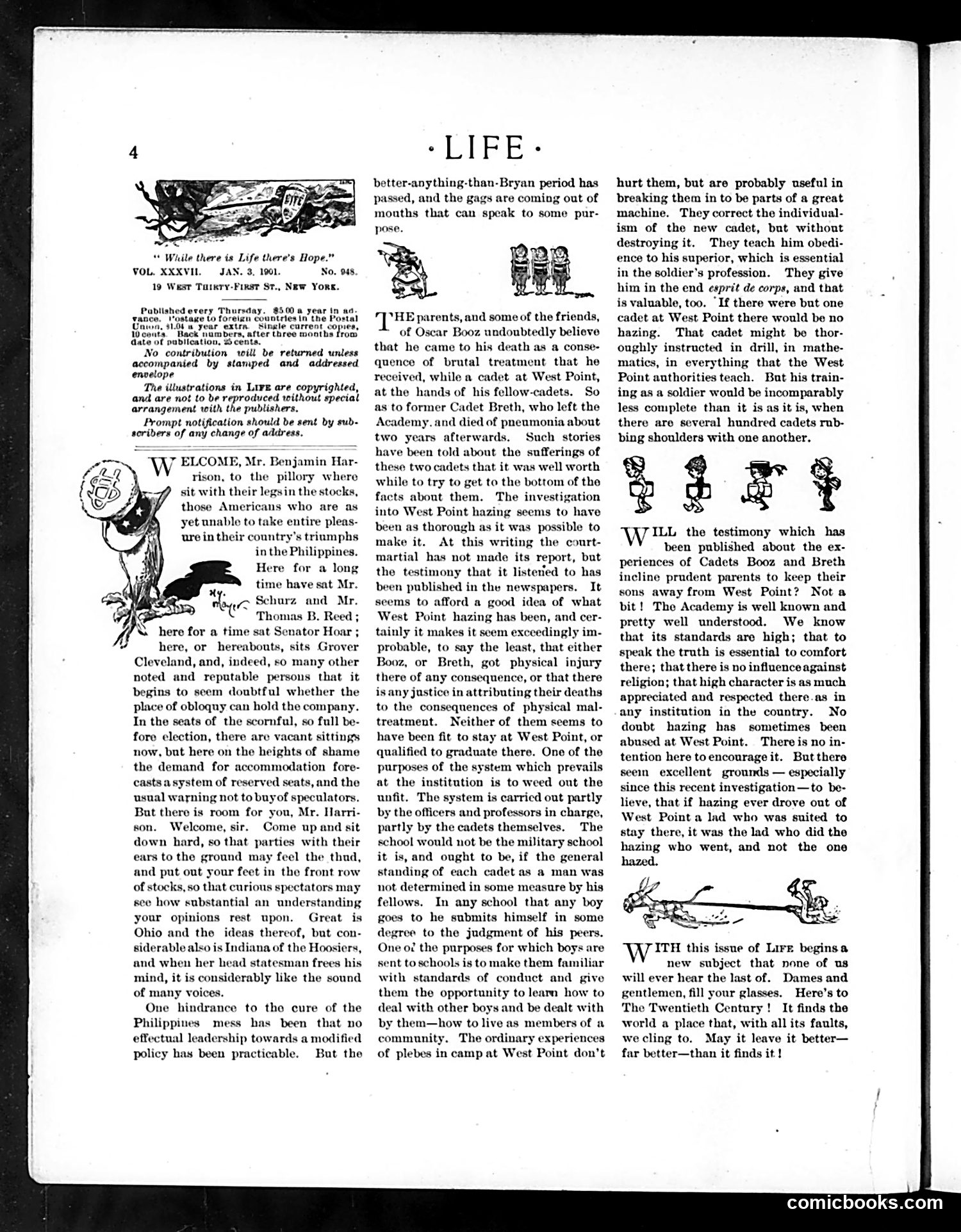
**Main Content:** This page discusses West Point hazing incidents involving cadets Oscar Booz and Breth, who reportedly suffered brutal treatment from fellow cadets. The text defends West Point's disciplinary system while acknowledging the investigation into these specific cases. **Left Cartoon:** Features a welcoming figure (possibly Uncle Sam or Columbia) greeting "Mr. Benjamin Harrison" to "the pillory"—a satirical critique suggesting Harrison's administration is being mocked or tested by the Philippine situation and other political challenges. **Small Illustrations:** Four figures appear to depict cadets or soldiers in various poses, likely illustrating the hazing discussion. **Context:** This reflects late-1890s concerns about military academy discipline and Harrison-era foreign policy controversies, particularly regarding the Philippines.
📄 Transcribed text from this page (OCR, searchable)
Machine-transcribed from the original scan — historical spelling and the odd misread are preserved.
“* While there is Life there's Hope.” VOL. XXXVI. JAN. 3. 1901. No, 948. 19 West Turkry-First St., New YORK. every Thursday. $500 a year in w age to foreign countries in the Post: a Year exten Single current co) Hack numbers, after turee months frow Gato vf publication, 3 cents. No contribution will be returned unless accompanied by stamped and addressed envelope The illustrations in Live are copyrighted, and are not to be reproduced without special arrangement with the publishers. Prompt notification should be sent by sub- scribers of any change of address. WwW ELCOME, Mr. Benjamin Har- rison, to the pillory where 0 sit with their legsin the stocks, those Americans who are as yet unable to take entire pleas- ure in their country’s triumphs in the Philippines. Here for a long time have sat Mr. Vas Schurz and Mr. : Thomas B. Reed ; here for a time sat Senator Hoar ; here, or hereabouts, sits Grover Cleveland, and, indeed, so many other noted and reputable persons that it begins to seem doubtful whether the place of obloquy can hold the company. In the seats of the scornful, so full be- fore election, there are vacant sittings now, but here on the heights of shame the demand for accommodation fore- casts asystem of reserved seats, and the usual warning not to buyof speculators. But there is room for you, Mr. Harri- son. Welcome, sir. Come up and sit down hard, so that parties with their ears to the ground may feel the thud, and put out your feet in the front row of stocks, so that curious spectators may see how substantial an understanding your opinions rest upon. Great is Ohio and the ideas thereof, but con- siderable also is Indiana of the Hoosiers, and when her head statesman frees his mind, it is considerably like the sound of many voices. One hindrance to the cure of the Philippines mess has been that no effectual leadership towards a modified policy has been practicable. But the better-anything-than-Bryan period has passed, and the gags are coming out of months that can speak to some pur- pose. = HL ‘HE parents, and some of the friends, of Oscar Booz undoubtedly believe that he came to his death as a conse- quence of brutal treatment that he received, while a cadet at West Point, at the hands of his fellow-cadets. So as to former Cadet Breth, who left the Academy, and died of pneumonia about two years afterwards. Such stories have been told about the sufferings of these two cadets that it was well worth while to try to get to the bottom of the facts about them. The investigation into West Point hazing seems to have been as thorough as it was possible to make it. At this writing the court- martial has not made its report, but the testimony that it listetied to has been published in the newspapers. It seems to afford a good idea of what West Point hazing has been, and cer- tainly it makes it seem exceedingly im- probable, to say the least, that either Booz, or Breth, got physical injury there of any consequence, or that there is any justice in attributing their deaths to the consequences of physical mal- treatment. Neither of them seems to have been fit to stay at West Point, or qualified to graduate there. One of the purposes of the system which prevails at the institution is to weed out the unfit. The system is carricd out partly by the officers and professors in charge, partly by the cadets themselves. The school would not be the military school it is, and ought to be, if the general standing of each cadet as a man was not determined in some measure by his fellows. In any school that any boy goes to he submits himself in some degree to the judgment of his peers. One of the purposes for which boys are sent toschools is to make them fa ar with standards of conduct and give them the opportunity to learn how to deal with other boys and be dealt with by them—how to live as members of a community. The ordinary experiences of plebes in camp at West Point don't hurt them, but are probably useful in breaking them in to be parts of a great machine. They correct the individual- ism of the new cadet, bat without destroying it. They teach him obedi- ence to his superior, which is essential in the soldier's profession. They give him in the end esprit de corps, and that is valuable, too. “If there were but one cadet at West Point there would be no hazing. That cadet might be thor- oughly instructed in drill, in mathe- matics, in everything that the West Point authorities teach. Bat his train- ing as a soldier would be incomparably less complete than it is as it is, when there are several hundred cadets rmb- bing shoulders with one another, 3 oF % JV tL the testimony which has been published about the ex- wi of Cadets Booz and Breth incline prudent parents to keep their sons away from West Point? Nota bit! The Academy is well known and pretty well understood. We know that its standards are high; that to speak the truth is essential to comfort there; that there is no influence against. religion; that high character is as much appreciated and respected there.as in any institution in the country. No doubt hazing has sometimes been abused at West Point. There is no in- tention here toencourage it. But there seein excellent grounds — especially since this recent investigation—to be- lieve, that if hazing ever drove out of West Point a lad who was suited to stay there, it was the lad who did the hazing who went, and not the one hazed. with this issue of Lirz begins a new subject that none of us. will ever hear the last of. Dames and gentlemen, fill your glasses. Here’s to The Twentieth Century! It finds the world a place that, with all its faults, we cling to. May it leave it better— far better—than it finds it! comicbooks.com