
A complete issue · 22 pages · 1900
Life — October 11, 1900
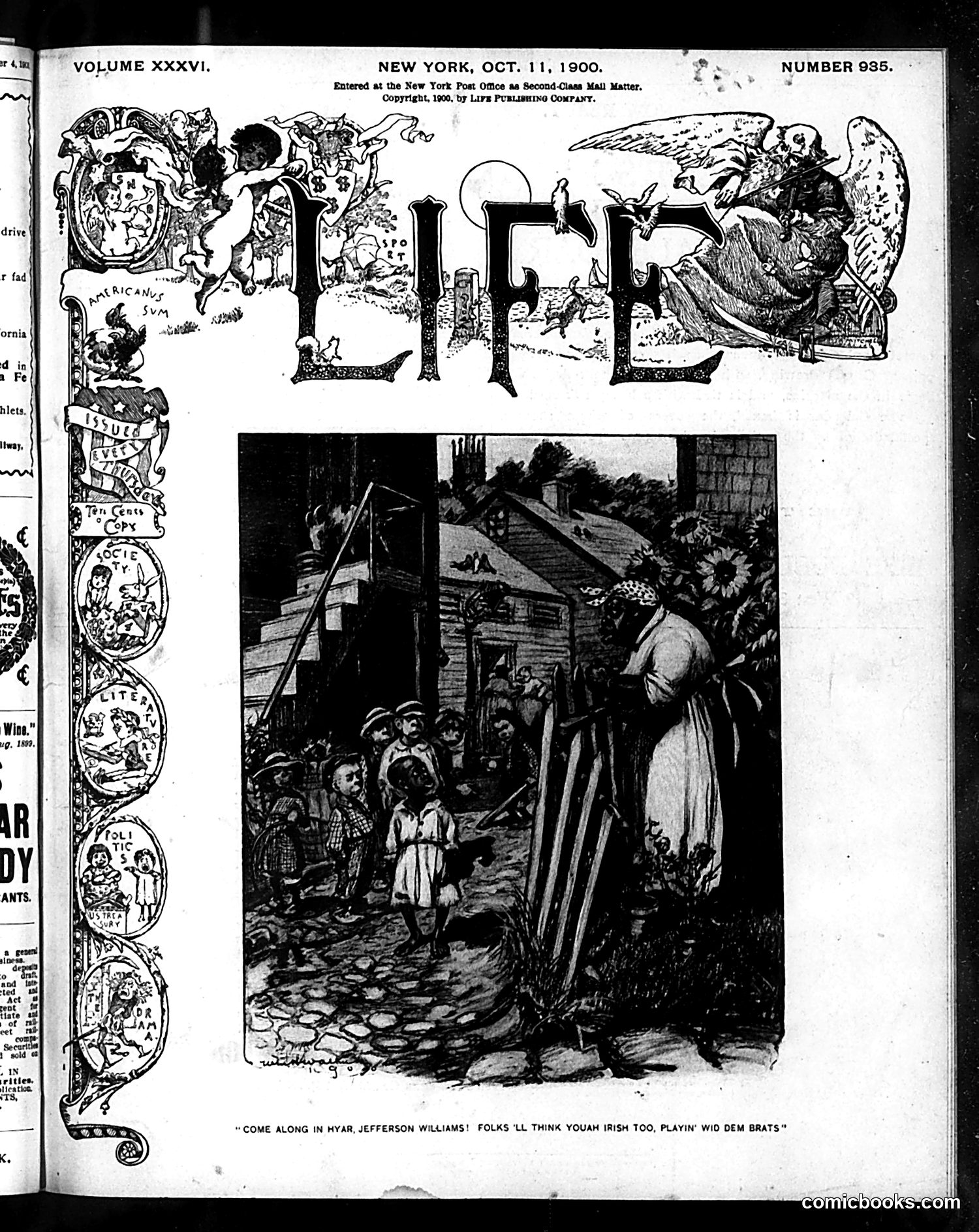
This is the cover of *Life* magazine from October 11, 1900. The main illustration depicts a figure addressing a group of children in front of a rural cabin, with the caption: "COME ALONG IN HYAR, JEFFERSON WILLIAMS! FOLKS'LL THINK YOUAH IRISH TOO, PLAYIN' WID DEM BRATS" The satire concerns American racial and ethnic prejudices at the turn of the 20th century. The scene appears to mock social anxieties about Irish immigrants and their children, suggesting that participation in certain activities or associations could make someone appear "Irish"—treating Irish identity as something stigmatizing to be avoided. The rural dialect in the caption reinforces period stereotypes. The cartoon critiques how Americans categorized and stigmatized immigrant groups, particularly the Irish, in this era.
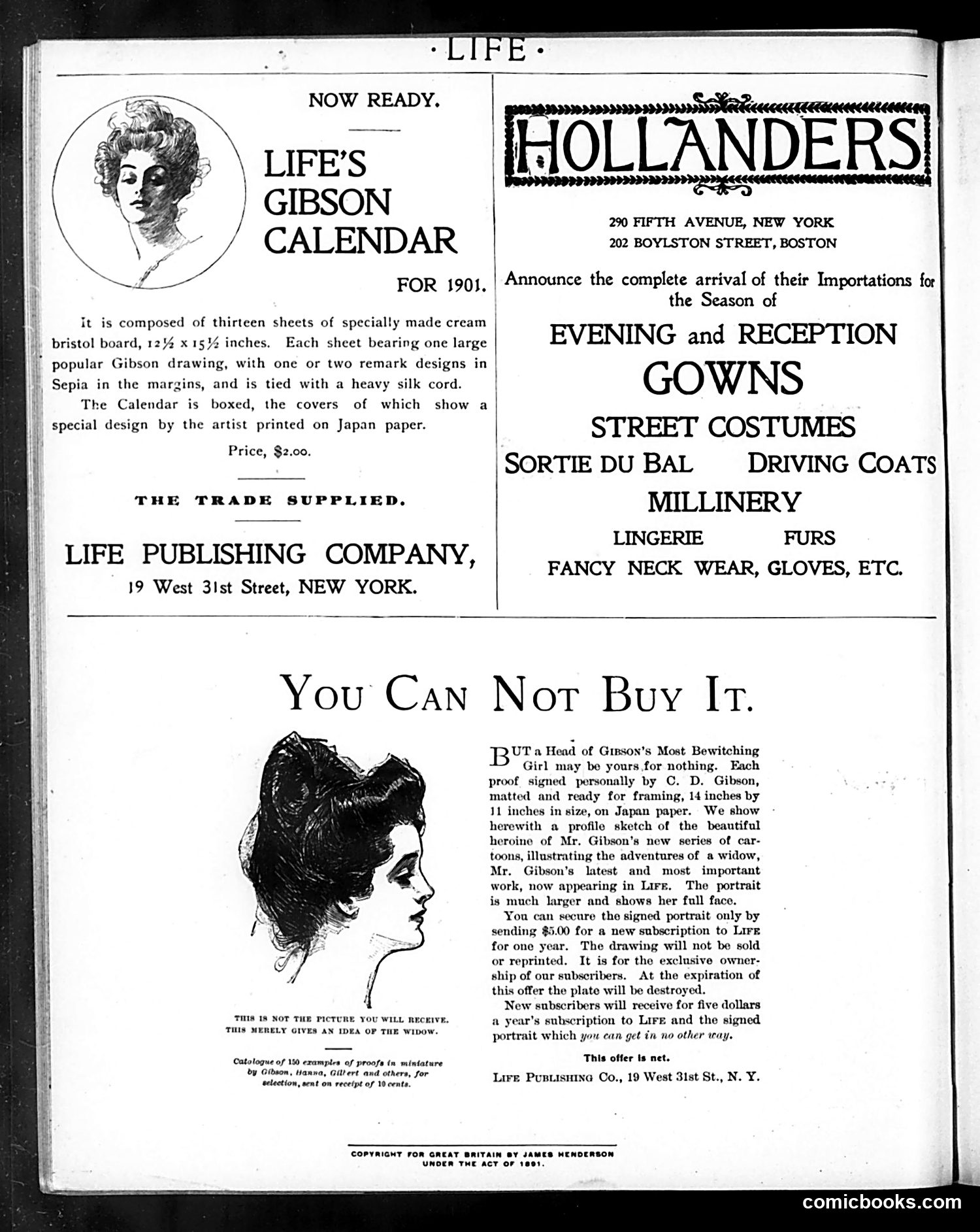
This page is primarily **advertising**, not satirical content. The top half promotes Life's Gibson Calendar for 1901 and Hollanders' fashion store offerings (gowns, coats, millinery, furs). The bottom section advertises a promotional offer: subscribers can obtain a signed C.D. Gibson portrait drawing titled "You Can Not Buy It" by subscribing to Life for one year at $3.00. The accompanying profile sketch shows Gibson's characteristic "Gibson Girl" style—an idealized female face representing the popular aesthetic of the era. The "satire" here is gentle marketing wordplay: the portrait itself cannot be purchased with money alone; it requires a subscription commitment. The offer emphasizes exclusivity and the drawing's value as a collectible. This represents early-1900s magazine promotion targeting affluent readers.
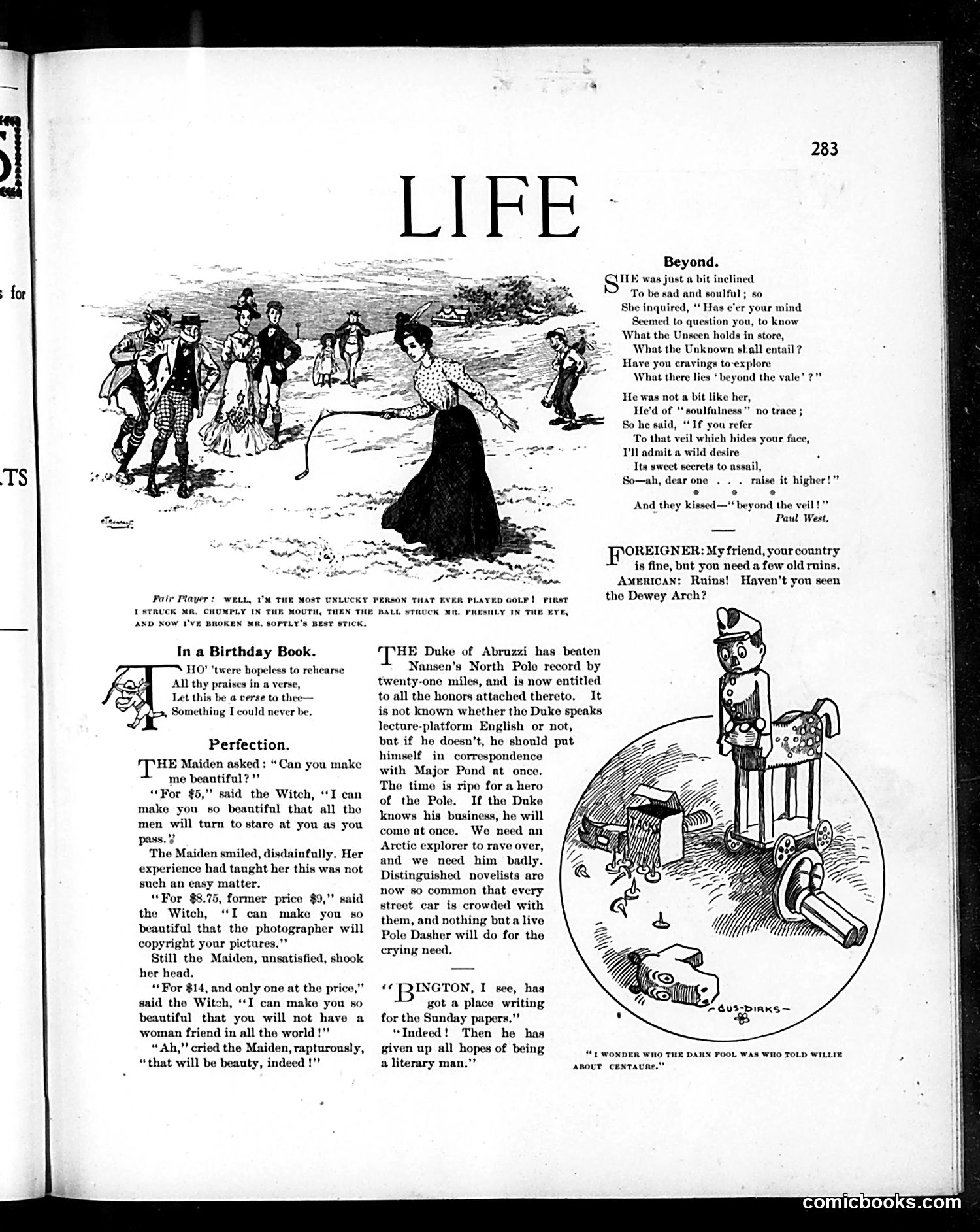
This page contains several humorous short pieces rather than a unified political cartoon. **"Beyond"** depicts a woman questioning life's mysteries, with a man dismissively responding that he prefers physical pleasures ("raise it higher") to philosophical inquiry. **"In a Birthday Book"** presents a Witch offering increasingly expensive photograph packages, satirizing commercialized gift-giving through escalating prices and dubious claims of beauty enhancement. **"Perfection"** features a Maiden and Witch debating whether expensive photography can make someone beautiful—mocking both vanity and commercial manipulation. The remaining sections discuss Arctic exploration achievements and literary aspirations, appearing to be gossip or social commentary rather than direct political satire. The overall tone is lighthearted mockery of human pretension and commercialism.
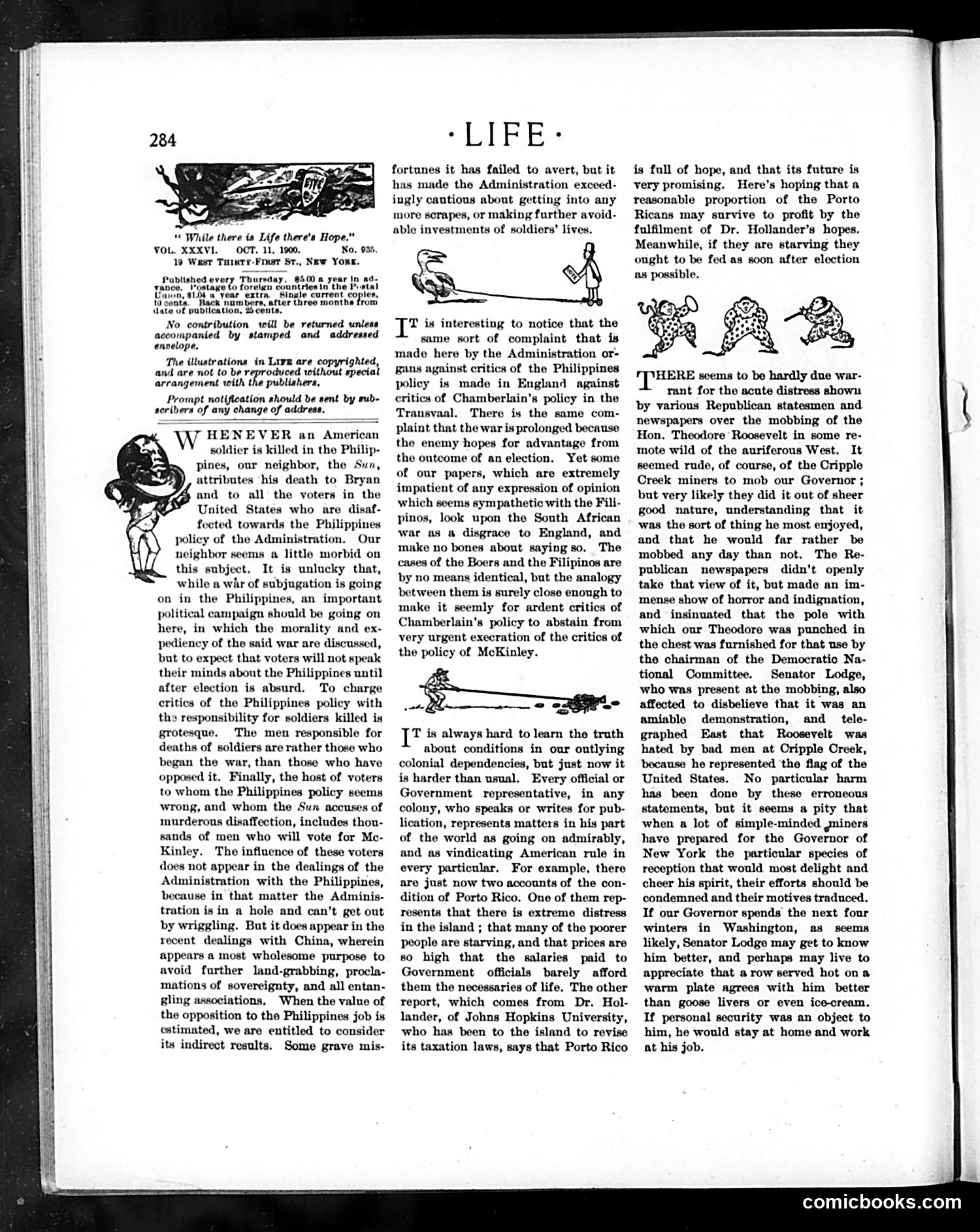
This page from Life magazine critiques the McKinley Administration's Philippines policy and its critics. The editorial discusses how American soldiers' deaths in the Philippines are being used as political ammunition against the Administration, particularly by Democratic opponents. The text references Bryan (likely William Jennings Bryan, the Democratic candidate), debates over whether the war is prolonged for political advantage, and comparisons to British policy in South Africa. The small cartoons appear to illustrate public reaction—figures gesturing in debate or protest. The page argues that newspapers and politicians are exploiting soldier deaths and colonial hardship (mentioning Porto Rico's distress) for electoral gain rather than addressing actual policy problems. The satire targets opportunistic political exploitation of military casualties.
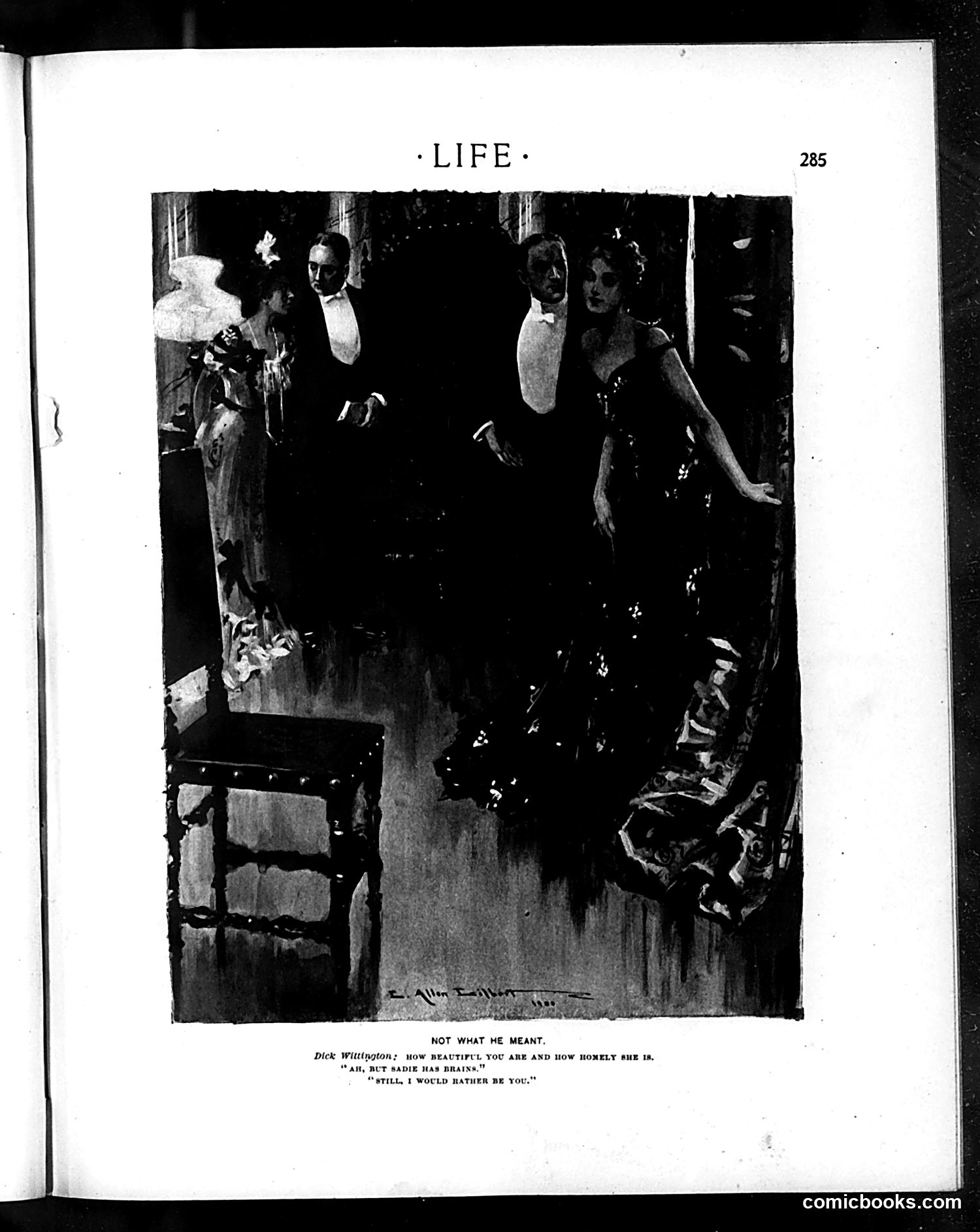
This Life magazine cartoon depicts a social scene where a man (Dick Willington) makes an awkward compliment to a woman. The caption reads: "How beautiful you are and how homely she is. 'Ah, but sadie has brains.' 'Still, I would rather be you.'" The satire targets the social awkwardness of backhanded compliments and misguided gallantry. Willington attempts flattery by contrasting the woman's beauty favorably against another ("Sadie"), but his comment backfires—he essentially insults Sadie while offering dubious praise based solely on appearance. The woman's response reveals his gaffe: he's inadvertently suggested she'd rather be valued for looks than intelligence. The cartoon mocks masculine social ineptitude and the contradictions in how women were valued during this era.
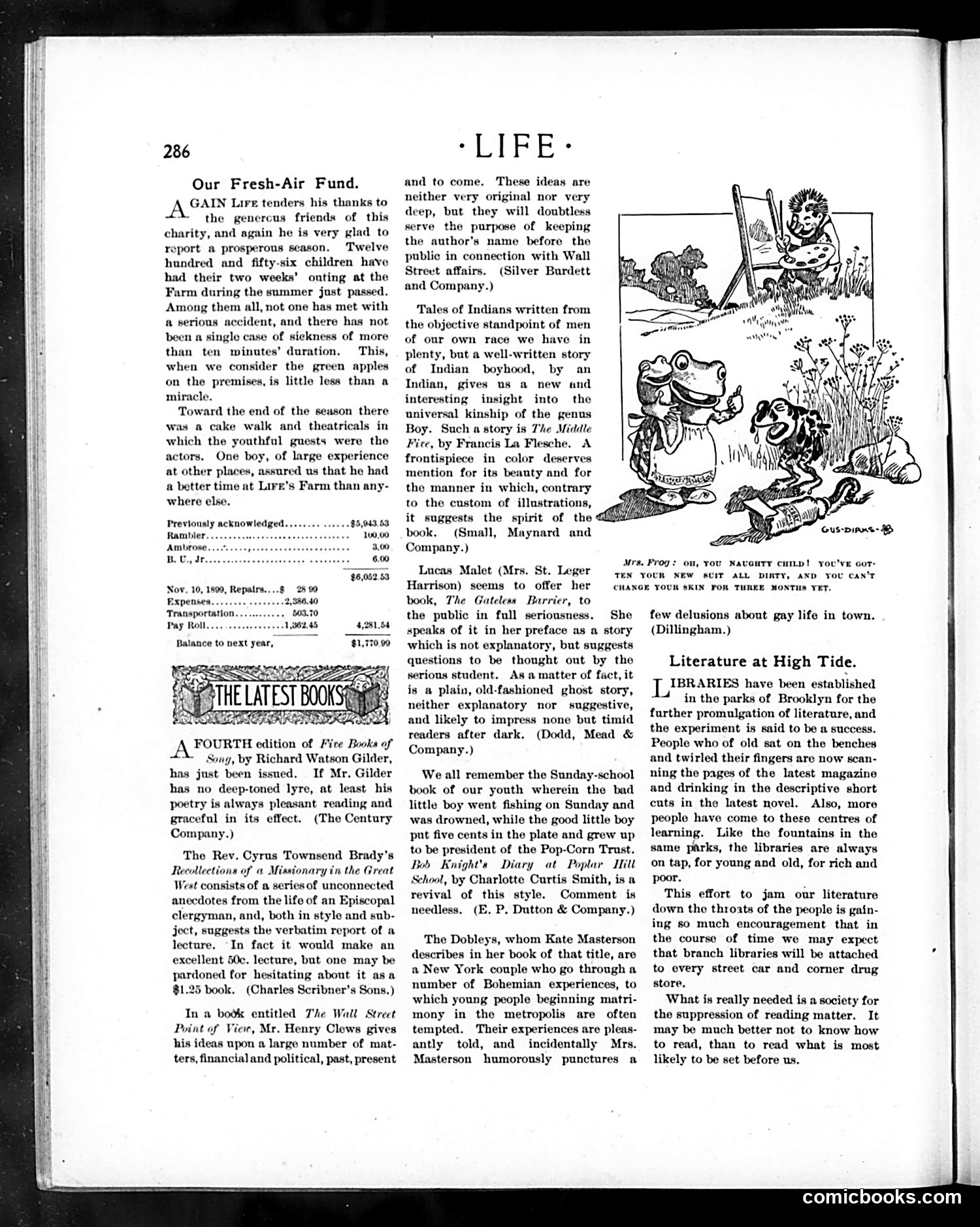
This page contains book reviews and literary discussion rather than political cartoons. The main illustration shows a anthropomorphic frog character addressing what appears to be a smaller frog or toad, with the caption reading "Mrs. Frog: Oh, you naughty child! You've gotten your new suit all dirty, and you can't change your skin for three months yet." The joke appears to be a pun playing on the biological fact that frogs shed their skin. The "naughty child" scenario uses this natural frog behavior as the basis for humor—the parent character cannot simply wash the suit since the frog cannot change its literal skin for months. The surrounding text reviews contemporary books about Indians, Bohemian life, and ghost stories, representing typical Life magazine literary coverage of the period.
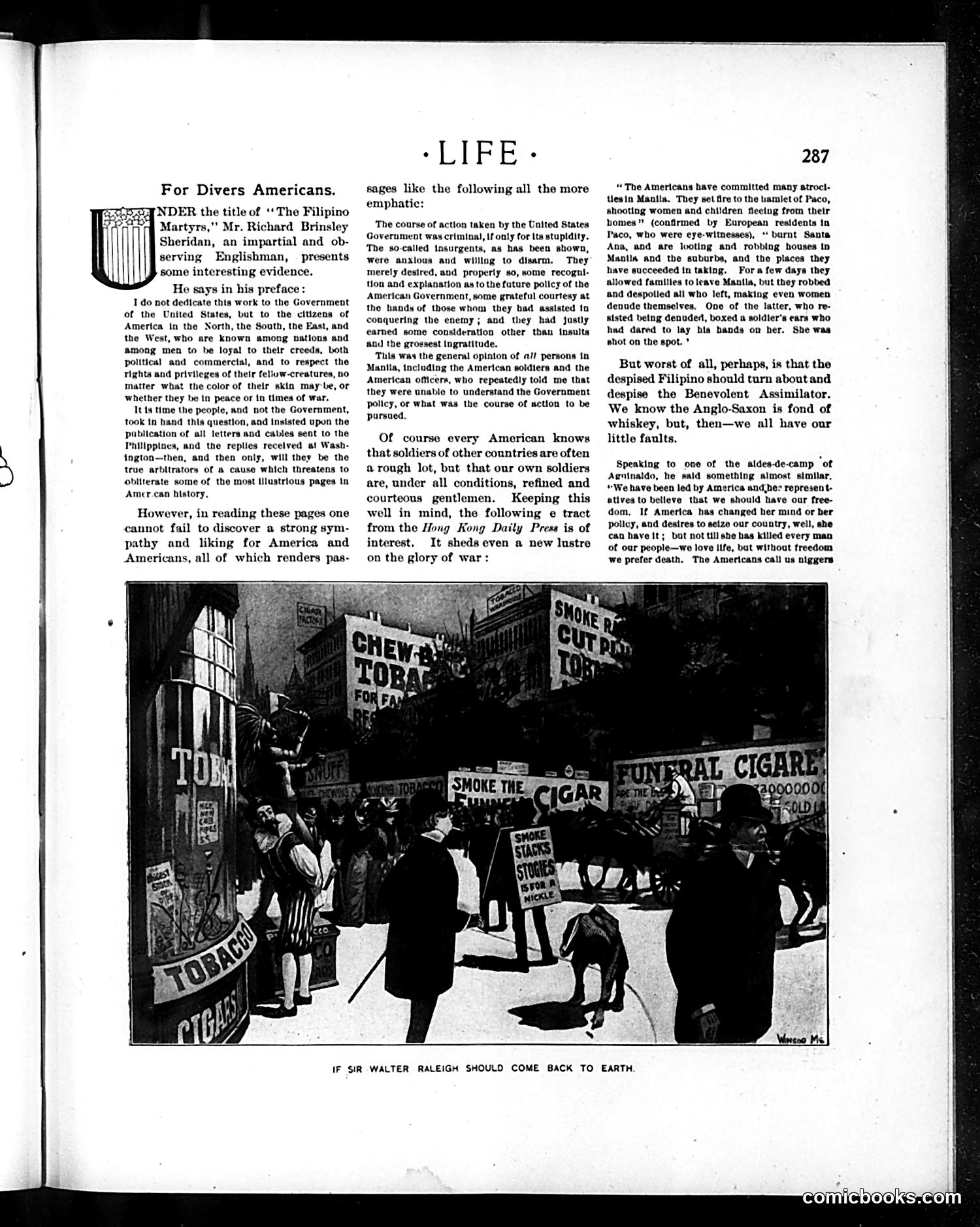
This satirical cartoon depicts a crowded urban street dominated by commercial advertising for tobacco and cigars—signs reading "CHEW TOBACCO," "SMOKE THE CIGAR," and "FUNERAL CIGARS" are prominently displayed. The caption references Sir Walter Raleigh, the Elizabethan explorer credited with introducing tobacco to England from the New World. The satire suggests that if Raleigh could witness modern America, he would see his accidental legacy transformed into aggressive commercialism and mass consumption culture, with tobacco advertising utterly saturating public spaces. The cartoon critiques both American consumerism and the pervasive influence of tobacco marketing on urban life, using historical irony to highlight how a colonial curiosity became an omnipresent commercial force.
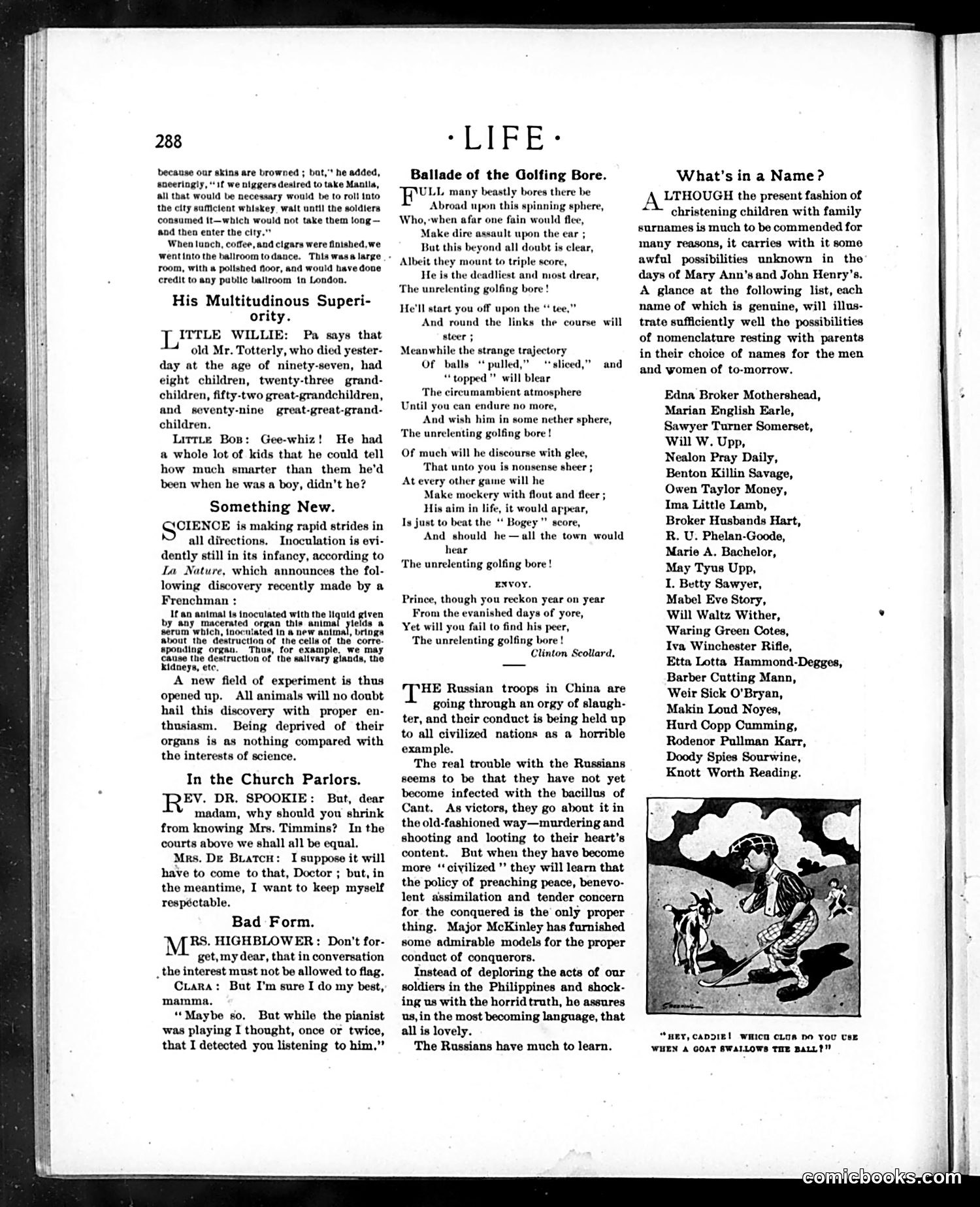
The page contains primarily text articles and a single illustrated cartoon. The cartoon shows what appears to be a goat swallowing a ball, with the caption "HEY, CADDIE! WHICH CLUB DO YOU USE WHEN A GOAT SWALLOWS THE BALL?" This is a golf joke playing on the absurdity of an animal interference during play. The humor relies on the golfer asking the caddie (his assistant) which club to use in an impossible situation—treating the ridiculous scenario as a legitimate golfing problem. The surrounding text includes satirical pieces like "Ballade of the Golfing Bore" (mocking repetitive golf anecdotes) and articles about Russian troops in China, presenting typical Life magazine content mixing humor, social commentary, and light satire on contemporary issues.
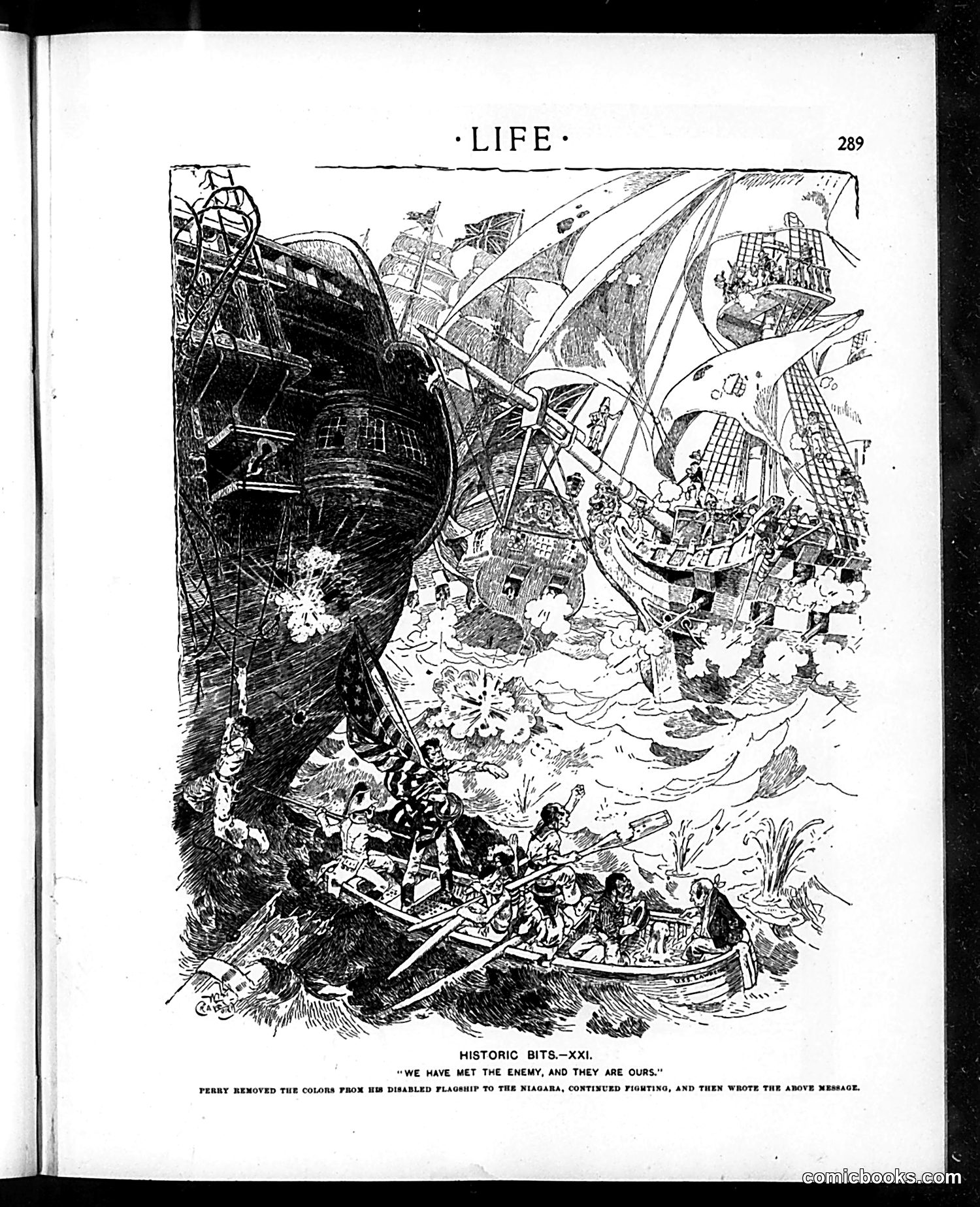
This illustration depicts Commodore Perry's famous 1853 encounter with Japan. The large dark ship on the left represents Perry's American "Black Ships" that forcibly opened Japan to Western trade. The smaller vessels and boats show the initial confrontation in Japanese waters. The caption quotes Perry's famous report: "We have met the enemy, and they are ours," referencing his successful mission to end Japan's isolation policy. The satirical point appears to be commentary on American expansionism and military superiority—celebrating Western naval power imposing itself on Asian nations. For modern readers, this represents a pivotal moment when Western powers forced non-Western nations into trade agreements through military threat, a colonial-era practice now viewed critically.
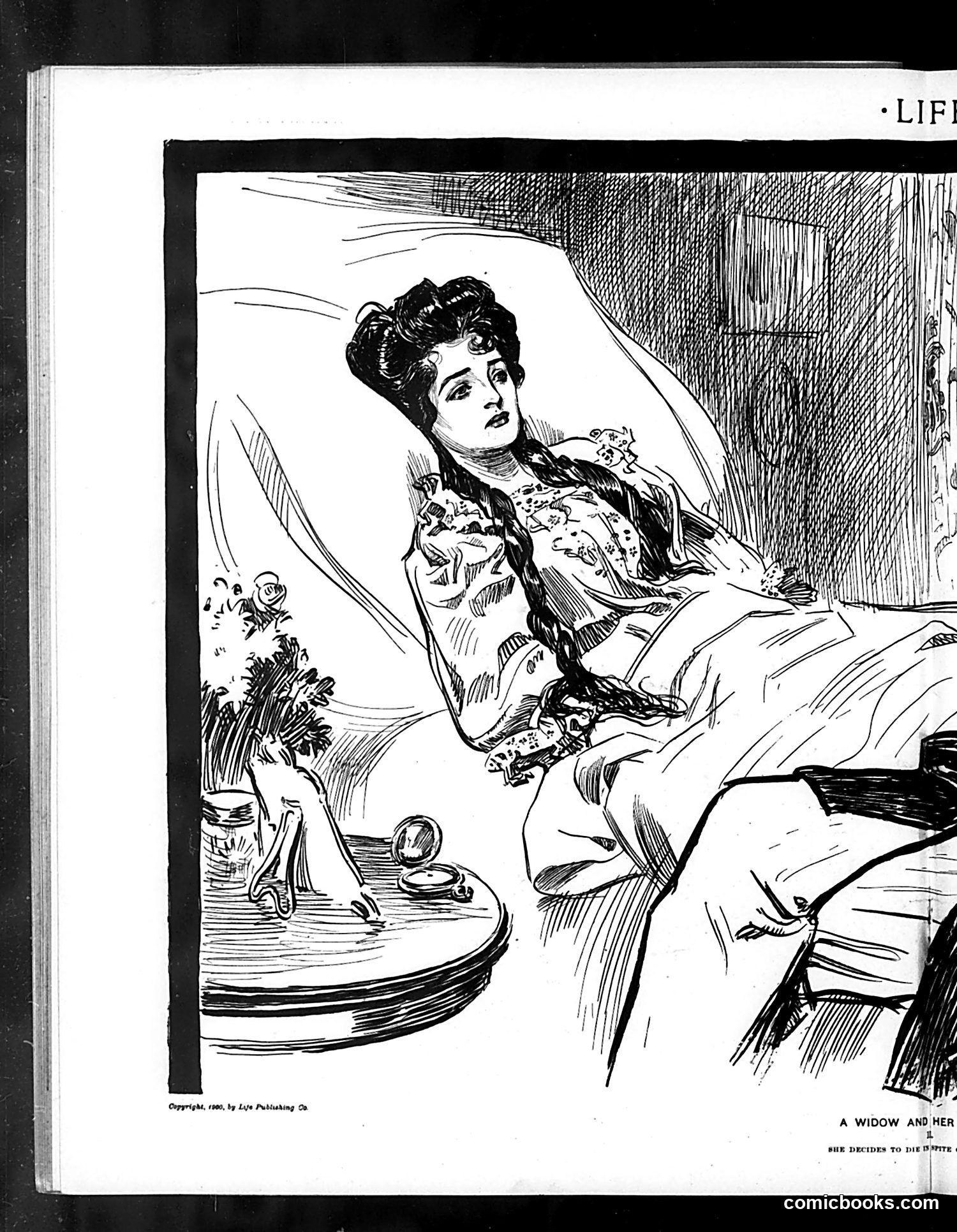
This is an ink illustration from Life magazine (copyright 1908, Life Publishing Co.) depicting a woman in an elegant bedroom scene. The partially visible caption reads "A WIDOW AND HER..." with text below suggesting "SHE DECIDES TO DIE QUITE I[...]" (cut off). The image shows a woman in fashionable early 1900s dress reclining on a bed, gazing pensively toward a bedside table with flowers. The style and composition suggest this illustrates a domestic melodrama—likely a literary adaptation or serialized story rather than political satire. Without the complete caption and text, the specific plot point remains unclear, though the theatrical staging indicates this was meant to accompany a narrative article typical of Life's illustrated fiction content from this era.
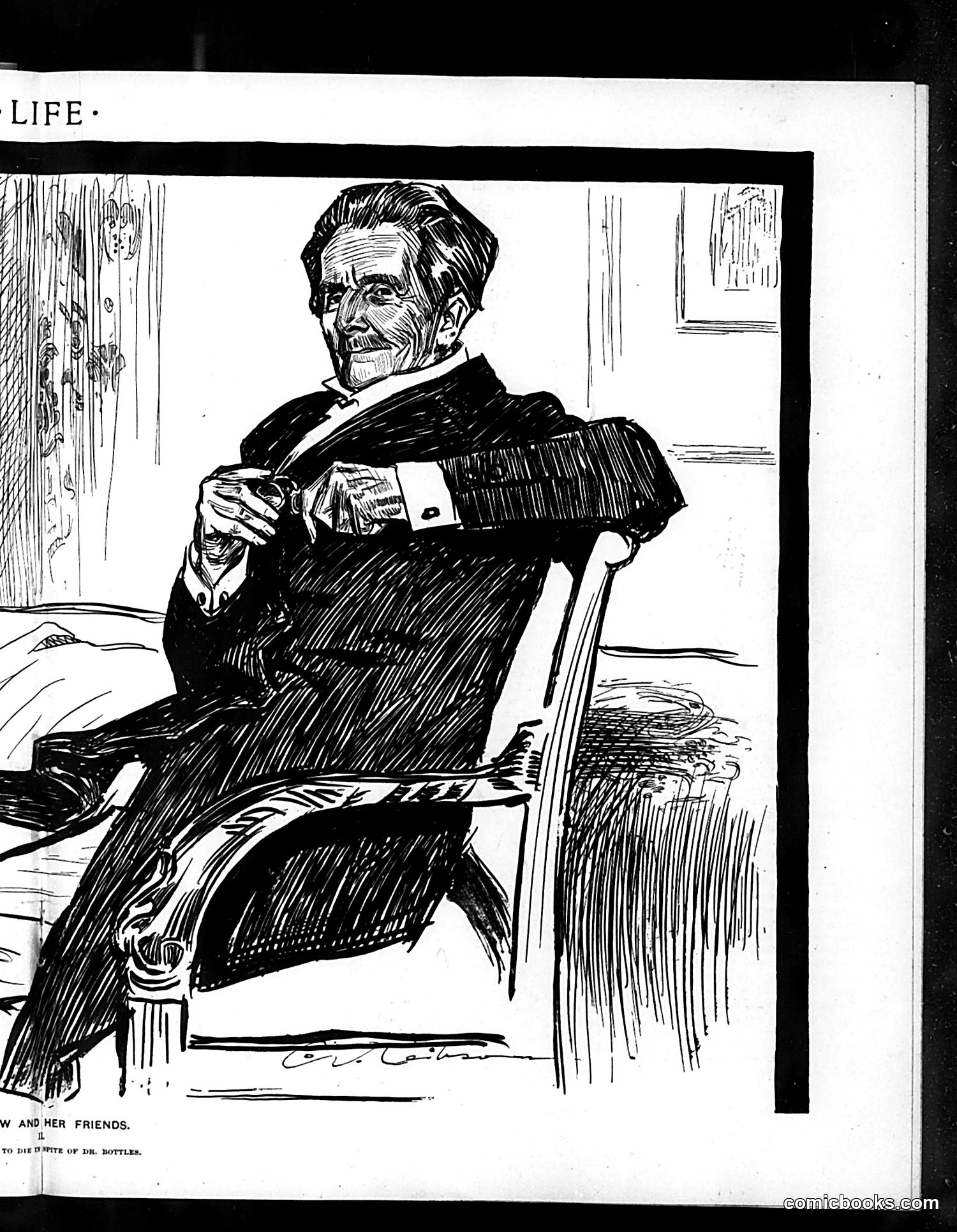
This is a Life magazine illustration showing a well-dressed man in military dress with epaulettes, seated and holding what appears to be bottles. The OCR text fragments reference "Dr. Bottles" and mention "her friends," suggesting this is satirical commentary on a specific figure or public personality. The military uniform and formal attire indicate this likely depicts someone of rank or authority. The emphasis on "bottles" in the partial caption suggests the satire concerns drinking or alcohol consumption — possibly criticizing this person's habits or character. However, without the complete caption and full context of the surrounding article, I cannot definitively identify who this caricature represents or the specific historical incident being mocked. The artistic style and page quality suggest early-to-mid 20th century publication.
This page contains a satirical article titled "The Opera and a Few Words from Cap'n Dan'l" criticizing grand opera in America. The author argues that grand opera is an affectation—foreign, incomprehensible to ordinary Americans, and patronized primarily for social status rather than genuine appreciation. The piece uses "Cap'n Dan'l" as a folksy voice to mock opera-goers who pretend to understand performances sung in foreign languages they don't speak. The satire targets the pretentiousness of American high society, suggesting grand opera serves mainly as "a grand bluff to make the common people aspire to pay large money" for what they cannot understand. The ornamental illustrations are decorative period artwork typical of Life magazine's era.
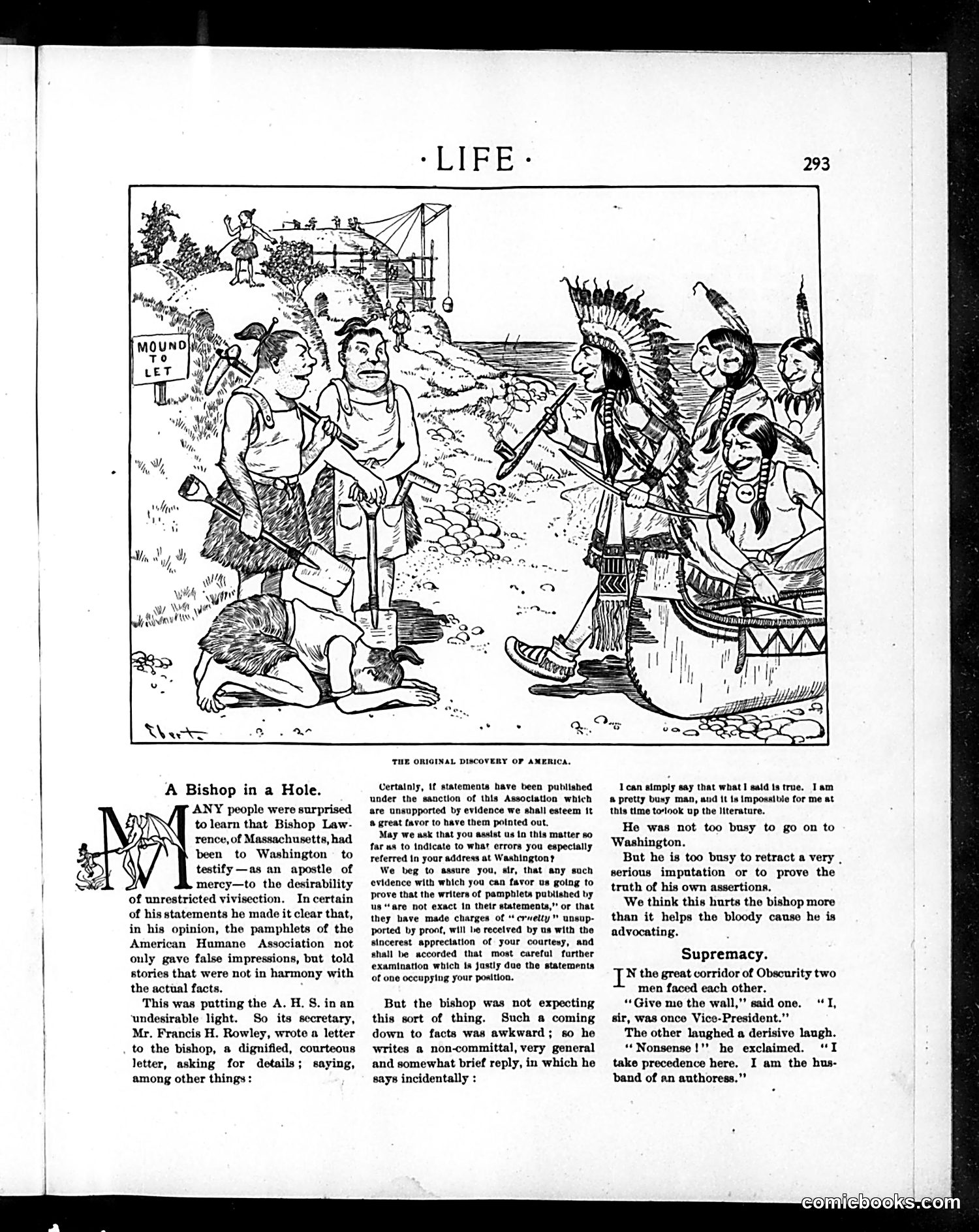
**The Main Cartoon** ("The Original Discovery of America"): This satirizes a confrontation between European settlers/officials and Native Americans. The caption's ironic title mocks the colonial narrative of "discovering" America, implying the Europeans are actually the intruders. **"A Bishop in a Hole"**: Life ridicules Bishop Lawrence of Massachusetts, who testified to Congress supporting unrestricted animal experimentation (vivisection) and criticized the American Humane Association's pamphlets as false. When the Association's secretary politely requested specifics, the bishop refused to provide evidence—claiming he was "too busy" to review literature, despite having traveled to Washington to make his accusations. Life mocks his hypocrisy: willing to make serious charges publicly but unwilling to substantiate them privately. **"Supremacy"**: A brief joke contrasting two men's claims to importance—one proud of being a former Vice-President, the other claiming superiority as "husband of an authoress," suggesting absurd status hierarchies. The page critiques evasion, hypocrisy, and unsupported public accusations.
This page contains two distinct pieces of social satire: **"Modern Vice"** (top) is a brief poem mocking how easily fashionable women ("sirens") attract suitors, then become tired of the attention and demand "reform"—a jab at society's superficial moral posturing. **"The Opera and a Few Words from Cap'n Dan'l"** (main article) critiques grand opera as an elitist pretense. The author argues that *Faust* performed in English at the Metropolitan Opera House reveals opera's true nature: a "grand bluff" where Americans pay exorbitant prices to hear something they don't understand, valuing it only because it's foreign and exclusive. When made accessible through English, the spectacle loses its cachet. The accompanying monologue by "Cap'n Dan'l" (a vernacular character, likely representing common folk wisdom) references playwright James Herne, who wrote *Sag Harbor*—a play featuring realistic depictions of ordinary people. This serves as a counterpoint: authentic American theater depicting real life versus pretentious European imports. The satire targets American class anxiety and cultural snobbery.
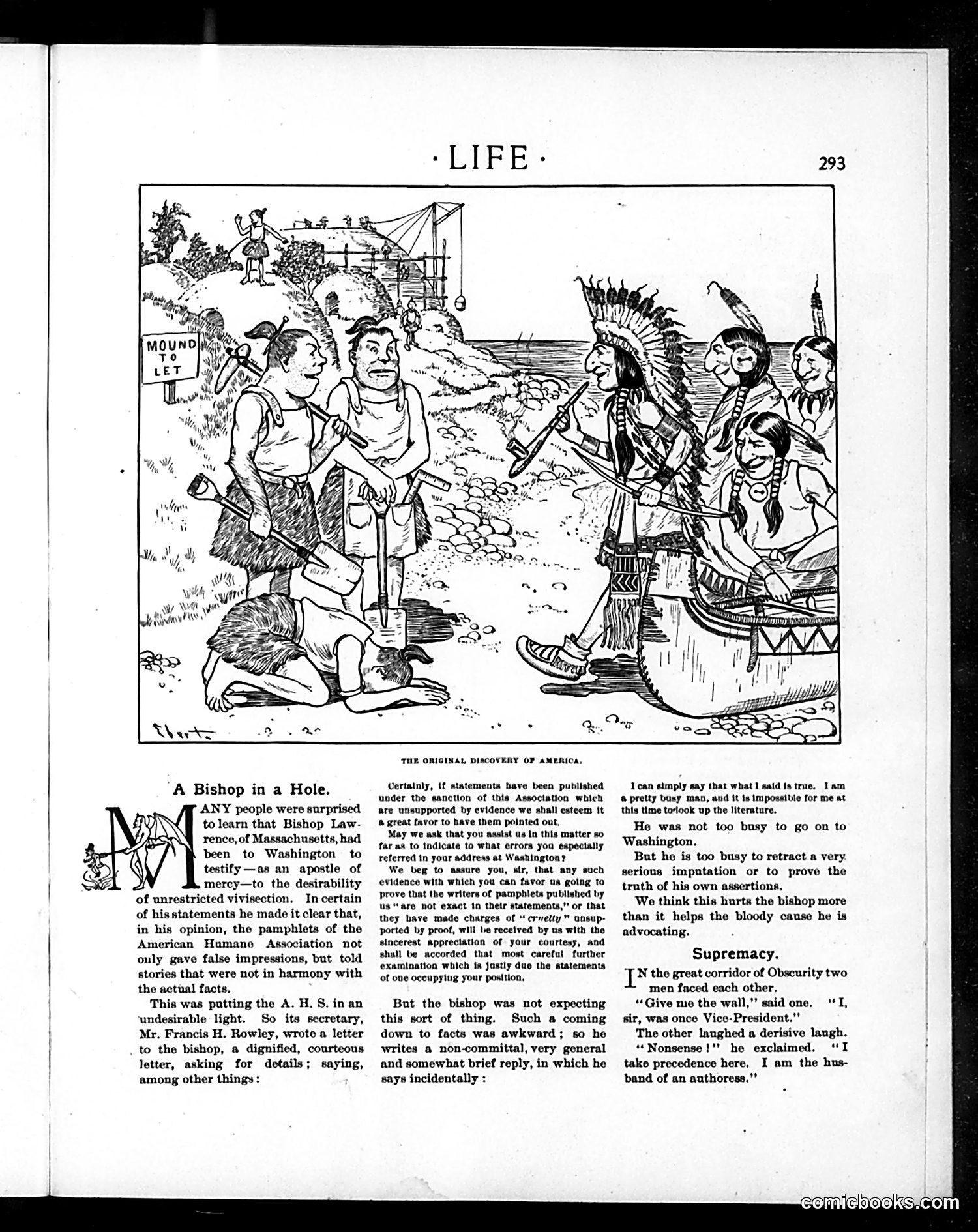
This satirical piece mocks Bishop Lawrence of Massachusetts for testifying to Congress supporting unrestricted vivisection (animal experimentation), while claiming the American Humane Association's pamphlets contained false statements. When the Association's secretary politely asked for specific examples to correct errors, the Bishop refused to provide details, claiming he was "too busy" to review the literature—despite having been busy enough to testify in Washington. The satire's point: the Bishop made serious public accusations he couldn't or wouldn't substantiate. His evasive non-response exposes his argument as hollow and damages his credibility more than it helps his pro-vivisection cause. The cartoon "The Original Discovery of America" appears to satirize early European colonizers encountering Native Americans, likely commenting on the "discovery" narrative itself, though the specific satirical target is unclear from the visible text.
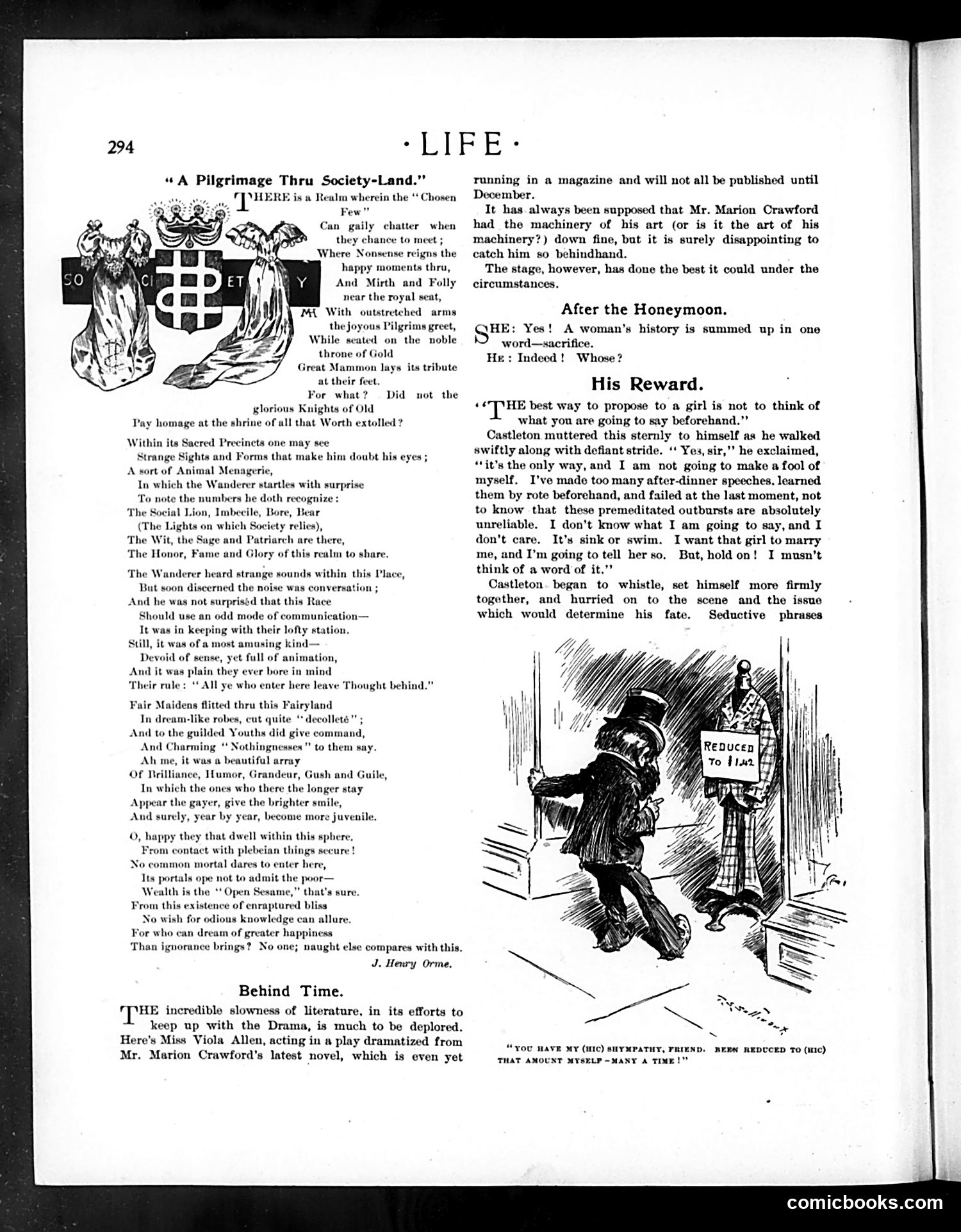
This page contains satire on American high society and courtship customs, likely from the early 1900s. **"A Pilgrimage Thru Society-Land"** (left) is a poem mocking wealthy social circles as shallow and materialistic. It depicts "Society-Land" as a realm where "Mammon" (wealth personified) rules, populated by social types—lions, bores, wits—who value appearance over substance. The pointed critique: society members "leave Thought behind" and remain "juvenile" through constant social performance. **"His Reward"** (right) satirizes male courtship anxiety. A man named Castleton overthinks proposing to a girl, ironically undermining his goal by trying *not* to think beforehand. The cartoon illustration shows him "reduced to (11¢)" financially—suggesting marriage's economic toll. **"After the Honeymoon"** presents a cynical gender joke: a woman's life is "summed up in one word—sacrifice," implying wives lose their identity. **"Behind Time"** notes that literature lags behind theater—Marion Crawford's novels are slow to adapt for stage. The overall message critiques both aristocratic frivolity and the anxiety-ridden business of courtship and marriage.
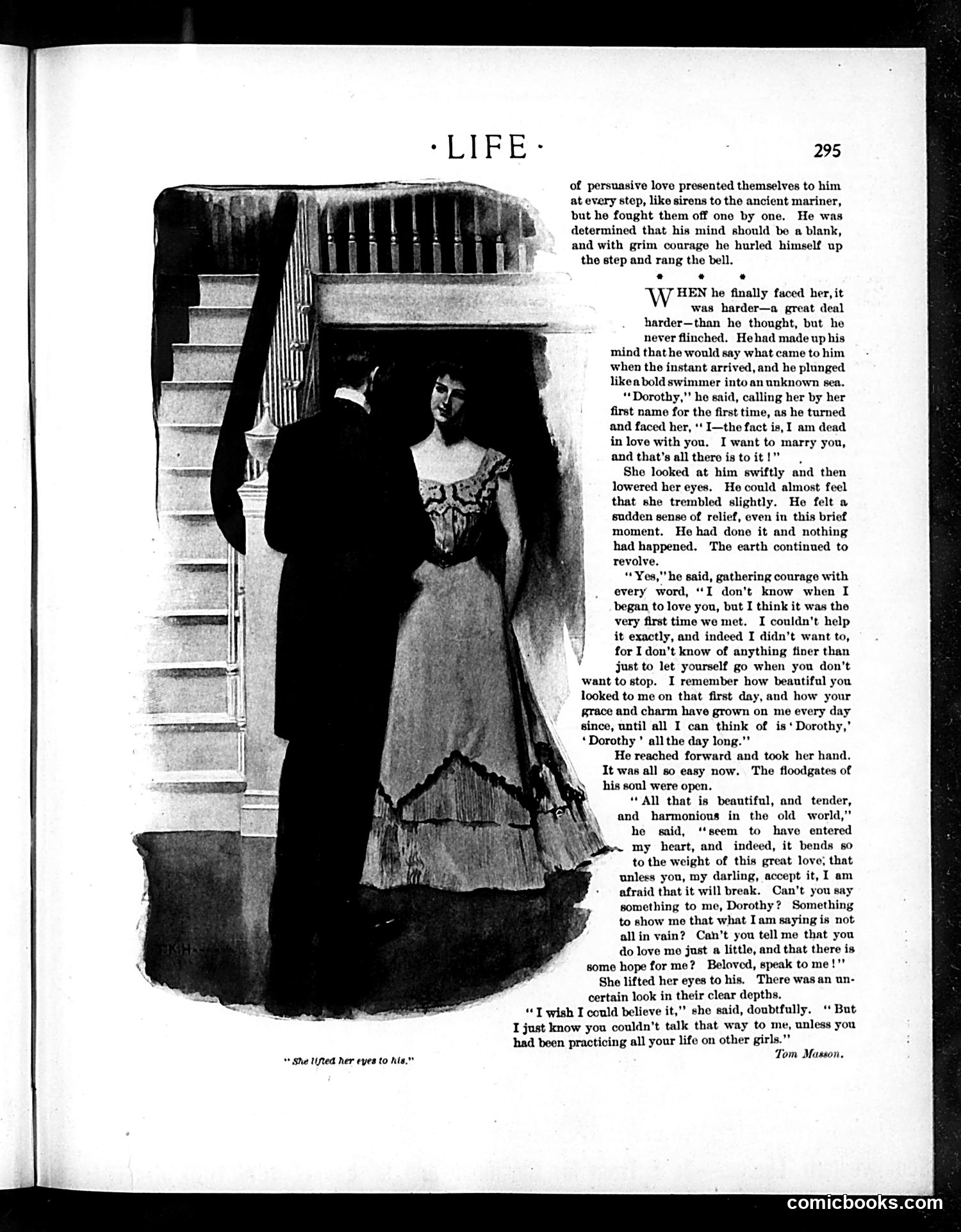
This is a satirical fiction excerpt (credited to Tom Masson) depicting a man's awkward marriage proposal. The humor lies in the contrast between his elaborate, flowery romantic declarations and the woman's skeptical response. The satire targets masculine courtship pretense: the man rehearses his confession obsessively, steels himself with "grim courage," and delivers an overwrought speech about souls and floodgates. Dorothy's deadpan reply—that his eloquence is suspiciously polished, suggesting he's "been practicing all your life on other girls"—deflates his sincerity entirely. The joke reflects early 20th-century anxieties about male authenticity in romance. While he believes he's being genuinely spontaneous and heartfelt, his theatrical language and calculated approach betray him as either insincere or comically inept at actual human connection. Dorothy's skepticism suggests women recognized performative courtship when they heard it.
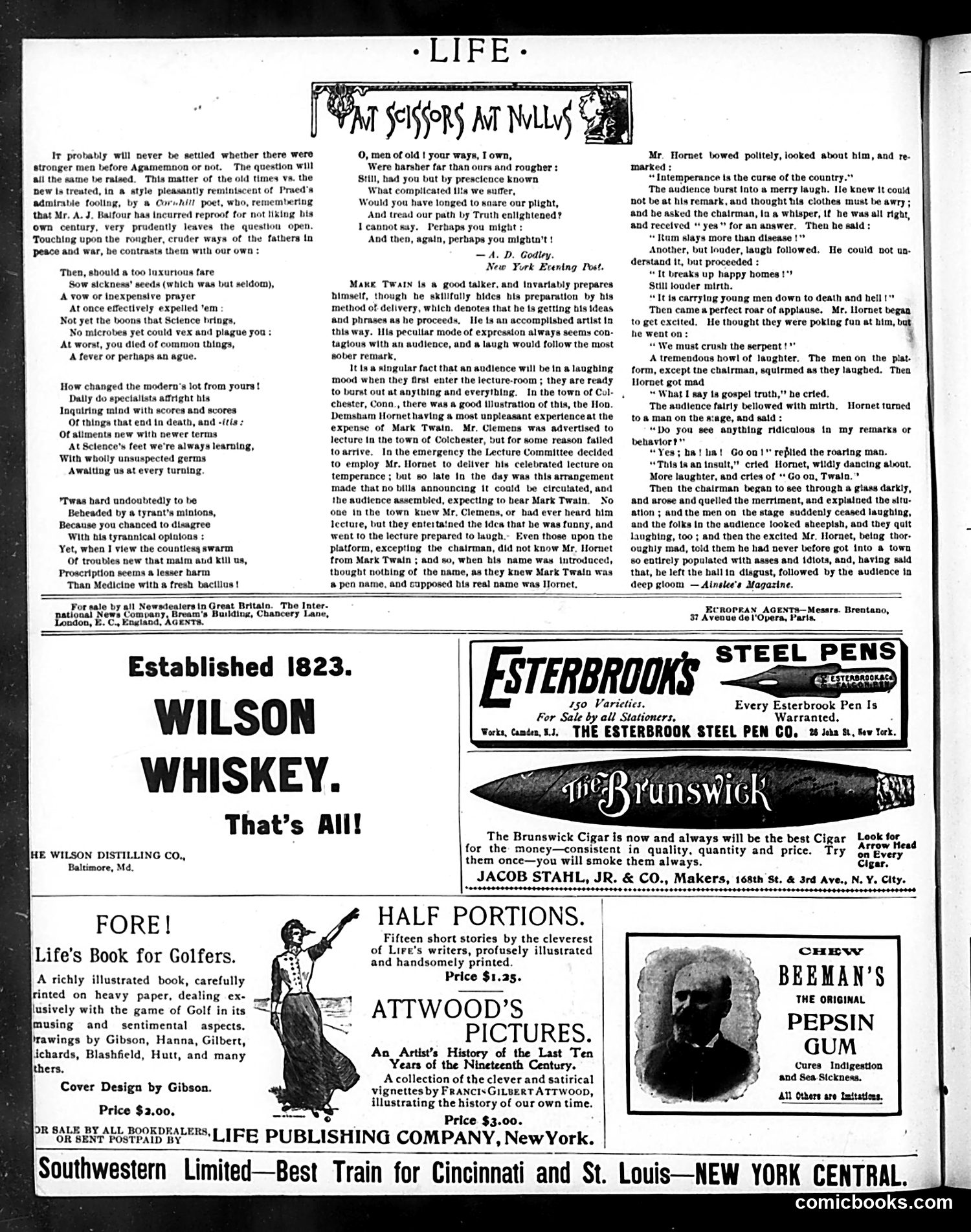
This page contains two main pieces of satirical content: **The Poetry Section ("Am Scissors Am Mules")**: A humorous poem by A.D. Godley comparing modern life unfavorably to ancient times. The joke is ironic: while the old days were harsh (beheading by tyrants, simple fevers), modern life brings new anxieties—hypochondria, medical terminology, and newly-discovered diseases and germs. The satire mocks contemporary obsession with health scares and "science-induced" worrying. **The Mark Twain Anecdote**: A story about lecturer Denham Hornet accidentally substituting for Mark Twain in Colchester, Connecticut. The audience, primed to laugh at "Mark Twain," finds Hornet's opening line about temperance hilarious—not because it's funny, but because they expect entertainment. The satire skewers both audience psychology (ready-made laughter) and the celebrity effect (people laugh at a name rather than content). The remainder is advertisements. Both pieces reflect turn-of-century American humor and social commentary.
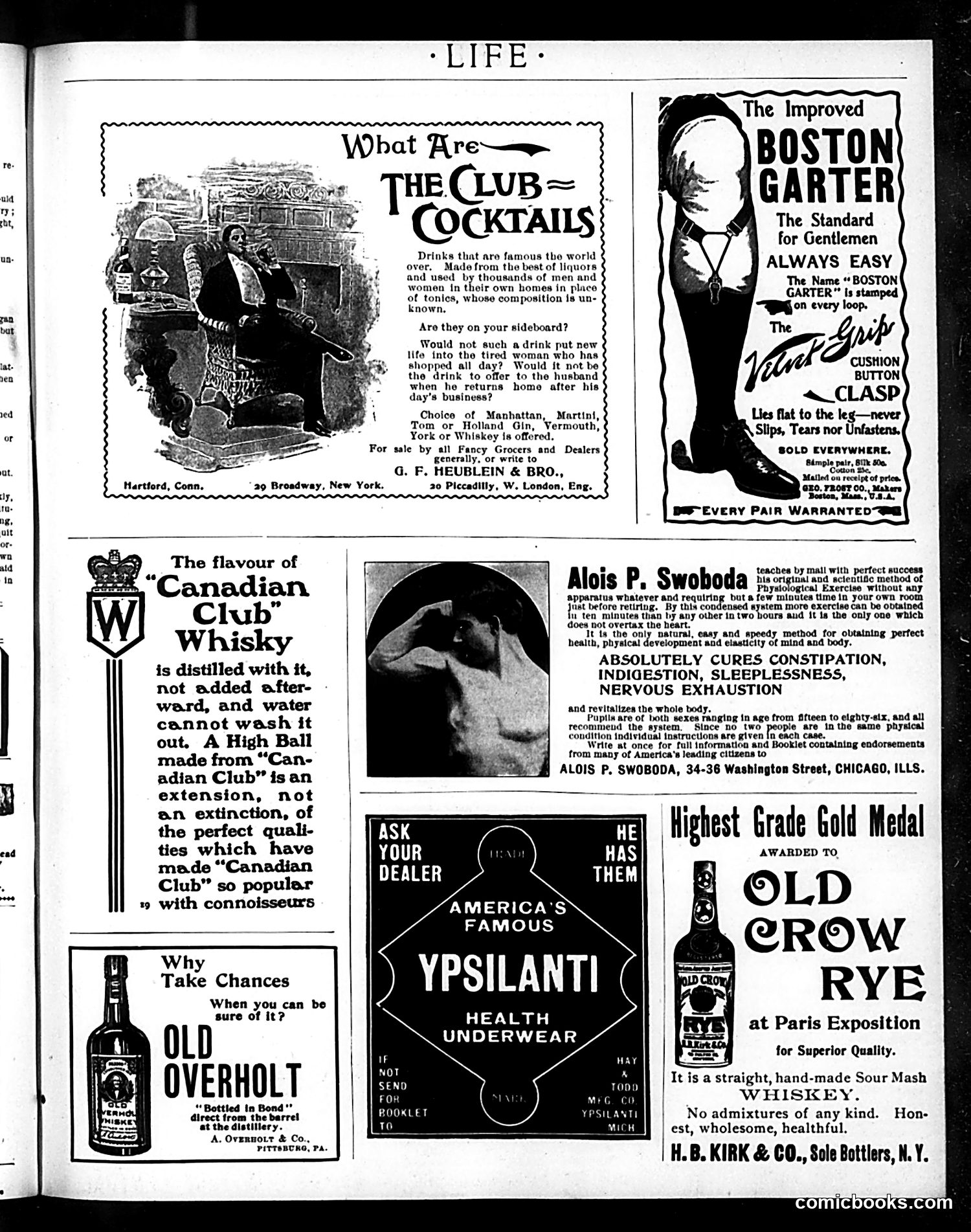
This is primarily a **advertisements page**, not satirical content. The page dates from the Prohibition era (early 1900s, pre-1920) when alcohol advertising was legal and common. **Key content:** - **Club Cocktails advertisement** (top): Promotes ready-made cocktail drinks as convenient alternatives to tonics for home use—marketed to tired shoppers and businessmen. - **Alcohol ads dominate**: Canadian Club Whisky, Old Overholt, and Old Crow Rye all emphasize quality and purity ("no admixtures"). These ads predate Prohibition's 1920 implementation. - **Health/wellness products**: Alois P. Swoboda advertises mail-order exercise instruction; Boston Garter sells men's garters; Ypsilanti sells "health underwear." **Modern context**: The casual promotion of alcohol as a restorative tonic reflects pre-Prohibition attitudes. These drinks were marketed as legitimate wellness products, not luxuries—a stance that would become illegal within years.
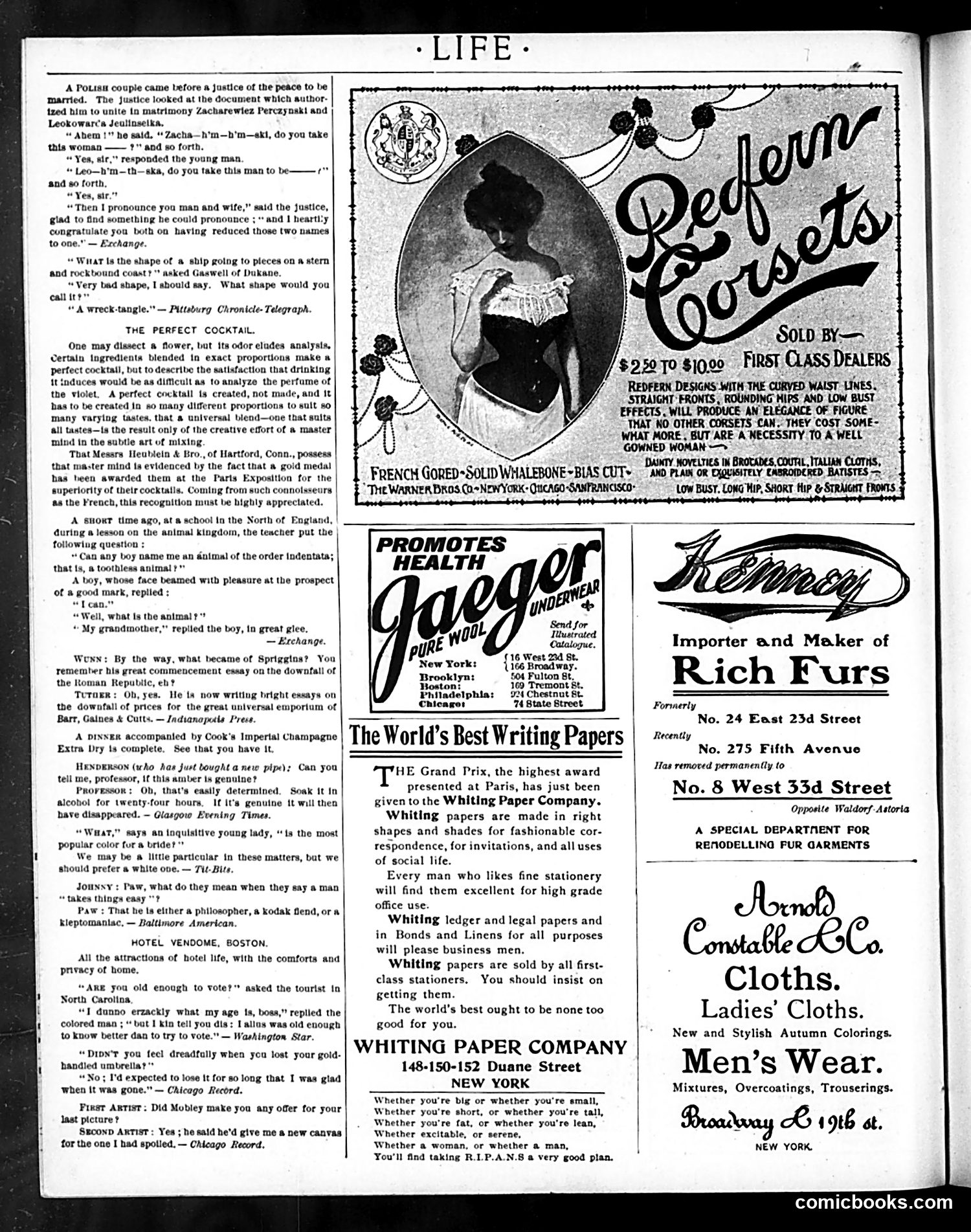
This page is primarily **advertising and humorous anecdotes** with minimal political content. The main satirical content consists of **ethnic humor jokes** typical of early 20th-century American magazines. A prominent joke mocks Polish names—a justice of the peace struggles to pronounce "Zacharewtez Perczynakt" and "Leokowarca Jeulinselka," finding relief when marriage "reduces those two names to one." Another joke features a **racial stereotype**: a Black man in North Carolina claims he's "old enough" to know better than to vote—referencing post-Reconstruction voting discrimination against African Americans, presented here as comedic material. The page is dominated by **period advertisements**: Redfern Corsets, Jaeger underwear, Hennery furs, and Arnold Constable cloths. These ads reflect contemporary fashion and consumer culture. The remaining content includes light puns ("wreck-tangle" for shipwreck shape) and observational humor about cocktails and household items. The satire reflects **turn-of-the-century attitudes toward immigration and race**—viewing ethnic and racial differences as inherently comedic rather than serious social issues.
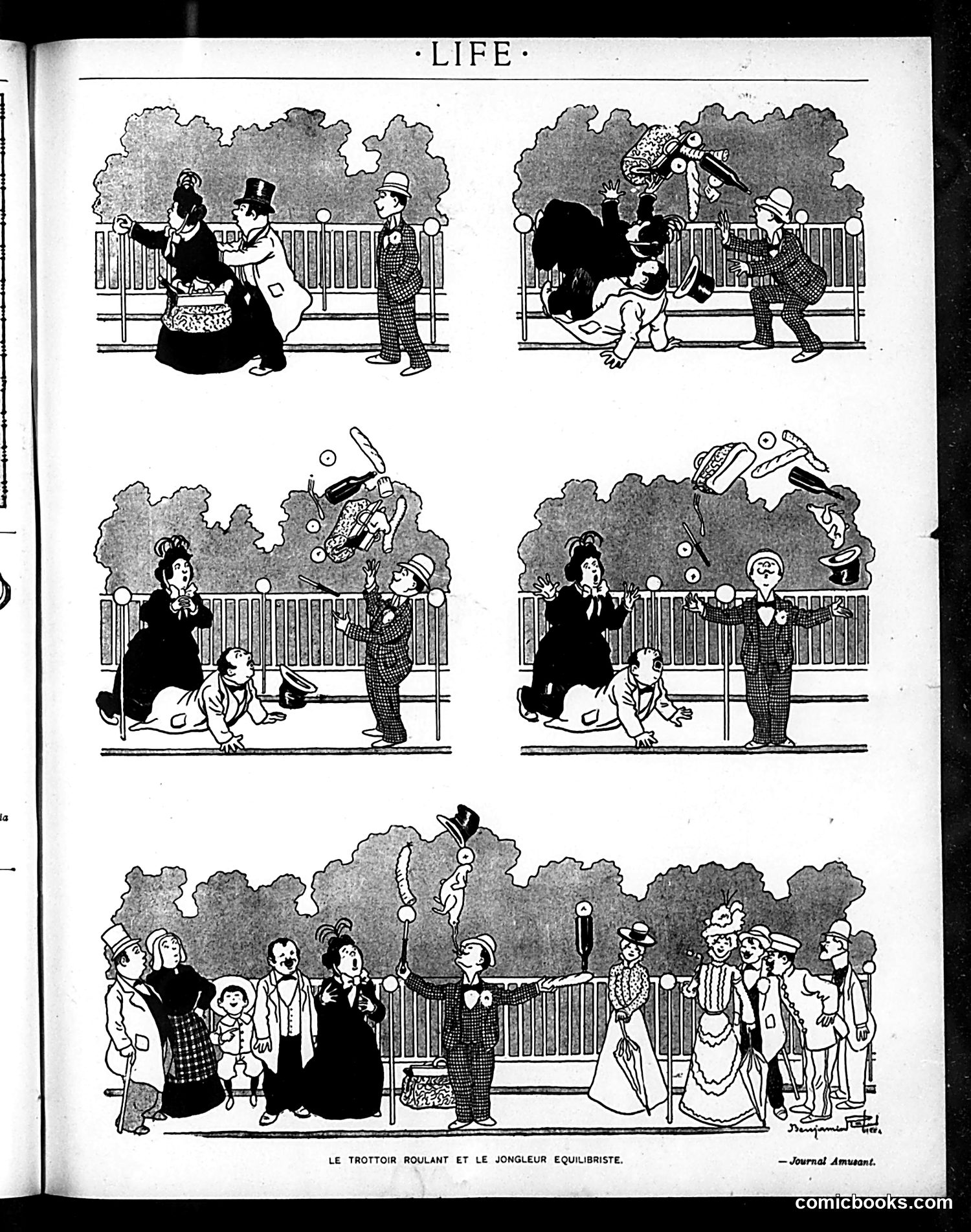
This French-language cartoon (titled "The Moving Sidewalk and the Equilibrist Juggler") uses a visual narrative across five panels to satirize modern urban life, likely from the early 20th century. The sequence shows a juggler attempting to perform while standing on a moving sidewalk—a then-novel technological innovation. The panels depict his escalating struggle: he juggles successfully at first, but the moving platform's motion increasingly disrupts his balance and performance. By the final panel, a crowd gathers to watch the chaos unfold. The satire mocks how new technology disrupts traditional skills and crafts. The juggler represents traditional performers or workers whose livelihoods are threatened by mechanization and modern conveniences that make their expertise obsolete or comically irrelevant.
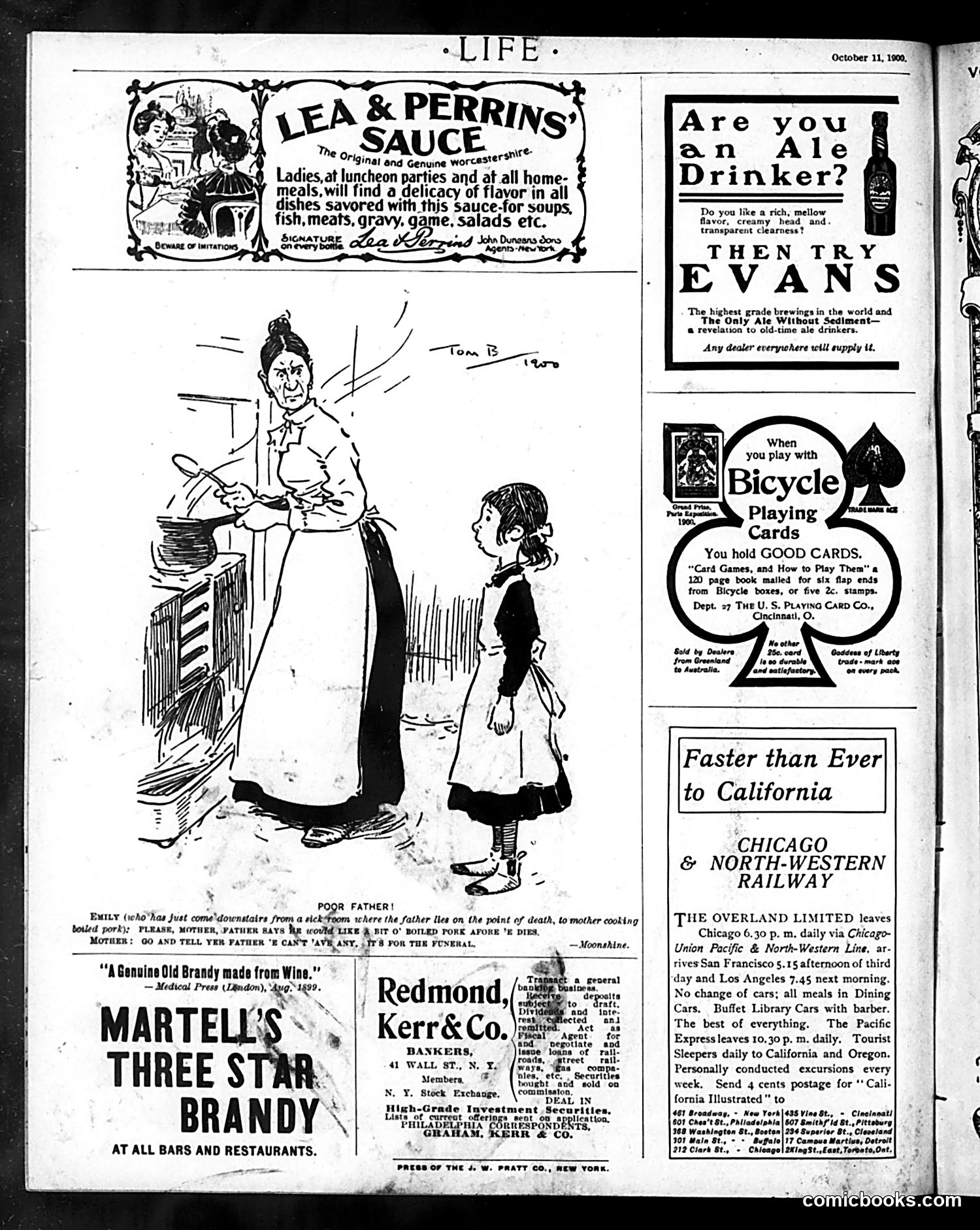
**Main Cartoon ("Poor Father!"):** A dark domestic satire depicting a dying father who requests boiled pork before death. The mother refuses, saying she needs the pork for his funeral feast. The joke critiques working-class priorities and Victorian morbidity—the mother's concern for the funeral meal supersedes her husband's final wishes. It's labeled as satire by "Moonshine," a regular Life cartoonist. **Page Content:** Mostly **advertisements** (Lea & Perrins sauce, Martell's brandy, Evans ale, Bicycle playing cards, railroad travel, and banking services). These ads reflect upper-middle-class consumer goods and leisure activities typical of 1900 America. The cartoon's gallows humor—treating death and poverty with irreverent comedy—was characteristic of Life magazine's satirical approach to social commentary.