
Life, 1900-10-11 · page 6 of 22
Life — October 11, 1900 — page 6: what you’re looking at
What you’re looking at
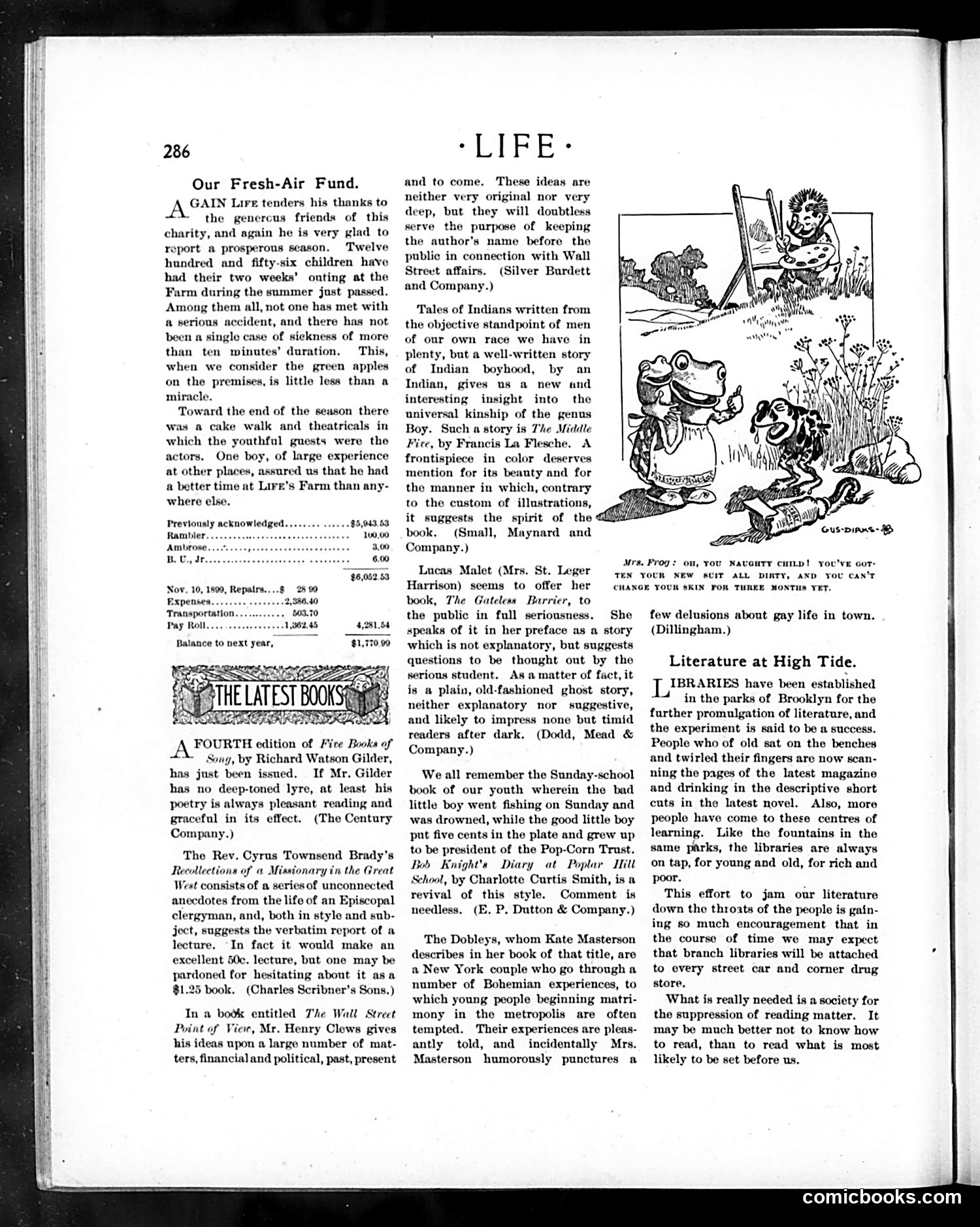
This page contains book reviews and literary discussion rather than political cartoons. The main illustration shows a anthropomorphic frog character addressing what appears to be a smaller frog or toad, with the caption reading "Mrs. Frog: Oh, you naughty child! You've gotten your new suit all dirty, and you can't change your skin for three months yet." The joke appears to be a pun playing on the biological fact that frogs shed their skin. The "naughty child" scenario uses this natural frog behavior as the basis for humor—the parent character cannot simply wash the suit since the frog cannot change its literal skin for months. The surrounding text reviews contemporary books about Indians, Bohemian life, and ghost stories, representing typical Life magazine literary coverage of the period.
📄 Transcribed text from this page (OCR, searchable)
Machine-transcribed from the original scan — historical spelling and the odd misread are preserved.
286 Our Fresh-Air Fund. ASAIN Lire tenders his thanks to the genercus friends of this charity, and again he is very glad to report a prosperous season. Twelve hundred and fifty-six children have had their two weeks’ onting at the Farm during the summer just passed. Among them all, not one has met with a serious accident, and there has not been a single case of sickness of more than ten minutes’ duration. This, when we consider the green apples on the premises, is little less than a miracle. Toward the end of the season there was a cake walk and theatricals in which the youthful guests were the actors. One boy, of large experience at other places, assured us that he had a better time at Lire’s Farm than any- where else, Previonsly acknowledged. Rambler. Ambrose. B. U., Jr, + $5,943.63 100,00 3.00 6.00 $6,052.63 Nov, 10, 1909, Repatrs.... Expenses... Pay Roll, FOURTH edition of Fire Books of Song, by Richard Watson Gilder, has just been issued. If Mr. Gilder has no deep-toned lyre, at least his poetry is always pleasant reading and graceful in its effect. (The Century Company.) The Rev. Cyrus Townsend Brady's Recollections of a Missionary in the Great West consists of a series of unconnected anecdotes from the life of an Episcopal clergyman, and, both in style and sub- ject, suggests the verbatim report of a lecture. In fact it would make an excellent 50c. lecture, but one may be pardoned for hesitating about it asa $1.25 book. (Charles Scribner's Sons.) In a book entitled The Wall Street Point of View, Mr. Henry Clews gives his ideas upon a large number of mat- ters, financial and political, past, present ‘LIFE and to come. These ideas are neither very original nor very deep, bat they will doubtless serve the purpose of keeping the author’s name before the public in connection with Wall Street affairs. (Silver Burdett and Company.) Tales of Indians written from the objective standpoint of men of our own race we have in plenty, but a well-written story of Indian boyhood, by an Indian, gives us a new and interesting insight into the universal kinship of the genus Boy. Such a story is The Middle Fire, by Francis La Flesche. A frontispiece in color deserves mention for its beauty and for the manner in which, contrary to the custom of illustrations, pul it suggests the spirit of the igiseo book. (Small, Company.) Maynard and Lucas Malet (Mrs. St. Leger Harrison) seems to offer her book, The Gateleas Barrier, to the public in full seriousness. She speaks of it in her preface as a story which is not explanatory, but suggests questions to be thought out by the serious student. As a matter of fact, it is a plain, old-fashioned ghost story, neither explanatory nor suggestive, and likely to impress none but timid readers after dark, (Dodd, Mead & Company.) We all remember the Sunday-school book of our youth wherein the bad little boy went fishing on Sunday and was drowned, while the good little boy put five cents in the plate and grew up to be president of the Pop-Corn Trust. Bob Knight's Diary at Poplar Hilt School, by Charlotte Curtis Smith, is a revival of this style. Comment is needless, (E. P, Dutton & Company.) The Dobleys, whom Kate Masterson describes in her book of that title, are a New York couple who go through a number of Bohemian experiences, to which young people beginning matri- mony in the metropolis are often tempted. Their experiences are pleas- antly told, and incidentally Mrs. Masterson humorously punctures a de CUS-DIRKe-® LUE” Mra, Frog: ou, you Navouty cump! you've cot TEN YOUR NEW SUIT ALL DIRTY, AND YOU CAN'T CHANGE YOUR SKIN FOR TUREE MONTHS YET. few delusions about gay life in town. (Dillingham.) Literature at High Tide. L IBRARIES have been established + in the parks of Brooklyn for the further promulgation of literature, and the experiment is said to be a success. People who of old sat on the benches and twirled their fingers are now scan- ning the pages of the latest magazine and drinking in the descriptive short cuts in the latest novel. Also, more people have come to these centres of learning. Like the fountains in the same parks, the libraries are always on tap, for young and old, for rich and poor, This effort to jam our literature down the throats of the people is gain- ing so much encouragement that in the course of time we may expect that branch libraries will be attached to every street car and corner drug store. What is really needed is a society for the suppression of reading matter. It may be much better not to know how to read, than to read what is most likely to be set before us. comicbooks.com