
Life, 1900-10-11 · page 4 of 22
Life — October 11, 1900 — page 4: what you’re looking at
What you’re looking at
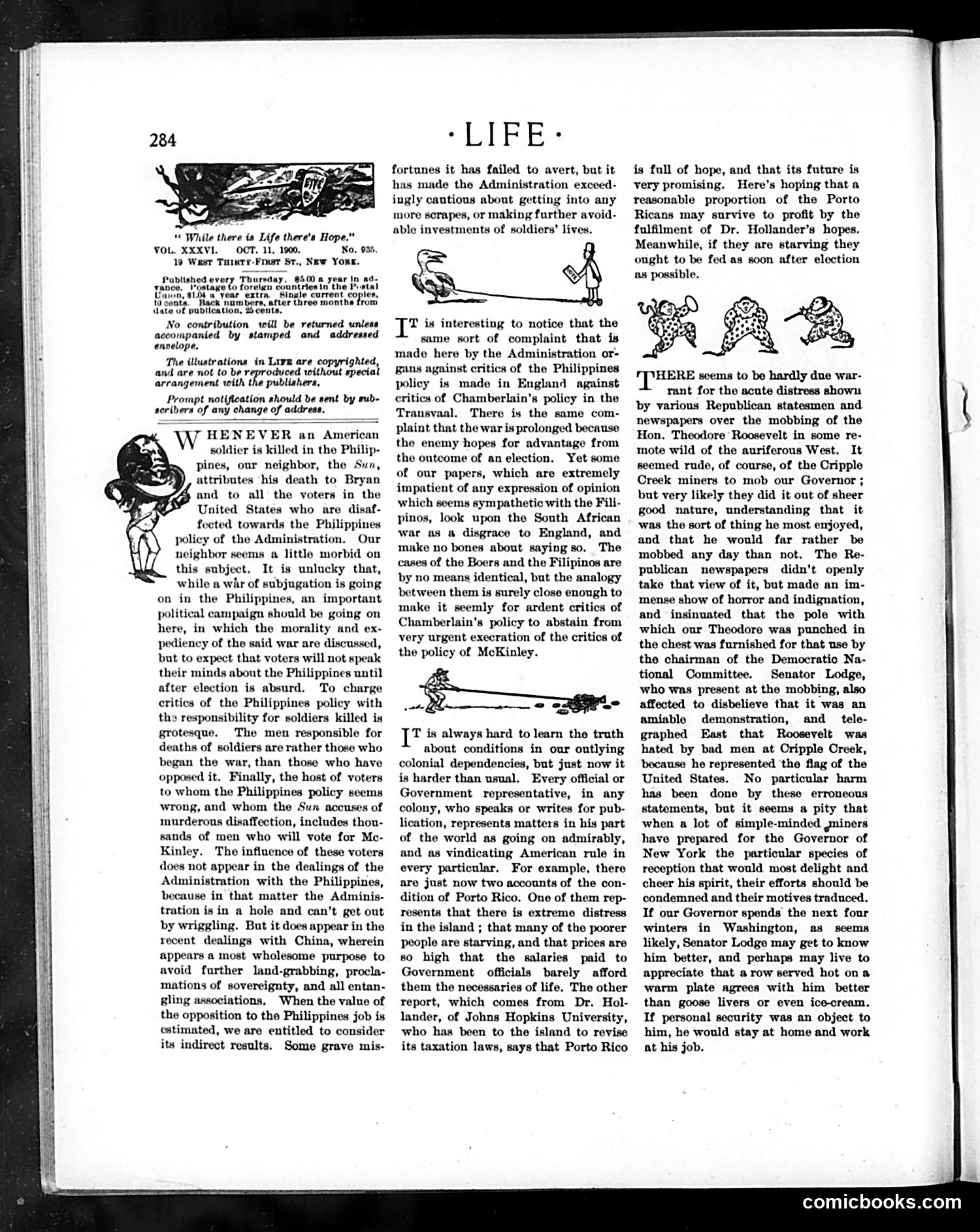
This page from Life magazine critiques the McKinley Administration's Philippines policy and its critics. The editorial discusses how American soldiers' deaths in the Philippines are being used as political ammunition against the Administration, particularly by Democratic opponents. The text references Bryan (likely William Jennings Bryan, the Democratic candidate), debates over whether the war is prolonged for political advantage, and comparisons to British policy in South Africa. The small cartoons appear to illustrate public reaction—figures gesturing in debate or protest. The page argues that newspapers and politicians are exploiting soldier deaths and colonial hardship (mentioning Porto Rico's distress) for electoral gain rather than addressing actual policy problems. The satire targets opportunistic political exploitation of military casualties.
📄 Transcribed text from this page (OCR, searchable)
Machine-transcribed from the original scan — historical spelling and the odd misread are preserved.
“While there is Life there's Hope.” VOL. XXXVI. OCT. 11, 1900. No. 935. 19 West Taety-Frmst . New Youre. Da Hack numbers, after three monthe from date uf publication. 33 cents. No contribution will be returned unless accompanied by stamped and addressed envelope. The illustrations in Live are copyrighted, and are not to be reproduced without special arrangement with the publishers, Prompt notification should be sent by sub- seribers of any change of address, WW! H E NEV E R an American soldier is killed in the Philip- pines, our neighbor, the Sun, attributes his death to Bryan and to all the voters in the United States who are disaf- fected towards the Philippines policy of the Administration. Our neighbor seems a little morbid on this subject. It is unlucky that, while a wir of subjugation is going on in the Philippines, an important political campaign should be going on here, in which the morality and ex- pediency of the said war are discussed, but to expect that voters will not speak their minds about the Philippines until after election is absurd. To charge critics of the Philippines policy with the responsibility for soldiers killed is grotesque. The men responsible for deaths of soldiers are rather those who began the war, than those who have opposed it. Finally, the host of voters to whom the Philippines policy seems wrong, and whom the Sun accuses of murderous disaffection, includes thou- sands of men who will vote for Mc- Kinley. The influence of these voters does not appear in the dealings of the Administration with the Philippines, because in that matter the Adminis- tration is in a hole and can’t get out by wriggling. But it does appear in the recent dealings with China, wherein appears a most wholesome purpose to avoid further land-grabbing, procla- mations of sovereignty, and all entan- gling associations. When the value of the opposition to the Philippines job is estimated, we are entitled to consider its indirect results. Some grave mis- LIFE fortunes it has failed to avert, but it has made the Administration exceed- ingly cautious about getting into any more scrapes, or making further avoid- able investments of soldiers’ lives. Bley is interesting to notice that the same sort of complaint that is made here by the Administration or> gans against critics of the Philippines policy is mado in England against critics of Chamberlain's policy in the Transvaal. There iy the same com- plaint that the war is prolonged because the enemy hopes for advantage from the outcome of an election. Yet some of our papers, which are extremely impatient of any expression of opinion which seems sympathetic with the Fili- pinos, look upon the South African war as a disgrace to England, and make no bones about saying so. The cases of the Boers and the Filipinos are by no means identical, but the analogy between them is surely close enough to make it seemly for ardent critics of Chamberlain's policy to abstain from very urgent execration of the critics of the policy of McKinley. —— i is always hard to learn the truth about conditions in our outlying colonial dependencies, but just now it is harder than usual. Every official or Government representative, in any colony, who speaks or writes for pub- lication, represents matters in his part of the world as going on admirably, and as vindicating American rule in every particular. For example, there are just now two accounts of the con- dition of Porto Rico. One of them rep- resents that there is extremo distress in the island ; that many of the poorer people are starving, and that prices are so high that the salaries paid to Government officials barely afford them the necessaries of life. The other report, which comes from Dr. Hol- lander, of Johns Hopkins University, who has been to the island to revise its taxation laws, says that Porto Rico is full of hope, and that its future is very promising. Here’s hoping that a reasonable proportion of the Porto Ricans may survive to profit by the fulfilment of Dr. Hollander'’s hopes. Meanwhile, if they are starving they ought to be fed as soon after election THERE seems to be hardly due war- rant for the acute distress shown by various Republican statesmen and newspapers over the mobbing of the Hon. Theodore Roosevelt in some re- mote wild of the auriferous West. It seemed rude, of course, of the Cripple Creek miners to mob our Governor ; but very likely they did it out of sheer good nature, understanding that it was the sort of thing he most enjoyed, and that he would far rather be mobbed any day than not. The Re- publican newspapers didn’t openly take that view of it, but made an im- mense show of horror and indignation, and insinuated that the pole with which our Theodore was punched in the chest was furnished for that use by the chairman of the Democratic Na- tional Committee. Senator Lodge, who was present at the mobbing, also affected to disbelieve that it was an amiable demonstration, and tele- graphed East that Roosevelt was hated by bad men at Cripple Creek, because he represented ‘the flag of the United States. No particular harm has been done by these erroneous statements, but it seems a pity that when a lot of simple-minded gniners have prepared for the Governor of New York the particular species of reception that would most delight and cheer his spirit, their efforts should be condemned and their motives traduced. If our Governor spends the next four winters in Washington, as seems likely, Senator Lodge may get to know him better, and perhaps may live to appreciate that a row served hot ona warm plate agrees with him better than goose livers or even ice-cream. If personal security was an object to him, he would stay at home and work at his job. comicbooks.com