
A complete issue · 20 pages · 1900
Life — October 4, 1900
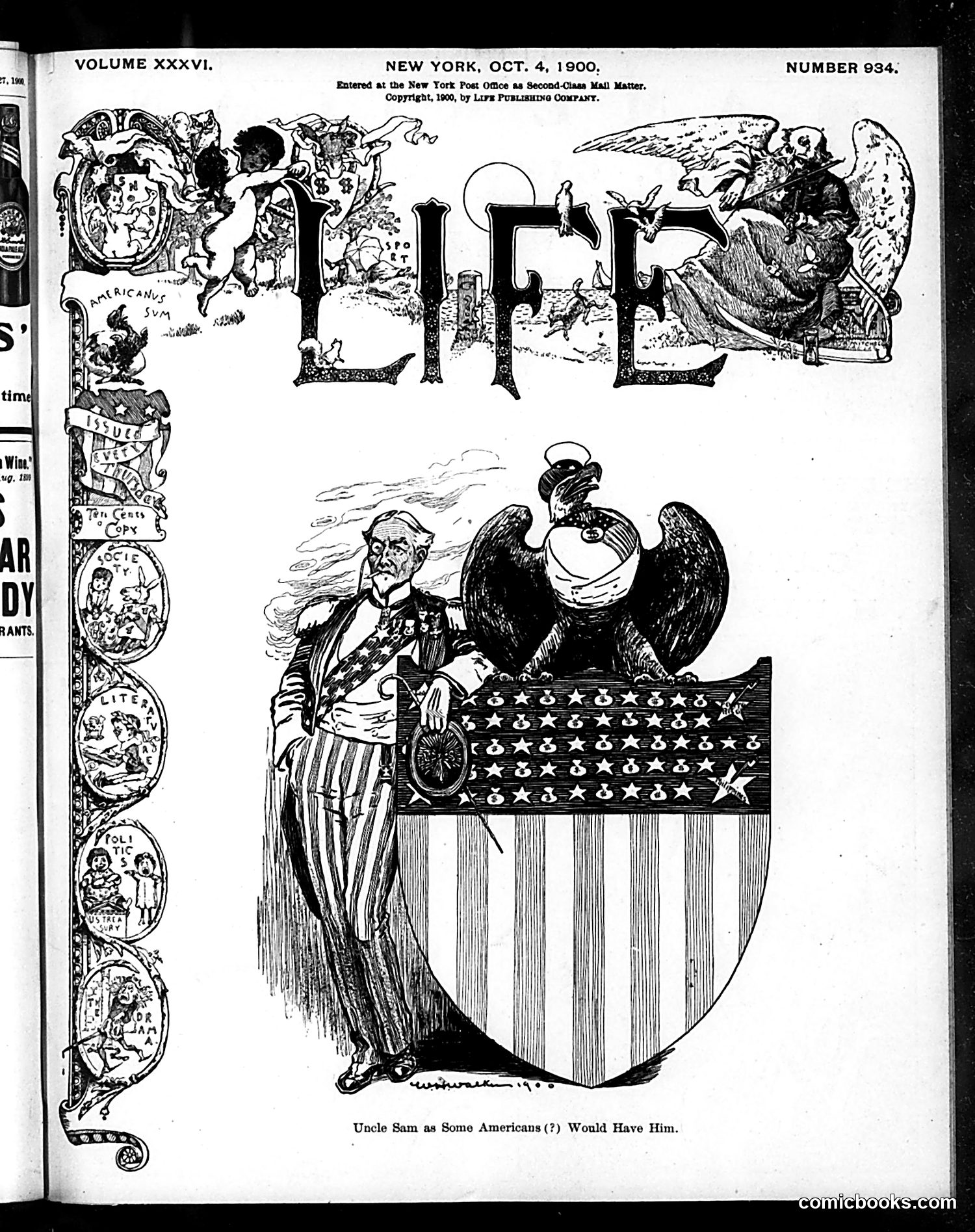
This October 4, 1900 *Life* cartoon satirizes American imperialism during the Spanish-American War aftermath. The illustration depicts Uncle Sam—the personified United States—transformed into an authoritarian military figure. He wears a foreign military uniform with medals and decorations, standing before an eagle and shield bearing American stars and stripes, but now styled as imperial regalia. The caption's parenthetical question mark suggests satirical skepticism: the cartoonist mocks certain Americans who wanted the U.S. to abandon its democratic ideals and adopt militaristic, imperialist posture like European powers. The ornate left border with classical imagery reinforces the critique—contrasting America's founding principles with this corrupted imperial vision.
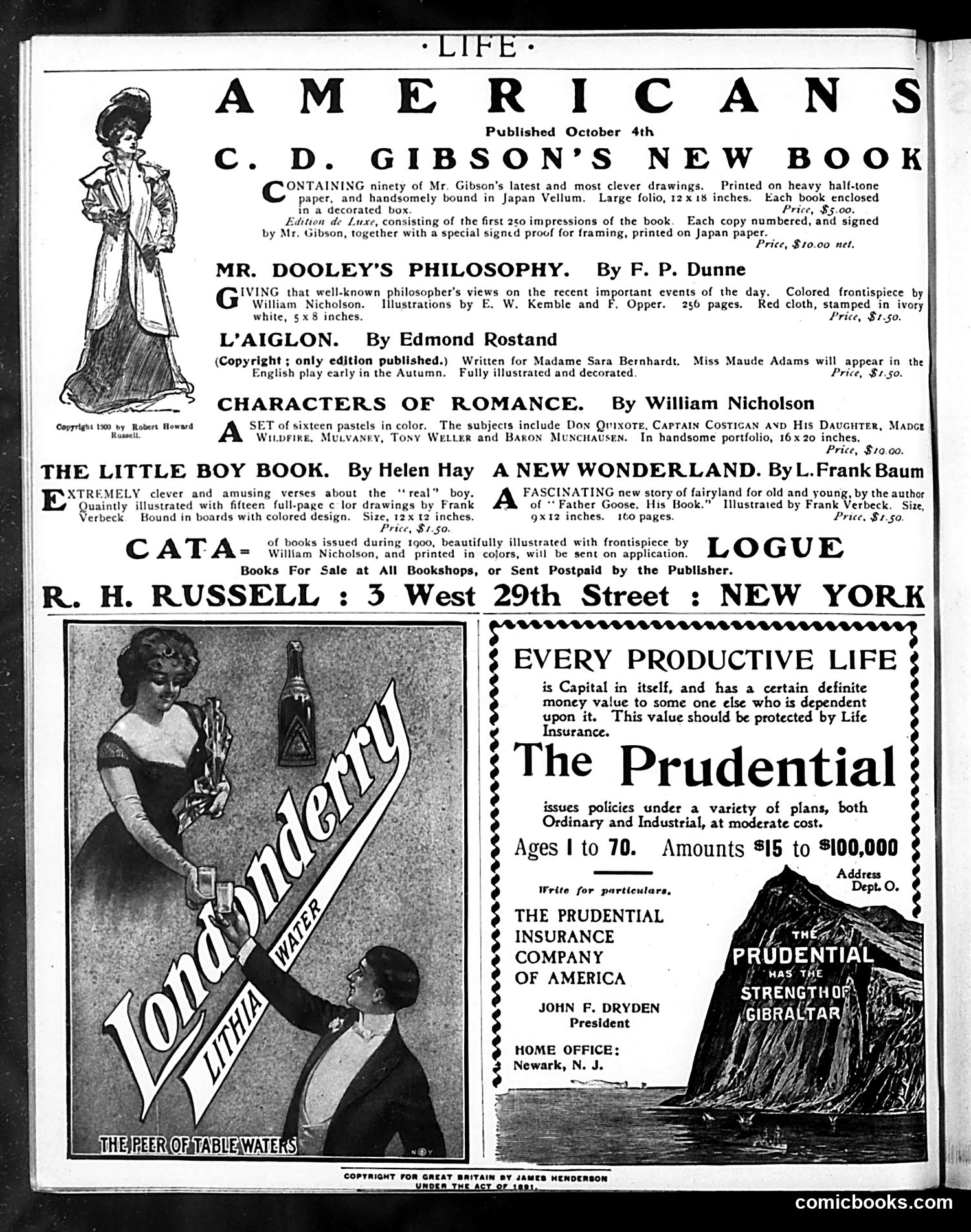
This Life magazine page (October 4th) is primarily **advertising and book announcements** rather than political satire. The main cartoon, titled "**The Beer of Table Waters**," depicts a woman and man examining a Apollinaris brand bottle/label. The humor appears to be a visual pun: Apollinaris was a German mineral water marketed as healthful, but the cartoon plays on "beer" versus "table waters"—likely satirizing either the product's taste, its German origin during a period of Franco-American tension, or contemporary debates about "healthful" beverages versus actual beer. The rest of the page advertises C.D. Gibson's new book, various literary works, and insurance products. Without additional historical context about Apollinaris's specific market position or reputation at this date, the cartoon's precise satirical target remains unclear, though it appears to mock pretentious health claims or German products.
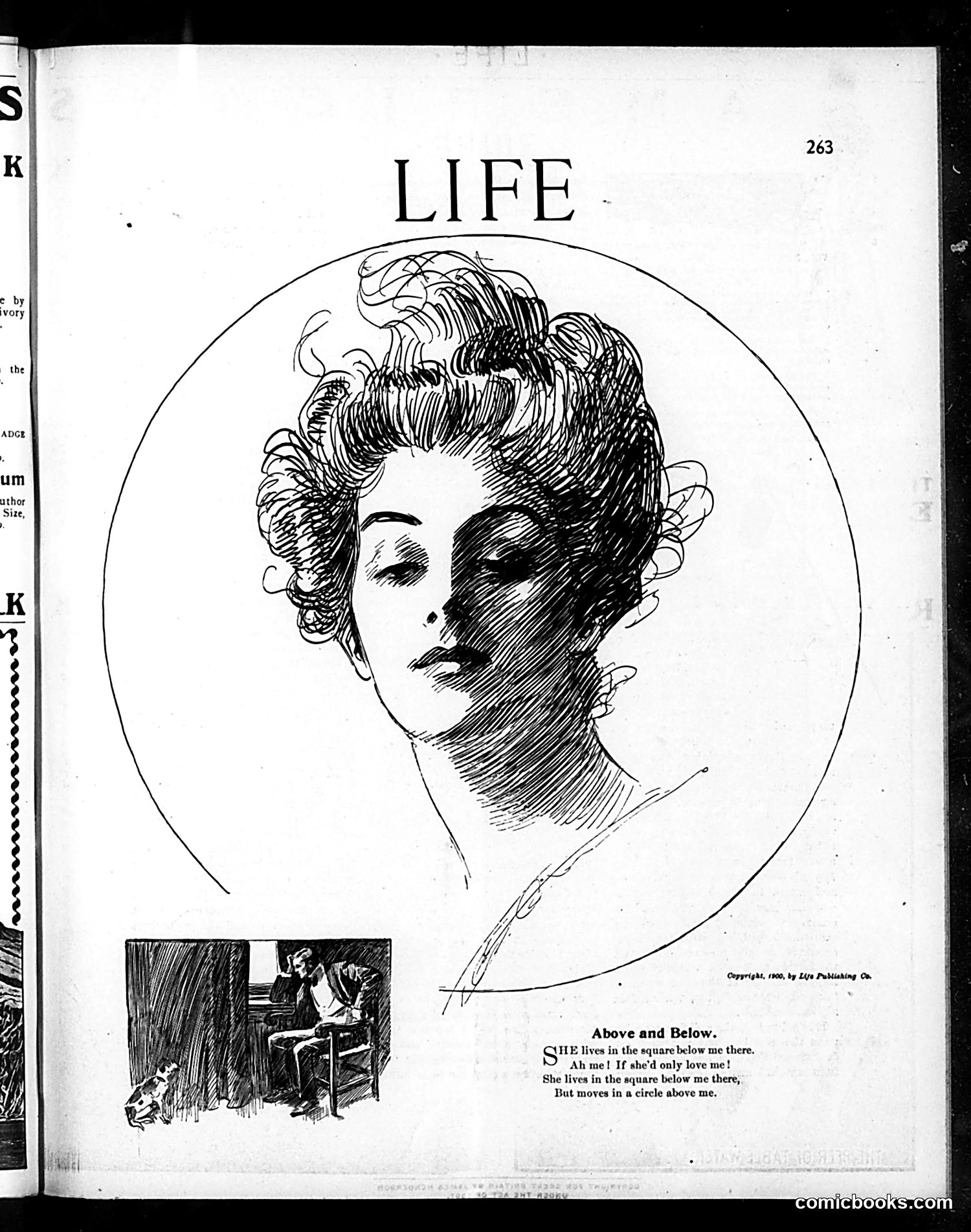
This page features a portrait illustration titled "LIFE" with an accompanying poem titled "Above and Below." The poem's text expresses romantic longing: "SHE lives in the square below me there. / Ah me! If she'd only love me! / She lives in the square below me there, / But moves in a circle above me." The small illustration at lower left shows a figure at a window looking down, presumably the poem's narrator observing the woman in the square below. The satire appears to address class distinction or social separation—the speaker is literally positioned above his love interest, yet she "moves in a circle" beyond his reach, suggesting romantic and social aspirations thwarted by circumstance or status difference. This was typical early-20th-century *Life* magazine content: sentimental yet gently mocking of romantic pretension.
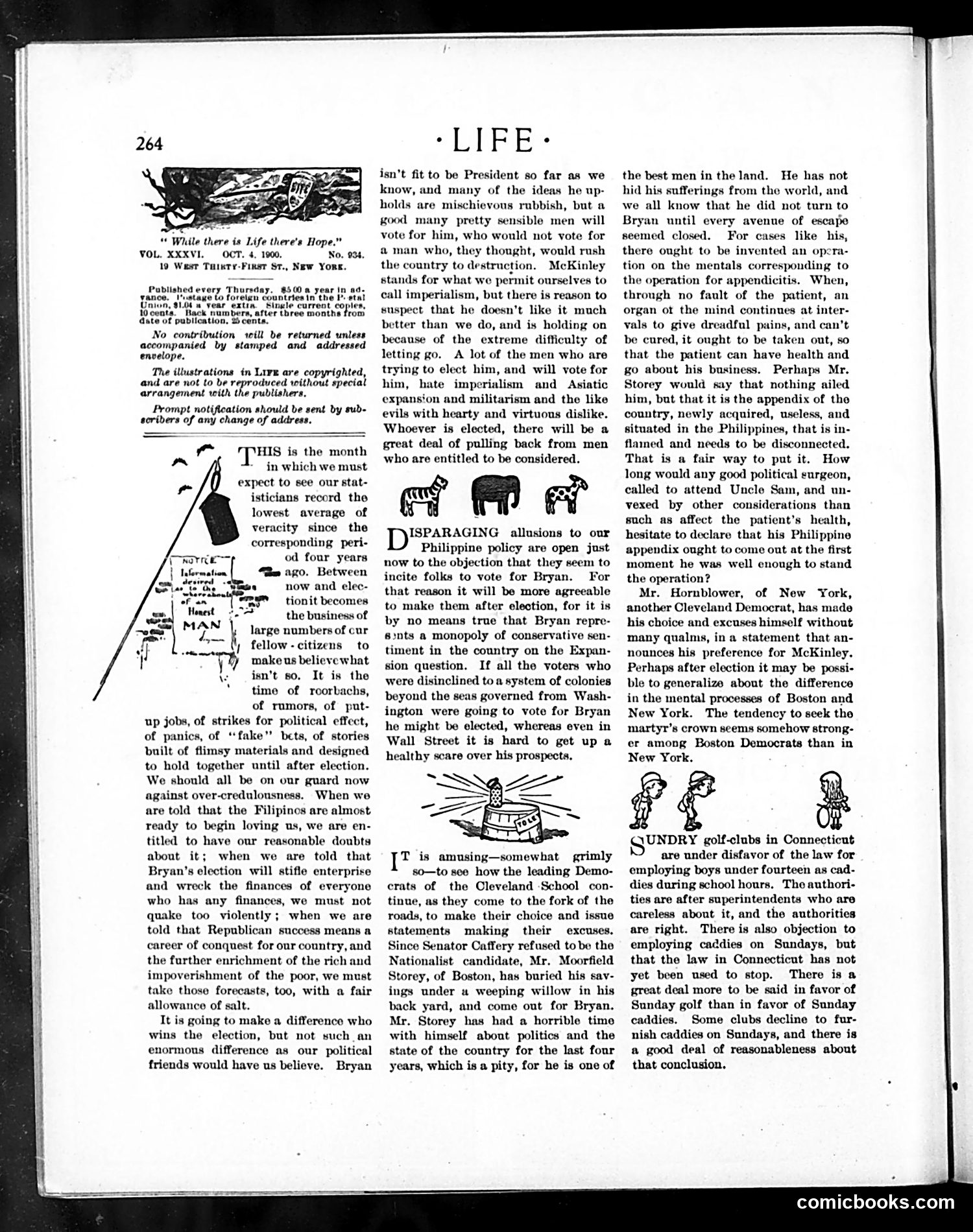
The main cartoon depicts a tall, thin figure labeled "MAN" being weighed on a scale, appearing to satirize American voters during the 1900 presidential election. The accompanying text discusses McKinley versus Bryan, with the author criticizing both candidates' viability and the electorate's reasoning. The satire mocks voters who might base their choice on imperialism and expansion policies rather than substantive governing ability. References to the Philippines appear multiple times, suggesting this concerns American colonial ambitions—likely related to the Spanish-American War aftermath. The text also ridicules Democratic concerns about Bryan's electability and mentions specific criticisms of Republican policies affecting wealthy interests, suggesting the piece argues neither candidate truly serves ordinary citizens' interests.
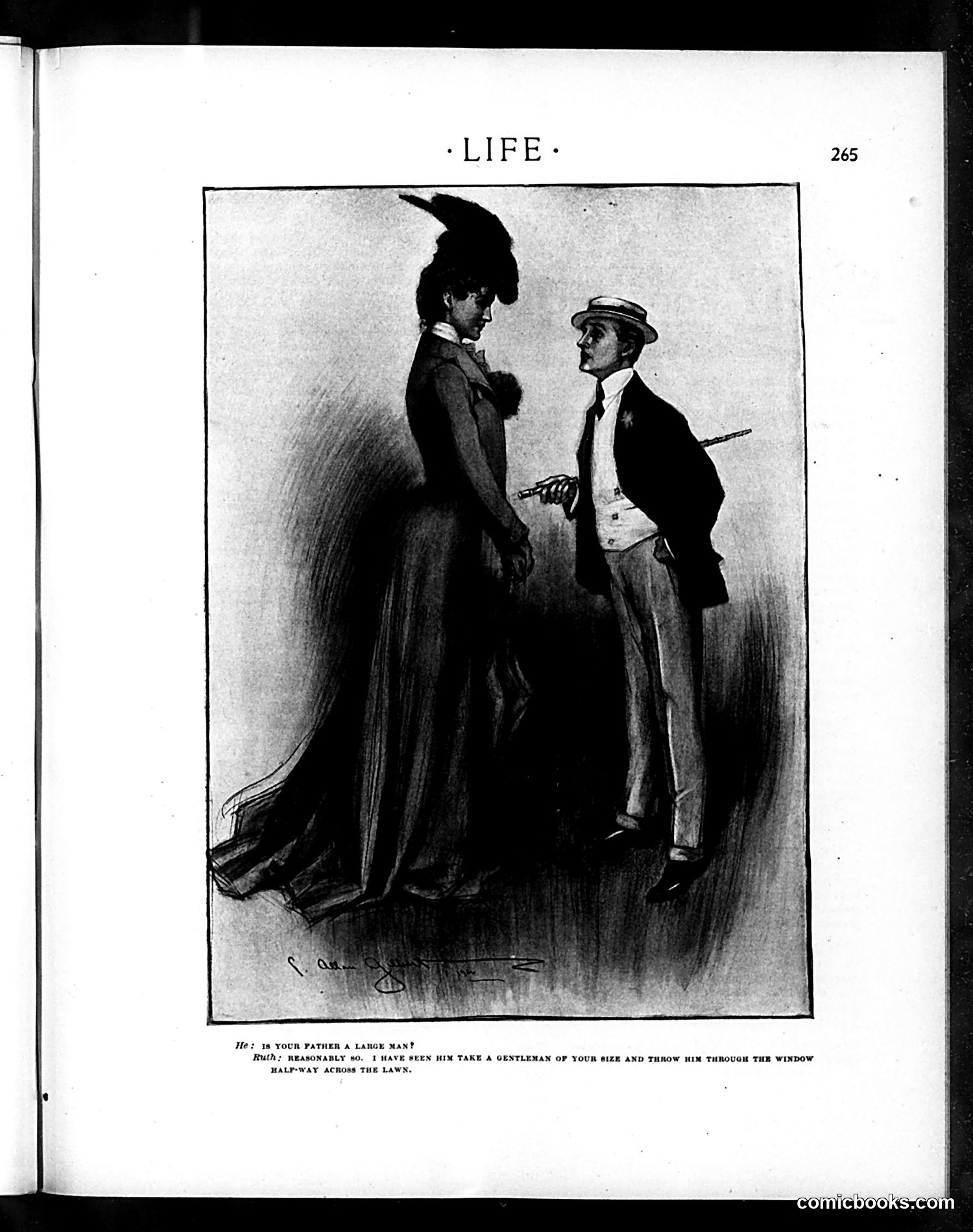
This is a satirical cartoon depicting a social interaction between two men and a woman in elaborate dress. The dialogue reads: **He:** "Is your father a large man?" **She:** "Reasonably no. I have seen his take a gentleman of your size and throw his through the window half-way across the lawns." The joke relies on a common Victorian-era humor trope: a young woman's protective father and the intimidation of suitors. The woman is humorously suggesting her father is physically formidable despite appearing small—capable of throwing men of the gentleman's (presumably larger) stature through windows. The satire targets anxious bachelors and the tradition of stern, protective fathers of marriageable daughters. The humor is gentle social commentary on courtship rituals and masculine anxieties about paternal approval.
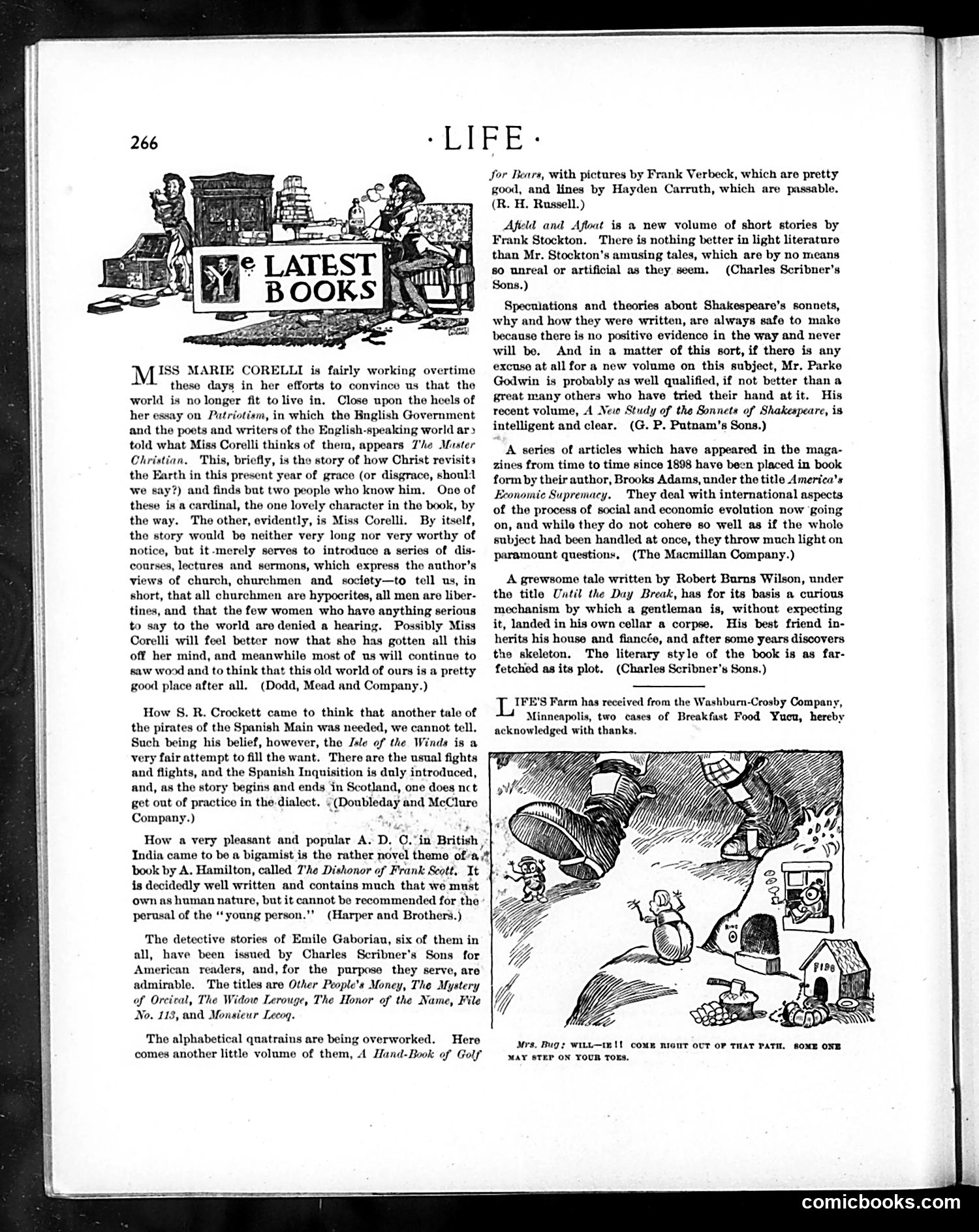
This page is primarily a **book review column** rather than political satire. It discusses recent literary releases, including works by Frank Stockton, Frank Stockton (again), and Robert Barna Wilson. The **illustration at bottom** depicts a domestic scene: a woman warns "Mrs. Budd—it'll come right out of that path. Some one may step on your toes," addressing what appears to be a large object or creature on a garden path. The cartoon seems to be a humorous commentary on **domestic hazards or unexpected intrusions** into everyday life, though the specific reference is unclear without additional context. The page focuses on **book recommendations and literary criticism** rather than political commentary. It's part of Life's cultural coverage, not its satirical editorial content.
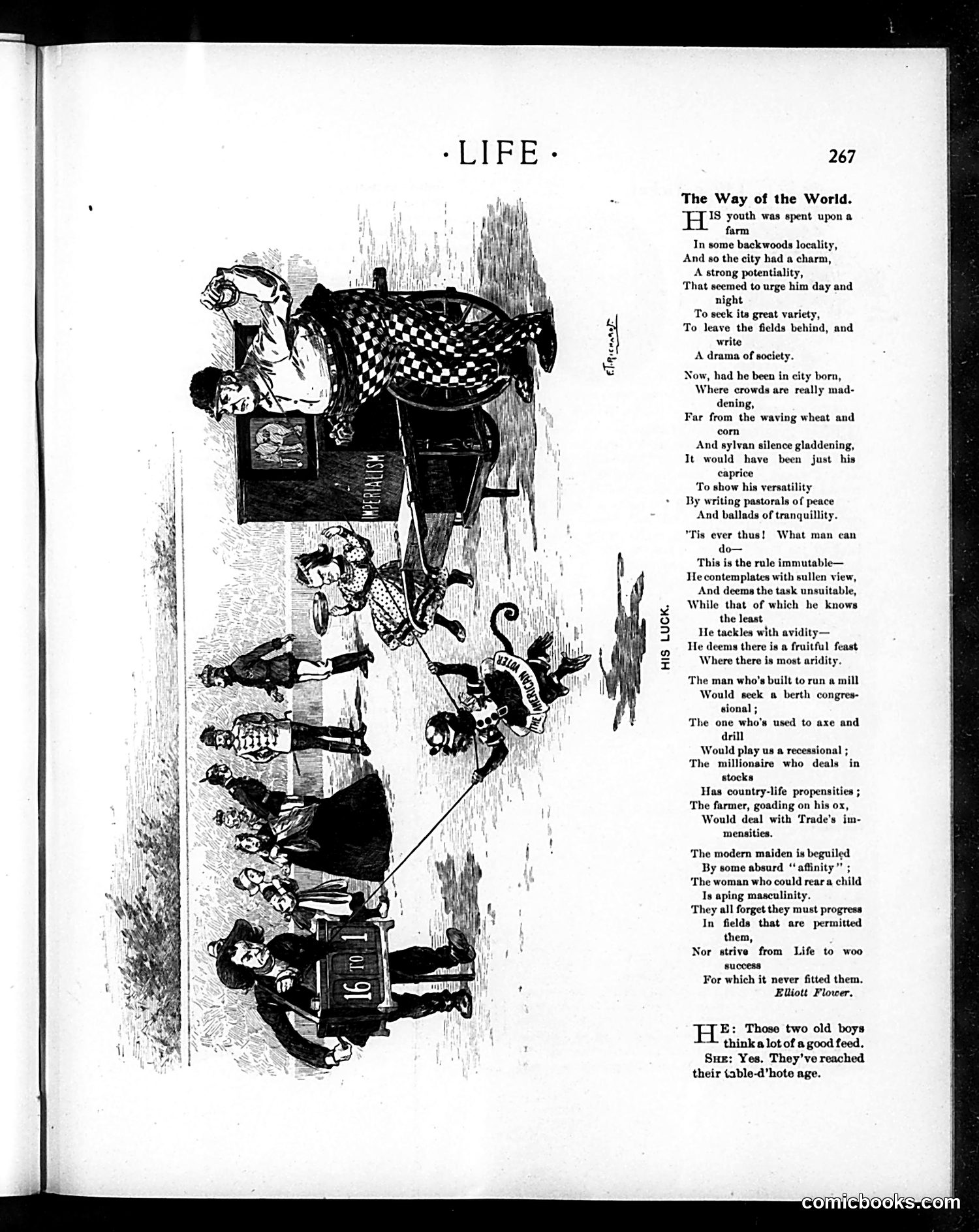
This page contains a poem by Elliott Flower (credited at bottom) accompanying a satirical illustration. The poem critiques social ambition and hypocrisy across various professions and classes. The illustration, oriented sideways, appears to show a vertical stack of figures representing different social types—likely mill owners, businessmen, farmers, and society women—each embodying the pretensions the poem mocks. The central figure appears to be a woman in fashionable dress, surrounded by smaller figures representing various occupations. The satire targets the universal human drive for social advancement and respectability, suggesting that people across all professions compromise their integrity to climb the social ladder. The poem's concluding dialogue between "HE" and "SHE" jokes darkly that elderly people have simply "reached their table-d'hôte age"—implying they've given up entirely on life's aspirations.
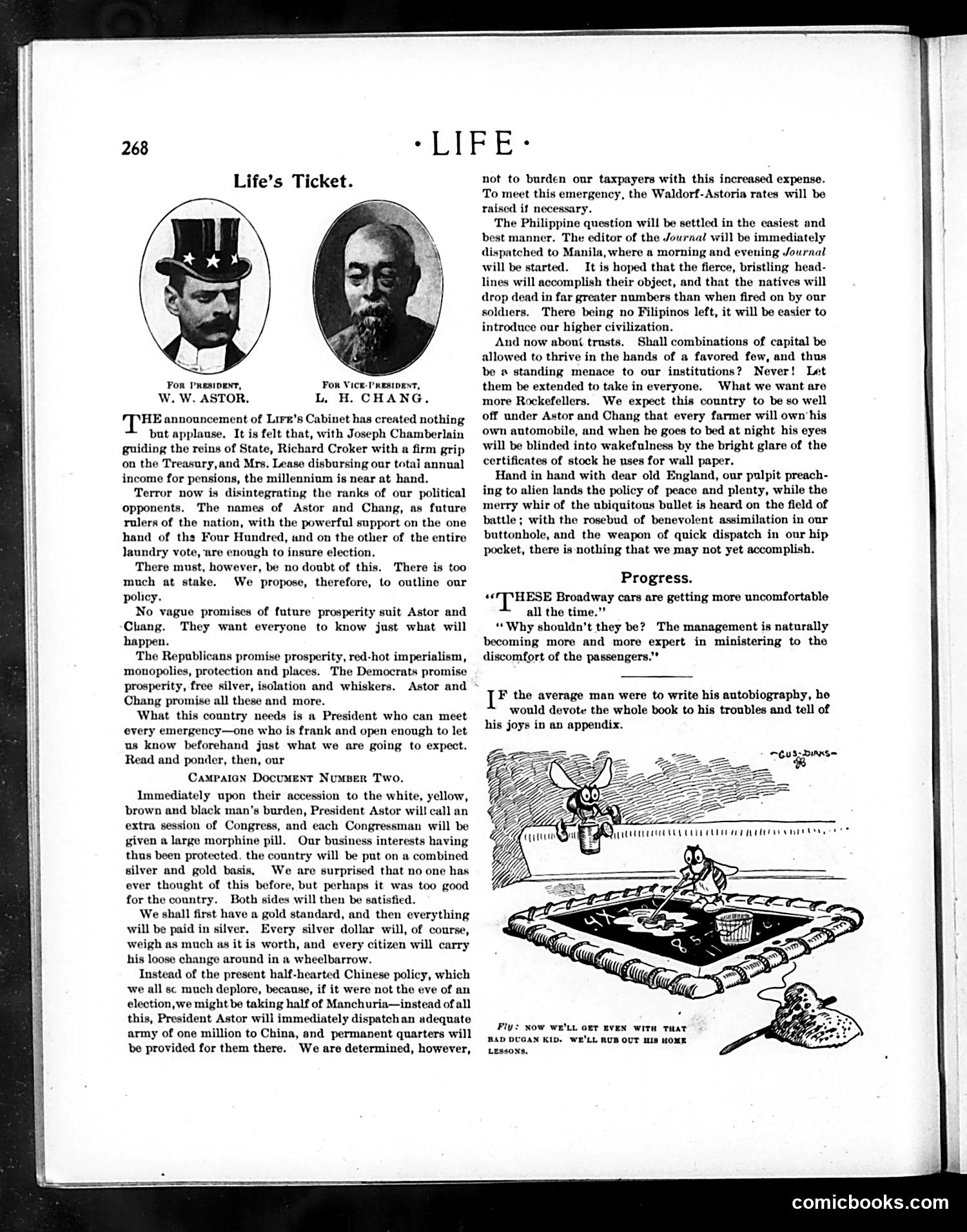
This page satirizes the presidential ticket of W.W. Astor (for President) and L.H. Chang (for Vice President), presented as a mock "Life's Ticket." The text is a biting parody of campaign promises, mocking both major parties' vague pledges of prosperity while presenting absurd Astor-Chang proposals: raising Waldorf-Astoria hotel rates, starting a newspaper in Manila, encouraging trusts and monopolies, and dispatching a million-man army to China. The satire targets wealthy industrialists' political ambitions and imperial overreach. A separate cartoon mocks Broadway streetcar discomfort. The overall message criticizes how the wealthy present themselves as qualified leaders while serving narrow interests—not the public good.
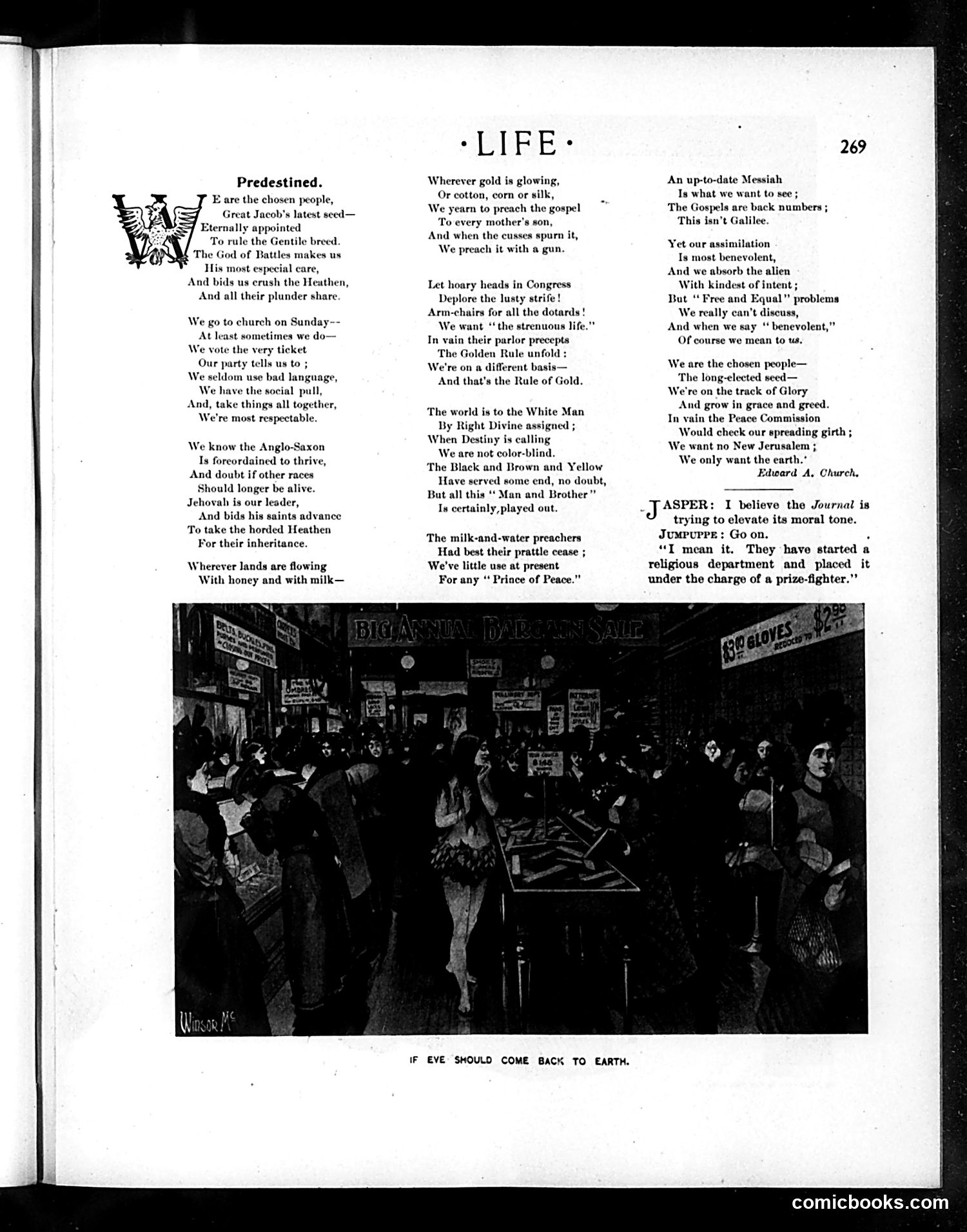
This page contains satirical poetry mocking early 20th-century American religious and social hypocrisy. The poems critique: 1. **Religious establishment** - attacking preachers who preach pacifism ("milk-and-water preachers") while the nation pursues militarism 2. **Racial ideology** - sarcastically noting the "White Man" is "by Right Divine assigned" the world, while claiming color-blindness about racial hierarchies 3. **Social selectiveness** - mocking the "chosen people" who preach brotherhood but practice exclusion The photograph below shows a crowded commercial street scene, likely illustrating the gap between professed religious values and materialistic urban reality. The interchange between "Jasper" and "Jumper" at page's end appears to mock sensationalist "religious departments" in newspapers positioned as moral authorities. The satire targets America's simultaneous claims to Christian virtue and actual practices of imperialism, racism, and commercialism.
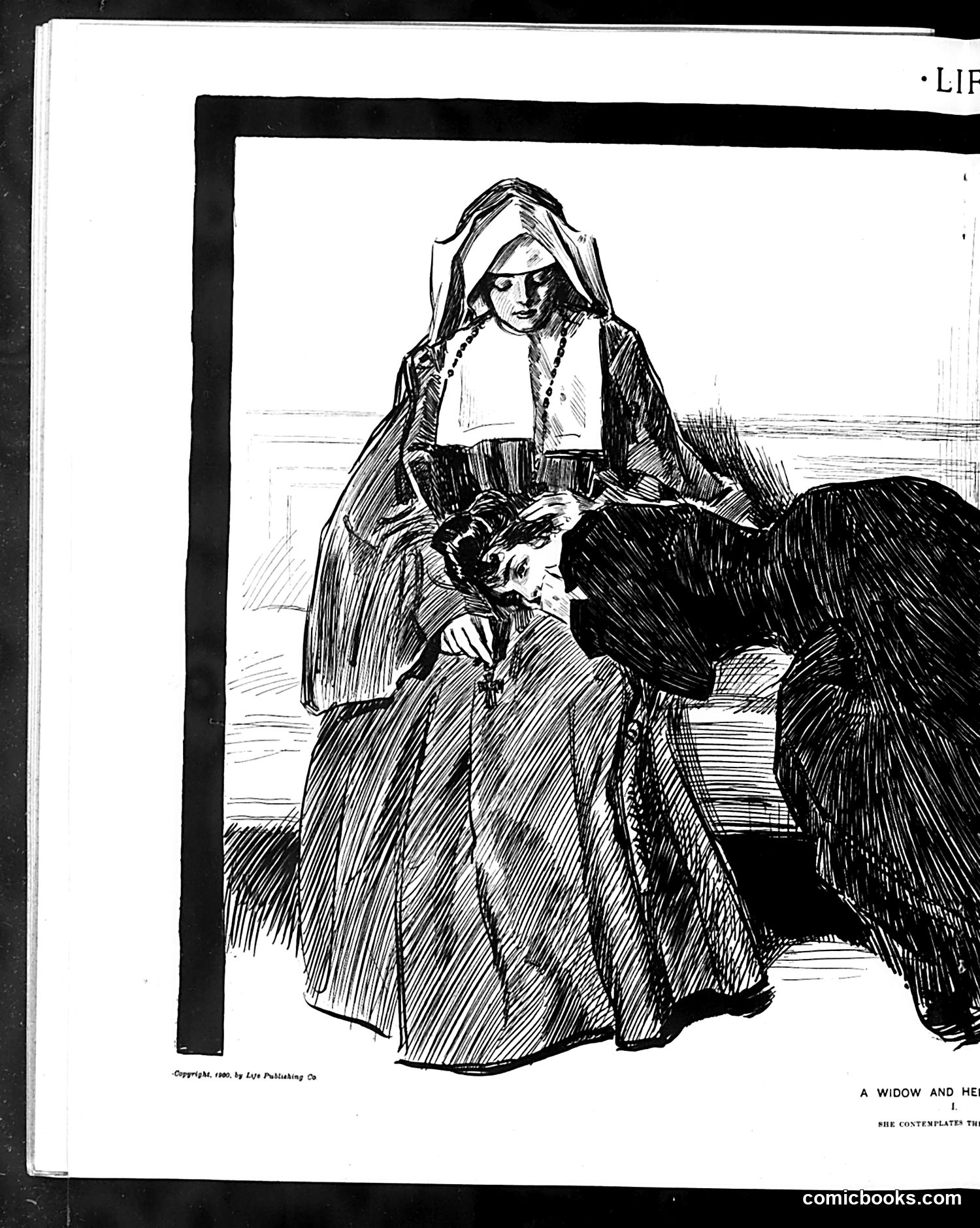
This appears to be an illustration titled "A Widow and Her..." (text cut off). The image shows a woman in widow's weeds—a hooded cloak and long dark dress typical of mourning attire from the late 19th or early 20th century—seated and contemplating something in her lap or hands. The copyright dates to 1906 via Life Publishing Co. Without the complete caption or surrounding text, the specific satirical point is unclear. It likely comments on widowhood, grief, or social expectations for bereaved women of that era. The artistic style employs cross-hatching typical of period illustration. The partial caption suggests this may be part of a series or longer piece in *Life* magazine addressing social commentary about women's experiences or mourning practices.
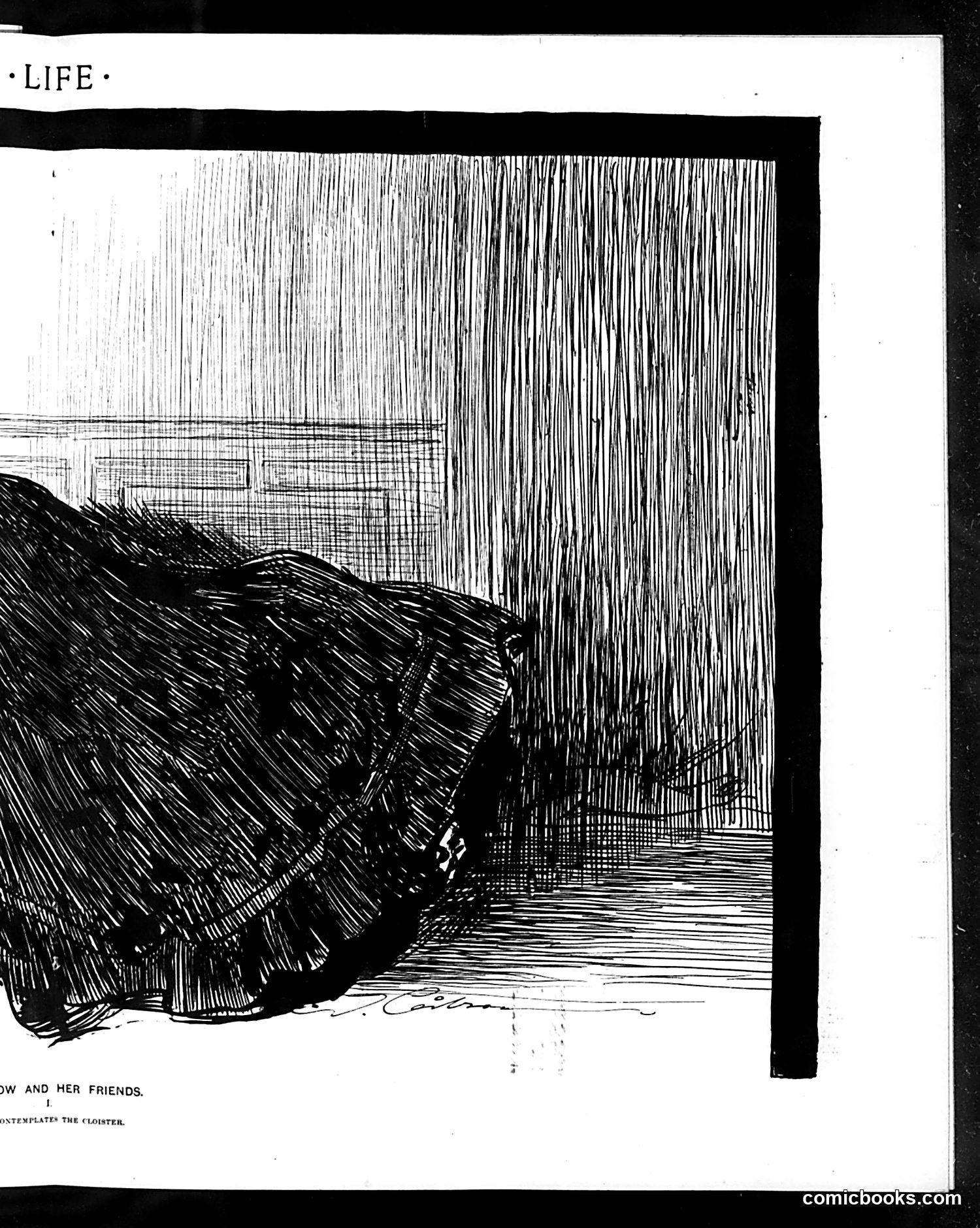
This appears to be a page from *Life* magazine featuring an ink sketch illustration. The visible text fragments reference "OW AND HER FRIENDS" and mention someone who "CONTEMPLATES THE COUNTER," though the complete caption is partially cut off. The image itself shows an expressive pen-and-ink drawing of what appears to be a figure in heavy clothing or a coat, rendered in dramatic cross-hatching. The artistic style is characteristic of early-to-mid 20th century editorial illustration. Without the complete caption and context, I cannot definitively identify the specific satirical subject or political/social reference intended. The drawing's emphatic style suggests social commentary, but the precise target of the satire remains unclear from this page fragment alone.
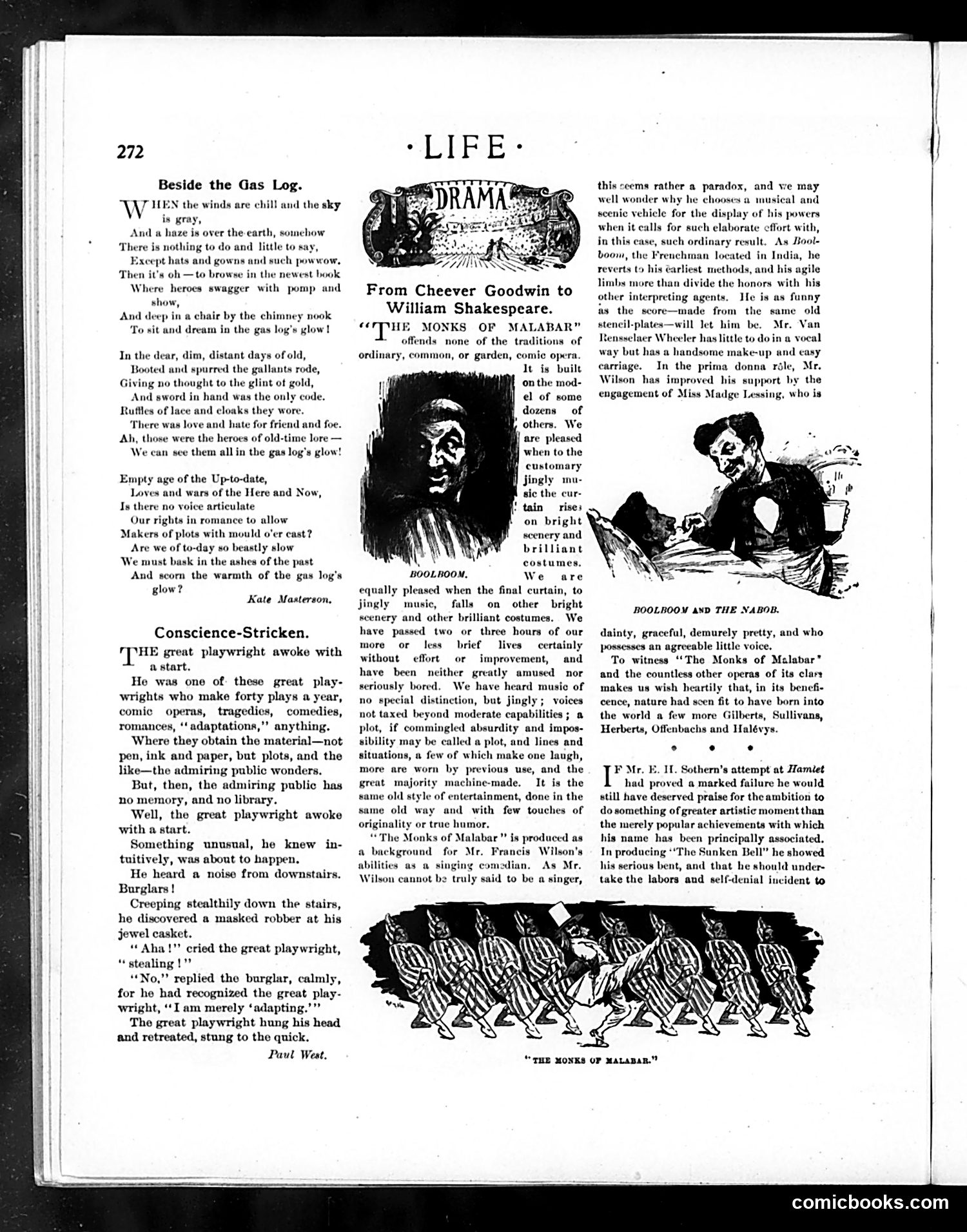
This page contains three distinct pieces: a poem "Beside the Gas Log" by Kate Masterson; an article titled "Conscience-Stricken" about a playwright's moral awakening; and a drama review of "The Monks of Malabar" featuring caricatured illustrations. The review discusses a theatrical production with sketches labeled "Hoolboom" and "Hoolboom and the Nabob," depicting character types from the opera. The text praises the performers' voices and staging while noting the plot involves "absurdity and impossibility." The "Conscience-Stricken" section satirizes a playwright who, overhearing recognition of a famous burglar, becomes inspired to "adapt" the criminal's story—mocking contemporary playwrights' tendency to borrow sensational material without original thought. The illustrations are period theatrical caricatures rather than political commentary.
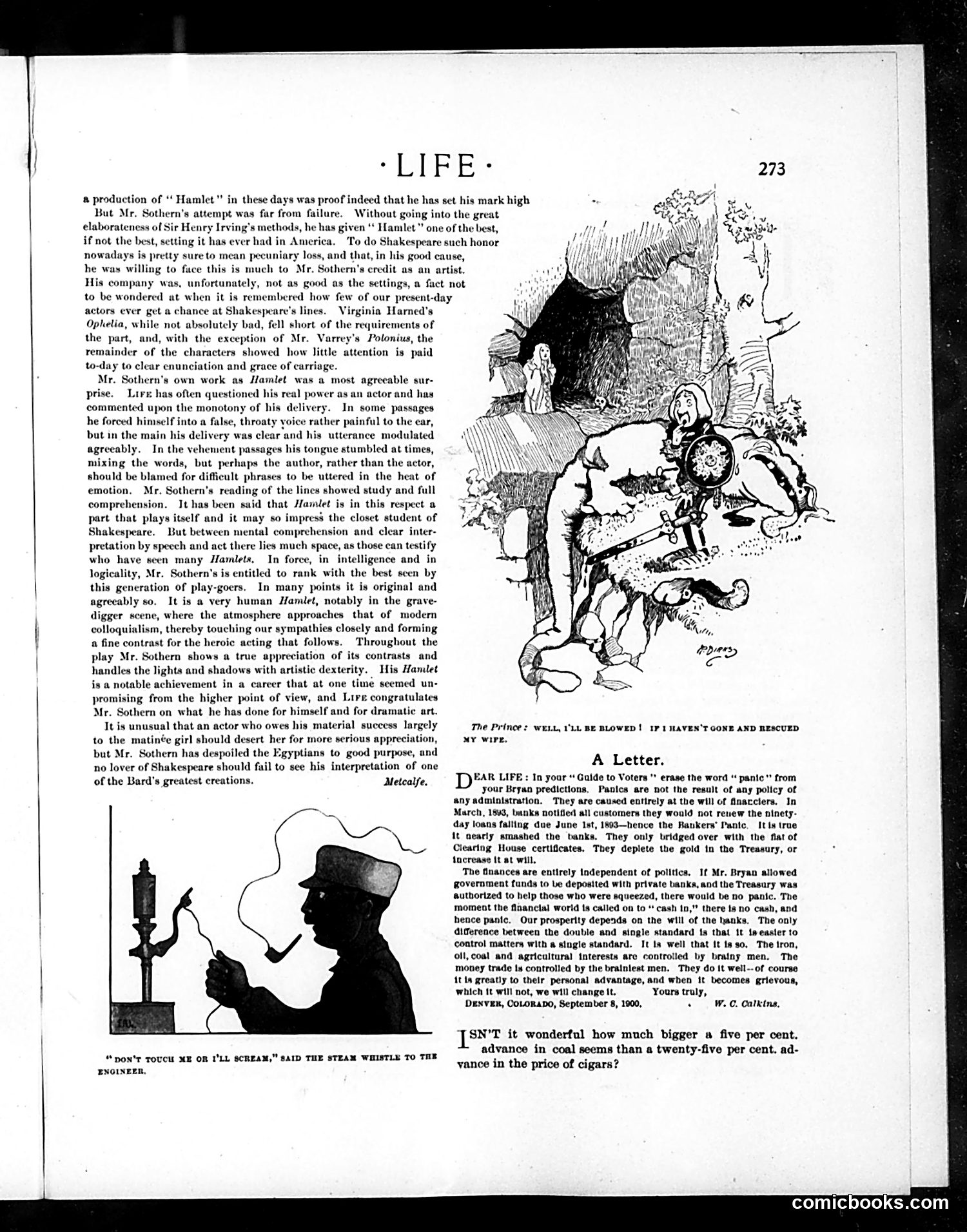
This page contains theater criticism and satirical content from an American satirical magazine. **Main Content:** A lengthy review of actor E.H. Sothern's production of *Hamlet*, praising his performance as surprisingly strong and intellectually rigorous, though noting flaws in supporting cast members like Virginia Harned's Ophelia. **The Cartoons:** 1. **Top right illustration:** Depicts a fairy-tale scene (appears to be from a children's story), captioned "The Prince: Well, I'll be blowed! If I haven't gone and rescued my wife"—a humorous twist on romantic rescue narratives. 2. **Bottom left silhouette:** Shows a steam whistle and engineer, captioned "Don't touch me or I'll scream," said the steam whistle to the engineer"—a pun personifying the whistle as a woman resisting unwanted touching. 3. **"A Letter"** section: Discusses financial panics and banking policy, arguing panics result from financiers' decisions rather than government policy—likely responding to Bryan's political predictions about economic crises.
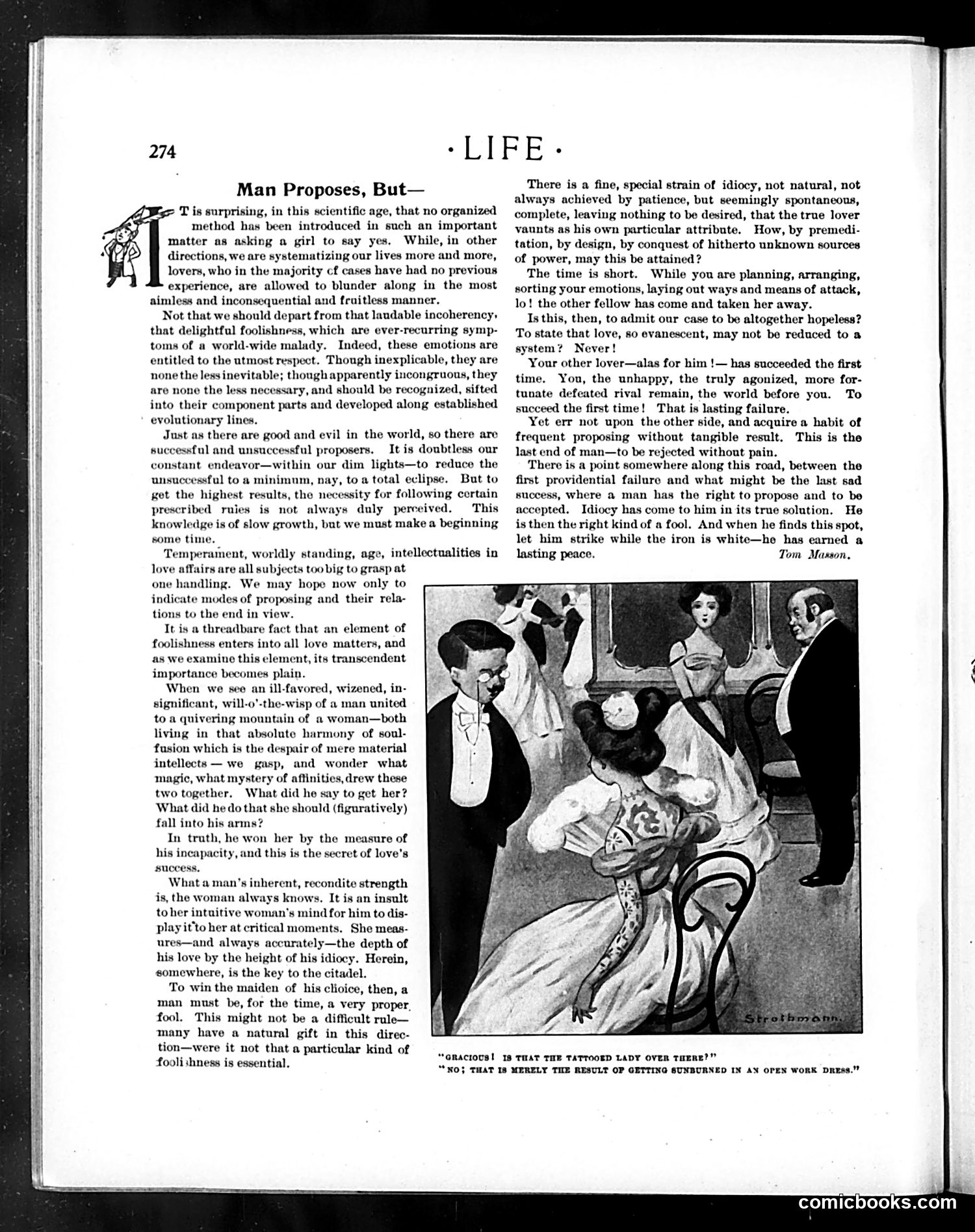
This is a satirical essay on marriage proposals, illustrated with a cartoon about a woman's wardrobe malfunction. The text humorously argues that men must adopt a specific kind of "foolishness" to successfully propose—paradoxically, a man wins a woman not through displaying his actual strength and intellect, but through strategic incompetence and bumbling charm. The accompanying cartoon depicts a social embarrassment: a woman in an open-work dress has been sunburned underneath, creating an unflattering tattoo-like pattern. A gentleman remarks on "the tattooed lady," while another explains it's merely a sunburn from an open dress. The joke satirizes both women's fashion choices and the awkwardness such exposure creates in proper society. Together, the essay and image mock courtship rituals and social pretension of the era.
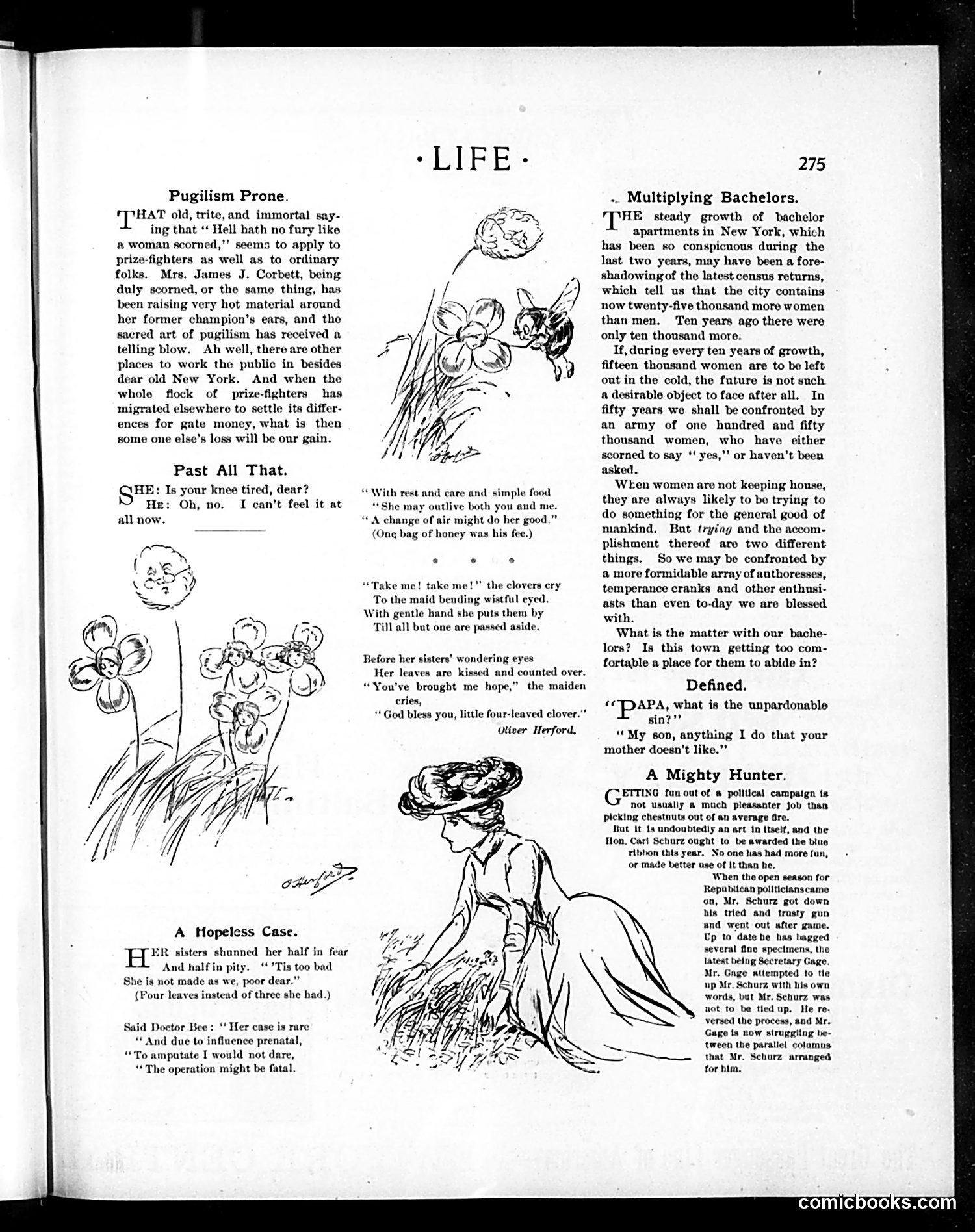
This page contains several satirical pieces reflecting late 19th/early 20th-century concerns: **"Pugilism Prone"** mocks boxer James J. Corbett's ex-wife publicly attacking him, suggesting prize-fighters will flee New York to escape such disputes. **"A Hopeless Case"** is a whimsical Oliver Herford poem about a four-leafed clover (rare like the anomalous flower) consulting a Doctor Bee—satirizing both superstition and medical pretension. **"Multiplying Bachelors"** addresses a real demographic crisis: New York census data showed women outnumbering men by increasing margins (10,000 then 25,000 in a decade). The piece satirizes bachelors' comfortable apartment living while warning of surplus unmarried women becoming "authoresses" and "temperance cranks." **"A Mighty Hunter"** portrays Carl Schurz as a skilled political hunter during Republican campaign season, with Secretary Gage as his latest "specimen"—a metaphor for Schurz out-maneuvering Gage in public debate. The page blends humor with genuine social anxieties about urbanization, changing gender ratios, and political conflict.
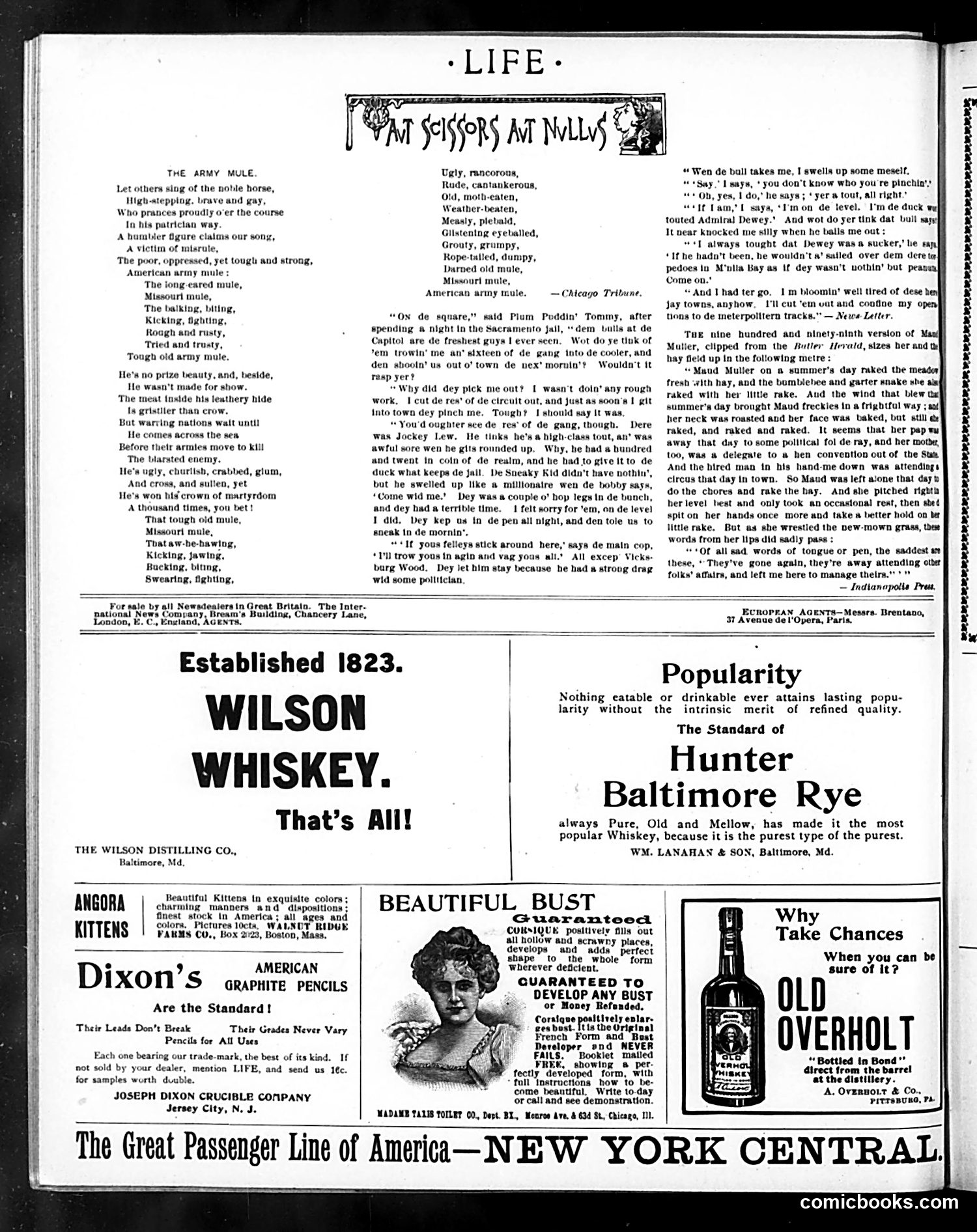
This page is primarily **advertising with poetic content**, not political cartoons. The main pieces are: 1. **"The Army Mule" poem** (top): A sentimental tribute to the unglamorous but essential military pack animal—tough, stubborn, and indispensable to army logistics. It's nostalgic Americana celebrating humble service. 2. **"On de Square" sketch** (center): A phonetic-dialect monologue from a transient ("Plum Puddin' Tommy") describing arrest in Sacramento. He complains about police harassment, mentions Admiral Dewey dismissively, and suggests one arrestee had political connections protecting him. It's street-level social commentary about class and corruption. 3. **The advertisements** (bottom half) dominate: Wilson Whiskey, graphite pencils, decorative busts, and Baltimore Rye whiskey. The satire here targets **police corruption and class favoritism** rather than national politics—the arrested man notes only well-connected individuals escape town restrictions. Overall, this is a miscellaneous entertainment/advertising page with period dialect humor, not focused political commentary.
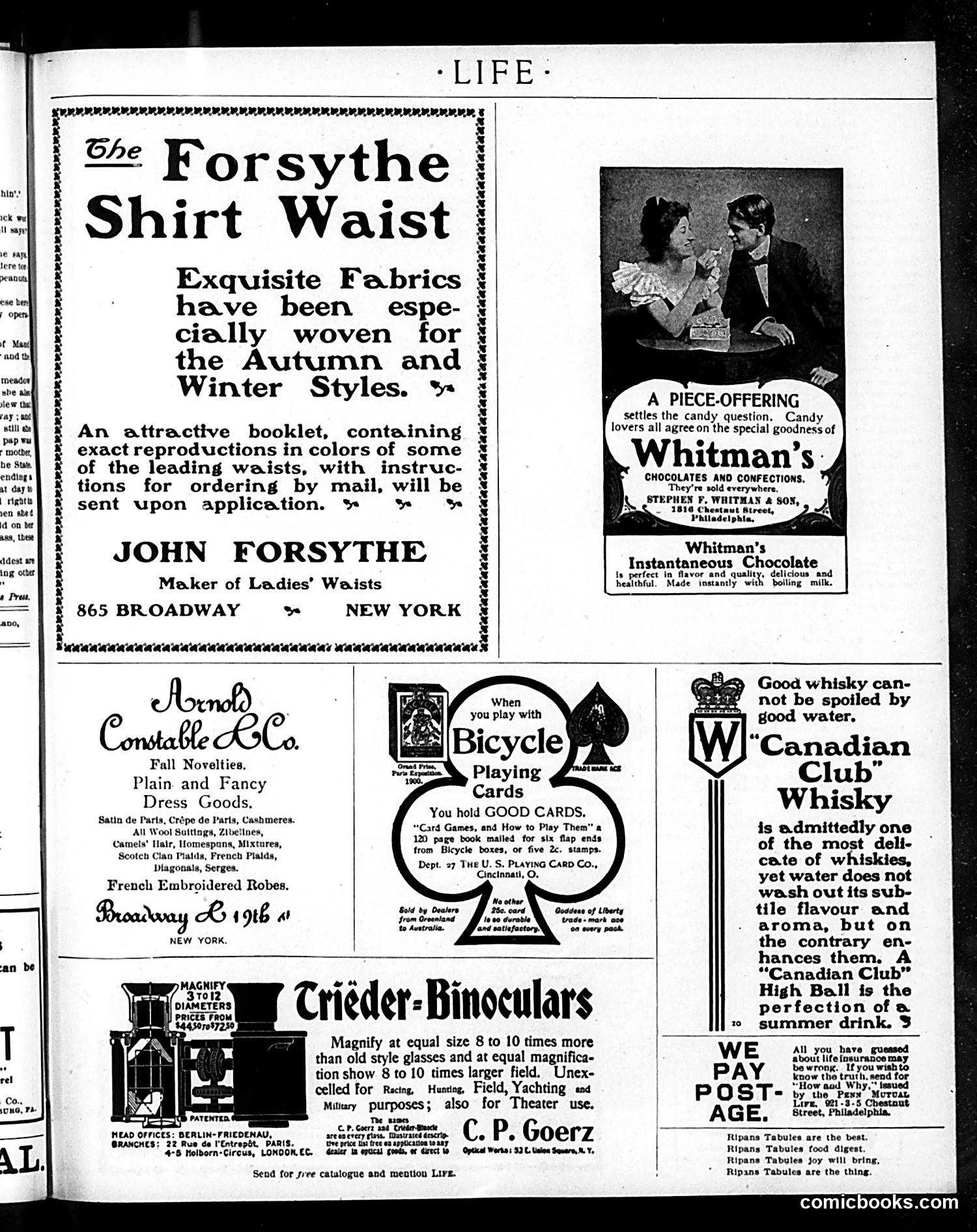
This is primarily an **advertising page** with no political cartoons or satire. It contains period product advertisements typical of early 20th-century Life magazine. The ads include: - **Forsythe Shirt Waist** (women's clothing, 865 Broadway) - **Whitman's Chocolates** (with a romantic couple illustration) - **Arnold Constable & Co.** (dress goods and French robes) - **Bicycle Playing Cards** (with instructional booklet offer) - **Crieder-Binoculars** (optical equipment) - **Canadian Club Whisky** (spirits) - **Ripans Tabules** (digestive tablets) - **Penn Mutual Life Insurance** (financial services) The only illustrated element beyond product logos is the Whitman's chocolate advertisement showing a well-dressed couple, emphasizing that candy-giving was a romantic gesture—a common marketing trope of the era. There is **no satire or political commentary** on this page. It's a straightforward commercial space reflecting consumer goods and social customs of approximately 1910s-1920s America.
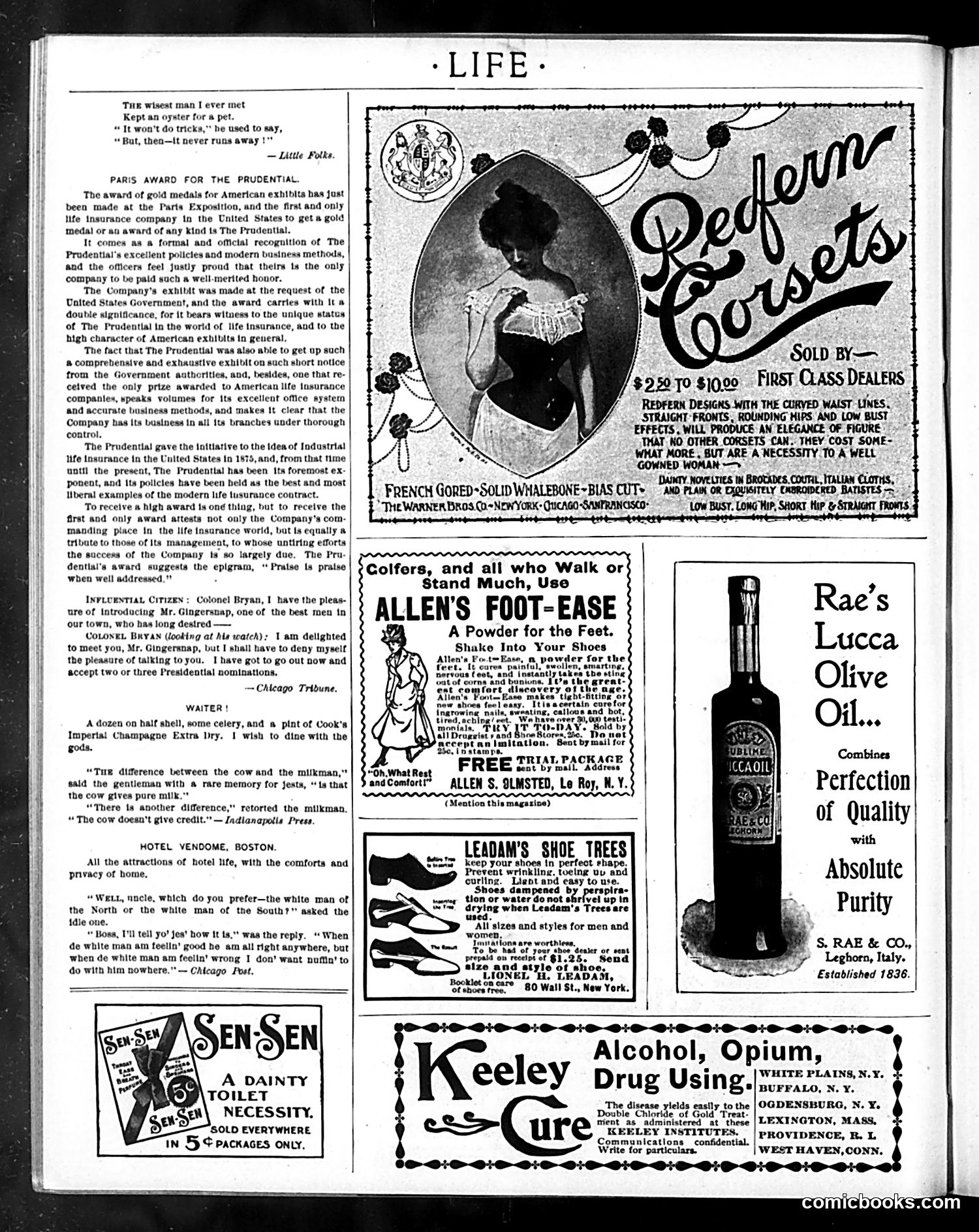
This page is primarily **advertising and light humor** rather than political satire. Key content: **Main Cartoon/Joke:** A brief Colonel Bryan reference mocks William Jennings Bryan's perpetual presidential ambitions—he repeatedly sought nominations across multiple elections, so he's too busy "accepting" them to meet constituents. **Advertisements dominate the page:** - Redfern corsets (emphasizing fashionable silhouette) - Allen's Foot-Ease powder - Rae's Lucca Olive Oil - Leadam's Shoe Trees - Sen-Sen toiletries - Keeley Cure (drug/alcohol addiction treatment) **Light humor pieces** include jokes about oysters as pets, differences between cows and milkmen (one gives pure milk, one doesn't give credit), and racial dialect humor typical of the era. **The Prudential Insurance section** celebrates the company's Paris Exposition award—straightforward corporate publicity, not satire. Overall, this is a **typical early 1900s Life magazine mix**: light domestic humor, advertisements, and corporate promotion rather than sharp political commentary.
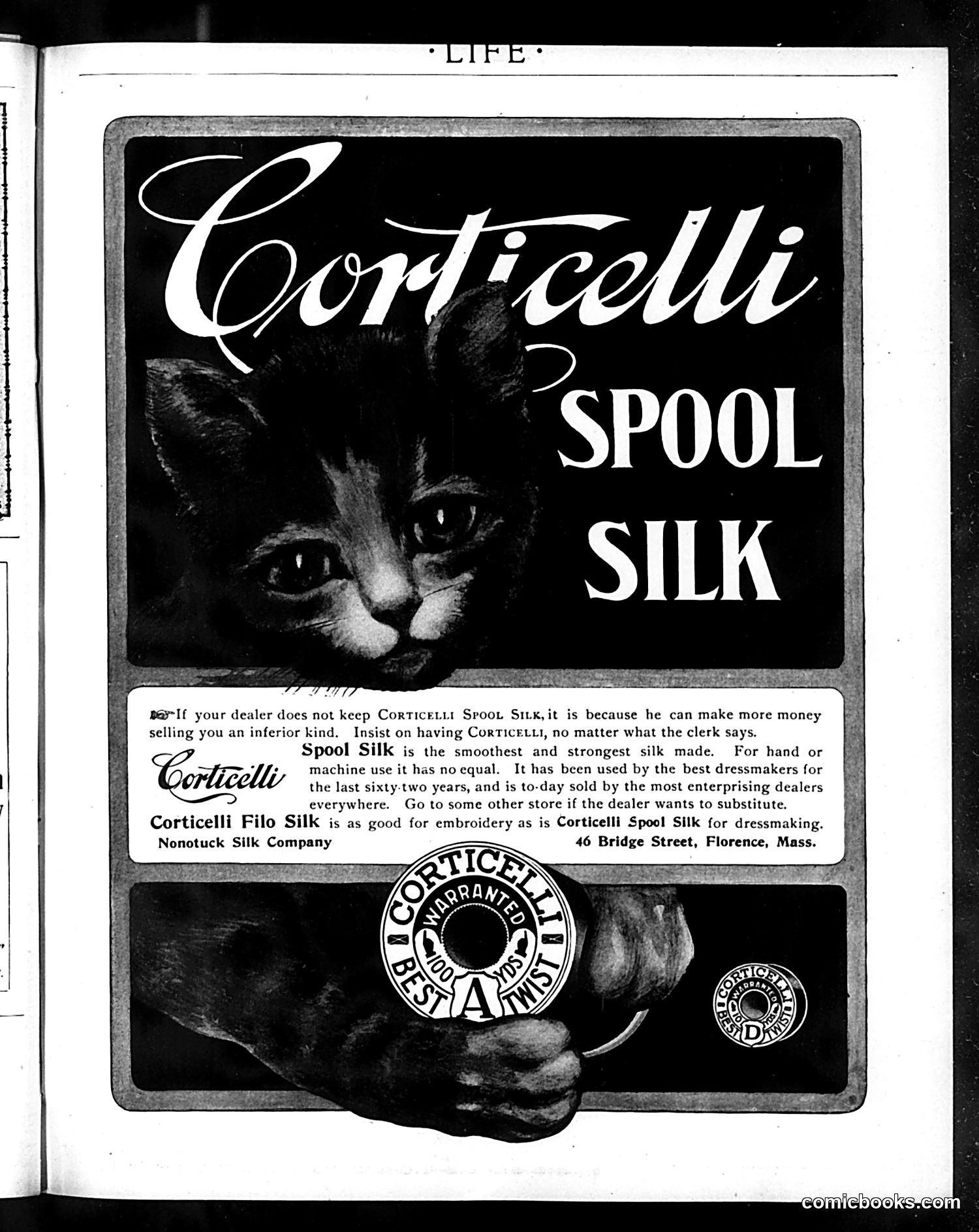
This is a **product advertisement**, not political satire. It promotes Corticelli Spool Silk thread, manufactured by Nonotuck Silk Company in Florence, Massachusetts. The ad features a cat's face and hand holding a spool of silk. The messaging is aggressive: it accuses retailers of deliberately stocking inferior thread brands to increase profits. The ad directly challenges consumers to "insist on having Corticelli" and threatens to shop elsewhere if dealers won't stock it. This reflects early 20th-century retail tension—manufacturers competing against store clerks who had financial incentives to push house brands or cheaper alternatives. The cat imagery was likely chosen for appeal and memorability in a magazine aimed at women who sewed. The "sixty-two years" claim establishes brand heritage and trustworthiness.
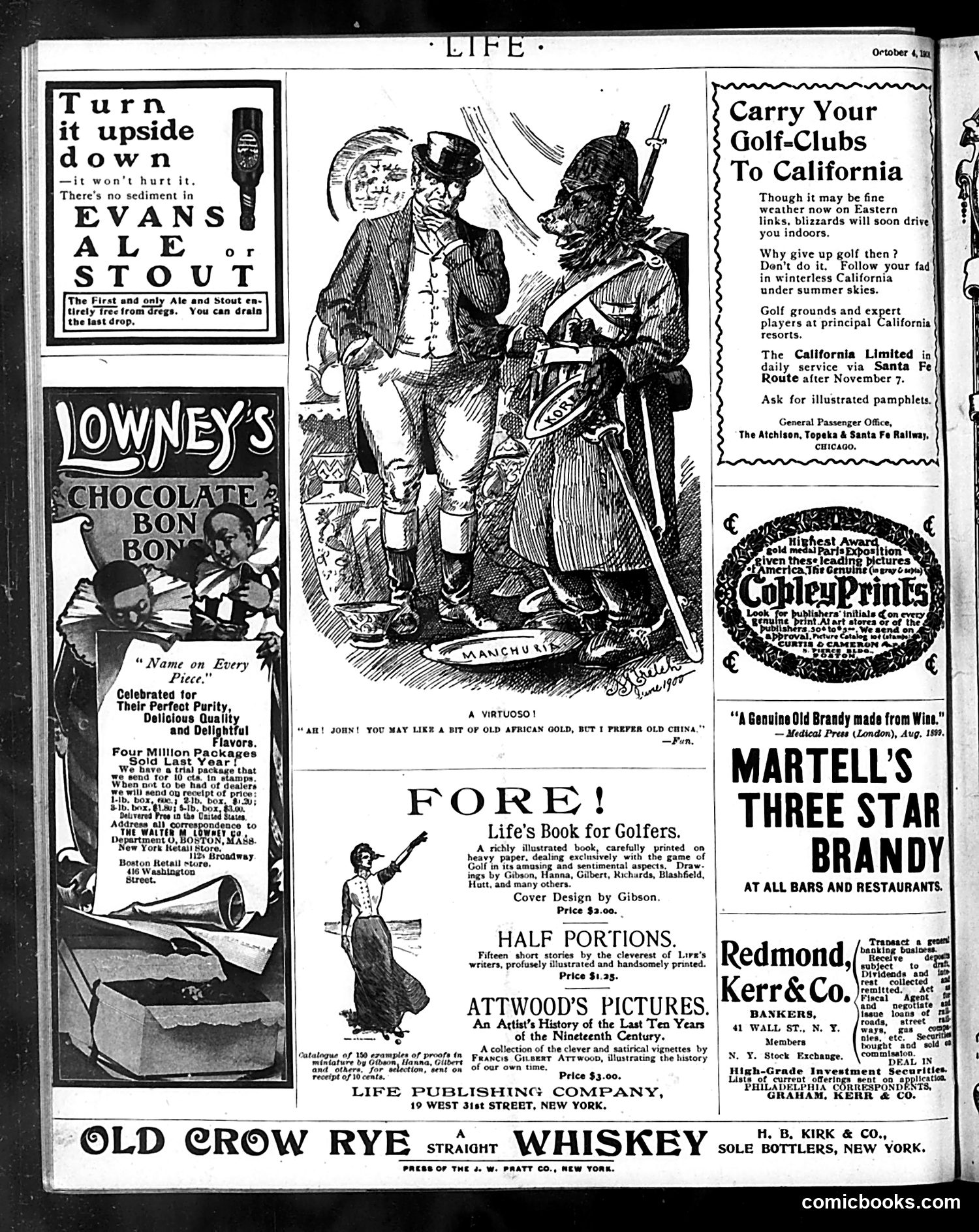
This is primarily an **advertising page** with one central cartoon. The main illustration depicts two men examining a Chinese figurine—one appears to be a wealthy collector or connoisseur, the other likely a servant or attendant. The caption reads: "Am! John! You may like a bit of old African gold, but I prefer old China." **The satire**: This jokes about wealthy Americans' fashionable obsession with collecting Chinese art and antiquities during the early 1900s. "Old China" (the artwork) is being humorously contrasted with "African gold" (material wealth), suggesting the owner's pretentious preference for refined cultural taste over mere money. The humor lies in the absurdity of this snobbish distinction and the era's craze for Asian collecting among the elite. **Context**: Turn-of-century America saw intense enthusiasm among the wealthy for Oriental art collecting, making this an accessible joke about class affectation and consumer trends of the period. The page is otherwise filled with product advertisements (ales, chocolate, brandy, books, financial services) typical of *Life* magazine's revenue model.