
Life, 1900-10-04 · page 6 of 20
Life — October 4, 1900 — page 6: what you’re looking at
What you’re looking at
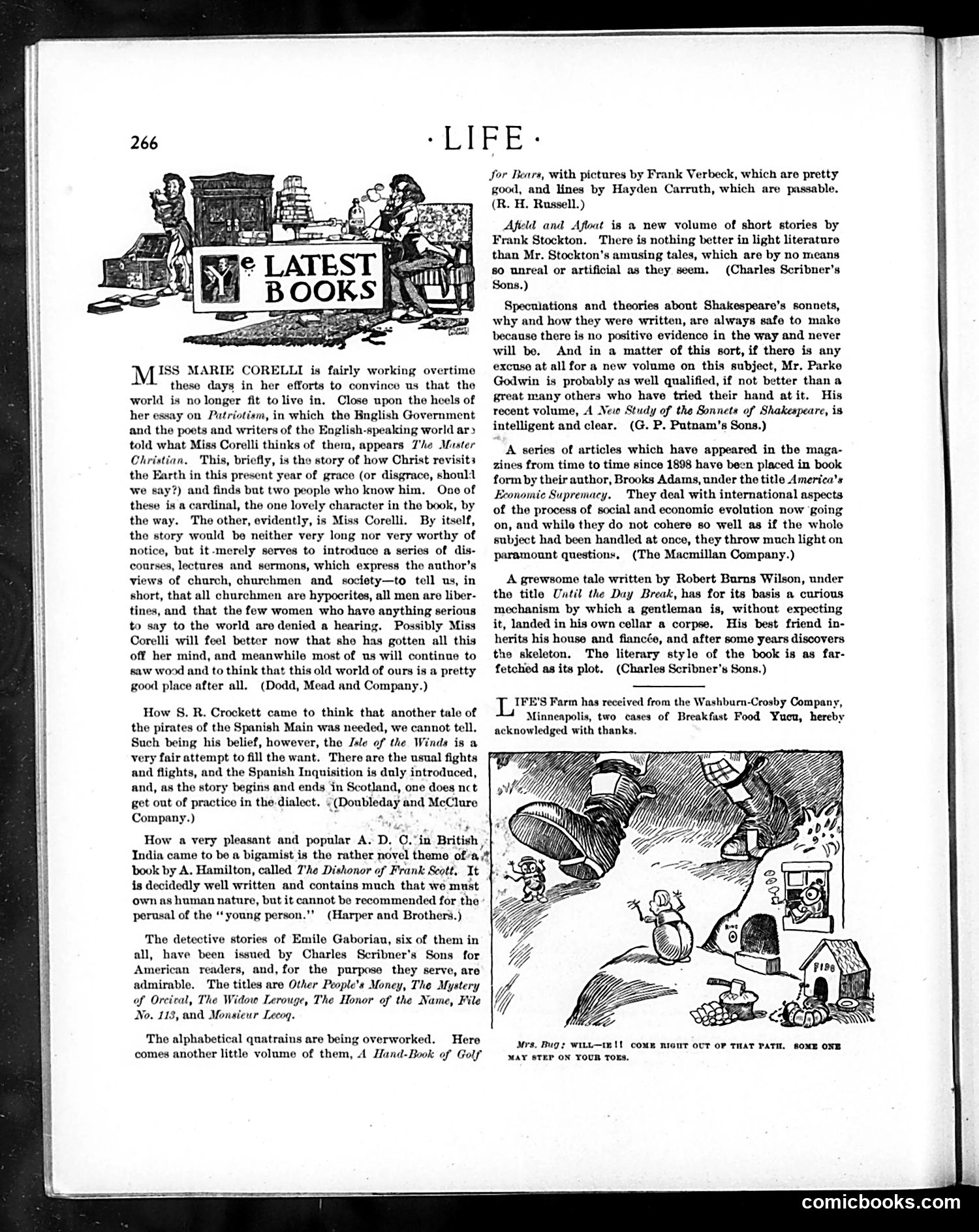
This page is primarily a **book review column** rather than political satire. It discusses recent literary releases, including works by Frank Stockton, Frank Stockton (again), and Robert Barna Wilson. The **illustration at bottom** depicts a domestic scene: a woman warns "Mrs. Budd—it'll come right out of that path. Some one may step on your toes," addressing what appears to be a large object or creature on a garden path. The cartoon seems to be a humorous commentary on **domestic hazards or unexpected intrusions** into everyday life, though the specific reference is unclear without additional context. The page focuses on **book recommendations and literary criticism** rather than political commentary. It's part of Life's cultural coverage, not its satirical editorial content.
📄 Transcribed text from this page (OCR, searchable)
Machine-transcribed from the original scan — historical spelling and the odd misread are preserved.
LIFE - “ Pas aia 3 MARIE CORELLI is fairly working overtime these days in her efforts to convince us that the world is no longer fit to live in, Close upon the heels of her essay on Patriotism, in which the English Government and the poets and writers of the English-speaking world ar> told what Miss Corelli thinks of them, appears 7'he Muster Christian, This, briefly, is the story of how Christ revisits the Earth in this present year of grace (or disgrace, shoul: we say?) and finds but two people who know him, One of these is a cardinal, the one lovely character in the book, by the way. The other, evidently, is Miss Corelli. By itself, the story would be neither very long nor very worthy of notice, but it-merely serves to introduce a series of dis- courses, lectures and sermons, which express the author's views of church, churchmen and society—to tell us, in short, that all churchmen are hypocrites, all men are liber- tines, and that the few women who havo anything serious to say to the world are denied a hearing. Possibly Miss Corelli will feel better now that she has gotten all this off her mind, and meanwhile most of us will continue to saw wood and to think that this old world of ours is a pretty good place after all. (Dodd, Mead and Company.) How 8. R. Crockett came to think that another tale of the pirates of the Spanish Main was needed, we cannot tell. Such being his belief, however, the Jsle of the Winds is a very fair attempt to fill the want. There are the usual fights and flights, and the Spanish Inquisition is duly introduced, and, as the story begins and ends in Scotland, one does nct get out of practice in the dialect. «(Doubleday and McClure Company.) f 4 How a very pleasant and popular A. D. Q."in British , India came to be a bigamist is the rather novel theme of’, #1 book by A. Hamilton, called The Dishonor of Frank Scott, It is decidedly well written and contains much that we must own as human nature, but it cannot be recommended for the perusal of the young person."” (Harper and Brothers.) The detective stories of Emile Gaboriau, six of them in all, have been issued by Charles Scribner's Sons for American readers, and, for the purpose they serve, are admirable. The titles are Other People's Money, The Mystery of Orcical, The Widow Lerouge, The Honor of the Name, File No. 113, and Monsieur Lecoq. The alphabetical quatrains are being overworked. Here comes another little volume of them, A Hand-Book of Golf for Bears, with pictures by Frank Verbeck, which are pretty good, and lines by Hayden Carruth, which are passable. (R. H. Russell.) Afield and Afloat is a new volume of short stories by Frank Stockton. There is nothing better in light literature than Mr. Stockton's amusing tales, which are by no means 80 unreal or artificial as they seem. (Charles Scribner's Sons.) Speculations and theories about Shakespeare’s sonnets, why and how they were written, are always safe to make because there is no positive evidence in the way and never will be. And in a matter of this sort, if there is any excuse at all for a new volume on this subject, Mr. Parke Godwin is probably as well qualified, if not better than a great many others who have tried their hand atit. His recent volume, A New Study of the Sonnets of Shakespeare, is intelligent and clear. (G. P. Putnam’s Sons.) A series of articles which have appeared in the maga- zines from time to time since 1898 have been placed in book form by their author, Brooks Adams, under the title America’s Economic Supremacy. They deal with international aspects of the process of social and economic evolution now ‘going on, and while they do not cohere so well as if the wholo subject had been handled at once, they throw much light on paramount questions, (The Macmillan Company.) A grewsome tale written by Robert Barns Wilson, under the title Until the Day Break, has for its basis a curious mechanism by which a gentleman is, without expecting it, landed in his own cellar a corpse. His best friend in- herits his house and fiancée, and after some years discovers the skeleton. The literary style of the book is as far- fetched as its plot. (Charles Scribner’s Sons.) IFE’S Farm has received from the Washburn-Crosby Company, Minneapolis, two cases of Breakfast Food Yucu, hereby acknowledged with thanks. If come mont ovt or THAT PATH. MAY STEP ON YOUR TOES, comicbooks.com