
Life, 1900-10-04 · page 7 of 20
Life — October 4, 1900 — page 7: what you’re looking at
What you’re looking at
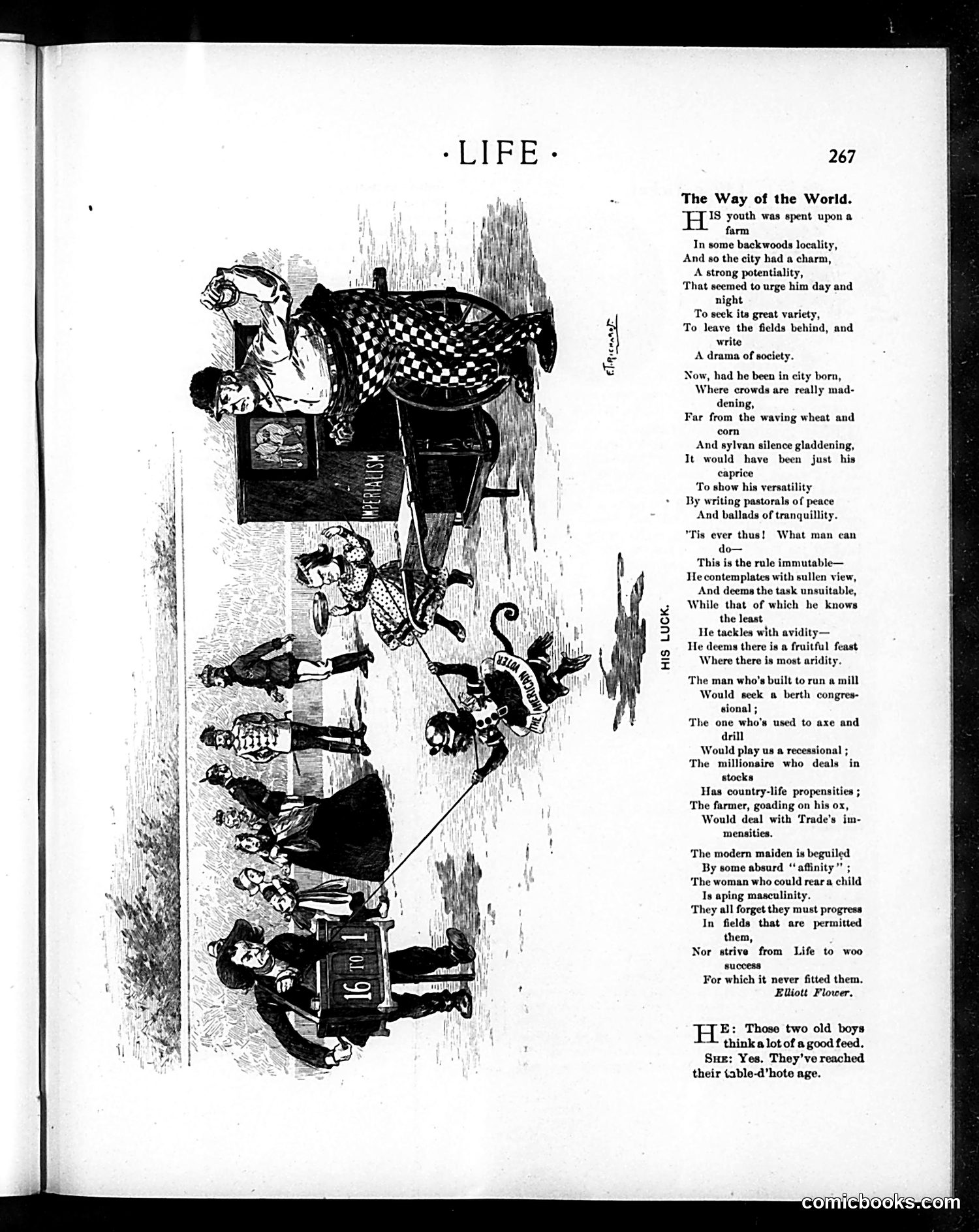
This page contains a poem by Elliott Flower (credited at bottom) accompanying a satirical illustration. The poem critiques social ambition and hypocrisy across various professions and classes. The illustration, oriented sideways, appears to show a vertical stack of figures representing different social types—likely mill owners, businessmen, farmers, and society women—each embodying the pretensions the poem mocks. The central figure appears to be a woman in fashionable dress, surrounded by smaller figures representing various occupations. The satire targets the universal human drive for social advancement and respectability, suggesting that people across all professions compromise their integrity to climb the social ladder. The poem's concluding dialogue between "HE" and "SHE" jokes darkly that elderly people have simply "reached their table-d'hôte age"—implying they've given up entirely on life's aspirations.
📄 Transcribed text from this page (OCR, searchable)
Machine-transcribed from the original scan — historical spelling and the odd misread are preserved.
4 ° 3 a 2 = 267 The Way of the World. “ELS youth was spent upon a farm In some backwoods locality, And so the city had a charm, A strong potentiality, That seemed to urge him day and night To seek its great variety, To leave the fields behind, and write A drama of society. Now, had he been in city born, Where crowds are really mad- dening, Far from the waving wheat and corn And sylvan silence gladdening, It would have been just his caprice To show his versatility By writing pastorals of peace ‘And ballads of tranquillity. ‘Tis ever thus!) What man can do— This is the rule immutable— He contemplates with sullen view, And deems the task unsuitable, While that of which he knows the least He tackles with avidity— He deems there is a fruitful feast Where there is most aridity. The man who's built to run a mill Would seek a berth congres- sional ; The one who's used to axe and drill Would play us a recessional ; The millionsire who deals in stocks Has country-life propensities ; ‘The farmer, goading on his ox, Would deal with ‘Trade’s im- mensities. ‘The modern maiden is beguiled By some absurd “ affinity” ; ‘The woman who could reara child Is aping masculinity. ‘They all forget they must progress In fields that are permitted them, Nor strive from Life to woo success For which it never fitted them. Eutiott Flower. E: Those two old boys think a lot of a good feed. Sue: Yes. They’ve reached their (able-d’hote age.