
Life, 1900-10-04 · page 12 of 20
Life — October 4, 1900 — page 12: what you’re looking at
What you’re looking at
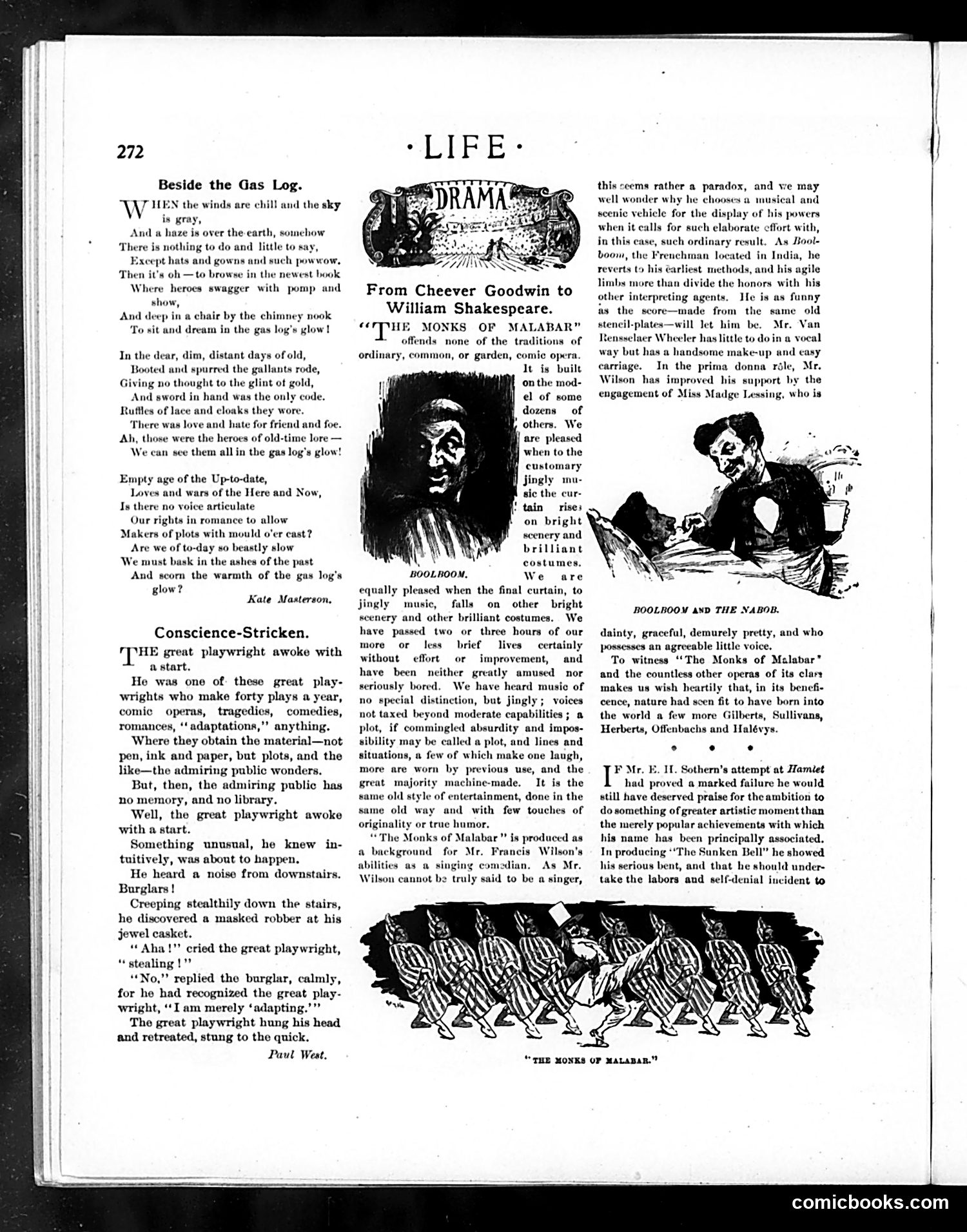
This page contains three distinct pieces: a poem "Beside the Gas Log" by Kate Masterson; an article titled "Conscience-Stricken" about a playwright's moral awakening; and a drama review of "The Monks of Malabar" featuring caricatured illustrations. The review discusses a theatrical production with sketches labeled "Hoolboom" and "Hoolboom and the Nabob," depicting character types from the opera. The text praises the performers' voices and staging while noting the plot involves "absurdity and impossibility." The "Conscience-Stricken" section satirizes a playwright who, overhearing recognition of a famous burglar, becomes inspired to "adapt" the criminal's story—mocking contemporary playwrights' tendency to borrow sensational material without original thought. The illustrations are period theatrical caricatures rather than political commentary.
📄 Transcribed text from this page (OCR, searchable)
Machine-transcribed from the original scan — historical spelling and the odd misread are preserved.
272 Beside the Gas Log. TW HEN the winds are chill and the sky is gray, And a haze is over the earth, somehow There is nothing to do and little to Except hats and gowns and such powwow, Then it’s oh —to browse in the newest book Where heroes swagger with pomp and show, And deep in a chair by the chimney nook To sit and dream in the gas log’s glow! In the dear, dim, distant days of old, Booted and spurred the gallants rode, Giving no thought to the glint of gold, And sword in hand was the only code, Ruttles of lace and cloaks they wore. ‘There was love and hate for friend and foe. Ah, those were the heroes of old-time lore ‘ We can see them all in the gas log's glo Empty age of the Up-to-date, Loves and wars of the Here and Now, Is there no voice articulate Our rights in romance to allow Makers of plots with mould o'er cast? 4 Are we of to-day so beastly slow We must bask in the ashes of the past And scorn the warmth of the gas log’s glow? Kate Masterson, Conscience-Stricken. ] THE great playwright awoke with | a start. | He was one of: these great play- wrights who make forty plays a year, comic operas, tragedies, comedies, | romances, ‘‘adaptations,"’ anything. } Where they obtain the material—not ] pen, ink and paper, but plots, and the like—the admiring public wonders, But, then, the admiring public has no memory, and no library, Well, the great playwright awoke with a start. Something unusual, he knew in- tuitively, was about to happen. He heard a noise from downstairs. Burglars! Creeping stealthily down the stairs, he discovered a masked robber at his jewel casket. “Aha!"’ cried the great playwright, * stealing !’” “No,” replied the burglar, calmly, for he had recognized the great play- wright, ‘I am merely ‘adapting.’” The great playwright hung his head and retreated, stung to the quick. Paul West. SS From Cheever Goodwin to William Shakespeare. id HE MONKS OF MALABAR” offends none of the traditions of ordinary, common, or garden, comic opera. It is built on the mod- el of some dozens of » others. We I] are pleased | when to the customary fingly mu- sic the cur- tain rises on bright scenery and brilliant . costumes, BOOLRBOOM, We are equally pleased when the final curtain, to Jingly| music, falls on other bright scenery and other brilliant costumes. We have passed two or three hours of our more or less brief lives certainly without effort or improvement, and have been neither greatly amused nor seriously bored. We have heard music of no special distinction, but jingly ; voices not taxed beyond moderate capabilities ; a plot, if commingled absurdity and impos- sibility may be called a plot, and lines and situations, a few of which make one laugh, more are worn by previous use, and the great majori ine-made. It is the same old style of entertainment, done in the same old way and with few touches of or true humor, “The Monks of Malabar” is produced as kground for Mr. Francis Wilson's ties as a singing com As Mr. Wilson cannot be truly said to be a singer, mac this ccems rather a paradox, and we may sical and of his powers well wonder why he chooses a scenic vehicle for the disp when it calls for such elaborate effort with, in this case, such ordinary result. As Bo boom, the Frenchman located in India, he reverts to his éarliest methods, and his agile limbs more than divide the honors with his other interpreting agents, He is as funny as the score—made from the same old ‘il-plates—will let him be. Mr. Van Rensselaer Wheeler has little to do in a vocal way but has a handsome make-up and easy carriage. In the prima donna role, Mr. Wilson has improved his support by the engagement of Miss Madge Lessing, who is ate BOOLBOOM AND THE NABOB. dainty, graceful, demurely pretty, and who possesses an agreeable little voice, To witness ‘‘The Monks of Malabar" and the countless other operas of its clary makes us wish heartily that, in its benefi- cence, nature had scen fit to have born into the world a few more Gilberts, Sullivans, Herberts, Offenbachs and Halév; ° ° ° I F Mr. E. If. Sothern’s attempt at Hamlet had proved a marked failure he would still have deserved praise for the ambition to do something of greater artistic moment than the merely popular achievements with which his name has been principally associated. In producing ‘‘The Sunken Bell” he showed his serious bent, and that he should under- take the labors and self-denial incident to “THE MONKS OF MALABAR.” comicbooks.com