
A complete issue · 20 pages · 1900
Life — September 13, 1900
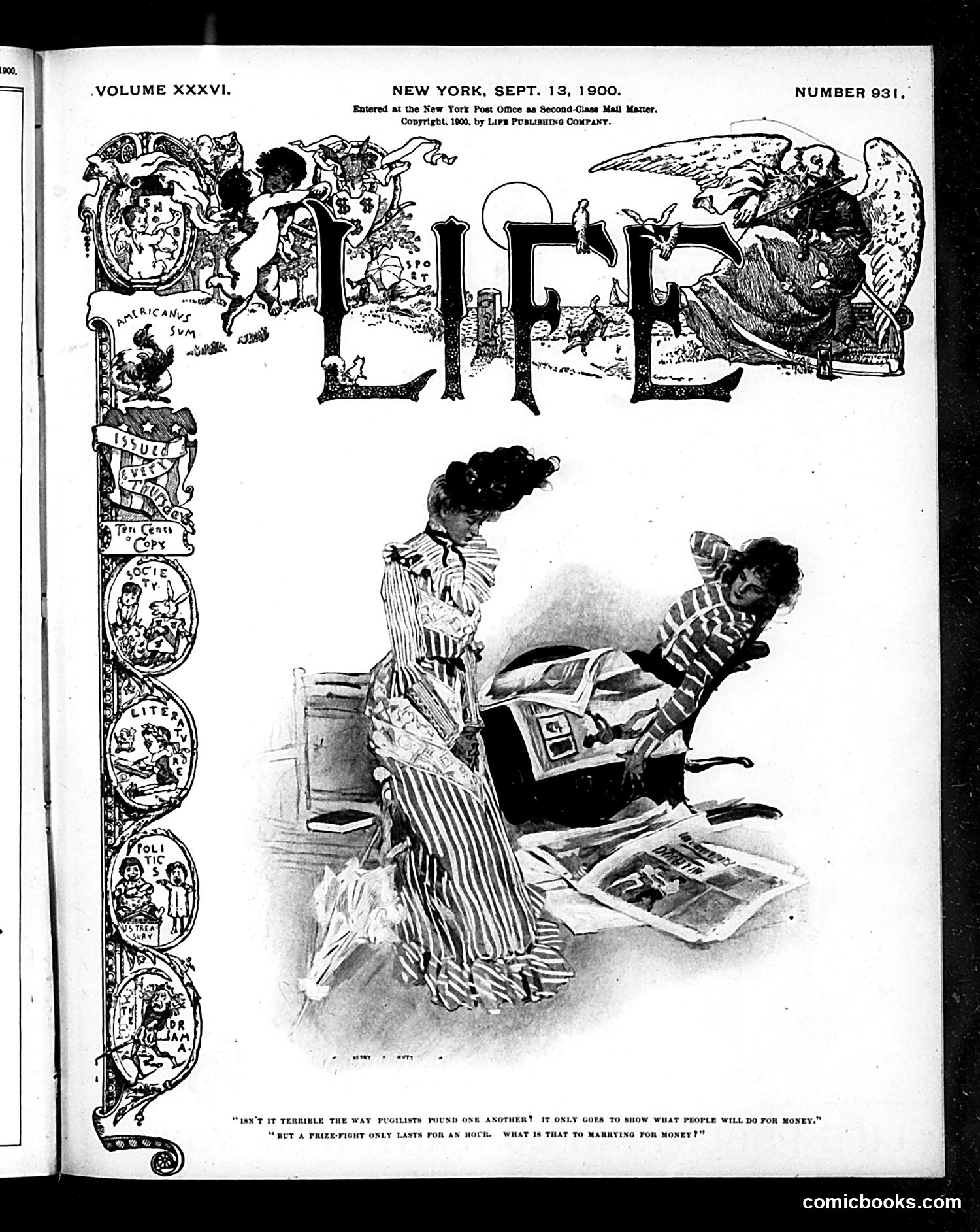
This satirical cover comments on **prizefighting and gambling**. The illustration shows two figures examining what appear to be fight announcements or betting materials, with newspapers scattered about. The caption addresses the contradiction of public outcry against prizefights while people eagerly wager money on them: "ISN'T IT TERRIBLE THE WAY PUGILISTS POUND ONE ANOTHER? IT ONLY GOES TO SHOW WHAT PEOPLE WILL DO FOR MONEY... BUT A PRIZE FIGHT ONLY LASTS FOR AN HOUR. WHAT IS THAT TO MARRYING FOR MONEY?" The satire suggests **hypocrisy**—society condemns brutal prizefights yet participates in arguably worse behavior (marrying for financial gain). The ornate left border contains typical Life magazine decorative elements and small illustrations. This reflects the era's ongoing debate over boxing's legitimacy and morality.
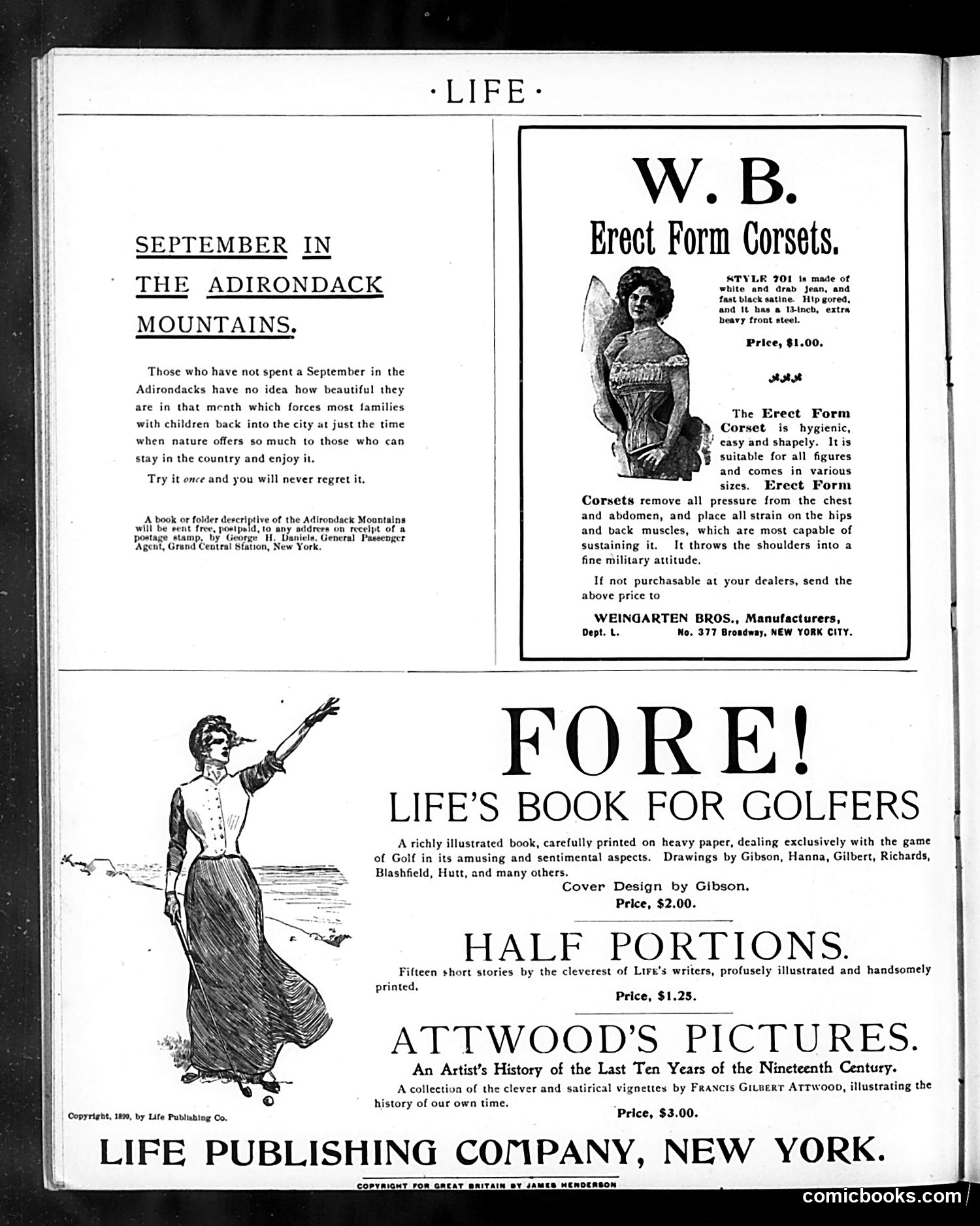
This page is primarily **advertising**, not satire or political commentary. The left column promotes September trips to the Adirondack Mountains, while the right features a corset advertisement for "W.B. Erect Form Corsets" ($1.00). The bottom half advertises **Life Publishing Company products**: a golf book ($2.00), a collection of short stories called "Half Portions" ($1.25), and "Attwood's Pictures"—described as an artist's satirical history of the last decade of the 19th century ($3.00). The illustration of a woman in period dress (left) appears to be decorative/promotional rather than cartoonical commentary. There is **no clear political satire visible** on this particular page—it functions as a standard magazine advertising section from early 1900s Life magazine.
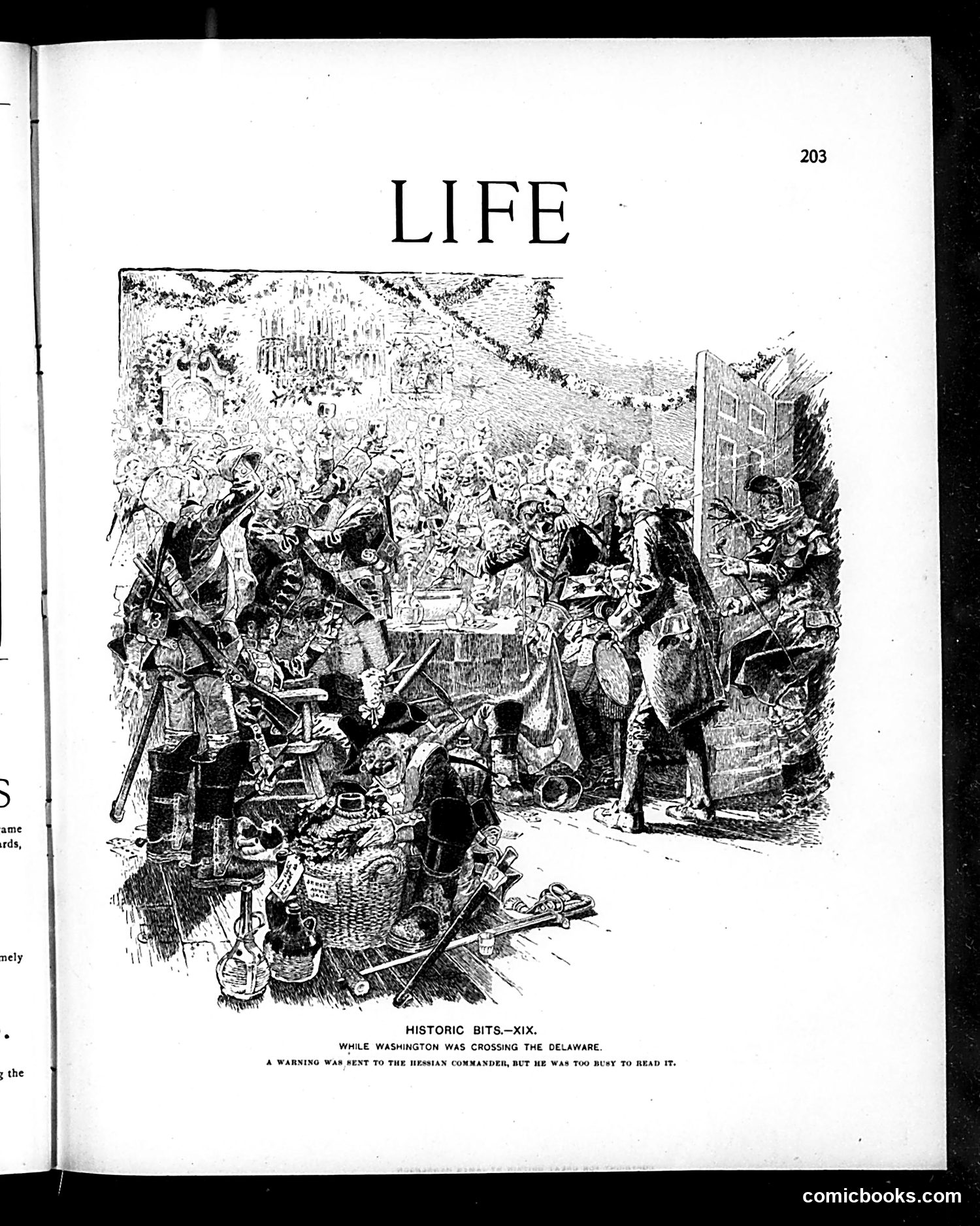
This satirical illustration depicts a military scene captioned "While Washington was crossing the Delaware. A warning was sent to the Hessian Commander, but he was too busy to read it." The cartoon shows soldiers in Revolutionary War-era uniforms gathered around a table, apparently ignoring important military intelligence. The satire seems to mock the Hessian Commander's inattention to a critical warning message during Washington's famous Delaware crossing—a pivotal moment in American Revolutionary history. The humor lies in suggesting the enemy commander was negligently too preoccupied to read urgent battlefield communications, implying his carelessness contributed to the Americans' strategic advantage. It's a lighthearted jab at military incompetence during this significant historical event.
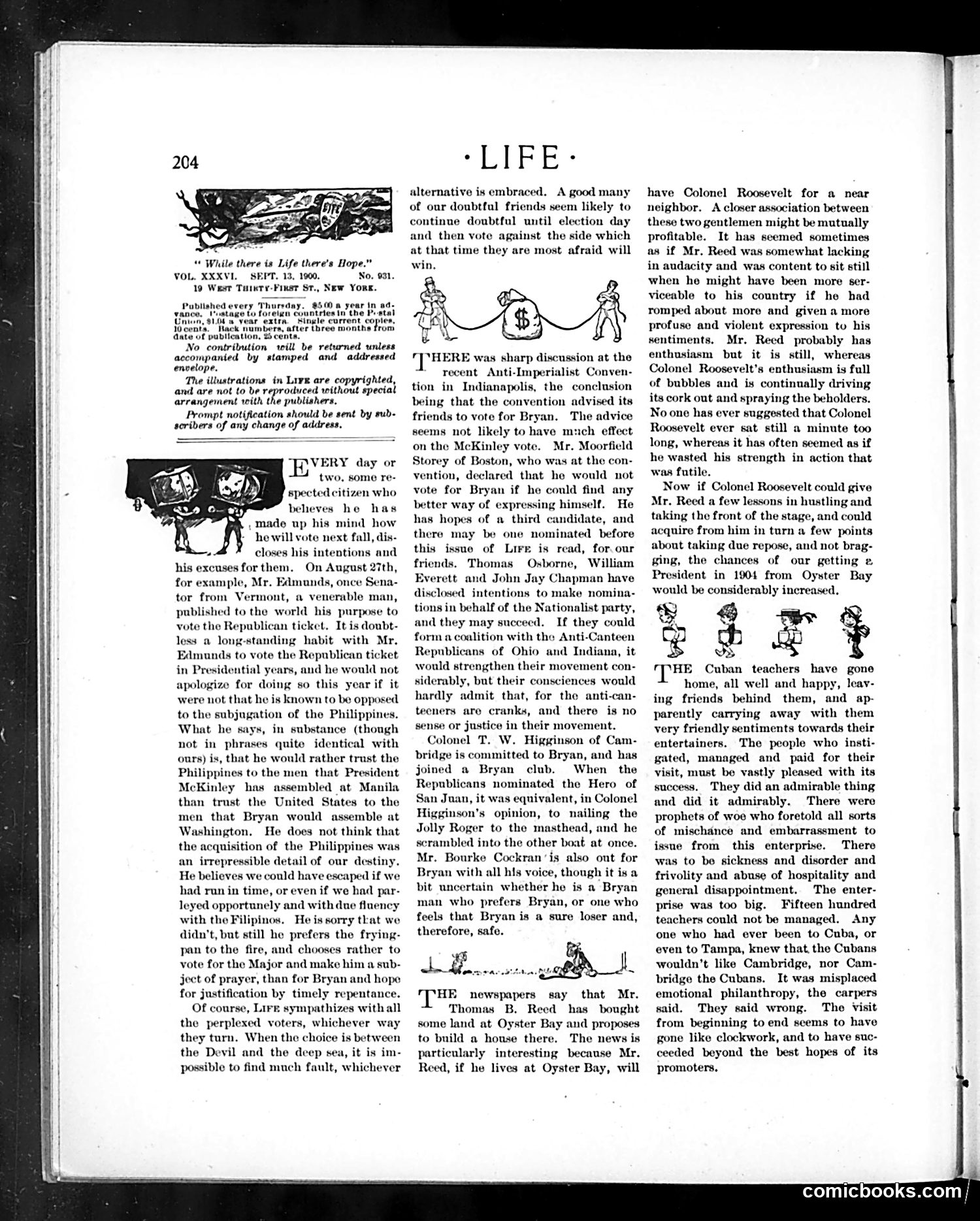
The page contains political commentary about the 1908 presidential election. The main text discusses **William Jennings Bryan** as a potential third-party candidate and debates about voting strategy among Republicans and Anti-Imperialists. Key figures mentioned include **Colonel Roosevelt** (appears to be Theodore Roosevelt, the sitting president), **Mr. Thomas B. Reed** (who apparently purchased property at Oyster Bay), and various political operatives considering whether to support Bryan or Republican nominees. The satire critiques indecision among voters and politicians—the central metaphor shows two figures pulling a "$" sign in opposite directions, illustrating the tension between supporting Bryan versus the Republican candidate. The commentary suggests that choosing between "the Devil and the deep sea" makes fault-finding difficult, mocking the political paralysis of uncertain voters.
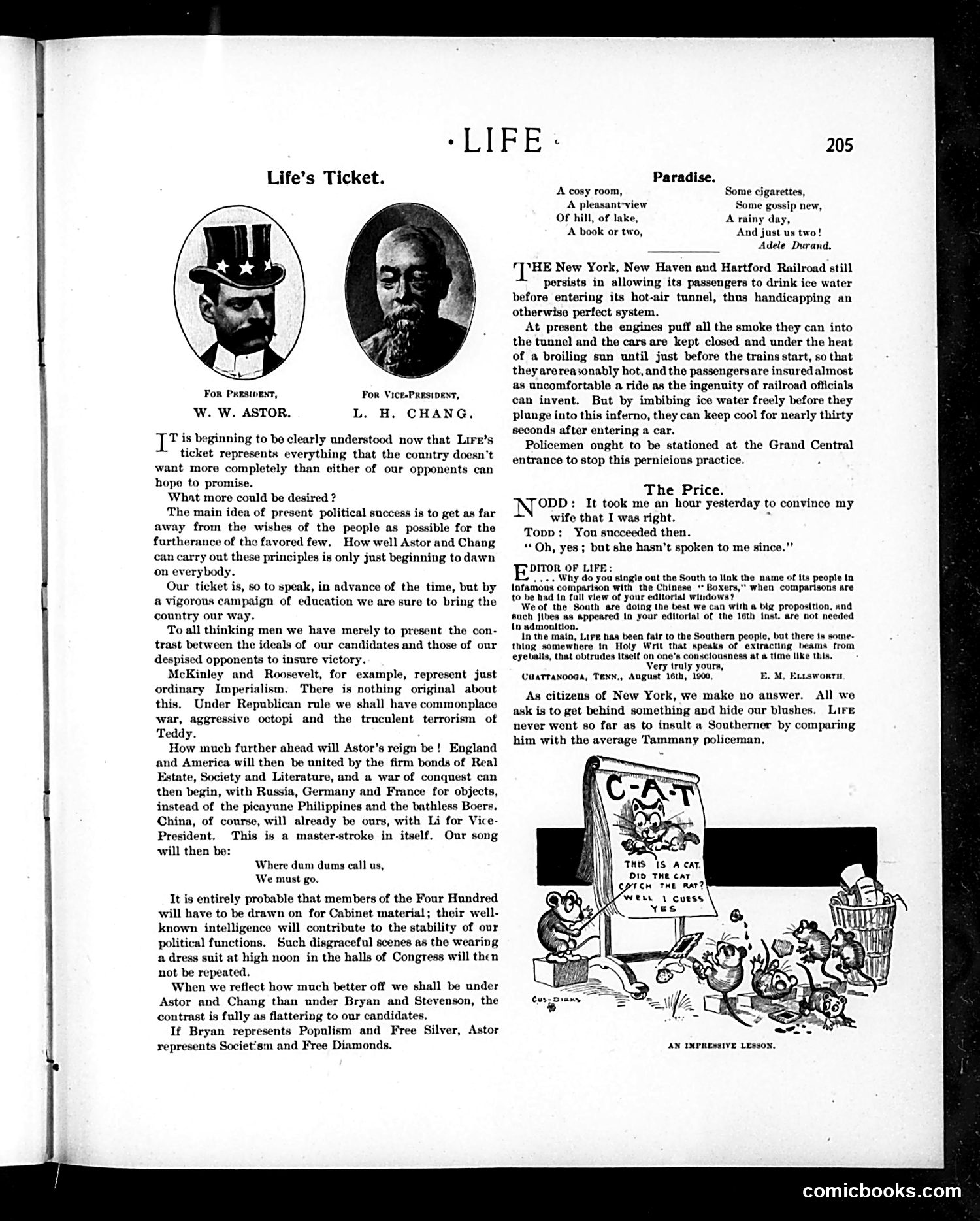
**Political Portraits & "Life's Ticket":** The page features caricatures of W.W. Astor (for President) and L.H. Chang (for Vice-President). The accompanying article sarcastically proposes these wealthy figures as an alternative to the 1900 election's actual candidates, mocking Republican and Democratic choices by suggesting ultra-wealthy elites instead. **"The Price" Dialogue:** A husband-wife exchange jokes about marital disagreement—the husband claims victory in an argument, though his wife hasn't spoken to him since. It's lighthearted domestic humor. **"An Impressive Lesson":** The cartoon shows cats discovering "This is a Cat" text, offering social commentary on education or awareness, though its precise satirical target remains unclear from the image alone. The page blends political satire with domestic comedy typical of early 1900s Life magazine humor.
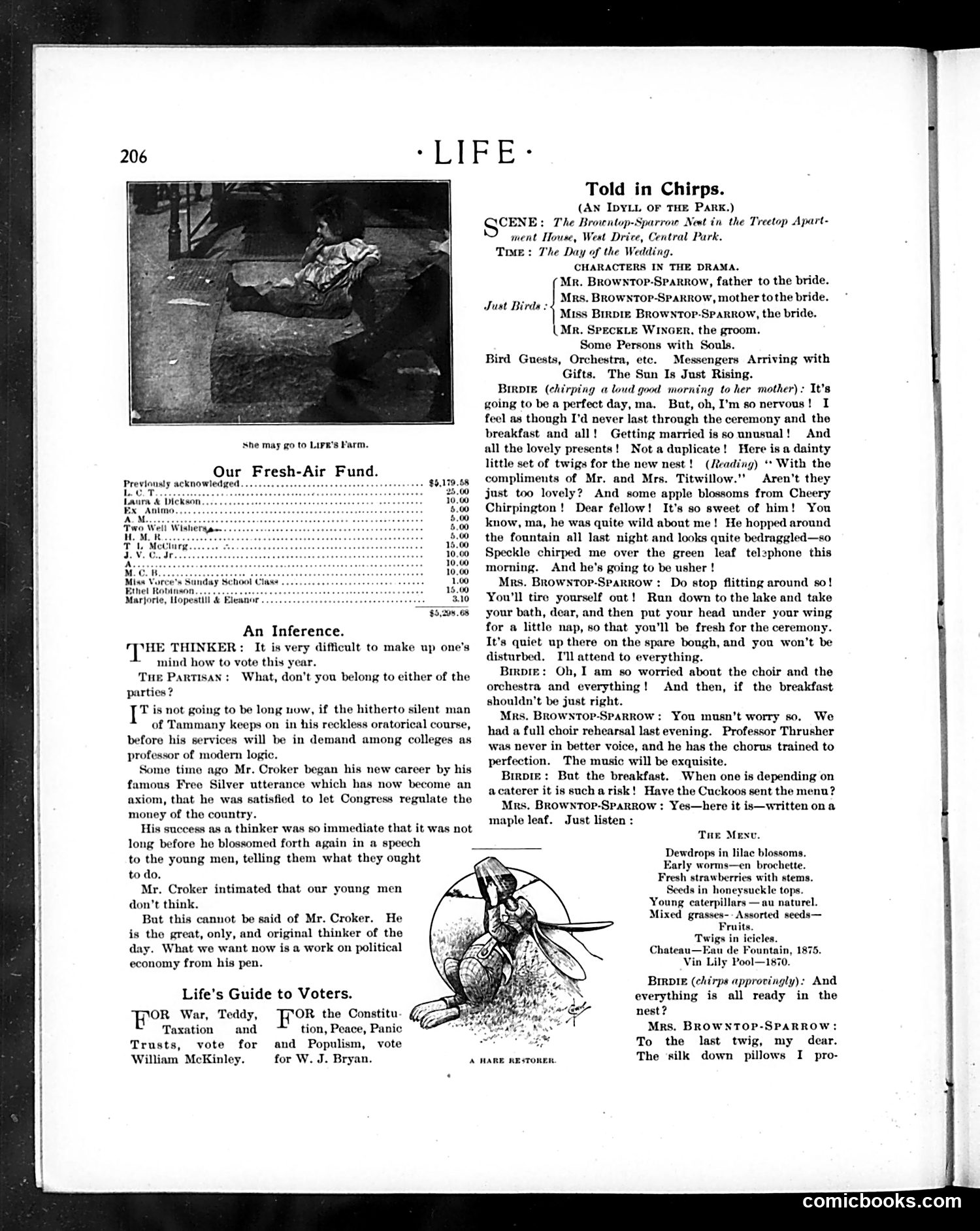
This page contains two distinct sections: **"Told in Chirps"** is a humorous wedding-day narrative featuring bird characters (the Brownstop-Sparrow family and guests). It's a lighthearted domestic comedy with no apparent political satire—just gentle humor about pre-wedding jitters and coordination challenges. **"An Inference"** and **"Life's Guide to Voters"** discuss Mr. Croker (likely Richard Croker, Tammany Hall boss) and contemporary political figures. The text praises Croker as "the great, only, and original thinker of the day" while sarcastically noting young men "don't think." The voting guide mockingly instructs readers to vote based on simplified political positions. This appears to critique both Croker's political dominance and voter ignorance in early 20th-century American politics.
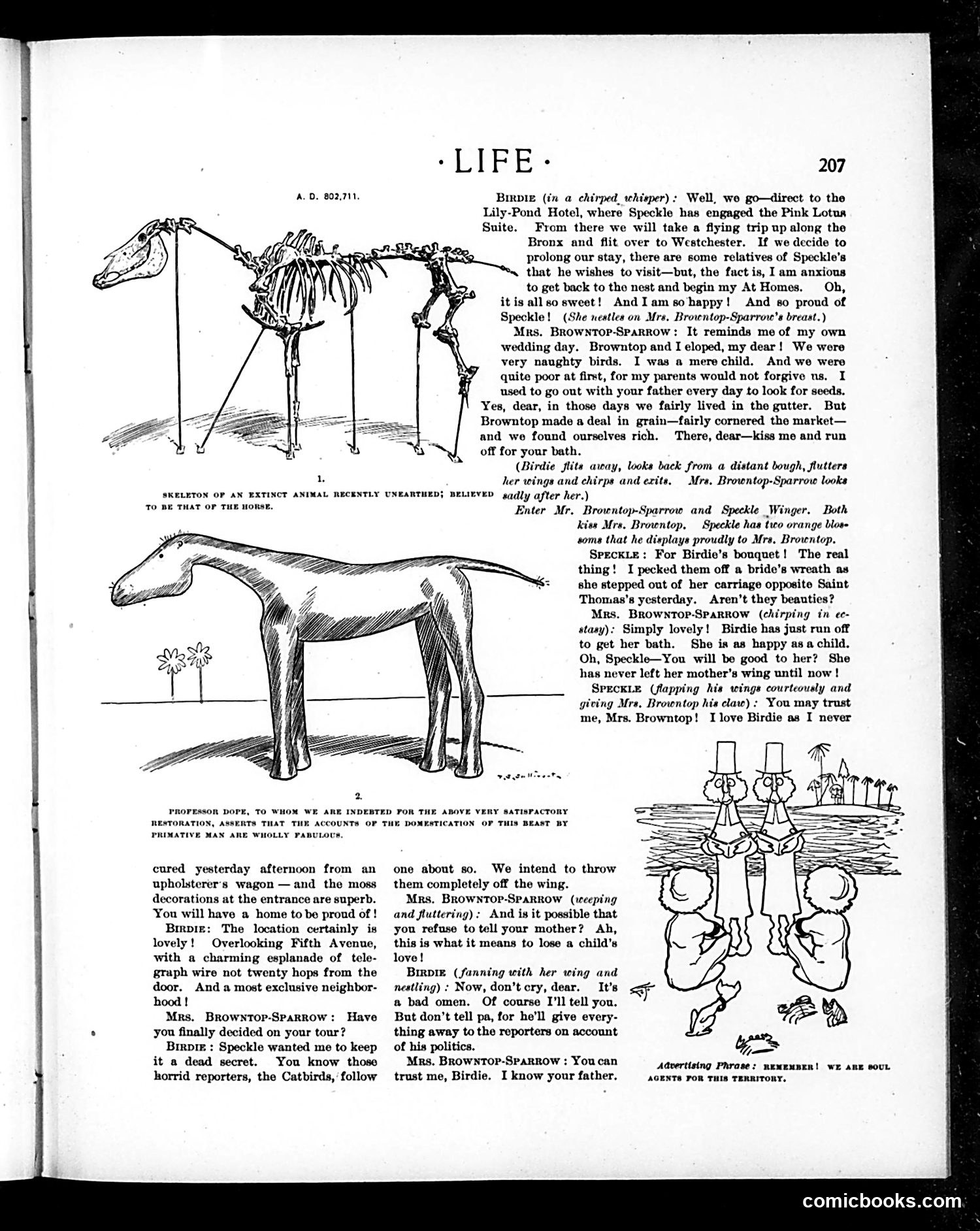
This page contains two skeletal anatomical drawings labeled as reconstructions of extinct animals—a horse skeleton (labeled "1") and what appears to be another prehistoric creature (labeled "2"). The accompanying text discusses paleontological restoration and domestication theories. The right side features a dialogue between characters named Birdie, Mrs. Browntop-Sparrow, and Speckle Winger, discussing domestic life, motherhood, and social propriety. The small illustration shows two women in conversation by the sea. This appears to be a **combination of educational content** (the skeleton diagrams) **and domestic social satire** mocking middle-class bird-society conventions, particularly around marriage, motherhood, and women's proper behavior. The juxtaposition suggests ironic commentary on "civilized" society.
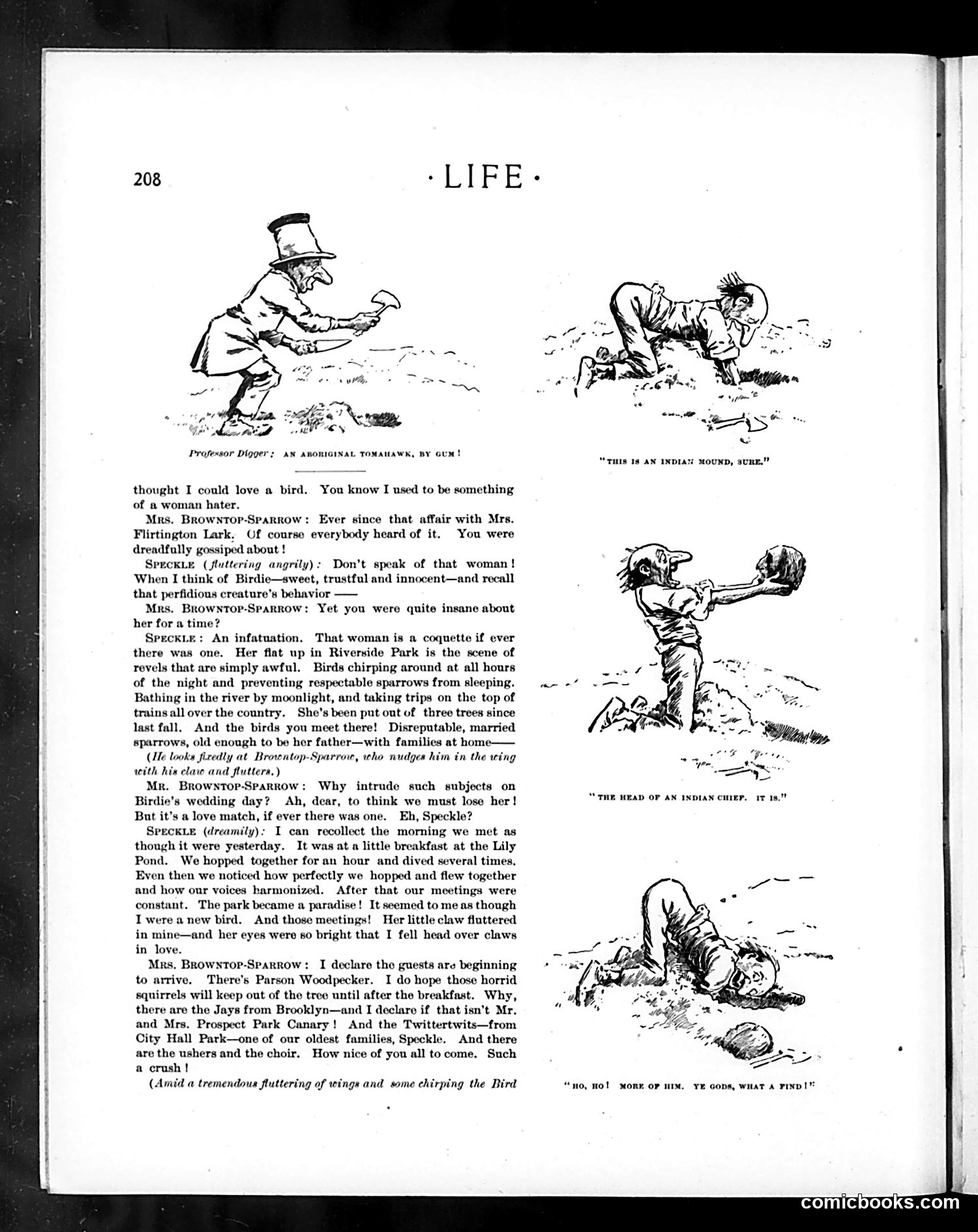
This page satirizes wealthy New York society figures through a dialogue between characters including "Professor Digger" (a naturalist), "Mrs. Browntop-Sparrow," and "Speckle." The humor turns on Mrs. Browntop-Sparrow's eccentric behavior—she's mocked for obsessively pursuing a relationship with a bird at Riverside Park, bathing in the river by moonlight, and generally behaving erratically ("quite insane"). The accompanying illustrations show men engaged in absurd physical activities outdoors. The satire targets upper-class Manhattan society's pretensions and peculiar eccentricities, particularly women's unconventional interests. The bird-watching romance premise is a vehicle for lampooning wealthy Park residents' bohemian affectations and social scandal.
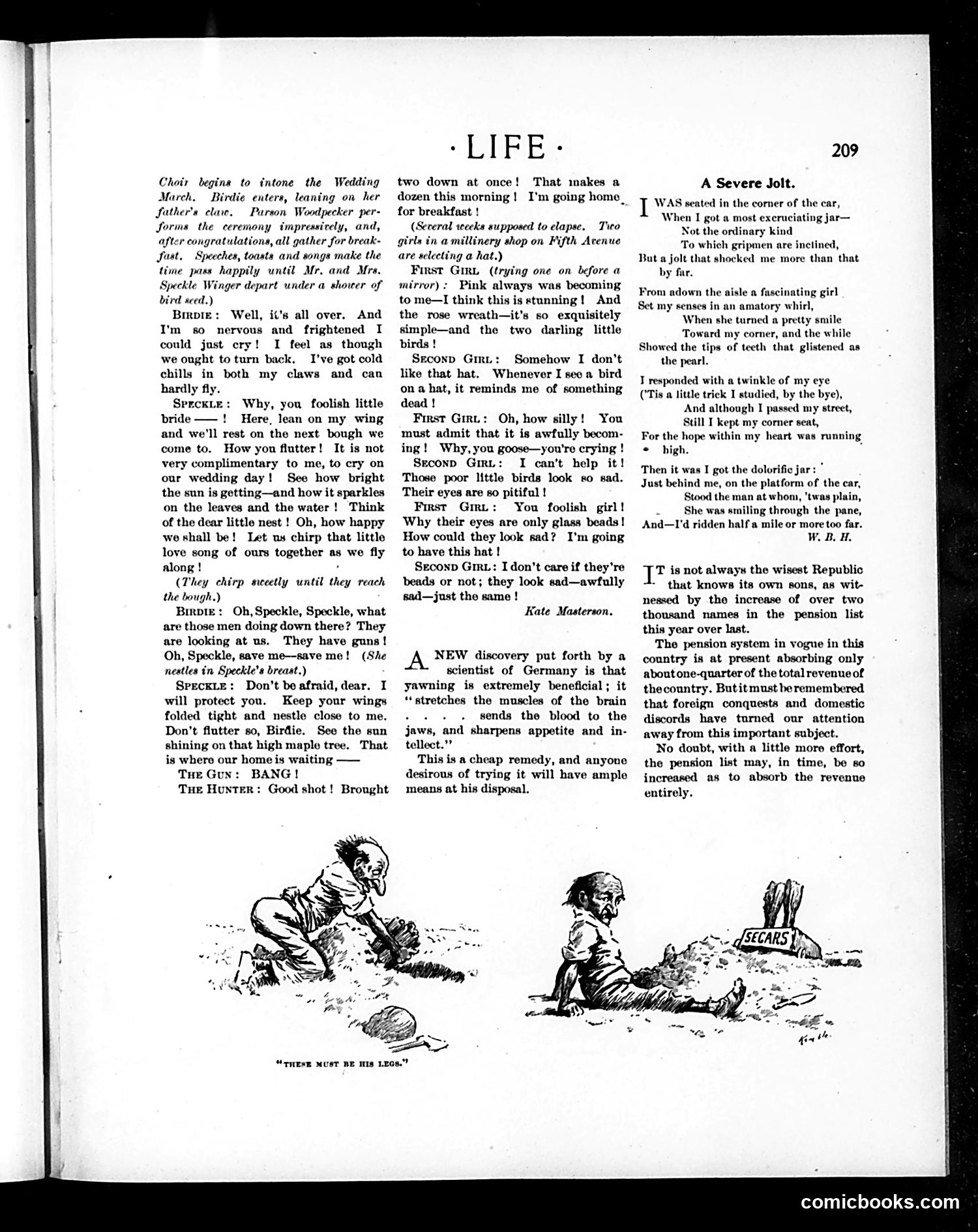
This page contains two distinct pieces: a theatrical dialogue about a wedding ("A Severe Jolt") and an unrelated cartoon about yawning. **The Wedding Scene:** A humorous exchange between bridesmaids discussing the ceremony. One bride is upset about birds in the rose wreath (believing dead birds are bad luck), while another dismisses her superstitions. The dialogue satirizes wedding anxieties and feminine superstitions. **The Cartoon:** Shows two figures in distress near what appears to be a "Sears" sign, captioned "There Must Be His Liege." The meaning is unclear from the image alone, though it appears to comment on social hierarchy or employment relations. **The Scientific Note:** Brief mention of a German scientist's discovery about yawning's benefits, presented as a humorous aside. The page reflects early 20th-century American satirical humor targeting gender anxieties and social customs.
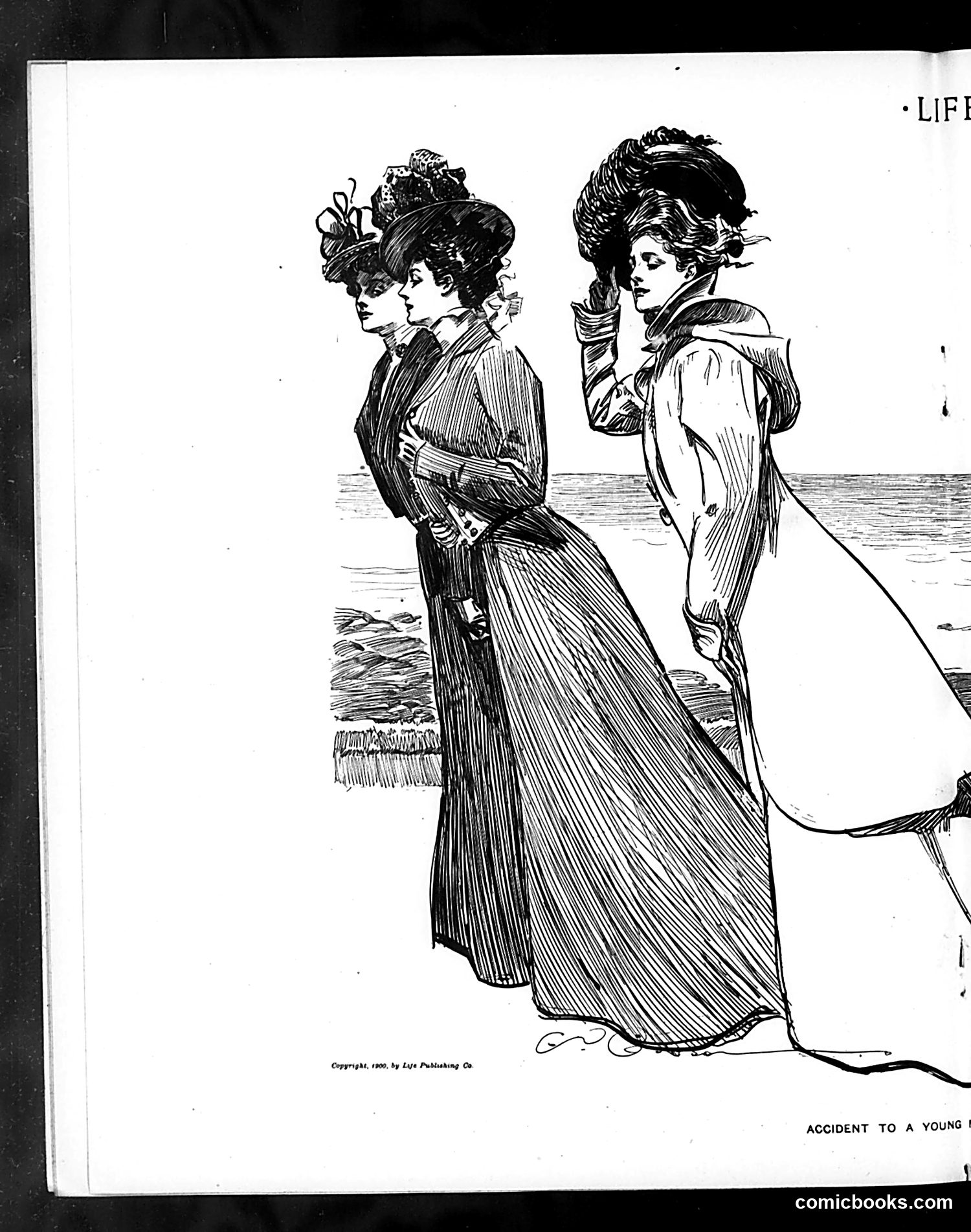
This appears to be a satirical illustration from *Life* magazine (copyright 1900, per the visible text). The drawing depicts three fashionably dressed women on what looks like a beach or seaside setting. The title "Accident to a Young Lady" suggests social commentary on women's clothing and comportment of the era. The joke likely concerns the woman on the right, whose skirt appears to be caught or blown away, exposing her leg—a scandalous situation in the prudish Edwardian period. The other women's composed reactions suggest this was a known hazard of the voluminous skirts and restrictive clothing fashionable at the time. The satire mocks both the impracticality of women's fashion and society's obsession with propriety.
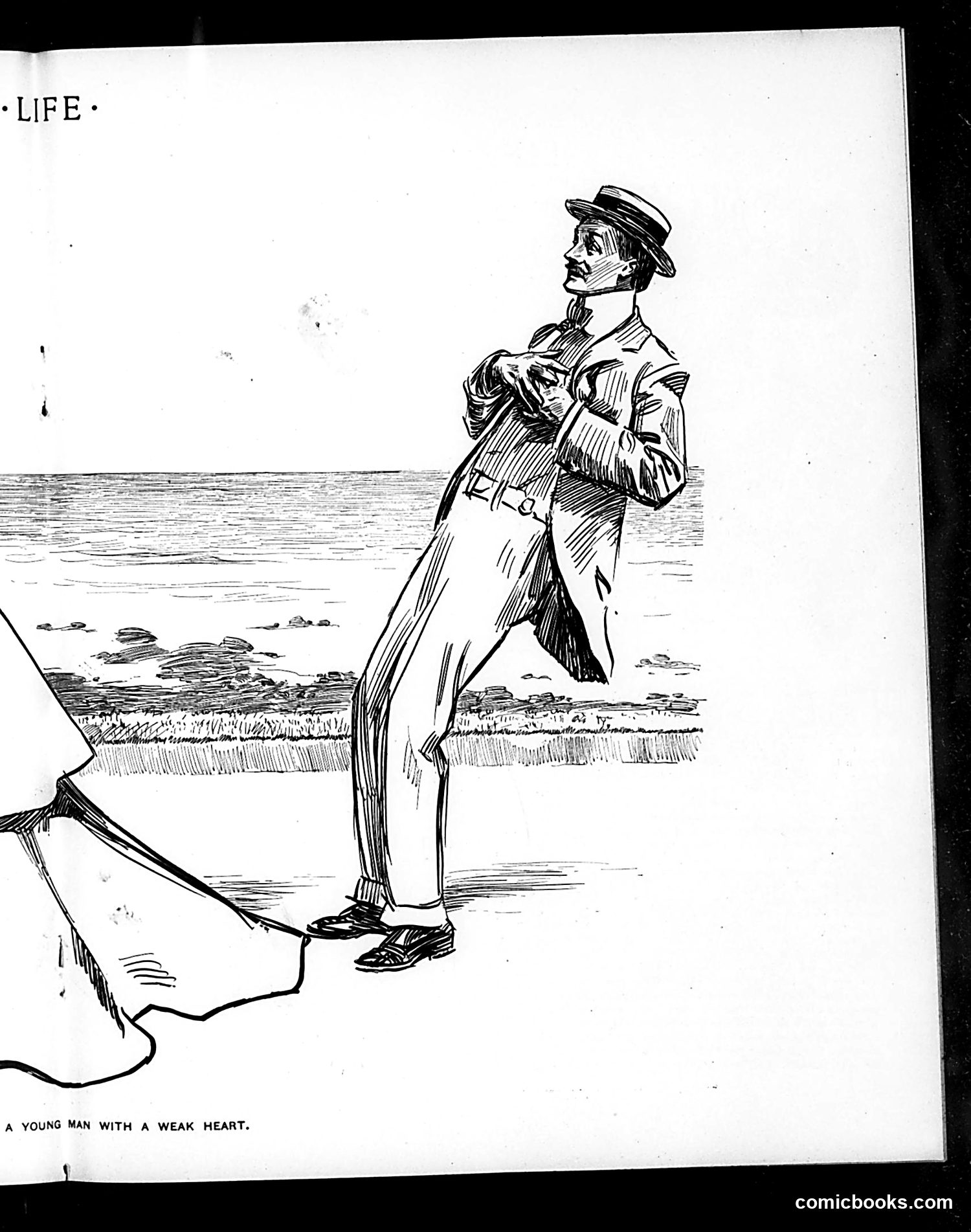
This is a satirical cartoon from *Life* magazine showing a fashionably dressed young man standing on a beach, gazing out at the sea. The title, "A Young Man with a Weak Heart," appears to be social satire about upper-class masculine vulnerability or sentimentality. The figure's refined clothing, hat, and affected posture suggest he represents a particular type of wealthy or leisured gentleman. The "weak heart" likely mocks either his emotional delicacy, romantic nature, or lack of physical vigor—characteristics that early 20th-century satirists used to critique modern urban masculinity as insufficiently robust or manly compared to idealized working-class vigor. The beach setting emphasizes his leisure and detachment from practical life.
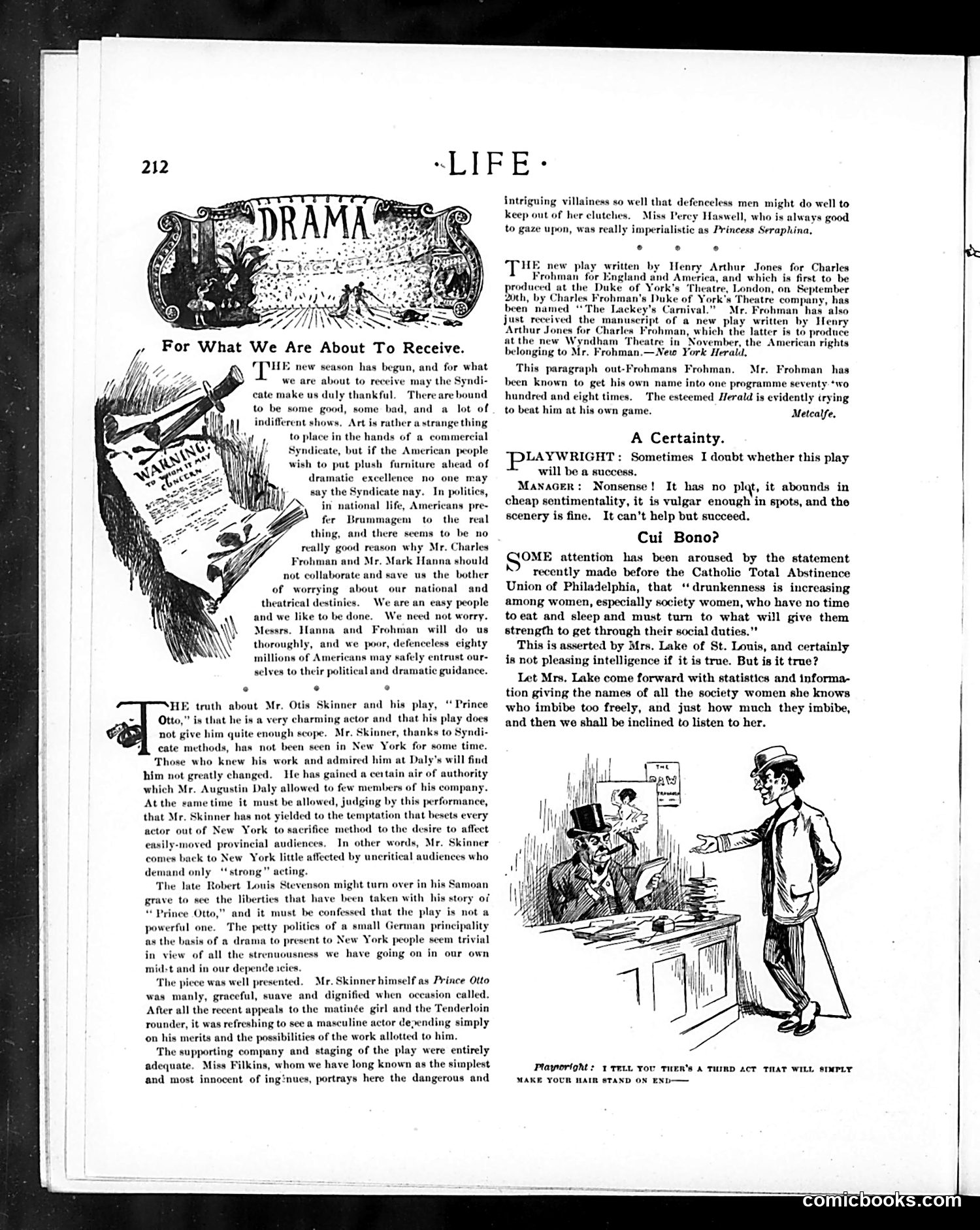
This is a theater criticism page from *Life* magazine's drama section. The main cartoon depicts a theatrical manager rejecting a playwright's work, with the caption "I tell you there's a third act that will simply make your hair stand on end." The satire mocks the disconnect between theatrical producers' and playwrights' perspectives on drama quality. The manager dismisses the play as lacking plot and being overly sentimental, while the playwright defends it. The page also reviews Henry Arthur Jones's "The Jacker's Carnival" and critiques Otis Skinner's "Prince Otto," praising Skinner's dignified performance but questioning the play's relevance to contemporary New York audiences. The broader satire targets commercial theater's prioritization of popular taste over artistic merit during this period.
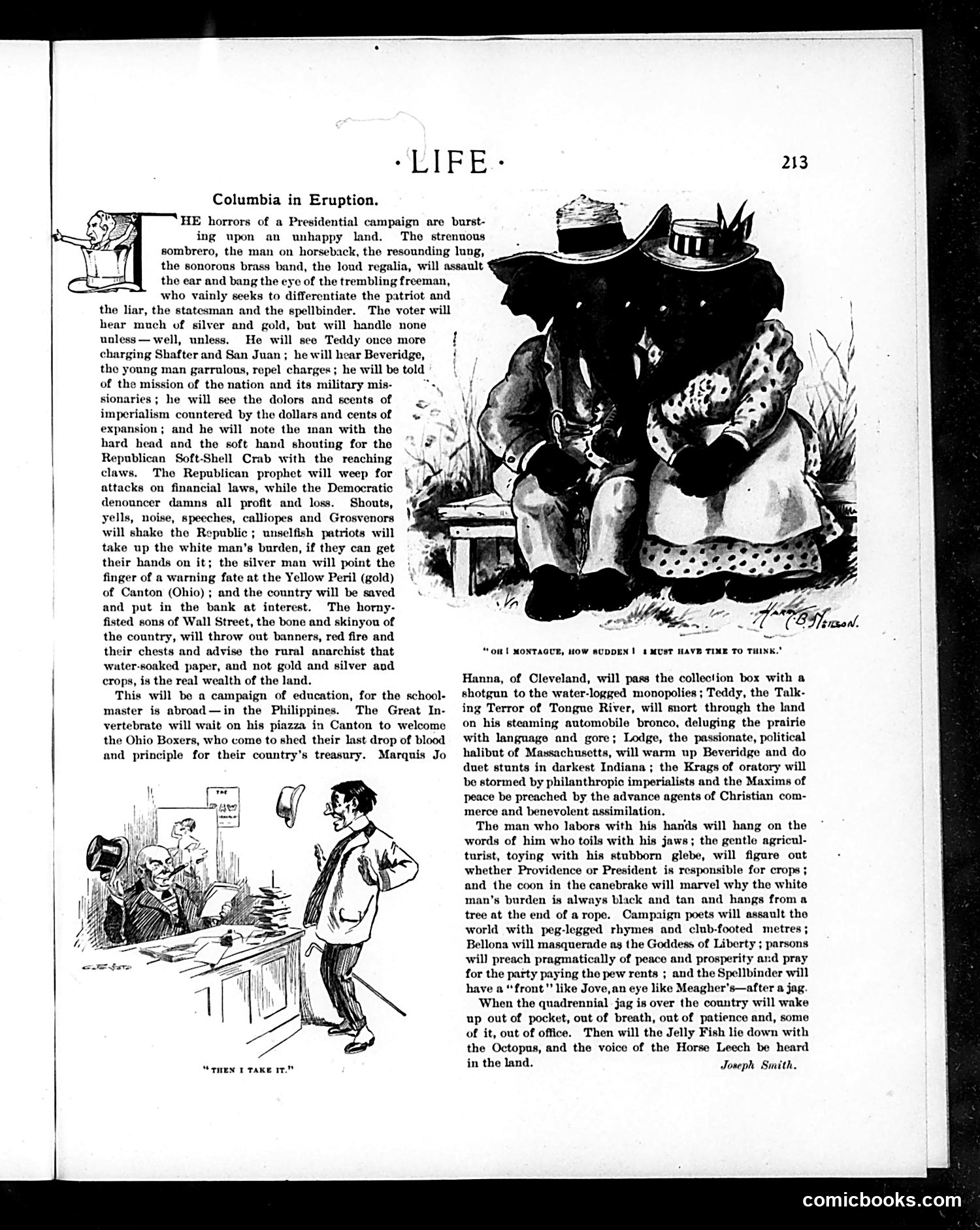
This is a satirical article about a U.S. Presidential campaign (likely 1900, given references to Theodore Roosevelt, the Philippines, and Canton, Ohio). The text mocks the spectacle and dishonesty of campaign rhetoric. **Key figures and references:** - "Teddy" = Theodore Roosevelt, charged with militarism ("Shafter and San Juan") - "Hanna, of Cleveland" = Mark Hanna, Republican campaign manager - "Canton" = William McKinley's hometown; the "Yellow Peril (gold) of Canton (Ohio)" is a satirical jab at McKinley - The Philippines campaign is criticized as imperialist "missionary" work - "Silver man" references the free-silver debate **The satire's point:** Politicians will bombard voters with noise, contradictory messages about expansion vs. financial policy, and empty patriotic rhetoric while working for wealthy interests. Rural workers and especially Black Americans ("the coon in the canebrake") bear the actual burden of imperial wars while seeing no benefit. The two small cartoons below reinforce themes of political manipulation and voter confusion.
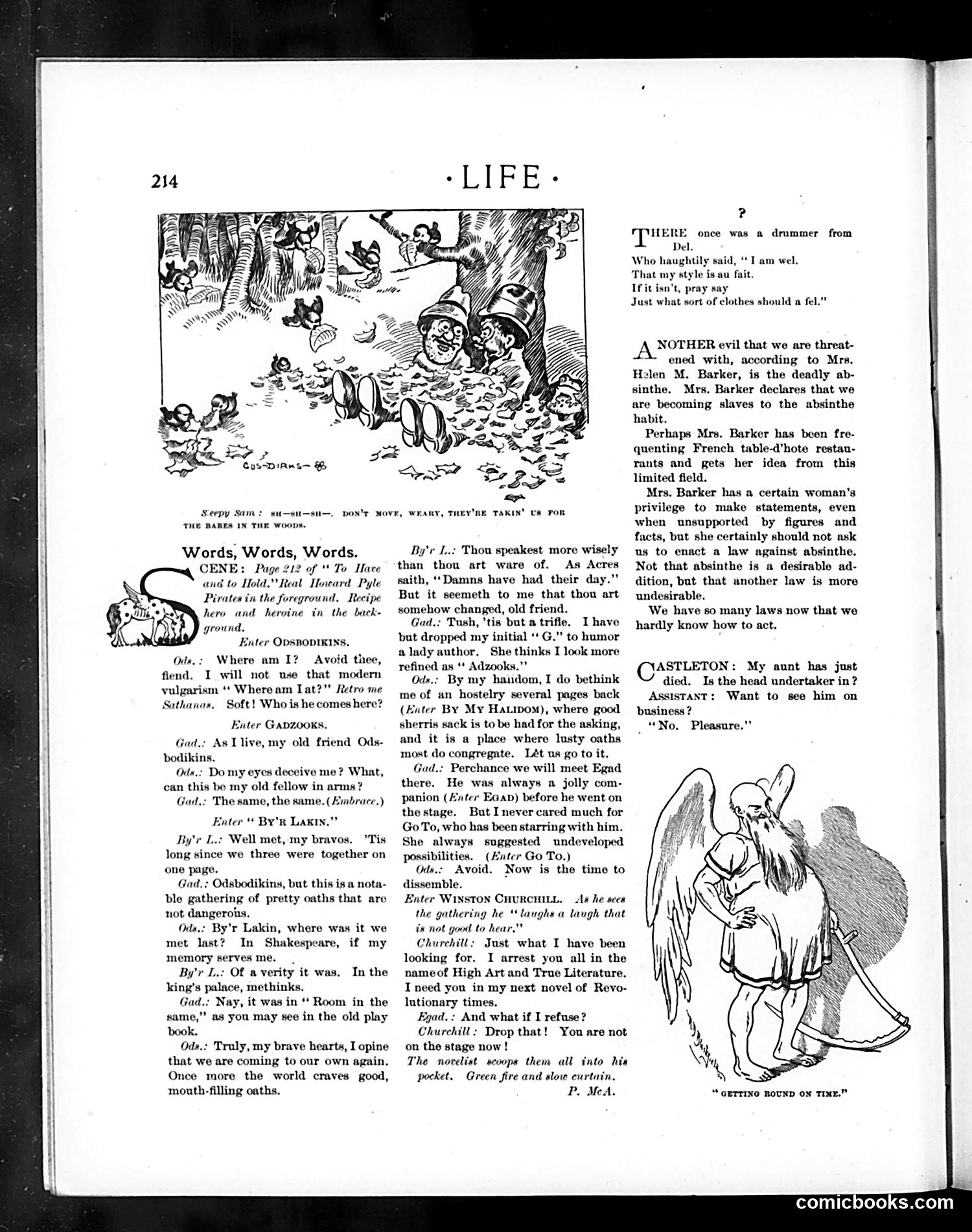
This page contains two satirical pieces from *Life* magazine: **"Words, Words, Words"** (left): A theatrical sketch mocking outdated Shakespearean oaths. Characters named "Odsbodikins," "Gadzooks," and "By'r Lakin"—old-fashioned exclamations from period literature—reunite and lament that modern writing has abandoned such colorful language. The joke concludes when novelist Winston Churchill literally arrests them for his "novel of Revolutionary times," suggesting contemporary literature mines the past for authentic material. It's satire on both archaic theatrical language and authors' desperation for "literary" authenticity. **Right column**: Two separate brief items: 1. A limerick mocking a fashion-conscious drummer from Delaware 2. Commentary on Mrs. Helen M. Barker's claims about absinthe causing addiction, arguing her anecdotal evidence from French restaurants shouldn't justify new laws—society already has too many laws to follow The page blends literary and social satire typical of early 20th-century *Life*.
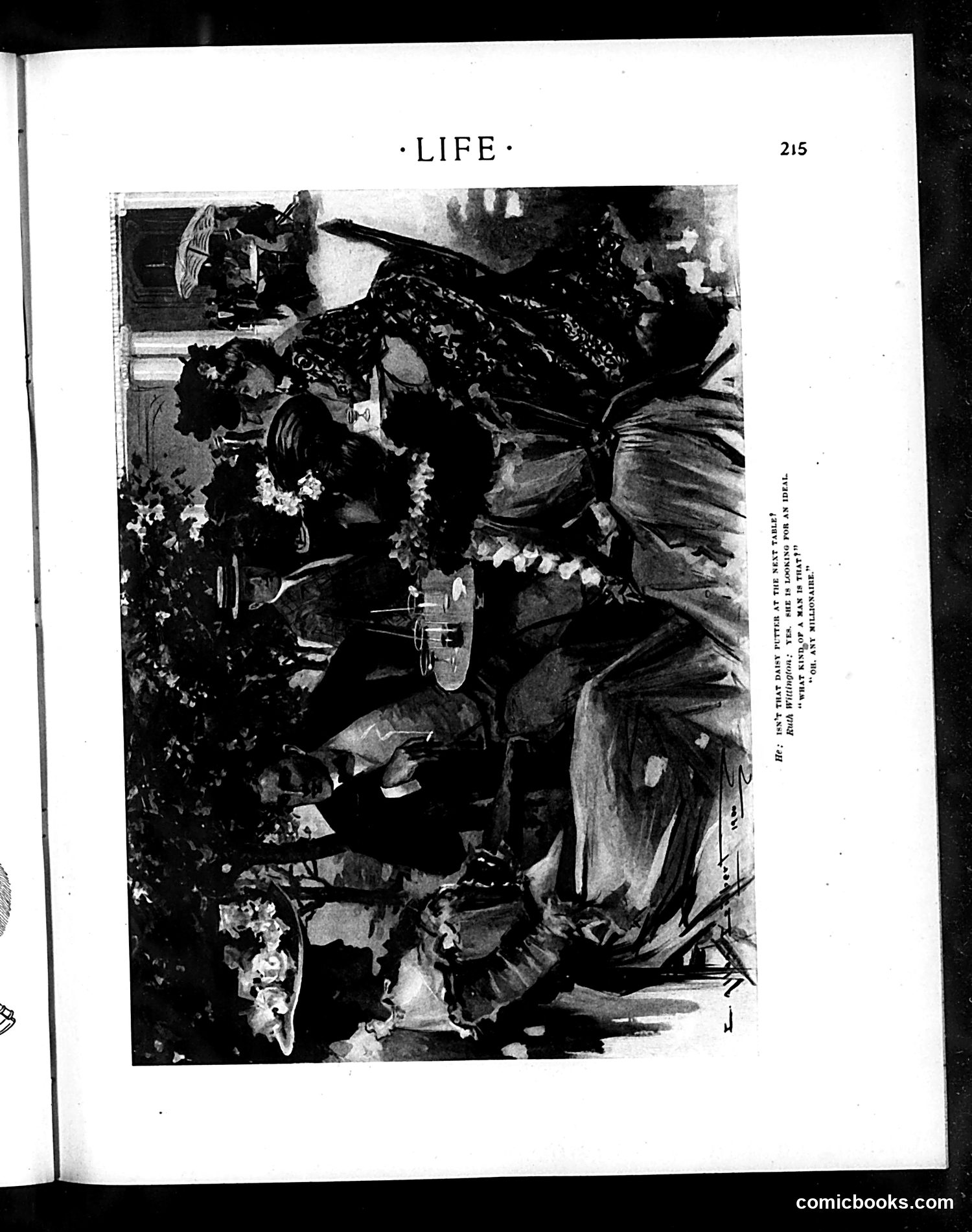
I can see this is a page from Life magazine (page 215), but the image quality and orientation make it difficult to read the specific caption text clearly. The photograph appears to be a theatrical or staged scene with multiple figures in elaborate costumes and dramatic poses, suggesting it may be satirizing a theatrical production, opera, or elaborate social event. Without being able to read the accompanying text reliably due to image clarity issues, I cannot definitively identify the specific figures, historical references, or the satire's intended target. To provide accurate historical context, I would need either a clearer image or the OCR text to be more legible. If you can provide clearer text or confirm the publication date, I could better explain what contemporary political or social commentary this represented.
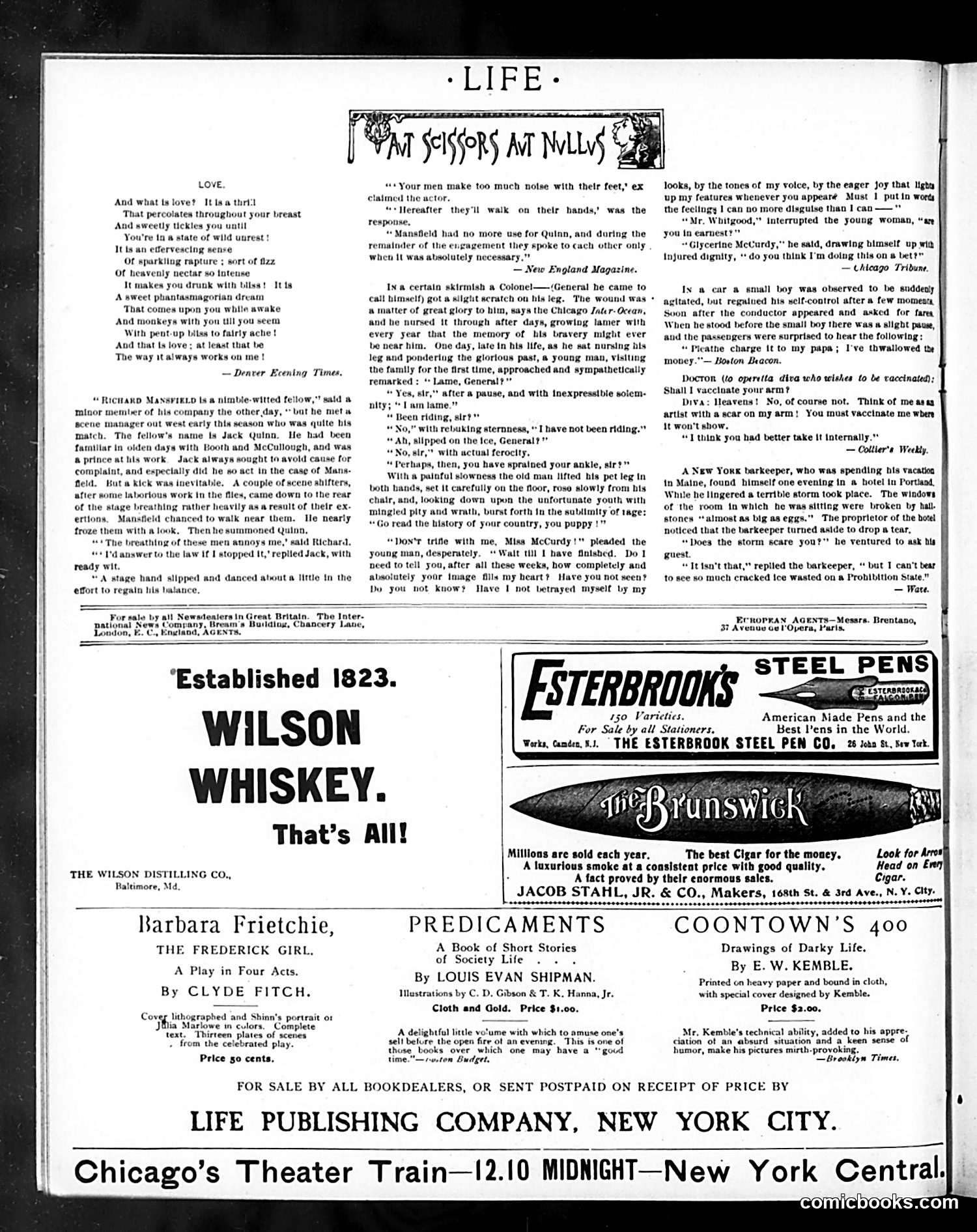
This page is primarily **advertising and book notices** rather than political satire or comics. The main content consists of: 1. **"Love" poem** (Denver Evening Times): A lighthearted verse about romantic love's physical effects—"effervescing," making one "drunk"—typical sentimental humor of the era. 2. **Anecdotes about theater figures**: Stories about actor Richard Mansfield and a stage manager, and a Colonel exaggerating a war wound. These are gossipy entertainment pieces, not political commentary. 3. **Comic dialogue**: A romantic scene between "Mr. Whitgood" and "Miss McCurdy" where he earnestly declares his love while she interrupts—typical domestic humor. 4. **Advertisements**: Wilson Whiskey, Esterbrook Steel Pens, Brunswick cigars dominate the lower half. **No significant political satire or caricature is present.** The page reflects early 20th-century light entertainment and advertising typical of Life magazine's social humor format.
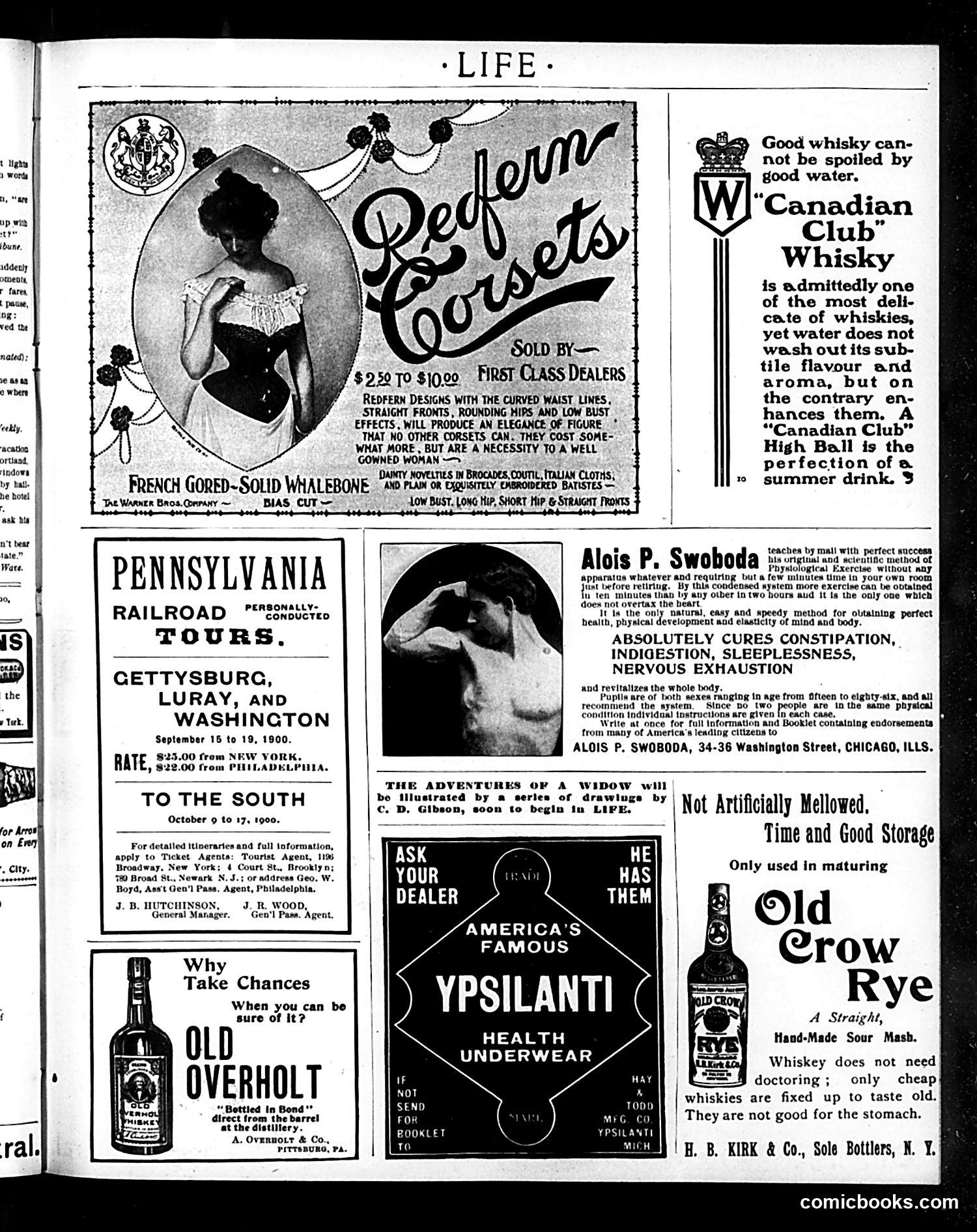
This is primarily an **advertising page** from Life magazine's turn-of-the-century era, with minimal editorial content. The page features period advertisements for: **Fashion/Health:** Redfern corsets emphasizing the fashionable "S-bend" silhouette with curved waist and low bust; Alois P. Swoboda's mail-order physical exercise system promising cures for constipation and nervousness. **Travel:** Pennsylvania Railroad tours to Civil War battlefields (Gettysburg) and Southern destinations. **Alcohol:** Multiple whiskey and health underwear ads—notably "Old Overholt" and "Old Crow Rye" using quality claims; "Canadian Club" whisky emphasizing that good water enhances rather than spoils the product. **Other:** Ypsilanti Health Underwear and a teaser for C.D. Gibson's upcoming "Widow" comic series. The ads reflect 1900 consumer culture: patent medicines, mail-order self-improvement, and the era's obsession with both refinement and bodily "health" through corsetry and dubious remedies. No satire is apparent—these are straightforward commercial pitches.
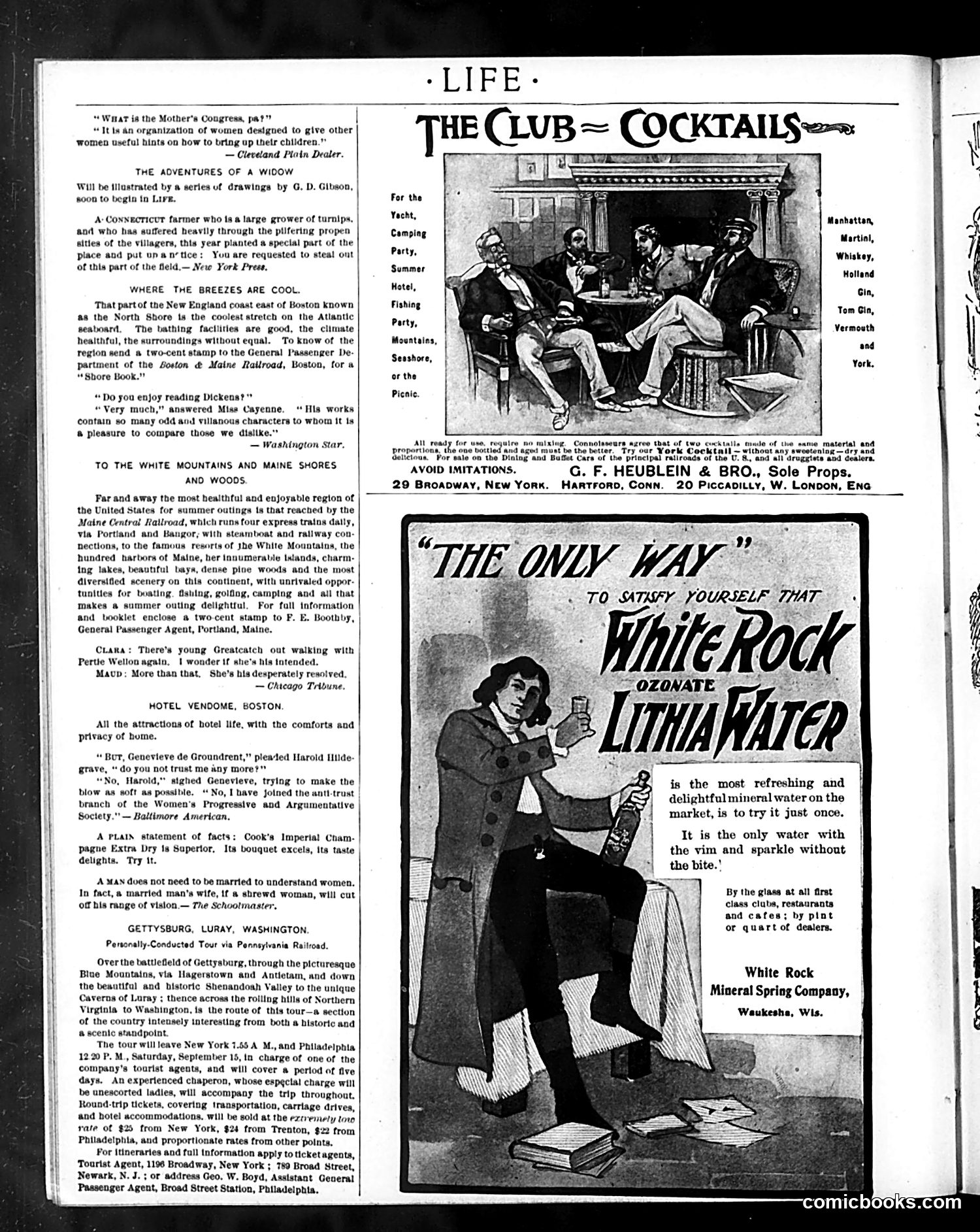
This page combines satirical commentary with travel advertising typical of early 1900s Life magazine. **The Satire:** The page opens with a joke about the "Mother's Congress"—a women's organization offering parenting advice. The humor relies on mocking women's organizations and implying mothers need instruction on child-rearing (reflecting period gender attitudes). A separate joke features a Connecticut farmer who, tired of villagers stealing turnips, posts a sign *inviting* theft from a specific field—satirizing either the futility of prevention or rural theft problems. Another quip jokes that a woman enjoys Dickens because his villainous fictional characters resemble people she dislikes—poking fun at both literary taste and social relationships. **The Advertisements:** The bulk of the page promotes travel (White Mountains, Maine shores) via railroads, hotels, and mineral water; plus Cook's champagne and a guided tour to Gettysburg and Washington, D.C. **Context for Modern Readers:** This represents Life's mixed model: light social satire aimed at educated urban readers, paired with advertisements for leisure activities accessible primarily to the affluent.
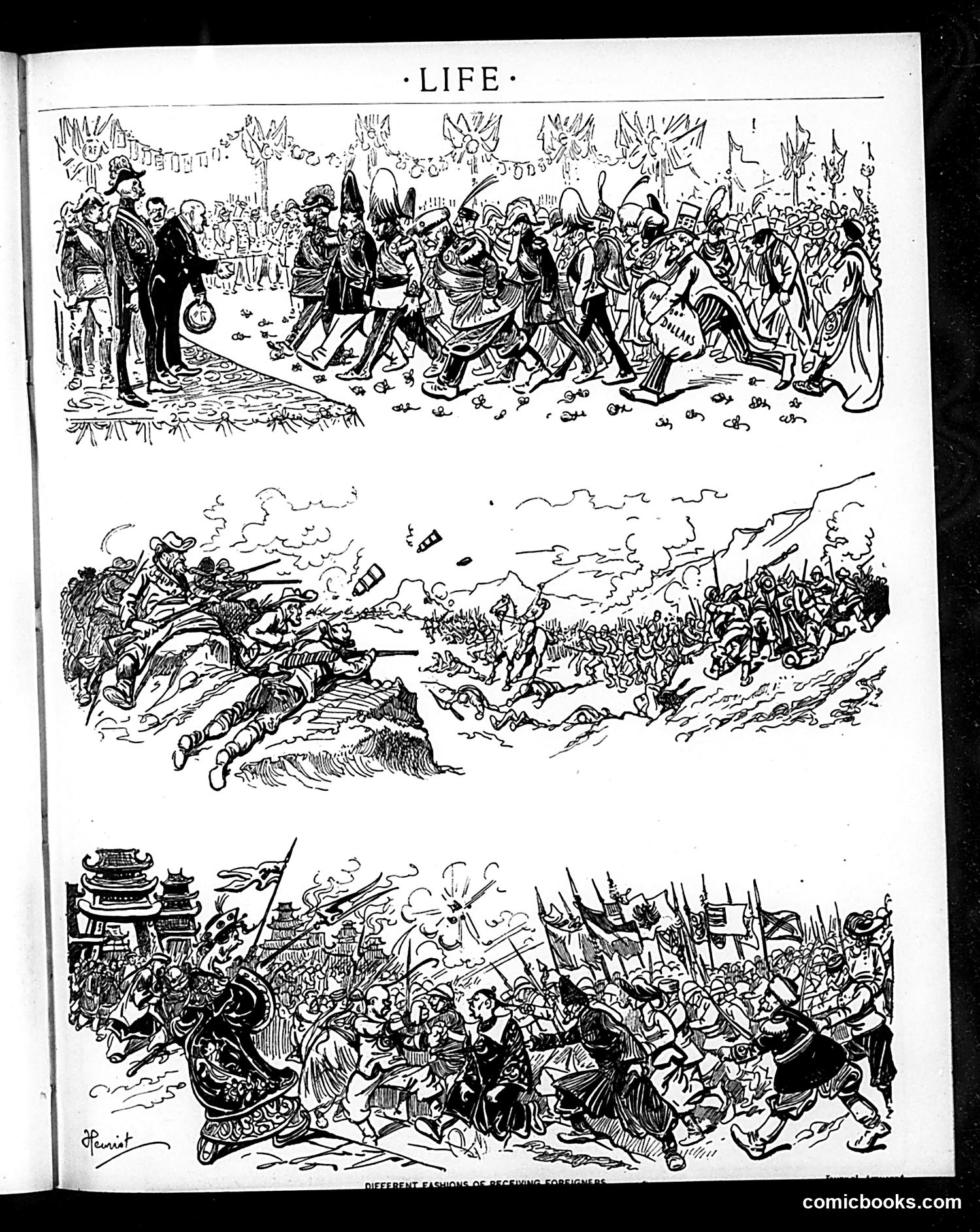
This page from *Life* magazine shows three satirical scenes labeled "DIFFERENT FASHIONS OF RECEIVING FOREIGNERS." The cartoons appear to depict contrasting diplomatic receptions across different cultures or time periods. The top panel shows what appears to be a formal, orderly Western reception with military officials and decorations. The middle panel depicts a more chaotic, violent encounter with armed forces. The bottom panel shows an elaborate Asian court scene with ornate structures and large crowds. The satire likely comments on how different nations or cultures received foreign visitors—contrasting Western formality and civility against stereotyped depictions of other cultures as either barbaric or exotically ornate. This reflects the patronizing, colonial-era attitudes common in early 20th-century American satire toward non-Western peoples and diplomatic practices. The OCR text is too degraded to provide additional specific context about the intended targets.
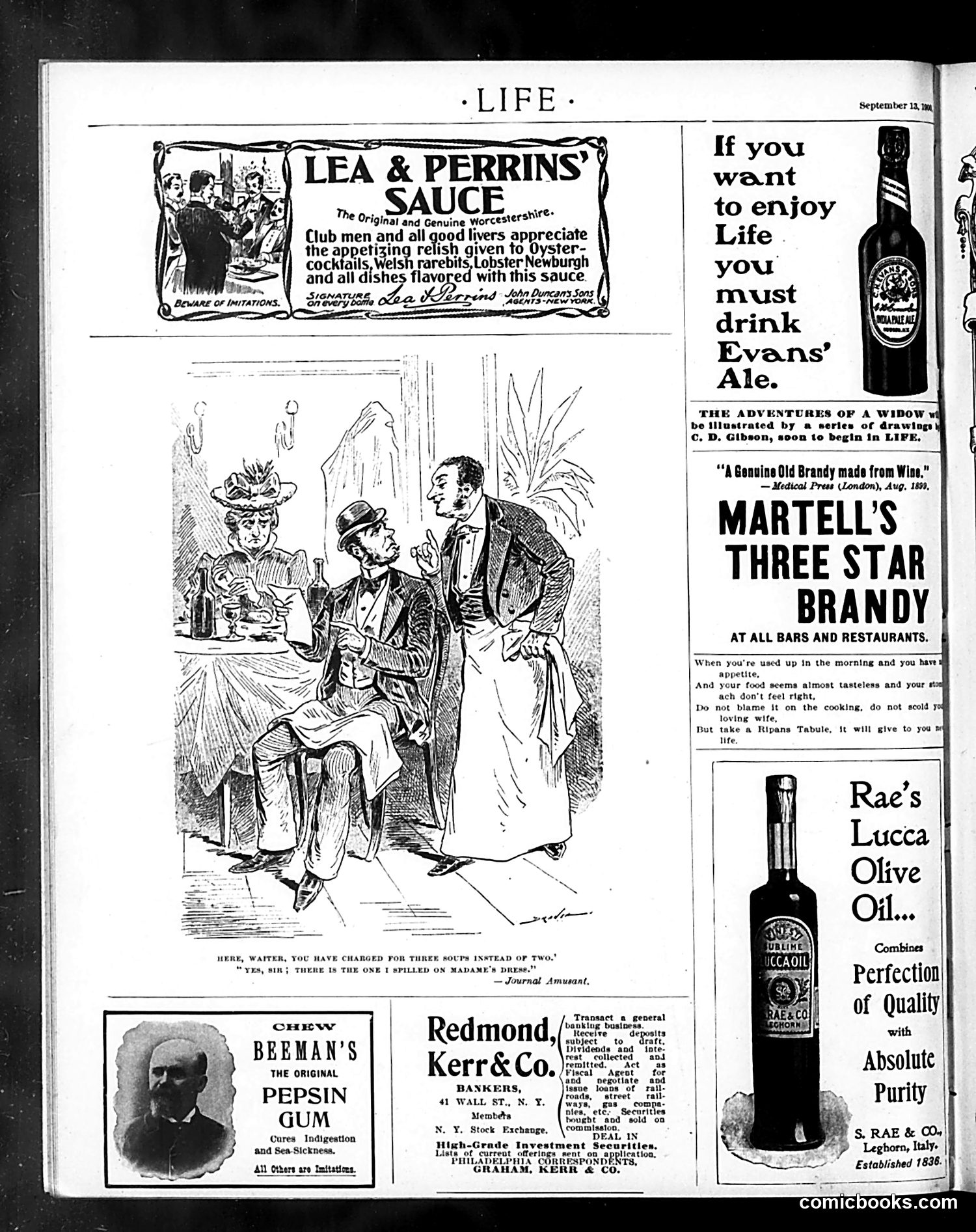
This page is primarily **advertising**, with one small cartoon joke. The main satirical content is a single-panel comic at bottom-left, captioned: "HERE, WAITER, YOU HAVE CHARGED FOR THREE SOUPS INSTEAD OF TWO." The waiter's response: "YES, SIR; THERE IS THE ONE I SPILLED ON MADAME'S DRESS." **The joke's context:** This mocks the waiter's absurd logic—he's charging the customer for soup he *ruined* by spilling it on a woman's dress, as if the customer should pay for the accident. It satirizes poor service and restaurants' audacity in overcharging patrons. The humor relies on the waiter's obvious dishonesty presented matter-of-factly. The remainder is **period advertising** for food/drink products (Lea & Perrins sauce, Evans' Ale, Martell's brandy, Ripans Tablets for digestion, Beeman's gum, olive oil, etc.)—typical for Life magazine, which subsidized itself through ads targeting affluent readers.