
Life, 1900-09-13 · page 12 of 20
Life — September 13, 1900 — page 12: what you’re looking at
What you’re looking at
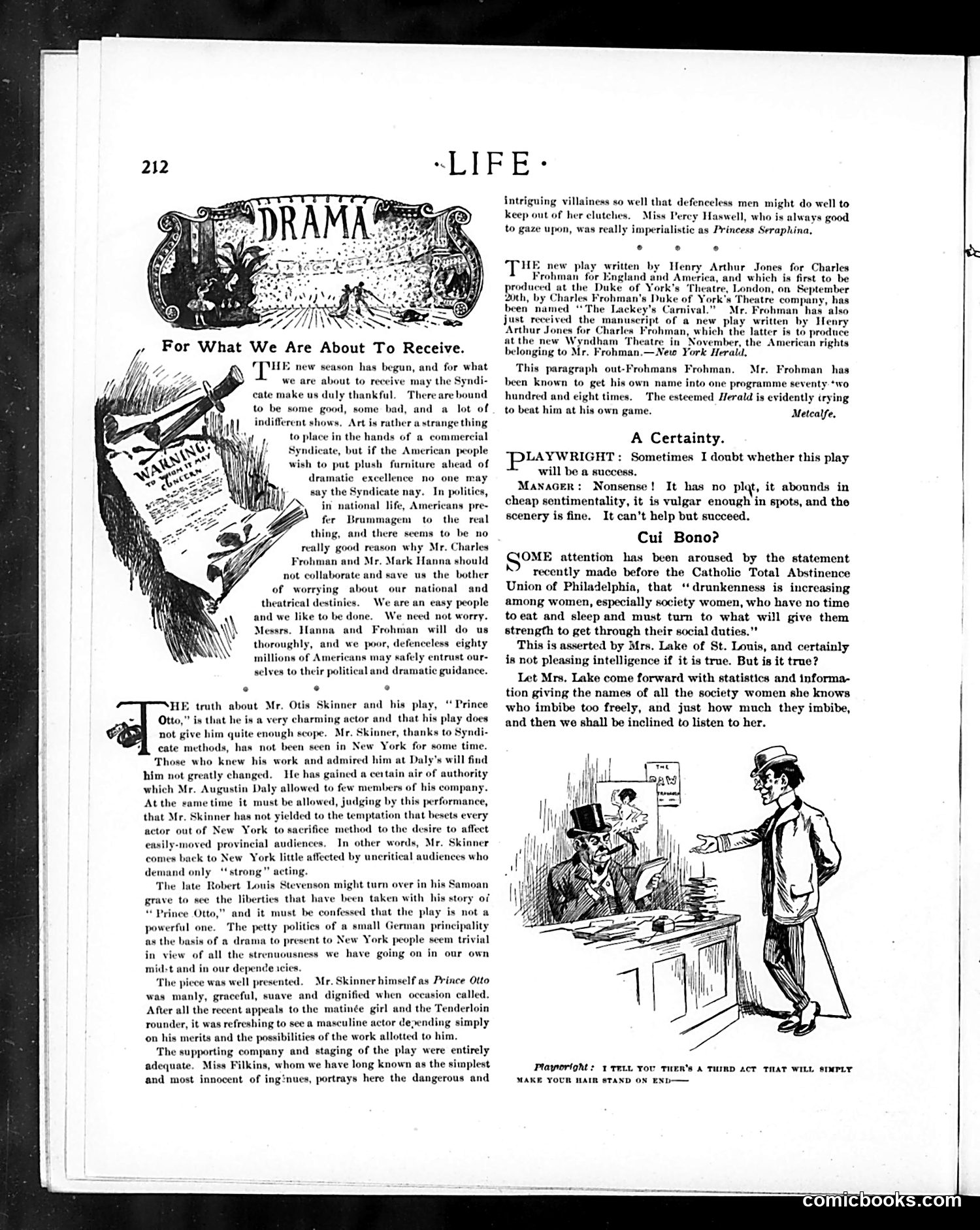
This is a theater criticism page from *Life* magazine's drama section. The main cartoon depicts a theatrical manager rejecting a playwright's work, with the caption "I tell you there's a third act that will simply make your hair stand on end." The satire mocks the disconnect between theatrical producers' and playwrights' perspectives on drama quality. The manager dismisses the play as lacking plot and being overly sentimental, while the playwright defends it. The page also reviews Henry Arthur Jones's "The Jacker's Carnival" and critiques Otis Skinner's "Prince Otto," praising Skinner's dignified performance but questioning the play's relevance to contemporary New York audiences. The broader satire targets commercial theater's prioritization of popular taste over artistic merit during this period.
📄 Transcribed text from this page (OCR, searchable)
Machine-transcribed from the original scan — historical spelling and the odd misread are preserved.
“LIFE * intriguing villainess so well that defenceless men might do well to keep out of her clutches. Miss Percy Haswell, who is always good to gaze upon, was really imperialistic as Princess Seraphina, ° e ° HE n Frohma: play written by Henry Arthur Jones for Charles England and An ica, and which is first Duke of York's Theatre, London, on Septe: eof York's Th ‘ e new Wyndham ‘Theatre in November, the American rig! For What We Are About To Receive. belonging to Mr. Rubmanc veciYoue Geran Amerioan rights TP HE new season has begun, and fe we are about to ree This paragraph out-Frohmans Frohman. Mr. Frohman has been known to get his own name into one programme seventy ‘wo cate make us duly thankful. Therearebound hundred and ei The esteemed Herald is evidently try ing to be some good, some bad, and a lot of to beat him at his own game. Metcalfe indifferent shows. Art is rather a strange thing eee ce in the hands of a commercial A Certainty. e, but i Amerie: Co} _ = cpidshi factinae ahead ot PLAYWRIGHT: Sometimes I doubt whether this play dramatic excellence no one may will bo a success. say the Syndicate nay. In politics, MANAGER : Nonsense! It has no plat, it abounds in int national life, Americans pre- cheap sentimentality, it is vulgar enough in spots, and the fer Brummagem to the real Scenery is fine. It can’t help but succeed. thing, and there seems to be no really good reason why Mr. Charles Cui Bono? Frohman and Mr. Mark Hanna should © OME attention has been aroused by the statement not collaborate and save us the bother recently made before the Catholic Total Abstinence of worrying about our national and Union of Philadelphia, that ‘drunkenness is increasing theatrical destinies. We are an easy people | among women, especially society women, who have no time and we like to be done. We need not worry. to eat and sleep and must turn to what will give them Messrs. Hanna and Frohman will do us strength to get through their social duties.”* thoroughly, and we poor, defenceless eighty This is asserted by Mrs. Lake of St. Louis, and certainly = ns * ane ay ay ee y St our- is not pleasing intelligence if it is true. But is it trae? . selves to tl si political ants ramatic guidance. ; Let Mrs, Take come forward ‘vithvstatistion and infornias tion giving the names of all the society women she knows HE truth about Mr. Otis Skinner and his play, “Prince who imbibe too freely, and just how much they imbibe, is that he is a very charming actor and that his play does and then we shall be inclined to listen to her. not give him quite enough scope. Mr. Skinner, thanks to Syndi- “BL cate methods, has not been seen in New York for some time. Those who knew his work and admired him at Daly's will find him not greatly changed. He has gained a certain air of authority which Mr. Augustin Daly allowed to few members of his company. At the same t must be allowed, judging by this performance, that Mr. Skinner has not yielded to the temptation that besets every actor out of Ne York to sacrifice method to the de to affect easily-moved provincial audiences, In other words, Mr. inner comes back to New York little affected by uncritical audiences who demand “strong” acting. The late Robert Louis Stevenson might turn over in his Samoan grave to see the liberties that have been taken with his story of “ Prince Otto,” and it must be confessed that the play is not a powerful The petty politics of a small German principality as the basis of a drama to present to New York people seem trivial in view of all the strenuousness we have going on in our own t and in our depencde icies. ne piece was well presented. Mr. Skinner himself as Prince Otto was manly, graceful, suave and dignified when occasion called. After all the recent appeals to the matinée girl and the Tenderloin rounder, it was refreshing to see a masculine actor depending simply on his merits and the possibilities of the work allotted to him, ‘The supporting company and staging of the play were entirely adequate. Miss Filkins, whom we have long known as the simplest Haprrl ont Gutkiay sue cesta a" cunt ace sear et eee and most innocent of ing!nues, portrays here the dangerous and MAKE YOUR MAIR STAND ON END—