
Life, 1900-09-13 · page 4 of 20
Life — September 13, 1900 — page 4: what you’re looking at
What you’re looking at
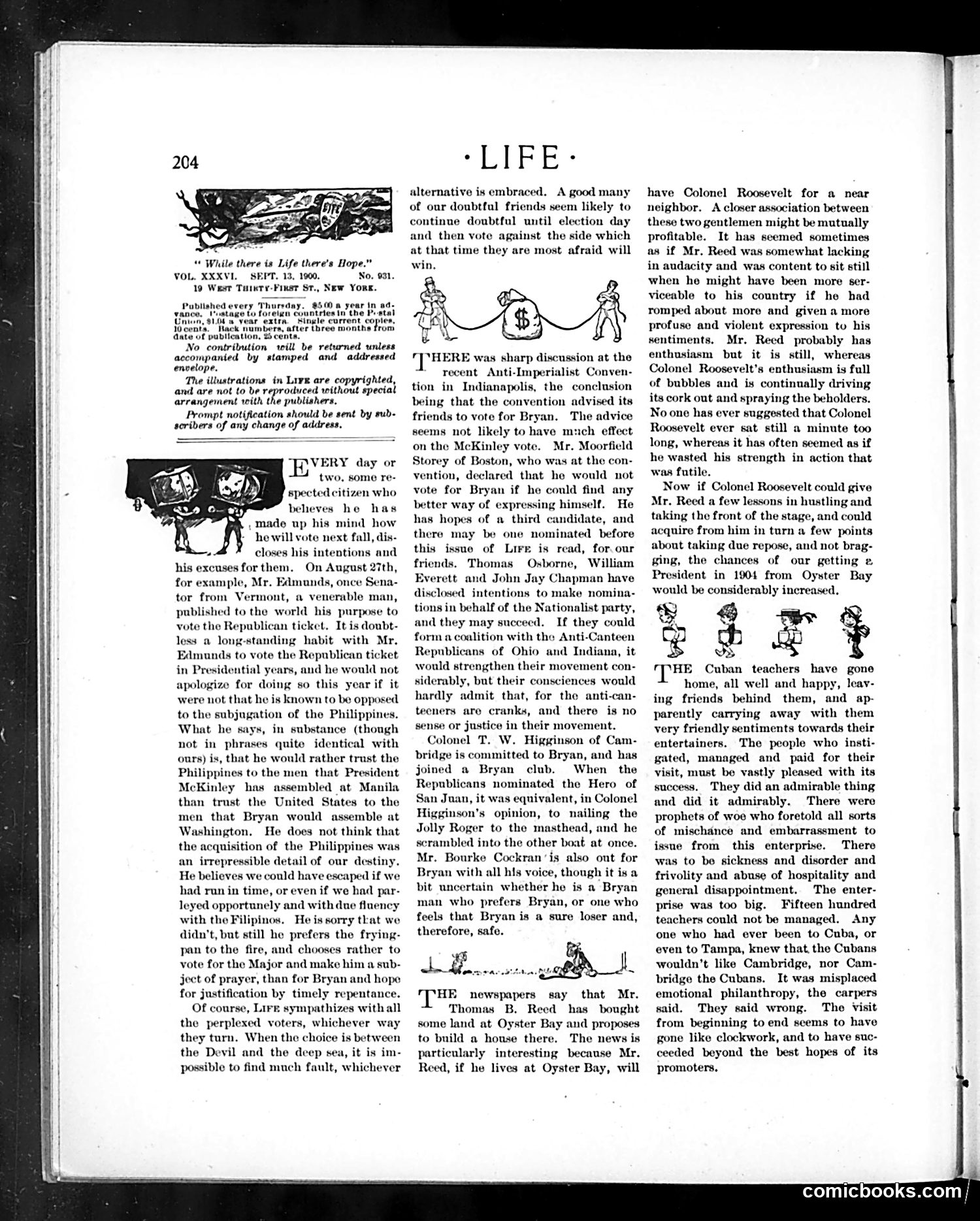
The page contains political commentary about the 1908 presidential election. The main text discusses **William Jennings Bryan** as a potential third-party candidate and debates about voting strategy among Republicans and Anti-Imperialists. Key figures mentioned include **Colonel Roosevelt** (appears to be Theodore Roosevelt, the sitting president), **Mr. Thomas B. Reed** (who apparently purchased property at Oyster Bay), and various political operatives considering whether to support Bryan or Republican nominees. The satire critiques indecision among voters and politicians—the central metaphor shows two figures pulling a "$" sign in opposite directions, illustrating the tension between supporting Bryan versus the Republican candidate. The commentary suggests that choosing between "the Devil and the deep sea" makes fault-finding difficult, mocking the political paralysis of uncertain voters.
📄 Transcribed text from this page (OCR, searchable)
Machine-transcribed from the original scan — historical spelling and the odd misread are preserved.
“* While there is Life there’s Hope.’ VOL. XXXVI. SE 19 West Ture: Publishes 00 a year in tries In the P+ date of publication, cents. No contribution twill be returned unless accompanied by stamped and addressed envelope. ‘The illustrations in Live are copyrighted, and ave not fo be reproduerd without special arrangement with the publishers, Prompt notification should be sent by mub- scribers of any change of address. pre ERY day or two, some re- spected citizen who beheves he has , made up his mind how he will vote next fall, dis- closes his intentions and his excuses for them. On August 27th, for example, Mr. Edmunds, once Sena- tor from Vermont, a venerable man, published to the world his purpose to vote the Republican ticket. It is doubt- less a long-standing habit with Mr. Edmunds to vote the Republican ticket in Presidential years, and he would not apologize for doing so this year if it were not that he is known to be opposed to the subjugation of the Philippines. What he says, in substance (though not in phrases quite identical with ours) is, that he would rather trust the Philippines to the men that President McKinley has assembled at Manila than trust the United States to the men that Bryan would assemble at Washington, He does not think that the acquisition of the Philippines was an irrepressible detail of our destiny. He believes we could have escaped if we had run in time, or even if we had par- leyed opportunely and with due fluency with the Filipinos. He is sorry that we didn’t, but still he prefers the frying- pan to the fire, and chooses rather to vote for the Major and make him a sub- ject of prayer, than for Bryan and hope for justification by timely repentance. Of course, Lire sympathizes with all the perplexed voters, whichever way they turn, When the choice is between the Devil and the deep sea, it is im- possible to find much fault, whichever LIFE alternative is embraced. A good many of our doubtful friends seem likely to continue doubtful until election day and then vote against the side which at that time they are most afraid will win, "THERE was sharp discussion at the recent Anti-Imperialist Conven- tion in Indianapolis, the conclusion being that the convention advised its friends to vote for Bryan. The advice seems not likely to have much effect on the McKinley vote. Mr. Moorfield Storey of Boston, who was at the con- vention, declared that he would not vote for Bryan if he could find any better way of expressing himself. He has hopes of a third candidate, and there may be one nominated before this issue of Lire is read, for.our friends. Thomas Osborne, William Everett and John Jay Chapman have disclosed intentions to make nomina- tions in behalf of the Nationalist party, and they may succecd. If they could form a coalition with the Anti-Canteen Republicans of Ohio and Indiana, it would strengthen their movement con- siderably, but their consciences would hardly admit that, for the anti-can- teeners are cranks, and there is no sense or justice in their movement. Colonel T. W. Higginson of Cam- bridge is committed to Bryan, and has joined a Bryan club. When the Republicans nominated the Hero of San Juan, it was equivalent, in Colonel Higginson’s opinion, to nailing the Jolly Roger to the masthead, and he scrambled into the other boat at once. Mr. Bourke Cockran ‘is also out for Bryan with all his voice, though it is a bit uncertain whether he is a Bryan man who prefers Bryan, or one who feels that Bryan is a sure loser and, therefore, safe. HE newspapers say that Mr. Thomas B. Reed has bought some land at Oyster Bay and proposes to build a house there. The news is particularly interesting because Mr. Reed, if he lives at Oyster Bay, will have Colonel Roosevelt for a near neighbor. A closer association between these two gentlemen might be mutually profitable. It has seemed sometimes as if Mr, Reed was somewhat lacking in audacity and was content to sit still when he might have been more ser- viceable to his country if he had romped about more and given a more profuse and violent expression to his sentiments, Mr. Reed probably has enthusiasm but it is still, whereas Colonel Roosevelt's enthusiasm is full of bubbles and is continually driving its cork out and spraying the beholders. No one has ever suggested that Colonel Roosevelt ever sat still a minute too long, whereas it has often seemed as if he wasted his strength in action that was futile. Now if Colonel Roosevelt could give Mr. Reed a few lessons in hustling and taking the front of the stage, and could acquire from him in turn a few points about taking due repose, and not brag- ging, the chances of our getting & President in 1904 from Oyster Bay would be considerably increased, ba & > op ‘(HE Cuban teachers have gone home, all well und happy, leav- ing friends behind them, and ap- parently carrying away with them very friendly sentiments towards their entertainers. The people who insti- gated, managed and paid for their visit, must be vastly pleased with its success. They did an admirable thing and did it admirably. There were prophets of woe who foretold all sorts of mischance and embarrassment to issue from this enterprise. There was to be sickness and disorder and frivolity and abuse of hospitality and general disappointment. The enter- prise was too big. Fifteen hundred teachers could not be managed, Any one who had ever been to Cuba, or even to Tampa, knew that the Cubans wouldn't like Cambridge, nor Cam- bridge the Cubans. It was misplaced emotional philanthropy, the carpers said. They said wrong. The Visit from beginning to end seems to have gone like clockwork, and to have suc- ceeded beyond the best hopes of its promoters, comicbooks.com